China Rendering Market Size & Growth Rate
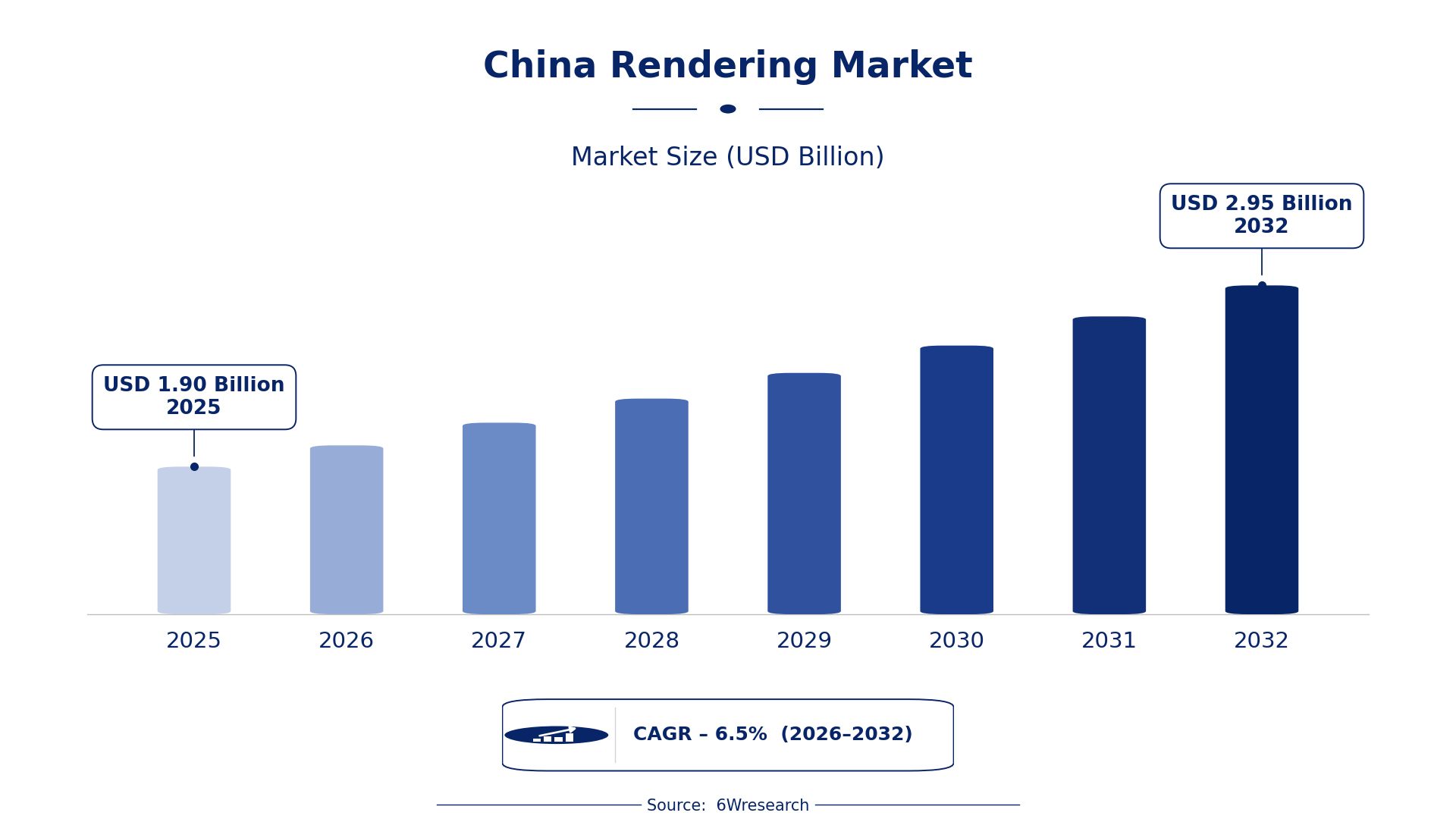
According to 6Wresearch internal database and industry insights, the China Rendering Market was valued at USD 1.90 billion in 2025 and is projected to reach USD 2.95 billion by 2032, growing at a CAGR of approximately 6.5% during 2026–2032.
China Rendering Market Highlights
| Report Metric | Details |
| Report Name | China Rendering Market |
| Market Size 2025 | USD 1.90 billion |
| Market Size 2032 | USD 2.95 billion |
| Absolute Growth 2025–2032 | USD 1.05 billion |
| CAGR 2026–2032 | 6.5% |
| Peak Annual Growth | 9.1% in 2032 |
| Forecast Period | 2026–2032 |
| Historical Data | 2022–2025 |
| Base Year | 2025 |
| Leading Rendering Type, 2025 | Real-Time Rendering (52% share) |
| Leading Engine/Tool, 2025 | Unreal Engine (41% share) |
| Leading Delivery Mode, 2025 | Cloud Pipelines (43% share) |
| Leading End User, 2025 | Video Game Developers (49% share) |
| Fastest-Growing Rendering Type | Architectural Rendering (7.6% CAGR) |
| Fastest-Growing Engine/Tool | Unity/Unreal (9.2% CAGR) |
| Fastest-Growing End User | Architecture Firms (8.4% CAGR) |
| Growing Sector | Architecture Firms |
| Key End Users | Video Game Developers, Animated Film Studios, Architecture Firms, Marketing & Design Agencies |
China Rendering Market Year-wise Growth Rate and Key Drivers (2022–2032)
This graph illustrates the annual growth rates of the market from 2022 to 2032, highlighting a steady upward trajectory and projected market expansion over the forecast period.
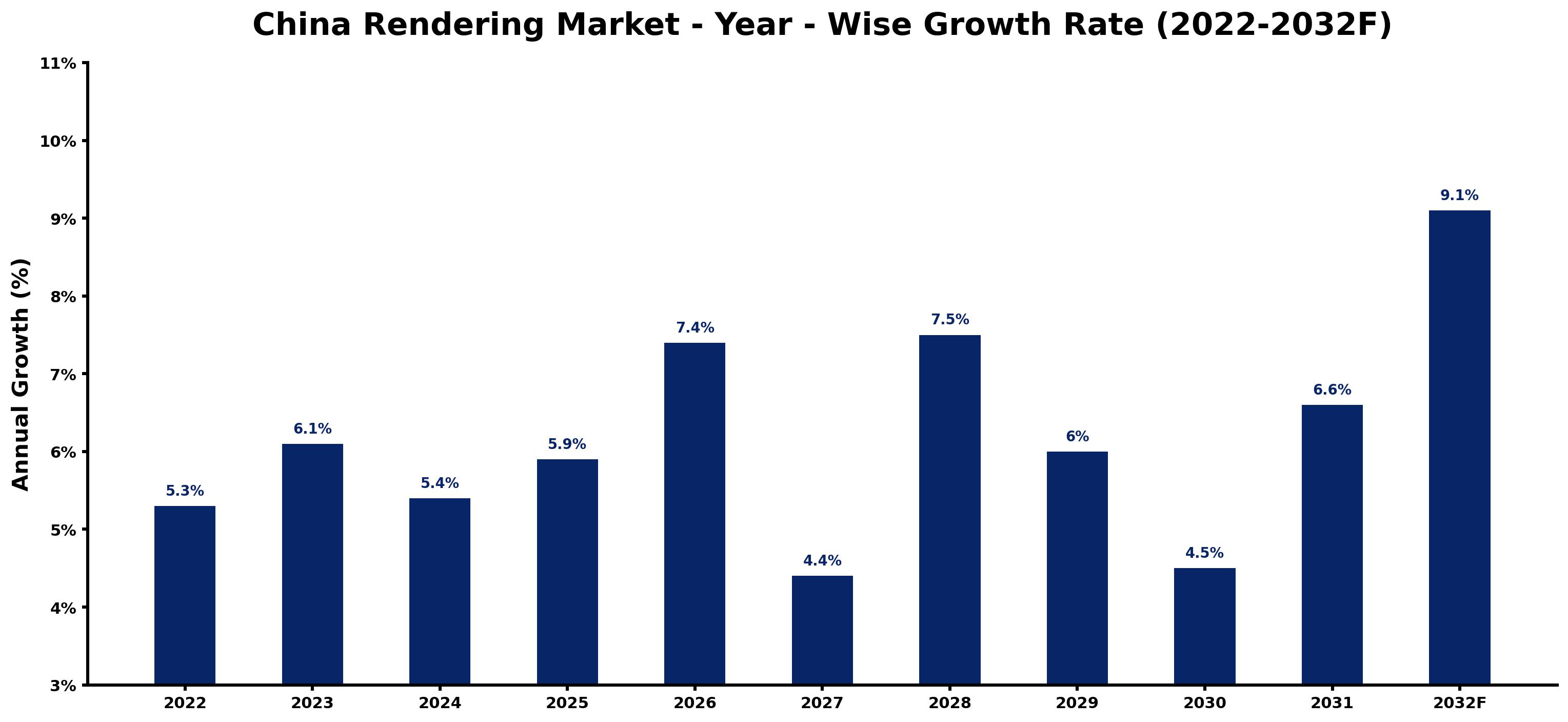
The following table presents the estimated annual growth rate for each year together with the principal factor influencing market performance.
| Year | Estimated Annual Growth (%) | Market Rationale |
| 2022 | 5.3 | The market showed steady growth due to increasing investments in the gaming sector. |
| 2023 | 6.1 | Demand surged as the video game industry generated over 440 billion yuan in revenue. |
| 2024 | 5.4 | Growth slowed slightly as the market adjusted to previous high demand levels. |
| 2025 | 5.9 | The architectural visualization market expanded, boosting the need for rendering technologies. |
| 2026 | 7.4 | Adoption of advanced rendering tools is projected to accelerate growth in the sector. |
| 2027 | 4.4 | Growth is expected to slow as the market stabilises after rapid advancements in technology. |
| 2028 | 7.5 | The rise of AR/VR applications will drive renewed interest in rendering solutions. |
| 2029 | 6.0 | Growth will decelerate as the market matures and consolidates. |
| 2030 | 4.5 | A slowdown is anticipated as the industry faces challenges in scaling technologies efficiently. |
| 2031 | 6.6 | The market will rebound with new investments in rendering technologies and tools. |
| 2032 | 9.1 | A peak in growth is anticipated due to heightened demand from the animation sector. |
Note: Market size estimations and growth projections presented in this report are based on 6Wresearch's proprietary forecasting methodology, utilizing the latest available industry data, government publications, and primary research inputs.
China Rendering Market Synopsis
Rendering in China refers to the technology used to generate images from 3D models through various processes. It is primarily made using software that simulates light and materials, serving industries like film, gaming, and architecture. The China Rendering Market is experiencing growth driven by a booming video game industry, which generated over 440 billion yuan in 2023, and substantial investments in animation and architectural visualization.
Market Dynamics Impact Analysis (2026–2032)
| Factor | Type | Impact | Primary Segment Affected |
| Increasing demand for high-quality visual effects in films and video games | Driver | High | Real-Time Rendering |
| Growth in the architectural visualization market | Driver | High | Architectural Rendering |
| Investment in training programs for rendering technologies | Opportunity | Medium | Real-Time Rendering |
| Expansion of cloud-based rendering solutions | Opportunity | High | Real-Time Rendering |
| Limited availability of skilled professionals in rendering technologies | Restraint | High | Real-Time Rendering |
| High costs associated with advanced rendering software and hardware | Restraint | Medium | Real-Time Rendering |
| Rendering in China faces challenges from a shortage of qualified talent | Challenge | High | Real-Time Rendering |
| Market players struggle to keep up with rapid technological advancements | Challenge | Medium | Real-Time Rendering |
Evaluation of Drivers in China Rendering Market (2026–2032)
The main growth drivers and the segments they affect most are set out below.
| Drivers | Primary Segment Affected | Why It Matters (Evidence) |
| Surge in video game industry revenue | Real-Time Rendering | The Chinese video game industry generated over 440 billion yuan in 2023, increasing demand for rendering technologies. |
| Growth in architectural visualization | Architectural Rendering | The architectural visualization market is expected to reach 50 billion yuan by 2025, driving demand for rendering. |
| Increased adoption of advanced rendering tools | Real-Time Rendering | The China Animation Association reported a 15% increase in advanced rendering tools adoption among its members in 2023. |
| Expansion of cloud-based rendering solutions | Real-Time Rendering | The China Software Industry Association noted a 20% rise in cloud-based rendering solutions usage in 2023. |
| Investment in AR/VR technologies | AR/VR Visualization | The Chinese AR/VR market is projected to reach 1 trillion yuan by 2026, increasing the need for rendering solutions. |
Expansion of the Rendering market in China is backed by the surge in video game industry revenue, growth in architectural visualization, and increased adoption of advanced rendering tools. The video game industry generated over 440 billion yuan in 2023, significantly increasing demand for rendering technologies. The China Animation Association reported a 15% increase in advanced rendering tools adoption among its members in 2023, indicating a shift towards higher quality outputs. The Chinese AR/VR market is set to reach 1 trillion yuan by 2026, creating new opportunities for rendering solutions in immersive experiences.
Evaluation of Restraints in China Rendering Market
The table below lists the restraints and the evidence behind each.
| Market Restraint | Primary Segment Affected | Why It Matters (Evidence) |
| Shortage of skilled professionals in rendering technologies | Real-Time Rendering | The rendering industry faces a talent gap, affecting the ability to meet growing demand for services, with a shortage impacting project timelines. |
| High costs of advanced rendering software and hardware | Real-Time Rendering | Prohibitive costs limit access to advanced technologies for smaller studios and firms, hindering their competitiveness. |
| Limited integration of rendering technologies in traditional sectors | Real-Time Rendering | Many traditional industries are slow to adopt rendering technologies, which limits overall market growth opportunities. |
| Regulatory hurdles in digital content production | Architectural Rendering | Strict regulations can delay project approvals, impacting the timeline for rendering services and client satisfaction. |
| Competition from international rendering service providers | Real-Time Rendering | Local firms struggle against established international players, which affects their market share and profitability. |
China Rendering Market Challenges
In the China Rendering Market, a significant challenge is the shortage of skilled professionals, which hampers project timelines for animation studios and architectural firms. Despite over 200 universities offering courses in 3D rendering, the industry struggles to meet the high demand for talent, leading to project delays of up to 30%. Intense competition among more than 1,000 animation studios results in price wars, squeezing margins for suppliers and forcing them to compromise on quality. Compliance with the National Standard for Digital Rendering Technology, introduced in 2022, has increased operational costs for studios, limiting their growth potential and innovation.
Trends in the China Rendering Market
The trends below show where the China Rendering Market is heading.
- Shift towards Cloud-Based Rendering Solutions: China is increasingly adopting cloud-based rendering solutions, driven by the need for efficiency and cost-effectiveness. The China Software Industry Association reported a 20% rise in cloud-based rendering usage in 2023, benefiting firms looking to reduce infrastructure costs.
- Emergence of AR/VR in Rendering: The rise of AR/VR applications is reshaping rendering in China. The Chinese AR/VR market is projected to reach 1 trillion yuan by 2026, creating new opportunities for rendering technologies in immersive experiences.
- Growing Demand for Architectural Visualization: Architectural firms are increasingly relying on rendering for client presentations. The architectural visualization market is expected to expand, highlighting the importance of rendering in design processes, with a projected value of 50 billion yuan by 2025.
- Increased Focus on Training and Certification: There is a growing emphasis on training in rendering technologies among educational institutions. In 2023, over 200 universities in China offered courses in 3D rendering and animation, improving the skill set of future professionals.
Investment Opportunities in the China Rendering Market
Several openings in the China Rendering Market merit attention from investors.
- Partnerships with Educational Institutions: Establishing partnerships with universities can improve training in rendering technologies. With over 200 universities offering courses in 3D rendering, firms can tap into a skilled workforce to meet industry demands.
- Investing in Cloud Rendering Services: The demand for cloud-based rendering solutions is rising, particularly among animation studios. With a 20% increase in usage reported in 2023, suppliers can focus on developing cloud services to meet this growing need.
- Certification Programs for Rendering Software: The China Animation Association launched a certification program for rendering software proficiency in 2023. This initiative can create opportunities for training providers to develop specialized courses that enhance industry standards.
- Expansion in the AR/VR Sector: The AR/VR market's projected growth to 1 trillion yuan by 2026 presents opportunities for rendering firms. Suppliers can invest in AR/VR rendering solutions to meet rising demand and capture new market segments.
Government Initiatives in the China Rendering Market
The State Administration of Radio and Television initiated a program in 2023 to support the integration of rendering technologies in film production, with a budget of 500 million yuan. This initiative aims to improve the quality and efficiency of rendering in film projects, enhancing the capabilities of local studios. The National Development and Reform Commission's 'Digital Economy Development Plan' launched in 2021 promotes rendering technology adoption in creative industries, complementing earlier initiatives by focusing on innovation and efficiency.
The Ministry of Culture and Tourism funds projects that integrate rendering technologies in film production, improving local studio capabilities. The Ministry of Education's 'Vocational Education Reform Plan' emphasizes training in rendering technologies for animation and game development careers, ensuring a skilled workforce for the industry. Additionally, the China Animation Association's certification program for rendering software proficiency aims to elevate industry standards and improve the quality of outputs.
Future Insight of the China Rendering Market
By 2032, the China Rendering Market will undergo substantial changes driven by the thriving video game industry, projected to generate over 600 billion yuan in revenue. The architectural visualization market will continue to grow, reaching 50 billion yuan, which will significantly boost demand for advanced rendering solutions. Ongoing support from the Ministry of Culture and Tourism for digitalization initiatives will improve rendering capabilities across various sectors. The rise of cloud-based rendering solutions, which saw a 20% increase in adoption in 2023, will streamline workflows and lower operational costs for producers.
Market Segmentation Analysis
The analysis below covers each segmentation, its leading category in 2025 and its fastest-growing category through 2032.
By Rendering Type – Real-Time Rendering Dominated, Architectural Rendering Expected to Grow Fastest
According to Ravi Bhandari, Research Head at 6Wresearch, Real-Time Rendering accounted for a 52% market share by rendering type in 2025. Real-Time Rendering holds the largest share because it is essential for interactive applications like video games, which generated over 440 billion yuan in revenue in 2023. This segment thrives in major production hubs such as Shanghai and Beijing, where developers heavily rely on its capabilities for engaging user experiences. Architectural Rendering is projected to grow fastest, at a CAGR of 7.6% during 2026–2032. Architectural Rendering is experiencing rapid growth, driven by the architectural visualization market projected to reach 50 billion yuan by 2025. The increasing demand for high-quality visual presentations in architecture will continue to propel this segment's expansion, further widening the lead of Real-Time Rendering. Suppliers should focus on developing advanced solutions for architectural rendering to address the rising needs of the construction and design industries.
By Engine/Tool – Unreal Engine Dominated, Unity/Unreal Expected to Grow Fastest
In 2025, Unreal Engine led the engine/tool split with a 41% share. Unreal Engine commands the largest market share as it is crucial for real-time rendering in the gaming sector, which is witnessing substantial growth. Its widespread adoption among game developers in China reinforces its strong installed base and market position. The quickest growth will come from Unity/Unreal, forecast to expand at a CAGR of 9.2% between 2026 and 2032. Unity/Unreal is the fastest-growing segment, fuelled by the increasing need for versatile tools in game development and interactive media. The surge in adoption among developers will likely enhance their market share further, ensuring Unreal Engine maintains its lead. Buyers should invest in Unity and Unreal Engine to remain competitive in the rapidly evolving gaming landscape.
By Delivery Mode – Cloud Pipelines Dominated and Is Expected to Record the Fastest Growth
The largest delivery mode category in 2025 was Cloud Pipelines, with a 43% share of total revenue. Cloud Pipelines lead the market because they facilitate remote rendering tasks, meeting the needs of a growing user base across various sectors. Their efficiency and scalability make them the preferred choice for rendering services in China, particularly among animation studios and game developers. Cloud Pipelines are also forecast to expand faster than any other category, at a CAGR of 8.2% over 2026–2032. Cloud Pipelines are also the fastest-growing delivery mode, reflecting a shift towards cloud-based solutions that improve collaboration and accessibility. As more companies adopt this model, the market share of cloud pipelines will continue to increase, solidifying their dominance. Suppliers must enhance their cloud rendering capabilities to meet the rising demand for flexible and efficient rendering solutions.
By End User – Video Game Developers Dominated, Architecture Firms Expected to Grow Fastest
Video Game Developers took a 49% share of end user in 2025, more than any other category. Video Game Developers represent the largest share of the market, as they are major consumers of rendering technologies essential for creating immersive gaming experiences. The substantial revenue generated by the gaming industry underscores the importance of this segment. Over 2026–2032, Architecture Firms are expected to post the fastest growth, at a CAGR of 8.4%. Architecture Firms are the fastest-growing end user group, driven by their dependence on rendering for impactful client presentations and design visualisations. As the architectural visualization market expands, so will the demand from these firms. Suppliers should tailor their offerings to meet the specific needs of architecture firms to capture this growing segment.
Key Attractiveness of the Report
- 10 Years of Market Numbers
- Historical Data Starting from 2022 to 2025
- Base Year 2025
- Forecast Data until 2032
- Key Performance Indicators Impacting the Market
- Major Upcoming Developments and Projects
Key Highlights of the Report:
- China Rendering Market Outlook
- Market Size of China Rendering Market, 2025
- Forecast of China Rendering Market, 2032
- Historical Data and Forecast of China Rendering Revenues & Volume for the Period 2022 - 2032F
- China Rendering Market Trend Evolution
- China Rendering Market Drivers and Challenges
- China Rendering Price Trends
- China Rendering Porter's Five Forces
- China Rendering Industry Life Cycle
- Historical Data and Forecast of China Rendering Market Revenues & Volume By Rendering Type for the Period 2022 - 2032F
- Historical Data and Forecast of China Rendering Market Revenues & Volume By Offline Ray-Tracing for the Period 2022 - 2032F
- Historical Data and Forecast of China Rendering Market Revenues & Volume By Real-Time Rendering for the Period 2022 - 2032F
- Historical Data and Forecast of China Rendering Market Revenues & Volume By Architectural Rendering for the Period 2022 - 2032F
- Historical Data and Forecast of China Rendering Market Revenues & Volume By AR/VR Visualization for the Period 2022 - 2032F
- Historical Data and Forecast of China Rendering Market Revenues & Volume By Engine/Tool for the Period 2022 - 2032F
- Historical Data and Forecast of China Rendering Market Revenues & Volume By V-Ray, Arnold for the Period 2022 - 2032F
- Historical Data and Forecast of China Rendering Market Revenues & Volume By Unreal Engine for the Period 2022 - 2032F
- Historical Data and Forecast of China Rendering Market Revenues & Volume By CAD-Based Tools for the Period 2022 - 2032F
- Historical Data and Forecast of China Rendering Market Revenues & Volume By Unity/Unreal for the Period 2022 - 2032F
- Historical Data and Forecast of China Rendering Market Revenues & Volume By Delivery Mode for the Period 2022 - 2032F
- Historical Data and Forecast of China Rendering Market Revenues & Volume By Workstation/Cloud for the Period 2022 - 2032F
- Historical Data and Forecast of China Rendering Market Revenues & Volume By Game Engines for the Period 2022 - 2032F
- Historical Data and Forecast of China Rendering Market Revenues & Volume By Cloud Pipelines for the Period 2022 - 2032F
- Historical Data and Forecast of China Rendering Market Revenues & Volume By In-App / Webstream for the Period 2022 - 2032F
- Historical Data and Forecast of China Rendering Market Revenues & Volume By End User for the Period 2022 - 2032F
- Historical Data and Forecast of China Rendering Market Revenues & Volume By Animated Film Studios for the Period 2022 - 2032F
- Historical Data and Forecast of China Rendering Market Revenues & Volume By Video Game Developers for the Period 2022 - 2032F
- Historical Data and Forecast of China Rendering Market Revenues & Volume By Architecture Firms for the Period 2022 - 2032F
- Historical Data and Forecast of China Rendering Market Revenues & Volume By Marketing & Design Agencies for the Period 2022 - 2032F
- China Rendering Import Export Trade Statistics
- Market Opportunity Assessment By Rendering Type
- Market Opportunity Assessment By Engine/Tool
- Market Opportunity Assessment By Delivery Mode
- Market Opportunity Assessment By End User
- China Rendering Top Companies Market Share
- China Rendering Competitive Benchmarking By Technical and Operational Parameters
- China Rendering Company Profiles
- China Rendering Key Strategic Recommendations
Market Covered
The report offers an extensive study of the following market segments.
By Rendering Type
- Offline Ray-Tracing
- Real-Time Rendering
- Architectural Rendering
- AR/VR Visualization
By Engine/Tool
- V-Ray
- Arnold
- Unreal Engine
- CAD-Based Tools
- Unity/Unreal
By Delivery Mode
- Workstation/Cloud
- Game Engines
- Cloud Pipelines
- In-App / Webstream
By End User
- Animated Film Studios
- Video Game Developers
- Architecture Firms
- Marketing & Design Agencies































