China Renewable Aviation Energy Market Size & Growth Rate
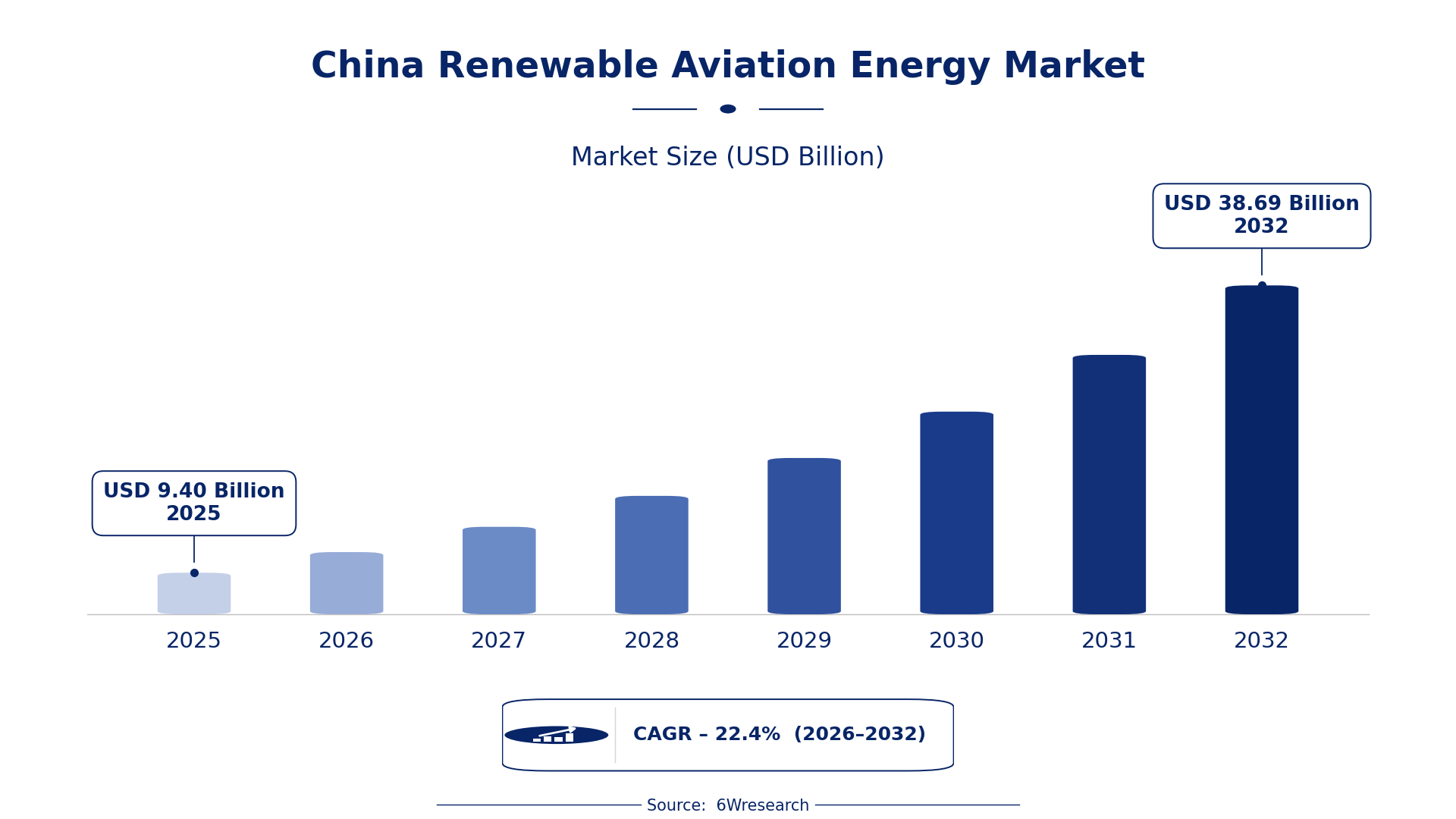
According to 6Wresearch internal database and industry insights, the China Renewable Aviation Energy Market was valued at USD 9.40 billion in 2025 and is projected to reach USD 38.69 billion by 2032, growing at a CAGR of approximately 22.4% during 2026–2032.
China Renewable Aviation Energy Market Highlights
| Report Metric | Details |
| Report Name | China Renewable Aviation Energy Market |
| Market Size 2025 | USD 9.40 billion |
| Market Size 2032 | USD 38.69 billion |
| Absolute Growth 2025–2032 | USD 29.29 billion |
| CAGR 2026–2032 | 22.4% |
| Peak Annual Growth | 23.9% in 2030 |
| Forecast Period | 2026–2032 |
| Historical Data | 2022–2025 |
| Base Year | 2025 |
| Leading Energy Strategy, 2025 | Hydrotreated Vegetable Oil (HVO) (47% share) |
| Leading Fuel Type, 2025 | Biofuel (43% share) |
| Leading Application Mode, 2025 | Commercial Flights (56% share) |
| Leading End User, 2025 | Airlines & Aircraft OEMs (52% share) |
| Fastest-Growing Energy Strategy | Sustainable Aviation Fuel (SAF) (24.4% CAGR) |
| Fastest-Growing Fuel Type | SAF Blends (23.9% CAGR) |
| Fastest-Growing Application Mode | Airport Fueling (24.5% CAGR) |
| Fastest-Growing End User | Airports & Fuel Companies (24.3% CAGR) |
| Growing Sector | Airlines & Aircraft OEMs |
| Key End Users | Airlines, Airports, Fuel Companies, Aerospace R&D |
China Renewable Aviation Energy Market Year-wise Growth Rate and Key Drivers (2022–2032)
This graph illustrates the annual growth rates of the market from 2022 to 2032, highlighting a steady upward trajectory and projected market expansion over the forecast period.
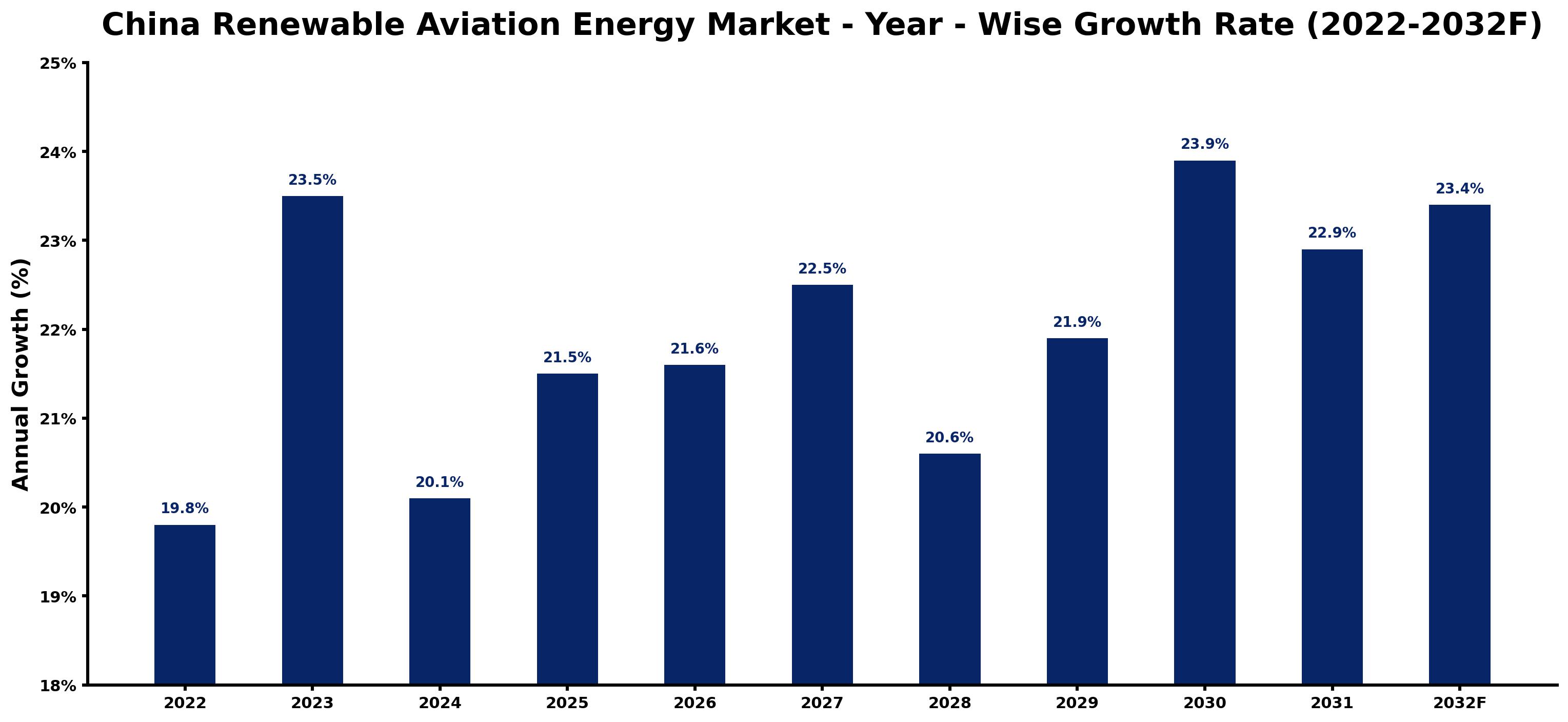
Each row of the following table gives one year's estimated growth and the event or demand shift that explains it.
| Year | Estimated Annual Growth (%) | Market Rationale |
| 2022 | 19.8 | The aviation sector showed strong demand for renewable fuels as airlines began transitioning to greener alternatives. |
| 2023 | 23.5 | Increased production capabilities and government support accelerated the adoption of sustainable aviation fuels. |
| 2024 | 20.1 | The market experienced a slowdown in growth as production faced temporary challenges in scaling up. |
| 2025 | 21.5 | Demand surged as more airports invested in infrastructure for renewable aviation energy solutions. |
| 2026 | 21.6 | The introduction of new biofuel blends is expected to stimulate market growth and expand buyer interest. |
| 2027 | 22.5 | Growing passenger numbers in the aviation sector will drive higher fuel demand, particularly for sustainable options. |
| 2028 | 20.6 | A slowdown is expected as the market adjusts to new regulations and production capacities. |
| 2029 | 21.9 | Increased international collaborations in aerospace research will boost the demand for renewable aviation fuels. |
| 2030 | 23.9 | The peak growth year will see substantial investments in sustainable aviation fuel production and technology. |
| 2031 | 22.9 | A slight slowdown is anticipated as the market stabilises after rapid growth in previous years. |
| 2032 | 23.4 | Continued government support and rising passenger traffic are projected to sustain growth momentum. |
Note: Market size estimations and growth projections presented in this report are based on 6Wresearch's proprietary forecasting methodology, utilizing the latest available industry data, government publications, and primary research inputs.
China Renewable Aviation Energy Market Synopsis
Renewable Aviation Energy in China encompasses fuels derived from renewable sources, primarily used in aviation. It includes biofuels and synthetic fuels produced through various methods, contributing to lower emissions. The China Renewable Aviation Energy Market is growing due to strong demand from domestic airlines and international collaborations in aerospace research. By 2030, the aviation sector aims for 10% of fuel to be sustainable aviation fuel, driving further investment and infrastructure development. Key buyers include airlines and airports, which are investing in renewable energy solutions to meet regulatory targets.
Market Dynamics Impact Analysis (2026–2032)
| Factor | Type | Impact | Primary Segment Affected |
| Government initiatives to promote sustainable aviation fuels enhance production capabilities. | Driver | High | Sustainable Aviation Fuel (SAF) |
| Airlines are increasingly adopting renewable fuels to meet carbon reduction targets. | Driver | High | Airlines & Aircraft OEMs |
| Airports in regions like Guangdong are investing heavily in SAF infrastructure. | Opportunity | High | Airport Fueling |
| The growing passenger base in China's aviation market presents a significant fuel demand gap. | Opportunity | High | Commercial Flights |
| Challenges in scaling production of renewable fuels may limit supply. | Restraint | High | Biofuel |
| Compliance with international standards for aviation fuels can complicate market entry. | Restraint | Medium | Sustainable Aviation Fuel (SAF) |
| The Renewable Aviation Energy market in China faces practical problems related to production scalability. | Challenge | High | Hydrotreated Vegetable Oil (HVO) |
| Technological advancements in fuel production are lagging behind market demand. | Challenge | Medium | Synthetic Fuels |
Evaluation of Drivers in China Renewable Aviation Energy Market (2026–2032)
The table below links each growth driver to the segment it affects and the evidence for it.
| Drivers | Primary Segment Affected | Why It Matters (Evidence) |
| Government support for sustainable aviation fuel development | Sustainable Aviation Fuel (SAF) | The 14th Five-Year Plan promotes investments in SAF production, enabling airlines to source renewable fuels effectively. |
| Growing passenger traffic in the aviation sector | Commercial Flights | With the aviation market expected to reach 1.6 billion passengers by 2035, airlines are increasingly seeking sustainable fuel solutions to meet rising demand. |
| Investment in renewable energy infrastructure at airports | Airport Fueling | Airports in regions like Guangdong and Shanghai are enhancing infrastructure for renewable energy solutions, facilitating greater adoption of biofuels. |
| Production capabilities for biofuels | Biofuel | In 2022, China produced approximately 1 million tons of biofuels for aviation, reflecting strong production capabilities that support market growth. |
| Collaborative research initiatives in aerospace | Aerospace R&D | Research initiatives drive the development of efficient fuel technologies, prompting further investment in production and infrastructure. |
The 14th Five-Year Plan for the Aviation Industry promotes sustainable aviation fuel development, encouraging airlines to invest in renewable options. In 2022, approximately 1 million tons of biofuels were produced for aviation, reflecting strong production capabilities. With the aviation market expected to reach 1.6 billion passengers by 2035, airlines are increasingly seeking sustainable fuel solutions to meet growing demand.
Evaluation of Restraints in China Renewable Aviation Energy Market
The main factors holding the market back are set out below.
| Market Restraint | Primary Segment Affected | Why It Matters (Evidence) |
| Production scalability challenges hinder the availability of renewable aviation fuels. | Sustainable Aviation Fuel (SAF) | Inadequate production facilities limit supply, affecting airlines' fuel sourcing. |
| Compliance with international standards for aviation fuels complicates market entry. | Biofuel | Stringent regulations can delay the introduction of new fuel types, impacting availability for airlines. |
| High initial investment costs for SAF production facilities deter new entrants. | Hydrotreated Vegetable Oil (HVO) | Limited financial resources restrict the growth of smaller producers, affecting market competition. |
| Technological advancements in fuel production are lagging behind market demand. | Synthetic Fuels | Slow innovation affects the availability of efficient renewable fuel options, limiting choices for airlines. |
| Market volatility in feedstock prices can impact biofuel production costs. | Biofuel | Fluctuating prices may lead to unpredictable supply and pricing for airlines, complicating budgeting. |
China Renewable Aviation Energy Market Challenges
The China Renewable Aviation Energy market encounters several practical issues, starting with fierce competition among producers. Many suppliers face a saturated market, leading to price wars that diminish profit margins for renewable aviation energy producers. Technological constraints also present challenges; current production methods struggle to fulfil the National Civil Aviation Administration's target of 10% sustainable aviation fuel by 2030, delaying supply for airlines. A shortage of skilled workers in renewable energy technologies creates an expertise gap, hindering producers' ability to innovate and scale operations. High production costs of around 5,000 yuan per ton for biofuels limit market entry for new suppliers, restricting options for airlines in search of sustainable fuel alternatives.
Trends in the China Renewable Aviation Energy Market
Buyers and suppliers in the China Renewable Aviation Energy Market are adjusting to the following trends.
- Shift towards Sustainable Aviation Fuel Implementation: Airports in regions like Guangdong are leading initiatives to implement sustainable aviation fuel solutions, with over 240 airports investing in renewable energy. This trend supports fuel supply chains and reduces carbon emissions.
- Increase in Biofuel Production Capacity: In 2022, China produced approximately 1 million tons of biofuels for aviation use, reflecting a growing capacity to meet demand. This increase supports airlines in achieving sustainability goals and reducing their carbon footprint.
- Rise of Collaborative Aerospace Research: The Chinese aviation sector is increasingly engaging in international collaborations for aerospace research and development, focusing on sustainable fuel technologies. This trend drives innovation and accelerates the adoption of renewable aviation energy.
- Adoption of SAF Blends in Commercial Aviation: The market is experiencing a growing adoption of SAF blends in commercial flights, driven by airlines seeking compliance with environmental standards. This shift is expected to support market growth and sustainability.
Investment Opportunities in the China Renewable Aviation Energy Market
The following opportunities in the China Renewable Aviation Energy Market pair current demand with a clear way in.
- Airlines seeking sustainable fuel solutions: Airlines are progressively searching for renewable aviation fuels to meet carbon reduction targets, with the aviation market expected to reach 1.6 billion passengers by 2035. Partnering with local fuel producers can ease access to sustainable options.
- Investment in SAF production facilities: The demand for sustainable aviation fuels is climbing, with a target of 10% SAF usage by 2030. Investing in SAF production facilities can address this demand, particularly in regions like Guangdong, where infrastructure is rapidly advancing.
- Expansion of airport fueling infrastructure: Airports are making substantial investments in renewable energy solutions, creating opportunities for suppliers of sustainable aviation fuels. With over 240 airports in China, collaborations with local airport authorities can facilitate market entry.
- Development of innovative biofuel blends: The market gap for innovative biofuel blends offers an opportunity for suppliers to focus on research and development. Collaborating with airlines can ensure adherence to evolving environmental standards.
Government Initiatives in the China Renewable Aviation Energy Market
The 14th Five-Year Plan for the Aviation Industry, established in 2021, aims to promote the development of sustainable aviation fuels in China. This initiative encourages investments in production and infrastructure, ensuring that airlines can effectively source renewable fuels. The plan aligns with the country's broader objectives of achieving carbon neutrality in civil aviation by 2060, creating a supportive environment for renewable energy adoption. Additionally, the government allocated 500 million yuan in 2022 for research in sustainable aviation technologies, enhancing the capabilities of producers and buyers alike.
The National Energy Administration supports renewable energy projects in aviation through various funding schemes. Initiatives launched since 2021 provide financial assistance for developing sustainable aviation technologies. These schemes enable airports and fuel companies to invest in infrastructure and production capabilities, ensuring a reliable supply of renewable aviation fuels. In 2022, the government allocated 500 million yuan for research in sustainable aviation technologies, bolstering the capabilities of producers.
Future Insight of the China Renewable Aviation Energy Market
The China Renewable Aviation Energy market will undergo notable changes by 2032, driven by several forward-looking factors. The Chinese government's 14th Five-Year Plan will continue to support sustainable aviation fuel development, encouraging investment in advanced production technologies. Airports in regions like Guangdong and Shanghai are set to enhance infrastructure for renewable energy solutions, facilitating greater adoption of biofuels. With the aviation sector expected to produce around 1 million tons of biofuels annually, suppliers will need to scale up production to meet rising demand.
Market Segmentation Analysis
Each segment group is reviewed below, with the leader by share and the fastest grower by CAGR.
By Energy Strategy – Hydrotreated Vegetable Oil (HVO) Dominated, Sustainable Aviation Fuel (SAF) Expected to Grow Fastest
According to Ravi Bhandari, Research Head at 6Wresearch, the largest energy strategy category in 2025 was Hydrotreated Vegetable Oil (HVO), with a 47% share of total revenue. Hydrotreated Vegetable Oil (HVO) holds the largest share in China's renewable aviation energy market due to its established use as a drop-in fuel for commercial flights. With the aviation sector aiming for 10% of fuel to be sustainable aviation fuel by 2030, HVO meets current demands effectively. The quickest growth will come from Sustainable Aviation Fuel (SAF), forecast to expand at a CAGR of 24.4% between 2026 and 2032. Sustainable Aviation Fuel (SAF) is experiencing rapid growth as the Chinese government supports its development through the 14th Five-Year Plan for the Aviation Industry. This initiative aligns with the goal of achieving carbon neutrality in civil aviation by 2060, ensuring SAF's prominence in the market. Suppliers must focus on developing SAF technologies to align with government policies and meet the growing demand from airlines.
By Fuel Type – Biofuel Dominated, SAF Blends Expected to Grow Fastest
With a 43% revenue share in 2025, Biofuel was the largest fuel type category. Biofuel commands the largest market share due to its widespread use in blends that effectively reduce the carbon footprint of aviation fuels. In 2022, China produced approximately 1 million tons of biofuels, making it a preferred option for airlines focused on sustainability. SAF Blends are set to record the highest CAGR in this split, 23.9% over 2026–2032. SAF Blends are witnessing rapid growth as they effectively combine traditional fuels with sustainable aviation fuel, meeting emerging regulatory requirements. This trend is particularly relevant as the aviation market anticipates a significant increase in passenger numbers by 2035. Suppliers should prioritise the development of SAF Blends to align with regulatory standards and enhance their sustainability initiatives.
By Application Mode – Commercial Flights Dominated, Airport Fueling Expected to Grow Fastest
Commercial Flights held a 56% share of the China Renewable Aviation Energy Market by application mode in 2025. Commercial Flights dominate the renewable aviation energy market, being the primary application for these fuels. The growing number of airports in China investing in renewable energy solutions reinforces this segment's leading position. Over 2026–2032, Airport Fueling is expected to post the fastest growth, at a CAGR of 24.5%. Airport Fueling is the fastest-growing application mode, driven by the critical need for refueling operations at airports adopting renewable energy solutions. As the aviation sector expands, efficient fueling practices will become increasingly vital. Suppliers must tailor their solutions for airport fueling to capitalise on the growth opportunities in this essential area.
By End User – Airlines & Aircraft OEMs Dominated, Airports & Fuel Companies Expected to Grow Fastest
Airlines & Aircraft OEMs accounted for a 52% market share by end user in 2025. Airlines & Aircraft OEMs hold the largest market share as they are the primary consumers of renewable aviation fuels, driving demand through their sustainability goals. Their commitment to reducing carbon emissions significantly influences the uptake of these fuels in commercial aviation. Airports & Fuel Companies are projected to grow fastest, at a CAGR of 24.3% during 2026–2032. Airports & Fuel Companies are the fastest-growing end users, crucial for the distribution and supply of renewable fuels. The Chinese government's support for renewable energy projects further accelerates their involvement in the market. Suppliers should engage with airports and fuel companies to expand their market reach and support the transition to renewable aviation fuels.
Key Attractiveness of the Report
- 10 Years of Market Numbers
- Historical Data Starting from 2022 to 2025
- Base Year 2025
- Forecast Data until 2032
- Key Performance Indicators Impacting the Market
- Major Upcoming Developments and Projects
Key Highlights of the Report:
- China Renewable Aviation Energy Market Outlook
- Market Size of China Renewable Aviation Energy Market, 2025
- Forecast of China Renewable Aviation Energy Market, 2032
- Historical Data and Forecast of China Renewable Aviation Energy Revenues & Volume for the Period 2022 - 2032F
- China Renewable Aviation Energy Market Trend Evolution
- China Renewable Aviation Energy Market Drivers and Challenges
- China Renewable Aviation Energy Price Trends
- China Renewable Aviation Energy Porter's Five Forces
- China Renewable Aviation Energy Industry Life Cycle
- Historical Data and Forecast of China Renewable Aviation Energy Market Revenues & Volume By Energy Strategy for the Period 2022 - 2032F
- Historical Data and Forecast of China Renewable Aviation Energy Market Revenues & Volume By Hydrotreated Vegetable Oil (HVO) for the Period 2022 - 2032F
- Historical Data and Forecast of China Renewable Aviation Energy Market Revenues & Volume By Sustainable Aviation Fuel (SAF) for the Period 2022 - 2032F
- Historical Data and Forecast of China Renewable Aviation Energy Market Revenues & Volume By Hydrogen/E-fuels for the Period 2022 - 2032F
- Historical Data and Forecast of China Renewable Aviation Energy Market Revenues & Volume By Fuel Type for the Period 2022 - 2032F
- Historical Data and Forecast of China Renewable Aviation Energy Market Revenues & Volume By Biofuel for the Period 2022 - 2032F
- Historical Data and Forecast of China Renewable Aviation Energy Market Revenues & Volume By SAF Blends for the Period 2022 - 2032F
- Historical Data and Forecast of China Renewable Aviation Energy Market Revenues & Volume By Synthetic Fuels for the Period 2022 - 2032F
- Historical Data and Forecast of China Renewable Aviation Energy Market Revenues & Volume By Application Mode for the Period 2022 - 2032F
- Historical Data and Forecast of China Renewable Aviation Energy Market Revenues & Volume By Commercial Flights for the Period 2022 - 2032F
- Historical Data and Forecast of China Renewable Aviation Energy Market Revenues & Volume By Airport Fueling for the Period 2022 - 2032F
- Historical Data and Forecast of China Renewable Aviation Energy Market Revenues & Volume By Experimental Aircraft for the Period 2022 - 2032F
- Historical Data and Forecast of China Renewable Aviation Energy Market Revenues & Volume By End User for the Period 2022 - 2032F
- Historical Data and Forecast of China Renewable Aviation Energy Market Revenues & Volume By Airlines & Aircraft OEMs for the Period 2022 - 2032F
- Historical Data and Forecast of China Renewable Aviation Energy Market Revenues & Volume By Airports & Fuel Companies for the Period 2022 - 2032F
- Historical Data and Forecast of China Renewable Aviation Energy Market Revenues & Volume By Aerospace R&D for the Period 2022 - 2032F
- China Renewable Aviation Energy Import Export Trade Statistics
- Market Opportunity Assessment By Energy Strategy
- Market Opportunity Assessment By Fuel Type
- Market Opportunity Assessment By Application Mode
- Market Opportunity Assessment By End User
- China Renewable Aviation Energy Top Companies Market Share
- China Renewable Aviation Energy Competitive Benchmarking By Technical and Operational Parameters
- China Renewable Aviation Energy Company Profiles
- China Renewable Aviation Energy Key Strategic Recommendations
Market Covered
The report offers an extensive study of the following market segments.
By Energy Strategy
- Hydrotreated Vegetable Oil (HVO)
- Sustainable Aviation Fuel (SAF)
- Hydrogen/E-fuels
By Fuel Type
- Biofuel
- SAF Blends
- Synthetic Fuels
By Application Mode
- Commercial Flights
- Airport Fueling
- Experimental Aircraft
By End User
- Airlines & Aircraft OEMs
- Airports & Fuel Companies
- Aerospace R&D































