China Reservoir Modeling AI Market Size & Growth Rate
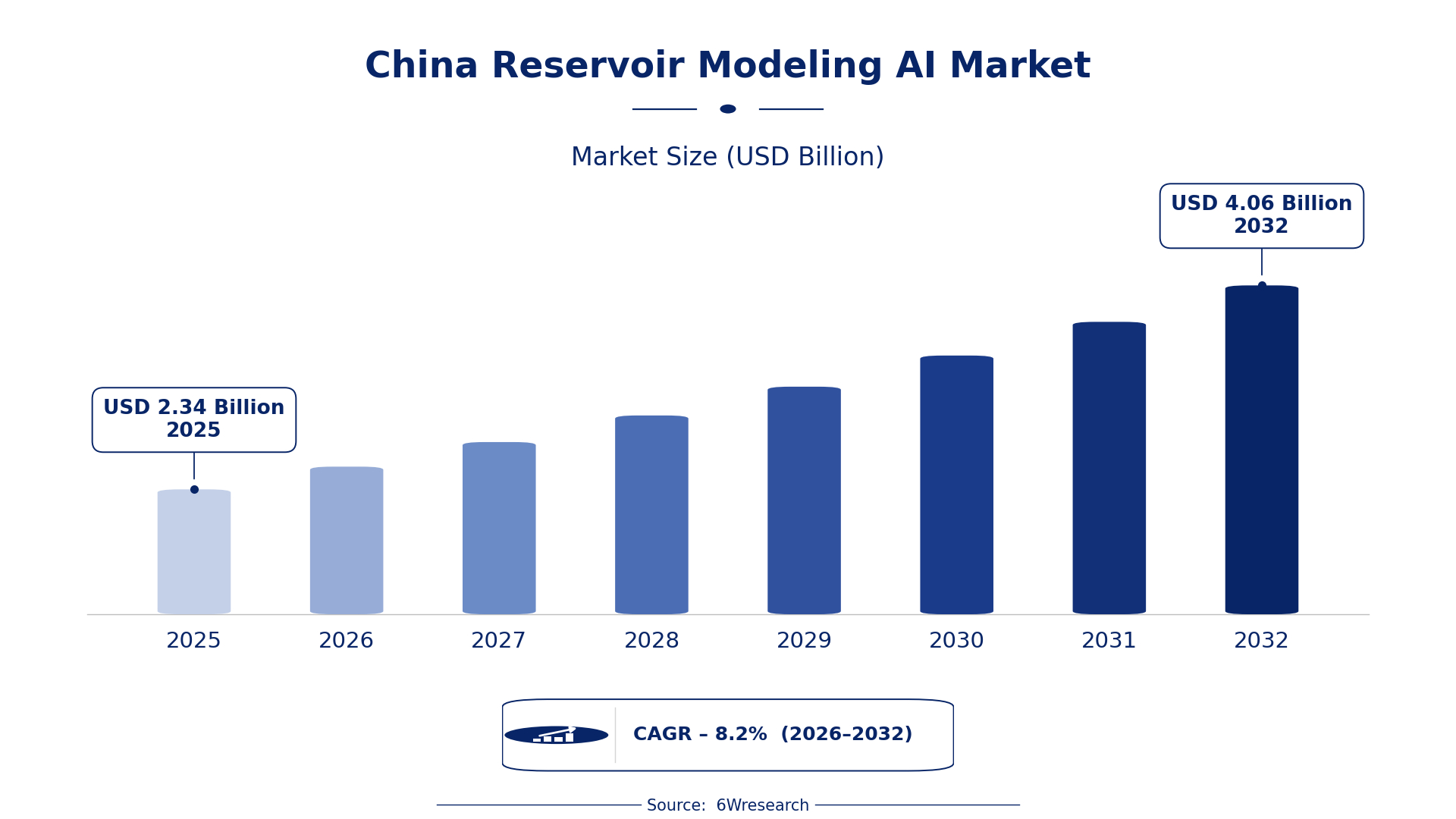
According to 6Wresearch internal database and industry insights, the China Reservoir Modeling AI Market was valued at USD 2.34 billion in 2025 and is projected to reach USD 4.06 billion by 2032, growing at a CAGR of approximately 8.2% during 2026–2032.
China Reservoir Modeling AI Market Highlights
| Report Metric | Details |
| Report Name | China Reservoir Modeling AI Market |
| Market Size 2025 | USD 2.34 billion |
| Market Size 2032 | USD 4.06 billion |
| Absolute Growth 2025–2032 | USD 1.72 billion |
| CAGR 2026–2032 | 8.2% |
| Peak Annual Growth | 10.0% in 2026 |
| Forecast Period | 2026–2032 |
| Historical Data | 2022–2025 |
| Base Year | 2025 |
| Leading AI Model Function, 2025 | Flood Forecasting (59% share) |
| Leading Data Input, 2025 | Rainfall & Flow Data (55% share) |
| Leading Deployment Mode, 2025 | Cloud-Based (63% share) |
| Leading End User, 2025 | Water Management Agencies (54% share) |
| Fastest-Growing AI Model Function | Reservoir Optimization (9.3% CAGR) |
| Fastest-Growing Data Input | Level + Usage Metrics (9.3% CAGR) |
| Fastest-Growing Deployment Mode | AI Edge Platforms (10.3% CAGR) |
| Fastest-Growing End User | Utility Operators (10.0% CAGR) |
| Growing Sector | Water Management |
| Key End Users | Water Management Agencies, Utility Operators, Urban Water Utilities |
China Reservoir Modeling AI Market Year-wise Growth Rate and Key Drivers (2022–2032)
This graph illustrates the annual growth rates of the market from 2022 to 2032, highlighting a steady upward trajectory and projected market expansion over the forecast period.
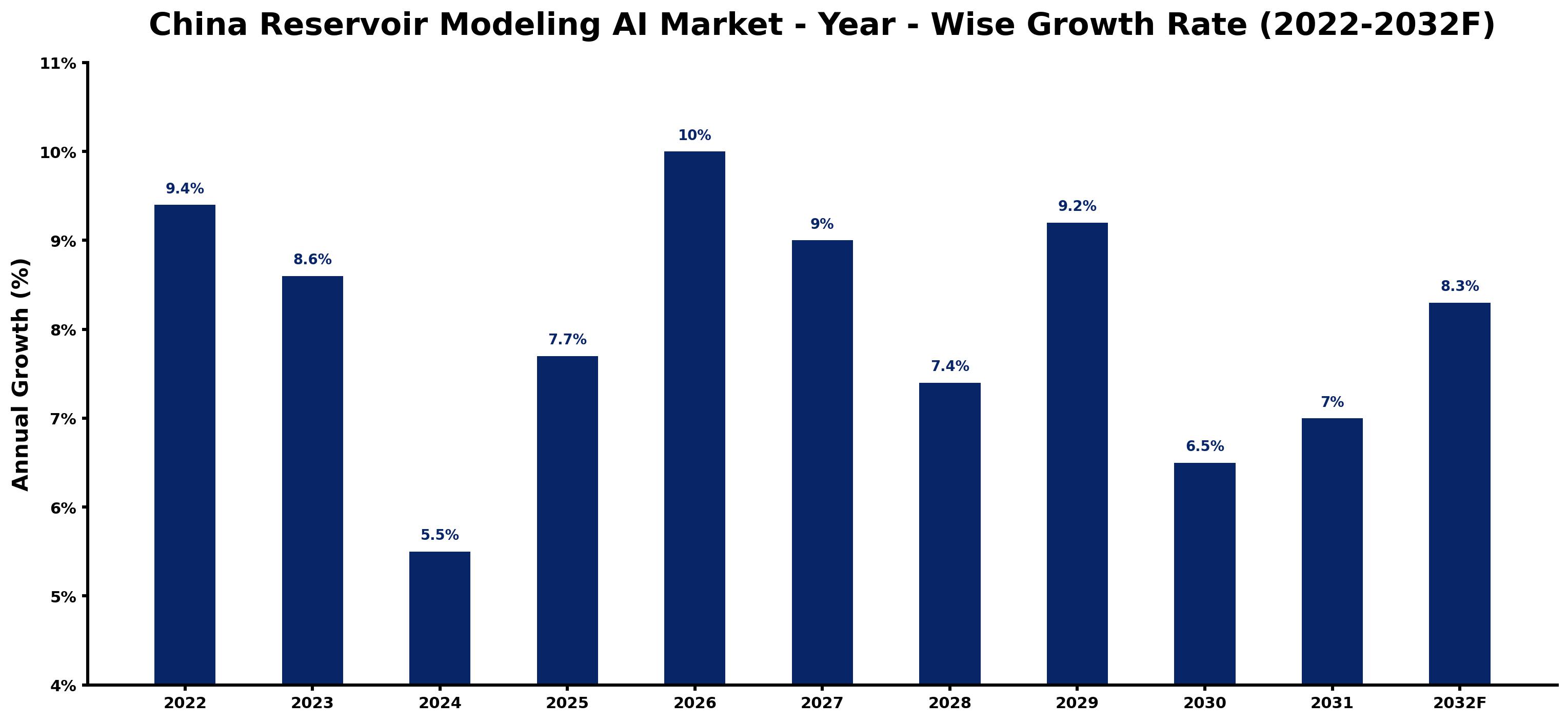
Each row of the following table gives one year's estimated growth and the event or demand shift that explains it.
| Year | Estimated Annual Growth (%) | Market Rationale |
| 2022 | 9.4 | The market experienced strong growth due to heightened focus on water resource management initiatives. |
| 2023 | 8.6 | Demand growth slowed as agencies adapted to new technologies in water management practices. |
| 2024 | 5.5 | Adoption continued at a slower pace as agencies evaluated the efficiency of implemented projects. |
| 2025 | 7.7 | A resurgence in demand occurred as the Ministry of Water Resources promoted AI solutions across various regions. |
| 2026 | 10.0 | The market is set to peak as investments in AI technologies are expected to rise under the 'Smart Water Management Initiative'. |
| 2027 | 9.0 | Growth will slow as agencies begin to stabilise after rapid expansion in previous years. |
| 2028 | 7.4 | Demand will continue to moderate as agencies integrate existing technologies into operations more effectively. |
| 2029 | 9.2 | A rebound in demand is anticipated as innovative solutions attract new investments in water management technologies. |
| 2030 | 6.5 | Growth will decelerate as the market matures across the sector, leading to more efficient operations. |
| 2031 | 7.0 | An increase in demand is expected as more agencies adopt advanced AI solutions for improved efficiency. |
| 2032 | 8.3 | The market will see sustained growth driven by ongoing technological advancements in water management practices. |
Note: Market size estimations and growth projections presented in this report are based on 6Wresearch's proprietary forecasting methodology, utilizing the latest available industry data, government publications, and primary research inputs.
China Reservoir Modeling AI Market Synopsis
Reservoir Modeling AI in China encompasses advanced artificial intelligence technologies used to analyse and predict water reservoir behaviour. This technology optimises reservoir operations and forecasts flood events, utilising data inputs such as rainfall and flow metrics. The China Reservoir Modeling AI Market is expanding due to increasing demand from over 2,000 water management agencies and utility operators. The government's initiatives, such as the 'National Water Conservation Plan', promote the integration of AI in water management, further driving market growth.
Market Dynamics Impact Analysis (2026–2032)
| Factor | Type | Impact | Primary Segment Affected |
| Increasing investments in AI technologies for water management | Driver | High | Reservoir Optimization |
| Growing need for efficient water resource management | Driver | High | Flood Forecasting |
| Expansion of urban water supply systems | Opportunity | High | Water Management Agencies |
| Rising demand for flood forecasting solutions | Opportunity | High | Utility Operators |
| Limited awareness of AI benefits among smaller agencies | Restraint | Medium | Reservoir Optimization |
| High initial investment costs for AI technologies | Restraint | Medium | Flood Forecasting |
| The biggest obstacle is the slow adoption of AI technologies | Challenge | High | Water Management Agencies |
| Integration challenges with existing systems hinder progress | Challenge | Medium | Utility Operators |
Evaluation of Drivers in China Reservoir Modeling AI Market (2026–2032)
The table below links each growth driver to the segment it affects and the evidence for it.
| Drivers | Primary Segment Affected | Why It Matters (Evidence) |
| Increased funding for AI-driven flood forecasting models | Flood Forecasting | The government allocated 300 million yuan for upgrading water management infrastructure, encouraging purchases from agencies. |
| Growing urbanisation necessitates better water management solutions | Reservoir Optimization | Urban areas are expanding rapidly, prompting agencies to invest in AI technologies for efficient resource management. |
| Implementation of the 'National Water Conservation Plan' | Water Management Agencies | This initiative encourages agencies to adopt AI for improved water efficiency, boosting demand for advanced solutions. |
| Rising population in urban areas creates pressure on water resources | Utility Operators | With over 1.4 billion residents served, utilities are investing in AI solutions to optimise water supply and distribution. |
| The 'Smart Water Management Initiative' promotes AI adoption | Flood Forecasting | This initiative drives demand for advanced technologies among urban water utilities, improving operational efficiency. |
Growth in the Reservoir Modeling AI market in China comes from increased funding for AI-driven flood forecasting models, with the government allocating 300 million yuan for infrastructure upgrades. Urbanisation is driving demand as agencies seek efficient solutions to manage expanding populations. The 'National Water Conservation Plan' encourages water management agencies to adopt AI technologies, resulting in greater investment in reservoir optimisation. With over 1.4 billion residents served, utility operators are focusing on AI solutions to optimise water supply and distribution, addressing the growing needs of urban areas. The 'Smart Water Management Initiative' promotes AI adoption among urban utilities, further increasing demand for advanced technologies.
Evaluation of Restraints in China Reservoir Modeling AI Market
The main factors holding the market back are set out below.
| Market Restraint | Primary Segment Affected | Why It Matters (Evidence) |
| Limited awareness of AI benefits among smaller agencies | Reservoir Optimization | Many smaller agencies lack knowledge about AI, which slows adoption and reduces purchases. |
| High initial investment costs for AI technologies | Flood Forecasting | The financial burden of implementing AI systems deters some agencies from investing in upgrades. |
| Integration challenges with existing systems hinder progress | Utility Operators | Legacy systems complicate the implementation of new AI technologies, delaying necessary upgrades. |
| Insufficient training for staff on new technologies | Water Management Agencies | A lack of skilled personnel to operate AI systems limits effective implementation and efficiency. |
| Regulatory hurdles slow down technology adoption | Flood Forecasting | Compliance with existing regulations can delay the integration of AI solutions into operations. |
China Reservoir Modeling AI Market Challenges
The China Reservoir Modeling AI market faces high implementation costs for buyers, with initial investments exceeding 500,000 yuan for advanced systems, which deters smaller water management agencies from adopting these technologies. Limited availability of skilled professionals in AI leads to project delays, extending timelines by up to six months for utility operators. Domestic agencies struggle to keep pace with international advancements in AI technology, increasing competition and risking obsolescence in their operations. Uncertain government policies on water management create hesitancy, complicating long-term infrastructure investments for water management agencies.
Trends in the China Reservoir Modeling AI Market
The trends below show where the China Reservoir Modeling AI Market is heading.
- Shift towards AI-Driven Flood Forecasting in Urban Areas: China is increasingly adopting AI-driven flood forecasting models, particularly in urban regions like the Yangtze River basin. In 2023, the government allocated 300 million yuan to improve these capabilities, improving disaster response strategies.
- Transition from Traditional to Smart Water Management: The 'Smart Water Management Initiative' launched in 2023 is promoting the shift from traditional methods to AI-enhanced systems. This initiative aims to modernise urban water utilities, with 300 million yuan allocated for infrastructure upgrades.
- Growing Demand for Real-Time Data Integration: There is a noticeable shift towards real-time data integration in reservoir management. The average annual rainfall variability in China necessitates advanced modeling solutions, leading to increased AI adoption among agencies, with a projected growth of 9.3% in this area.
- Emergence of Cloud-Based Solutions in Reservoir Management: Cloud-based solutions are becoming the preferred deployment mode for reservoir modeling AI. As of 2025, they are expected to account for 63% of the market, providing flexibility and scalability for agencies.
Investment Opportunities in the China Reservoir Modeling AI Market
The following opportunities in the China Reservoir Modeling AI Market pair current demand with a clear way in.
- Market Gap in AI Training for Water Management: With over 2,000 water management agencies in China, there is a notable gap in AI training. Investing in training programmes can improve the capabilities of these agencies, leading to better technology adoption and operational efficiency.
- Timing for Investment in Urban Water Utilities: The ongoing urbanisation in China presents a timely opportunity for investment in AI technologies. Urban water utilities are increasingly seeking advanced solutions to manage growing populations effectively, with a market potential exceeding 1 billion yuan.
- Entry through Partnerships with Local Agencies: Forming partnerships with local water management agencies can facilitate entry into the market. Collaborating on AI projects can build credibility and lead to successful implementations, particularly in urban areas with high demand.
- Focus on Flood Forecasting Technologies: The rising demand for flood forecasting solutions creates an opportunity for technology suppliers. Investing in innovative AI-driven models can meet the needs of utility operators and agencies, with an estimated market growth of 10% in this segment.
Government Initiatives in the China Reservoir Modeling AI Market
The 'Smart Water Management Initiative' launched in 2023 by the Ministry of Housing and Urban-Rural Development promotes AI adoption in urban water utilities. This initiative builds on previous strategies, such as the 'National Water Resource Management Plan' updated in 2021, which aimed to improve reservoir efficiency and sustainability. By integrating AI technologies, the initiative seeks to improve water management practices across the country, ensuring better resource allocation and disaster preparedness, with a funding allocation of 300 million yuan.
The Ministry of Water Resources oversees the implementation of various programmes aimed at improving water management. The agency funds projects that integrate AI technologies into existing systems, focusing on enhancing efficiency and sustainability. In 2022, the State Council approved the 'Water Security Strategy', which directs 500 million yuan towards innovative solutions for water management, ensuring that agencies have the necessary resources to adopt advanced technologies.
Future Insight of the China Reservoir Modeling AI Market
The China Reservoir Modeling AI market is set for transformation by 2032, driven by the government's support for the National Water Conservation Plan and increased funding for AI infrastructure upgrades. Improved data integration techniques will enhance forecasting accuracy, benefiting over 1.4 billion residents served by water utilities. The adoption of ISO 14046 standards will promote sustainable practices in reservoir management, while AI-driven flood forecasting models will strengthen regional disaster response strategies, ensuring better preparedness for extreme weather events.
Market Segmentation Analysis
The analysis below covers each segmentation, its leading category in 2025 and its fastest-growing category through 2032.
By AI Model Function – Flood Forecasting Dominated, Reservoir Optimization Expected to Grow Fastest
According to Ravi Bhandari, Research Head at 6Wresearch, in 2025, Flood Forecasting led the ai model function split with a 59% share. Flood forecasting holds the largest market share due to its critical role in predicting flood events and managing water resources effectively. The integration of these models into regional disaster response strategies is vital for safeguarding communities against potential disasters. Over 2026–2032, Reservoir Optimization is expected to post the fastest growth, at a CAGR of 9.3%. Reservoir optimization is experiencing rapid growth as agencies strive to enhance water usage efficiency and management strategies. The government's recent funding for water management infrastructure upgrades will significantly accelerate this segment's growth trajectory. Suppliers should prioritise developing advanced solutions for reservoir optimization to cater to the increasing demand from water management agencies.
By Data Input – Rainfall & Flow Data Dominated, Level + Usage Metrics Expected to Grow Fastest
Rainfall & Flow Data held a 55% share of the China Reservoir Modeling AI Market by data input in 2025. Rainfall and flow data leads the market as it is a vital input for accurate reservoir modeling and predictions. This data is indispensable for over 2,000 water management agencies in China that rely on precise information for informed decision-making. Level + Usage Metrics are projected to grow fastest, at a CAGR of 9.3% during 2026–2032. Level and usage metrics are experiencing swift growth due to their importance in monitoring reservoir conditions and ensuring optimal usage. With urban water supply systems serving over 800 million residents, the need for real-time data on reservoir levels is increasingly critical. Buyers must invest in advanced data collection methods to ensure they obtain the most accurate information for effective reservoir management.
By Deployment Mode – Cloud-Based Dominated, AI Edge Platforms Expected to Grow Fastest
The largest deployment mode category in 2025 was Cloud-Based, with a 63% share of total revenue. Cloud-based deployment captures the largest market share owing to its flexibility and scalability in processing substantial data volumes. This approach is widely adopted by water management agencies aiming to improve operational efficiency through modern technologies. AI Edge Platforms are set to record the highest CAGR in this split, 10.3% over 2026–2032. AI edge platforms are gaining momentum as they facilitate localized processing, which is particularly beneficial in remote areas. With the rising demand for real-time data processing, this segment is set for considerable growth in the near future. Suppliers should explore expanding their offerings to include AI edge platforms to meet the changing needs of water management agencies.
By End User – Water Management Agencies Dominated, Utility Operators Expected to Grow Fastest
Water Management Agencies took a 54% share of end user in 2025, more than any other category. Water management agencies dominate this segment as they are the primary users responsible for managing water resources across China. Their active role in implementing the 'National Water Conservation Plan' underscores their importance in adopting reservoir modeling technologies. The quickest growth will come from Utility Operators, forecast to expand at a CAGR of 10.0% between 2026 and 2032. Utility operators represent the fastest-growing end user group, motivated by their need to optimise water supply and distribution. With urban water supply systems catering to a growing population, utility operators are increasingly seeking advanced solutions to improve operational efficiency. Suppliers should customise their solutions to meet the specific demands of utility operators as their presence in the market expands.
Key Attractiveness of the Report
- 10 Years of Market Numbers
- Historical Data Starting from 2022 to 2025
- Base Year 2025
- Forecast Data until 2032
- Key Performance Indicators Impacting the Market
- Major Upcoming Developments and Projects
Key Highlights of the Report:
- China Reservoir Modeling AI Market Outlook
- Market Size of China Reservoir Modeling AI Market, 2025
- Forecast of China Reservoir Modeling AI Market, 2032
- Historical Data and Forecast of China Reservoir Modeling AI Revenues & Volume for the Period 2022 - 2032F
- China Reservoir Modeling AI Market Trend Evolution
- China Reservoir Modeling AI Market Drivers and Challenges
- China Reservoir Modeling AI Price Trends
- China Reservoir Modeling AI Porter's Five Forces
- China Reservoir Modeling AI Industry Life Cycle
- Historical Data and Forecast of China Reservoir Modeling AI Market Revenues & Volume By AI Model Function for the Period 2022 - 2032F
- Historical Data and Forecast of China Reservoir Modeling AI Market Revenues & Volume By Flood Forecasting for the Period 2022 - 2032F
- Historical Data and Forecast of China Reservoir Modeling AI Market Revenues & Volume By Reservoir Optimization for the Period 2022 - 2032F
- Historical Data and Forecast of China Reservoir Modeling AI Market Revenues & Volume By Data Input for the Period 2022 - 2032F
- Historical Data and Forecast of China Reservoir Modeling AI Market Revenues & Volume By Rainfall & Flow Data for the Period 2022 - 2032F
- Historical Data and Forecast of China Reservoir Modeling AI Market Revenues & Volume By Level + Usage Metrics for the Period 2022 - 2032F
- Historical Data and Forecast of China Reservoir Modeling AI Market Revenues & Volume By Deployment Mode for the Period 2022 - 2032F
- Historical Data and Forecast of China Reservoir Modeling AI Market Revenues & Volume By Cloud-Based for the Period 2022 - 2032F
- Historical Data and Forecast of China Reservoir Modeling AI Market Revenues & Volume By AI Edge Platforms for the Period 2022 - 2032F
- Historical Data and Forecast of China Reservoir Modeling AI Market Revenues & Volume By End User for the Period 2022 - 2032F
- Historical Data and Forecast of China Reservoir Modeling AI Market Revenues & Volume By Water Management Agencies for the Period 2022 - 2032F
- Historical Data and Forecast of China Reservoir Modeling AI Market Revenues & Volume By Utility Operators for the Period 2022 - 2032F
- China Reservoir Modeling AI Import Export Trade Statistics
- Market Opportunity Assessment By AI Model Function
- Market Opportunity Assessment By Data Input
- Market Opportunity Assessment By Deployment Mode
- Market Opportunity Assessment By End User
- China Reservoir Modeling AI Top Companies Market Share
- China Reservoir Modeling AI Competitive Benchmarking By Technical and Operational Parameters
- China Reservoir Modeling AI Company Profiles
- China Reservoir Modeling AI Key Strategic Recommendations
Market Covered
This report examines the market across the segments below.
By AI Model Function
- Flood Forecasting
- Reservoir Optimization
By Data Input
- Rainfall & Flow Data
- Level + Usage Metrics
By Deployment Mode
- Cloud-Based
- AI Edge Platforms
By End User
- Water Management Agencies
- Utility Operators































