China Reservoir Simulation Software Market Size & Growth Rate
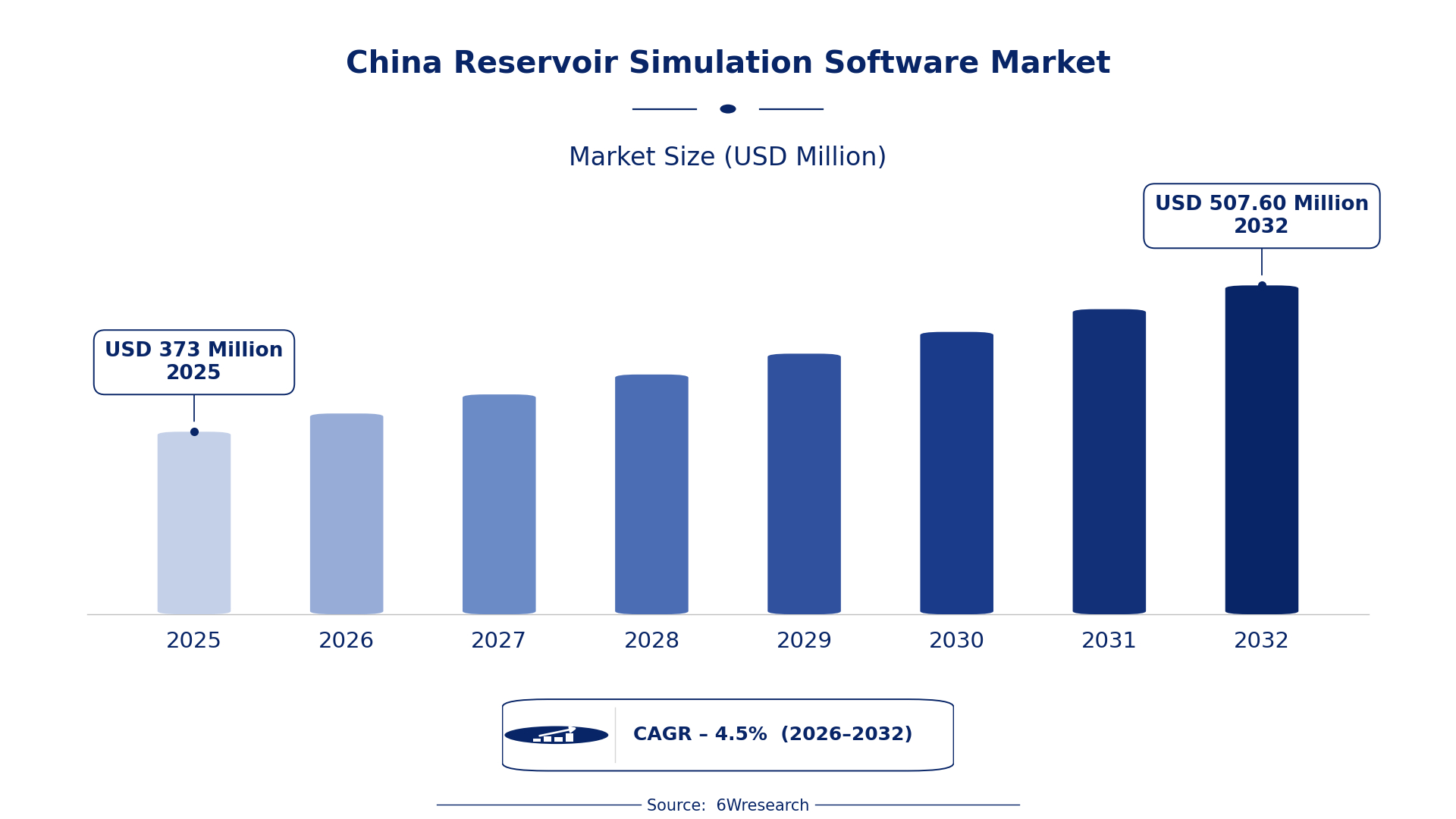
According to 6Wresearch internal database and industry insights, the China Reservoir Simulation Software Market was valued at USD 373.0 million in 2025 and is projected to reach USD 507.60 million by 2032, growing at a CAGR of approximately 4.5% during 2026–2032.
China Reservoir Simulation Software Market Highlights
| Report Metric | Details |
| Report Name | China Reservoir Simulation Software Market |
| Market Size 2025 | USD 373.0 million |
| Market Size 2032 | USD 507.60 million |
| Absolute Growth 2025–2032 | USD 134.60 million |
| CAGR 2026–2032 | 4.5% |
| Peak Annual Growth | 6.4% in 2026 |
| Forecast Period | 2026–2032 |
| Historical Data | 2022–2025 |
| Base Year | 2025 |
| Leading Simulation Type, 2025 | Hydrologic Modeling (46% share) |
| Leading Fluid Type, 2025 | Water (55% share) |
| Leading User Interface, 2025 | 2D/3D Visualization (55% share) |
| Leading End User, 2025 | Environmental Engineers (54% share) |
| Fastest-Growing Simulation Type | Sediment Transport (6.6% CAGR) |
| Fastest-Growing Fluid Type | Water & Particulate (5.9% CAGR) |
| Fastest-Growing User Interface | Cloud/On-Premise (7.1% CAGR) |
| Fastest-Growing End User | Civil Infrastructure Firms (5.8% CAGR) |
| Growing Sector | Environmental Engineering |
| Key End Users | Environmental Engineers, Civil Infrastructure Firms, Hydropower Plants |
China Reservoir Simulation Software Market Year-wise Growth Rate and Key Drivers (2022–2032)
This graph illustrates the annual growth rates of the market from 2022 to 2032, highlighting a steady upward trajectory and projected market expansion over the forecast period.
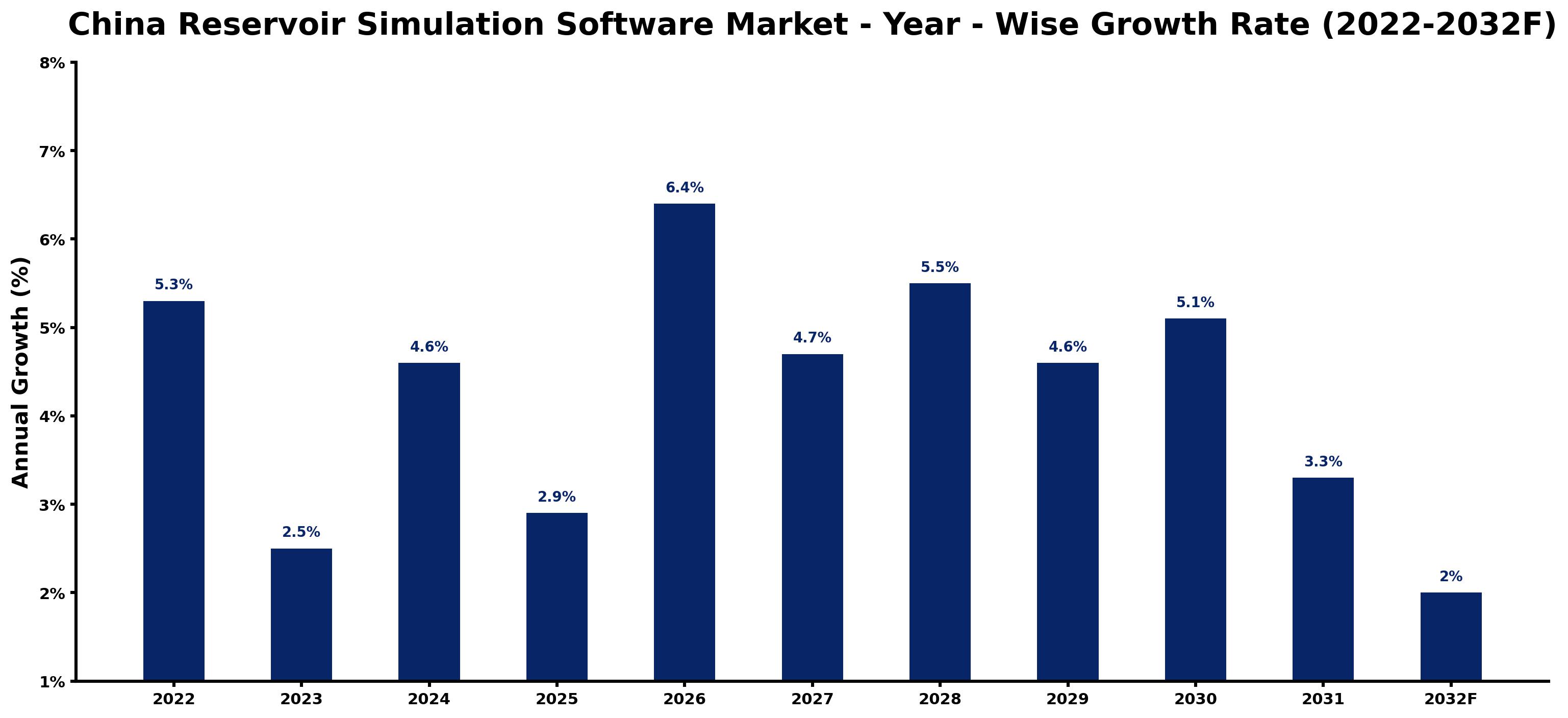
Annual growth estimates for each year appear below with the principal reason behind them, explaining the shifts that set the pace of the market.
| Year | Estimated Annual Growth (%) | Market Rationale |
| 2022 | 5.3 | The market experienced steady growth due to ongoing demand from environmental engineering projects. |
| 2023 | 2.5 | Growth slowed as some hydropower initiatives faced delays in implementation. |
| 2024 | 4.6 | An increase in environmental engineering program enrollments spurred demand for simulation software. |
| 2025 | 2.9 | Demand continued to rise as hydropower plants sought operational efficiency improvements. |
| 2026 | 6.4 | The market peaked as the National Water Resource Management Strategy encouraged technology adoption. |
| 2027 | 4.7 | Growth slowed due to a temporary dip in new hydropower projects. |
| 2028 | 5.5 | Increased investment in sediment transport studies revitalised demand for simulation software. |
| 2029 | 4.6 | Demand slowed as the market adjusted to recent technological advancements. |
| 2030 | 5.1 | Demand rose again as environmental engineers sought more advanced simulation tools. |
| 2031 | 3.3 | A slowdown occurred as the market matured and competition intensified. |
| 2032 | 2.0 | Growth slowed further as the market stabilised after rapid expansion. |
Note: Market size estimations and growth projections presented in this report are based on 6Wresearch's proprietary forecasting methodology, utilizing the latest available industry data, government publications, and primary research inputs.
China Reservoir Simulation Software Market Synopsis
Reservoir Simulation Software in China covers computational tools used to model and analyse reservoir behaviour, primarily in hydrology and environmental engineering. This software optimises water resource management and predicts sediment transport. The China Reservoir Simulation Software Market is expanding due to increased demand from environmental engineers and hydropower sectors, supported by initiatives like the National Water Resource Management Strategy and the Green Water Management Initiative. With over 1,000 hydropower plants in operation, the need for effective simulation tools is vital for sustainable practices.
Market Dynamics Impact Analysis (2026–2032)
| Factor | Type | Impact | Primary Segment Affected |
| Growing demand for effective water management solutions | Driver | High | Hydrologic Modeling |
| Increased focus on sediment transport studies | Driver | High | Sediment Transport |
| Rising interest in environmental engineering programs | Opportunity | High | Environmental Engineers |
| Adoption of cloud-based solutions for flexibility | Opportunity | Medium | Cloud/On-Premise |
| Regulatory challenges in water management practices | Restraint | High | Hydrologic Modeling |
| Limited funding for advanced simulation technologies | Restraint | Medium | Sediment Transport |
| Competition from alternative simulation tools | Challenge | High | Environmental Engineers |
| Delays in hydropower project implementations | Challenge | Medium | Hydropower Plants |
Evaluation of Drivers in China Reservoir Simulation Software Market (2026–2032)
The main growth drivers and the segments they affect most are set out below.
| Drivers | Primary Segment Affected | Why It Matters (Evidence) |
| Increased investment in hydropower projects | Hydrologic Modeling | Over 1,000 hydropower plants in China drive demand for operational efficiency, resulting in higher software purchases. |
| Focus on environmental sustainability | Sediment Transport | Sediment transport studies in the Yellow River Basin are essential for local policies, increasing software demand. |
| Growing enrollment in environmental engineering programs | Environmental Engineers | A 15% increase in program enrollment since 2020 indicates rising demand for simulation tools among future professionals. |
| Adoption of cloud-based simulation solutions | Cloud/On-Premise | Civil infrastructure firms are increasingly using cloud solutions for their flexibility, boosting software demand. |
| Implementation of the Water Resource Protection Law | Hydrologic Modeling | Stricter regulations on water management practices necessitate advanced simulation technologies for compliance. |
Market growth for Reservoir Simulation Software in China is underpinned by rising investment in hydropower projects, increased focus on environmental sustainability, and growing enrollment in environmental engineering programs. The presence of over 1,000 hydropower plants utilising simulation software drives demand for operational efficiency. A 15% increase in environmental engineering program enrollment since 2020 indicates a growing interest in simulation tools among future professionals. Civil infrastructure firms are adopting cloud-based solutions for their flexibility, further increasing software demand. The implementation of the Water Resource Protection Law necessitates advanced simulation technologies for compliance, supporting market expansion.
Evaluation of Restraints in China Reservoir Simulation Software Market
The key brakes on demand, and where they bite hardest, are shown below.
| Market Restraint | Primary Segment Affected | Why It Matters (Evidence) |
| Regulatory challenges in water management practices | Hydrologic Modeling | Stricter regulations necessitate compliance, which can delay project timelines and increase costs for users. |
| Limited funding for advanced simulation technologies | Sediment Transport | Budget constraints can hinder the adoption of new technologies, affecting the growth of simulation software. |
| Competition from alternative simulation tools | Environmental Engineers | Emerging technologies may divert investment away from traditional simulation software, impacting market share. |
| Delays in hydropower project implementations | Hydropower Plants | Project delays can slow demand for simulation software, affecting revenue for producers. |
| Market maturity leading to slower growth rates | Cloud/On-Premise | As the market stabilises, growth rates are expected to normalise, impacting future investments. |
China Reservoir Simulation Software Market Challenges
Buyers in the China Reservoir Simulation Software market encounter supply chain disruptions due to dependence on specific software components, which can delay project timelines by up to three months. Increased demand for advanced algorithms leads to higher costs, with operational expenses rising by 20% for users in environmental engineering. Technology adoption struggles arise from the lack of integration between existing systems and new simulation tools, creating inefficiencies for engineers who require seamless data management. Skills shortages in advanced simulation techniques remain a concern, as a 15% increase in enrolment in related programs has not yet fulfilled industry demands, resulting in delayed projects for hydropower plants.
Trends in the China Reservoir Simulation Software Market
Buyers and suppliers in the China Reservoir Simulation Software Market are adjusting to the following trends.
- Environmental Engineers Increasingly Adopting Simulation Software: Environmental engineers are increasingly utilising reservoir simulation software for project assessments. In 2023, a 15% increase in program enrollment indicates growing interest, resulting in higher software demand.
- Shift Towards Cloud-Based Solutions: Cloud-based simulation solutions are gaining traction among civil infrastructure firms for their flexibility and accessibility. In 2023, a substantial portion of firms reported adopting these solutions, improving operational efficiency.
- Growth in Sediment Transport Studies: Sediment transport studies are becoming more critical, particularly in the Yellow River Basin. This trend is reflected in a 6.6% CAGR for sediment transport simulation software from 2026 to 2032.
- Focus on Sustainable Water Management: The Green Water Management Initiative introduced in 2022 is driving sustainable practices in water management. This initiative has led to increased demand for simulation software, supporting effective resource management.
Investment Opportunities in the China Reservoir Simulation Software Market
Investors looking at the China Reservoir Simulation Software Market should consider the following areas.
- Partnerships with Local Governments: Now is an ideal time for partnerships with local governments to promote the adoption of simulation technology. The National Water Resource Management Strategy allocates substantial funding, creating opportunities for collaboration.
- Investment in Environmental Engineering Programs: The rising interest in environmental engineering programmes presents an opportunity to supply simulation software. With a 15% increase in enrolment, educational institutions represent potential buyers.
- Focus on Cloud-Based Solutions: The shift towards cloud-based simulation solutions presents a chance for suppliers. Civil infrastructure firms are seeking flexible tools, making this an opportune moment to enter the market.
- Engagement in Sediment Transport Studies: Investing in sediment transport simulation tools is timely given the increasing emphasis on these studies. The critical environmental policies in the Yellow River Basin create demand for advanced simulation technologies.
Government Initiatives in the China Reservoir Simulation Software Market
The Ministry of Water Resources initiated the 'National Water Resource Management Strategy' in 2021 to promote the adoption of simulation technology among local governments. This strategy aims to enhance operational efficiency across hydropower plants and ensure sustainable water management practices. By enforcing standards and providing funding, the ministry supports the integration of advanced simulation tools in water resource management, driving market demand. Additionally, the 'Water Resource Protection Law' implemented in 2023 enforces stricter regulations, further necessitating the use of simulation software for compliance.
The National Development and Reform Commission is responsible for approving budgets for hydrological modelling capabilities across major river basins. In 2022, it approved a budget of 30 billion yuan for improvements in this area, impacting the demand for simulation software. The commission also promotes initiatives that encourage local governments to adopt advanced simulation technologies. The National Hydrology and Water Resources Research Institute supports research and development in simulation technologies, funding projects that enhance reservoir simulation software capabilities.
Future Insight of the China Reservoir Simulation Software Market
The China Reservoir Simulation Software market is set for substantial growth by 2032, driven by government investment of 50 billion yuan in water infrastructure improvements and the implementation of the 'Water Resource Management Plan'. Cloud-based solutions will gain popularity, offering greater flexibility for engineers. The adoption of ISO 14001 standards will streamline compliance and improve operational efficiency. The 'Green Water Management Initiative' will promote sustainable practices, creating new opportunities for buyers and suppliers in the sector.
Market Segmentation Analysis
Each segment group is reviewed below, with the leader by share and the fastest grower by CAGR.
By Simulation Type – Hydrologic Modeling Dominated, Sediment Transport Expected to Grow Fastest
According to Ravi Bhandari, Research Head at 6Wresearch, in 2025, Hydrologic Modeling led the simulation type split with a 46% share. Hydrologic modeling holds the largest market share because it is essential for effective water resource management and planning in China. The operational efficiency of over 1,000 hydropower plants heavily relies on these simulations, highlighting their critical importance. The quickest growth will come from Sediment Transport, forecast to expand at a CAGR of 6.6% between 2026 and 2032. Sediment transport is experiencing rapid growth due to increasing focus on studies in the Yellow River Basin, where sediment dynamics play a crucial role in shaping local environmental policies. This growing emphasis will likely drive further adoption of simulation software in the future. This indicates that suppliers should prioritise features that enhance hydrologic modeling capabilities to meet the increasing demand.
By Fluid Type – Water Dominated, Water & Particulate Expected to Grow Fastest
Water held a 55% share of the China Reservoir Simulation Software Market by fluid type in 2025. Water commands the largest share in the market as it is fundamental for various hydrological simulations, catering to multiple applications in resource management. Its essential role ensures consistent demand from diverse user groups across the country. Over 2026–2032, Water & Particulate is expected to post the fastest growth, at a CAGR of 5.9%. The water and particulate segment is growing quickly, serving niche applications in environmental studies and reflecting a rising interest in comprehensive modeling solutions. This trend suggests an expanding market for specialised simulation tools. Suppliers should consider developing tailored solutions to address the specific needs of users engaged in water and particulate simulations.
By User Interface – 2D/3D Visualization Dominated, Cloud/On-Premise Expected to Grow Fastest
2D/3D Visualization took a 55% share of user interface in 2025, more than any other category. 2D/3D visualization leads the market share by providing users with clear insights through effective data representation. This capability is essential for decision-making processes, particularly for those dealing with complex simulation data. Cloud/On-Premise is projected to grow fastest, at a CAGR of 7.1% during 2026–2032. Cloud and on-premise solutions are rapidly gaining popularity as they provide flexibility and accessibility, aligning with the needs of civil infrastructure firms. This growth indicates a shift towards more adaptable user interfaces in the market. Suppliers need to invest in user-friendly interfaces that integrate visualization with cloud functionalities to appeal to a wider audience.
By End User – Environmental Engineers Dominated, Civil Infrastructure Firms Expected to Grow Fastest
With a 54% revenue share in 2025, Environmental Engineers was the largest end user category. Environmental engineers command the largest share as they are the primary users of reservoir simulation software for project assessments and planning. Their critical role in environmental management ensures consistent demand for these tools. Civil Infrastructure Firms are set to record the highest CAGR in this split, 5.8% over 2026–2032. Civil infrastructure firms are rapidly adopting simulation software for planning and design purposes, driven by increased investment in water infrastructure improvements. This trend indicates a growing market segment that suppliers should target. This suggests that suppliers should focus on creating solutions that cater specifically to the needs of civil infrastructure firms to capitalise on this growth.
Key Attractiveness of the Report
- 10 Years of Market Numbers
- Historical Data Starting from 2022 to 2025
- Base Year 2025
- Forecast Data until 2032
- Key Performance Indicators Impacting the Market
- Major Upcoming Developments and Projects
Key Highlights of the Report:
- China Reservoir Simulation Software Market Outlook
- Market Size of China Reservoir Simulation Software Market, 2025
- Forecast of China Reservoir Simulation Software Market, 2032
- Historical Data and Forecast of China Reservoir Simulation Software Revenues & Volume for the Period 2022 - 2032F
- China Reservoir Simulation Software Market Trend Evolution
- China Reservoir Simulation Software Market Drivers and Challenges
- China Reservoir Simulation Software Price Trends
- China Reservoir Simulation Software Porter's Five Forces
- China Reservoir Simulation Software Industry Life Cycle
- Historical Data and Forecast of China Reservoir Simulation Software Market Revenues & Volume By Simulation Type for the Period 2022 - 2032F
- Historical Data and Forecast of China Reservoir Simulation Software Market Revenues & Volume By Hydrologic Modeling for the Period 2022 - 2032F
- Historical Data and Forecast of China Reservoir Simulation Software Market Revenues & Volume By Sediment Transport for the Period 2022 - 2032F
- Historical Data and Forecast of China Reservoir Simulation Software Market Revenues & Volume By Thermal Stratification for the Period 2022 - 2032F
- Historical Data and Forecast of China Reservoir Simulation Software Market Revenues & Volume By Fluid Type for the Period 2022 - 2032F
- Historical Data and Forecast of China Reservoir Simulation Software Market Revenues & Volume By Water for the Period 2022 - 2032F
- Historical Data and Forecast of China Reservoir Simulation Software Market Revenues & Volume By Water & Particulate for the Period 2022 - 2032F
- Historical Data and Forecast of China Reservoir Simulation Software Market Revenues & Volume By Water Bodies for the Period 2022 - 2032F
- Historical Data and Forecast of China Reservoir Simulation Software Market Revenues & Volume By User Interface for the Period 2022 - 2032F
- Historical Data and Forecast of China Reservoir Simulation Software Market Revenues & Volume By 2D/3D Visualization for the Period 2022 - 2032F
- Historical Data and Forecast of China Reservoir Simulation Software Market Revenues & Volume By GUI & APIs for the Period 2022 - 2032F
- Historical Data and Forecast of China Reservoir Simulation Software Market Revenues & Volume By Cloud/On-Premise for the Period 2022 - 2032F
- Historical Data and Forecast of China Reservoir Simulation Software Market Revenues & Volume By End User for the Period 2022 - 2032F
- Historical Data and Forecast of China Reservoir Simulation Software Market Revenues & Volume By Environmental Engineers for the Period 2022 - 2032F
- Historical Data and Forecast of China Reservoir Simulation Software Market Revenues & Volume By Civil Infrastructure Firms for the Period 2022 - 2032F
- Historical Data and Forecast of China Reservoir Simulation Software Market Revenues & Volume By Hydropower Plants for the Period 2022 - 2032F
- China Reservoir Simulation Software Import Export Trade Statistics
- Market Opportunity Assessment By Simulation Type
- Market Opportunity Assessment By Fluid Type
- Market Opportunity Assessment By User Interface
- Market Opportunity Assessment By End User
- China Reservoir Simulation Software Top Companies Market Share
- China Reservoir Simulation Software Competitive Benchmarking By Technical and Operational Parameters
- China Reservoir Simulation Software Company Profiles
- China Reservoir Simulation Software Key Strategic Recommendations
Market Covered
Segments analysed in this report are listed below.
By Simulation Type
- Hydrologic Modeling
- Sediment Transport
- Thermal Stratification
By Fluid Type
- Water
- Water & Particulate
- Water Bodies
By User Interface
- 2D/3D Visualization
- GUI & APIs
- Cloud/On-Premise
By End User
- Environmental Engineers
- Civil Infrastructure Firms
- Hydropower Plants































