China Residential 5G Market Size & Growth Rate
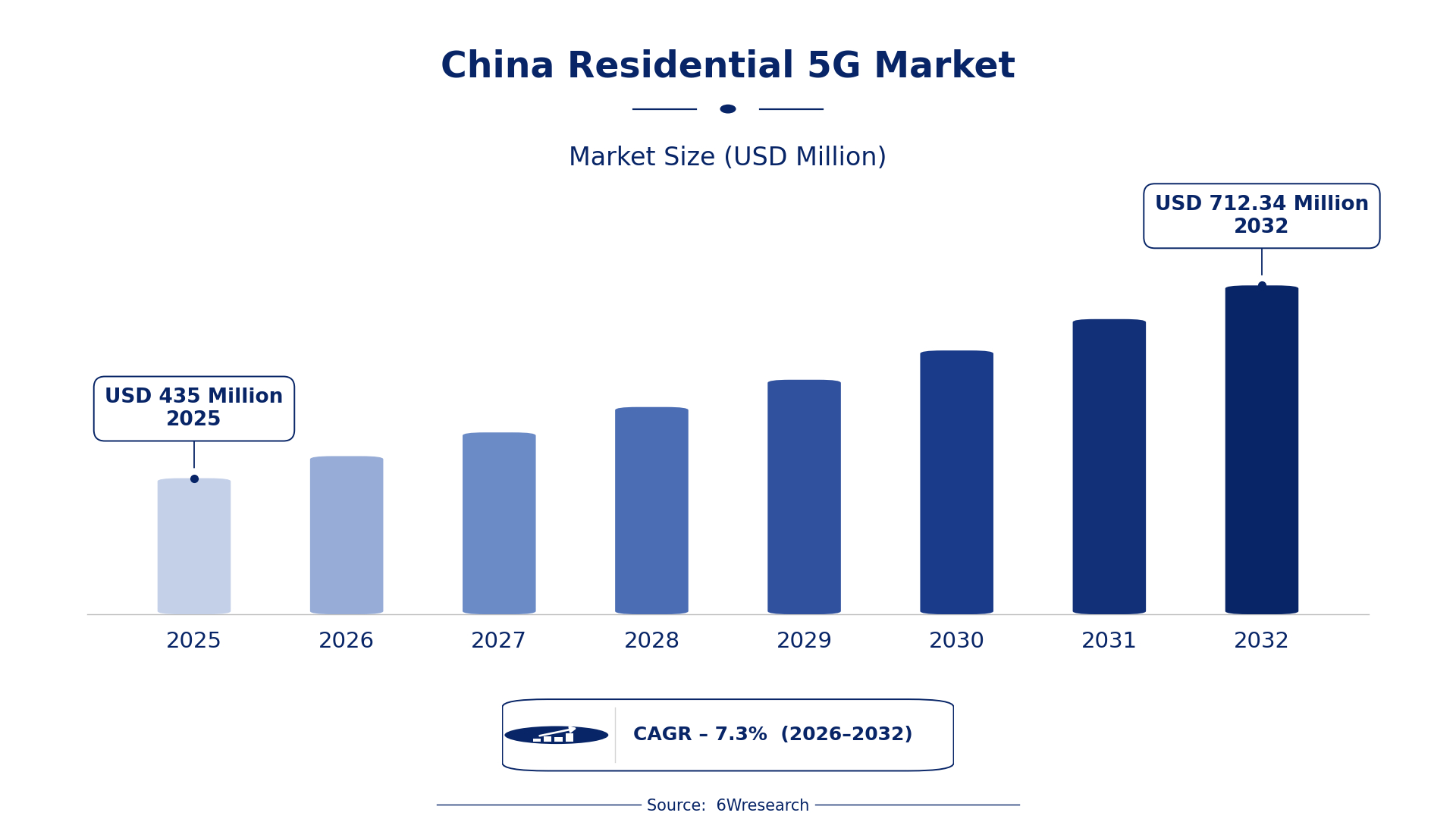
According to 6Wresearch internal database and industry insights, the China Residential 5G Market was valued at USD 435.0 million in 2025 and is projected to reach USD 712.34 million by 2032, growing at a CAGR of approximately 7.3% during 2026–2032.
China Residential 5G Market Highlights
| Report Metric | Details |
| Report Name | China Residential 5G Market |
| Market Size 2025 | USD 435.0 million |
| Market Size 2032 | USD 712.34 million |
| Absolute Growth 2025–2032 | USD 277.34 million |
| CAGR 2026–2032 | 7.3% |
| Peak Annual Growth | 8.6% in 2030 |
| Forecast Period | 2026–2032 |
| Historical Data | 2022–2025 |
| Base Year | 2025 |
| Leading Deployment Type, 2025 | Fixed Wireless Access (49% share) |
| Leading Throughput Tier, 2025 | Up to 5 Gbps (45% share) |
| Leading Consumer Segment, 2025 | Urban Households (58% share) |
| Leading End User, 2025 | Service ISPs & MNOs (41% share) |
| Fastest-Growing Deployment Type | Home 5G Routers (8.6% CAGR) |
| Fastest-Growing Consumer Segment | Gamers/Content Creators (8.8% CAGR) |
| Fastest-Growing End User | Telecom Retailers (9.6% CAGR) |
| Growing Sector | Telecom Retailers |
| Key End Users | Service ISPs & MNOs, Telecom Retailers, Smart Home Integrators |
China Residential 5G Market Year-wise Growth Rate and Key Drivers (2022–2032)
This graph illustrates the annual growth rates of the market from 2022 to 2032, highlighting a steady upward trajectory and projected market expansion over the forecast period.
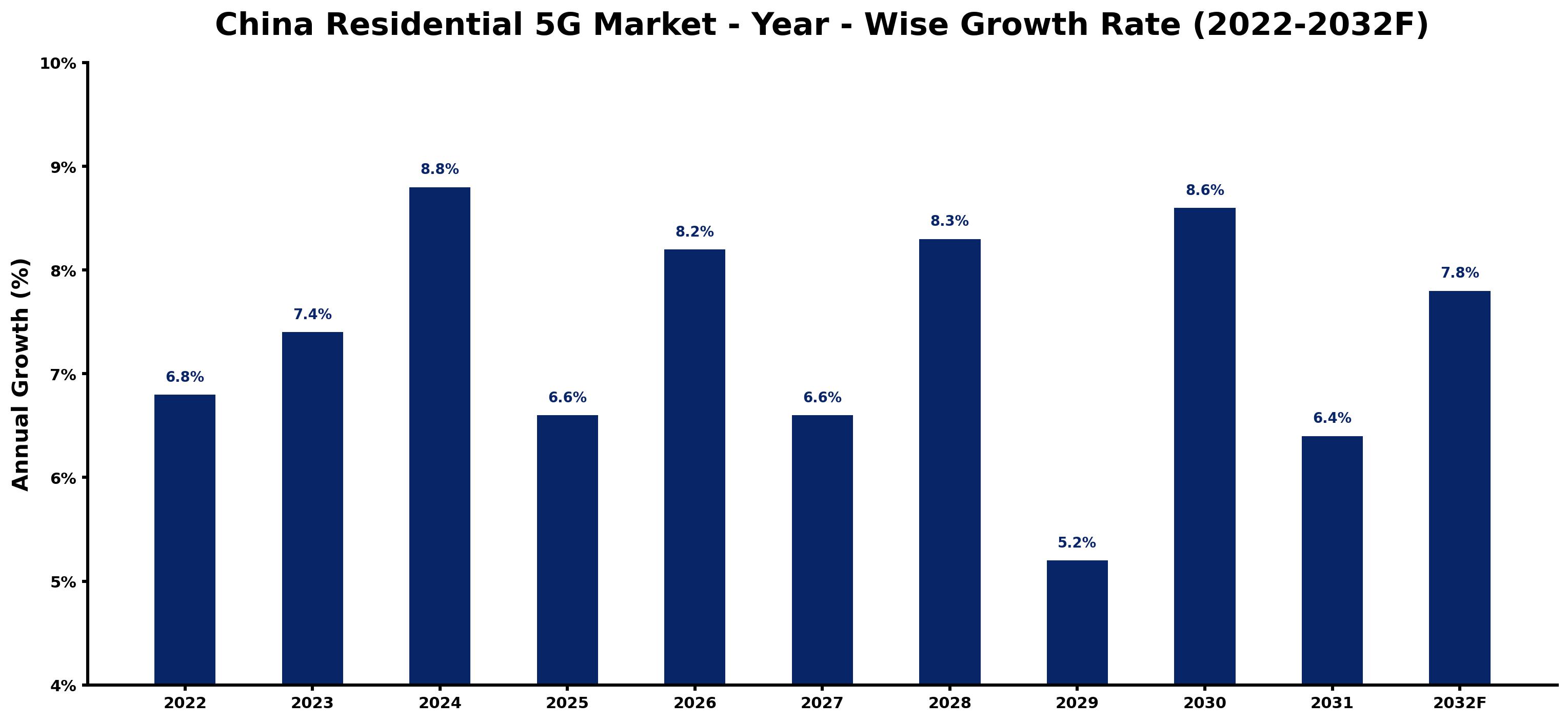
Annual growth estimates for each year appear below with the principal reason behind them, explaining the shifts that set the pace of the market.
| Year | Estimated Annual Growth (%) | Market Rationale |
| 2022 | 6.8 | The market experienced steady growth due to increasing urbanisation and demand for high-speed internet. |
| 2023 | 7.4 | Demand accelerated as urban households sought better connectivity for multiple devices and streaming services. |
| 2024 | 8.8 | Growth peaked as 5G coverage expanded, attracting more users and applications. |
| 2025 | 6.6 | The growth rate slowed as the market adjusted to rapid infrastructure expansion and user adoption. |
| 2026 | 8.2 | Investment in infrastructure is expected to stimulate demand for residential 5G services among urban households. |
| 2027 | 6.6 | A slowdown is anticipated as the market matures, yet urban demand for high-speed internet will remain strong. |
| 2028 | 8.3 | Growth is projected to accelerate again as more households adopt 5G for gaming and smart home applications. |
| 2029 | 5.2 | The market will see a slowdown as saturation in urban areas begins to impact growth rates. |
| 2030 | 8.6 | A surge in demand is anticipated as new applications for 5G technology emerge in residential settings. |
| 2031 | 6.4 | Growth will slow again as competition intensifies among service providers and market saturation increases. |
| 2032 | 7.8 | Demand is projected to rise as urban households increasingly rely on multiple connected devices. |
Note: Market size estimations and growth projections presented in this report are based on 6Wresearch's proprietary forecasting methodology, utilizing the latest available industry data, government publications, and primary research inputs.
China Residential 5G Market Synopsis
Residential 5G in China delivers high-speed internet access to homes through advanced wireless infrastructure. This technology supports streaming, gaming, and smart home applications, primarily serving urban households. The China Residential 5G Market is experiencing rapid growth, fuelled by a rising urban population and an increasing number of connected devices. In 2023, over 1 billion 5G users were reported, highlighting the demand for this service. The '5G Home Plan' aims to drive residential 5G adoption, further accelerating market expansion.
Market Dynamics Impact Analysis (2026–2032)
| Factor | Type | Impact | Primary Segment Affected |
| Increasing urbanisation drives demand for high-speed internet access in homes. | Driver | High | Fixed Wireless Access |
| Investment in 5G infrastructure is expanding coverage and service availability. | Driver | High | Home 5G Routers |
| The growing number of smart home devices creates a need for reliable internet connections. | Opportunity | High | Urban Households |
| The rise of content creators drives demand for high-speed internet for streaming and gaming. | Opportunity | High | Gamers/Content Creators |
| High installation costs can deter some households from adopting residential 5G services. | Restraint | Medium | Fixed Wireless Access |
| Limited coverage in rural areas restricts market growth outside urban centres. | Restraint | Medium | Home 5G Routers |
| Infrastructure delays can hinder timely deployment of residential 5G services. | Challenge | High | Urban Households |
| Intense competition among service providers may lead to price wars, affecting profitability. | Challenge | High | Gamers/Content Creators |
Evaluation of Drivers in China Residential 5G Market (2026–2032)
Below mentioned are some major drivers and their influence on market dynamics.
| Drivers | Primary Segment Affected | Why It Matters (Evidence) |
| Rising urban population increases demand for high-speed internet access. | Fixed Wireless Access | In 2023, China's urban population reached 64%, driving more households to seek reliable internet services. |
| Investment in 5G infrastructure expands service availability. | Home 5G Routers | China plans to invest 1 trillion RMB in 5G infrastructure by 2025, expanding network reach. |
| The proliferation of smart home devices boosts demand for high-speed connectivity. | Urban Households | In 2023, the number of smart home devices connected via 5G is projected to reach 300 million. |
| Content creators require high-speed internet for streaming and gaming. | Gamers/Content Creators | The average household in urban areas is expected to have 10 connected devices by 2025, increasing demand. |
| The expansion of 5G networks supports various applications in residential settings. | Service ISPs & MNOs | As of 2023, 5G networks cover over 90% of urban areas in China, improving service delivery. |
The Residential 5G market in China is expanding as investment in 5G infrastructure increases, improving service availability and coverage. In 2023, China's urban population reached 64%, driving demand for high-speed internet access in homes. The number of smart home devices connected via 5G is set to reach 300 million, creating a need for reliable connectivity. The average household in urban areas is expected to have 10 connected devices by 2025, further boosting demand. Content creators require dependable high-speed internet for streaming and gaming, contributing to market growth.
Evaluation of Restraints in China Residential 5G Market
The following restraints limit how fast demand can grow.
| Market Restraint | Primary Segment Affected | Why It Matters (Evidence) |
| High installation costs deter some households from adopting residential 5G services. | Fixed Wireless Access | The initial investment required for infrastructure can be a barrier for many potential users. |
| Limited coverage in rural areas restricts market growth outside urban centres. | Home 5G Routers | As of 2023, 5G networks cover over 90% of urban areas, leaving rural areas underserved. |
| Infrastructure delays can hinder timely deployment of residential 5G services. | Urban Households | Challenges in infrastructure rollout can lead to delays in service availability for consumers. |
| Regulatory hurdles may slow down the expansion of 5G networks. | Gamers/Content Creators | Compliance with local regulations can complicate and delay the deployment process. |
| High competition may lead to price wars affecting profitability. | Service ISPs & MNOs | Intense competition among providers can result in reduced margins and profitability. |
China Residential 5G Market Challenges
The China Residential 5G market faces several challenges, starting with the high installation costs for consumers. Many urban households encounter fees that can reach 5,000 RMB, which limits adoption rates. Regulatory inconsistencies present another hurdle; local governments enforce varying standards, causing deployment delays for providers. Rapid technological advancements create a third challenge; suppliers must frequently upgrade equipment to remain competitive, leading to higher operational costs. Finally, the overall expense of 5G infrastructure is daunting, with a projected investment of 1 trillion RMB needed by 2025, straining the resources of smaller providers.
Trends in the China Residential 5G Market
Below mentioned are some of the trends shaping the China Residential 5G Market growth.
- Increase in High-Speed Internet Subscriptions: Urban households are expected to represent 70% of residential 5G subscriptions by 2025. This shift reflects the growing reliance on high-speed internet for daily activities and entertainment.
- Transition from Fixed to Wireless Solutions: The market is shifting towards fixed wireless access solutions, which provide internet without physical cables. This change indicates the need for faster and more flexible internet options.
- Expansion of 5G Coverage: The '5G Home Plan' launched in 2021 aims to boost residential 5G coverage by 30% by 2025. This initiative highlights the government's commitment to improving connectivity in urban areas.
- Shift Towards Smart Home Integration: In 2023, the number of smart home devices connected via 5G is anticipated to reach 300 million, reflecting a growing demand for integrated smart home solutions that require reliable internet access.
Investment Opportunities in the China Residential 5G Market
Some of the investment opportunities in the China Residential 5G Market are mentioned below.
- Investment in Infrastructure: With a planned investment of 1 trillion RMB in 5G infrastructure by 2025, there is an opportunity to improve service availability. Service ISPs can benefit by expanding their networks in urban areas.
- Focus on Smart Home Technologies: As the number of smart home devices increases, there is a growing need for reliable connectivity. Urban households are prime targets for suppliers of smart home technologies.
- Collaborative Deployment Strategies: Partnering with local governments can facilitate faster deployment of residential 5G services. Service ISPs can utilise these partnerships to improve their market presence.
- Targeting Content Creators: The rise of content creators presents an opportunity for high-speed internet providers. Gamers and streamers require reliable connections, making them a key demographic for targeted marketing.
Government Initiatives in the China Residential 5G Market
The '5G Home Plan' launched by the Ministry of Industry and Information Technology in 2021 aims to increase residential 5G coverage by 30% by 2025. This policy encourages the expansion of 5G networks in urban areas, facilitating greater access for households. Additionally, the 'Digital China Strategy' approved by the State Council in 2023 aims to improve 5G integration in homes and businesses, promoting technological advancements in the sector. The 'Smart Home Development Plan' introduced in 2022 by the Ministry of Housing and Urban-Rural Development promotes 5G-enabled smart home technologies, encouraging innovation in this area.
The Ministry of Industry and Information Technology oversees the implementation of the '5G Home Plan', which funds initiatives to expand residential 5G coverage. In 2023, the National Development and Reform Commission initiated the '5G Infrastructure Investment Plan', targeting 1 trillion RMB investment by 2025 to improve network infrastructure. The Ministry of Housing and Urban-Rural Development also supports projects under the 'Smart Home Development Plan', which funds the integration of smart home technologies with 5G.
Future Insight of the China Residential 5G Market
By 2032, buyers and suppliers in the China Residential 5G market can anticipate transformative changes driven by several key factors. The '5G Home Plan' will promote wider adoption, with urban households projected to account for 70% of subscriptions. The average internet speed in urban areas is expected to exceed 1 Gbps, improving user experiences for streaming and smart devices. The establishment of 5G standards for home networking will facilitate seamless integration of connected devices, enhancing overall connectivity and functionality.
Market Segmentation Analysis
The report offers a comprehensive study of the following market segments and their leading categories in the market.
By Deployment Type – Fixed Wireless Access Dominated, Home 5G Routers Expected to Grow Fastest
According to Ravi Bhandari, Research Head at 6Wresearch, Fixed Wireless Access accounted for a 49% market share by deployment type in 2025. Fixed Wireless Access holds the largest share because it directly provides internet access to homes without physical cables, catering to urban populations. With over 90% of urban areas covered by 5G networks, this technology meets the increasing demand for high-speed connectivity effectively. Over 2026–2032, Home 5G Routers are expected to post the fastest growth, at a CAGR of 8.6%. Home 5G Routers are experiencing rapid growth as they are essential for connecting multiple devices in households, with urban households expected to average 10 connected devices by 2025. This trend will further widen the lead of Fixed Wireless Access as the demand for robust connectivity rises with more devices. Suppliers should focus on developing and distributing Home 5G Routers to meet the growing needs of urban households.
By Throughput Tier – Up to 5 Gbps Dominated and Is Expected to Record the Fastest Growth
With a 45% revenue share in 2025, Up to 5 Gbps was the largest throughput tier category. The Up to 5 Gbps tier commands the largest share as it targets users with high internet demands, such as gamers and content creators who need seamless streaming and fast downloads. The expected average internet speed in urban households exceeding 1 Gbps by 2025 enhances the appeal of this segment. The same category are also set to grow fastest, at a CAGR of 8.5% during 2026–2032. The Up to 5 Gbps tier is also the fastest-growing segment, driven by the projected increase of smart home devices connected via 5G, reaching 300 million in 2023. This growth will reinforce the dominance of this tier as users seek enhanced performance for multiple connected devices. This indicates that suppliers must ensure their offerings align with the high-speed requirements of users, particularly in urban areas.
By Consumer Segment – Urban Households Dominated, Gamers/Content Creators Expected to Grow Fastest
Urban Households held a 58% share of the China Residential 5G Market by consumer segment in 2025. Urban Households represent the largest share due to their higher population density and greater demand for high-speed internet services, making them the primary market for residential 5G. As urbanisation progresses, the need for reliable connectivity in these households will continue to grow, solidifying their position. Gamers/Content Creators are projected to grow fastest, at a CAGR of 8.8% during 2026–2032. Gamers and Content Creators are the fastest-growing segment, driven by their need for high-speed internet for seamless streaming and online gaming experiences. The rise in smart home devices and the increasing trend of content creation will sustain this segment's growth. This suggests that suppliers should tailor their marketing strategies to address the specific needs of gamers and content creators.
By End User – Service ISPs & MNOs Dominated, Telecom Retailers Expected to Grow Fastest
In 2025, Service ISPs & MNOs led the end user split with a 41% share. Service ISPs & MNOs dominate the market as they provide the essential infrastructure and services necessary for the deployment of residential 5G. Their established networks and customer bases position them well to capture the growing demand for high-speed internet access in urban areas. The quickest growth will come from Telecom Retailers, forecast to expand at a CAGR of 9.6% between 2026 and 2032. Telecom Retailers are the fastest-growing group, as they play a crucial role in selling devices and services related to residential 5G. As more consumers seek high-speed internet solutions, the demand for retail outlets offering these products will surge. This highlights the importance for suppliers to strengthen partnerships with telecom retailers to enhance market reach.
Key Attractiveness of the Report
- 10 Years of Market Numbers
- Historical Data Starting from 2022 to 2025
- Base Year 2025
- Forecast Data until 2032
- Key Performance Indicators Impacting the Market
- Major Upcoming Developments and Projects
Key Highlights of the Report:
- China Residential 5G Market Outlook
- Market Size of China Residential 5G Market, 2025
- Forecast of China Residential 5G Market, 2032
- Historical Data and Forecast of China Residential 5G Revenues & Volume for the Period 2022 - 2032F
- China Residential 5G Market Trend Evolution
- China Residential 5G Market Drivers and Challenges
- China Residential 5G Price Trends
- China Residential 5G Porter's Five Forces
- China Residential 5G Industry Life Cycle
- Historical Data and Forecast of China Residential 5G Market Revenues & Volume By Deployment Type for the Period 2022 - 2032F
- Historical Data and Forecast of China Residential 5G Market Revenues & Volume By Fixed Wireless Access for the Period 2022 - 2032F
- Historical Data and Forecast of China Residential 5G Market Revenues & Volume By Home 5G Routers for the Period 2022 - 2032F
- Historical Data and Forecast of China Residential 5G Market Revenues & Volume By Mesh Networking for the Period 2022 - 2032F
- Historical Data and Forecast of China Residential 5G Market Revenues & Volume By Throughput Tier for the Period 2022 - 2032F
- Historical Data and Forecast of China Residential 5G Market Revenues & Volume By Up to 1 2 Gbps for the Period 2022 - 2032F
- Historical Data and Forecast of China Residential 5G Market Revenues & Volume By Up to 5 Gbps for the Period 2022 - 2032F
- Historical Data and Forecast of China Residential 5G Market Revenues & Volume By Home Coverage Networks for the Period 2022 - 2032F
- Historical Data and Forecast of China Residential 5G Market Revenues & Volume By Consumer Segment for the Period 2022 - 2032F
- Historical Data and Forecast of China Residential 5G Market Revenues & Volume By Urban Households for the Period 2022 - 2032F
- Historical Data and Forecast of China Residential 5G Market Revenues & Volume By Gamers/Content Creators for the Period 2022 - 2032F
- Historical Data and Forecast of China Residential 5G Market Revenues & Volume By Suburban Families for the Period 2022 - 2032F
- Historical Data and Forecast of China Residential 5G Market Revenues & Volume By End User for the Period 2022 - 2032F
- Historical Data and Forecast of China Residential 5G Market Revenues & Volume By Service ISPs & MNOs for the Period 2022 - 2032F
- Historical Data and Forecast of China Residential 5G Market Revenues & Volume By Telecom Retailers for the Period 2022 - 2032F
- Historical Data and Forecast of China Residential 5G Market Revenues & Volume By Smart Home Integrators for the Period 2022 - 2032F
- China Residential 5G Import Export Trade Statistics
- Market Opportunity Assessment By Deployment Type
- Market Opportunity Assessment By Throughput Tier
- Market Opportunity Assessment By Consumer Segment
- Market Opportunity Assessment By End User
- China Residential 5G Top Companies Market Share
- China Residential 5G Competitive Benchmarking By Technical and Operational Parameters
- China Residential 5G Company Profiles
- China Residential 5G Key Strategic Recommendations
Market Covered
Segments analysed in this report are listed below.
By Deployment Type
- Fixed Wireless Access
- Home 5G Routers
- Mesh Networking
By Throughput Tier
- Up to 1–2 Gbps
- Up to 5 Gbps
- Home Coverage Networks
By Consumer Segment
- Urban Households
- Gamers/Content Creators
- Suburban Families
By End User
- Service ISPs & MNOs
- Telecom Retailers
- Smart Home Integrators































