India Residential 5G Market Size & Growth Rate
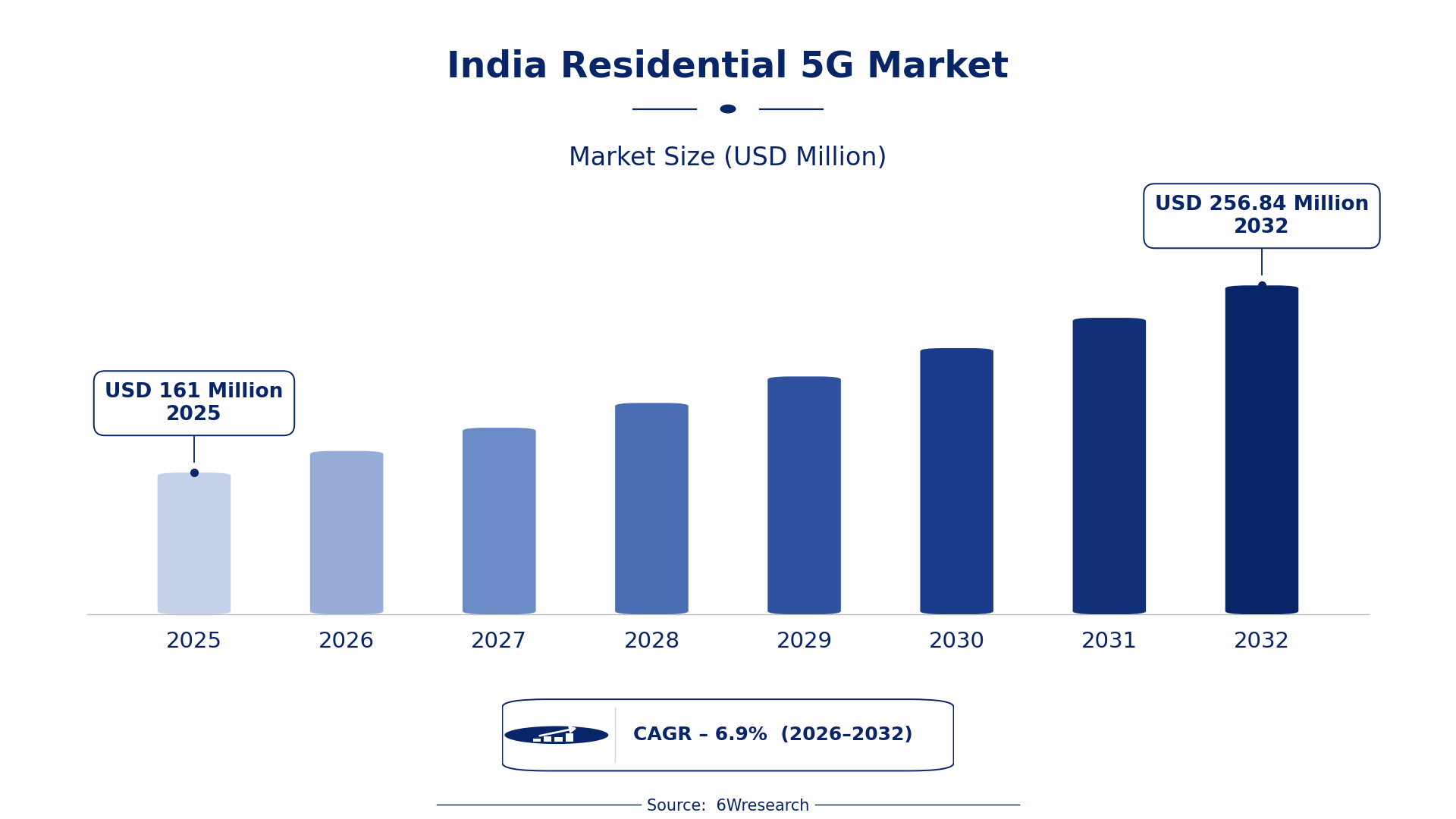
According to 6Wresearch internal database and industry insights, the India Residential 5G Market was valued at USD 161.0 million in 2025 and is projected to reach USD 256.84 million by 2032, growing at a CAGR of approximately 6.9% during 2026–2032.
India Residential 5G Market Highlights
| Report Metric | Details |
| Report Name | India Residential 5G Market |
| Market Size 2025 | USD 161.0 million |
| Market Size 2032 | USD 256.84 million |
| Absolute Growth 2025–2032 | USD 95.84 million |
| CAGR 2026–2032 | 6.9% |
| Peak Annual Growth | 9.9% in 2032 |
| Forecast Period | 2026–2032 |
| Historical Data | 2022–2025 |
| Base Year | 2025 |
| Leading Deployment Type, 2025 | Fixed Wireless Access (46% share) |
| Leading Throughput Tier, 2025 | Up to 5 Gbps (56% share) |
| Leading Consumer Segment, 2025 | Urban Households (51% share) |
| Leading End User, 2025 | Service ISPs & MNOs (48% share) |
| Fastest-Growing Deployment Type | Home 5G Routers (8.1% CAGR) |
| Fastest-Growing Consumer Segment | Gamers/Content Creators (8.3% CAGR) |
| Fastest-Growing End User | Telecom Retailers (8.1% CAGR) |
| Growing Sector | Residential Connectivity |
| Key End Users | Urban Households, Service ISPs, Gamers, Content Creators |
India Residential 5G Market Year-wise Growth Rate and Key Drivers (2022–2032)
This graph illustrates the annual growth rates of the market from 2022 to 2032, highlighting a steady upward trajectory and projected market expansion over the forecast period.
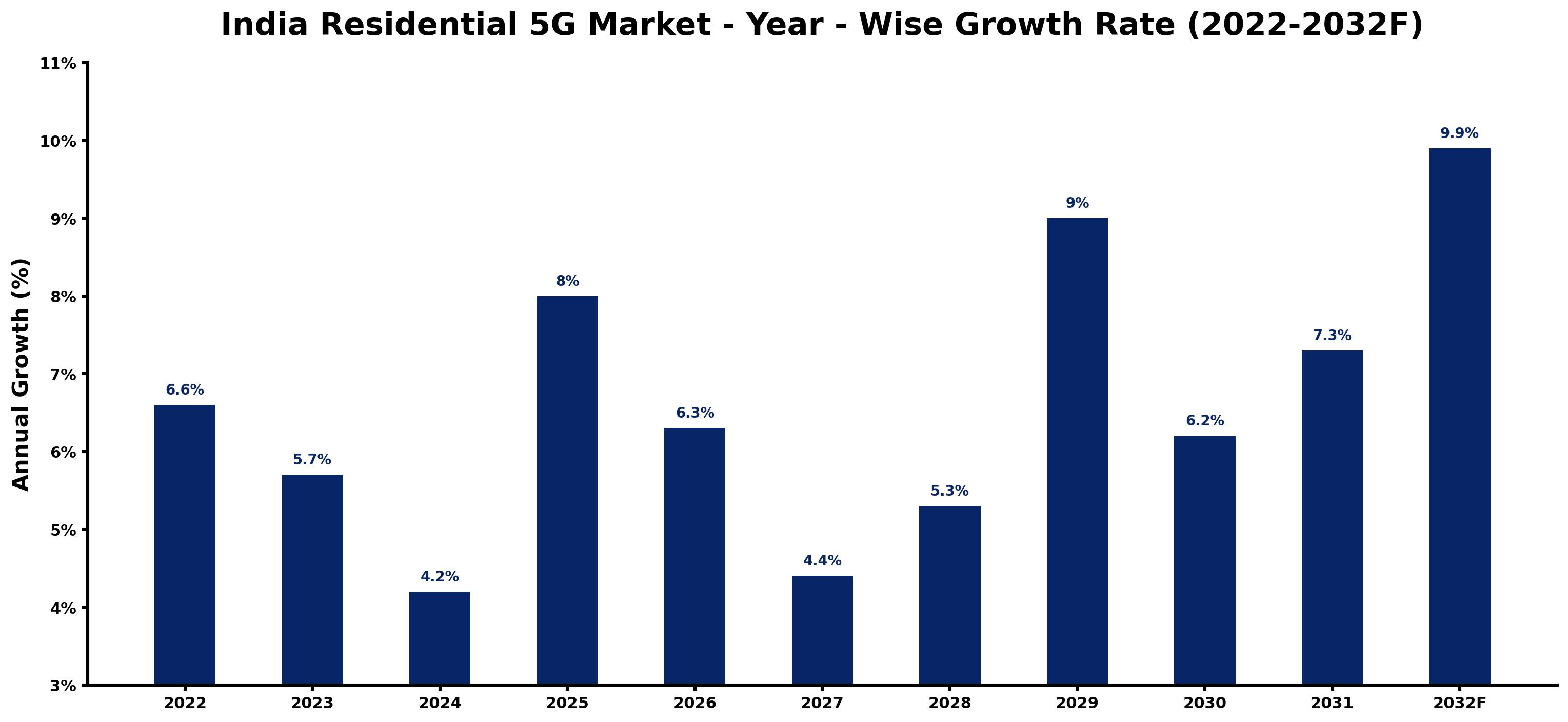
The table below sets out the estimated growth rate for each year and the main factor behind it.
| Year | Estimated Annual Growth (%) | Market Rationale |
| 2022 | 6.6 | The market experienced steady growth, driven by increasing urbanisation and demand for high-speed internet services. |
| 2023 | 5.7 | Growth slowed compared to the previous year due to challenges in infrastructure development and service rollout. |
| 2024 | 4.2 | The market continued to grow, albeit at a slower pace, as users awaited broader 5G coverage in urban areas. |
| 2025 | 8.0 | Demand surged as 5G coverage expanded, attracting more urban households seeking high-speed internet access. |
| 2026 | 6.3 | Growth decelerated slightly as the market adjusted to the increased competition among service providers in urban areas. |
| 2027 | 4.4 | The market growth slowed further as infrastructure development faced delays, impacting service availability in key regions. |
| 2028 | 5.3 | An uptick in growth occurred as more households adopted 5G home routers, enhancing their internet connectivity experience. |
| 2029 | 9.0 | Demand accelerated again, driven by the expanding gaming market and content creators needing high-speed access for streaming. |
| 2030 | 6.2 | Growth moderated as market saturation began to affect new subscriber acquisition in densely populated urban centres. |
| 2031 | 7.3 | A resurgence in demand occurred as service providers improved infrastructure and service offerings to meet consumer needs. |
| 2032 | 9.9 | The market peaked with increased investments in 5G infrastructure and rising consumer demand for high-speed internet. |
Note: Market size estimations and growth projections presented in this report are based on 6Wresearch's proprietary forecasting methodology, utilizing the latest available industry data, government publications, and primary research inputs.
India Residential 5G Market Synopsis
India Residential 5G Market encompasses high-speed wireless communication technology designed for home use, utilising advanced radio frequencies. This technology supports internet connectivity through fixed wireless access and home routers, catering to activities like streaming and gaming. The market is expanding due to India's urban population, which reached 471 million in 2023, alongside a growing demand for high-speed internet. Contributions from service providers and domestic users further fuel this growth, supported by initiatives like the National Broadband Mission.
Market Dynamics Impact Analysis (2026–2032)
| Factor | Type | Impact | Primary Segment Affected |
| Urbanisation drives demand for high-speed internet access, particularly in metropolitan areas. | Driver | High | Fixed Wireless Access |
| The rise in gaming and content creation increases the need for faster internet solutions. | Driver | High | Home 5G Routers |
| Investment in 5G infrastructure is essential for expanding service coverage in urban areas. | Opportunity | High | Fixed Wireless Access |
| Growing adoption of smart home devices creates demand for reliable high-speed internet. | Opportunity | Medium | Fixed Wireless Access |
| Infrastructure development challenges can delay service rollout in urban areas. | Restraint | High | Fixed Wireless Access |
| Competition among service providers may lead to price wars, affecting profitability. | Restraint | Medium | Fixed Wireless Access |
| Residential 5G in India faces challenges related to regulatory approvals and spectrum allocation. | Challenge | High | Fixed Wireless Access |
| Limited consumer awareness about the benefits of 5G technology can hinder market growth. | Challenge | Medium | Fixed Wireless Access |
Evaluation of Drivers in India Residential 5G Market (2026–2032)
The factors lifting demand, and the evidence behind each, are summarised below.
| Drivers | Primary Segment Affected | Why It Matters (Evidence) |
| Increasing urban population drives demand for high-speed internet access. | Fixed Wireless Access | India's urban population reached 471 million in 2023, leading to higher demand for residential 5G services. |
| Expansion of gaming and streaming services boosts internet usage. | Home 5G Routers | India's gaming market is projected to grow to 1.5 billion users by 2025, increasing the need for high-speed internet. |
| Government initiatives support infrastructure development for 5G technology. | Fixed Wireless Access | The National Broadband Mission aims to improve connectivity in urban areas, facilitating the rollout of 5G services. |
| Rising data consumption per user necessitates faster internet solutions. | Fixed Wireless Access | The average data consumption per user is expected to reach 20 GB per month by 2025, fuelling demand for 5G services. |
| Development of standards ensures quality and safety for consumers. | Fixed Wireless Access | The Bureau of Indian Standards is developing standards for 5G technology to ensure quality and safety for users. |
Market growth for Residential 5G in India is underpinned by rising urbanisation, increasing data consumption, and expanding gaming demand. With India's urban population reaching 471 million in 2023, the need for high-speed internet is surging. The average data consumption per user is projected to reach 20 GB per month by 2025, prompting households to seek faster internet solutions. The development of standards by the Bureau of Indian Standards ensures quality and safety for consumers, boosting confidence in 5G adoption.
Evaluation of Restraints in India Residential 5G Market
The key brakes on demand, and where they bite hardest, are shown below.
| Market Restraint | Primary Segment Affected | Why It Matters (Evidence) |
| Infrastructure development challenges can delay service rollout. | Fixed Wireless Access | The National Digital Communications Policy aims to provide broadband access by 2025, but delays in infrastructure can hinder progress. |
| Competition among service providers may lead to price wars, affecting profitability. | Fixed Wireless Access | As more service providers enter the market, pricing pressures can reduce margins for existing players. |
| Regulatory approvals can slow down the deployment of 5G services. | Fixed Wireless Access | The Telecom Regulatory Authority of India released a consultation paper in 2023 discussing spectrum allocation, which can delay approvals. |
| Limited consumer awareness about the benefits of 5G technology can hinder market growth. | Fixed Wireless Access | Many potential users are unaware of the advantages of 5G over existing technologies, affecting adoption rates. |
| High costs associated with infrastructure investment can limit expansion. | Fixed Wireless Access | The Indian government allocated INR 1,000 crore for 5G infrastructure development in 2022, but further funding may be needed. |
India Residential 5G Market Challenges
The India Residential 5G market faces a few practical problems, starting with supply chain disruptions. Limited infrastructure development delays timely access to high-speed internet for buyers, who increasingly rely on seamless connectivity. Regulatory hurdles further complicate matters, as the Telecom Regulatory Authority of India’s guidelines slow deployment processes, creating compliance challenges for service providers. High installation costs deter many potential users, with expenses reaching INR 15,000 for home setups, restricting adoption among budget-conscious consumers. Inconsistent service quality also frustrates buyers, as only 40% of urban households currently have 5G coverage, leading to dissatisfaction among those seeking reliable internet access.
Trends in the India Residential 5G Market
The trends below show where the India Residential 5G Market is heading.
- Shift towards Home 5G Routers: Sales of home 5G routers are rising by 30% annually, as households seek reliable internet solutions. This trend reflects the growing demand for high-speed connectivity in urban areas.
- Increase in Data Consumption: The average data consumption per user is expected to reach 20 GB per month by 2025, driving demand for faster internet solutions. This increase highlights the need for strong 5G infrastructure.
- Urban Households Leading Adoption: Urban households are the primary target for residential 5G services, accounting for 51% of the consumer segment. This demographic shift underscores the importance of catering to urban users' connectivity needs.
- Integration of 5G in Smart Cities: The Smart Cities Mission integrates 5G technology into urban planning, improving connectivity and infrastructure. This initiative aims to elevate overall urban living standards.
Investment Opportunities in the India Residential 5G Market
Investors looking at the India Residential 5G Market should consider the following areas.
- Investment in 5G Infrastructure: With the Indian government allocating INR 1,000 crore for 5G infrastructure development, there is a notable investment opportunity. Service ISPs can partner with local firms to improve urban connectivity.
- Supply of Home 5G Routers: The growing demand for home 5G routers presents an opportunity for manufacturers to supply high-quality devices. Urban households are increasingly seeking reliable internet solutions, creating a market gap.
- Partnerships for Smart Home Solutions: As smart home devices gain popularity, partnerships with smart home integrators can broaden service offerings. This approach allows service providers to tap into a growing consumer segment.
- Expansion of Fixed Wireless Access: The demand for fixed wireless access is expected to rise as urbanisation continues. Service providers can focus on expanding their coverage in densely populated areas.
Government Initiatives in the India Residential 5G Market
The National Digital Communications Policy 2020 aims to provide broadband access to all citizens by 2025, improving connectivity across urban and rural areas. This policy builds on earlier efforts to improve digital infrastructure and ensures that residential 5G services are accessible to a broader population. The policy's focus on infrastructure development is vital for supporting the growth of residential 5G in India, as it encourages investment and innovation in the sector.
The 5G Test Bed initiative, managed by the Department of Telecommunications, facilitates research and development in 5G technologies. This scheme allows service providers to test and refine their offerings, ensuring compliance with regulatory standards. The Smart Cities Mission integrates 5G technology into urban planning, funding projects that improve connectivity and infrastructure. These initiatives support residential users by improving service quality and access to high-speed internet.
Future Insight of the India Residential 5G Market
Several forward-looking factors should support the India Residential 5G market over the coming years. The National Broadband Mission aims to enhance connectivity, expanding 5G access in urban areas. By 2025, the gaming market is projected to grow to 1.5 billion users, driving demand for high-speed internet. The Bureau of Indian Standards is developing quality standards for 5G technology, which will improve service reliability. With average data consumption expected to reach 20 GB per month by 2025, suppliers will be encouraged to invest in robust infrastructure, benefiting both buyers and service providers.
Market Segmentation Analysis
The analysis below covers each segmentation, its leading category in 2025 and its fastest-growing category through 2032.
By Deployment Type – Fixed Wireless Access Dominated, Home 5G Routers Expected to Grow Fastest
According to Ravi Bhandari, Research Head at 6Wresearch, the largest deployment type category in 2025 was Fixed Wireless Access, with a 46% share of total revenue. Fixed Wireless Access captures the largest share due to its crucial role in delivering high-speed internet to homes without extensive fibre infrastructure. This method is particularly effective in urban areas, where the demand for immediate connectivity is rising sharply. Home 5G Routers are set to record the highest CAGR in this split, 8.1% over 2026–2032. The Home 5G Routers segment is set for rapid growth, with a projected annual sales increase of 30%, as households increasingly seek dependable internet solutions. This trend suggests that the demand for home routers will further strengthen the position of Fixed Wireless Access. Suppliers should focus on enhancing Fixed Wireless Access solutions to meet the escalating urban demand for residential 5G.
By Throughput Tier – Up to 5 Gbps Dominated and Is Expected to Record the Fastest Growth
Up to 5 Gbps took a 56% share of throughput tier in 2025, more than any other category. The Up to 5 Gbps segment holds the largest share as it caters to high-demand users, such as gamers and content creators, who require superior internet speeds for optimal performance. This high throughput is essential in urban settings, where bandwidth competition is intense. The same category are also set to grow fastest, at a CAGR of 8.3% during 2026–2032. The Up to 5 Gbps segment also showcases the fastest growth, fuelled by the anticipated rise in average data consumption per user, projected to reach 20 GB per month by 2025. This dual role as both leader and fastest will further reinforce its market dominance. Providers must ensure their offerings meet the high-speed demands of users to remain competitive in the residential 5G market.
By Consumer Segment – Urban Households Dominated, Gamers/Content Creators Expected to Grow Fastest
Urban Households held a 51% share of the India Residential 5G Market by consumer segment in 2025. Urban Households represent the largest share in the consumer segment, as they are the primary target for residential 5G services seeking high-speed internet access. The urban population's growth, which reached 471 million in 2023, further fuels this demand. The quickest growth will come from Gamers/Content Creators, forecast to expand at a CAGR of 8.3% between 2026 and 2032. Gamers and Content Creators are the fastest-growing segment, driven by the projected growth of India's gaming market to 1.5 billion users by 2025. This segment's need for high-speed, low-latency internet will continue to expand, contributing to the overall market growth. Suppliers should tailor their marketing strategies to meet the specific needs of gamers and content creators to capture this fast-growing segment.
By End User – Service ISPs & MNOs Dominated, Telecom Retailers Expected to Grow Fastest
With a 48% revenue share in 2025, Service ISPs & MNOs was the largest end user category. Service ISPs & MNOs dominate the market share as they are the primary providers of residential 5G services, facilitating widespread access to high-speed internet. Their established infrastructure and extensive customer networks provide them with a significant competitive edge. Over 2026–2032, Telecom Retailers are expected to post the fastest growth, at a CAGR of 8.1%. Telecom Retailers are experiencing the fastest growth as they play a critical role in facilitating the sales of residential 5G products. Their increasing participation will bolster the expansion of service providers, enhancing the overall market ecosystem. Suppliers should consider partnerships with Telecom Retailers to improve distribution and effectively reach a wider consumer base.
Key Attractiveness of the Report
- 10 Years of Market Numbers
- Historical Data Starting from 2022 to 2025
- Base Year 2025
- Forecast Data until 2032
- Key Performance Indicators Impacting the Market
- Major Upcoming Developments and Projects
Key Highlights of the Report:
- India Residential 5G Market Outlook
- Market Size of India Residential 5G Market, 2025
- Forecast of India Residential 5G Market, 2032
- Historical Data and Forecast of India Residential 5G Revenues & Volume for the Period 2022 - 2032F
- India Residential 5G Market Trend Evolution
- India Residential 5G Market Drivers and Challenges
- India Residential 5G Price Trends
- India Residential 5G Porter's Five Forces
- India Residential 5G Industry Life Cycle
- Historical Data and Forecast of India Residential 5G Market Revenues & Volume By Deployment Type for the Period 2022 - 2032F
- Historical Data and Forecast of India Residential 5G Market Revenues & Volume By Fixed Wireless Access for the Period 2022 - 2032F
- Historical Data and Forecast of India Residential 5G Market Revenues & Volume By Home 5G Routers for the Period 2022 - 2032F
- Historical Data and Forecast of India Residential 5G Market Revenues & Volume By Mesh Networking for the Period 2022 - 2032F
- Historical Data and Forecast of India Residential 5G Market Revenues & Volume By Throughput Tier for the Period 2022 - 2032F
- Historical Data and Forecast of India Residential 5G Market Revenues & Volume By Up to 1 2 Gbps for the Period 2022 - 2032F
- Historical Data and Forecast of India Residential 5G Market Revenues & Volume By Up to 5 Gbps for the Period 2022 - 2032F
- Historical Data and Forecast of India Residential 5G Market Revenues & Volume By Home Coverage Networks for the Period 2022 - 2032F
- Historical Data and Forecast of India Residential 5G Market Revenues & Volume By Consumer Segment for the Period 2022 - 2032F
- Historical Data and Forecast of India Residential 5G Market Revenues & Volume By Urban Households for the Period 2022 - 2032F
- Historical Data and Forecast of India Residential 5G Market Revenues & Volume By Gamers/Content Creators for the Period 2022 - 2032F
- Historical Data and Forecast of India Residential 5G Market Revenues & Volume By Suburban Families for the Period 2022 - 2032F
- Historical Data and Forecast of India Residential 5G Market Revenues & Volume By End User for the Period 2022 - 2032F
- Historical Data and Forecast of India Residential 5G Market Revenues & Volume By Service ISPs & MNOs for the Period 2022 - 2032F
- Historical Data and Forecast of India Residential 5G Market Revenues & Volume By Telecom Retailers for the Period 2022 - 2032F
- Historical Data and Forecast of India Residential 5G Market Revenues & Volume By Smart Home Integrators for the Period 2022 - 2032F
- India Residential 5G Import Export Trade Statistics
- Market Opportunity Assessment By Deployment Type
- Market Opportunity Assessment By Throughput Tier
- Market Opportunity Assessment By Consumer Segment
- Market Opportunity Assessment By End User
- India Residential 5G Top Companies Market Share
- India Residential 5G Competitive Benchmarking By Technical and Operational Parameters
- India Residential 5G Company Profiles
- India Residential 5G Key Strategic Recommendations
Market Covered
This report examines the market across the segments below.
By Deployment Type
- Fixed Wireless Access
- Home 5G Routers
- Mesh Networking
By Throughput Tier
- Up to 1–2 Gbps
- Up to 5 Gbps
- Home Coverage Networks
By Consumer Segment
- Urban Households
- Gamers/Content Creators
- Suburban Families
By End User
- Service ISPs & MNOs
- Telecom Retailers
- Smart Home Integrators































