China Residential AC Market Size & Growth Rate
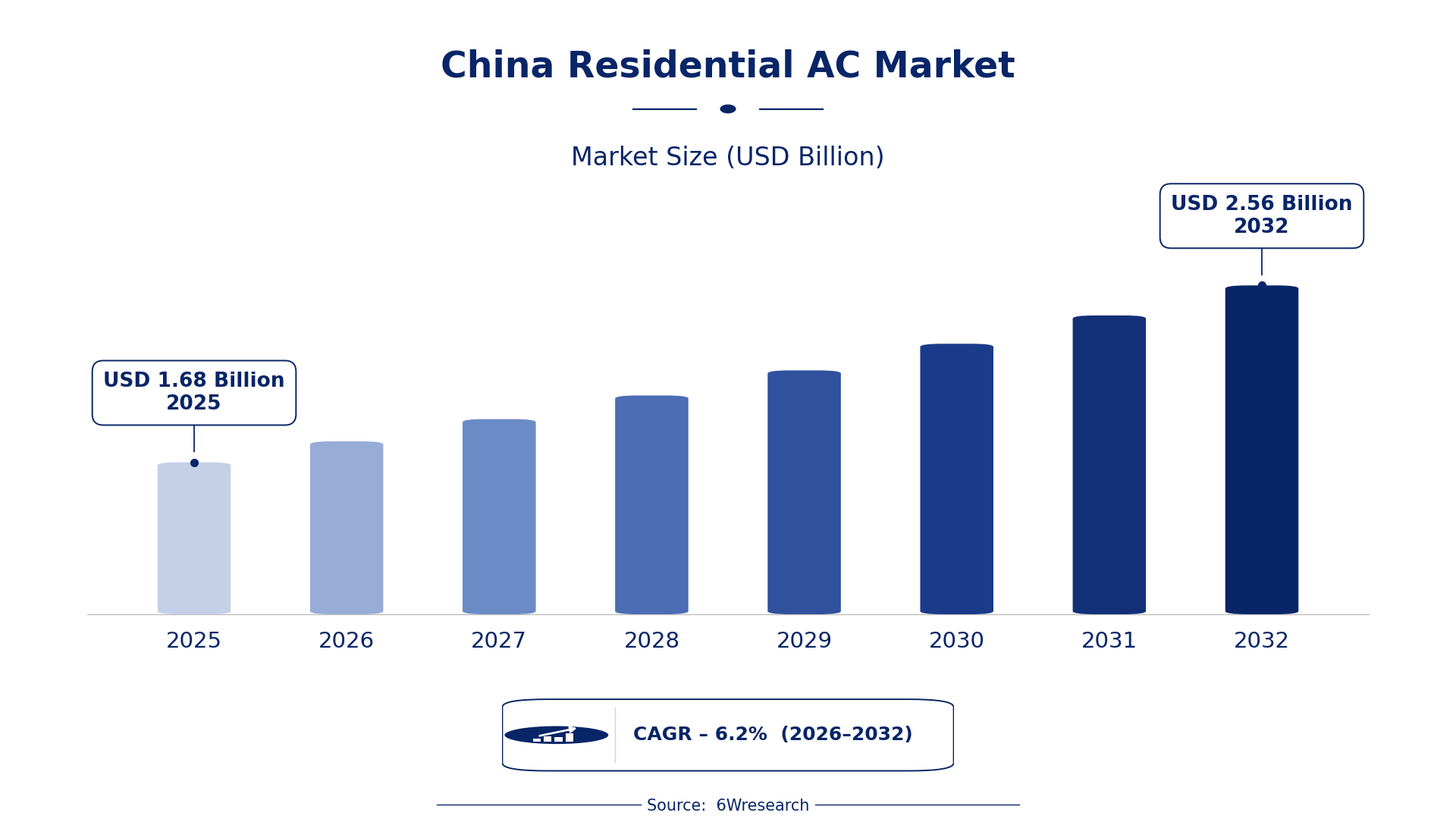
According to 6Wresearch internal database and industry insights, the China Residential AC Market was valued at USD 1.68 billion in 2025 and is projected to reach USD 2.56 billion by 2032, growing at a CAGR of approximately 6.2% during 2026–2032.
China Residential AC Market Highlights
| Report Metric | Details |
| Report Name | China Residential AC Market |
| Market Size 2025 | USD 1.68 billion |
| Market Size 2032 | USD 2.56 billion |
| Absolute Growth 2025–2032 | USD 0.88 billion |
| CAGR 2026–2032 | 6.2% |
| Peak Annual Growth | 8.5% in 2028 |
| Forecast Period | 2026–2032 |
| Historical Data | 2022–2025 |
| Base Year | 2025 |
| Leading AC Type, 2025 | Split ACs (43% share) |
| Leading Compressor Type, 2025 | Inverter/Fixed (45% share) |
| Leading Capacity Range, 2025 | 1–3 Tons (37% share) |
| Leading End User, 2025 | Urban Apartments (42% share) |
| Fastest-Growing AC Type | VRF Systems (8.5% CAGR) |
| Fastest-Growing Compressor Type | Multi-zone Inverter (7.9% CAGR) |
| Fastest-Growing End User | Houses & Small Buildings (7.8% CAGR) |
| Growing Sector | Urban Apartments |
| Key End Users | Urban Apartments, Budget Homes, Houses & Small Buildings |
China Residential AC Market Year-wise Growth Rate and Key Drivers (2022–2032)
This graph illustrates the annual growth rates of the market from 2022 to 2032, highlighting a steady upward trajectory and projected market expansion over the forecast period.
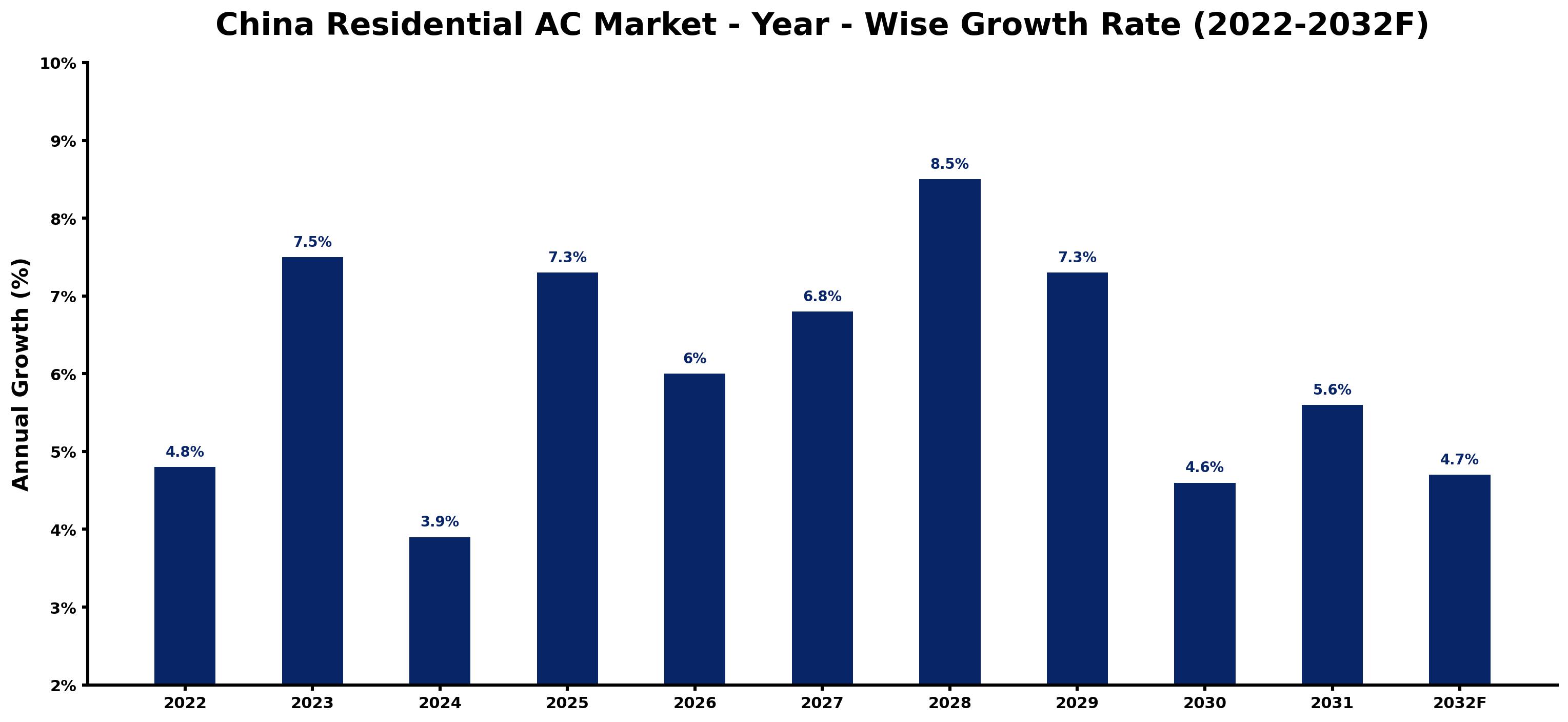
Below, each year's estimated growth is shown next to the factor that most influenced it.
| Year | Estimated Annual Growth (%) | Market Rationale |
| 2022 | 4.8 | The urban population reached 64%, driving demand for cooling solutions. |
| 2023 | 7.5 | The market experienced growth due to a hot summer, increasing AC purchases. |
| 2024 | 3.9 | Demand slowed as consumers adjusted to previous high spending on AC units. |
| 2025 | 7.3 | Growth accelerated again as energy-efficient models gained popularity among buyers. |
| 2026 | 6.0 | Market growth is projected to slow as consumers become cautious about spending amid economic changes. |
| 2027 | 6.8 | Increased urbanisation is anticipated to lead to higher demand for residential AC in cities. |
| 2028 | 8.5 | The market is expected to peak as new energy efficiency standards drive purchases of modern units. |
| 2029 | 7.3 | Growth is anticipated to slow slightly as buyers begin to prioritise energy costs over new purchases. |
| 2030 | 4.6 | Demand is expected to decrease as consumers face rising energy prices and economic uncertainty. |
| 2031 | 5.6 | The market is projected to rebound as new housing projects increase demand for residential AC. |
| 2032 | 4.7 | Growth is expected to slow again as the Green Building Action Plan promotes energy-efficient solutions. |
Note: Market size estimations and growth projections presented in this report are based on 6Wresearch's proprietary forecasting methodology, utilizing the latest available industry data, government publications, and primary research inputs.
China Residential AC Market Synopsis
Residential AC in China includes a variety of cooling units tailored for indoor environments, primarily serving homes and offices. These systems, such as Split and Inverter ACs, incorporate essential components like compressors and refrigerants. The China Residential AC Market is expanding due to urbanisation and increasing disposable incomes, with demand fuelled by urban apartments and affordable housing. Major cities experience average summer temperatures exceeding 30°C, leading to a surge in purchases. By 2025, the market is anticipated to surpass 100 million units, reflecting strong consumer interest in energy-efficient options.
Market Dynamics Impact Analysis (2026–2032)
| Factor | Type | Impact | Primary Segment Affected |
| Rising urbanisation and disposable incomes drive demand for Residential AC units, particularly in urban apartments. | Driver | High | Urban Apartments |
| Support for energy-efficient appliances through government subsidies enhances the appeal of inverter ACs. | Driver | High | Inverter/Fixed |
| The increasing urban population creates a need for more energy-efficient cooling solutions in residential buildings. | Opportunity | High | Houses & Small Buildings |
| The Green Cooling Initiative encourages investment in environmentally friendly refrigerants and technologies. | Opportunity | Medium | Split ACs |
| Fierce competition among producers leads to reduced profit margins, impacting sustainability. | Restraint | High | Split ACs |
| Regulatory compliance with energy efficiency standards increases operational costs for manufacturers. | Restraint | Medium | Split ACs |
| Skills shortages in the workforce hinder production efficiency, delaying product launches. | Challenge | High | Split ACs |
| Rising tariffs on AC components increase costs for importers, leading to higher prices for consumers. | Challenge | Medium | Split ACs |
Evaluation of Drivers in China Residential AC Market (2026–2032)
The factors lifting demand, and the evidence behind each, are summarised below.
| Drivers | Primary Segment Affected | Why It Matters (Evidence) |
| Increasing urban population drives demand for residential cooling solutions. | Urban Apartments | In 2022, urban population in China reached 64%, resulting in higher AC sales. |
| Government subsidies for energy-efficient appliances encourage consumer purchases. | Inverter/Fixed | The government supports energy-efficient appliances through subsidies, boosting sales. |
| Rising temperatures during summer months lead to higher AC demand. | Split ACs | The average temperature in major cities exceeds 30°C, increasing cooling needs. |
| Growing awareness of energy efficiency promotes inverter technology adoption. | VRF Systems | Inverter ACs are promoted under the National Energy Efficiency Standards, driving sales. |
| New housing developments increase the need for residential AC installations. | Houses & Small Buildings | Urbanisation is driving new residential projects, resulting in higher AC demand. |
Market growth in China for Residential AC rests on rising urbanisation, increased disposable incomes, and support for energy-efficient appliances. The average temperature in major cities exceeds 30°C, prompting consumers to seek effective cooling solutions. New housing developments are driving demand for residential AC installations, particularly in urban apartments and budget homes. By 2025, the market is projected to exceed 100 million units, reflecting strong consumer interest in modern cooling solutions.
Evaluation of Restraints in China Residential AC Market
The main factors holding the market back are set out below.
| Market Restraint | Primary Segment Affected | Why It Matters (Evidence) |
| High installation costs deter potential buyers from upgrading their systems. | Houses & Small Buildings | Installation costs for new AC units can exceed 20% of the total price, limiting upgrades. |
| Limited availability of environmentally friendly refrigerants may hinder market growth. | VRF Systems | The transition to eco-friendly refrigerants is slow, affecting product offerings. |
| Supply chain disruptions affect the availability of key components for AC units. | Portable AC Units | Global supply chain issues have led to delays in component availability, impacting production. |
| Consumer hesitation due to rising energy costs slows new purchases. | Split ACs | Increased energy prices have made consumers cautious about investing in new cooling solutions. |
| Economic uncertainty leads to cautious spending on home appliances. | Inverter/Fixed | Economic fluctuations have caused consumers to delay purchases of new AC units. |
China Residential AC Market Challenges
Producers in the China residential AC market contend with intense competition, which compresses profit margins to as low as 5%. Compliance with the GB 19576-2017 standard necessitates manufacturers to allocate around 10% of their annual revenue towards energy-efficient upgrades, placing financial pressure on them. Importers face escalating costs due to increased tariffs on AC components, resulting in price hikes for consumers of up to 15%. A shortage of skilled labour in the workforce hampers production efficiency, causing delays in product launches and inflating costs for producers by approximately 15%.
Trends in the China Residential AC Market
The trends below show where the China Residential AC Market is heading.
- Shift from Traditional to Energy-Efficient AC Units: Since 2021, the Green Cooling Initiative has encouraged the adoption of energy-efficient AC units in China. This initiative aims to cut energy consumption by 15% in urban areas by 2025, motivating consumers to invest in modern systems.
- Transition from Window ACs to Split ACs: In recent years, urban areas have increasingly favoured Split ACs, which now account for over 60% of residential sales. This trend highlights consumers' preference for more efficient and visually appealing cooling solutions.
- Emergence of Smart AC Technologies: The introduction of smart AC technologies in 2022 has revolutionised how consumers manage indoor climates. These systems offer remote control and energy monitoring features, appealing to tech-savvy buyers.
- Growing Popularity of Multi-zone Inverter Systems: The demand for Multi-zone Inverter systems has escalated, particularly in larger residential buildings. With a CAGR of 7.9%, these systems provide efficient cooling across multiple rooms.
Investment Opportunities in the China Residential AC Market
Several openings in the China Residential AC Market merit attention from investors.
- Partnerships with Local Manufacturers: Now is an ideal time for foreign firms to partner with local manufacturers to enter the Chinese market. The government supports energy-efficient appliances through subsidies, creating a favourable environment for new entrants.
- Investment in Energy-Efficient Technologies: Investing in energy-efficient AC technologies aligns with government initiatives. The National Energy Efficiency Standards encourage manufacturers to innovate, creating opportunities for suppliers of advanced components.
- Expansion into Urban Areas: Urban apartments represent a growth opportunity for AC suppliers. With urbanisation rates at 64%, there is a strong demand for residential cooling solutions in cities.
- Focus on Eco-friendly Refrigerants: As regulations tighten, there is a growing need for suppliers of eco-friendly refrigerants. The Green Cooling Initiative promotes environmentally friendly solutions, creating a market for compliant products.
Government Initiatives in the China Residential AC Market
The National Standard for Energy Efficiency of Room Air Conditioners (GB 19576-2017), updated in 2022, mandates improved efficiency requirements for AC units. This regulation ensures that all new models meet strict energy-saving criteria, benefiting both producers and consumers. Additionally, the Energy Efficiency Labeling Program, launched by the Ministry of Industry and Information Technology in 2021, requires energy labels on all AC units sold, aiding consumers in making informed choices. These measures strengthen the market for energy-efficient appliances, driving sales of compliant products.
In 2023, the State Council initiated the Green Building Action Plan to promote energy-efficient cooling solutions in residential buildings. This plan aims to reduce energy consumption by 15% in urban areas by 2025, encouraging the adoption of modern AC technologies. The Ministry of Ecology and Environment oversees the implementation of the Green Cooling Initiative, which advocates for environmentally friendly refrigerants. This initiative supports manufacturers in transitioning to sustainable practices, ensuring compliance with new regulations.
Future Insight of the China Residential AC Market
The China residential AC market is set for notable changes by 2032, driven by urbanisation and supportive government policies. The Green Cooling Initiative will promote the adoption of energy-efficient technologies, encouraging suppliers to innovate in design. By 2025, the government aims to reduce energy consumption in urban areas by 15%, which will prompt manufacturers to develop advanced cooling solutions. With the urban population projected to reach 70% by 2030, demand for residential AC units will increase, creating new opportunities for both buyers and suppliers.
Market Segmentation Analysis
The report offers a comprehensive study of the following market segments and their leading categories in the market.
By AC Type – Split ACs Dominated, VRF Systems Expected to Grow Fastest
According to Ravi Bhandari, Research Head at 6Wresearch, Split ACs accounted for a 43% market share by ac type in 2025. Split ACs hold the largest share in the market as they are extensively used for cooling individual rooms in urban areas. Their popularity is underscored by the fact that they account for over 60% of residential AC sales in these densely populated regions. VRF Systems are set to record the highest CAGR in this split, 8.5% over 2026–2032. VRF Systems are experiencing rapid growth as they are increasingly adopted in larger residential buildings for their efficiency in multi-zone cooling. This trend is further propelled by government initiatives that promote energy-efficient appliances, making VRF Systems a preferred choice for new constructions. Suppliers should prioritise the availability of VRF Systems to align with the rising demand in larger residential projects.
By Compressor Type – Inverter/Fixed Dominated, Multi-zone Inverter Expected to Grow Fastest
Inverter/Fixed held a 45% share of the China Residential AC Market by compressor type in 2025. Inverter/Fixed compressors lead the market due to their energy efficiency, which is highly valued by consumers in urban areas. The preference for inverter technology aligns with the government's push for energy-efficient appliances, making it a popular choice among buyers. The quickest growth will come from Multi-zone Inverter, forecast to expand at a CAGR of 7.9% between 2026 and 2032. Multi-zone Inverter compressors are experiencing rapid adoption as they offer effective cooling solutions for multiple rooms, appealing to larger households. This shift is further encouraged by rising energy costs, prompting consumers to seek more efficient options. Manufacturers should prioritise the development of Multi-zone Inverter technologies to capture the increasing demand for energy-efficient cooling solutions.
By Capacity Range – 1–3 Tons Dominated and Is Expected to Record the Fastest Growth
The largest capacity range category in 2025 was 1–3 Tons, with a 37% share of total revenue. The 1–3 Tons capacity range leads the China Residential AC market, as it meets the cooling requirements of most urban households. This segment is particularly relevant given that the average household in urban areas uses around 1.5 tons of cooling capacity. Its lead should widen, with a projected CAGR of 8.8% during 2026–2032, the highest in this split. As the leading capacity range, 1–3 Tons is expected to continue its rapid growth, driven by urbanisation and increasing disposable incomes that create a demand for effective cooling solutions. The persistent need for efficient residential cooling will further solidify this segment's dominance. Suppliers should focus on maintaining a robust inventory of 1–3 Tons units to meet the sustained demand from urban households.
By End User – Urban Apartments Dominated, Houses & Small Buildings Expected to Grow Fastest
Urban Apartments took a 42% share of end user in 2025, more than any other category. Urban Apartments represent the largest share of the market for residential AC units, primarily due to the high density of urban living. This segment is crucial as it addresses the cooling needs of a significant portion of the population residing in cities. Houses & Small Buildings are projected to grow fastest, at a CAGR of 7.8% during 2026–2032. Houses & Small Buildings are experiencing rapid growth as consumers increasingly seek larger living spaces that necessitate effective cooling solutions. This trend is bolstered by urban expansion and a rise in small residential developments, indicating a shift in consumer preferences. Providers must tailor their offerings to meet the distinct requirements of Houses & Small Buildings to capitalise on this growing segment.
Key Attractiveness of the Report
- 10 Years of Market Numbers
- Historical Data Starting from 2022 to 2025
- Base Year 2025
- Forecast Data until 2032
- Key Performance Indicators Impacting the Market
- Major Upcoming Developments and Projects
Key Highlights of the Report:
- China Residential AC Market Outlook
- Market Size of China Residential AC Market, 2025
- Forecast of China Residential AC Market, 2032
- Historical Data and Forecast of China Residential AC Revenues & Volume for the Period 2022 - 2032F
- China Residential AC Market Trend Evolution
- China Residential AC Market Drivers and Challenges
- China Residential AC Price Trends
- China Residential AC Porter's Five Forces
- China Residential AC Industry Life Cycle
- Historical Data and Forecast of China Residential AC Market Revenues & Volume By AC Type for the Period 2022 - 2032F
- Historical Data and Forecast of China Residential AC Market Revenues & Volume By Split ACs for the Period 2022 - 2032F
- Historical Data and Forecast of China Residential AC Market Revenues & Volume By Window ACs for the Period 2022 - 2032F
- Historical Data and Forecast of China Residential AC Market Revenues & Volume By Portable AC Units for the Period 2022 - 2032F
- Historical Data and Forecast of China Residential AC Market Revenues & Volume By VRF Systems for the Period 2022 - 2032F
- Historical Data and Forecast of China Residential AC Market Revenues & Volume By Compressor Type for the Period 2022 - 2032F
- Historical Data and Forecast of China Residential AC Market Revenues & Volume By Inverter/Fixed for the Period 2022 - 2032F
- Historical Data and Forecast of China Residential AC Market Revenues & Volume By Fixed Speed for the Period 2022 - 2032F
- Historical Data and Forecast of China Residential AC Market Revenues & Volume By Compact for the Period 2022 - 2032F
- Historical Data and Forecast of China Residential AC Market Revenues & Volume By Multi-zone Inverter for the Period 2022 - 2032F
- Historical Data and Forecast of China Residential AC Market Revenues & Volume By Capacity Range for the Period 2022 - 2032F
- Historical Data and Forecast of China Residential AC Market Revenues & Volume By 1 3 Tons for the Period 2022 - 2032F
- Historical Data and Forecast of China Residential AC Market Revenues & Volume By 0.8 1.5 Tons for the Period 2022 - 2032F
- Historical Data and Forecast of China Residential AC Market Revenues & Volume By 12,000 BTU for the Period 2022 - 2032F
- Historical Data and Forecast of China Residential AC Market Revenues & Volume By 5 20 Tons for the Period 2022 - 2032F
- Historical Data and Forecast of China Residential AC Market Revenues & Volume By End User for the Period 2022 - 2032F
- Historical Data and Forecast of China Residential AC Market Revenues & Volume By Urban Apartments for the Period 2022 - 2032F
- Historical Data and Forecast of China Residential AC Market Revenues & Volume By Budget Homes for the Period 2022 - 2032F
- Historical Data and Forecast of China Residential AC Market Revenues & Volume By Temporary/Dorm Use for the Period 2022 - 2032F
- Historical Data and Forecast of China Residential AC Market Revenues & Volume By Houses & Small Buildings for the Period 2022 - 2032F
- China Residential AC Import Export Trade Statistics
- Market Opportunity Assessment By AC Type
- Market Opportunity Assessment By Compressor Type
- Market Opportunity Assessment By Capacity Range
- Market Opportunity Assessment By End User
- China Residential AC Top Companies Market Share
- China Residential AC Competitive Benchmarking By Technical and Operational Parameters
- China Residential AC Company Profiles
- China Residential AC Key Strategic Recommendations
Market Covered
The report offers an extensive study of the following market segments.
By AC Type
- Split ACs
- Window ACs
- Portable AC Units
- VRF Systems
By Compressor Type
- Inverter/Fixed
- Fixed Speed
- Compact
- Multi-zone Inverter
By Capacity Range
- 1–3 Tons
- 0.8–1.5 Tons
- <12
- 000 BTU
- 5–20 Tons
By End User
- Urban Apartments
- Budget Homes
- Temporary/Dorm Use
- Houses & Small Buildings































