India Residential AC Market Size & Growth Rate
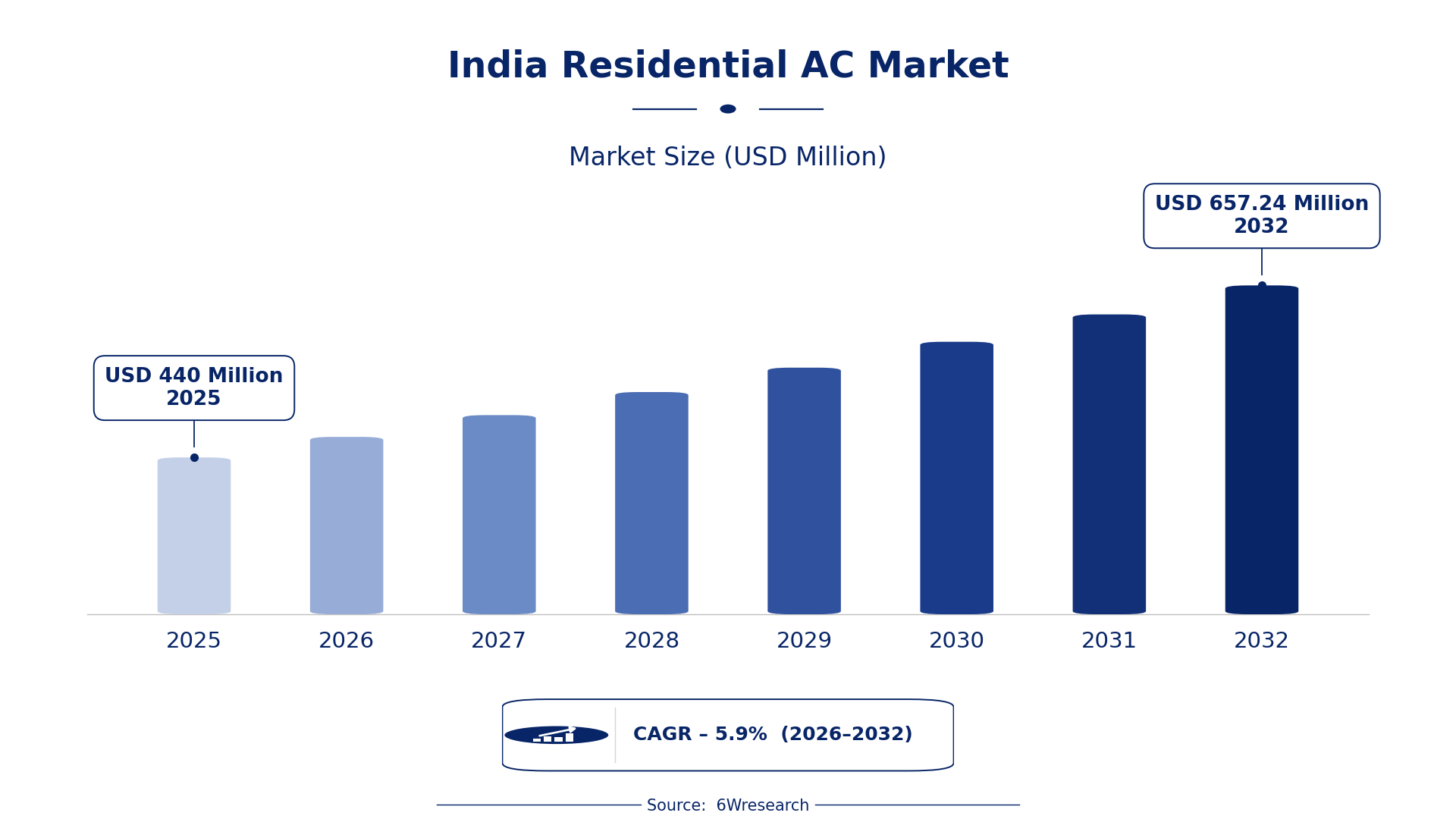
According to 6Wresearch internal database and industry insights, the India Residential AC Market was valued at USD 440.0 million in 2025 and is projected to reach USD 657.24 million by 2032, growing at a CAGR of approximately 5.9% during 2026–2032.
India Residential AC Market Highlights
| Report Metric | Details |
| Report Name | India Residential AC Market |
| Market Size 2025 | USD 440.0 million |
| Market Size 2032 | USD 657.24 million |
| Absolute Growth 2025–2032 | USD 217.24 million |
| CAGR 2026–2032 | 5.9% |
| Peak Annual Growth | 8.4% in 2031 |
| Forecast Period | 2026–2032 |
| Historical Data | 2022–2025 |
| Base Year | 2025 |
| Leading AC Type, 2025 | Split ACs (36% share) |
| Leading Compressor Type, 2025 | Inverter/Fixed (39% share) |
| Leading Capacity Range, 2025 | 1–3 Tons (43% share) |
| Leading End User, 2025 | Urban Apartments (41% share) |
| Fastest-Growing AC Type | VRF Systems (8.0% CAGR) |
| Fastest-Growing Compressor Type | Multi-zone Inverter (7.7% CAGR) |
| Fastest-Growing End User | Houses & Small Buildings (8.6% CAGR) |
| Growing Sector | Urban Apartments |
| Key End Users | Urban households, property developers, HVAC contractors |
India Residential AC Market Year-wise Growth Rate and Key Drivers (2022–2032)
This graph illustrates the annual growth rates of the market from 2022 to 2032, highlighting a steady upward trajectory and projected market expansion over the forecast period.
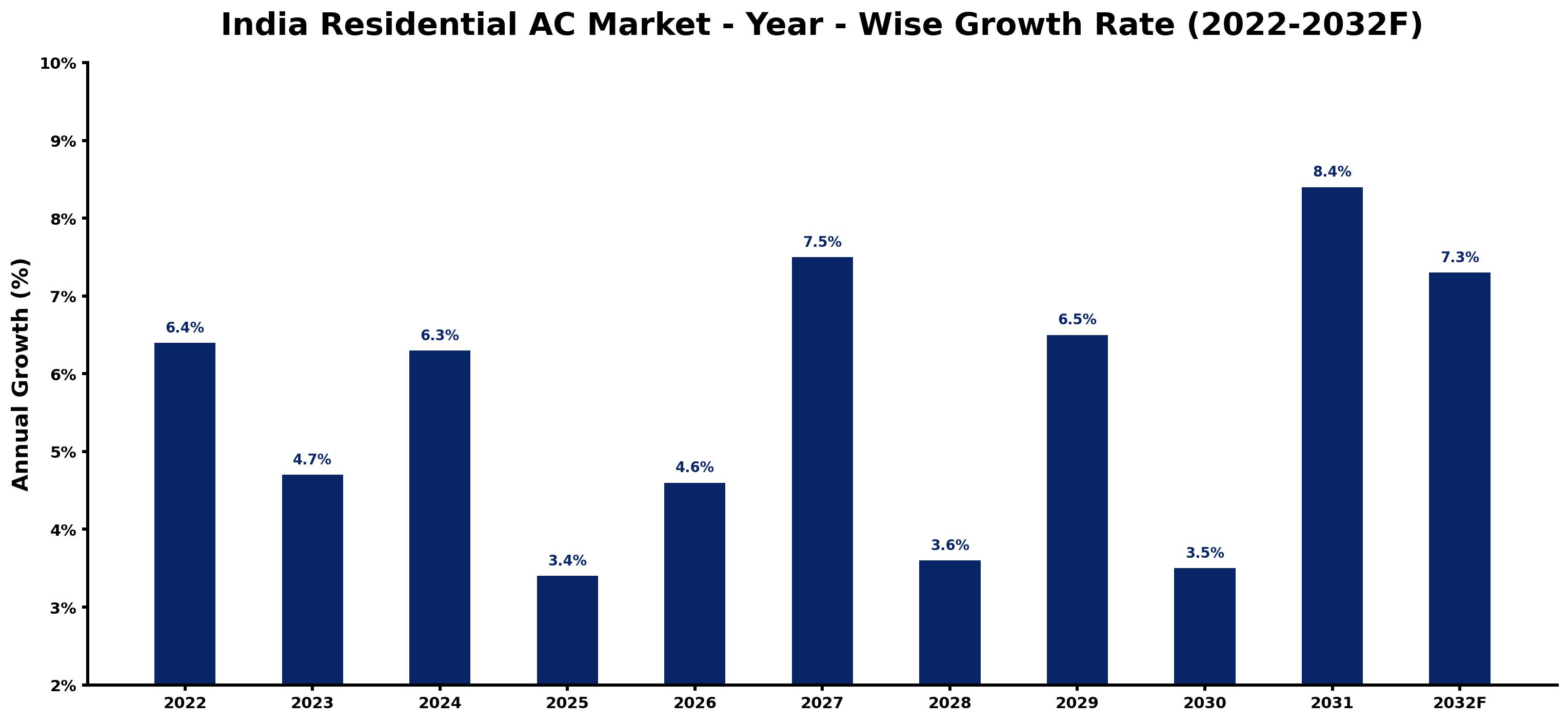
Year by year, the estimates below pair each growth rate with the development that shaped it.
| Year | Estimated Annual Growth (%) | Market Rationale |
| 2022 | 6.4 | The urban population surged, driving demand for cooling solutions in homes. |
| 2023 | 4.7 | Demand growth slowed as consumers faced rising costs of living and inflation. |
| 2024 | 6.3 | Increased temperatures led to higher demand for residential cooling solutions. |
| 2025 | 3.4 | Market growth slowed due to economic uncertainties affecting consumer spending. |
| 2026 | 4.6 | The introduction of energy-efficient models revitalised market interest and purchases. |
| 2027 | 7.5 | Rising disposable incomes encouraged more households to invest in AC units. |
| 2028 | 3.6 | Consumer preferences shifted towards more energy-efficient models, impacting growth. |
| 2029 | 6.5 | Improved energy efficiency standards spurred demand for newer models. |
| 2030 | 3.5 | Market growth slowed as competition intensified among manufacturers. |
| 2031 | 8.4 | The peak demand was driven by extreme summer temperatures and urbanisation. |
| 2032 | 7.3 | Demand stabilised as energy-efficient models became mainstream under the National Cooling Action Plan. |
Note: Market size estimations and growth projections presented in this report are based on 6Wresearch's proprietary forecasting methodology, utilizing the latest available industry data, government publications, and primary research inputs.
India Residential AC Market Synopsis
The Residential AC Market in India encompasses cooling systems designed for indoor environments, primarily using vapor-compression technology. These systems improve indoor air quality and control humidity. The market is growing, driven by an urban population of approximately 500 million and rising disposable incomes. The average annual temperature in major cities exceeds 30°C, increasing the need for cooling solutions. The Indian HVAC industry is projected to reach $23 billion by 2025, with residential ACs being a major contributor to this growth.
Market Dynamics Impact Analysis (2026–2032)
| Factor | Type | Impact | Primary Segment Affected |
| Urban population growth driving demand for cooling solutions | Driver | High | Urban Apartments |
| Rising disposable incomes enabling more households to purchase AC units | Driver | High | Budget Homes |
| Increasing demand for energy-efficient models due to rising energy costs | Opportunity | High | Inverter/Fixed |
| Growing interest in sustainable cooling solutions among consumers | Opportunity | Medium | Split ACs |
| High initial costs for energy-efficient models limiting access for some buyers | Restraint | High | Budget Homes |
| Competition from low-cost imports affecting local manufacturers | Restraint | Medium | Split ACs |
| Supply chain disruptions impacting availability of components | Challenge | High | Inverter/Fixed |
| Regulatory compliance costs affecting production timelines | Challenge | Medium | Urban Apartments |
Evaluation of Drivers in India Residential AC Market (2026–2032)
Below mentioned are some major drivers and their influence on market dynamics.
| Drivers | Primary Segment Affected | Why It Matters (Evidence) |
| Urban population growth | Urban Apartments | The urban population of India was approximately 500 million in 2022, increasing demand for residential ACs. |
| Rising disposable incomes | Budget Homes | As disposable incomes rise, more households are investing in residential cooling solutions. |
| Energy efficiency standards | Inverter/Fixed | The Bureau of Energy Efficiency sets standards that encourage the adoption of energy-efficient ACs. |
| High average temperatures | Split ACs | The average annual temperature in major Indian cities exceeds 30°C, driving the need for cooling. |
| Government initiatives promoting local manufacturing | Inverter/Fixed | The 'Atmanirbhar Bharat' initiative boosts local production, reducing reliance on imports. |
Growth across the Residential AC market in India is anchored in urban population expansion, rising incomes, and energy efficiency standards. The urban population reached approximately 500 million in 2022, which significantly increased demand for residential ACs. With the average annual temperature in major cities exceeding 30°C, households are increasingly investing in cooling solutions. These factors encourage consumers to seek reliable and cost-effective cooling options.
Evaluation of Restraints in India Residential AC Market
The table below lists the restraints and the evidence behind each.
| Market Restraint | Primary Segment Affected | Why It Matters (Evidence) |
| High initial costs for energy-efficient models | Budget Homes | The average household in urban India consumes about 300 kWh per month for cooling, making energy-efficient models costly upfront. |
| Competition from low-cost imports | Split ACs | Local manufacturers face challenges due to lower-priced imported AC units affecting market share. |
| Supply chain disruptions | Inverter/Fixed | Ongoing supply chain issues have delayed the availability of essential components for AC production. |
| Regulatory compliance costs | Urban Apartments | Compliance with energy efficiency standards increases production costs for manufacturers. |
| Consumer price sensitivity | Budget Homes | Economic uncertainties have made consumers more cautious about spending on non-essential items. |
India Residential AC Market Challenges
The India Residential AC market encounters stringent regulatory challenges, particularly from the Bureau of Energy Efficiency, which can delay product approvals by up to six months for manufacturers. Rising production costs burden suppliers, as the average household consumes about 300 kWh per month for cooling, leading to elevated operational expenses. Supply chain disruptions occur due to local manufacturers relying on imported components, resulting in potential delays and price increases for buyers. The limited uptake of advanced cooling technologies restricts options for consumers seeking energy-efficient solutions, ultimately hindering market growth.
Trends in the India Residential AC Market
Four trends stand out in the India Residential AC Market.
- Shift towards Energy-Efficient Models: In 2023, the trend towards energy-efficient ACs accelerated as consumers aimed to lower electricity bills. The Bureau of Energy Efficiency's standards are driving manufacturers to innovate, with energy-efficient models set to dominate the market.
- Increase in Urban Apartment Installations: Urban Apartments are experiencing a surge in AC installations as the urban population expands. In 2022, over 500 million individuals resided in urban areas, fuelling demand for residential cooling solutions.
- Rising Popularity of Inverter Technology: The shift towards Inverter ACs commenced in 2022, with consumers prioritising energy efficiency. Inverter/Fixed models accounted for 39% of the market share in 2025, reflecting evolving consumer preferences.
- Expansion of Local Manufacturing: Since 2020, the 'Atmanirbhar Bharat' initiative has encouraged local manufacturing of AC components. This initiative aims to reduce import dependency, targeting a 20% increase in domestic production by 2030.
Investment Opportunities in the India Residential AC Market
The following opportunities in the India Residential AC Market pair current demand with a clear way in.
- Partnerships for Local Manufacturing: Establishing joint ventures with local manufacturers can facilitate entry into the Indian market. The 'Atmanirbhar Bharat' initiative supports local production, with a target to increase domestic manufacturing by 20% by 2030.
- Supply of Energy-Efficient AC Units: Investing in energy-efficient AC units is essential as demand rises. Urban Apartments are increasingly seeking these models to reduce energy costs, with the market projected to reach $657.24 million by 2032.
- Focus on Smart Cooling Solutions: There is a growing demand for smart AC systems that integrate with home automation. Urban consumers are increasingly interested in these technologies, creating new investment opportunities.
- Targeting Budget Homes: Budget Homes represent a significant opportunity for affordable cooling solutions. With rising temperatures, there is a strong demand for cost-effective AC units in lower-income segments.
Government Initiatives in the India Residential AC Market
The 'Perform, Achieve and Trade' scheme, launched by the Bureau of Energy Efficiency in 2020, incentivises energy-efficient cooling technologies. This measure complements existing regulations by providing financial incentives for manufacturers to produce compliant AC units, thereby improving energy efficiency in the market. The 'National Cooling Action Plan' aims to reduce cooling demand by 20% by 2030, initiated by the Ministry of Environment, Forest and Climate Change, further supporting sustainable cooling solutions.
The Bureau of Energy Efficiency oversees the approval of energy-efficient appliances under the 'Perform, Achieve and Trade' scheme. This agency also funds initiatives aimed at improving energy efficiency in cooling technologies, ensuring that manufacturers meet compliance standards. The Ministry of Power introduced the 'Energy Efficiency Financing Platform' in 2021, facilitating investments in energy-efficient technologies, thus promoting local production and innovation in the residential AC market.
Future Insight of the India Residential AC Market
The outlook for the India Residential AC market is shaped by key developments expected by 2032. The 'National Cooling Action Plan' aims to reduce cooling energy demand by 20% by 2030, driving the adoption of energy-efficient technologies. The 'Make in India' initiative will support local manufacturing, strengthening supply chain resilience. By 2025, the Indian HVAC industry is projected to reach $23 billion, with residential ACs playing a crucial role as urban populations grow and disposable incomes increase.
Market Segmentation Analysis
Each segment group is reviewed below, with the leader by share and the fastest grower by CAGR.
By AC Type – Split ACs Dominated, VRF Systems Expected to Grow Fastest
According to Ravi Bhandari, Research Head at 6Wresearch, the largest ac type category in 2025 was Split ACs, with a 36% share of total revenue. Split ACs hold the largest market share due to their efficiency in cooling individual rooms, making them ideal for urban households. Their widespread adoption is reflected in the fact that they account for over 60% of the residential AC market in India. Over 2026–2032, VRF Systems are expected to post the fastest growth, at a CAGR of 8.0%. VRF Systems are rapidly gaining traction as they offer efficient centralized cooling for larger residential complexes, appealing to the growing trend of energy efficiency. Their growth is further propelled by the increasing number of multi-storey apartments in urban settings. Suppliers should prioritise VRF System innovations to capitalise on the rising demand from larger residential projects.
By Compressor Type – Inverter/Fixed Dominated, Multi-zone Inverter Expected to Grow Fastest
Inverter/Fixed accounted for a 39% market share by compressor type in 2025. Inverter/Fixed compressors hold a substantial share in the market as they are favoured for their energy efficiency, appealing to cost-conscious consumers. This preference aligns with the government's initiatives to improve energy efficiency in cooling appliances. Multi-zone Inverter is set to record the highest CAGR in this split, 7.7% over 2026–2032. Multi-zone Inverter technology is gaining traction due to its ability to efficiently cool multiple rooms, making it ideal for larger homes. As energy costs rise, more consumers are likely to adopt this technology for its long-term savings. Manufacturers should invest in developing and marketing Multi-zone Inverter systems to meet the increasing demand for efficient cooling solutions.
By Capacity Range – 1–3 Tons Dominated and Is Expected to Record the Fastest Growth
1–3 Tons held a 43% share of the India Residential AC Market by capacity range in 2025. The 1–3 Tons capacity range holds the largest share in the India Residential AC Market due to its suitability for typical urban household sizes, which often require efficient cooling solutions. This capacity effectively addresses the cooling needs of the approximately 500 million urban residents in India, making it a preferred choice. 1–3 Tons are also forecast to expand faster than any other category, at a CAGR of 8.0% over 2026–2032. This capacity range is also the fastest-growing segment as urbanisation accelerates, with more households in cities demanding effective cooling solutions to combat rising temperatures exceeding 30°C. The ongoing trend towards increased disposable incomes further fuels the demand for 1–3 Tons residential ACs, ensuring its growth continues. Suppliers should focus on expanding their offerings within the 1–3 Tons capacity range to meet the increasing demand from urban consumers.
By End User – Urban Apartments Dominated, Houses & Small Buildings Expected to Grow Fastest
In 2025, Urban Apartments led the end user split with a 41% share. Urban Apartments represent the largest share of the market, driven by high population density and the increasing number of residential developments in cities. This segment's growth is directly linked to the expanding urban population, which was around 500 million in 2022. The quickest growth will come from Houses & Small Buildings, forecast to expand at a CAGR of 8.6% between 2026 and 2032. Houses & Small Buildings are rapidly gaining popularity as more consumers move towards standalone living spaces, especially in suburban areas. This shift is partly due to changing lifestyle preferences post-pandemic, leading to increased demand for individual homes. Suppliers should tailor their marketing strategies to address the unique needs of both urban apartments and standalone houses.
Key Attractiveness of the Report
- 10 Years of Market Numbers
- Historical Data Starting from 2022 to 2025
- Base Year 2025
- Forecast Data until 2032
- Key Performance Indicators Impacting the Market
- Major Upcoming Developments and Projects
Key Highlights of the Report:
- India Residential AC Market Outlook
- Market Size of India Residential AC Market, 2025
- Forecast of India Residential AC Market, 2032
- Historical Data and Forecast of India Residential AC Revenues & Volume for the Period 2022 - 2032F
- India Residential AC Market Trend Evolution
- India Residential AC Market Drivers and Challenges
- India Residential AC Price Trends
- India Residential AC Porter's Five Forces
- India Residential AC Industry Life Cycle
- Historical Data and Forecast of India Residential AC Market Revenues & Volume By AC Type for the Period 2022 - 2032F
- Historical Data and Forecast of India Residential AC Market Revenues & Volume By Split ACs for the Period 2022 - 2032F
- Historical Data and Forecast of India Residential AC Market Revenues & Volume By Window ACs for the Period 2022 - 2032F
- Historical Data and Forecast of India Residential AC Market Revenues & Volume By Portable AC Units for the Period 2022 - 2032F
- Historical Data and Forecast of India Residential AC Market Revenues & Volume By VRF Systems for the Period 2022 - 2032F
- Historical Data and Forecast of India Residential AC Market Revenues & Volume By Compressor Type for the Period 2022 - 2032F
- Historical Data and Forecast of India Residential AC Market Revenues & Volume By Inverter/Fixed for the Period 2022 - 2032F
- Historical Data and Forecast of India Residential AC Market Revenues & Volume By Fixed Speed for the Period 2022 - 2032F
- Historical Data and Forecast of India Residential AC Market Revenues & Volume By Compact for the Period 2022 - 2032F
- Historical Data and Forecast of India Residential AC Market Revenues & Volume By Multi-zone Inverter for the Period 2022 - 2032F
- Historical Data and Forecast of India Residential AC Market Revenues & Volume By Capacity Range for the Period 2022 - 2032F
- Historical Data and Forecast of India Residential AC Market Revenues & Volume By 1 3 Tons for the Period 2022 - 2032F
- Historical Data and Forecast of India Residential AC Market Revenues & Volume By 0.8 1.5 Tons for the Period 2022 - 2032F
- Historical Data and Forecast of India Residential AC Market Revenues & Volume By 12,000 BTU for the Period 2022 - 2032F
- Historical Data and Forecast of India Residential AC Market Revenues & Volume By 5 20 Tons for the Period 2022 - 2032F
- Historical Data and Forecast of India Residential AC Market Revenues & Volume By End User for the Period 2022 - 2032F
- Historical Data and Forecast of India Residential AC Market Revenues & Volume By Urban Apartments for the Period 2022 - 2032F
- Historical Data and Forecast of India Residential AC Market Revenues & Volume By Budget Homes for the Period 2022 - 2032F
- Historical Data and Forecast of India Residential AC Market Revenues & Volume By Temporary/Dorm Use for the Period 2022 - 2032F
- Historical Data and Forecast of India Residential AC Market Revenues & Volume By Houses & Small Buildings for the Period 2022 - 2032F
- India Residential AC Import Export Trade Statistics
- Market Opportunity Assessment By AC Type
- Market Opportunity Assessment By Compressor Type
- Market Opportunity Assessment By Capacity Range
- Market Opportunity Assessment By End User
- India Residential AC Top Companies Market Share
- India Residential AC Competitive Benchmarking By Technical and Operational Parameters
- India Residential AC Company Profiles
- India Residential AC Key Strategic Recommendations
Market Covered
The report offers an extensive study of the following market segments.
By AC Type
- Split ACs
- Window ACs
- Portable AC Units
- VRF Systems
By Compressor Type
- Inverter/Fixed
- Fixed Speed
- Compact
- Multi-zone Inverter
By Capacity Range
- 1–3 Tons
- 0.8–1.5 Tons
- <12
- 000 BTU
- 5–20 Tons
By End User
- Urban Apartments
- Budget Homes
- Temporary/Dorm Use
- Houses & Small Buildings































