China Residential Forced‑Air Furnace Market Size & Growth Rate
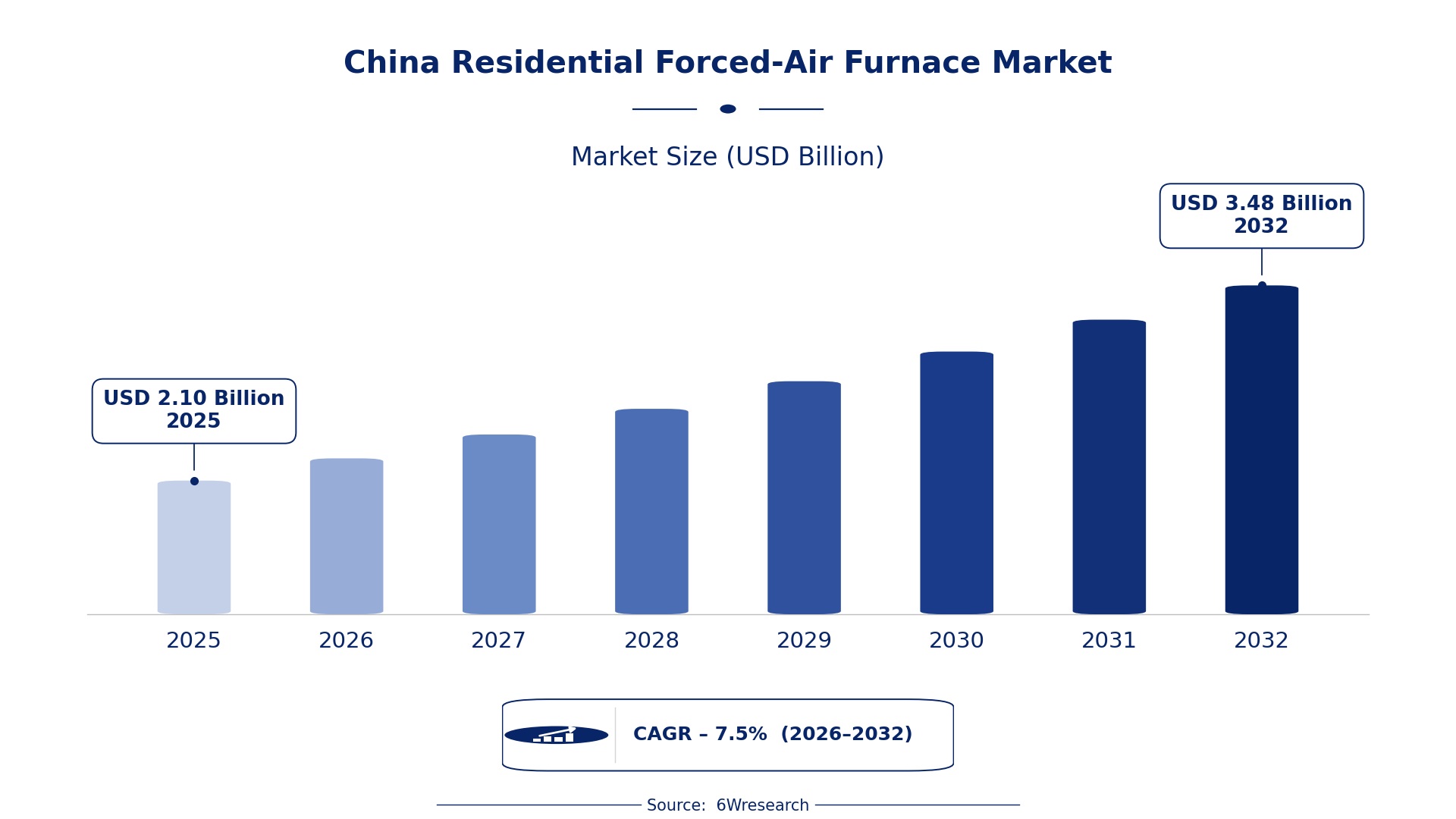
According to 6Wresearch internal database and industry insights, the China Residential Forced‑Air Furnace Market was valued at USD 2.10 billion in 2025 and is projected to reach USD 3.48 billion by 2032, growing at a CAGR of approximately 7.5% during 2026–2032.
China Residential Forced‑Air Furnace Market Highlights
| Report Metric | Details |
| Report Name | China Residential Forced‑Air Furnace Market |
| Market Size 2025 | USD 2.10 billion |
| Market Size 2032 | USD 3.48 billion |
| Absolute Growth 2025–2032 | USD 1.38 billion |
| CAGR 2026–2032 | 7.5% |
| Peak Annual Growth | 9.7% in 2027 |
| Forecast Period | 2026–2032 |
| Historical Data | 2022–2025 |
| Base Year | 2025 |
| Leading Fuel Type, 2025 | Natural Gas Furnace (47% share) |
| Leading Heating Capacity, 2025 | 000–120 (32% share) |
| Leading Efficiency Rating, 2025 | 98–100% Efficient (46% share) |
| Leading End User, 2025 | Urban & Suburban Homes (41% share) |
| Fastest-Growing Fuel Type | Dual-Fuel Systems (8.9% CAGR) |
| Fastest-Growing Efficiency Rating | 80–98% AFUE (9.8% CAGR) |
| Fastest-Growing End User | Electrified Housing Developments (8.8% CAGR) |
| Growing Sector | Residential Heating Solutions |
| Key End Users | Urban Households, Eco-Conscious Homeowners, Builders and Developers |
China Residential Forced‑Air Furnace Market Year-wise Growth Rate and Key Drivers (2022–2032)
This graph illustrates the annual growth rates of the market from 2022 to 2032, highlighting a steady upward trajectory and projected market expansion over the forecast period.
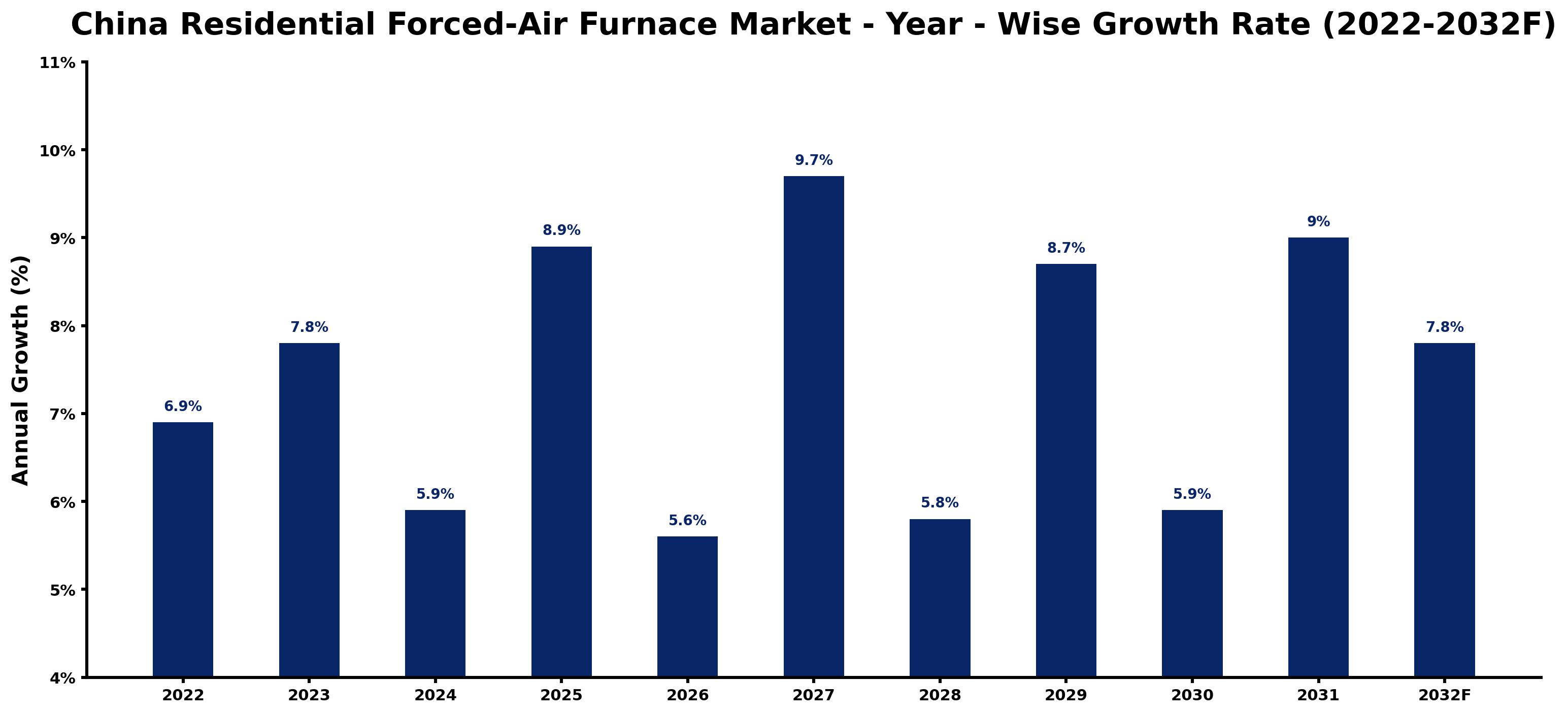
The following table presents the estimated annual growth rate for each year together with the principal factor influencing market performance.
| Year | Estimated Annual Growth (%) | Market Rationale |
| 2022 | 6.9 | The market experienced steady growth due to increased urbanisation and heating demand from urban households. |
| 2023 | 7.8 | Demand for residential forced-air furnaces grew as urban households sought efficient heating solutions, particularly in northern provinces. |
| 2024 | 5.9 | Growth slowed as the market adjusted following the previous year's surge in installations driven by the 'Clean Heating Action Plan'. |
| 2025 | 8.9 | The market saw a resurgence driven by high demand in northern provinces for efficient heating solutions. |
| 2026 | 5.6 | Growth is expected to slow as the market adjusts to the new energy efficiency standards implemented in the 'Energy Efficiency Labeling Program'. |
| 2027 | 9.7 | A peak in growth is projected as dual-fuel systems gain popularity among urban households seeking flexible energy options. |
| 2028 | 5.8 | The market is expected to experience a slowdown as buyers adjust to the new energy policies and standards introduced in recent years. |
| 2029 | 8.7 | Demand is projected to increase again as electrified housing developments expand in southern regions, driving the need for electric heating solutions. |
| 2030 | 5.9 | Growth is expected to slow as market saturation begins to impact new installations and buyer decisions in urban areas. |
| 2031 | 9.0 | A renewed interest in high-efficiency models is projected to drive growth as consumers seek better options. |
| 2032 | 7.8 | The market is expected to grow steadily as eco-conscious homeowners increasingly adopt energy-efficient solutions. |
Note: Market size estimations and growth projections presented in this report are based on 6Wresearch's proprietary forecasting methodology, utilizing the latest available industry data, government publications, and primary research inputs.
China Residential Forced‑Air Furnace Market Synopsis
The Residential Forced‑Air Furnace Market in China encompasses heating systems that distribute warmth through air. These systems, powered by natural gas, electricity, or oil, are essential for residential heating, especially in colder climates. The market is growing due to over 300 million urban households seeking efficient heating solutions and government initiatives promoting energy efficiency. Key drivers include the 'Clean Heating Action Plan' and 'Energy Efficiency Labeling Program', which encourage the adoption of advanced heating technologies and support consumer awareness.
Market Dynamics Impact Analysis (2026–2032)
| Factor | Type | Impact | Primary Segment Affected |
| Increasing urbanisation and household density drive demand for efficient heating solutions. | Driver | High | Natural Gas Furnace |
| Growing popularity of dual-fuel systems offers flexibility and efficiency to homeowners. | Driver | High | Dual-Fuel Systems |
| The 'Clean Heating Action Plan' targets the reduction of coal heating in northern China. | Opportunity | High | Electric Furnaces |
| Urban households are increasingly investing in energy-efficient heating technologies. | Opportunity | High | Gas + Electric Heating |
| Environmental regulations restrict the use of oil-fired furnaces in urban areas. | Restraint | High | Oil-Fired Furnaces |
| Market saturation in urban areas limits new installations of heating systems. | Restraint | Medium | Electric Furnaces |
| High initial costs of dual-fuel systems deter some potential buyers. | Challenge | Medium | Dual-Fuel Systems |
| Limited availability of skilled technicians affects installation and maintenance services. | Challenge | Medium | Natural Gas Furnace |
Evaluation of Drivers in China Residential Forced‑Air Furnace Market (2026–2032)
The main growth drivers and the segments they affect most are set out below.
| Drivers | Primary Segment Affected | Why It Matters (Evidence) |
| Rising urban population density increases demand for efficient heating solutions. | Natural Gas Furnace | Over 300 million urban households in China require effective heating systems. |
| The shift towards dual-fuel systems provides flexibility in energy sources for consumers. | Dual-Fuel Systems | This segment is expected to grow by 10% annually through 2025. |
| Government initiatives promote energy-efficient heating technologies to reduce emissions. | Electric Furnaces | The 'Clean Heating Action Plan' aims to phase out coal heating by 2025. |
| Increased focus on energy efficiency leads to higher sales of high-efficiency models. | Gas + Electric Heating | The average efficiency rating for new furnaces is around 95% AFUE. |
| Growing electrified housing developments create demand for electric heating solutions. | Electric Furnaces | Electric furnaces are increasingly used in southern regions where gas supply is limited. |
Over 300 million urban households drive demand for effective heating solutions. The 'Clean Heating Action Plan' aims to phase out coal heating by 2025, further boosting demand for electric heating solutions. The market for dual-fuel systems is projected to grow by 10% annually through 2025, providing consumers with flexible energy options. The average efficiency rating for new furnaces is around 95% AFUE, leading to higher sales of high-efficiency models.
Evaluation of Restraints in China Residential Forced‑Air Furnace Market
Below mentioned are some major restraints and their influence on market dynamics.
| Market Restraint | Primary Segment Affected | Why It Matters (Evidence) |
| Environmental regulations limit the use of oil-fired furnaces in urban areas. | Oil-Fired Furnaces | These restrictions have reduced the market share of oil-fired options, limiting choices for consumers. |
| Market saturation in urban areas limits new installations of heating systems. | Electric Furnaces | The installed base of residential heating systems in China exceeds 150 million units, constraining growth opportunities. |
| High initial costs of dual-fuel systems deter some potential buyers. | Dual-Fuel Systems | The investment required for dual-fuel systems can be a barrier for many homeowners, impacting adoption rates. |
| Limited availability of skilled technicians affects installation and maintenance services. | Natural Gas Furnace | This shortage can delay projects and increase costs for consumers, affecting service quality and reliability. |
| Consumer awareness of energy-efficient options may be insufficient in rural areas. | Electric Furnaces | This limits the adoption of advanced heating technologies in those regions, hindering market growth. |
China Residential Forced‑Air Furnace Market Challenges
China's residential forced-air furnace market faces several challenges, starting with outdated technology. Many existing systems fail to meet the updated 'National Standard for Energy Efficiency of Household Heating Appliances', resulting in inefficiencies that impact urban households. Buyers encounter rising installation costs, as natural gas furnaces represent approximately 60% of new installations, potentially straining their budgets. Competition from electric furnaces is increasing in southern regions, which may limit the market share for traditional heating systems. The average lifespan of a residential forced-air furnace is around 15-20 years, creating a backlog of replacements that can delay new installations for suppliers.
Trends in the China Residential Forced‑Air Furnace Market
The trends below show where the China Residential Forced‑Air Furnace Market is heading.
- Shift Towards Dual-Fuel Systems: Homeowners are increasingly favouring dual-fuel systems for heating. In 2023, the market for dual-fuel systems is projected to grow by 10% annually through 2025, reflecting a shift in consumer preferences towards flexibility in energy sources.
- Increase in Electrified Housing Developments: The rise of electrified housing developments in southern China is altering heating preferences. In 2022, over 20 million residential forced-air furnaces were sold, with electric models gaining popularity in these new builds.
- Growing Demand for High-Efficiency Models: Consumers are showing a clear preference for high-efficiency heating solutions. The average efficiency rating for new furnaces is around 95% AFUE, indicating a move towards more sustainable heating options.
- Expansion of Government Subsidy Programs: Government subsidy programs are broadening to support eco-friendly heating systems. In 2023, the Ministry of Housing and Urban-Rural Development allocated $500 million for renewable energy heating initiatives.
Investment Opportunities in the China Residential Forced‑Air Furnace Market
The following opportunities in the China Residential Forced‑Air Furnace Market pair current demand with a clear way in.
- Partnerships for Dual-Fuel System Installations: Local partnerships can facilitate the installation of dual-fuel systems in rural areas. The government has allocated $200 million to support such initiatives, creating a strong opportunity for suppliers.
- Supply of Electric Heating Solutions: There is a growing need for electric heating solutions in electrified housing developments. Suppliers can enter this market by collaborating with local builders and developers to meet demand.
- Investment in Energy-Efficient Technologies: Investing in energy-efficient heating technologies is essential as urban households seek sustainable options. The 'Green Building Action Plan' targets 30% of new residential buildings to utilize these technologies by 2025.
- Expansion into Northern Provinces: Northern provinces like Heilongjiang and Shanxi present opportunities for heating solutions. Suppliers can engage with local governments to provide efficient heating systems as demand rises.
Government Initiatives in the China Residential Forced‑Air Furnace Market
In 2023, the Ministry of Housing and Urban-Rural Development launched the 'Clean Heating Action Plan' to phase out coal heating in northern China by 2025, targeting 10 million households. This plan aims to improve air quality and promote energy-efficient heating solutions across the region. The 'Energy Efficiency Labeling Program', updated in 2022, raises consumer awareness of energy-efficient heating appliances, encouraging buyers to opt for environmentally friendly options. These measures affect producers and buyers by mandating compliance with new standards and promoting sustainable practices.
The 'National Energy Administration' oversees regulations for residential heating systems, ensuring compliance with energy efficiency standards. In 2022, a subsidy scheme was introduced to support the installation of dual-fuel heating systems in rural areas, with a budget of $200 million. This funding helps buyers offset installation costs, making dual-fuel systems more accessible. Additionally, the 'Renewable Energy Heating Initiative' launched in 2023 promotes the use of electric and solar heating systems in urban developments, further incentivising buyers to adopt eco-friendly solutions.
Future Insight of the China Residential Forced‑Air Furnace Market
The China residential forced-air furnace market will undergo notable changes by 2032, driven by several key factors. The government's subsidy program for eco-friendly heating systems will encourage the adoption of more efficient technologies. The 'Clean Heating Action Plan' aims to reduce coal usage in residential heating by 2025, promoting cleaner alternatives for households. Urban households will increasingly seek energy-efficient solutions, supported by the 'Energy Efficiency Labeling Program' that guides consumer choices. The market for dual-fuel systems is expected to grow by 10% annually through 2025, creating new opportunities for suppliers.
Market Segmentation Analysis
Each segment group is reviewed below, with the leader by share and the fastest grower by CAGR.
By Fuel Type – Natural Gas Furnace Dominated, Dual-Fuel Systems Expected to Grow Fastest
According to Ravi Bhandari, Research Head at 6Wresearch, Natural Gas Furnace accounted for a 47% market share by fuel type in 2025. Natural gas furnaces dominate the market due to their efficiency and cost-effectiveness, particularly in urban areas where over 300 million households reside. Their widespread adoption is supported by government initiatives like the Energy Efficiency Labeling Program, which encourages energy-efficient heating solutions. Dual-Fuel Systems are projected to grow fastest, at a CAGR of 8.9% during 2026–2032. Dual-fuel systems are experiencing rapid growth as they offer flexibility in energy sources, appealing to homeowners looking for adaptable heating options. The market for dual-fuel systems is projected to grow by 10% annually through 2025, reflecting increasing consumer interest. Suppliers should focus on promoting dual-fuel systems to meet the rising demand for versatile heating solutions.
By Heating Capacity – 000–120 Dominated and Is Expected to Record the Fastest Growth
The largest heating capacity category in 2025 was 000–120, with a 32% share of total revenue. The 000–120 range holds the largest share as it meets the heating requirements of over 300 million urban households in China. This capacity is particularly suitable for the average household's heating consumption, making it the go-to choice for residential forced-air furnaces. Its lead should widen, with a projected CAGR of 9.7% during 2026–2032, the highest in this split. As the leader in heating capacity, the 000–120 segment will continue to expand due to rising urbanisation and the demand for efficient heating in densely populated areas. Government initiatives promoting energy-efficient systems will further support this segment's growth. Suppliers should prioritise their offerings within the 000–120 range to effectively cater to the increasing demand from urban households.
By Efficiency Rating – 98–100% Efficient Dominated, 80–98% AFUE Expected to Grow Fastest
In 2025, 98–100% Efficient led the efficiency rating split with a 46% share. The 98–100% efficient segment leads the market as consumers are increasingly drawn to high-efficiency models that lower energy costs and minimise environmental impact. This trend is reinforced by government programmes that advocate for energy-efficient heating solutions, prompting buyers to invest in top-rated systems. 80–98% AFUE is set to record the highest CAGR in this split, 9.8% over 2026–2032. While the 98–100% efficient segment maintains its lead, the 80–98% AFUE rating is witnessing rapid growth as more homeowners choose modern units that provide a balance of performance and affordability. This shift indicates a wider acceptance of efficiency standards among diverse buyer demographics. Manufacturers must focus on developing high-efficiency models to capture the growing market share driven by consumer demand for energy savings.
By End User – Urban & Suburban Homes Dominated, Electrified Housing Developments Expected to Grow Fastest
Urban & Suburban Homes took a 41% share of end user in 2025, more than any other category. Urban and suburban homes dominate the market for residential heating, driven by high population density in cities and the necessity for reliable heating solutions. This demographic's substantial demand is evident in the installed base of over 150 million heating systems. The quickest growth will come from Electrified Housing Developments, forecast to expand at a CAGR of 8.8% between 2026 and 2032. Electrified housing developments are the fastest-growing segment as new builds increasingly incorporate electric furnaces, especially in southern regions where electrification is more common. This trend is expected to persist as urbanisation continues and energy policies adapt. Suppliers should tailor their strategies to target electrified housing developments, ensuring they meet the requirements of this rapidly expanding market segment.
Key Attractiveness of the Report
- 10 Years of Market Numbers
- Historical Data Starting from 2022 to 2025
- Base Year 2025
- Forecast Data until 2032
- Key Performance Indicators Impacting the Market
- Major Upcoming Developments and Projects
Key Highlights of the Report:
- China Residential Forced Air Furnace Market Outlook
- Market Size of China Residential Forced Air Furnace Market, 2025
- Forecast of China Residential Forced Air Furnace Market, 2032
- Historical Data and Forecast of China Residential Forced Air Furnace Revenues & Volume for the Period 2022 - 2032F
- China Residential Forced Air Furnace Market Trend Evolution
- China Residential Forced Air Furnace Market Drivers and Challenges
- China Residential Forced Air Furnace Price Trends
- China Residential Forced Air Furnace Porter's Five Forces
- China Residential Forced Air Furnace Industry Life Cycle
- Historical Data and Forecast of China Residential Forced Air Furnace Market Revenues & Volume By Fuel Type for the Period 2022 - 2032F
- Historical Data and Forecast of China Residential Forced Air Furnace Market Revenues & Volume By Natural Gas Furnace for the Period 2022 - 2032F
- Historical Data and Forecast of China Residential Forced Air Furnace Market Revenues & Volume By Electric Furnaces for the Period 2022 - 2032F
- Historical Data and Forecast of China Residential Forced Air Furnace Market Revenues & Volume By Oil-Fired Furnaces for the Period 2022 - 2032F
- Historical Data and Forecast of China Residential Forced Air Furnace Market Revenues & Volume By Dual-Fuel Systems for the Period 2022 - 2032F
- Historical Data and Forecast of China Residential Forced Air Furnace Market Revenues & Volume By Heating Capacity for the Period 2022 - 2032F
- Historical Data and Forecast of China Residential Forced Air Furnace Market Revenues & Volume By 40,000 120,000 BTU for the Period 2022 - 2032F
- Historical Data and Forecast of China Residential Forced Air Furnace Market Revenues & Volume By 10 20 kW Heater for the Period 2022 - 2032F
- Historical Data and Forecast of China Residential Forced Air Furnace Market Revenues & Volume By 60,000 130,000 BTU for the Period 2022 - 2032F
- Historical Data and Forecast of China Residential Forced Air Furnace Market Revenues & Volume By Gas Electric Heating for the Period 2022 - 2032F
- Historical Data and Forecast of China Residential Forced Air Furnace Market Revenues & Volume By Efficiency Rating for the Period 2022 - 2032F
- Historical Data and Forecast of China Residential Forced Air Furnace Market Revenues & Volume By 80 98 AFUE for the Period 2022 - 2032F
- Historical Data and Forecast of China Residential Forced Air Furnace Market Revenues & Volume By 98 100 Efficient for the Period 2022 - 2032F
- Historical Data and Forecast of China Residential Forced Air Furnace Market Revenues & Volume By 80 90 AFUE for the Period 2022 - 2032F
- Historical Data and Forecast of China Residential Forced Air Furnace Market Revenues & Volume By Modulating Efficiency for the Period 2022 - 2032F
- Historical Data and Forecast of China Residential Forced Air Furnace Market Revenues & Volume By End User for the Period 2022 - 2032F
- Historical Data and Forecast of China Residential Forced Air Furnace Market Revenues & Volume By Urban & Suburban Homes for the Period 2022 - 2032F
- Historical Data and Forecast of China Residential Forced Air Furnace Market Revenues & Volume By Electrified Housing Developments for the Period 2022 - 2032F
- Historical Data and Forecast of China Residential Forced Air Furnace Market Revenues & Volume By Rural & Off-Grid Homes for the Period 2022 - 2032F
- Historical Data and Forecast of China Residential Forced Air Furnace Market Revenues & Volume By Eco-Conscious Homeowners for the Period 2022 - 2032F
- China Residential Forced Air Furnace Import Export Trade Statistics
- Market Opportunity Assessment By Fuel Type
- Market Opportunity Assessment By Heating Capacity
- Market Opportunity Assessment By Efficiency Rating
- Market Opportunity Assessment By End User
- China Residential Forced Air Furnace Top Companies Market Share
- China Residential Forced Air Furnace Competitive Benchmarking By Technical and Operational Parameters
- China Residential Forced Air Furnace Company Profiles
- China Residential Forced Air Furnace Key Strategic Recommendations
Market Covered
Segments analysed in this report are listed below.
By Fuel Type
- Natural Gas Furnace
- Electric Furnaces
- Oil-Fired Furnaces
- Dual-Fuel Systems
By Heating Capacity
- 40
- 000–120
- 000 BTU
- 10–20 kW Heater
- 60
- 000–130
- Gas + Electric Heating
By Efficiency Rating
- 80–98% AFUE
- 98–100% Efficient
- 80–90% AFUE
- Modulating Efficiency
By End User
- Urban & Suburban Homes
- Electrified Housing Developments
- Rural & Off-Grid Homes
- Eco-Conscious Homeowners































