India Residential Forced‑Air Furnace Market Size & Growth Rate
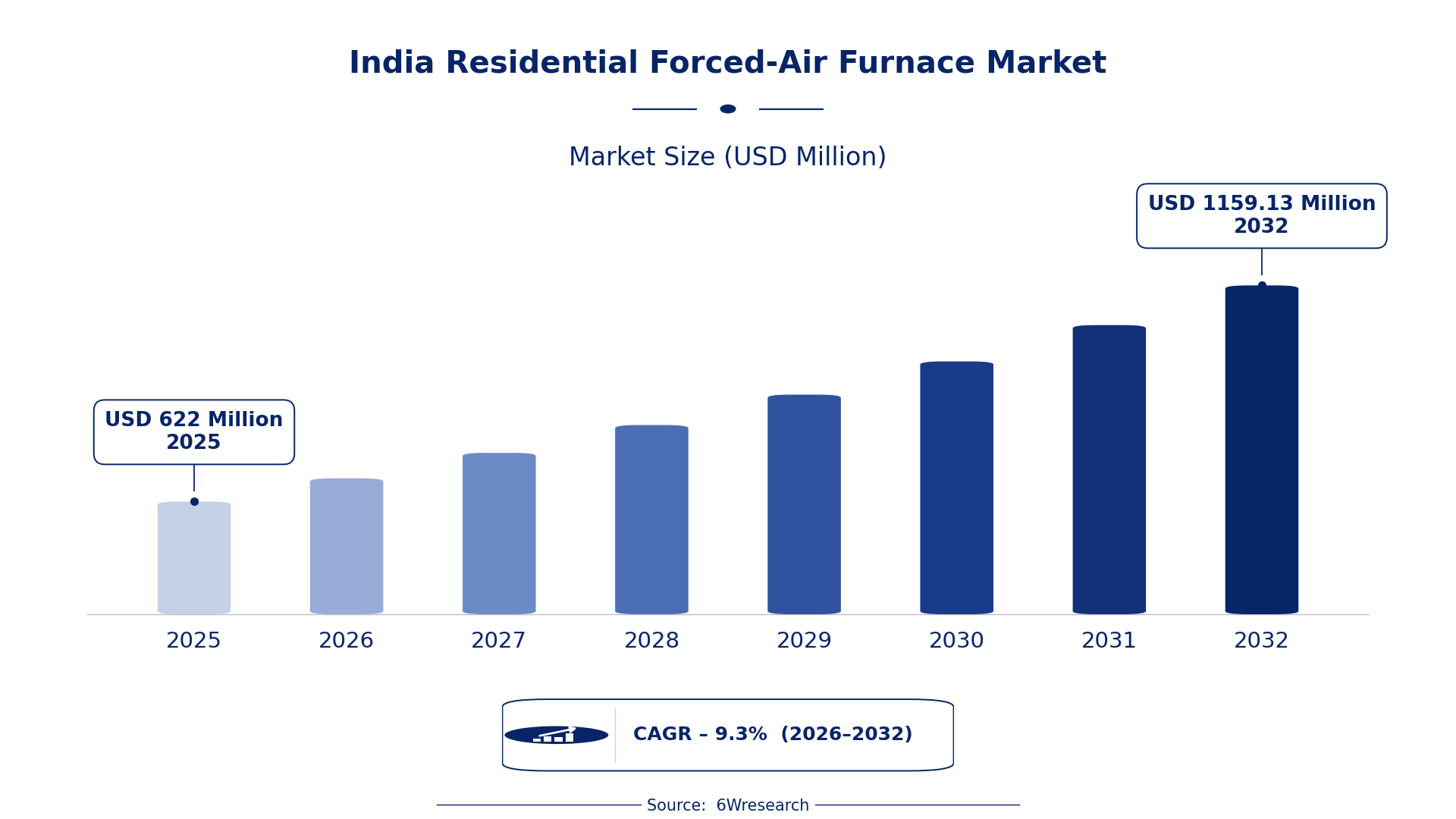
According to 6Wresearch internal database and industry insights, the India Residential Forced‑Air Furnace Market was valued at USD 622.0 million in 2025 and is projected to reach USD 1,159.13 million by 2032, growing at a CAGR of approximately 9.3% during 2026–2032.
India Residential Forced‑Air Furnace Market Highlights
| Report Metric | Details |
| Report Name | India Residential Forced‑Air Furnace Market |
| Market Size 2025 | USD 622.0 million |
| Market Size 2032 | USD 1,159.13 million |
| Absolute Growth 2025–2032 | USD 537.13 million |
| CAGR 2026–2032 | 9.3% |
| Peak Annual Growth | 12.0% in 2032 |
| Forecast Period | 2026–2032 |
| Historical Data | 2022–2025 |
| Base Year | 2025 |
| Leading Fuel Type, 2025 | Natural Gas Furnace (42% share) |
| Leading Heating Capacity, 2025 | 000–120 (47% share) |
| Leading Efficiency Rating, 2025 | 98–100% Efficient (51% share) |
| Leading End User, 2025 | Urban & Suburban Homes (47% share) |
| Fastest-Growing Fuel Type | Electric Furnaces (11.2% CAGR) |
| Fastest-Growing Efficiency Rating | 80–98% AFUE (11.1% CAGR) |
| Fastest-Growing End User | Electrified Housing Developments (11.2% CAGR) |
| Growing Sector | Electrified Housing Developments |
| Key End Users | Urban & Suburban Homes, Electrified Housing Developments, Rural & Off-Grid Homes, Eco-Conscious Homeowners |
India Residential Forced‑Air Furnace Market Year-wise Growth Rate and Key Drivers (2022–2032)
This graph illustrates the annual growth rates of the market from 2022 to 2032, highlighting a steady upward trajectory and projected market expansion over the forecast period.
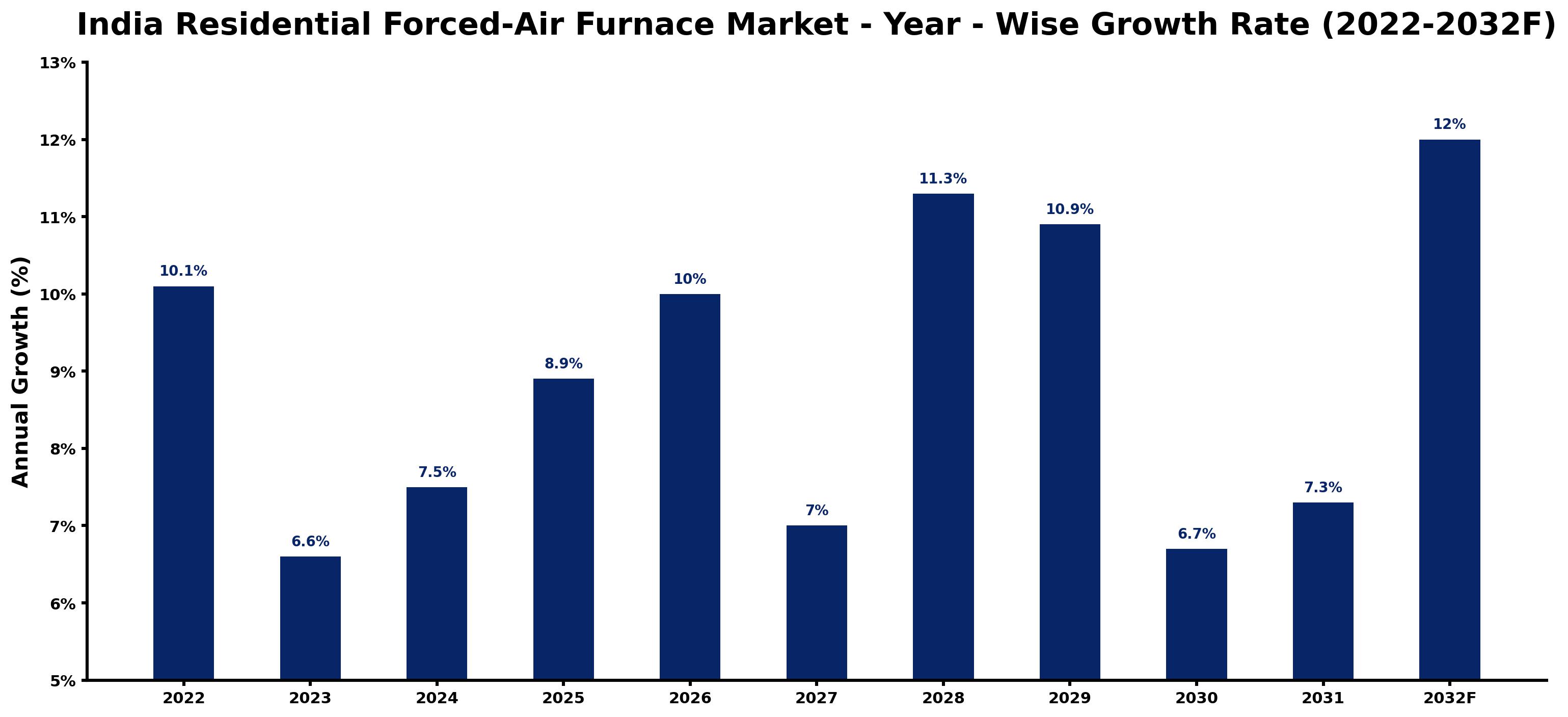
The table below sets out the estimated growth rate for each year and the main factor behind it.
| Year | Estimated Annual Growth (%) | Market Rationale |
| 2022 | 10.1 | The market experienced strong demand due to increased urbanization and rising living standards. |
| 2023 | 6.6 | Growth slowed as consumers adjusted to rising energy costs and economic conditions. |
| 2024 | 7.5 | Demand increased as more urban households sought efficient heating solutions. |
| 2025 | 8.9 | The market grew faster as new housing developments incorporated modern heating systems. |
| 2026 | 10.0 | Demand is expected to rise due to the introduction of stricter energy efficiency standards set by the Bureau of Energy Efficiency. |
| 2027 | 7.0 | Market growth is projected to slow as saturation begins to influence purchasing decisions in urban areas. |
| 2028 | 11.3 | The market is expected to rebound with increased interest in energy-efficient heating options among homeowners. |
| 2029 | 10.9 | Demand is projected to slow as consumers face higher costs of living and energy prices. |
| 2030 | 6.7 | Growth is expected to slow as the market stabilises after rapid expansion in previous years. |
| 2031 | 7.3 | Demand will increase again as urban areas push for energy-efficient solutions in new housing. |
| 2032 | 12.0 | The market is projected to peak due to heightened awareness of energy efficiency and environmental concerns. |
Note: Market size estimations and growth projections presented in this report are based on 6Wresearch's proprietary forecasting methodology, utilizing the latest available industry data, government publications, and primary research inputs.
India Residential Forced‑Air Furnace Market Synopsis
The Residential Forced‑Air Furnace Market in India includes heating systems that distribute warm air throughout homes. These furnaces, powered by natural gas, electricity, or oil, play a crucial role in residential heating, especially in colder regions. Valued at approximately 1.5 billion USD in 2022, the market is expanding due to urbanisation and increasing household incomes. The electrification of new housing developments is further driving demand for efficient heating solutions, particularly in urban areas.
Market Dynamics Impact Analysis (2026–2032)
| Factor | Type | Impact | Primary Segment Affected |
| Rising urbanization and household incomes drive demand for heating solutions in cities. | Driver | High | Natural Gas Furnace |
| The shift towards electrified housing developments creates opportunities for electric furnace sales. | Driver | High | Electric Furnaces |
| The increasing focus on energy efficiency presents opportunities for suppliers of high-efficiency models. | Opportunity | High | 98–100% Efficient |
| The growing demand for dual-fuel systems offers a chance to cater to diverse energy needs. | Opportunity | Medium | Dual-Fuel Systems |
| High fuel costs can deter consumers from switching to more efficient heating systems. | Restraint | High | Oil-Fired Furnaces |
| Limited access to electricity in rural areas restricts the market for electric furnaces. | Restraint | Medium | Electric Furnaces |
| Competition from alternative heating solutions can limit market growth for forced-air systems. | Challenge | High | Natural Gas Furnace |
| Regulatory compliance with efficiency standards can increase operational costs for producers. | Challenge | Medium | Natural Gas Furnace |
Evaluation of Drivers in India Residential Forced‑Air Furnace Market (2026–2032)
Key forces behind demand, with the segment each one moves most, are listed below.
| Drivers | Primary Segment Affected | Why It Matters (Evidence) |
| Rising household incomes in urban areas lead to increased spending on heating solutions. | Natural Gas Furnace | The average annual household income in urban areas is around 1,000,000 INR, influencing heating system choices. |
| Electrification of new housing developments boosts demand for electric furnaces. | Electric Furnaces | As of 2023, around 20% of new housing developments are electrified, increasing demand for electric furnaces. |
| Stricter energy efficiency standards encourage consumers to invest in high-efficiency models. | 98–100% Efficient | The Bureau of Energy Efficiency has set standards for energy efficiency in heating appliances, including furnaces. |
| The need for flexibility in energy sources drives demand for dual-fuel systems. | Dual-Fuel Systems | The market for dual-fuel systems is expected to grow due to rising energy costs and the need for flexibility. |
| Growing awareness of eco-friendly heating solutions attracts environmentally conscious consumers. | Eco-Conscious Homeowners | The demand for eco-friendly heating solutions is rising among 25% of homeowners in urban areas. |
The Residential Forced‑Air Furnace market in India is growing on the back of rising urbanization, increased household incomes, and the adoption of energy-efficient technologies. Urban areas are experiencing a shift towards modern heating solutions, with the average annual household income influencing spending patterns. Approximately 20% of new housing developments are electrified, driving demand for electric furnaces. Stricter energy efficiency standards set by the Bureau of Energy Efficiency encourage consumers to invest in high-efficiency models. There is also a notable increase in demand for dual-fuel systems, as consumers seek flexibility amidst rising energy costs. Eco-conscious homeowners are prioritising sustainable heating solutions, with a significant portion of urban homeowners expressing interest in eco-friendly options.
Evaluation of Restraints in India Residential Forced‑Air Furnace Market
The following restraints limit how fast demand can grow.
| Market Restraint | Primary Segment Affected | Why It Matters (Evidence) |
| High initial costs deter potential buyers from investing in heating systems. | Natural Gas Furnace | The average cost of a residential forced-air furnace ranges from 30,000 to 80,000 INR, which can be prohibitive for some households. |
| Regulatory compliance can delay product launches for suppliers. | Electric Furnaces | Standards set by the Bureau of Energy Efficiency require compliance that can complicate the introduction of new models. |
| Supply chain issues can lead to delays in product availability. | Dual-Fuel Systems | Dependence on specific components can create shortages, impacting delivery times for producers. |
| Limited market penetration due to slow technology adoption. | Eco-Conscious Homeowners | Only 15% of new homes installed forced-air systems in 2022, limiting market growth. |
| Consumer hesitation in switching from traditional heating methods. | Oil-Fired Furnaces | The high fuel costs associated with oil-fired systems make them less attractive compared to natural gas options. |
India Residential Forced‑Air Furnace Market Challenges
The India Residential Forced-Air Furnace Market still has to solve a few problems, and the first is cost. The average price of a residential forced-air furnace ranges from 30,000 to 80,000 INR, which can deter buyers in urban areas where household incomes average around 1,000,000 INR. Regulatory challenges arise from compliance with Bureau of Energy Efficiency standards, which can delay product launches for suppliers, impacting their ability to meet market demand. Supply chain issues persist, as reliance on specific components can lead to shortages, affecting delivery times for producers. Lastly, technology adoption remains limited; only 15% of new homes installed these heating systems in 2022, restricting market growth for suppliers.
Trends in the India Residential Forced‑Air Furnace Market
Buyers and suppliers in the India Residential Forced‑Air Furnace Market are adjusting to the following trends.
- Shift Towards Electrified Housing Developments: Urban homeowners are increasingly opting for electrified housing developments, with around 20% of new constructions adopting this trend as of 2023. This shift is driving demand for electric furnaces, which are more efficient and environmentally friendly.
- Growing Demand for Energy-Efficient Models: The push for energy-efficient heating solutions is clear, with the Bureau of Energy Efficiency updating standards in 2021. This has led to a significant increase in interest for models rated 98-100% efficient, appealing to eco-conscious consumers.
- Rise of Dual-Fuel Systems: As energy costs rise, dual-fuel systems are gaining traction among homeowners seeking flexibility. This trend is anticipated to grow, with consumers looking for adaptable heating solutions that can utilise multiple energy sources.
- Emerging Interest in Smart Heating Solutions: Smart heating technologies are becoming more popular, with consumers seeking systems that offer remote control and energy monitoring. This trend is supported by the increasing integration of technology in residential heating systems.
Investment Opportunities in the India Residential Forced‑Air Furnace Market
Investors looking at the India Residential Forced‑Air Furnace Market should consider the following areas.
- Supply Energy-Efficient Heating Systems: The rising interest in energy-efficient heating solutions presents an opportunity to supply high-efficiency models. Urban developers are increasingly incorporating these systems, driven by the Bureau of Energy Efficiency's updated standards.
- Expand Dual-Fuel Heating Systems: With rising energy costs, the market for dual-fuel systems is expanding. Suppliers can enter this segment by partnering with local manufacturers to develop flexible heating solutions.
- Focus on Electrified Housing Developments: The electrification of new housing developments is a key opportunity, with 20% of new homes adopting this approach. Suppliers can target urban areas where electrification is a priority for developers.
- Promote Eco-Friendly Heating Solutions: The growing interest in sustainable heating options offers a chance to supply eco-friendly models. Engaging with environmentally conscious homeowners in urban areas can drive sales and market penetration.
Government Initiatives in the India Residential Forced‑Air Furnace Market
This initiative supports urban households in transitioning to cleaner cooking fuels, which indirectly affects heating fuel choices. By promoting cleaner energy sources, it aligns with government efforts to reduce emissions and improve air quality.
Launched by the Ministry of Housing and Urban Affairs, this scheme encourages the integration of energy-efficient technologies in urban development. It funds projects that incorporate modern heating systems, benefiting both producers and buyers.
Future Insight of the India Residential Forced‑Air Furnace Market
By 2032, buyers and suppliers in the India Residential Forced-Air Furnace Market can expect substantial changes due to several key factors. The Indian government's initiative to boost energy-efficient housing by 30% by 2025 will drive demand for compliant heating systems. The anticipated growth in dual-fuel systems will provide consumers with flexible energy options, particularly as energy costs increase. Additionally, the promotion of renewable energy sources by the Indian Renewable Energy Development Agency will encourage the adoption of eco-friendly heating solutions, appealing to a rising segment of environmentally conscious homeowners.
Market Segmentation Analysis
The report offers a comprehensive study of the following market segments and their leading categories in the market.
By Fuel Type – Natural Gas Furnace Dominated, Electric Furnaces Expected to Grow Fastest
According to Ravi Bhandari, Research Head at 6Wresearch, Natural Gas Furnace accounted for a 42% market share by fuel type in 2025. Natural gas furnaces dominate the market due to their widespread use in urban areas, effectively meeting the heating demands of residents. This is especially evident in northern states like Punjab and Himachal Pradesh, where reliable heating solutions are essential. Over 2026–2032, Electric Furnaces are expected to post the fastest growth, at a CAGR of 11.2%. Electric furnaces are rapidly gaining traction, driven by the electrification of new housing developments, which now account for about 20% of all new homes. The increasing household incomes in urban areas further facilitate the shift towards electric heating options. Suppliers should enhance their electric furnace product lines to capture the expanding market share in electrified housing.
By Heating Capacity – 000–120 Dominated and Is Expected to Record the Fastest Growth
In 2025, 000–120 led the heating capacity split with a 47% share. The 60,000 to 120,000 range is the most common heating capacity for residential furnaces, as it aligns well with the heating requirements of homes in India. This capacity is particularly suitable for urban and suburban areas, where the demand for effective heating solutions is high during colder months. The same category is also set to grow fastest, at a CAGR of 10.6% during 2026–2032. This same capacity range is also the fastest-growing segment, catering to the increasing number of homes built with modern heating needs. As urbanisation progresses, the demand for efficient heating solutions within this capacity range is expected to continue rising. Manufacturers should ensure they maintain adequate inventory of furnaces within this capacity range to meet rising demand.
By Efficiency Rating – 98–100% Efficient Dominated, 80–98% AFUE Expected to Grow Fastest
98–100% Efficient took a 51% share of efficiency rating in 2025, more than any other category. Furnaces with an efficiency rating of 98% to 100% hold a substantial market share, appealing to consumers focused on energy savings and reduced utility costs. These high-efficiency models are particularly sought after in urban areas, where energy expenses are a significant concern. 80–98% AFUE is set to record the highest CAGR in this split, 11.1% over 2026–2032. The segment with an efficiency rating of 80% to 98% AFUE is experiencing rapid growth as homeowners upgrade from older systems to meet new energy efficiency standards. Government initiatives promoting energy-efficient appliances further encourage this transition in residential settings. Suppliers should highlight the benefits of energy-efficient models to attract environmentally conscious consumers and align with new regulations.
By End User – Urban & Suburban Homes Dominated, Electrified Housing Developments Expected to Grow Fastest
With a 47% revenue share in 2025, Urban & Suburban Homes was the largest end user category. Urban and suburban homes represent the largest market share for residential forced-air furnaces, driven by the high demand for effective heating solutions in these densely populated areas. The concentration of residents in urban settings creates a robust market for heating systems. The quickest growth will come from Electrified Housing Developments, forecast to expand at a CAGR of 11.2% between 2026 and 2032. Electrified housing developments are the fastest-growing segment, reflecting the shift towards modern, energy-efficient homes that predominantly use electric heating. As urbanisation progresses, this segment is poised for substantial growth, influenced by changing consumer preferences. Vendors must adapt their marketing strategies to effectively target electrified housing developments, ensuring they cater to the specific needs of this growing consumer base.
Key Attractiveness of the Report
- 10 Years of Market Numbers
- Historical Data Starting from 2022 to 2025
- Base Year 2025
- Forecast Data until 2032
- Key Performance Indicators Impacting the Market
- Major Upcoming Developments and Projects
Key Highlights of the Report:
- India Residential Forced Air Furnace Market Outlook
- Market Size of India Residential Forced Air Furnace Market, 2025
- Forecast of India Residential Forced Air Furnace Market, 2032
- Historical Data and Forecast of India Residential Forced Air Furnace Revenues & Volume for the Period 2022 - 2032F
- India Residential Forced Air Furnace Market Trend Evolution
- India Residential Forced Air Furnace Market Drivers and Challenges
- India Residential Forced Air Furnace Price Trends
- India Residential Forced Air Furnace Porter's Five Forces
- India Residential Forced Air Furnace Industry Life Cycle
- Historical Data and Forecast of India Residential Forced Air Furnace Market Revenues & Volume By Fuel Type for the Period 2022 - 2032F
- Historical Data and Forecast of India Residential Forced Air Furnace Market Revenues & Volume By Natural Gas Furnace for the Period 2022 - 2032F
- Historical Data and Forecast of India Residential Forced Air Furnace Market Revenues & Volume By Electric Furnaces for the Period 2022 - 2032F
- Historical Data and Forecast of India Residential Forced Air Furnace Market Revenues & Volume By Oil-Fired Furnaces for the Period 2022 - 2032F
- Historical Data and Forecast of India Residential Forced Air Furnace Market Revenues & Volume By Dual-Fuel Systems for the Period 2022 - 2032F
- Historical Data and Forecast of India Residential Forced Air Furnace Market Revenues & Volume By Heating Capacity for the Period 2022 - 2032F
- Historical Data and Forecast of India Residential Forced Air Furnace Market Revenues & Volume By 40,000 120,000 BTU for the Period 2022 - 2032F
- Historical Data and Forecast of India Residential Forced Air Furnace Market Revenues & Volume By 10 20 kW Heater for the Period 2022 - 2032F
- Historical Data and Forecast of India Residential Forced Air Furnace Market Revenues & Volume By 60,000 130,000 BTU for the Period 2022 - 2032F
- Historical Data and Forecast of India Residential Forced Air Furnace Market Revenues & Volume By Gas Electric Heating for the Period 2022 - 2032F
- Historical Data and Forecast of India Residential Forced Air Furnace Market Revenues & Volume By Efficiency Rating for the Period 2022 - 2032F
- Historical Data and Forecast of India Residential Forced Air Furnace Market Revenues & Volume By 80 98 AFUE for the Period 2022 - 2032F
- Historical Data and Forecast of India Residential Forced Air Furnace Market Revenues & Volume By 98 100 Efficient for the Period 2022 - 2032F
- Historical Data and Forecast of India Residential Forced Air Furnace Market Revenues & Volume By 80 90 AFUE for the Period 2022 - 2032F
- Historical Data and Forecast of India Residential Forced Air Furnace Market Revenues & Volume By Modulating Efficiency for the Period 2022 - 2032F
- Historical Data and Forecast of India Residential Forced Air Furnace Market Revenues & Volume By End User for the Period 2022 - 2032F
- Historical Data and Forecast of India Residential Forced Air Furnace Market Revenues & Volume By Urban & Suburban Homes for the Period 2022 - 2032F
- Historical Data and Forecast of India Residential Forced Air Furnace Market Revenues & Volume By Electrified Housing Developments for the Period 2022 - 2032F
- Historical Data and Forecast of India Residential Forced Air Furnace Market Revenues & Volume By Rural & Off-Grid Homes for the Period 2022 - 2032F
- Historical Data and Forecast of India Residential Forced Air Furnace Market Revenues & Volume By Eco-Conscious Homeowners for the Period 2022 - 2032F
- India Residential Forced Air Furnace Import Export Trade Statistics
- Market Opportunity Assessment By Fuel Type
- Market Opportunity Assessment By Heating Capacity
- Market Opportunity Assessment By Efficiency Rating
- Market Opportunity Assessment By End User
- India Residential Forced Air Furnace Top Companies Market Share
- India Residential Forced Air Furnace Competitive Benchmarking By Technical and Operational Parameters
- India Residential Forced Air Furnace Company Profiles
- India Residential Forced Air Furnace Key Strategic Recommendations
Market Covered
This report examines the market across the segments below.
By Fuel Type
- Natural Gas Furnace
- Electric Furnaces
- Oil-Fired Furnaces
- Dual-Fuel Systems
By Heating Capacity
- 40
- 000–120
- 000 BTU
- 10–20 kW Heater
- 60
- 000–130
- Gas + Electric Heating
By Efficiency Rating
- 80–98% AFUE
- 98–100% Efficient
- 80–90% AFUE
- Modulating Efficiency
By End User
- Urban & Suburban Homes
- Electrified Housing Developments
- Rural & Off-Grid Homes
- Eco-Conscious Homeowners































