China Resource Allocation AI Market Size & Growth Rate
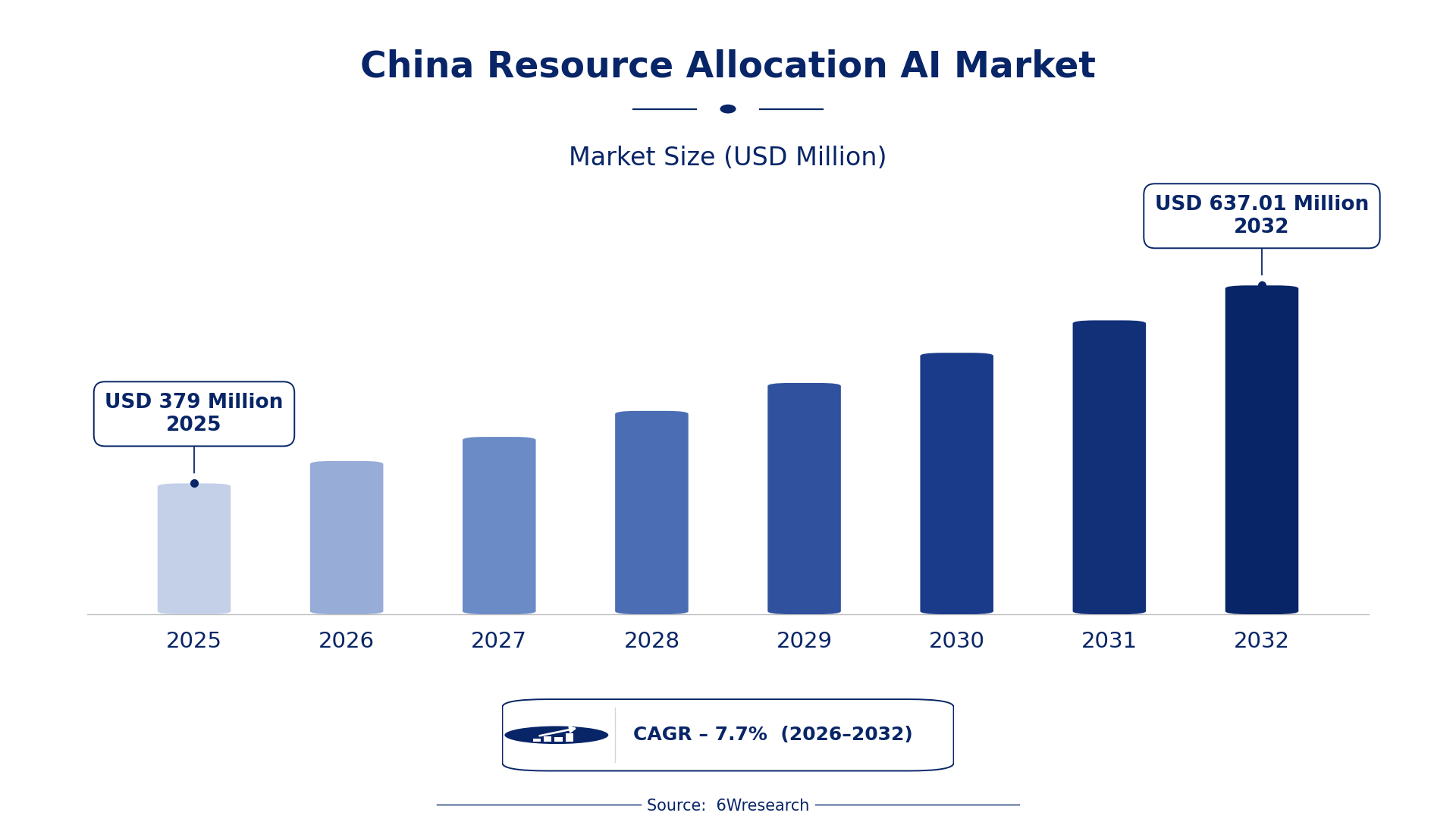
According to 6Wresearch internal database and industry insights, the China Resource Allocation AI Market was valued at USD 379.0 million in 2025 and is projected to reach USD 637.01 million by 2032, growing at a CAGR of approximately 7.7% during 2026–2032.
China Resource Allocation AI Market Highlights
| Report Metric | Details |
| Report Name | China Resource Allocation AI Market |
| Market Size 2025 | USD 379.0 million |
| Market Size 2032 | USD 637.01 million |
| Absolute Growth 2025–2032 | USD 258.01 million |
| CAGR 2026–2032 | 7.7% |
| Peak Annual Growth | 10.3% in 2026 |
| Forecast Period | 2026–2032 |
| Historical Data | 2022–2025 |
| Base Year | 2025 |
| Leading AI Application, 2025 | Healthcare Scheduling (34% share) |
| Leading Domain, 2025 | Doctor/Nurse Allocation (35% share) |
| Leading Optimization Method, 2025 | Predictive Analytics (41% share) |
| Leading End User, 2025 | Hospitals/Clinics (40% share) |
| Fastest-Growing AI Application | Manufacturing Planning (8.9% CAGR) |
| Fastest-Growing Domain | Machine/Staff Utilization (9.3% CAGR) |
| Fastest-Growing Optimization Method | Dynamic Scaling (9.9% CAGR) |
| Fastest-Growing End User | IT Companies (10.1% CAGR) |
| Growing Sector | Healthcare |
| Key End Users | Hospitals, IT Companies, Manufacturing Facilities, Telecom Providers |
China Resource Allocation AI Market Year-wise Growth Rate and Key Drivers (2022–2032)
This graph illustrates the annual growth rates of the market from 2022 to 2032, highlighting a steady upward trajectory and projected market expansion over the forecast period.
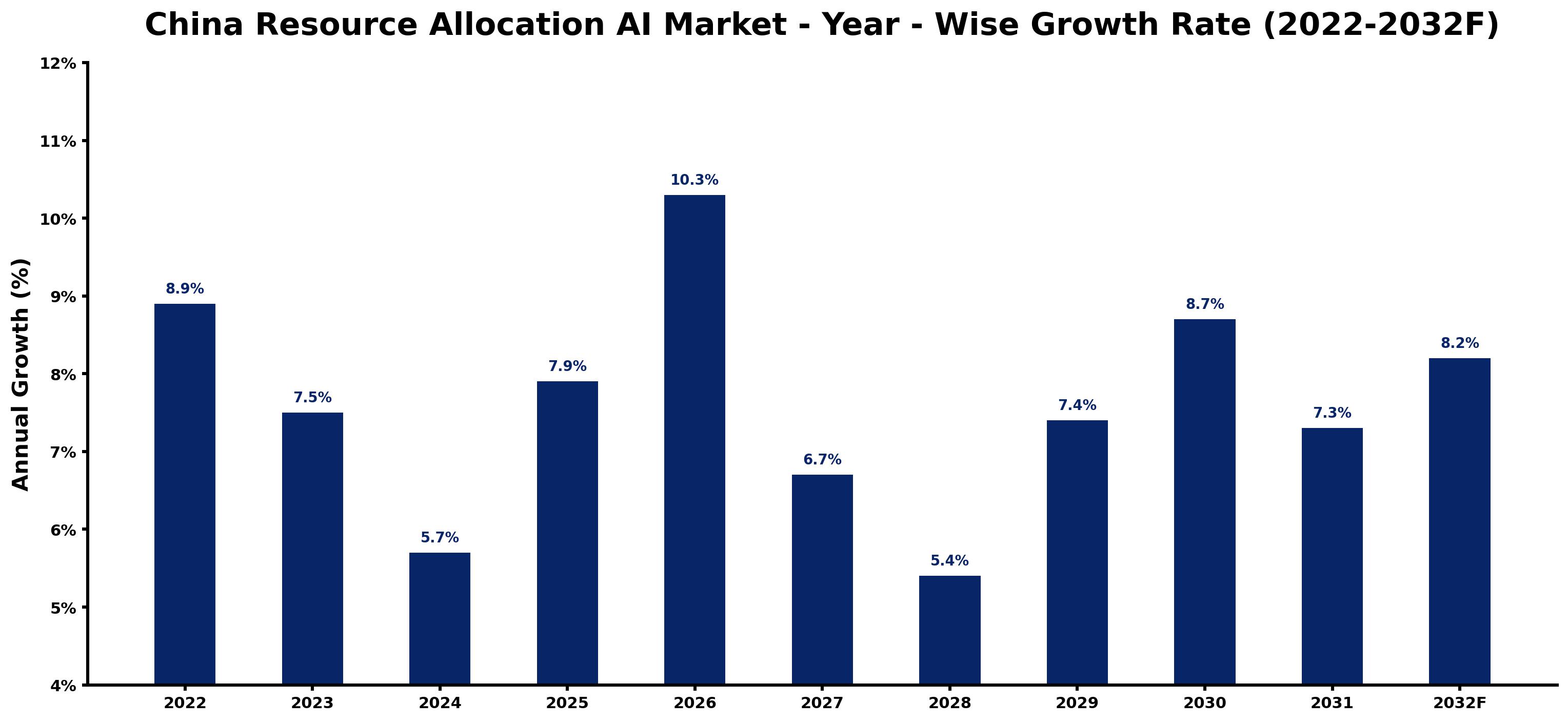
The table below sets out the estimated growth rate for each year and the main factor behind it.
| Year | Estimated Annual Growth (%) | Market Rationale |
| 2022 | 8.9 | The healthcare sector required efficient scheduling solutions due to over 2.5 million medical professionals. |
| 2023 | 7.5 | AI utilization in hospitals increased by 15%, indicating growing acceptance of advanced technologies. |
| 2024 | 5.7 | Demand slowed as the market adjusted to the rapid adoption of AI solutions in various sectors. |
| 2025 | 7.9 | The cloud computing market's growth accelerated demand for resource management solutions in healthcare. |
| 2026 | 10.3 | The Ministry of Industry and Information Technology's new program is expected to spur AI adoption in manufacturing. |
| 2027 | 6.7 | Growth is projected to slow as the 'AI Talent Development Program' matures and companies adapt to new technologies. |
| 2028 | 5.4 | The focus on optimizing cloud infrastructure will lead to a decrease in growth rate as businesses refine their strategies. |
| 2029 | 7.4 | Increased demand from IT companies for resource allocation solutions is expected to boost market growth as they seek efficiency. |
| 2030 | 8.7 | Healthcare facilities will continue to adopt AI for scheduling, driving further demand for advanced technologies. |
| 2031 | 7.3 | The market is projected to experience a slowdown as companies consolidate their AI investments and focus on core applications. |
| 2032 | 8.2 | Growth is expected to rise as the AI industry is projected to reach $150 billion, enhancing resource allocation capabilities. |
Note: Market size estimations and growth projections presented in this report are based on 6Wresearch's proprietary forecasting methodology, utilizing the latest available industry data, government publications, and primary research inputs.
China Resource Allocation AI Market Synopsis
Resource Allocation AI encompasses sophisticated algorithms designed to optimise resource distribution across various sectors in China. This technology enhances efficiency in healthcare scheduling, cloud resource management, and manufacturing processes. The China Resource Allocation AI Market is growing due to heightened demand from the healthcare and IT sectors. With over 2.5 million professionals in healthcare, there is a pressing need for effective scheduling solutions. The cloud computing market, valued at around $20 billion in 2022, further fuels the demand for resource management tools.
Market Dynamics Impact Analysis (2026–2032)
| Factor | Type | Impact | Primary Segment Affected |
| Growing healthcare workforce necessitates efficient scheduling solutions. | Driver | High | Healthcare Scheduling |
| Increasing cloud computing market fuels demand for resource management tools. | Driver | High | Cloud Resource Mgmt |
| Investment in AI technologies for healthcare optimization is rising. | Opportunity | High | Hospitals/Clinics |
| The rapid growth of AI applications in telecom creates new opportunities. | Opportunity | High | Telecom Network AI |
| Challenges in integrating AI with existing systems can slow adoption. | Restraint | Medium | Manufacturing Planning |
| High costs of AI implementation may deter smaller healthcare facilities. | Restraint | Medium | Healthcare Scheduling |
| Limited availability of skilled AI professionals affects project timelines. | Challenge | High | Healthcare Scheduling |
| Regulatory hurdles can delay the deployment of new AI technologies. | Challenge | High | Cloud Resource Mgmt |
Evaluation of Drivers in China Resource Allocation AI Market (2026–2032)
The table below links each growth driver to the segment it affects and the evidence for it.
| Drivers | Primary Segment Affected | Why It Matters (Evidence) |
| Growing healthcare workforce drives demand for scheduling solutions. | Healthcare Scheduling | China's healthcare sector employs over 2.5 million doctors and nurses, necessitating efficient scheduling. |
| Expansion of cloud computing market increases need for resource management. | Cloud Resource Mgmt | The cloud computing market in China reached approximately $20 billion in 2022, driving demand for resource management solutions. |
| AI adoption in manufacturing improves operational efficiency. | Manufacturing Planning | The Ministry of Industry and Information Technology launched a program to enhance AI adoption in 2023. |
| AI integration in telecom networks improves service quality. | Telecom Network AI | The China Academy of Information and Communications Technology reported a 20% growth in AI applications in telecom. |
| Healthcare facilities increasingly rely on AI for patient management. | Hospitals/Clinics | The National Health Commission reported a 15% increase in AI utilization in hospitals in 2023. |
Market growth for Resource Allocation AI in China is underpinned by the expanding healthcare workforce, increasing cloud computing market, and rising AI adoption in manufacturing. The healthcare sector employs over 2.5 million professionals, necessitating efficient scheduling solutions. The cloud computing market reached approximately $20 billion in 2022, driving demand for resource management tools. Hospitals reported a 15% increase in AI utilization, indicating a shift towards advanced technologies.
Evaluation of Restraints in China Resource Allocation AI Market
The table below lists the restraints and the evidence behind each.
| Market Restraint | Primary Segment Affected | Why It Matters (Evidence) |
| Integration challenges with existing systems slow down AI adoption. | Manufacturing Planning | Many manufacturers struggle to incorporate new AI technologies into their established processes, leading to inefficiencies. |
| High implementation costs deter smaller healthcare providers. | Healthcare Scheduling | Smaller hospitals may lack the budget for advanced AI systems, limiting their adoption and impacting patient care. |
| Limited availability of skilled professionals impacts project timelines. | Healthcare Scheduling | The demand for AI talent exceeds supply, causing delays in implementation and affecting project delivery. |
| Regulatory hurdles can complicate AI deployment. | Cloud Resource Mgmt | Strict regulations may slow the approval process for new AI technologies, hindering market growth. |
| Market maturity leads to slower growth rates. | Telecom Network AI | As the market matures, growth rates are expected to stabilise, impacting investment decisions. |
China Resource Allocation AI Market Challenges
Resource Allocation AI in China faces a skills shortage, as the rapid expansion of the AI sector outpaces the availability of qualified professionals, causing delays in project timelines for producers. Intense competition among developers leads to price wars, eroding profit margins and restricting investment in innovation for suppliers. Technological gaps remain, particularly in integrating AI with existing systems, resulting in inefficiencies and increased operational costs for buyers in healthcare and manufacturing. Compliance with standards such as ISO/IEC 27001 incurs high costs, deterring smaller firms from entering the market and limiting options for buyers seeking diverse solutions.
Trends in the China Resource Allocation AI Market
The trends below show where the China Resource Allocation AI Market is heading.
- AI Innovation Action Plan Promotes Resource Allocation: In 2023, the Ministry of Industry and Information Technology launched the 'AI Innovation Action Plan' to promote AI integration in various sectors. This initiative aims to boost resource allocation technologies, reflecting a growing emphasis on efficiency in industries.
- Shift Towards AI in Healthcare Scheduling: Healthcare facilities are increasingly adopting AI for scheduling, improving patient management and resource allocation. The National Health Commission reported a 15% increase in AI utilization in hospitals in 2023, indicating a trend towards technology integration.
- Cloud Resource Management Gains Traction: The cloud computing market's growth is driving demand for resource management solutions. In 2022, the market reached approximately $20 billion, prompting companies to seek AI tools for optimizing cloud infrastructure.
- Manufacturing Planning Embraces AI Solutions: Manufacturers are increasingly integrating AI technologies to improve production efficiency. A recent initiative supports this trend, focusing on resource allocation improvements.
Investment Opportunities in the China Resource Allocation AI Market
Below are the investment opportunities with the strongest case in the China Resource Allocation AI Market.
- Focus on Telecom AI Solutions: Telecom network providers are increasingly seeking AI solutions to manage resources effectively. Entering this market necessitates an understanding of regulatory frameworks and local partnerships, especially as the sector expands rapidly.
- Investment in Healthcare AI Technologies: With the healthcare sector employing over 2.5 million professionals, there is a growing demand for efficient scheduling solutions. Collaborating with hospitals can ease market entry and address this urgent need.
- Cloud Resource Management Solutions: The cloud computing market, valued at approximately $20 billion, indicates a demand for resource management tools. Partnering with IT companies can provide access to this expanding sector and improve service delivery.
- Manufacturing AI Integration: As manufacturers strive to enhance efficiency, there is a rising need for AI solutions in production planning. Establishing joint ventures with local firms can facilitate entry into this market and drive innovation.
Government Initiatives in the China Resource Allocation AI Market
In 2021, the National Health Commission implemented the 'Smart Healthcare Development Plan', aiming to improve AI utilization in hospitals by 30% by 2025. This initiative promotes the integration of AI technologies in healthcare settings, improving patient management and resource allocation. In 2022, the State Council approved the '14th Five-Year Plan for Digital Economy Development', emphasizing AI's role in optimizing resource allocation across industries. This plan outlines strategic goals for AI integration, ensuring that various sectors benefit from advanced technologies.
In 2023, the Ministry of Industry and Information Technology launched the 'AI Innovation Action Plan' to promote AI integration in various sectors, focusing on resource allocation technologies. This initiative has a budget of $10 billion for 2023-2025, aiming to support AI applications across industries. The National Development and Reform Commission facilitates AI integration in public services through funding programs, enabling the adoption of advanced technologies in various sectors.
Future Insight of the China Resource Allocation AI Market
The Resource Allocation AI market in China is poised for transformation by 2032, primarily driven by the government's commitment to the 'AI 2.0' strategy, which aims to expand AI applications across various sectors. By 2025, the AI industry is projected to reach $150 billion, with resource allocation emerging as a key focus area. Increased collaboration between tech startups and established industries will spur innovation and improve service delivery. As manufacturing processes become more efficient, buyers will benefit from reduced operational costs and improved service quality.
Market Segmentation Analysis
The report offers a comprehensive study of the following market segments and their leading categories in the market.
By AI Application – Healthcare Scheduling Dominated, Manufacturing Planning Expected to Grow Fastest
According to Ravi Bhandari, Research Head at 6Wresearch, with a 34% revenue share in 2025, Healthcare Scheduling was the largest ai application category. Healthcare scheduling commands the largest share in China as it directly addresses the needs of over 2.5 million healthcare professionals requiring efficient management. This sub-segment is vital for optimising patient care and resource allocation in hospitals, ensuring effective healthcare delivery. Over 2026–2032, Manufacturing Planning is expected to post the fastest growth, at a CAGR of 8.9%. Manufacturing planning is witnessing rapid growth, spurred by a 2023 initiative from the Ministry of Industry and Information Technology aimed at enhancing technology adoption in manufacturing. This focus on improving production efficiency will likely accelerate the demand for resource management solutions in factories nationwide. Suppliers should concentrate on creating specialised solutions for healthcare and manufacturing sectors to capture increasing market share.
By Domain – Doctor/Nurse Allocation Dominated, Machine/Staff Utilization Expected to Grow Fastest
Doctor/Nurse Allocation took a 35% share of domain in 2025, more than any other category. Doctor/nurse allocation leads the market share as it significantly impacts staffing efficiency in healthcare facilities, essential for managing the vast workforce in China's healthcare sector. This focus ensures better patient outcomes and operational effectiveness across hospitals and clinics. Machine/Staff Utilization is set to record the highest CAGR in this split, 9.3% over 2026–2032. Machine/staff utilization is the fastest-growing domain, propelled by the rising demand for operational efficiency across various industries. Companies are increasingly prioritising resource optimisation to stay competitive in the market. Buyers in healthcare and industrial sectors should focus on solutions that enhance staff and machine utilisation to maintain competitiveness.
By Optimization Method – Predictive Analytics Dominated, Dynamic Scaling Expected to Grow Fastest
Predictive Analytics accounted for a 41% market share by optimization method in 2025. Predictive analytics holds the largest share as it supports decision-making processes across various applications, indirectly improving operational efficiency. Its widespread use in sectors like healthcare and manufacturing makes it a fundamental component of resource allocation strategies. The quickest growth will come from Dynamic Scaling, forecast to expand at a CAGR of 9.9% between 2026 and 2032. Dynamic scaling is the fastest-growing method, reflecting the increased need for automation in resource management. As industries adopt more flexible systems, this method will become crucial for optimising resource allocation. Suppliers must invest in dynamic scaling technologies to meet the growing demand for automated resource management solutions.
By End User – Hospitals/Clinics Dominated, IT Companies Expected to Grow Fastest
Hospitals/Clinics held a 40% share of the China Resource Allocation AI Market by end user in 2025. Hospitals and clinics represent the largest market share as primary users of resource allocation technologies, directly employing these systems for patient care and operational efficiency. Their pivotal role in the healthcare system highlights the necessity for effective resource management. IT Companies are projected to grow fastest, at a CAGR of 10.1% during 2026–2032. IT companies are the fastest-growing end user group, driven by their urgent need to optimise operations and service delivery in a competitive environment. As digital transformation accelerates, these companies will increasingly depend on resource allocation technologies. Providers should tailor their offerings to meet the specific needs of hospitals and IT companies to capture a larger share of the market.
Key Attractiveness of the Report
- 10 Years of Market Numbers
- Historical Data Starting from 2022 to 2025
- Base Year 2025
- Forecast Data until 2032
- Key Performance Indicators Impacting the Market
- Major Upcoming Developments and Projects
Key Highlights of the Report:
- China Resource Allocation AI Market Outlook
- Market Size of China Resource Allocation AI Market, 2025
- Forecast of China Resource Allocation AI Market, 2032
- Historical Data and Forecast of China Resource Allocation AI Revenues & Volume for the Period 2022 - 2032F
- China Resource Allocation AI Market Trend Evolution
- China Resource Allocation AI Market Drivers and Challenges
- China Resource Allocation AI Price Trends
- China Resource Allocation AI Porter's Five Forces
- China Resource Allocation AI Industry Life Cycle
- Historical Data and Forecast of China Resource Allocation AI Market Revenues & Volume By AI Application for the Period 2022 - 2032F
- Historical Data and Forecast of China Resource Allocation AI Market Revenues & Volume By Healthcare Scheduling for the Period 2022 - 2032F
- Historical Data and Forecast of China Resource Allocation AI Market Revenues & Volume By Cloud Resource Mgmt for the Period 2022 - 2032F
- Historical Data and Forecast of China Resource Allocation AI Market Revenues & Volume By Manufacturing Planning for the Period 2022 - 2032F
- Historical Data and Forecast of China Resource Allocation AI Market Revenues & Volume By Telecom Network AI for the Period 2022 - 2032F
- Historical Data and Forecast of China Resource Allocation AI Market Revenues & Volume By Domain for the Period 2022 - 2032F
- Historical Data and Forecast of China Resource Allocation AI Market Revenues & Volume By Doctor/Nurse Allocation for the Period 2022 - 2032F
- Historical Data and Forecast of China Resource Allocation AI Market Revenues & Volume By Data Center Load Balancing for the Period 2022 - 2032F
- Historical Data and Forecast of China Resource Allocation AI Market Revenues & Volume By Machine/Staff Utilization for the Period 2022 - 2032F
- Historical Data and Forecast of China Resource Allocation AI Market Revenues & Volume By Bandwidth Allocation for the Period 2022 - 2032F
- Historical Data and Forecast of China Resource Allocation AI Market Revenues & Volume By Optimization Method for the Period 2022 - 2032F
- Historical Data and Forecast of China Resource Allocation AI Market Revenues & Volume By Predictive Analytics for the Period 2022 - 2032F
- Historical Data and Forecast of China Resource Allocation AI Market Revenues & Volume By Dynamic Scaling for the Period 2022 - 2032F
- Historical Data and Forecast of China Resource Allocation AI Market Revenues & Volume By AI Scheduling Tools for the Period 2022 - 2032F
- Historical Data and Forecast of China Resource Allocation AI Market Revenues & Volume By Reinforcement Learning for the Period 2022 - 2032F
- Historical Data and Forecast of China Resource Allocation AI Market Revenues & Volume By End User for the Period 2022 - 2032F
- Historical Data and Forecast of China Resource Allocation AI Market Revenues & Volume By Hospitals/Clinics for the Period 2022 - 2032F
- Historical Data and Forecast of China Resource Allocation AI Market Revenues & Volume By IT Companies for the Period 2022 - 2032F
- Historical Data and Forecast of China Resource Allocation AI Market Revenues & Volume By Factory Operations for the Period 2022 - 2032F
- Historical Data and Forecast of China Resource Allocation AI Market Revenues & Volume By Network Providers for the Period 2022 - 2032F
- China Resource Allocation AI Import Export Trade Statistics
- Market Opportunity Assessment By AI Application
- Market Opportunity Assessment By Domain
- Market Opportunity Assessment By Optimization Method
- Market Opportunity Assessment By End User
- China Resource Allocation AI Top Companies Market Share
- China Resource Allocation AI Competitive Benchmarking By Technical and Operational Parameters
- China Resource Allocation AI Company Profiles
- China Resource Allocation AI Key Strategic Recommendations
Market Covered
This report examines the market across the segments below.
By AI Application
- Healthcare Scheduling
- Cloud Resource Mgmt
- Manufacturing Planning
- Telecom Network AI
By Domain
- Doctor/Nurse Allocation
- Data Center Load Balancing
- Machine/Staff Utilization
- Bandwidth Allocation
By Optimization Method
- Predictive Analytics
- Dynamic Scaling
- AI Scheduling Tools
- Reinforcement Learning
By End User
- Hospitals/Clinics
- IT Companies
- Factory Operations
- Network Providers































