China Restaurant Automation AI Market Size & Growth Rate
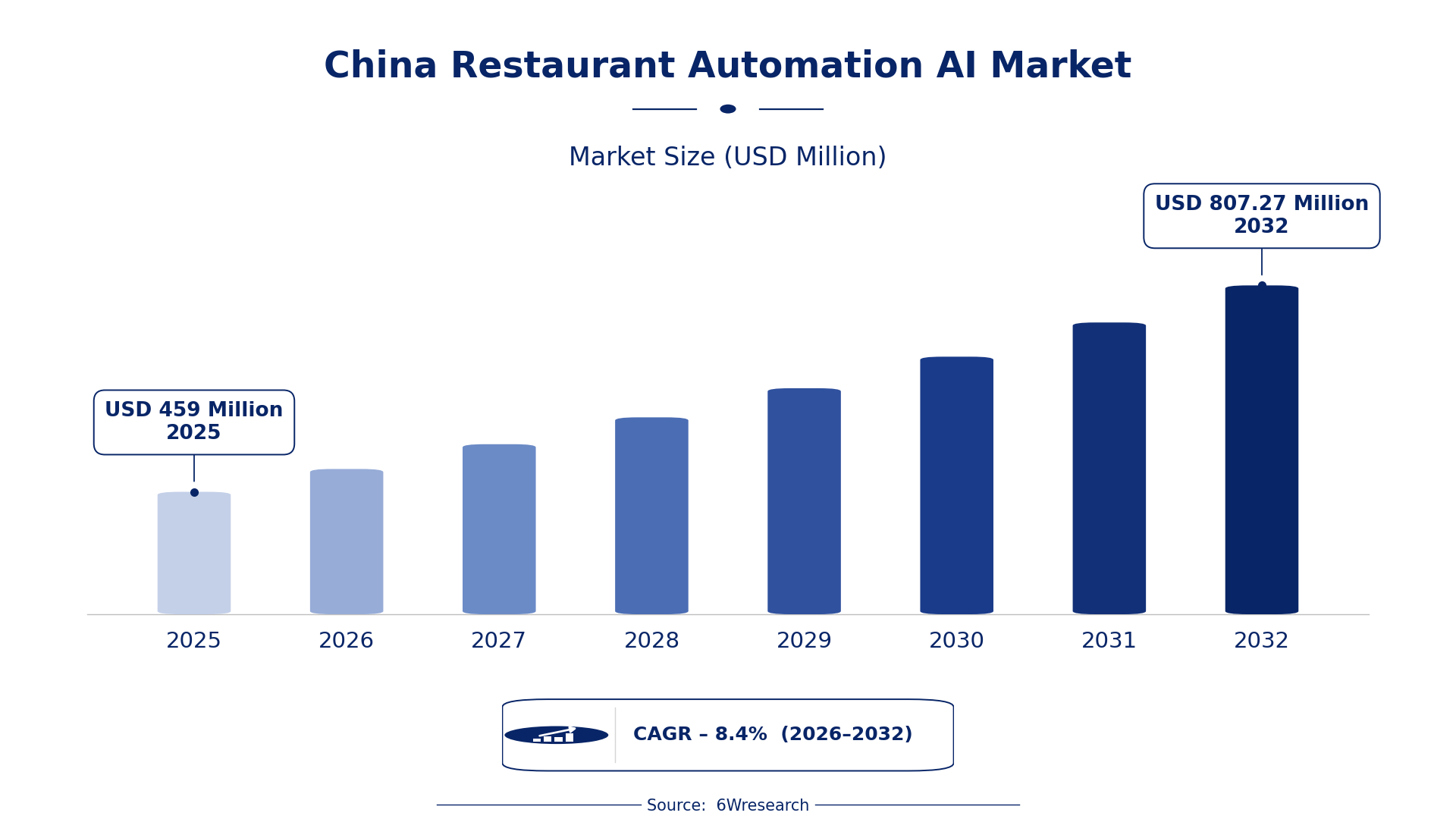
According to 6Wresearch internal database and industry insights, the China Restaurant Automation AI Market was valued at USD 459.0 million in 2025 and is projected to reach USD 807.27 million by 2032, growing at a CAGR of approximately 8.4% during 2026–2032.
China Restaurant Automation AI Market Highlights
| Report Metric | Details |
| Report Name | China Restaurant Automation AI Market |
| Market Size 2025 | USD 459.0 million |
| Market Size 2032 | USD 807.27 million |
| Absolute Growth 2025–2032 | USD 348.27 million |
| CAGR 2026–2032 | 8.4% |
| Peak Annual Growth | 10.7% in 2030 |
| Forecast Period | 2026–2032 |
| Historical Data | 2022–2025 |
| Base Year | 2025 |
| Leading AI Module, 2025 | Order Recognition AI (47% share) |
| Leading Application, 2025 | Voice/Kiosk Ordering (38% share) |
| Leading Deployment Type, 2025 | SaaS Cloud (45% share) |
| Leading End User, 2025 | Quick‑Serve Restaurants (34% share) |
| Fastest-Growing AI Module | Kitchen Robotics (11.1% CAGR) |
| Fastest-Growing Application | Food Prep/Plating (9.6% CAGR) |
| Fastest-Growing End User | Commercial Kitchens (10.5% CAGR) |
| Growing Sector | Quick-Serve Restaurants |
| Key End Users | Quick-Serve Restaurants, Commercial Kitchens, Restaurant Chains, Family & Fine-Dining Outlets |
China Restaurant Automation AI Market Year-wise Growth Rate and Key Drivers (2022–2032)
This graph illustrates the annual growth rates of the market from 2022 to 2032, highlighting a steady upward trajectory and projected market expansion over the forecast period.
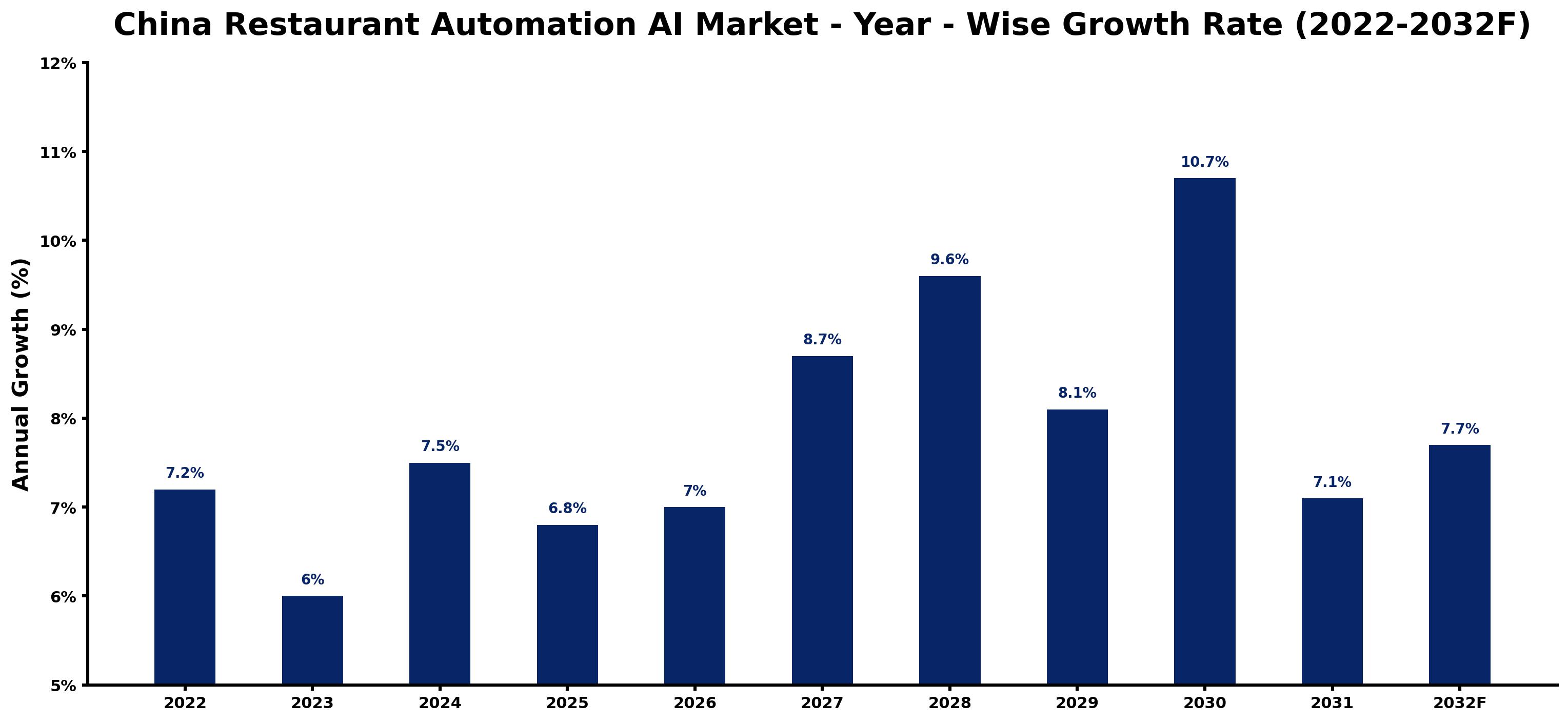
Annual growth estimates for each year appear below with the principal reason behind them, explaining the shifts that set the pace of the market.
| Year | Estimated Annual Growth (%) | Market Rationale |
| 2022 | 7.2 | The market experienced steady growth due to the integration of AI technologies in quick-serve restaurants. |
| 2023 | 6.0 | Demand growth slowed as some restaurants faced challenges in adopting advanced AI solutions for efficiency. |
| 2024 | 7.5 | Demand increased as more restaurants implemented AI for order recognition and kitchen operations, driven by the Smart Restaurant Development Plan. |
| 2025 | 6.8 | Growth slowed again as the market adjusted to rapid technological changes in automation. |
| 2026 | 7.0 | Demand is expected to rise as restaurants adopt cloud-based AI solutions to streamline operations, supported by the Digital Transformation of Restaurants Program. |
| 2027 | 8.7 | Growth is projected to continue as commercial kitchens increasingly implement automation technologies to improve efficiency. |
| 2028 | 9.6 | Demand is expected to rise further with advancements in kitchen robotics and AI applications for food service, driven by the AI in Food Service Strategy. |
| 2029 | 8.1 | Growth is projected to slow slightly as market saturation begins to affect new AI implementations in urban areas. |
| 2030 | 10.7 | The market is expected to peak as 80% of restaurants adopt automation technologies by 2030, driven by government initiatives. |
| 2031 | 7.1 | Growth is expected to slow as the market stabilises after high adoption rates in previous years. |
| 2032 | 7.7 | Demand is projected to increase again as new AI innovations emerge in the restaurant sector. |
Note: Market size estimations and growth projections presented in this report are based on 6Wresearch's proprietary forecasting methodology, utilizing the latest available industry data, government publications, and primary research inputs.
China Restaurant Automation AI Market Synopsis
Restaurant Automation AI in China refers to the integration of artificial intelligence technologies in the restaurant sector to streamline operations and improve customer service. This technology is developed through machine learning algorithms and data analytics, focusing on automating order processing and improving kitchen efficiency. The China Restaurant Automation AI Market is expanding rapidly, driven by strong demand from quick-serve restaurants and urban dining establishments. With over 1 million restaurants utilizing AI technologies in 2023, the market is set for continued growth as automation becomes essential for operational efficiency.
Market Dynamics Impact Analysis (2026–2032)
| Factor | Type | Impact | Primary Segment Affected |
| Growing demand for efficient service in urban areas drives automation adoption. | Driver | High | Voice/Kiosk Ordering |
| Increased focus on reducing food waste encourages investment in AI-driven inventory systems. | Driver | High | Inventory Forecasting AI |
| The rapid urbanisation in China creates a significant market for automation technologies. | Opportunity | High | Quick‑Serve Restaurants |
| The increasing number of new restaurant openings presents opportunities for AI solutions. | Opportunity | High | SaaS Cloud |
| Integration costs for AI technologies can be a barrier for smaller establishments. | Restraint | Medium | Commercial Kitchens |
| Limited understanding of AI capabilities among traditional restaurant owners may hinder adoption. | Restraint | Medium | Family & Fine-Dining Outlets |
| Buyers face challenges in selecting the right AI technologies for their operations. | Challenge | High | Restaurant Chains |
| Suppliers encounter delays in developing tailored solutions for diverse restaurant needs. | Challenge | Medium | Quick‑Serve Restaurants |
Evaluation of Drivers in China Restaurant Automation AI Market (2026–2032)
The main growth drivers and the segments they affect most are set out below.
| Drivers | Primary Segment Affected | Why It Matters (Evidence) |
| Increased consumer dining frequency drives demand for automation. | Quick‑Serve Restaurants | The average consumer dines out 4 times a week, leading to higher demand for efficient service solutions. |
| AI-driven inventory management reduces food waste. | Inventory Forecasting AI | AI systems can cut food waste by up to 30%, appealing to environmentally conscious establishments. |
| Urban areas are investing heavily in restaurant automation technologies. | Voice/Kiosk Ordering | In 2023, urban areas accounted for 70% of automation investments, driving demand for these solutions. |
| The quick-serve restaurant segment is leading in AI adoption. | SaaS Cloud | This segment is projected to dominate AI adoption by 2025, pushing demand for cloud solutions. |
| Government initiatives support AI integration in the restaurant sector. | Kitchen Robotics | The National Restaurant Association of China promotes AI technologies, encouraging widespread adoption. |
Market growth for Restaurant Automation AI in China is underpinned by rising consumer dining frequency, with the average consumer dining out four times a week. Urban areas accounted for 70% of automation investments in 2023, creating a strong demand for efficient service solutions. AI-driven inventory management systems can reduce food waste by up to 30%, appealing to environmentally conscious establishments. The quick-serve restaurant segment is set to lead in AI adoption by 2025, pushing demand for cloud solutions.
Evaluation of Restraints in China Restaurant Automation AI Market
The key brakes on demand, and where they bite hardest, are shown below.
| Market Restraint | Primary Segment Affected | Why It Matters (Evidence) |
| Market saturation in urban areas may slow down new AI implementations. | SaaS Cloud | As more restaurants adopt AI, fewer opportunities for new entrants may arise. |
| High implementation costs can deter smaller establishments from adopting AI solutions. | Quick‑Serve Restaurants | Annual investments in automation technology reached 5 billion yuan, making it challenging for smaller players. |
| Skills shortages in AI training hinder effective deployment. | Kitchen Robotics | Many staff lack the necessary expertise, resulting in inefficiencies for operators. |
| Rapid technological advancements can overwhelm restaurant owners. | Inventory Forecasting AI | This can cause delays in integrating new systems and negatively affect customer satisfaction. |
| Competition among over 1 million restaurants adopting AI technologies is fierce. | Voice/Kiosk Ordering | This makes it difficult for producers to maintain profit margins. |
China Restaurant Automation AI Market Challenges
High competition in the China Restaurant Automation AI market pressures producers, as over 1 million restaurants are integrating AI technologies, compelling many to lower prices to attract customers. Implementation costs pose a barrier for smaller establishments, with annual investments in automation reaching 5 billion yuan, which can delay their market entry. A shortage of skilled workers in AI training hampers effective deployment, leaving many staff without the necessary expertise, resulting in operational inefficiencies for restaurant operators. Rapid technological advancements can overwhelm owners, causing delays in system integration and negatively affecting customer satisfaction.
Trends in the China Restaurant Automation AI Market
Below mentioned are some of the trends shaping the China Restaurant Automation AI Market growth.
- Shift to AI-Driven Inventory Management: The National Restaurant Association of China is promoting AI-driven inventory systems, with a projected reduction in food waste by up to 30%. This shift allows restaurants to operate more sustainably while improving efficiency.
- Increase in Cloud-Based Solutions: In 2023, 60% of new restaurant openings preferred cloud-based AI solutions, reflecting a trend towards scalable technology. This preference helps streamline operations and reduce upfront costs for new establishments.
- Growing Demand from Quick-Serve Restaurants: Quick-serve restaurants are increasingly adopting automation technologies, with a projected lead in AI adoption by 2025. This trend indicates a shift towards efficiency in fast-paced dining environments.
- Adoption of ISO 9001 Standards: ISO 9001 standards are being adopted by restaurants to ensure quality management in AI applications. This trend improves operational reliability and customer satisfaction in the industry.
Investment Opportunities in the China Restaurant Automation AI Market
Investors looking at the China Restaurant Automation AI Market should consider the following areas.
- Partnerships with Technology Providers: Now is the time to invest in AI solutions, as urban areas accounted for 70% of automation investments in 2023. Collaborating with technology providers can assist restaurants in improving operational efficiency.
- Expansion of AI Training Programs: AI training programs for restaurant staff are being rolled out in major cities, creating a demand for training providers. This presents an opportunity for businesses to offer educational solutions.
- Focus on Voice/Kiosk Ordering Solutions: The demand for voice and kiosk ordering systems is on the rise, with a 38% market share anticipated by 2025. Suppliers can enter this market by developing user-friendly solutions.
- Investment in Kitchen Robotics: With a projected CAGR of 11.1% for Kitchen Robotics, there is an increasing need for suppliers to create advanced robotic solutions. This presents an opportunity for businesses to meet the evolving demands of restaurants.
Government Initiatives in the China Restaurant Automation AI Market
In 2023, the Ministry of Commerce launched the 'Digital Transformation of Restaurants Program' to enhance operational efficiency through AI. This initiative builds on the 'Smart Restaurant Development Plan' from 2021, which aimed to boost AI adoption by 30% by 2025. These measures support the integration of advanced technologies in the restaurant sector, ensuring compliance with safety and operational standards. The updated 'Food Safety Standards for AI Technologies' guarantees that automated systems meet necessary regulations, further facilitating AI adoption. The initiatives are designed to improve the operational capabilities of restaurants, allowing them to effectively leverage AI solutions.
The National Development and Reform Commission initiated the 'AI in Food Service Strategy' in 2022, with a budget of 1 billion yuan to support technology integration. This funding aims to enhance the operational capabilities of restaurants through AI solutions, while the Ministry of Industry and Information Technology oversees the implementation of these initiatives. This support enables producers to access advanced technologies and improve their operational efficiencies, allowing them to meet the growing demands of consumers.
Future Insight of the China Restaurant Automation AI Market
The China Restaurant Automation AI market will experience notable changes by 2032, driven by several key factors. The National Restaurant Association's initiatives aim for 80% of restaurants to adopt automation by 2030, which will improve operational efficiency. Urban centres will witness a rise in AI-driven customer interactions, enhancing the overall dining experience. AI training programs for restaurant staff in major cities will ensure effective use of these technologies, while AI-driven inventory management systems are expected to significantly reduce food waste, benefiting both buyers and suppliers.
Market Segmentation Analysis
Each segment group is reviewed below, with the leader by share and the fastest grower by CAGR.
By AI Module – Order Recognition AI Dominated, Kitchen Robotics Expected to Grow Fastest
According to Ravi Bhandari, Research Head at 6Wresearch, in 2025, Order Recognition AI led the ai module split with a 47% share. Order Recognition AI commands the largest share due to its role in automating order taking, which is crucial for efficiency in busy restaurant environments. With a notable 50% adoption rate in major cities, it has become a go-to solution for establishments aiming to enhance operational workflows. Kitchen Robotics are set to record the highest CAGR in this split, 11.1% over 2026–2032. Kitchen Robotics is experiencing rapid growth as restaurants increasingly seek to improve food preparation and consistency, driven by customer demand for quality. This segment's expansion is highlighted by rising investments in robotic solutions that meet evolving service expectations. Suppliers should focus on developing advanced automation modules to cater to the growing demand in the restaurant sector.
By Application – Voice/Kiosk Ordering Dominated, Food Prep/Plating Expected to Grow Fastest
Voice/Kiosk Ordering took a 38% share of application in 2025, more than any other category. Voice/Kiosk Ordering leads the market by streamlining ordering processes, making it a preferred choice for restaurants aiming to enhance customer interaction. Its widespread adoption in urban areas, where dining out is common, underscores its substantial market share. Over 2026–2032, Food Prep/Plating is expected to post the fastest growth, at a CAGR of 9.6%. Food Prep/Plating is the fastest-growing application, fuelled by the necessity for consistent food presentation in a competitive landscape. As restaurants strive to maintain high standards, this segment is attracting significant investment and interest. Buyers should explore advanced food preparation solutions to elevate service quality and meet customer expectations.
By Deployment Type – SaaS Cloud Dominated and Is Expected to Record the Fastest Growth
The largest deployment type category in 2025 was SaaS Cloud, with a 45% share of total revenue. SaaS Cloud dominates the deployment type segment by providing scalable solutions for restaurants, facilitating seamless integration of automation technologies. Its popularity is evident among new restaurant openings, which prefer cloud-based systems for their flexibility and ease of use. SaaS Cloud is also forecast to expand faster than any other category, at a CAGR of 10.4% over 2026–2032. SaaS Cloud is also the fastest-growing deployment type, as its scalability and user-friendliness continue to attract more establishments. The ongoing demand for cloud solutions indicates that this trend will persist, further solidifying its market position. Suppliers must prioritise cloud-based offerings to align with the industry's shift towards scalable automation solutions.
By End User – Quick‑Serve Restaurants Dominated, Commercial Kitchens Expected to Grow Fastest
Quick‑Serve Restaurants accounted for a 34% market share by end user in 2025. Quick‑Serve Restaurants hold the largest share of the end-user segment, being primary users of automation technologies designed to boost operational efficiency. Their high transaction volumes necessitate the adoption of solutions that effectively manage customer interactions and streamline service. Commercial Kitchens are projected to grow fastest, at a CAGR of 10.5% during 2026–2032. Commercial Kitchens are the fastest-growing end-user segment, utilising automation to enhance efficiency in food preparation and service. As the demand for streamlined operations increases, this segment is rapidly adopting technologies to maintain competitiveness. Suppliers should tailor their solutions to meet the specific needs of commercial kitchens, which are increasingly seeking automation to optimise their processes.
Key Attractiveness of the Report
- 10 Years of Market Numbers
- Historical Data Starting from 2022 to 2025
- Base Year 2025
- Forecast Data until 2032
- Key Performance Indicators Impacting the Market
- Major Upcoming Developments and Projects
Key Highlights of the Report:
- China Restaurant Automation AI Market Outlook
- Market Size of China Restaurant Automation AI Market, 2025
- Forecast of China Restaurant Automation AI Market, 2032
- Historical Data and Forecast of China Restaurant Automation AI Revenues & Volume for the Period 2022 - 2032F
- China Restaurant Automation AI Market Trend Evolution
- China Restaurant Automation AI Market Drivers and Challenges
- China Restaurant Automation AI Price Trends
- China Restaurant Automation AI Porter's Five Forces
- China Restaurant Automation AI Industry Life Cycle
- Historical Data and Forecast of China Restaurant Automation AI Market Revenues & Volume By AI Module for the Period 2022 - 2032F
- Historical Data and Forecast of China Restaurant Automation AI Market Revenues & Volume By Order Recognition AI for the Period 2022 - 2032F
- Historical Data and Forecast of China Restaurant Automation AI Market Revenues & Volume By Kitchen Robotics for the Period 2022 - 2032F
- Historical Data and Forecast of China Restaurant Automation AI Market Revenues & Volume By Inventory Forecasting AI for the Period 2022 - 2032F
- Historical Data and Forecast of China Restaurant Automation AI Market Revenues & Volume By Customer Experience AI for the Period 2022 - 2032F
- Historical Data and Forecast of China Restaurant Automation AI Market Revenues & Volume By Application for the Period 2022 - 2032F
- Historical Data and Forecast of China Restaurant Automation AI Market Revenues & Volume By Voice/Kiosk Ordering for the Period 2022 - 2032F
- Historical Data and Forecast of China Restaurant Automation AI Market Revenues & Volume By Food Prep/Plating for the Period 2022 - 2032F
- Historical Data and Forecast of China Restaurant Automation AI Market Revenues & Volume By Stock Management for the Period 2022 - 2032F
- Historical Data and Forecast of China Restaurant Automation AI Market Revenues & Volume By Voice Assistant/Table Service for the Period 2022 - 2032F
- Historical Data and Forecast of China Restaurant Automation AI Market Revenues & Volume By Deployment Type for the Period 2022 - 2032F
- Historical Data and Forecast of China Restaurant Automation AI Market Revenues & Volume By Cloud or Edge for the Period 2022 - 2032F
- Historical Data and Forecast of China Restaurant Automation AI Market Revenues & Volume By On-Premise for the Period 2022 - 2032F
- Historical Data and Forecast of China Restaurant Automation AI Market Revenues & Volume By SaaS Cloud for the Period 2022 - 2032F
- Historical Data and Forecast of China Restaurant Automation AI Market Revenues & Volume By Edge AI for the Period 2022 - 2032F
- Historical Data and Forecast of China Restaurant Automation AI Market Revenues & Volume By End User for the Period 2022 - 2032F
- Historical Data and Forecast of China Restaurant Automation AI Market Revenues & Volume By Quick Serve Restaurants for the Period 2022 - 2032F
- Historical Data and Forecast of China Restaurant Automation AI Market Revenues & Volume By Commercial Kitchens for the Period 2022 - 2032F
- Historical Data and Forecast of China Restaurant Automation AI Market Revenues & Volume By Restaurant Chains for the Period 2022 - 2032F
- Historical Data and Forecast of China Restaurant Automation AI Market Revenues & Volume By Family & Fine-Dining Outlets for the Period 2022 - 2032F
- China Restaurant Automation AI Import Export Trade Statistics
- Market Opportunity Assessment By AI Module
- Market Opportunity Assessment By Application
- Market Opportunity Assessment By Deployment Type
- Market Opportunity Assessment By End User
- China Restaurant Automation AI Top Companies Market Share
- China Restaurant Automation AI Competitive Benchmarking By Technical and Operational Parameters
- China Restaurant Automation AI Company Profiles
- China Restaurant Automation AI Key Strategic Recommendations
Market Covered
This report examines the market across the segments below.
By AI Module
- Order Recognition AI
- Kitchen Robotics
- Inventory Forecasting AI
- Customer Experience AI
By Application
- Voice/Kiosk Ordering
- Food Prep/Plating
- Stock Management
- Voice Assistant/Table Service
By Deployment Type
- Cloud or Edge
- On-Premise
- SaaS Cloud
- Edge AI
By End User
- Quick‑Serve Restaurants
- Commercial Kitchens
- Restaurant Chains
- Family & Fine-Dining Outlets































