India Restaurant Automation AI Market Size & Growth Rate
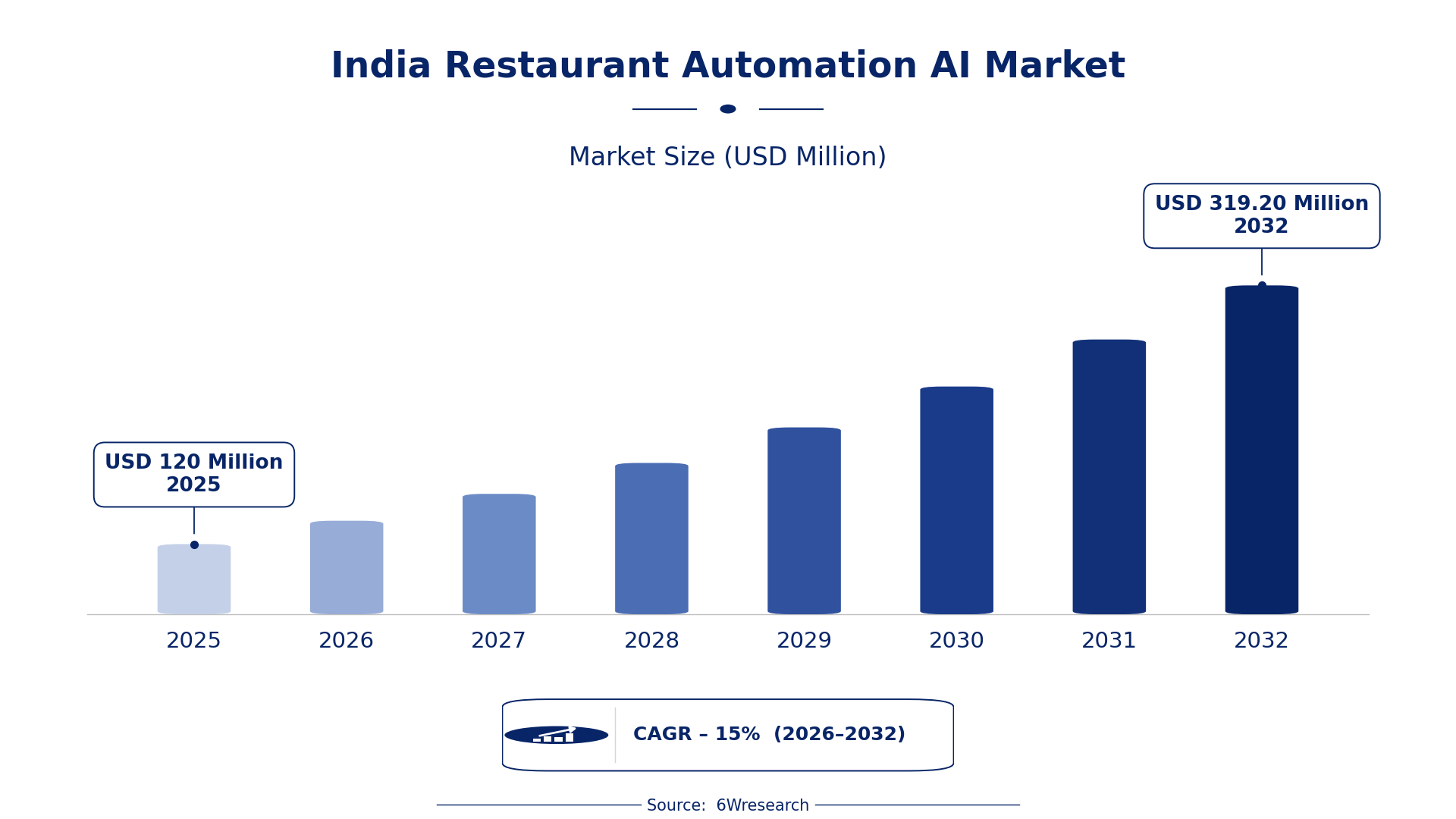
According to 6Wresearch internal database and industry insights, the India Restaurant Automation AI Market was valued at USD 120 million in 2025 and is projected to reach USD 319.20 million by 2032, growing at a CAGR of approximately 15% during 2026–2032.
India Restaurant Automation AI Market Highlights
| Report Metric | Details |
| Report Name | India Restaurant Automation AI Market |
| Market Size 2025 | USD 120 million |
| Market Size 2032 | USD 319.20 million |
| Absolute Growth 2025–2032 | USD 199.20 million |
| CAGR 2026–2032 | 15% |
| Peak Annual Growth | 16.9% in 2032 |
| Forecast Period | 2026–2032 |
| Historical Data | 2022–2025 |
| Base Year | 2025 |
| Leading AI Module, 2025 | Order Recognition AI (43% share) |
| Leading Application, 2025 | Voice/Kiosk Ordering (51% share) |
| Leading Deployment Type, 2025 | SaaS Cloud (46% share) |
| Leading End User, 2025 | Quick‑Serve Restaurants (48% share) |
| Fastest-Growing AI Module | Inventory Forecasting AI (17.7% CAGR) |
| Fastest-Growing Deployment Type | Cloud or Edge (16.5% CAGR) |
| Fastest-Growing End User | Restaurant Chains (16.4% CAGR) |
| Growing Sector | Quick-Service Restaurants |
| Key End Users | Quick-Service Restaurants, Commercial Kitchens, Restaurant Chains, Family & Fine-Dining Outlets |
India Restaurant Automation AI Market Year-wise Growth Rate and Key Drivers (2022–2032)
This graph illustrates the annual growth rates of the market from 2022 to 2032, highlighting a steady upward trajectory and projected market expansion over the forecast period.
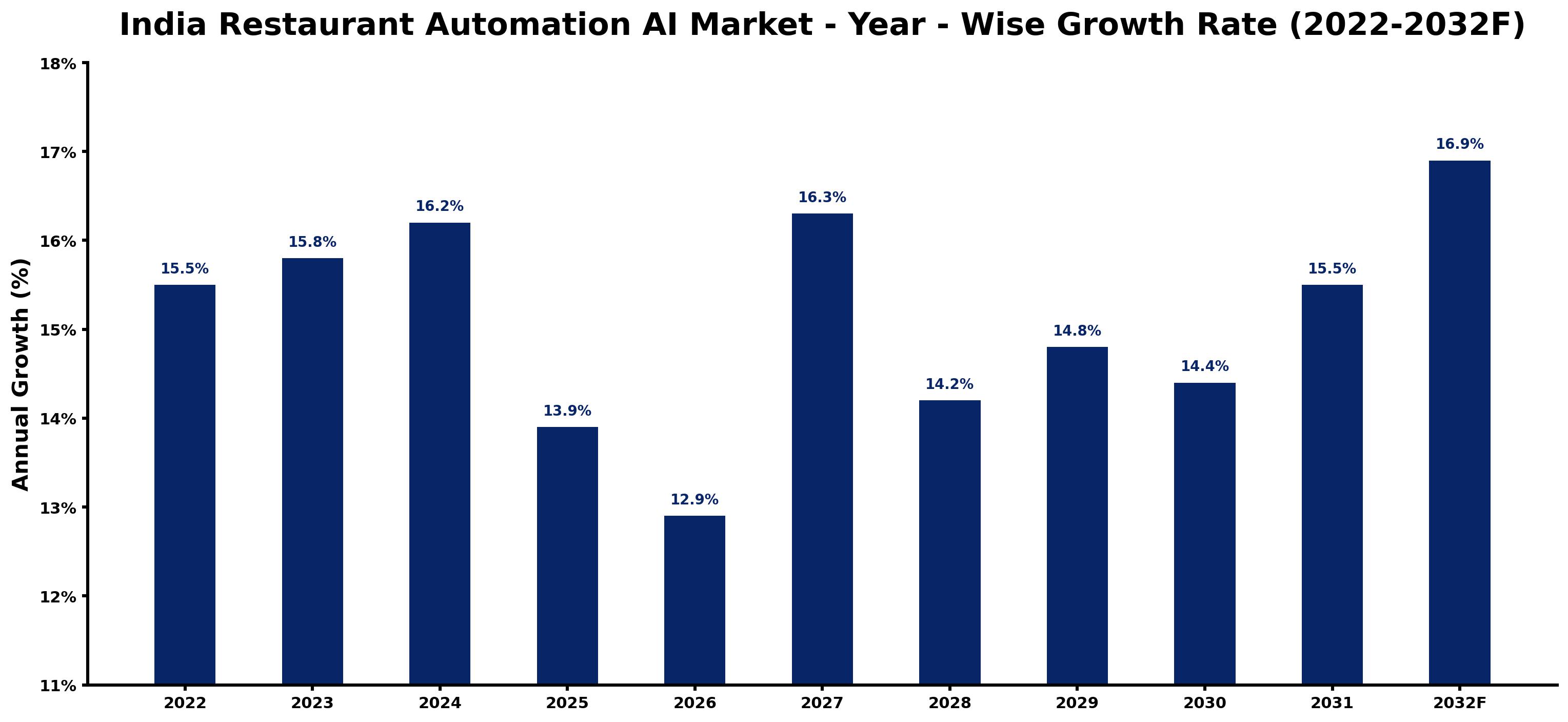
Year by year, the estimates below pair each growth rate with the development that shaped it.
| Year | Estimated Annual Growth (%) | Market Rationale |
| 2022 | 15.5 | The market experienced strong demand from urban restaurants adopting AI technologies. |
| 2023 | 15.8 | Growth accelerated as more establishments integrated automation into their operations. |
| 2024 | 16.2 | Technological advancements drove higher adoption rates among restaurant owners, particularly in urban areas. |
| 2025 | 13.9 | Growth slowed as some restaurants faced challenges in implementing new systems, impacting operational efficiency. |
| 2026 | 12.9 | Demand is expected to rise as the 'Digital India 2.0' programme promotes technology in hospitality. |
| 2027 | 16.3 | A resurgence in interest for automation spurred by changing consumer preferences is projected to emerge. |
| 2028 | 14.2 | Growth is anticipated to decelerate slightly as some segments mature and competition intensifies. |
| 2029 | 14.8 | Increased consumer spending on dining out will boost demand for automation solutions in quick-service restaurants. |
| 2030 | 14.4 | A slight slowdown is expected as the market begins to stabilise after rapid growth in automation adoption. |
| 2031 | 15.5 | Demand is projected to surge again as urbanisation continues to drive restaurant automation initiatives. |
| 2032 | 16.9 | The market is expected to peak as advancements in AI technologies reach new heights, enhancing operational capabilities. |
Note: Market size estimations and growth projections presented in this report are based on 6Wresearch's proprietary forecasting methodology, utilizing the latest available industry data, government publications, and primary research inputs.
India Restaurant Automation AI Market Synopsis
The India Restaurant Automation AI Market includes technologies that optimise operations through automation and artificial intelligence. This market is propelled by the swift adoption of AI technologies in urban areas, with the restaurant industry anticipated to reach $73 billion by 2025. Factors such as the burgeoning urban population, expected to surpass 600 million by 2031, and a rising demand for operational efficiency are driving this expansion. The National Restaurant Association of India actively encourages technology adoption, further reinforcing this trend.
Market Dynamics Impact Analysis (2026–2032)
| Factor | Type | Impact | Primary Segment Affected |
| Rapid urbanisation is increasing the demand for efficient restaurant operations. | Driver | High | Quick‑Serve Restaurants |
| AI-driven inventory management reduces food waste significantly, appealing to cost-conscious operators. | Driver | High | Inventory Forecasting AI |
| The growing trend of digital dining experiences creates opportunities for innovative solutions. | Opportunity | High | Voice/Kiosk Ordering |
| Investment in local production of automation technologies is on the rise, enhancing supply chains. | Opportunity | Medium | SaaS Cloud |
| High initial costs of AI implementation can deter smaller establishments from adopting technology. | Restraint | High | Commercial Kitchens |
| Limited technical expertise among staff can hinder effective implementation of automation. | Restraint | Medium | Restaurant Chains |
| Supply chain disruptions can delay the availability of essential technologies for restaurants. | Challenge | High | Quick‑Serve Restaurants |
| Competition from traditional dining establishments can slow the adoption of automation technologies. | Challenge | Medium | Family & Fine-Dining Outlets |
Evaluation of Drivers in India Restaurant Automation AI Market (2026–2032)
The table below links each growth driver to the segment it affects and the evidence for it.
| Drivers | Primary Segment Affected | Why It Matters (Evidence) |
| Growing urban population drives demand for efficient restaurant operations. | Quick‑Serve Restaurants | The urban population in India is expected to exceed 600 million by 2031, increasing the need for automation. |
| AI-driven inventory management reduces food waste. | Inventory Forecasting AI | AI-driven inventory management can reduce food waste by up to 30% in restaurants, appealing to cost-conscious operators. |
| Increasing consumer spending on dining out boosts demand for automation solutions. | Voice/Kiosk Ordering | The average Indian consumer spends approximately ₹1,200 on dining out per month, creating demand for efficient ordering systems. |
| Technological advancements in AI are improving restaurant operations. | Customer Experience AI | The National Restaurant Association of India promotes the adoption of technology, leading to increased efficiency. |
| The 'Digital India' initiative encourages technology adoption in various sectors. | SaaS Cloud | In 2023, the Indian government launched the 'Digital India' initiative to enhance technology in hospitality. |
The Restaurant Automation AI market in India is expanding as urbanisation drives demand for efficient restaurant operations and consumer spending on dining out increases. The urban population is projected to exceed 600 million by 2031, creating a greater need for automation solutions. AI-driven inventory management can reduce food waste by up to 30%, appealing to cost-conscious operators. As consumer preferences shift towards efficiency, restaurants are increasingly adopting AI technologies to improve service quality and operational performance.
Evaluation of Restraints in India Restaurant Automation AI Market
The table below lists the restraints and the evidence behind each.
| Market Restraint | Primary Segment Affected | Why It Matters (Evidence) |
| High initial costs of AI implementation can deter smaller establishments from adopting technology. | Commercial Kitchens | The average investment required for AI systems can be substantial, limiting access for smaller operators. |
| Limited technical expertise among staff can hinder effective implementation of automation. | Restaurant Chains | Many restaurant staff lack the necessary training to operate advanced AI systems, slowing adoption. |
| Supply chain disruptions can delay the availability of essential technologies for restaurants. | Quick‑Serve Restaurants | Recent global supply chain issues have caused delays in acquiring necessary automation equipment. |
| Regulatory hurdles can complicate the integration of new technologies in restaurants. | Family & Fine-Dining Outlets | Compliance with food safety standards can slow the adoption of automated services, delaying market entry. |
| Market competition from traditional dining establishments can slow the adoption of automation technologies. | Quick‑Serve Restaurants | Some consumers prefer traditional dining experiences, affecting the speed of automation uptake. |
India Restaurant Automation AI Market Challenges
The India Restaurant Automation AI Market faces a critical skills shortage, as many restaurant staff lack the necessary technical expertise, raising training costs for owners by around 20%. Supply chain issues impede the timely acquisition of essential AI technologies, leading to potential revenue losses of up to ₹5 lakh for restaurants unable to modernise swiftly. Intense competition among establishments to adopt automation escalates costs, prompting many to postpone investments in AI systems that improve operational efficiency. Regulatory hurdles, particularly compliance with FSSAI standards for automated food services, complicate approvals, resulting in delays of several months for new technologies to enter the market.
Trends in the India Restaurant Automation AI Market
Four trends stand out in the India Restaurant Automation AI Market.
- Shift from Traditional Ordering to Voice/Kiosk Systems: Since 2023, the adoption of voice and kiosk ordering systems has surged in urban restaurants, with over 50% of establishments implementing these technologies. This shift improves customer experience and operational efficiency, appealing to tech-savvy consumers.
- Transition to Cloud-Based Solutions: In 2023, the trend towards cloud-based restaurant management systems gained momentum, with SaaS Cloud solutions capturing 46% of the deployment market. This transition allows restaurants to streamline operations and enhance data management.
- AI Integration in Inventory Management: Beginning in 2024, AI-driven inventory management systems are projected to reduce food waste by up to 30%, with many commercial kitchens adopting these technologies to optimise stock levels. This integration is crucial for cost savings and sustainability.
- Growth of Quick-Service Restaurants: The quick-service restaurant segment is experiencing rapid growth, expected to expand at a CAGR of 10% from 2023 to 2028. This expansion is driven by increasing consumer demand for fast, efficient dining options, prompting more establishments to adopt automation.
Investment Opportunities in the India Restaurant Automation AI Market
Some of the investment opportunities in the India Restaurant Automation AI Market are mentioned below.
- Quick-Service Restaurants Seeking Efficiency: Quick-service restaurants are increasingly pursuing automation solutions to improve efficiency. Collaborating with local technology providers can facilitate entry into this expanding segment, projected to reach $73 billion by 2025.
- Investment in Local Production of Automation Technologies: The 'Make in India' initiative encourages local production of restaurant automation technologies, creating opportunities for investment. Partnering with local firms can help navigate regulatory requirements and enhance market presence.
- Expansion of Smart Commercial Kitchens: Commercial kitchens are broadening their operations and seeking automation solutions to streamline food preparation. Investing in AI-driven kitchen robotics can cater to this growing demand, particularly in urban areas.
- Supply of AI-Driven Customer Experience Solutions: Restaurants are increasingly focusing on enhancing customer interactions through AI-driven solutions. Providing tailored customer experience AI technologies can meet the needs of urban establishments aiming to improve service quality.
Government Initiatives in the India Restaurant Automation AI Market
In 2021, the Ministry of Electronics and Information Technology launched the 'Digital India 2.0' programme to enhance digital infrastructure across sectors, including restaurants. This initiative aims to increase technology access and stimulate innovation in the hospitality industry. Additionally, the 'Skill India' initiative, launched in 2020, focuses on training workers in the hospitality sector to effectively utilise technology, ensuring that staff are equipped to handle automated systems. These measures support the growth of the Restaurant Automation AI market by promoting technology adoption and workforce readiness.
The 'Startup India' programme provides funding and support for new ventures in restaurant technology, encouraging innovation in automation solutions. The Ministry of Food Processing Industries introduced a scheme in 2022 for technology upgradation in food processing units, benefiting restaurants by facilitating access to advanced technologies. Furthermore, the 'Atmanirbhar Bharat' initiative promotes self-reliance in technology development for the hospitality sector, including automation solutions, which improves local production capabilities.
Future Insight of the India Restaurant Automation AI Market
The India Restaurant Automation AI Market will undergo substantial transformation by 2032, driven by the urban population exceeding 600 million, which will heighten demand for automation solutions. The 'Digital India' initiative will encourage technology adoption in restaurants, streamlining operations and enhancing customer experiences. Over 50% of urban restaurants are expected to implement AI technologies, which can reduce food waste by up to 30% through effective inventory management. Support from the Ministry of Tourism for smart tourism will also promote the expansion of automated services, benefiting both buyers and suppliers.
Market Segmentation Analysis
Each segment group is reviewed below, with the leader by share and the fastest grower by CAGR.
By AI Module – Order Recognition AI Dominated, Inventory Forecasting AI Expected to Grow Fastest
According to Ravi Bhandari, Research Head at 6Wresearch, Order Recognition AI took a 43% share of ai module in 2025, more than any other category. Order Recognition holds the largest share because it significantly enhances the ordering process, which is vital for operational efficiency and customer satisfaction. This technology is particularly prevalent in urban restaurants, where the need for accuracy and speed in order processing is critical. Inventory Forecasting AI is set to record the highest CAGR in this split, 17.7% over 2026–2032. Inventory Forecasting is witnessing rapid growth as restaurants increasingly look to optimise stock levels and minimise waste, with evidence indicating it can reduce food waste by up to 30%. As the push for efficient inventory management intensifies, this segment is poised for substantial expansion. Suppliers should prioritise the development of solutions that address the specific operational challenges faced by restaurants, especially in urban settings.
By Application – Voice/Kiosk Ordering Dominated and Is Expected to Record the Fastest Growth
With a 51% revenue share in 2025, Voice/Kiosk Ordering was the largest application category. Voice/Kiosk Ordering dominates the market as it directly facilitates customer orders, improving the overall efficiency of the ordering process. Its widespread use in urban restaurants highlights a strong consumer preference for self-service options, which enhances service speed. The same category is also set to grow fastest, at a CAGR of 16.5% during 2026–2032. Voice/Kiosk Ordering is also the fastest-growing application, spurred by the rising demand for contactless service options in response to evolving consumer preferences. As more restaurants implement this technology, its market share is expected to grow rapidly. Buyers should invest in voice and kiosk ordering systems to improve customer experience and streamline operations.
By Deployment Type – SaaS Cloud Dominated, Cloud or Edge Expected to Grow Fastest
The largest deployment type category in 2025 was SaaS Cloud, with a 46% share of total revenue. SaaS Cloud dominates the market as it provides scalable solutions that are essential for managing restaurant operations efficiently. The flexibility and cost-effectiveness of SaaS models make them particularly appealing to urban restaurants looking to streamline their processes. Cloud or Edge is projected to grow fastest, at a CAGR of 16.5% during 2026–2032. Cloud or Edge deployment types are growing quickly due to their ability to facilitate real-time data management and analytics, which are critical for operational success. As more restaurants transition to these technologies, their market share will continue to rise. Suppliers must ensure their solutions are compatible with cloud technologies to meet the evolving demands of the restaurant industry.
By End User – Quick‑Serve Restaurants Dominated, Restaurant Chains Expected to Grow Fastest
In 2025, Quick‑Serve Restaurants led the end user split with a 48% share. Quick‑Serve Restaurants hold the largest share as they benefit directly from automation technologies that enhance service speed and operational efficiency. The high transaction volume in this segment necessitates the adoption of advanced solutions to remain competitive. Over 2026–2032, Restaurant Chains are expected to post the fastest growth, at a CAGR of 16.4%. Restaurant Chains are the fastest-growing end user segment, as they increasingly implement automation to standardise operations across multiple locations, ensuring consistency and efficiency. This trend is likely to accelerate as chains expand their operational capabilities. Suppliers should customise their offerings to meet the unique needs of restaurant chains, focusing on solutions that enhance standardisation and operational efficiency.
Key Attractiveness of the Report
- 10 Years of Market Numbers
- Historical Data Starting from 2022 to 2025
- Base Year 2025
- Forecast Data until 2032
- Key Performance Indicators Impacting the Market
- Major Upcoming Developments and Projects
Key Highlights of the Report:
- India Restaurant Automation AI Market Outlook
- Market Size of India Restaurant Automation AI Market, 2025
- Forecast of India Restaurant Automation AI Market, 2032
- Historical Data and Forecast of India Restaurant Automation AI Revenues & Volume for the Period 2022 - 2032F
- India Restaurant Automation AI Market Trend Evolution
- India Restaurant Automation AI Market Drivers and Challenges
- India Restaurant Automation AI Price Trends
- India Restaurant Automation AI Porter's Five Forces
- India Restaurant Automation AI Industry Life Cycle
- Historical Data and Forecast of India Restaurant Automation AI Market Revenues & Volume By AI Module for the Period 2022 - 2032F
- Historical Data and Forecast of India Restaurant Automation AI Market Revenues & Volume By Order Recognition AI for the Period 2022 - 2032F
- Historical Data and Forecast of India Restaurant Automation AI Market Revenues & Volume By Kitchen Robotics for the Period 2022 - 2032F
- Historical Data and Forecast of India Restaurant Automation AI Market Revenues & Volume By Inventory Forecasting AI for the Period 2022 - 2032F
- Historical Data and Forecast of India Restaurant Automation AI Market Revenues & Volume By Customer Experience AI for the Period 2022 - 2032F
- Historical Data and Forecast of India Restaurant Automation AI Market Revenues & Volume By Application for the Period 2022 - 2032F
- Historical Data and Forecast of India Restaurant Automation AI Market Revenues & Volume By Voice/Kiosk Ordering for the Period 2022 - 2032F
- Historical Data and Forecast of India Restaurant Automation AI Market Revenues & Volume By Food Prep/Plating for the Period 2022 - 2032F
- Historical Data and Forecast of India Restaurant Automation AI Market Revenues & Volume By Stock Management for the Period 2022 - 2032F
- Historical Data and Forecast of India Restaurant Automation AI Market Revenues & Volume By Voice Assistant/Table Service for the Period 2022 - 2032F
- Historical Data and Forecast of India Restaurant Automation AI Market Revenues & Volume By Deployment Type for the Period 2022 - 2032F
- Historical Data and Forecast of India Restaurant Automation AI Market Revenues & Volume By Cloud or Edge for the Period 2022 - 2032F
- Historical Data and Forecast of India Restaurant Automation AI Market Revenues & Volume By On-Premise for the Period 2022 - 2032F
- Historical Data and Forecast of India Restaurant Automation AI Market Revenues & Volume By SaaS Cloud for the Period 2022 - 2032F
- Historical Data and Forecast of India Restaurant Automation AI Market Revenues & Volume By Edge AI for the Period 2022 - 2032F
- Historical Data and Forecast of India Restaurant Automation AI Market Revenues & Volume By End User for the Period 2022 - 2032F
- Historical Data and Forecast of India Restaurant Automation AI Market Revenues & Volume By Quick Serve Restaurants for the Period 2022 - 2032F
- Historical Data and Forecast of India Restaurant Automation AI Market Revenues & Volume By Commercial Kitchens for the Period 2022 - 2032F
- Historical Data and Forecast of India Restaurant Automation AI Market Revenues & Volume By Restaurant Chains for the Period 2022 - 2032F
- Historical Data and Forecast of India Restaurant Automation AI Market Revenues & Volume By Family & Fine-Dining Outlets for the Period 2022 - 2032F
- India Restaurant Automation AI Import Export Trade Statistics
- Market Opportunity Assessment By AI Module
- Market Opportunity Assessment By Application
- Market Opportunity Assessment By Deployment Type
- Market Opportunity Assessment By End User
- India Restaurant Automation AI Top Companies Market Share
- India Restaurant Automation AI Competitive Benchmarking By Technical and Operational Parameters
- India Restaurant Automation AI Company Profiles
- India Restaurant Automation AI Key Strategic Recommendations
Market Covered
Segments analysed in this report are listed below.
By AI Module
- Order Recognition AI
- Kitchen Robotics
- Inventory Forecasting AI
- Customer Experience AI
By Application
- Voice/Kiosk Ordering
- Food Prep/Plating
- Stock Management
- Voice Assistant/Table Service
By Deployment Type
- Cloud or Edge
- On-Premise
- SaaS Cloud
- Edge AI
By End User
- Quick‑Serve Restaurants
- Commercial Kitchens
- Restaurant Chains
- Family & Fine-Dining Outlets































