China RF IC Market Size & Growth Rate
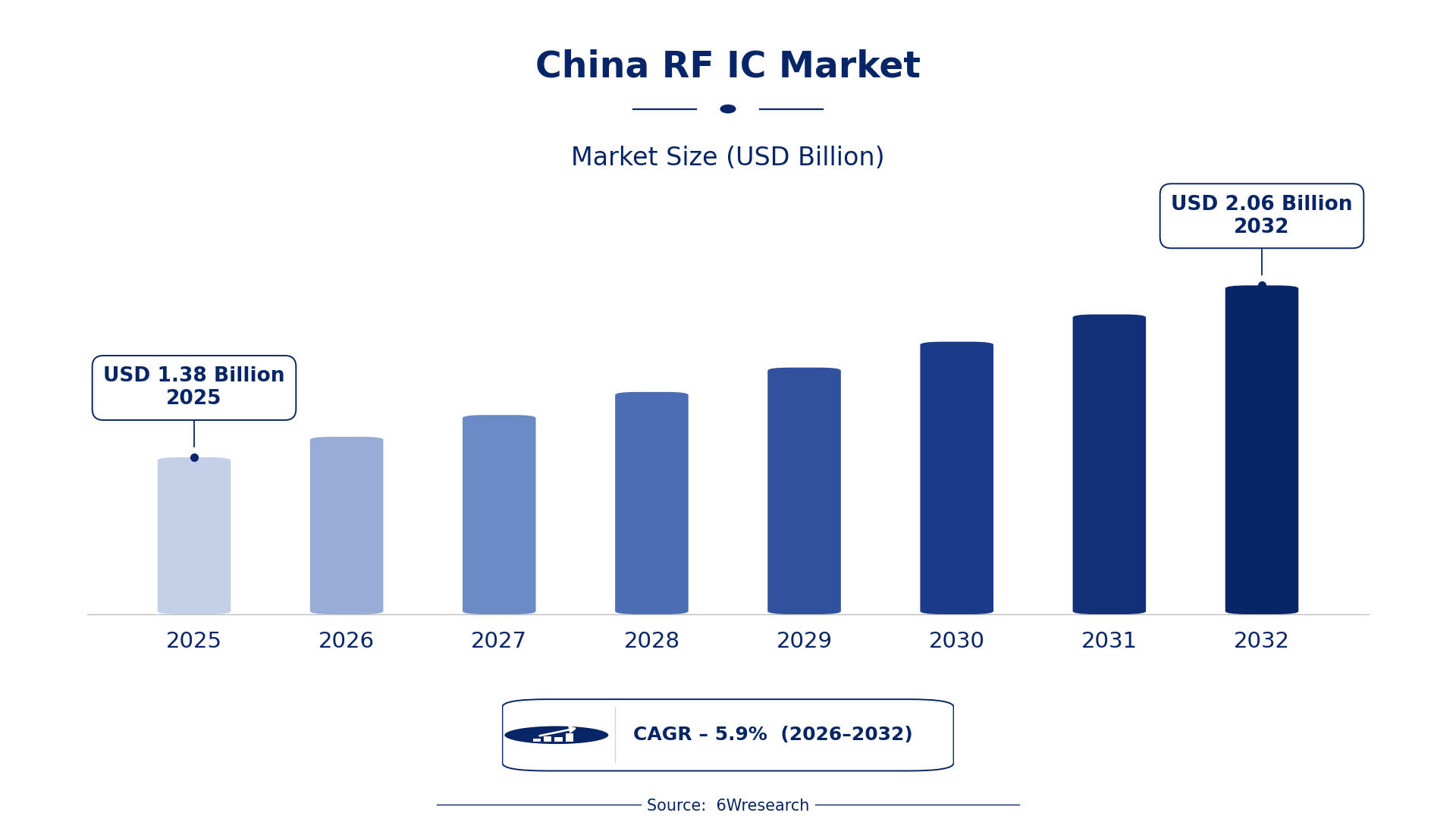
According to 6Wresearch internal database and industry insights, the China RF IC Market was valued at USD 1.38 billion in 2025 and is projected to reach USD 2.06 billion by 2032, growing at a CAGR of approximately 5.9% during 2026–2032.
China RF IC Market Highlights
| Report Metric | Details |
| Report Name | China RF IC Market |
| Market Size 2025 | USD 1.38 billion |
| Market Size 2032 | USD 2.06 billion |
| Absolute Growth 2025–2032 | USD 0.68 billion |
| CAGR 2026–2032 | 5.9% |
| Peak Annual Growth | 8.2% in 2026 |
| Forecast Period | 2026–2032 |
| Historical Data | 2022–2025 |
| Base Year | 2025 |
| Leading IC Type, 2025 | RF Transceivers / SoCs (39% share) |
| Leading Frequency Range, 2025 | 700 MHz–6 GHz (46% share) |
| Leading Architecture, 2025 | CMOS/BiCMOS (40% share) |
| Leading End User, 2025 | Mobile Device OEMs (37% share) |
| Fastest-Growing IC Type | Low-Noise Amplifier (LNA) (8.2% CAGR) |
| Fastest-Growing Frequency Range | Wi‑Fi/Cellular Bands (7.9% CAGR) |
| Fastest-Growing Architecture | MMIC/Discrete (7.7% CAGR) |
| Fastest-Growing End User | Infrastructure Vendors (7.6% CAGR) |
| Growing Sector | Mobile Devices |
| Key End Users | Mobile Device OEMs, Infrastructure Vendors, Handset Manufacturers |
China RF IC Market Year-wise Growth Rate and Key Drivers (2022–2032)
This graph illustrates the annual growth rates of the market from 2022 to 2032, highlighting a steady upward trajectory and projected market expansion over the forecast period.
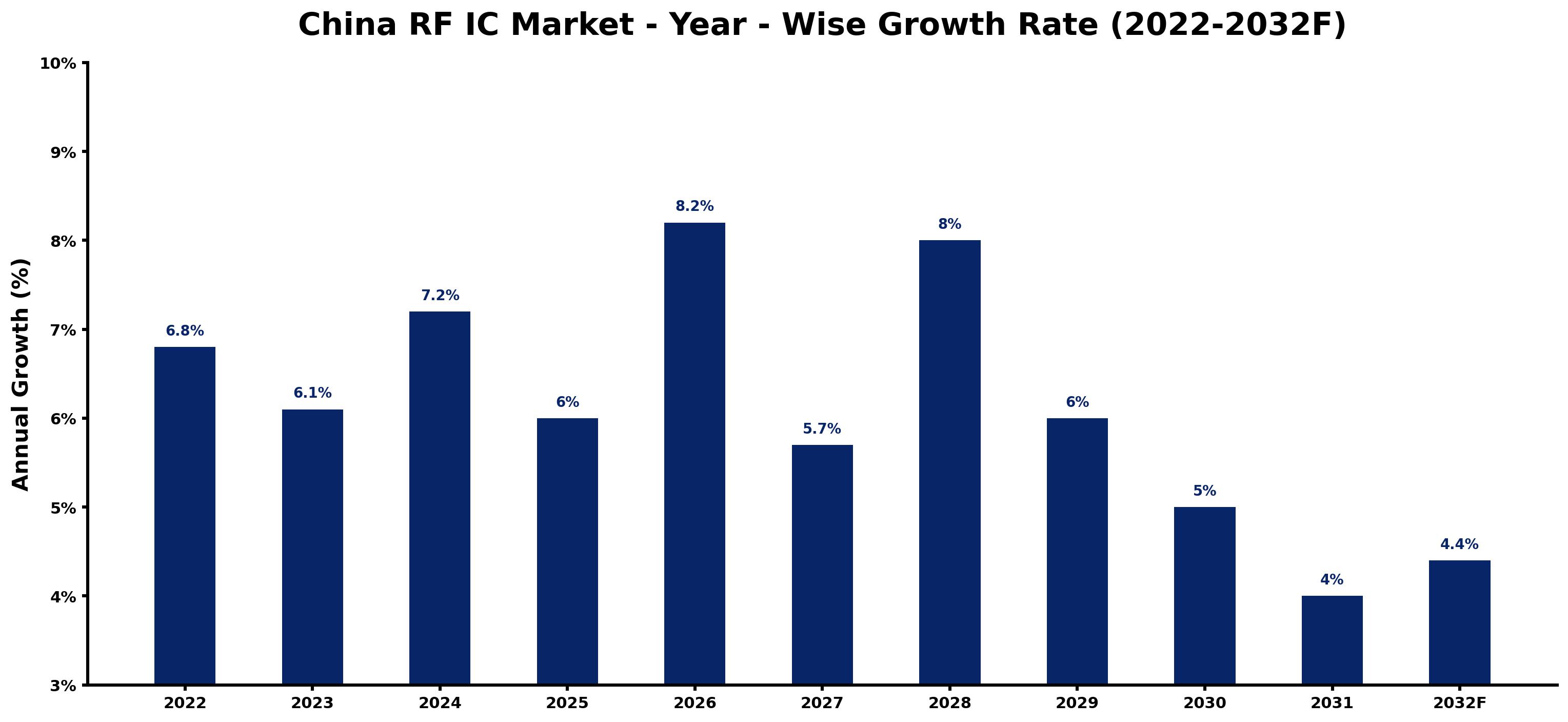
Each row of the following table gives one year's estimated growth and the event or demand shift that explains it.
| Year | Estimated Annual Growth (%) | Market Rationale |
| 2022 | 6.8 | The market experienced solid growth due to increasing mobile device penetration. |
| 2023 | 6.1 | Growth slowed as the market adjusted to the saturation of smartphone sales. |
| 2024 | 7.2 | Demand accelerated with the ongoing rollout of 5G infrastructure across the country. |
| 2025 | 6.0 | Market growth slowed again as the industry faced challenges in production capacity. |
| 2026 | 8.2 | A surge in demand for RF ICs coincided with the peak of 5G deployment. |
| 2027 | 5.7 | Growth decelerated as the market stabilises after the rapid expansion of previous years. |
| 2028 | 8.0 | Increased adoption of Wi-Fi and cellular bands will drive renewed demand for RF ICs. |
| 2029 | 6.0 | The market will continue to grow, supported by ongoing investments in 5G technology. |
| 2030 | 5.0 | Growth will slow as the market begins to mature and face competitive pressures. |
| 2031 | 4.0 | Demand growth will further decelerate as the focus shifts to efficiency improvements. |
| 2032 | 4.4 | A slight uptick in growth is expected as new technologies emerge and gain traction. |
Note: Market size estimations and growth projections presented in this report are based on 6Wresearch's proprietary forecasting methodology, utilizing the latest available industry data, government publications, and primary research inputs.
China RF IC Market Synopsis
RF ICs in China are semiconductor devices tailored for wireless communication applications, including mobile devices and 5G infrastructure. They are produced using advanced techniques such as CMOS technology and SiGe technology. The China RF IC Market is growing due to the rising mobile device penetration, which reached 1.6 billion in 2023. The ongoing deployment of over 700,000 base stations fuels the increasing demand for RF ICs. With domestic production surpassing 80%, the market is well-prepared for future growth, driven by mobile device OEMs and infrastructure vendors.
Market Dynamics Impact Analysis (2026–2032)
| Factor | Type | Impact | Primary Segment Affected |
| Increasing mobile device penetration drives demand for RF ICs. | Driver | High | Mobile Device OEMs |
| Expansion of 5G infrastructure creates a need for advanced RF ICs. | Driver | High | Infrastructure Vendors |
| Investment in semiconductor production facilities presents growth opportunities. | Opportunity | High | RF Transceivers / SoCs |
| Emerging applications in IoT require new RF IC solutions. | Opportunity | Medium | Low-Noise Amplifier (LNA) |
| Production capacity constraints limit supply of RF ICs. | Restraint | High | RF Switch ICs |
| Technological complexity in manufacturing RF ICs can hinder growth. | Restraint | Medium | Envelope Tracking ICs |
| Competition from international markets pressures local pricing. | Challenge | High | RF Transceivers / SoCs |
| Rapid technological advancements require constant innovation. | Challenge | Medium | Low-Noise Amplifier (LNA) |
Evaluation of Drivers in China RF IC Market (2026–2032)
The table below links each growth driver to the segment it affects and the evidence for it.
| Drivers | Primary Segment Affected | Why It Matters (Evidence) |
| Rising mobile device penetration increases the need for RF ICs, with an average smartphone using 3-4 RF ICs. | Mobile Device OEMs | This drives higher production volumes and demand for RF ICs. |
| The rollout of 5G infrastructure supports demand for RF ICs, with over 700,000 base stations in operation. | Infrastructure Vendors | This creates a market for RF ICs in base station radios. |
| Investment in semiconductor production is projected to exceed $200 billion by 2025, boosting RF IC supply. | RF Transceivers / SoCs | This improves local manufacturing capabilities and reduces reliance on imports. |
| The adoption of Wi-Fi and cellular bands is increasing, driving demand for RF ICs. | RF Transceivers / SoCs | This supports the growth of consumer electronics and connectivity solutions. |
| Emerging IoT applications require innovative RF IC solutions, expanding the market. | Low-Noise Amplifier (LNA) | This opens new revenue streams for manufacturers. |
The RF IC market in China is expanding as mobile device manufacturers and infrastructure vendors increase their production. In 2023, mobile device penetration reached 1.6 billion, driving demand for RF ICs, with each smartphone using 3-4 units. The ongoing rollout of over 700,000 5G base stations accelerates this demand. Investment in semiconductor production is set to exceed $200 billion by 2025, ensuring a stable supply chain. The increasing adoption of Wi-Fi and cellular bands supports the growth of consumer electronics and connectivity solutions.
Evaluation of Restraints in China RF IC Market
The key brakes on demand, and where they bite hardest, are shown below.
| Market Restraint | Primary Segment Affected | Why It Matters (Evidence) |
| Production capacity constraints limit the availability of RF ICs, affecting supply. | RF Switch ICs | This results in longer lead times and potential delays for buyers. |
| Technological complexity in manufacturing RF ICs can hinder growth and innovation. | Envelope Tracking ICs | This increases costs and requires specialized skills, limiting market entry. |
| Regulatory hurdles can slow down the approval process for new RF IC products. | RF Transceivers / SoCs | This impacts time-to-market for new technologies. |
| Competition from international markets pressures local pricing and profit margins. | RF Transceivers / SoCs | This can lead to reduced profitability for local manufacturers. |
| Rapid technological advancements necessitate continuous innovation in RF IC design. | Low-Noise Amplifier (LNA) | This can strain resources and increase R&D costs for companies. |
China RF IC Market Challenges
Producers in the China RF IC market still face several challenges, starting with technological hurdles. Rapid advancements in wireless communication standards require frequent upgrades in manufacturing processes, which can increase production costs by up to 15% and lead to delays. Importers encounter fierce competition from both domestic and international firms, driving prices down and squeezing profit margins, complicating their ability to maintain profitability. Buyers face skills shortages in advanced semiconductor design, resulting in project timelines extending by an average of three months and increasing costs for hiring skilled engineers. Supply chain disruptions can arise from reliance on specific components, causing production delays and affecting the availability of RF ICs in the market.
Trends in the China RF IC Market
The trends below show where the China RF IC Market is heading.
- Shift towards 5G Infrastructure Investment: Infrastructure vendors are increasingly investing in 5G technology, with over $200 billion projected by 2025. This trend is reshaping the RF IC market as demand for advanced solutions rises.
- Emergence of IoT Applications: The growing adoption of IoT devices is driving demand for specialised RF ICs. In 2023, mobile device penetration reached 1.6 billion, highlighting the need for connectivity solutions.
- Increased Focus on Domestic Production: China is prioritising local production of RF ICs, with over 80% produced domestically as of 2023. This shift supports national security and reduces reliance on imports.
- Expansion of Wi-Fi and Cellular Bands: The demand for Wi-Fi and cellular connectivity is increasing, with new standards being developed. This trend is important for improving consumer electronics and connectivity solutions.
Investment Opportunities in the China RF IC Market
Below are the investment opportunities with the strongest case in the China RF IC Market.
- Guangdong Province as a Manufacturing Hub: Guangdong province is a major hub for RF IC manufacturing, presenting opportunities for investment. With over 1 billion units produced in 2022, suppliers can tap into this growing market.
- Timing for Semiconductor Production: The Ministry of Industry and Information Technology's 2021 program to boost semiconductor production creates a timely opportunity. Suppliers can engage in partnerships to improve local capabilities.
- Infrastructure Vendors Seeking Advanced Solutions: Infrastructure vendors are increasingly looking for advanced RF IC solutions to support 5G deployment. This presents opportunities for suppliers to provide innovative products.
- Supply of Low-Noise Amplifiers: The demand for Low-Noise Amplifiers is rising as mobile devices evolve. Suppliers can enter this market by collaborating with mobile device OEMs.
Government Initiatives in the China RF IC Market
The Ministry of Industry and Information Technology launched a program in 2021 to boost semiconductor production, which directly impacts RF IC manufacturers. This initiative aims to increase domestic production, ensuring a steady supply of RF ICs for local markets. The National Development and Reform Commission supports innovation in RF technology, providing funding for research and development. These measures help streamline the production process and improve the competitiveness of local manufacturers.
The China Communications Standards Association oversees RF IC standards, ensuring compliance with international regulations. This agency approves new RF IC designs and technologies, facilitating market entry for new products. Additionally, the Ministry of Industry and Information Technology funds projects aimed at improving semiconductor capabilities, which supports the growth of the RF IC market. These efforts are important for maintaining quality and encouraging innovation in the industry.
Future Insight of the China RF IC Market
By 2032, buyers and suppliers in the China RF IC market can expect substantial changes driven by technological advancements and government initiatives. The National 5G Development Plan will facilitate the allocation of 600 MHz of spectrum, improving communication capabilities. Investment in semiconductor production is projected to exceed $200 billion by 2025, ensuring a more resilient supply chain. The Guangdong province will continue to solidify its role as a manufacturing hub, attracting talent and resources. Standards established by the China Communications Standards Association will simplify production processes, benefiting both buyers and suppliers.
Market Segmentation Analysis
The analysis below covers each segmentation, its leading category in 2025 and its fastest-growing category through 2032.
By IC Type – RF Transceivers / SoCs Dominated, Low-Noise Amplifier (LNA) Expected to Grow Fastest
According to Ravi Bhandari, Research Head at 6Wresearch, the largest ic type category in 2025 was RF Transceivers / SoCs, with a 39% share of total revenue. RF Transceivers and SoCs dominate the China RF IC market due to their critical function in mobile communications. Their extensive use in over 1 billion units produced in 2022 highlights their importance in the smartphone ecosystem. Low-Noise Amplifier (LNA) is set to record the highest CAGR in this split, 8.2% over 2026–2032. The Low-Noise Amplifier (LNA) segment is witnessing rapid growth, fuelled by the increasing need for enhanced signal clarity in mobile devices. With smartphones utilising 3-4 RF ICs on average, the demand for LNAs is becoming increasingly vital. Suppliers should focus on expanding LNA product lines to meet the growing requirements of mobile device manufacturers.
By Frequency Range – 700 MHz–6 GHz Dominated, Wi‑Fi/Cellular Bands Expected to Grow Fastest
700 MHz–6 GHz accounted for a 46% market share by frequency range in 2025. The 700 MHz–6 GHz frequency range captures the largest market share as it is the most commonly used range for wireless devices. This frequency band is essential for ensuring connectivity in mobile devices and related infrastructure, leading to widespread adoption. Wi‑Fi/Cellular Bands are projected to grow fastest, at a CAGR of 7.9% during 2026–2032. Wi-Fi/Cellular Bands are experiencing the fastest growth, driven by the surge in mobile device penetration, which reached 1.6 billion in 2023. Their critical role in maintaining user connectivity underscores the segment's increasing significance. Buyers should prioritise RF ICs within this frequency range to ensure compatibility with both current and future wireless technologies.
By Architecture – CMOS/BiCMOS Dominated, MMIC/Discrete Expected to Grow Fastest
In 2025, CMOS/BiCMOS led the architecture split with a 40% share. CMOS/BiCMOS architecture leads the market due to its prevalent application in RF IC manufacturing, providing both efficiency and reliability. This architecture is widely preferred for its compatibility with mobile device specifications, making it a top choice among manufacturers. The quickest growth will come from MMIC/Discrete, forecast to expand at a CAGR of 7.7% between 2026 and 2032. MMIC/Discrete architectures are experiencing rapid growth as they cater to specialised applications within infrastructure. Their unique capabilities are becoming increasingly relevant as the demand for advanced RF solutions continues to rise. Suppliers must consider diversifying their architecture offerings to include MMIC/Discrete solutions to seize emerging market opportunities.
By End User – Mobile Device OEMs Dominated, Infrastructure Vendors Expected to Grow Fastest
Mobile Device OEMs took a 37% share of end user in 2025, more than any other category. Mobile Device OEMs represent the largest consumer segment, driving substantial demand for RF ICs in smartphones and tablets. Their significant market share is bolstered by the robust mobile device ecosystem in China, which is consistently expanding. Over 2026–2032, Infrastructure Vendors are expected to post the fastest growth, at a CAGR of 7.6%. Infrastructure Vendors are experiencing rapid growth, driven by China's ambitious 5G rollout supported by over 700,000 base stations. This trend indicates a shift towards enhancing network capabilities, further increasing the demand for RF ICs. Suppliers should strengthen partnerships with infrastructure vendors to capitalise on the expanding 5G network deployment.
Key Attractiveness of the Report
- 10 Years of Market Numbers
- Historical Data Starting from 2022 to 2025
- Base Year 2025
- Forecast Data until 2032
- Key Performance Indicators Impacting the Market
- Major Upcoming Developments and Projects
Key Highlights of the Report:
- China RF IC Market Outlook
- Market Size of China RF IC Market, 2025
- Forecast of China RF IC Market, 2032
- Historical Data and Forecast of China RF IC Revenues & Volume for the Period 2022 - 2032F
- China RF IC Market Trend Evolution
- China RF IC Market Drivers and Challenges
- China RF IC Price Trends
- China RF IC Porter's Five Forces
- China RF IC Industry Life Cycle
- Historical Data and Forecast of China RF IC Market Revenues & Volume By IC Type for the Period 2022 - 2032F
- Historical Data and Forecast of China RF IC Market Revenues & Volume By RF Transceivers / SoCs for the Period 2022 - 2032F
- Historical Data and Forecast of China RF IC Market Revenues & Volume By Low-Noise Amplifier (LNA) for the Period 2022 - 2032F
- Historical Data and Forecast of China RF IC Market Revenues & Volume By RF Switch ICs for the Period 2022 - 2032F
- Historical Data and Forecast of China RF IC Market Revenues & Volume By Envelope Tracking ICs for the Period 2022 - 2032F
- Historical Data and Forecast of China RF IC Market Revenues & Volume By Frequency Range for the Period 2022 - 2032F
- Historical Data and Forecast of China RF IC Market Revenues & Volume By 700 MHz 6 GHz for the Period 2022 - 2032F
- Historical Data and Forecast of China RF IC Market Revenues & Volume By Wi Fi/Cellular Bands for the Period 2022 - 2032F
- Historical Data and Forecast of China RF IC Market Revenues & Volume By 5G/mmWave Bands for the Period 2022 - 2032F
- Historical Data and Forecast of China RF IC Market Revenues & Volume By Power Efficiency for the Period 2022 - 2032F
- Historical Data and Forecast of China RF IC Market Revenues & Volume By Architecture for the Period 2022 - 2032F
- Historical Data and Forecast of China RF IC Market Revenues & Volume By CMOS/BiCMOS for the Period 2022 - 2032F
- Historical Data and Forecast of China RF IC Market Revenues & Volume By MMIC/Discrete for the Period 2022 - 2032F
- Historical Data and Forecast of China RF IC Market Revenues & Volume By SiGe/CMOS for the Period 2022 - 2032F
- Historical Data and Forecast of China RF IC Market Revenues & Volume By Power Management ICs for the Period 2022 - 2032F
- Historical Data and Forecast of China RF IC Market Revenues & Volume By End User for the Period 2022 - 2032F
- Historical Data and Forecast of China RF IC Market Revenues & Volume By Mobile Device OEMs for the Period 2022 - 2032F
- Historical Data and Forecast of China RF IC Market Revenues & Volume By Infrastructure Vendors for the Period 2022 - 2032F
- Historical Data and Forecast of China RF IC Market Revenues & Volume By Base Station Radios for the Period 2022 - 2032F
- Historical Data and Forecast of China RF IC Market Revenues & Volume By Handset Manufacturers for the Period 2022 - 2032F
- China RF IC Import Export Trade Statistics
- Market Opportunity Assessment By IC Type
- Market Opportunity Assessment By Frequency Range
- Market Opportunity Assessment By Architecture
- Market Opportunity Assessment By End User
- China RF IC Top Companies Market Share
- China RF IC Competitive Benchmarking By Technical and Operational Parameters
- China RF IC Company Profiles
- China RF IC Key Strategic Recommendations
Market Covered
Segments analysed in this report are listed below.
By IC Type
- RF Transceivers / SoCs
- Low-Noise Amplifier (LNA)
- RF Switch ICs
- Envelope Tracking ICs
By Frequency Range
- 700 MHz–6 GHz
- Wi‑Fi/Cellular Bands
- 5G/mmWave Bands
- Power Efficiency
By Architecture
- CMOS/BiCMOS
- MMIC/Discrete
- SiGe/CMOS
- Power Management ICs
By End User
- Mobile Device OEMs
- Infrastructure Vendors
- Base Station Radios
- Handset Manufacturers































