India RF IC Market Size & Growth Rate
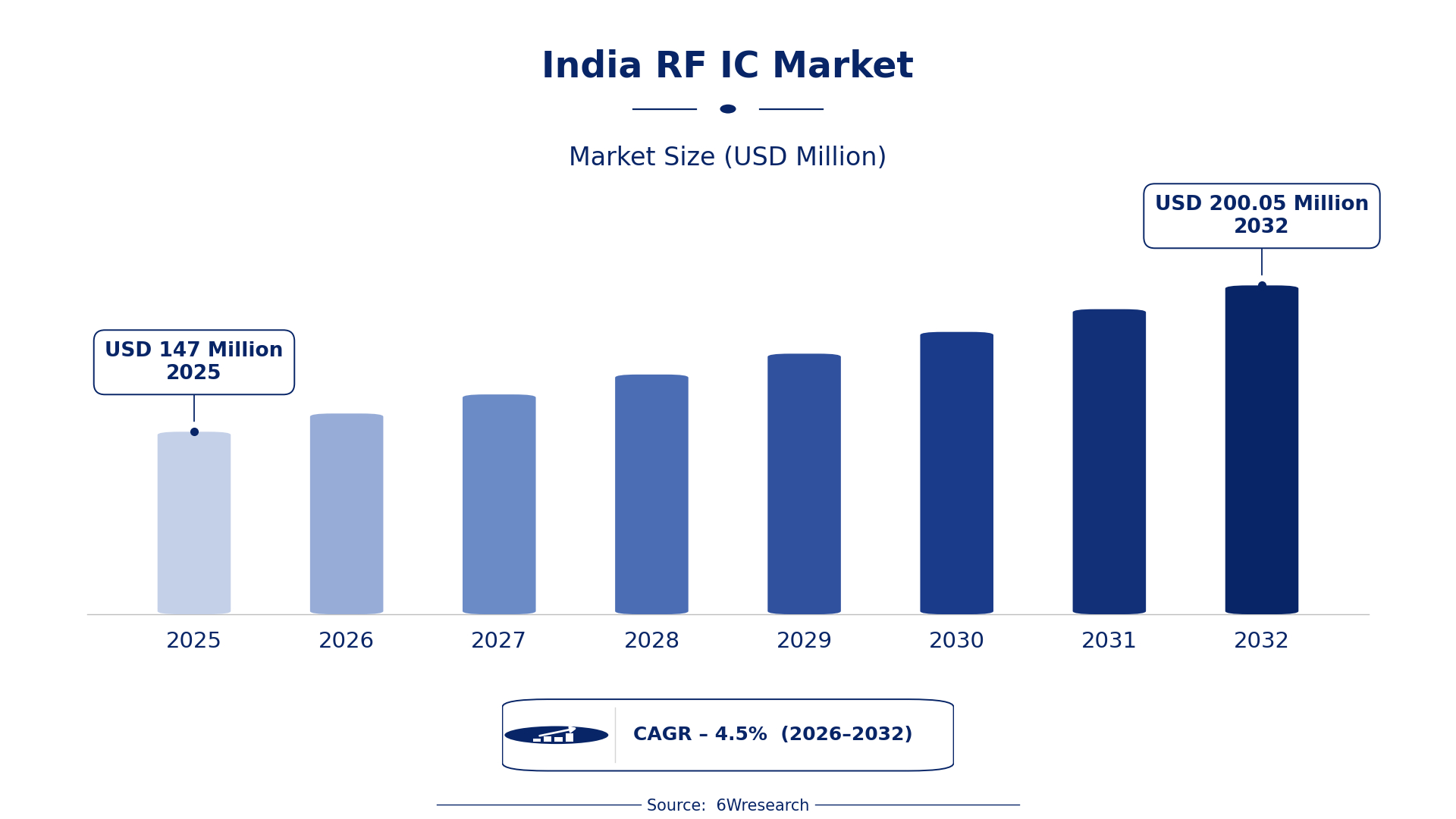
According to 6Wresearch internal database and industry insights, the India RF IC Market was valued at USD 147.0 million in 2025 and is projected to reach USD 200.05 million by 2032, growing at a CAGR of approximately 4.5% during 2026–2032.
India RF IC Market Highlights
| Report Metric | Details |
| Report Name | India RF IC Market |
| Market Size 2025 | USD 147.0 million |
| Market Size 2032 | USD 200.05 million |
| Absolute Growth 2025–2032 | USD 53.05 million |
| CAGR 2026–2032 | 4.5% |
| Peak Annual Growth | 6.2% in 2029 |
| Forecast Period | 2026–2032 |
| Historical Data | 2022–2025 |
| Base Year | 2025 |
| Leading IC Type, 2025 | RF Transceivers / SoCs (48% share) |
| Leading Frequency Range, 2025 | 700 MHz–6 GHz (36% share) |
| Leading Architecture, 2025 | CMOS/BiCMOS (40% share) |
| Leading End User, 2025 | Mobile Device OEMs (43% share) |
| Fastest-Growing IC Type | Low-Noise Amplifier (LNA) (6.9% CAGR) |
| Fastest-Growing Frequency Range | Wi‑Fi/Cellular Bands (7.1% CAGR) |
| Fastest-Growing Architecture | MMIC/Discrete (5.8% CAGR) |
| Fastest-Growing End User | Infrastructure Vendors (7.1% CAGR) |
| Growing Sector | Mobile Devices |
| Key End Users | Mobile Device OEMs, Infrastructure Vendors, Handset Manufacturers |
India RF IC Market Year-wise Growth Rate and Key Drivers (2022–2032)
This graph illustrates the annual growth rates of the market from 2022 to 2032, highlighting a steady upward trajectory and projected market expansion over the forecast period.
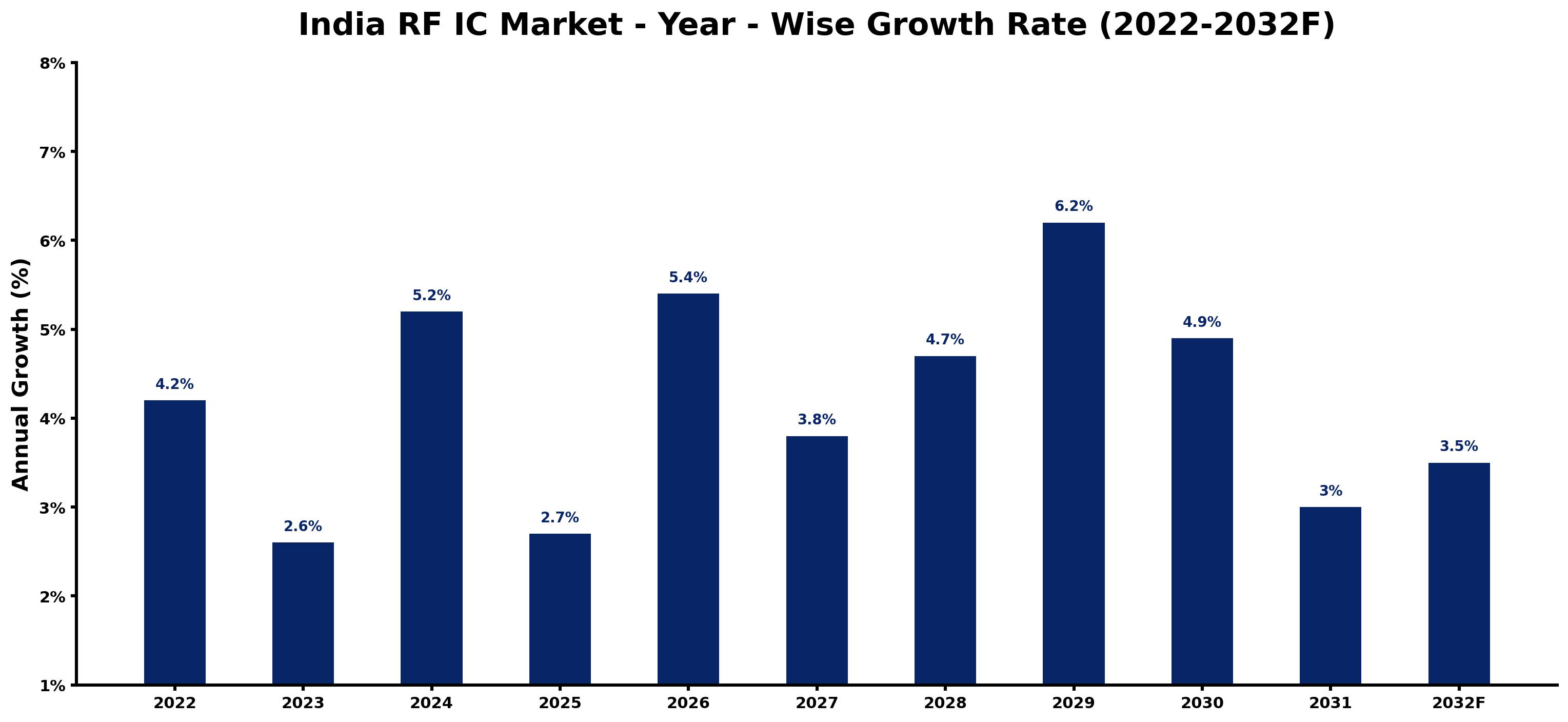
Annual growth estimates for each year appear below with the principal reason behind them, explaining the shifts that set the pace of the market.
| Year | Estimated Annual Growth (%) | Market Rationale |
| 2022 | 4.2 | The market showed steady growth, supported by a large mobile subscriber base. |
| 2023 | 2.6 | Growth slowed due to supply chain challenges affecting component availability. |
| 2024 | 5.2 | Demand increased as 5G infrastructure projects gained momentum across the country. |
| 2025 | 2.7 | Growth decelerated as market adjustments took place following rapid expansion. |
| 2026 | 5.4 | Investment in semiconductor manufacturing spurred faster growth in RF IC demand. |
| 2027 | 3.8 | Growth slowed as the market adjusted to increased competition and supply constraints. |
| 2028 | 4.7 | Demand picked up due to rising smartphone penetration and new technology adoption. |
| 2029 | 6.2 | The market peaked with heightened demand driven by the 5G rollout. |
| 2030 | 4.9 | Growth slowed as the market began to stabilise after rapid expansion. |
| 2031 | 3.0 | A further slowdown occurred as the market adjusted to new technological standards. |
| 2032 | 3.5 | Growth is expected to rise again as infrastructure projects continue to develop. |
Note: Market size estimations and growth projections presented in this report are based on 6Wresearch's proprietary forecasting methodology, utilizing the latest available industry data, government publications, and primary research inputs.
India RF IC Market Synopsis
The RF IC Market in India includes semiconductor devices that are fundamental for wireless communication. These integrated circuits play a key role in mobile communication, Wi-Fi, and 5G applications. The market is growing, supported by a mobile subscriber base of 1.2 billion and substantial investments in infrastructure. The government's plan to establish 100 smart cities by 2024 is also driving demand for RF ICs. In addition, the 5G rollout is expected to reach 200 million users by 2025, increasing the need for these components.
Market Dynamics Impact Analysis (2026–2032)
| Factor | Type | Impact | Primary Segment Affected |
| Growing mobile subscriber base and 5G rollout. | Driver | High | RF Transceivers / SoCs |
| Investment in semiconductor manufacturing capabilities. | Driver | High | Low-Noise Amplifier (LNA) |
| Rising demand for mobile devices and infrastructure. | Opportunity | High | Mobile Device OEMs |
| Expanding applications in 5G technologies. | Opportunity | High | Infrastructure Vendors |
| Supply chain disruptions affecting component availability. | Restraint | High | RF Switch ICs |
| Quality and safety standards imposed by regulatory bodies. | Restraint | Medium | Low-Noise Amplifier (LNA) |
| High costs of advanced semiconductor fabrication. | Challenge | High | RF Transceivers / SoCs |
| Long approval processes for new technologies. | Challenge | Medium | RF Switch ICs |
Evaluation of Drivers in India RF IC Market (2026–2032)
The main growth drivers and the segments they affect most are set out below.
| Drivers | Primary Segment Affected | Why It Matters (Evidence) |
| Increasing smartphone penetration driving demand for RF components. | RF Transceivers / SoCs | India's mobile subscriber base reached 1.2 billion in 2023, boosting RF IC purchases significantly. |
| Government investments in semiconductor manufacturing. | Low-Noise Amplifier (LNA) | The Semiconductor Mission aims to attract $10 billion in investments for manufacturing, enhancing local production capabilities. |
| Expansion of 5G infrastructure across urban areas. | Infrastructure Vendors | The 5G rollout is set to cover 200 million users by 2025, increasing RF IC usage substantially. |
| Growing electronics manufacturing sector in India. | Mobile Device OEMs | The electronics manufacturing sector is projected to grow to $300 billion by 2026, creating more opportunities for RF IC suppliers. |
| Rising demand for Wi-Fi and cellular connectivity. | RF Switch ICs | The demand for wireless communication solutions is increasing due to urbanisation and smart city initiatives, with a projected growth of 20%. |
Expansion of the RF IC market in India is backed by investments in semiconductor manufacturing and a growing demand for mobile devices. The mobile subscriber base reached 1.2 billion in 2023, driving the need for RF components. The 5G rollout is set to cover 200 million users by 2025, increasing RF IC usage. The electronics manufacturing sector is projected to grow to $300 billion by 2026, creating more opportunities for RF IC suppliers. Local manufacturers are expected to benefit from these trends as they enhance production capabilities.
Evaluation of Restraints in India RF IC Market
The following restraints limit how fast demand can grow.
| Market Restraint | Primary Segment Affected | Why It Matters (Evidence) |
| Supply chain disruptions affecting timely delivery of components. | RF Transceivers / SoCs | Supply chain challenges have delayed the availability of RF ICs, impacting production schedules. |
| Regulatory compliance costs for quality standards. | Low-Noise Amplifier (LNA) | Compliance with Bureau of Indian Standards (BIS) regulations increases production costs by approximately 15%. |
| High costs associated with advanced semiconductor fabrication. | RF Switch ICs | The expenses related to state-of-the-art manufacturing processes limit market entry for new players, raising costs by 25%. |
| Long approval processes for new RF technologies. | RF Transceivers / SoCs | Prolonged regulatory approvals hinder the timely introduction of new solutions, delaying market entry by several months. |
| Limited domestic production capacity for RF ICs. | Infrastructure Vendors | Dependence on imports for certain RF IC types affects supply stability, with imports constituting 40% of the market. |
India RF IC Market Challenges
India's RF IC market contends with high production costs, largely due to expensive raw materials like gallium arsenide, which can increase prices for producers by up to 30%. A shortage of skilled professionals in semiconductor fabrication techniques affects production efficiency, resulting in delays in product availability for buyers and potentially extending lead times by six months. Buyers also face challenges from fluctuating demand in the mobile sector, as the mobile subscriber base reached 1.2 billion in 2023, leading to unpredictable supply issues. Local producers encounter intense competition from international markets, which pressures them to lower prices and impacts profit margins, limiting their capacity to invest in new developments.
Trends in the India RF IC Market
The trends below show where the India RF IC Market is heading.
- Shift towards 5G technology adoption: The shift towards 5G technology commenced in 2022, with investments in infrastructure. The government’s 5G Testbed program is facilitating the development of RF ICs, aiming to cover 200 million users by 2025.
- Transition from traditional to advanced RF ICs: Since 2021, there has been a transition towards advanced RF ICs, particularly in 5G applications. The rising demand for high-performance devices is clear as the electronics manufacturing sector is projected to reach $300 billion by 2026.
- Emergence of smart city initiatives: The establishment of smart cities began in 2020, driving demand for advanced RF technologies. With the goal of creating 100 smart cities by 2024, the need for RF ICs is expected to surge.
- Prioritisation of local semiconductor manufacturing: The focus on local semiconductor manufacturing intensified in 2021, following the Semiconductor Mission launch. The aim to attract $10 billion in investments is reshaping RF IC production.
Investment Opportunities in the India RF IC Market
Several openings in the India RF IC Market merit attention from investors.
- Supply of advanced RF ICs for 5G applications: The demand for advanced RF ICs is rising, with the 5G rollout projected to cover 200 million users by 2025. Infrastructure vendors are seeking local suppliers to meet this need, presenting a considerable investment opportunity.
- Investment in semiconductor manufacturing facilities: The Indian government aims to attract $10 billion in investments for semiconductor manufacturing. Local partners can collaborate to establish facilities, tapping into the growing electronics manufacturing sector projected to reach $300 billion by 2026.
- Development of training programs for RF technology: The Electronics Sector Skill Council of India is training professionals in RF technology, addressing the skills gap in the industry. This presents an opportunity for educational institutions to partner with industry players to enhance workforce capabilities.
- Expansion of manufacturing capabilities for mobile devices: With the mobile device sector growing rapidly, there is a need for enhanced manufacturing capabilities. Local OEMs are looking for partners to increase production efficiency and meet the rising demand.
Government Initiatives in the India RF IC Market
The National Policy on Electronics 2019 aims to achieve a $300 billion electronics manufacturing industry by 2026, promoting RF IC production capabilities. This policy encourages local manufacturers to invest in advanced technologies and improve production standards. The Semiconductor Mission launched in 2021 seeks to attract $10 billion in investments for semiconductor manufacturing, further boosting the RF IC market. This initiative aims to develop a self-sustaining semiconductor industry in India, reducing reliance on imports and enhancing local production.
The Ministry of Electronics and Information Technology oversees the Semiconductor Mission, funding projects aimed at boosting domestic semiconductor manufacturing. The Department of Telecommunications plays a key role in approving initiatives like the 5G Testbed program, launched in 2022, which facilitates the development and testing of RF IC technologies. Furthermore, the Electronics Development Fund established in 2020 supports innovation and research in the electronics sector, helping to create a competitive environment for local manufacturers.
Future Insight of the India RF IC Market
The RF IC market in India will undergo notable changes by 2032, driven by the rollout of 5G technology, which is expected to cover 200 million users by 2025. This shift will increase demand for RF ICs as the electronics manufacturing sector is projected to grow to $300 billion by 2026. The government's semiconductor policy aims to attract $10 billion in investments, strengthening local production capabilities. The establishment of 100 smart cities by 2024 will further enhance infrastructure development, creating new opportunities for both suppliers and buyers.
Market Segmentation Analysis
The report offers a comprehensive study of the following market segments and their leading categories in the market.
By IC Type – RF Transceivers / SoCs Dominated, Low-Noise Amplifier (LNA) Expected to Grow Fastest
According to Ravi Bhandari, Research Head at 6Wresearch, RF Transceivers / SoCs took a 48% share of ic type in 2025, more than any other category. RF Transceivers and SoCs dominate the market share as they are essential for mobile communications and 5G applications. With India's mobile subscriber base reaching 1.2 billion in 2023, the demand for these components continues to be robust. The quickest growth will come from Low-Noise Amplifier (LNA), forecast to expand at a CAGR of 6.9% between 2026 and 2032. The Low-Noise Amplifier (LNA) segment is experiencing rapid growth due to its crucial role in improving signal quality in RF systems. This expansion is particularly driven by the anticipated 5G rollout, which aims to cover 200 million users by 2025, heightening the need for LNAs. Suppliers should focus on developing LNA products to meet the increasing demand for enhanced signal processing in RF applications.
By Frequency Range – 700 MHz–6 GHz Dominated, Wi‑Fi/Cellular Bands Expected to Grow Fastest
In 2025, 700 MHz–6 GHz led the frequency range split with a 36% share. The 700 MHz–6 GHz frequency range captures the largest market share as it is the standard for mobile and Wi-Fi communications. This broad applicability ensures consistent demand across various sectors, including telecommunications and consumer electronics. Wi‑Fi/Cellular Bands are projected to grow fastest, at a CAGR of 7.1% during 2026–2032. Wi-Fi/Cellular Bands are the fastest-growing segment due to their direct application in mobile and wireless communication devices. The rise in smartphone penetration in India further accelerates this growth, indicating a vital area for suppliers to concentrate on. Buyers should prioritise products that operate efficiently within these frequency bands to meet the growing connectivity demands.
By Architecture – CMOS/BiCMOS Dominated, MMIC/Discrete Expected to Grow Fastest
With a 40% revenue share in 2025, CMOS/BiCMOS was the largest architecture category. CMOS/BiCMOS technology leads the market as it is widely used for RF IC fabrication, offering a reliable balance of performance and cost. This established technology is favoured by manufacturers for its effectiveness across a range of applications. MMIC/Discrete is set to record the highest CAGR in this split, 5.8% over 2026–2032. MMIC/Discrete architectures are witnessing significant growth, particularly in specialised applications that require high performance. As infrastructure development advances, the demand for these advanced solutions is expected to rise, creating new opportunities. Suppliers should consider diversifying their product offerings to include MMIC/Discrete solutions to capitalise on emerging opportunities in niche markets.
By End User – Mobile Device OEMs Dominated, Infrastructure Vendors Expected to Grow Fastest
Mobile Device OEMs accounted for a 43% market share by end user in 2025. Mobile Device OEMs represent the largest share of the market as they are the primary users of RF ICs for smartphones and tablets. The surge in mobile device usage in India directly correlates with the demand for these components. Over 2026–2032, Infrastructure Vendors are expected to post the fastest growth, at a CAGR of 7.1%. Infrastructure Vendors are the fastest-growing segment, utilising RF ICs for base stations and network infrastructure. The government's initiative to establish 100 smart cities by 2024 is a key driver for this growth. Suppliers should align their strategies to cater to the increasing needs of infrastructure vendors as demand for network solutions escalates.
Key Attractiveness of the Report
- 10 Years of Market Numbers
- Historical Data Starting from 2022 to 2025
- Base Year 2025
- Forecast Data until 2032
- Key Performance Indicators Impacting the Market
- Major Upcoming Developments and Projects
Key Highlights of the Report:
- India RF IC Market Outlook
- Market Size of India RF IC Market, 2025
- Forecast of India RF IC Market, 2032
- Historical Data and Forecast of India RF IC Revenues & Volume for the Period 2022 - 2032F
- India RF IC Market Trend Evolution
- India RF IC Market Drivers and Challenges
- India RF IC Price Trends
- India RF IC Porter's Five Forces
- India RF IC Industry Life Cycle
- Historical Data and Forecast of India RF IC Market Revenues & Volume By IC Type for the Period 2022 - 2032F
- Historical Data and Forecast of India RF IC Market Revenues & Volume By RF Transceivers / SoCs for the Period 2022 - 2032F
- Historical Data and Forecast of India RF IC Market Revenues & Volume By Low-Noise Amplifier (LNA) for the Period 2022 - 2032F
- Historical Data and Forecast of India RF IC Market Revenues & Volume By RF Switch ICs for the Period 2022 - 2032F
- Historical Data and Forecast of India RF IC Market Revenues & Volume By Envelope Tracking ICs for the Period 2022 - 2032F
- Historical Data and Forecast of India RF IC Market Revenues & Volume By Frequency Range for the Period 2022 - 2032F
- Historical Data and Forecast of India RF IC Market Revenues & Volume By 700 MHz 6 GHz for the Period 2022 - 2032F
- Historical Data and Forecast of India RF IC Market Revenues & Volume By Wi Fi/Cellular Bands for the Period 2022 - 2032F
- Historical Data and Forecast of India RF IC Market Revenues & Volume By 5G/mmWave Bands for the Period 2022 - 2032F
- Historical Data and Forecast of India RF IC Market Revenues & Volume By Power Efficiency for the Period 2022 - 2032F
- Historical Data and Forecast of India RF IC Market Revenues & Volume By Architecture for the Period 2022 - 2032F
- Historical Data and Forecast of India RF IC Market Revenues & Volume By CMOS/BiCMOS for the Period 2022 - 2032F
- Historical Data and Forecast of India RF IC Market Revenues & Volume By MMIC/Discrete for the Period 2022 - 2032F
- Historical Data and Forecast of India RF IC Market Revenues & Volume By SiGe/CMOS for the Period 2022 - 2032F
- Historical Data and Forecast of India RF IC Market Revenues & Volume By Power Management ICs for the Period 2022 - 2032F
- Historical Data and Forecast of India RF IC Market Revenues & Volume By End User for the Period 2022 - 2032F
- Historical Data and Forecast of India RF IC Market Revenues & Volume By Mobile Device OEMs for the Period 2022 - 2032F
- Historical Data and Forecast of India RF IC Market Revenues & Volume By Infrastructure Vendors for the Period 2022 - 2032F
- Historical Data and Forecast of India RF IC Market Revenues & Volume By Base Station Radios for the Period 2022 - 2032F
- Historical Data and Forecast of India RF IC Market Revenues & Volume By Handset Manufacturers for the Period 2022 - 2032F
- India RF IC Import Export Trade Statistics
- Market Opportunity Assessment By IC Type
- Market Opportunity Assessment By Frequency Range
- Market Opportunity Assessment By Architecture
- Market Opportunity Assessment By End User
- India RF IC Top Companies Market Share
- India RF IC Competitive Benchmarking By Technical and Operational Parameters
- India RF IC Company Profiles
- India RF IC Key Strategic Recommendations
Market Covered
This report examines the market across the segments below.
By IC Type
- RF Transceivers / SoCs
- Low-Noise Amplifier (LNA)
- RF Switch ICs
- Envelope Tracking ICs
By Frequency Range
- 700 MHz–6 GHz
- Wi‑Fi/Cellular Bands
- 5G/mmWave Bands
- Power Efficiency
By Architecture
- CMOS/BiCMOS
- MMIC/Discrete
- SiGe/CMOS
- Power Management ICs
By End User
- Mobile Device OEMs
- Infrastructure Vendors
- Base Station Radios
- Handset Manufacturers































