China Risk Assessment AI Market Size & Growth Rate
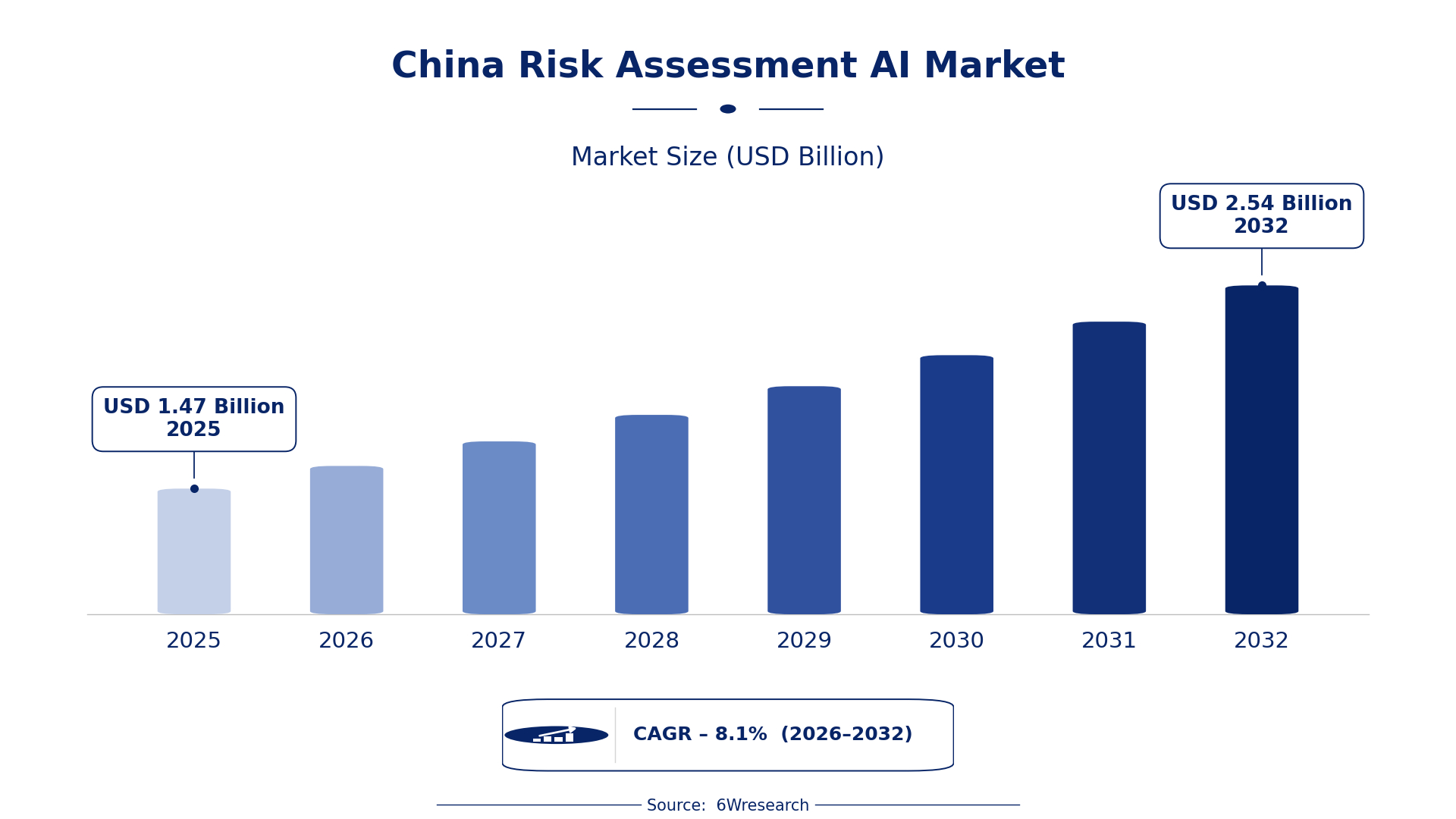
According to 6Wresearch internal database and industry insights, the China Risk Assessment AI Market was valued at USD 1.47 billion in 2025 and is projected to reach USD 2.54 billion by 2032, growing at a CAGR of approximately 8.1% during 2026–2032.
China Risk Assessment AI Market Highlights
| Report Metric | Details |
| Report Name | China Risk Assessment AI Market |
| Market Size 2025 | USD 1.47 billion |
| Market Size 2032 | USD 2.54 billion |
| Absolute Growth 2025–2032 | USD 1.07 billion |
| CAGR 2026–2032 | 8.1% |
| Peak Annual Growth | 9.7% in 2026 |
| Forecast Period | 2026–2032 |
| Historical Data | 2022–2025 |
| Base Year | 2025 |
| Leading Risk Category, 2025 | Financial Risk (41% share) |
| Leading AI Application, 2025 | Anomaly Detection (38% share) |
| Leading Data Type, 2025 | Transaction Data (48% share) |
| Leading End User, 2025 | Banks & Fintech Firms (47% share) |
| Fastest-Growing Risk Category | Cybersecurity Risk (10.1% CAGR) |
| Fastest-Growing AI Application | Predictive Modelling (9.8% CAGR) |
| Fastest-Growing End User | Insurance Companies (9.9% CAGR) |
| Growing Sector | Predictive Modelling |
| Key End Users | Anomaly Detection, Threat Intelligence, Predictive Modelling, Root Cause Analysis |
China Risk Assessment AI Market Year-wise Growth Rate and Key Drivers (2022–2032)
This graph illustrates the annual growth rates of the market from 2022 to 2032, highlighting a steady upward trajectory and projected market expansion over the forecast period.
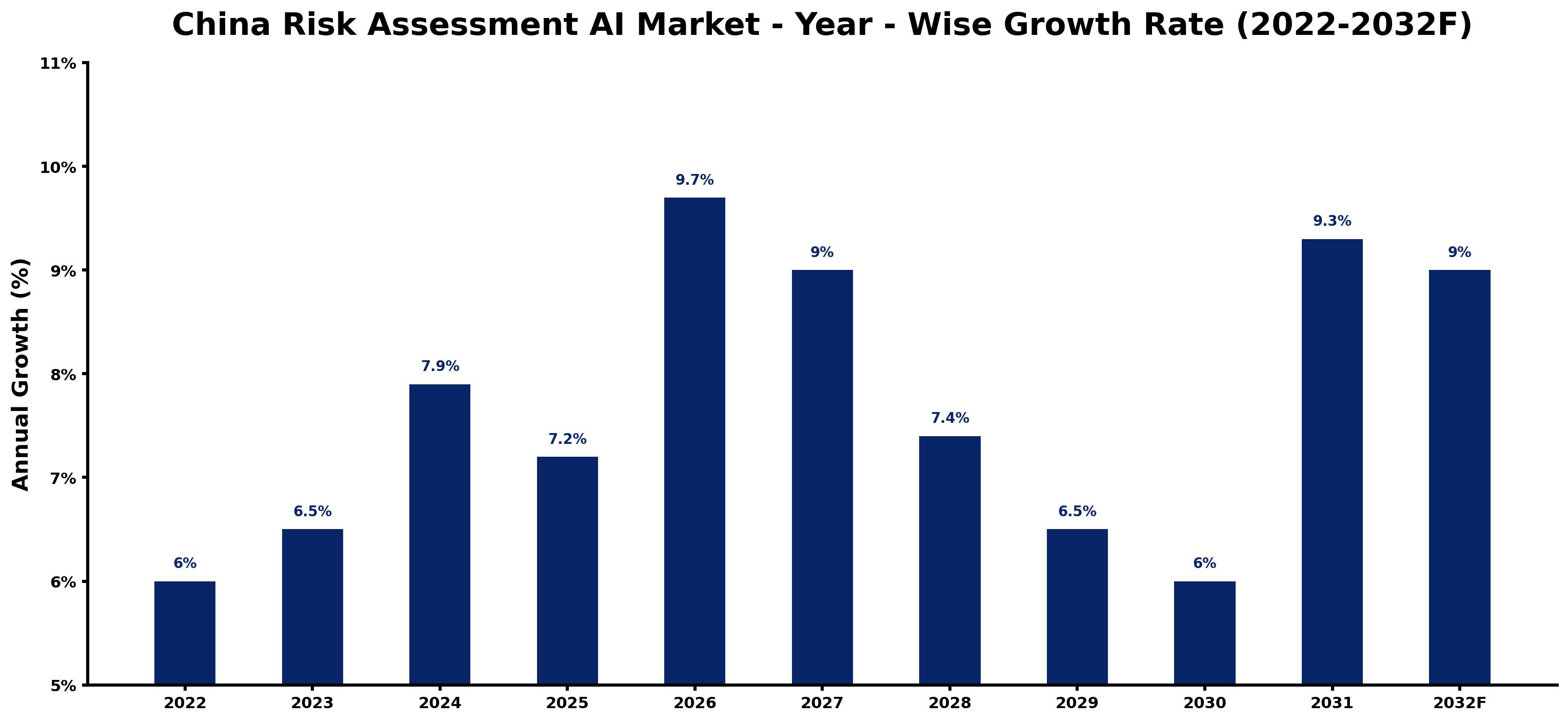
Annual growth estimates for each year appear below with the principal reason behind them, explaining the shifts that set the pace of the market.
| Year | Estimated Annual Growth (%) | Market Rationale |
| 2022 | 6.0 | The market experienced steady growth due to rising interest in AI technologies for risk assessment. |
| 2023 | 6.5 | Demand for risk assessment AI increased as financial institutions sought to enhance fraud detection capabilities. |
| 2024 | 7.9 | The market continued to grow, driven by the adoption of AI in cybersecurity measures. |
| 2025 | 7.2 | Growth slowed as firms consolidated their AI investments following earlier expansions. |
| 2026 | 9.7 | A surge in demand for predictive modelling boosted growth as firms aimed to forecast risks effectively. |
| 2027 | 9.0 | The market growth rate slowed as firms focused on optimising existing AI systems and processes. |
| 2028 | 7.4 | Demand remained stable, with continued interest in operational risk management solutions. |
| 2029 | 6.5 | Growth decelerated as the market matured and competition intensified among providers. |
| 2030 | 6.0 | The market experienced further slowdown as firms prioritised cost management in AI investments. |
| 2031 | 9.3 | A rebound in growth occurred as new regulations spurred investment in risk assessment technologies. |
| 2032 | 9.0 | The market growth rate stabilised as firms adapted to evolving regulatory requirements. |
Note: Market size estimations and growth projections presented in this report are based on 6Wresearch's proprietary forecasting methodology, utilizing the latest available industry data, government publications, and primary research inputs.
China Risk Assessment AI Market Synopsis
Risk Assessment AI in China includes technologies that employ algorithms and machine learning to assess potential risks across multiple sectors. This technology plays a critical role in detecting financial fraud, improving cybersecurity, and streamlining operational processes. The China Risk Assessment AI Market is growing due to rising demand from over 4,000 banks and fintech firms. The financial sector's dependence on AI for risk management propels investment in this field. Furthermore, government backing for AI initiatives accelerates market expansion, with a projected market size of USD 2.54 billion by 2032.
Market Dynamics Impact Analysis (2026–2032)
| Factor | Type | Impact | Primary Segment Affected |
| Growing adoption of AI technologies in financial services | Driver | High | Financial Risk |
| Rising cybersecurity threats necessitating advanced solutions | Driver | High | Cybersecurity Risk |
| Increased investment in AI for operational efficiency | Opportunity | High | Operational Risk |
| Expansion of AI applications in environmental assessments | Opportunity | Medium | Environmental Risk |
| High costs associated with implementing AI solutions | Restraint | High | Financial Risk |
| Complex regulatory requirements for AI technologies | Restraint | Medium | Cybersecurity Risk |
| The Risk Assessment AI market in China faces challenges from data privacy concerns | Challenge | High | Cybersecurity Risk |
| Limited availability of skilled professionals in AI development | Challenge | Medium | Financial Risk |
Evaluation of Drivers in China Risk Assessment AI Market (2026–2032)
Below mentioned are some major drivers and their influence on market dynamics.
| Drivers | Primary Segment Affected | Why It Matters (Evidence) |
| Increased investment in AI technologies by financial institutions | Financial Risk | Over 4,000 banks and fintech firms are adopting AI for improved fraud detection and credit risk assessment, driving demand for advanced solutions. |
| Growing cybersecurity threats driving demand for advanced solutions | Cybersecurity Risk | The cybersecurity market in China was valued at approximately $40 billion in 2022, necessitating the integration of AI technologies for effective risk management. |
| Government initiatives promoting AI in risk management | Operational Risk | The Financial Stability and Development Committee initiated a program in 2023 targeting a 30% increase in AI adoption by 2025, encouraging investment. |
| Rising demand for predictive modelling to forecast risks | Predictive Modelling | The installed base of AI systems in the banking sector is projected to exceed 70% by 2025, indicating strong end-use demand for predictive tools. |
| Development of national standards for AI applications | Anomaly Detection | The AI Standards Committee is developing guidelines that improve the reliability of risk assessment AI, increasing trust among users. |
In 2022, the cybersecurity market was valued at around $40 billion, which boosts the need for advanced AI solutions. More than 4,000 banks and fintech firms are integrating AI technologies to enhance fraud detection and credit risk assessment. The adoption of AI systems in the banking sector is expected to surpass 70% by 2025, reflecting strong end-use demand.
Evaluation of Restraints in China Risk Assessment AI Market
The main factors holding the market back are set out below.
| Market Restraint | Primary Segment Affected | Why It Matters (Evidence) |
| High costs associated with implementing AI solutions | Financial Risk | Financial institutions face considerable expenses in integrating AI technologies into existing systems, impacting their operational budgets. |
| Complex regulatory requirements for AI technologies | Cybersecurity Risk | Companies must navigate stringent regulations, which can delay the implementation of AI solutions and increase compliance costs. |
| Data privacy concerns affecting AI adoption | Cybersecurity Risk | Growing scrutiny over data handling practices creates hesitation among firms to fully embrace AI technologies, impacting their effectiveness. |
| Limited availability of skilled professionals in AI development | Operational Risk | The shortage of qualified AI experts hampers the ability of firms to effectively implement risk assessment solutions, delaying projects. |
| Resistance to change from traditional risk management practices | Financial Risk | Many firms are hesitant to shift from established methods to AI-driven approaches, which slows market adoption and innovation. |
China Risk Assessment AI Market Challenges
The China Risk Assessment AI market encounters a technological hurdle as many existing algorithms struggle to keep pace with rapid advancements, resulting in outdated systems. This obsolescence affects over 4,000 banks and fintech firms, leading to potential inaccuracies in risk evaluations and financial losses. Limited access to high-quality data hampers model training, creating supply chain delays that reduce AI effectiveness. Consequently, buyers face increased operational costs as they are forced to source alternative data, impacting their overall efficiency. Evolving regulations, such as the updated Cybersecurity Law, impose budgetary constraints on financial institutions, restricting their investment in advanced risk assessment technologies.
Trends in the China Risk Assessment AI Market
Four trends stand out in the China Risk Assessment AI Market.
- Shift towards AI-Driven Cybersecurity Solutions: The updated Cybersecurity Law requires the incorporation of AI in risk management, enhancing threat detection capabilities. This transition is evident in the cybersecurity market's valuation of approximately $40 billion in 2022, which drives further investment in AI technologies.
- Increased Focus on Predictive Modelling: Banks and fintech firms are emphasising predictive modelling to accurately forecast risks. This trend is supported by the anticipated installed base of AI systems in the banking sector exceeding 70% by 2025, resulting in more informed decision-making.
- Expansion of AI Applications in Environmental Risk Management: The AI for Good initiative aims to leverage AI for environmental risk management by 2025. This programme is expected to stimulate investment in AI technologies, concentrating on compliance and sustainability.
- Growing Demand for Anomaly Detection Solutions: Anomaly Detection is becoming increasingly crucial for recognising unusual patterns in data. With a projected share of 38% in 2025, this segment is drawing considerable interest from banks and fintech firms.
Investment Opportunities in the China Risk Assessment AI Market
Investors looking at the China Risk Assessment AI Market should consider the following areas.
- Banks & Fintech Firms Seeking Advanced Risk Solutions: Financial institutions are increasingly investing in AI technologies for risk assessment, with a projected size of USD 2.54 billion by 2032. Partnering with local firms can facilitate market entry and improve service offerings.
- Shanghai and Beijing as AI Development Hubs: Shanghai and Beijing are key regions for AI development in risk assessment. Investing in these cities can provide access to a growing market, backed by government initiatives and funding.
- Growing Need for Compliance Solutions: The emphasis on compliance is driving demand for AI in environmental risk assessments. The AI for Good initiative aims to utilise AI for compliance by 2025, presenting investment opportunities in this area.
- Entry through Joint Ventures and Local Partnerships: Establishing joint ventures or partnerships with local firms can ease market entry. This approach is particularly advantageous in navigating regulatory landscapes and leveraging local expertise.
Government Initiatives in the China Risk Assessment AI Market
The Cybersecurity Law of 2021, enacted by the National People's Congress, mandates the integration of AI in cybersecurity risk management for all companies handling personal data. This law ensures that financial institutions adopt advanced AI technologies to improve their fraud detection capabilities. The 14th Five-Year Plan for Digital Economy Development, released in 2021 by the State Council, highlights the advancement of AI technologies for risk assessment across various sectors, aiming for a notable increase in AI adoption. Additionally, the Ministry of Industry and Information Technology launched the AI Innovation Action Plan in 2022, concentrating on enhancing AI applications in financial risk assessment, which is crucial for compliance and operational efficiency. These measures collectively support the growth of the Risk Assessment AI market by establishing a robust regulatory framework.
The Ministry of Ecology and Environment oversees environmental risk assessments in China, ensuring compliance with national standards. The China Banking and Insurance Regulatory Commission promotes AI in risk management for financial institutions, facilitating funding for AI-driven projects aimed at improving risk evaluation processes. Furthermore, the National Development and Reform Commission has initiated AI-driven risk management programmes since 2021, focusing on enhancing the integration of AI technologies in various sectors. This initiative aims to increase the adoption of AI solutions by 30% by 2025, providing financial institutions with the necessary tools to manage risks effectively. These agencies play a crucial role in shaping the market by approving and funding essential AI projects.
Future Insight of the China Risk Assessment AI Market
The China Risk Assessment AI market is set for considerable transformation by 2032, primarily driven by the establishment of national standards and improved regulatory frameworks. By 2025, the installed base of AI systems in the banking sector is expected to exceed 70%, resulting in enhanced accuracy in risk evaluations. The National Development and Reform Commission's AI-driven risk management programmes will enable greater integration across various sectors, providing buyers with more effective tools for risk assessment. Initiatives focused on environmental risk management will also gain momentum, encouraging responsible practices across industries.
Market Segmentation Analysis
Each segment group is reviewed below, with the leader by share and the fastest grower by CAGR.
By Risk Category – Financial Risk Dominated, Cybersecurity Risk Expected to Grow Fastest
According to Shubham Padhi, Research Analyst at 6Wresearch, Financial Risk accounted for a 41% market share by risk category in 2025. Financial Risk commands the largest share in China's Risk Assessment AI Market, largely due to the vast network of over 4,000 banks and fintech firms that depend on AI for fraud detection and credit risk assessment. This established base underscores the critical importance of financial risk management in the sector. Over 2026–2032, Cybersecurity Risk is expected to post the fastest growth, at a CAGR of 10.1%. Cybersecurity Risk is experiencing rapid growth, especially following the 2023 update of the Cybersecurity Law, which enhances AI applications in threat detection, highlighting an urgent need for effective cybersecurity measures. As cyber threats evolve, this segment's growth is set to accelerate further. Suppliers should prioritise developing specialised solutions for financial institutions to leverage this increasing demand.
By AI Application – Anomaly Detection Dominated, Predictive Modelling Expected to Grow Fastest
Anomaly Detection took a 38% share of ai application in 2025, more than any other category. Anomaly Detection leads the market as it plays a crucial role in identifying unusual patterns in data, essential for effective risk management across various sectors. Its significant application in financial services solidifies its dominant position within the market. The quickest growth will come from Predictive Modelling, forecast to expand at a CAGR of 9.8% between 2026 and 2032. Predictive Modelling is the fastest-growing application, driven by its ability to forecast future risks based on historical data, which is becoming increasingly vital for proactive risk management. As organisations aim to anticipate risks, this application will see greater adoption. Buyers should invest in predictive modelling tools to enhance decision-making processes and stay ahead of potential risks.
By Data Type – Transaction Data Dominated and Is Expected to Record the Fastest Growth
With a 48% revenue share in 2025, Transaction Data was the largest data type category. Transaction Data dominates the market share as it serves as the primary data source for financial risk assessments, providing essential insights for banks and fintech firms. Its widespread use in evaluating financial transactions secures its leading position. Its lead should widen, with a projected CAGR of 10.5% during 2026–2032, the highest in this split. Transaction Data is also the fastest-growing segment, as its importance in real-time risk assessment gains recognition across various industries. The increasing reliance on this data type for immediate decision-making will further strengthen its market position. Suppliers must ensure their solutions effectively utilise transaction data to meet the rising demand for real-time risk assessment capabilities.
By End User – Banks & Fintech Firms Dominated, Insurance Companies Expected to Grow Fastest
The largest end user category in 2025 was Banks & Fintech Firms, with a 47% share of total revenue. Banks & Fintech Firms constitute the largest share of the market, being the primary users of risk assessment AI for financial evaluations. Their substantial investment in AI technologies for fraud detection and credit management fuels this dominance. Insurance Companies are set to record the highest CAGR in this split, 9.9% over 2026–2032. Insurance Companies are the fastest-growing end user, leveraging AI for risk underwriting and claims analysis as they seek to optimise operations and improve customer service. This trend is expected to persist as the insurance sector embraces digital transformation. Suppliers should customise their offerings to meet the specific needs of insurance companies, which are increasingly adopting AI technologies.
Key Attractiveness of the Report
- 10 Years of Market Numbers
- Historical Data Starting from 2022 to 2025
- Base Year 2025
- Forecast Data until 2032
- Key Performance Indicators Impacting the Market
- Major Upcoming Developments and Projects
Key Highlights of the Report:
- China Risk Assessment AI Market Outlook
- Market Size of China Risk Assessment AI Market, 2025
- Forecast of China Risk Assessment AI Market, 2032
- Historical Data and Forecast of China Risk Assessment AI Revenues & Volume for the Period 2022 - 2032F
- China Risk Assessment AI Market Trend Evolution
- China Risk Assessment AI Market Drivers and Challenges
- China Risk Assessment AI Price Trends
- China Risk Assessment AI Porter's Five Forces
- China Risk Assessment AI Industry Life Cycle
- Historical Data and Forecast of China Risk Assessment AI Market Revenues & Volume By Risk Category for the Period 2022 - 2032F
- Historical Data and Forecast of China Risk Assessment AI Market Revenues & Volume By Financial Risk for the Period 2022 - 2032F
- Historical Data and Forecast of China Risk Assessment AI Market Revenues & Volume By Cybersecurity Risk for the Period 2022 - 2032F
- Historical Data and Forecast of China Risk Assessment AI Market Revenues & Volume By Environmental Risk for the Period 2022 - 2032F
- Historical Data and Forecast of China Risk Assessment AI Market Revenues & Volume By Operational Risk for the Period 2022 - 2032F
- Historical Data and Forecast of China Risk Assessment AI Market Revenues & Volume By AI Application for the Period 2022 - 2032F
- Historical Data and Forecast of China Risk Assessment AI Market Revenues & Volume By Anomaly Detection for the Period 2022 - 2032F
- Historical Data and Forecast of China Risk Assessment AI Market Revenues & Volume By Threat Intelligence for the Period 2022 - 2032F
- Historical Data and Forecast of China Risk Assessment AI Market Revenues & Volume By Predictive Modelling for the Period 2022 - 2032F
- Historical Data and Forecast of China Risk Assessment AI Market Revenues & Volume By Root Cause Analysis for the Period 2022 - 2032F
- Historical Data and Forecast of China Risk Assessment AI Market Revenues & Volume By Data Type for the Period 2022 - 2032F
- Historical Data and Forecast of China Risk Assessment AI Market Revenues & Volume By Transaction Data for the Period 2022 - 2032F
- Historical Data and Forecast of China Risk Assessment AI Market Revenues & Volume By Network Logs for the Period 2022 - 2032F
- Historical Data and Forecast of China Risk Assessment AI Market Revenues & Volume By Satellite & Weather Data for the Period 2022 - 2032F
- Historical Data and Forecast of China Risk Assessment AI Market Revenues & Volume By Process Metrics for the Period 2022 - 2032F
- Historical Data and Forecast of China Risk Assessment AI Market Revenues & Volume By End User for the Period 2022 - 2032F
- Historical Data and Forecast of China Risk Assessment AI Market Revenues & Volume By Banks & Fintech Firms for the Period 2022 - 2032F
- Historical Data and Forecast of China Risk Assessment AI Market Revenues & Volume By Cloud Providers for the Period 2022 - 2032F
- Historical Data and Forecast of China Risk Assessment AI Market Revenues & Volume By Insurance Companies for the Period 2022 - 2032F
- Historical Data and Forecast of China Risk Assessment AI Market Revenues & Volume By Manufacturing Units for the Period 2022 - 2032F
- China Risk Assessment AI Import Export Trade Statistics
- Market Opportunity Assessment By Risk Category
- Market Opportunity Assessment By AI Application
- Market Opportunity Assessment By Data Type
- Market Opportunity Assessment By End User
- China Risk Assessment AI Top Companies Market Share
- China Risk Assessment AI Competitive Benchmarking By Technical and Operational Parameters
- China Risk Assessment AI Company Profiles
- China Risk Assessment AI Key Strategic Recommendations
Market Covered
This report examines the market across the segments below.
By Risk Category
- Financial Risk
- Cybersecurity Risk
- Environmental Risk
- Operational Risk
By AI Application
- Anomaly Detection
- Threat Intelligence
- Predictive Modelling
- Root Cause Analysis
By Data Type
- Transaction Data
- Network Logs
- Satellite & Weather Data
- Process Metrics
By End User
- Banks & Fintech Firms
- Cloud Providers
- Insurance Companies
- Manufacturing Units































