China Risk-Based Inspection Market Size & Growth Rate
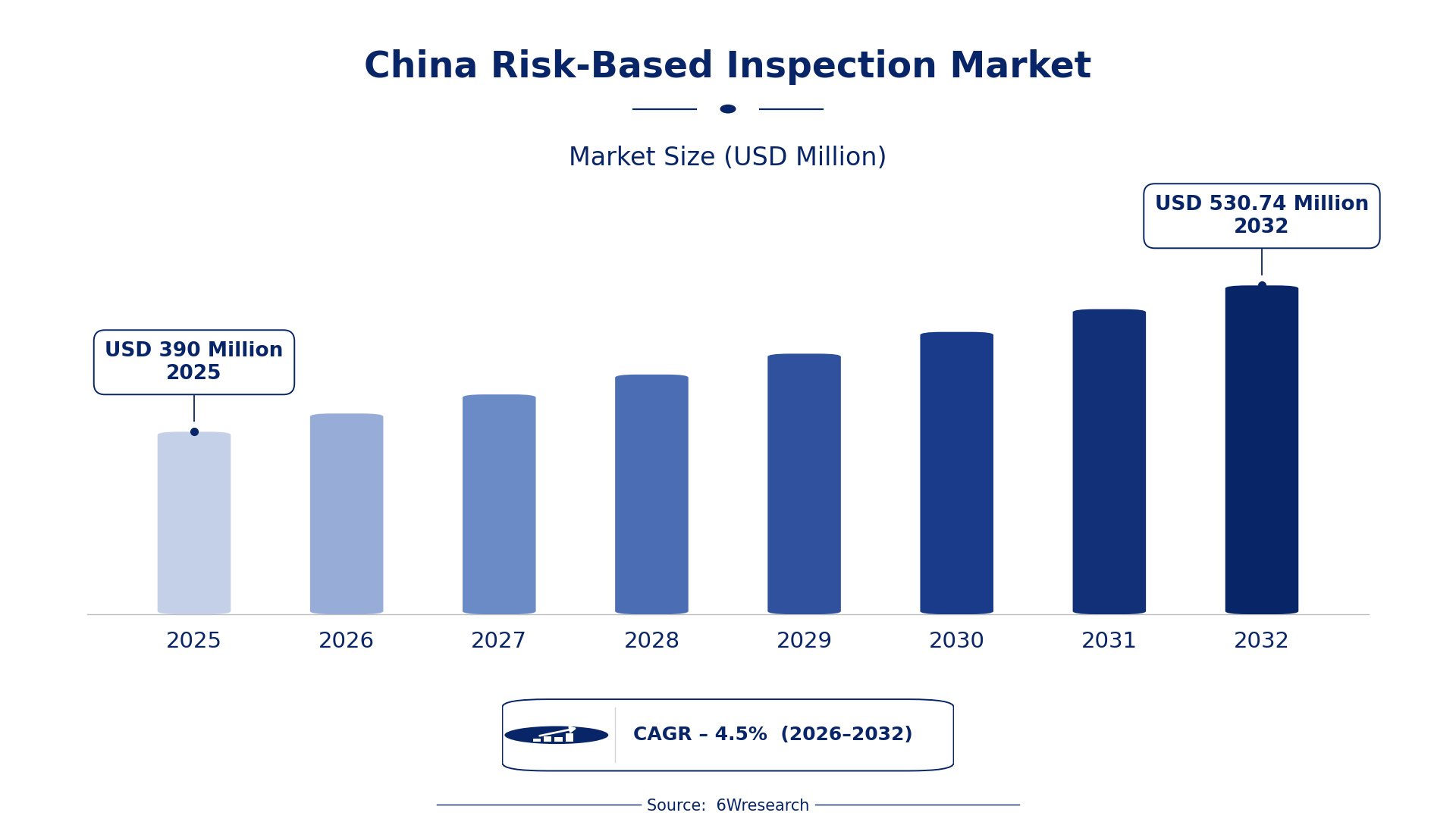
According to 6Wresearch internal database and industry insights, the China Risk-Based Inspection Market was valued at USD 390.0 million in 2025 and is projected to reach USD 530.74 million by 2032, growing at a CAGR of approximately 4.5% during 2026–2032.
China Risk-Based Inspection Market Highlights
| Report Metric | Details |
| Report Name | China Risk-Based Inspection Market |
| Market Size 2025 | USD 390.0 million |
| Market Size 2032 | USD 530.74 million |
| Absolute Growth 2025–2032 | USD 140.74 million |
| CAGR 2026–2032 | 4.5% |
| Peak Annual Growth | 6.2% in 2028 |
| Forecast Period | 2026–2032 |
| Historical Data | 2022–2025 |
| Base Year | 2025 |
| Leading Inspection Type, 2025 | Static Equipment (48% share) |
| Leading Risk Priority Category, 2025 | High Risk (41% share) |
| Leading Technique Used, 2025 | Ultrasonic Testing (39% share) |
| Leading End User, 2025 | Oil Refineries (50% share) |
| Fastest-Growing Inspection Type | Pipelines (7.1% CAGR) |
| Fastest-Growing Risk Priority Category | Critical Infrastructure (6.8% CAGR) |
| Fastest-Growing Technique Used | Vibration Monitoring (6.6% CAGR) |
| Fastest-Growing End User | Petrochemical Plants (6.9% CAGR) |
| Growing Sector | Oil Refineries |
| Key End Users | Oil Refineries, Petrochemical Plants, Power Plants, Gas Distribution Units |
China Risk-Based Inspection Market Year-wise Growth Rate and Key Drivers (2022–2032)
This graph illustrates the annual growth rates of the market from 2022 to 2032, highlighting a steady upward trajectory and projected market expansion over the forecast period.
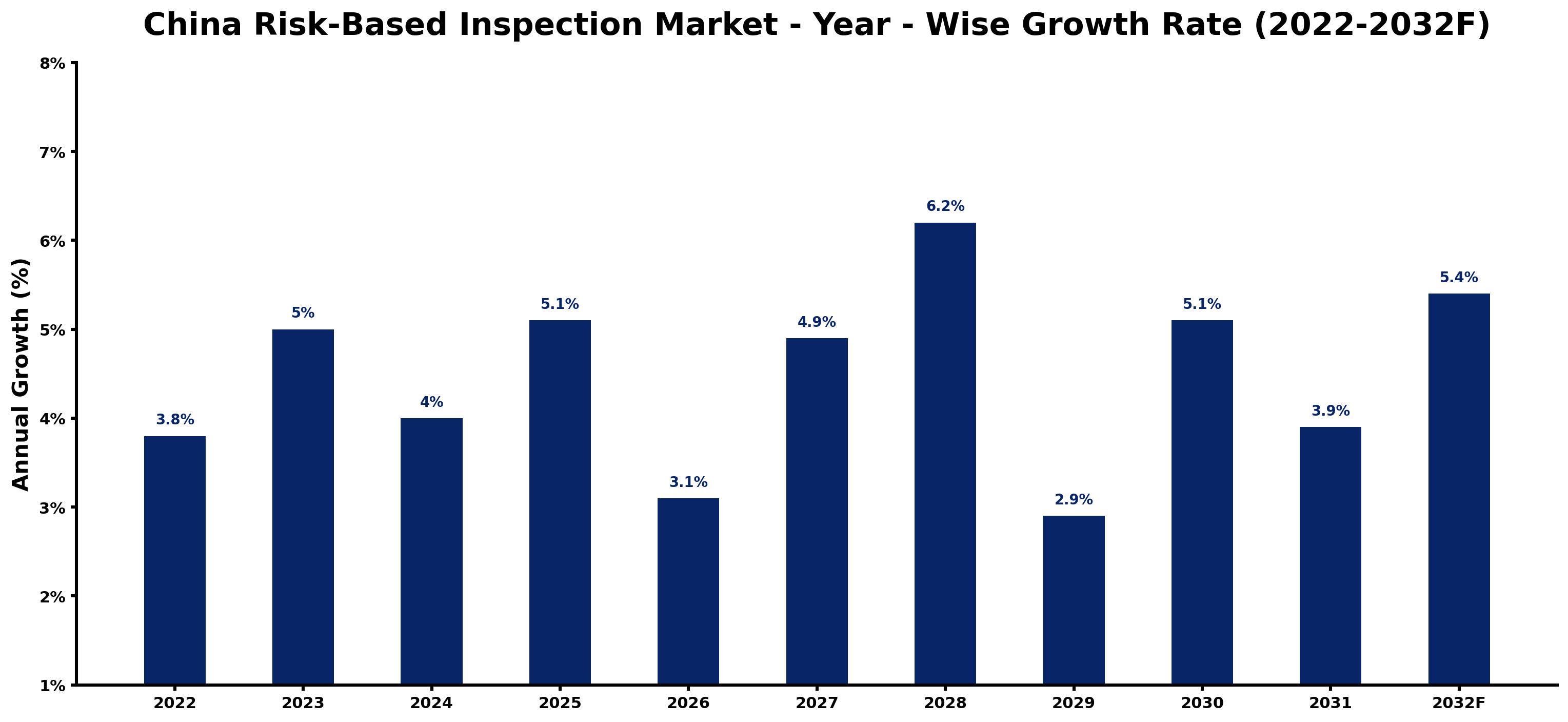
Year by year, the estimates below pair each growth rate with the development that shaped it.
| Year | Estimated Annual Growth (%) | Market Rationale |
| 2022 | 3.8 | The market experienced steady growth due to ongoing safety inspections in critical sectors, driven by the updated National Standard GB/T 20239-2006. |
| 2023 | 5.0 | Increased demand for safety compliance drove faster growth compared to the previous year, particularly in oil refineries. |
| 2024 | 4.0 | Growth slowed as industries adjusted to new safety regulations and inspection protocols mandated by the National Safety Production Plan. |
| 2025 | 5.1 | The market rebounded with faster growth as oil refineries ramped up their safety measures following stricter compliance requirements. |
| 2026 | 3.1 | A slowdown occurred as some sectors faced challenges in implementing new technologies for inspections. |
| 2027 | 4.9 | Growth accelerated as more industries adopted risk-based methodologies for inspections, particularly in petrochemical plants. |
| 2028 | 6.2 | The market peaked with the highest growth rate, driven by heightened safety standards across critical infrastructure. |
| 2029 | 2.9 | Growth slowed again as the market began to stabilise after rapid expansion, influenced by the ongoing implementation of the National Safety Inspection Program. |
| 2030 | 5.1 | A resurgence in demand occurred as industries sought to improve operational safety through updated inspection practices. |
| 2031 | 3.9 | Growth slowed slightly as the market adjusted to established safety protocols and compliance measures. |
| 2032 | 5.4 | The market is expected to grow faster as new technologies are integrated into inspections, enhancing overall safety compliance. |
Note: Market size estimations and growth projections presented in this report are based on 6Wresearch's proprietary forecasting methodology, utilizing the latest available industry data, government publications, and primary research inputs.
China Risk-Based Inspection Market Synopsis
This strategy optimises maintenance schedules while lowering costs, especially in sectors such as oil and gas. The petrochemical industry, which produced over 800 million tons in 2022, illustrates this trend, prompting investments in inspection methods that ensure compliance and safety.
Market Dynamics Impact Analysis (2026–2032)
| Factor | Type | Impact | Primary Segment Affected |
| Increasing safety regulations in high-risk industries | Driver | High | High Risk |
| Adoption of advanced inspection technologies | Driver | High | Ultrasonic Testing |
| Growing need for compliance with safety standards | Opportunity | High | Oil Refineries |
| Expansion of the petrochemical sector requiring inspections | Opportunity | Medium | Petrochemical Plants |
| Limited awareness of risk-based methodologies | Restraint | Medium | Static Equipment |
| High initial investment costs for advanced technologies | Restraint | High | Rotating Machinery |
| Inconsistent implementation of safety protocols | Challenge | High | Critical Infrastructure |
| Shortage of skilled professionals in inspection technologies | Challenge | Medium | Pipelines |
Evaluation of Drivers in China Risk-Based Inspection Market (2026–2032)
The main growth drivers and the segments they affect most are set out below.
| Drivers | Primary Segment Affected | Why It Matters (Evidence) |
| Growing safety compliance requirements | High Risk | This drives demand for inspections to meet regulatory standards, with over 1,000 operational oil refineries needing compliance to ensure safety. |
| Increased adoption of ultrasonic testing | Ultrasonic Testing | This technique improves asset integrity management, resulting in higher inspection frequency and reliability across the oil and gas sector. |
| Expansion of the petrochemical industry | Petrochemical Plants | With over 800 million tons produced in 2022, the need for inspections to ensure safety standards rises, prompting more frequent assessments. |
| Implementation of the National Safety Inspection Program | Critical Infrastructure | This government initiative boosts safety measures, leading to increased demand for risk-based inspections across various sectors. |
| Rising focus on risk management in energy sectors | Power Plants | The installed capacity of approximately 2,000 GW necessitates effective risk assessments to ensure operational reliability and safety. |
The Risk-Based Inspection market in China is expanding as end-use demand from sectors like oil and gas increases. The adoption of ultrasonic testing for asset integrity management is driving inspections, with over 1,000 operational oil refineries requiring compliance. The petrochemical industry, producing over 800 million tons in 2022, contributes to this demand. Industries are enhancing safety measures, resulting in a surge in inspection needs. The installed capacity of power plants, approximately 2,000 GW, also necessitates effective risk assessments to maintain operational reliability and safety standards.
Evaluation of Restraints in China Risk-Based Inspection Market
The following restraints limit how fast demand can grow.
| Market Restraint | Primary Segment Affected | Why It Matters (Evidence) |
| Limited understanding of risk-based inspection methodologies | Static Equipment | This affects the adoption rate, as many facilities lack knowledge of the benefits of risk-based approaches, resulting in lower compliance levels. |
| High costs associated with advanced inspection technologies | Rotating Machinery | These costs can deter smaller facilities from implementing necessary safety measures, restricting their operational capabilities. |
| Inconsistent enforcement of safety regulations | Critical Infrastructure | This creates variable compliance levels, impacting overall safety across sectors and increasing operational risks. |
| Dependence on traditional inspection methods | Pipelines | This reliance can hinder the adoption of more effective risk-based methodologies, resulting in outdated safety practices. |
| Shortage of qualified personnel for inspections | High Risk | This limits the capacity of facilities to conduct thorough risk assessments and inspections, delaying compliance efforts. |
China Risk-Based Inspection Market Challenges
In the China Risk-Based Inspection market, buyers encounter inconsistent inspection standards that jeopardise safety across critical sectors. Non-compliance with the National Standard GB/T 20239-2006 raises operational risks, particularly for oil refineries, which can face losses exceeding 10 million yuan during unplanned shutdowns. A shortage of skilled workers compounds these challenges, as the demand for qualified personnel in risk assessment surpasses supply, delaying project timelines for petrochemical plants. Rising costs for advanced inspection technologies, such as vibration monitoring, force companies to divert resources from other crucial operations. Supply chain disruptions in sourcing inspection equipment can lead to prolonged downtimes and increased maintenance expenses for producers, affecting overall efficiency.
Trends in the China Risk-Based Inspection Market
The trends below show where the China Risk-Based Inspection Market is heading.
- Shift towards Advanced Inspection Technologies: Increased adoption of ultrasonic testing is reshaping inspection practices in China, particularly in oil refineries, with over 1,000 refineries now utilising this technology to improve safety compliance.
- Growing Emphasis on Safety Compliance: The National Safety Inspection Program is prompting industries to prioritise safety compliance, impacting sectors like petrochemicals, which produced over 800 million tons in 2022 and require rigorous inspection protocols.
- Transition from Traditional to Risk-Based Approaches: Many oil refineries are moving from traditional inspection methods to risk-based methodologies, driven by regulatory changes and the need for efficiency in safety measures, ensuring better compliance.
- Increased Investment in Training and Development: The lack of skilled professionals is prompting investments in training programs, particularly in critical infrastructure sectors, where safety compliance is paramount and essential for operational success.
Investment Opportunities in the China Risk-Based Inspection Market
Several openings in the China Risk-Based Inspection Market merit attention from investors.
- Oil Refineries Adopting Risk-Based Inspections: With over 1,000 operational oil refineries in China, there is a notable opportunity to supply risk-based inspection services, as safety regulations become increasingly stringent and compliance is essential.
- Petrochemical Plants Seeking Compliance Solutions: The growing petrochemical sector, producing over 800 million tons in 2022, presents opportunities for suppliers of advanced inspection technologies to meet compliance needs and improve safety measures.
- Joint Ventures for Technology Implementation: Collaborating with local firms can facilitate entry into the market, especially in sectors like power generation, where the installed capacity is approximately 2,000 GW, ensuring effective risk management.
- Expansion of Training Programs for Inspectors: The shortage of qualified personnel creates a demand for training programs, particularly in high-risk industries, ensuring compliance and safety standards are met effectively.
Government Initiatives in the China Risk-Based Inspection Market
The 'National Safety Production Plan' implemented in 2022 aims to improve risk management in high-risk industries, mandating stricter compliance measures for producers. This plan establishes safety protocols across sectors, ensuring that inspection practices meet national standards. Additionally, the updated 'Regulations on Safety Supervision of Hazardous Chemicals' in 2021 further enforce inspection protocols, requiring producers to adhere to stringent safety regulations. These measures collectively strengthen the framework for risk-based inspections in critical infrastructure, promoting a safer industrial environment.
In 2023, new guidelines for risk-based inspections were introduced by the State Administration for Market Regulation, aimed at reducing accidents in critical infrastructure. This initiative is expected to improve compliance and safety standards across various sectors. The Ministry of Emergency Management oversees the implementation of safety regulations, ensuring that inspections are conducted effectively and efficiently. Funding for safety initiatives is allocated to support the adoption of risk-based methodologies, promoting a safer industrial environment and improving overall safety compliance.
Future Insight of the China Risk-Based Inspection Market
The China Risk-Based Inspection market is poised for significant evolution by 2032, driven by the National Safety Inspection Program and the updated Safety Production Law. Regulatory frameworks will encourage buyers to adopt stricter inspection protocols, improving safety across industries. The integration of advanced technologies will streamline maintenance processes and lower operational costs. By 2025, the total installed capacity of power plants is projected to reach approximately 2,200 GW, heightening the demand for effective risk-based inspection methodologies to ensure safety and operational efficiency.
Market Segmentation Analysis
The report offers a comprehensive study of the following market segments and their leading categories in the market.
By Inspection Type – Static Equipment Dominated, Pipelines Expected to Grow Fastest
According to Shubham Padhi, Research Analyst at 6Wresearch, in 2025, Static Equipment led the inspection type split with a 48% share. Static Equipment leads the China Risk-Based Inspection Market due to its critical role in assessing fixed assets, particularly in the extensive network of oil refineries. With over 1,000 operational oil refineries, the demand for effective inspection methodologies is paramount. Pipelines are projected to grow fastest, at a CAGR of 7.1% during 2026–2032. Pipelines are growing rapidly as they are crucial for ensuring the safety of transportation systems, especially with increased regulatory oversight. The launch of the National Safety Inspection Program in 2023 highlights the urgent need for improved pipeline inspection practices. Suppliers should focus on developing advanced inspection solutions tailored for pipelines to meet the rising demand for safety compliance.
By Risk Priority Category – High Risk Dominated, Critical Infrastructure Expected to Grow Fastest
High Risk took a 41% share of risk priority category in 2025, more than any other category. High Risk dominates the market share as it requires immediate attention for safety compliance, particularly in critical sectors like oil and gas. The emphasis on safety regulations has made high-risk assessments a priority for many industries. The quickest growth will come from Critical Infrastructure, forecast to expand at a CAGR of 6.8% between 2026 and 2032. Critical Infrastructure is the fastest-growing category, driven by the need to protect essential services and assets, especially in light of recent regulatory updates. The Ministry of Emergency Management's oversight further underscores the importance of prioritising inspections in this area. Buyers must prioritise high-risk and critical infrastructure inspections to ensure compliance and safeguard operations.
By Technique Used – Ultrasonic Testing Dominated, Vibration Monitoring Expected to Grow Fastest
With a 39% revenue share in 2025, Ultrasonic Testing was the largest technique used category. Ultrasonic Testing captures the largest market share owing to its extensive use for thickness measurements and flaw detection, making it a preferred choice across various sectors. Its effectiveness in maintaining asset integrity solidifies its position as the primary inspection technique. Vibration Monitoring is set to record the highest CAGR in this split, 6.6% over 2026–2032. Vibration Monitoring is experiencing the fastest growth, essential for early detection of machinery faults, particularly in critical sectors like oil and gas. The increasing occurrence of machinery-related incidents has prompted a shift towards more proactive monitoring solutions. Suppliers should enhance vibration monitoring technologies to cater to the growing demand for predictive maintenance solutions.
By End User – Oil Refineries Dominated, Petrochemical Plants Expected to Grow Fastest
Oil Refineries accounted for a 50% market share by end user in 2025. Oil Refineries dominate the market share as they are the main users of Risk-Based Inspection methodologies, vital for enhancing safety and operational efficiency. The large number of refineries in China drives the need for robust inspection practices to effectively manage risks. Over 2026–2032, Petrochemical Plants are expected to post the fastest growth, at a CAGR of 6.9%. Petrochemical Plants are the fastest-growing end user segment, critical for maintaining safety standards amid rising production demands. The production of over 800 million tons of petrochemical products in 2022 underscores the need for stringent inspection protocols. Buyers in the petrochemical sector must adopt advanced inspection methodologies to ensure compliance with safety standards and improve operational efficiency.
Key Attractiveness of the Report
- 10 Years of Market Numbers
- Historical Data Starting from 2022 to 2025
- Base Year 2025
- Forecast Data until 2032
- Key Performance Indicators Impacting the Market
- Major Upcoming Developments and Projects
Key Highlights of the Report:
- China Risk-Based Inspection Market Outlook
- Market Size of China Risk-Based Inspection Market, 2025
- Forecast of China Risk-Based Inspection Market, 2032
- Historical Data and Forecast of China Risk-Based Inspection Revenues & Volume for the Period 2022 - 2032F
- China Risk-Based Inspection Market Trend Evolution
- China Risk-Based Inspection Market Drivers and Challenges
- China Risk-Based Inspection Price Trends
- China Risk-Based Inspection Porter's Five Forces
- China Risk-Based Inspection Industry Life Cycle
- Historical Data and Forecast of China Risk-Based Inspection Market Revenues & Volume By Inspection Type for the Period 2022 - 2032F
- Historical Data and Forecast of China Risk-Based Inspection Market Revenues & Volume By Static Equipment for the Period 2022 - 2032F
- Historical Data and Forecast of China Risk-Based Inspection Market Revenues & Volume By Rotating Machinery for the Period 2022 - 2032F
- Historical Data and Forecast of China Risk-Based Inspection Market Revenues & Volume By Pipelines for the Period 2022 - 2032F
- Historical Data and Forecast of China Risk-Based Inspection Market Revenues & Volume By Storage Tanks for the Period 2022 - 2032F
- Historical Data and Forecast of China Risk-Based Inspection Market Revenues & Volume By Risk Priority Category for the Period 2022 - 2032F
- Historical Data and Forecast of China Risk-Based Inspection Market Revenues & Volume By High Risk for the Period 2022 - 2032F
- Historical Data and Forecast of China Risk-Based Inspection Market Revenues & Volume By Medium Risk for the Period 2022 - 2032F
- Historical Data and Forecast of China Risk-Based Inspection Market Revenues & Volume By Critical Infrastructure for the Period 2022 - 2032F
- Historical Data and Forecast of China Risk-Based Inspection Market Revenues & Volume By Low Risk for the Period 2022 - 2032F
- Historical Data and Forecast of China Risk-Based Inspection Market Revenues & Volume By Technique Used for the Period 2022 - 2032F
- Historical Data and Forecast of China Risk-Based Inspection Market Revenues & Volume By Ultrasonic Testing for the Period 2022 - 2032F
- Historical Data and Forecast of China Risk-Based Inspection Market Revenues & Volume By Vibration Monitoring for the Period 2022 - 2032F
- Historical Data and Forecast of China Risk-Based Inspection Market Revenues & Volume By Radiographic Testing for the Period 2022 - 2032F
- Historical Data and Forecast of China Risk-Based Inspection Market Revenues & Volume By Visual & Acoustic Methods for the Period 2022 - 2032F
- Historical Data and Forecast of China Risk-Based Inspection Market Revenues & Volume By End User for the Period 2022 - 2032F
- Historical Data and Forecast of China Risk-Based Inspection Market Revenues & Volume By Oil Refineries for the Period 2022 - 2032F
- Historical Data and Forecast of China Risk-Based Inspection Market Revenues & Volume By Power Plants for the Period 2022 - 2032F
- Historical Data and Forecast of China Risk-Based Inspection Market Revenues & Volume By Gas Distribution Units for the Period 2022 - 2032F
- Historical Data and Forecast of China Risk-Based Inspection Market Revenues & Volume By Petrochemical Plants for the Period 2022 - 2032F
- China Risk-Based Inspection Import Export Trade Statistics
- Market Opportunity Assessment By Inspection Type
- Market Opportunity Assessment By Risk Priority Category
- Market Opportunity Assessment By Technique Used
- Market Opportunity Assessment By End User
- China Risk-Based Inspection Top Companies Market Share
- China Risk-Based Inspection Competitive Benchmarking By Technical and Operational Parameters
- China Risk-Based Inspection Company Profiles
- China Risk-Based Inspection Key Strategic Recommendations
Market Covered
This report examines the market across the segments below.
By Inspection Type
- Static Equipment
- Rotating Machinery
- Pipelines
- Storage Tanks
By Risk Priority Category
- High Risk
- Medium Risk
- Critical Infrastructure
- Low Risk
By Technique Used
- Ultrasonic Testing
- Vibration Monitoring
- Radiographic Testing
- Visual & Acoustic Methods
By End User
- Oil Refineries
- Power Plants
- Gas Distribution Units
- Petrochemical Plants































