China Robot Control Software Market Size & Growth Rate
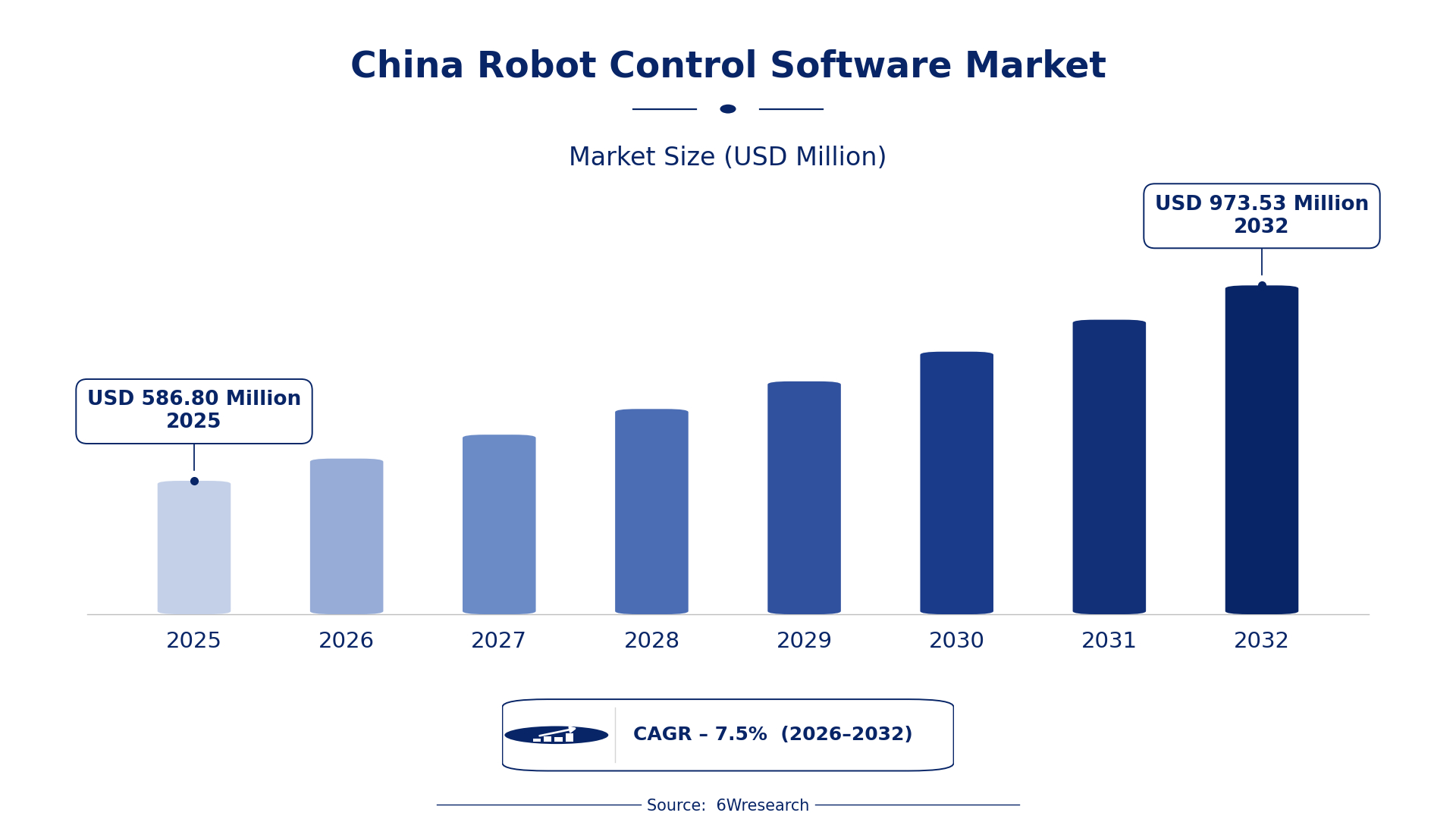
According to 6Wresearch internal database and industry insights, the China Robot Control Software Market was valued at USD 586.8 million in 2025 and is projected to reach USD 973.53 million by 2032, growing at a CAGR of approximately 7.5% during 2026–2032.
China Robot Control Software Market Highlights
| Report Metric | Details |
| Report Name | China Robot Control Software Market |
| Market Size 2025 | USD 586.8 million |
| Market Size 2032 | USD 973.53 million |
| Absolute Growth 2025–2032 | USD 386.73 million |
| CAGR 2026–2032 | 7.5% |
| Peak Annual Growth | 9.6% in 2027 |
| Forecast Period | 2026–2032 |
| Historical Data | 2022–2025 |
| Base Year | 2025 |
| Leading Software Type, 2025 | AI-Based Controllers (52% share) |
| Leading Control Method, 2025 | Trajectory-Based (38% share) |
| Leading Application Area, 2025 | Industrial Automation (40% share) |
| Leading End User, 2025 | Manufacturing Plants (42% share) |
| Fastest-Growing Control Method | Digital Twin (9.0% CAGR) |
| Fastest-Growing Application Area | Robotics R&D (8.9% CAGR) |
| Fastest-Growing End User | Robotics Developers (10.2% CAGR) |
| Growing Sector | Robotics R&D |
| Key End Users | Industrial Automation, Assembly Lines, Robotics R&D, Autonomous Systems |
China Robot Control Software Market Year-wise Growth Rate and Key Drivers (2022–2032)
This graph illustrates the annual growth rates of the market from 2022 to 2032, highlighting a steady upward trajectory and projected market expansion over the forecast period.
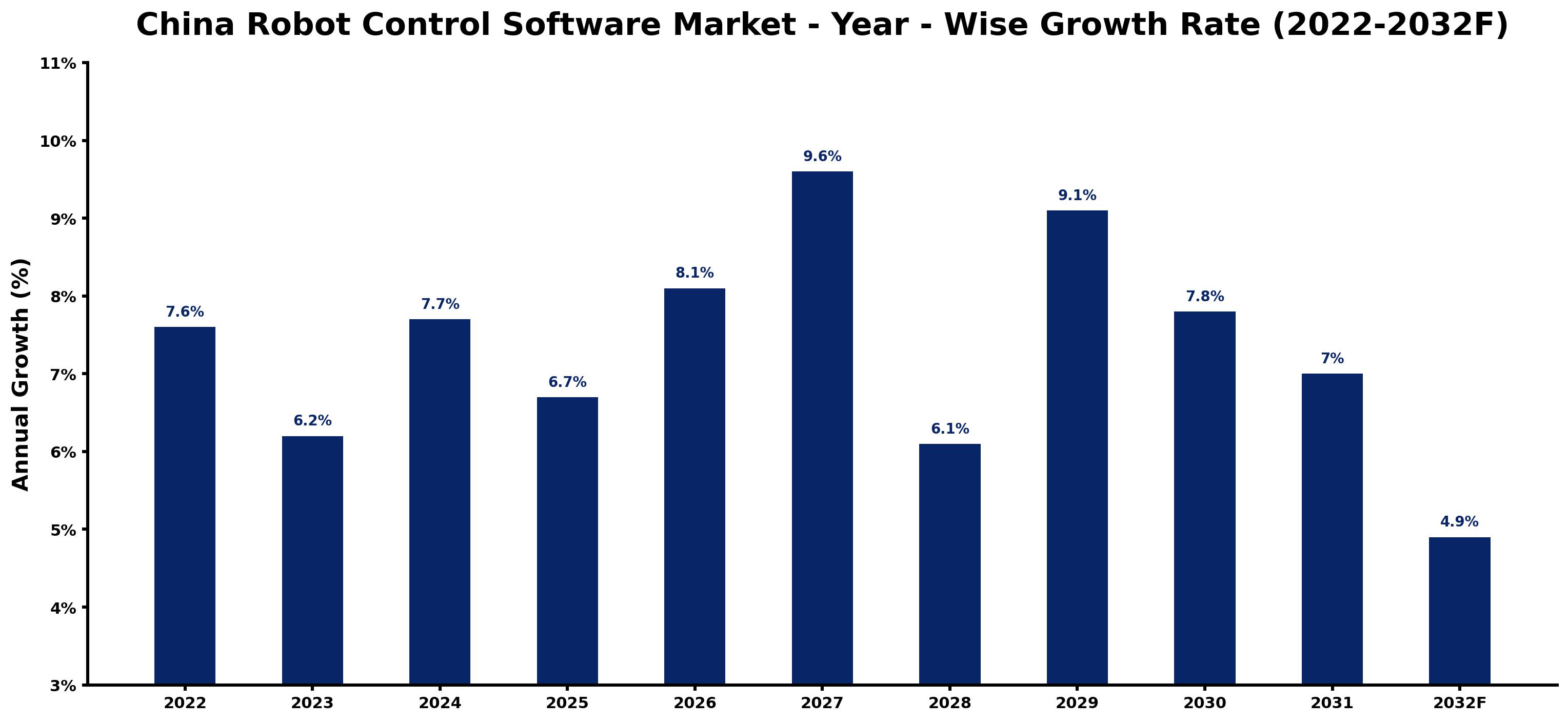
The table below sets out the estimated growth rate for each year and the main factor behind it.
| Year | Estimated Annual Growth (%) | Market Rationale |
| 2022 | 7.6 | The market experienced steady growth as industrial automation needs increased. |
| 2023 | 6.2 | Growth slowed due to supply chain challenges affecting production timelines. |
| 2024 | 7.7 | Demand surged as manufacturers adopted more robotic systems for efficiency. |
| 2025 | 6.7 | Growth decelerated as market adjustments took place following rapid expansion. |
| 2026 | 8.1 | Investment in AI-based controllers boosted demand for advanced robotic solutions. |
| 2027 | 9.6 | The market peaked as automation initiatives gained momentum across sectors. |
| 2028 | 6.1 | Growth slowed as the market began to stabilise after rapid advancements. |
| 2029 | 9.1 | Demand accelerated again as robotics developers sought innovative solutions. |
| 2030 | 7.8 | Growth decelerated as the market adjusted to new technological standards. |
| 2031 | 7.0 | The market continued to grow, albeit at a slower pace due to maturity. |
| 2032 | 4.9 | Growth slowed as the market reached a more stable phase. |
Note: Market size estimations and growth projections presented in this report are based on 6Wresearch's proprietary forecasting methodology, utilizing the latest available industry data, government publications, and primary research inputs.
China Robot Control Software Market Synopsis
Robot Control Software in China includes technologies for programming and managing robotic systems across diverse applications. This software is created through coding and algorithm design, with notable applications in industrial automation and robotics research. The ongoing "Made in China 2025" initiative further stimulates demand, as local manufacturers and system integrators pursue advanced solutions to improve productivity and efficiency.
Market Dynamics Impact Analysis (2026–2032)
| Factor | Type | Impact | Primary Segment Affected |
| Increasing demand for industrial automation solutions. | Driver | High | Industrial Automation |
| Growing adoption of AI-based controllers in manufacturing. | Driver | High | AI-Based Controllers |
| Investment opportunities in robotics R&D for new technologies. | Opportunity | High | Robotics R&D |
| Expansion of manufacturing plants seeking automation solutions. | Opportunity | High | Manufacturing Plants |
| Supply chain disruptions affecting software availability. | Restraint | Medium | Motion Control |
| High development costs for advanced robotic systems. | Restraint | Medium | AI-Based Controllers |
| Regulatory approvals can delay product launches. | Challenge | High | Simulation Software |
| Limited skilled workforce in robotics programming. | Challenge | Medium | Engineering Teams |
Evaluation of Drivers in China Robot Control Software Market (2026–2032)
The factors lifting demand, and the evidence behind each, are summarised below.
| Drivers | Primary Segment Affected | Why It Matters (Evidence) |
| Government initiatives promoting robotics adoption. | Simulation Software | Policies encourage companies to invest in advanced robotic technologies, creating a competitive environment for innovation. |
| Investment in AI technologies for manufacturing. | AI-Based Controllers | Funding for AI integration in robotics is projected to increase, driving demand for sophisticated solutions. |
| Growing demand for automation in manufacturing processes. | Industrial Automation | The manufacturing sector's reliance on robotics is expected to rise, leading to increased software purchases. |
| Focus on enhancing productivity through robotics. | Trajectory-Based | Manufacturers are adopting precise control methods to improve operational efficiency and reduce costs. |
| Expansion of robotics research and development. | Robotics R&D | Increased funding for R&D initiatives supports the development of innovative robot control solutions. |
The Robot Control Software market in China is expanding as end-use demand for automation in manufacturing processes rises, leading to increased investments in advanced technologies. Notably, the manufacturing sector employs over 30 million workers, many of whom rely on robotic systems for efficiency. The integration of AI technologies in robotics is driving the need for advanced control systems, with significant funding allocated for innovation in Shenzhen.
Evaluation of Restraints in China Robot Control Software Market
The following restraints limit how fast demand can grow.
| Market Restraint | Primary Segment Affected | Why It Matters (Evidence) |
| Limited access to advanced technologies | AI-Based Controllers | This hinders the development of effective applications, delaying projects and increasing costs. |
| High integration costs of outdated systems | Motion Control | Buyers face inflated operational expenses, making it difficult to adopt new technologies. |
| Shortage of skilled professionals | Simulation Software | This limits the capacity to develop and implement advanced robotic solutions. |
| Dependence on imports for sophisticated software | PLC-Based | This reliance can delay project timelines and increase costs for manufacturers. |
| Rapid technological advancements | Trajectory-Based | Producers struggle to keep pace with industry standards, impacting product offerings. |
China Robot Control Software Market Challenges
The China Robot Control Software Market encounters a critical supply issue due to restricted access to advanced technologies. This dependence on imports for sophisticated software solutions can extend project timelines for manufacturers by up to six months. Buyers face high costs when integrating outdated systems, inflating operational expenses by around 20%. A shortage of skilled professionals in coding and algorithm design hinders the development of effective applications, forcing companies to invest heavily in training programs that may take years to yield qualified workers. Rapid technological advancements create a gap in current offerings, leaving producers struggling to meet industry standards set by the National Standard for Industrial Robots.
Trends in the China Robot Control Software Market
Below mentioned are some of the trends shaping the China Robot Control Software Market growth.
- Shift Towards AI Integration in Robotics: China is undergoing a shift towards AI integration in robotics, particularly within manufacturing. The adoption of AI-based controllers is anticipated to grow by 8.6% from 2026 to 2032, reflecting the demand for smarter automation solutions.
- Growing Focus on Robotics R&D: There is a rising emphasis on robotics research and development in China, especially in hubs like Shenzhen. This focus is evident in the projected growth rate of 8.9% for robotics R&D applications, underscoring the need for innovative software solutions.
- Expansion of Manufacturing Facilities: The growth of manufacturing facilities in regions like Shenzhen is driving demand for robot control software. This expansion is expected to significantly increase the market size, with manufacturing plants representing 42% of the end-user share in 2025.
- Government Support for Robotics Adoption: Government initiatives are actively encouraging the adoption of robotics technologies across various sectors. The "Robot Industry Development Plan (2021-2025)" aims to strengthen domestic production capabilities, further incentivising investment in advanced robotic solutions.
Investment Opportunities in the China Robot Control Software Market
Investors looking at the China Robot Control Software Market should consider the following areas.
- Partnerships with Local Developers: Establishing partnerships with local developers in Shenzhen can ease market entry. With the robotics industry poised for growth, companies can leverage local expertise to improve product offerings and meet demand.
- Investment in Robotics R&D Facilities: The rising demand for AI-based controllers, projected to grow at 8.6%, presents a promising opportunity. Companies can target manufacturing plants seeking advanced automation solutions to boost efficiency.
- Utilising Government Subsidies: Now is an opportune moment to take advantage of government subsidies for advanced robotics technologies. The "Robotics Innovation Fund" established in 2023 supports startups and SMEs, providing financial assistance for innovative projects.
- Expansion into Emerging Markets: With the robotics market anticipated to grow, entering emerging markets can yield substantial returns. Companies can explore partnerships in regions with high manufacturing activity, capitalising on local demand.
Government Initiatives in the China Robot Control Software Market
The "Robot Industry Development Plan (2021-2025)" launched by the Ministry of Industry and Information Technology aims to enhance domestic production capabilities and innovation in robotics. This plan outlines strategies to improve the quality and efficiency of robot control software, ensuring compliance with national standards. Additionally, the "Smart Manufacturing Development Strategy" initiated by the National Development and Reform Commission in 2020 promotes the integration of AI and robotics in manufacturing processes, guiding investments towards advanced technologies. The "New Generation Artificial Intelligence Development Plan" approved in 2022 focuses on advancing AI technologies in robotics, allocating significant resources for research and development.
The Ministry of Industry and Information Technology oversees the approval of standards for robot control software, ensuring compliance with regulations. The "National Key R&D Program on Intelligent Manufacturing" introduced by the Ministry of Science and Technology allocates substantial resources for robotics advancements, supporting research initiatives. Furthermore, the "Robotics Innovation Fund" established in 2023 provides financial assistance for startups and SMEs developing advanced robot control technologies, promoting innovation in the sector. This fund aims to support over 100 projects annually, enhancing the capabilities of domestic producers.
Future Insight of the China Robot Control Software Market
The China Robot Control Software Market is set for a transformative shift towards automation and AI integration by 2032, driven by government initiatives like the "Made in China 2025" program. Increased investment in R&D facilities, particularly in Shenzhen, will support this transition. By 2025, the market is projected to reach a substantial value, reflecting the rising demand from the manufacturing sector, which employs over 30 million workers. The introduction of subsidy programs for advanced robotics technologies will further motivate companies to adopt new solutions.
Market Segmentation Analysis
The analysis below covers each segmentation, its leading category in 2025 and its fastest-growing category through 2032.
By Software Type – AI-Based Controllers Dominated and Is Expected to Record the Fastest Growth
According to Shubham Padhi, Research Analyst at 6Wresearch, in 2025, AI-Based Controllers led the software type split with a 52% share. AI-based controllers dominate the market due to their ability to enhance robotic decision-making and adaptability, making them essential for various applications. This technology is particularly vital in sectors like industrial automation, where efficiency and precision are paramount. Its lead should widen, with a projected CAGR of 8.6% during 2026–2032, the highest in this split. The growth of AI-based controllers is propelled by the increasing demand for smart manufacturing solutions, as highlighted by the Chinese government's focus on automation. This trend is expected to continue as more industries adopt AI technologies to improve productivity. Suppliers should prioritise AI-based solutions to meet the growing demand from manufacturers and ensure competitiveness in the market.
By Control Method – Trajectory-Based Dominated, Digital Twin Expected to Grow Fastest
Trajectory-Based accounted for a 38% market share by control method in 2025. Trajectory-based methods hold the largest share as they are crucial for achieving precise robotic movements in various applications. This approach is extensively used in manufacturing processes where accuracy is essential. Digital Twin is set to record the highest CAGR in this split, 9.0% over 2026–2032. Digital twin technology is gaining traction as it offers virtual modelling capabilities, allowing for enhanced simulation and testing of robotic systems. As industries recognise its potential, the adoption rate is expected to rise significantly. Suppliers need to invest in digital twin technologies to capture the emerging opportunities in the robotics sector.
By Application Area – Industrial Automation Dominated, Robotics R&D Expected to Grow Fastest
The largest application area category in 2025 was Industrial Automation, with a 40% share of total revenue. Industrial automation is the leading application area for robot control software, driven by the need for increased efficiency in manufacturing processes. This sector employs a vast number of workers, highlighting its reliance on robotic systems. The quickest growth will come from Robotics R&D, forecast to expand at a CAGR of 8.9% between 2026 and 2032. Robotics R&D is experiencing rapid growth as companies invest in innovation to develop new robotic applications. The emphasis on research is critical for advancing technology and meeting future market demands. Buyers should focus on R&D capabilities to stay ahead in the competitive landscape of robotics.
By End User – Manufacturing Plants Dominated, Robotics Developers Expected to Grow Fastest
Manufacturing Plants took a 42% share of end user in 2025, more than any other category. Manufacturing plants are the primary end users of robot control software, as they require automation solutions to enhance productivity and efficiency. This sector's vast scale ensures a consistent demand for advanced control technologies. Robotics Developers are projected to grow fastest, at a CAGR of 10.2% during 2026–2032. Robotics developers are rapidly adopting new software solutions to create innovative applications, reflecting the industry's push towards advanced robotics. Their role in driving technological advancements is crucial for future growth. Suppliers must cater to the specific needs of robotics developers to capitalise on the growing trend of innovation in the sector.
Key Attractiveness of the Report
- 10 Years of Market Numbers
- Historical Data Starting from 2022 to 2025
- Base Year 2025
- Forecast Data until 2032
- Key Performance Indicators Impacting the Market
- Major Upcoming Developments and Projects
Key Highlights of the Report:
- China Robot Control Software Market Outlook
- Market Size of China Robot Control Software Market, 2025
- Forecast of China Robot Control Software Market, 2032
- Historical Data and Forecast of China Robot Control Software Revenues & Volume for the Period 2022 - 2032F
- China Robot Control Software Market Trend Evolution
- China Robot Control Software Market Drivers and Challenges
- China Robot Control Software Price Trends
- China Robot Control Software Porter's Five Forces
- China Robot Control Software Industry Life Cycle
- Historical Data and Forecast of China Robot Control Software Market Revenues & Volume By Software Type for the Period 2022 - 2032F
- Historical Data and Forecast of China Robot Control Software Market Revenues & Volume By Motion Control for the Period 2022 - 2032F
- Historical Data and Forecast of China Robot Control Software Market Revenues & Volume By PLC-Based for the Period 2022 - 2032F
- Historical Data and Forecast of China Robot Control Software Market Revenues & Volume By AI-Based Controllers for the Period 2022 - 2032F
- Historical Data and Forecast of China Robot Control Software Market Revenues & Volume By Simulation Software for the Period 2022 - 2032F
- Historical Data and Forecast of China Robot Control Software Market Revenues & Volume By Control Method for the Period 2022 - 2032F
- Historical Data and Forecast of China Robot Control Software Market Revenues & Volume By Trajectory-Based for the Period 2022 - 2032F
- Historical Data and Forecast of China Robot Control Software Market Revenues & Volume By Ladder Logic for the Period 2022 - 2032F
- Historical Data and Forecast of China Robot Control Software Market Revenues & Volume By Reinforcement Learning for the Period 2022 - 2032F
- Historical Data and Forecast of China Robot Control Software Market Revenues & Volume By Digital Twin for the Period 2022 - 2032F
- Historical Data and Forecast of China Robot Control Software Market Revenues & Volume By Application Area for the Period 2022 - 2032F
- Historical Data and Forecast of China Robot Control Software Market Revenues & Volume By Industrial Automation for the Period 2022 - 2032F
- Historical Data and Forecast of China Robot Control Software Market Revenues & Volume By Assembly Lines for the Period 2022 - 2032F
- Historical Data and Forecast of China Robot Control Software Market Revenues & Volume By Autonomous Systems for the Period 2022 - 2032F
- Historical Data and Forecast of China Robot Control Software Market Revenues & Volume By Robotics R&D for the Period 2022 - 2032F
- Historical Data and Forecast of China Robot Control Software Market Revenues & Volume By End User for the Period 2022 - 2032F
- Historical Data and Forecast of China Robot Control Software Market Revenues & Volume By Manufacturing Plants for the Period 2022 - 2032F
- Historical Data and Forecast of China Robot Control Software Market Revenues & Volume By System Integrators for the Period 2022 - 2032F
- Historical Data and Forecast of China Robot Control Software Market Revenues & Volume By Robotics Developers for the Period 2022 - 2032F
- Historical Data and Forecast of China Robot Control Software Market Revenues & Volume By Engineering Teams for the Period 2022 - 2032F
- China Robot Control Software Import Export Trade Statistics
- Market Opportunity Assessment By Software Type
- Market Opportunity Assessment By Control Method
- Market Opportunity Assessment By Application Area
- Market Opportunity Assessment By End User
- China Robot Control Software Top Companies Market Share
- China Robot Control Software Competitive Benchmarking By Technical and Operational Parameters
- China Robot Control Software Company Profiles
- China Robot Control Software Key Strategic Recommendations
Market Covered
The report offers an extensive study of the following market segments.
By Software Type
- Motion Control
- PLC-Based
- AI-Based Controllers
- Simulation Software
By Control Method
- Trajectory-Based
- Ladder Logic
- Reinforcement Learning
- Digital Twin
By Application Area
- Industrial Automation
- Assembly Lines
- Autonomous Systems
- Robotics R&D
By End User
- Manufacturing Plants
- System Integrators
- Robotics Developers
- Engineering Teams































