China Robotics AI Software Market Size & Growth Rate
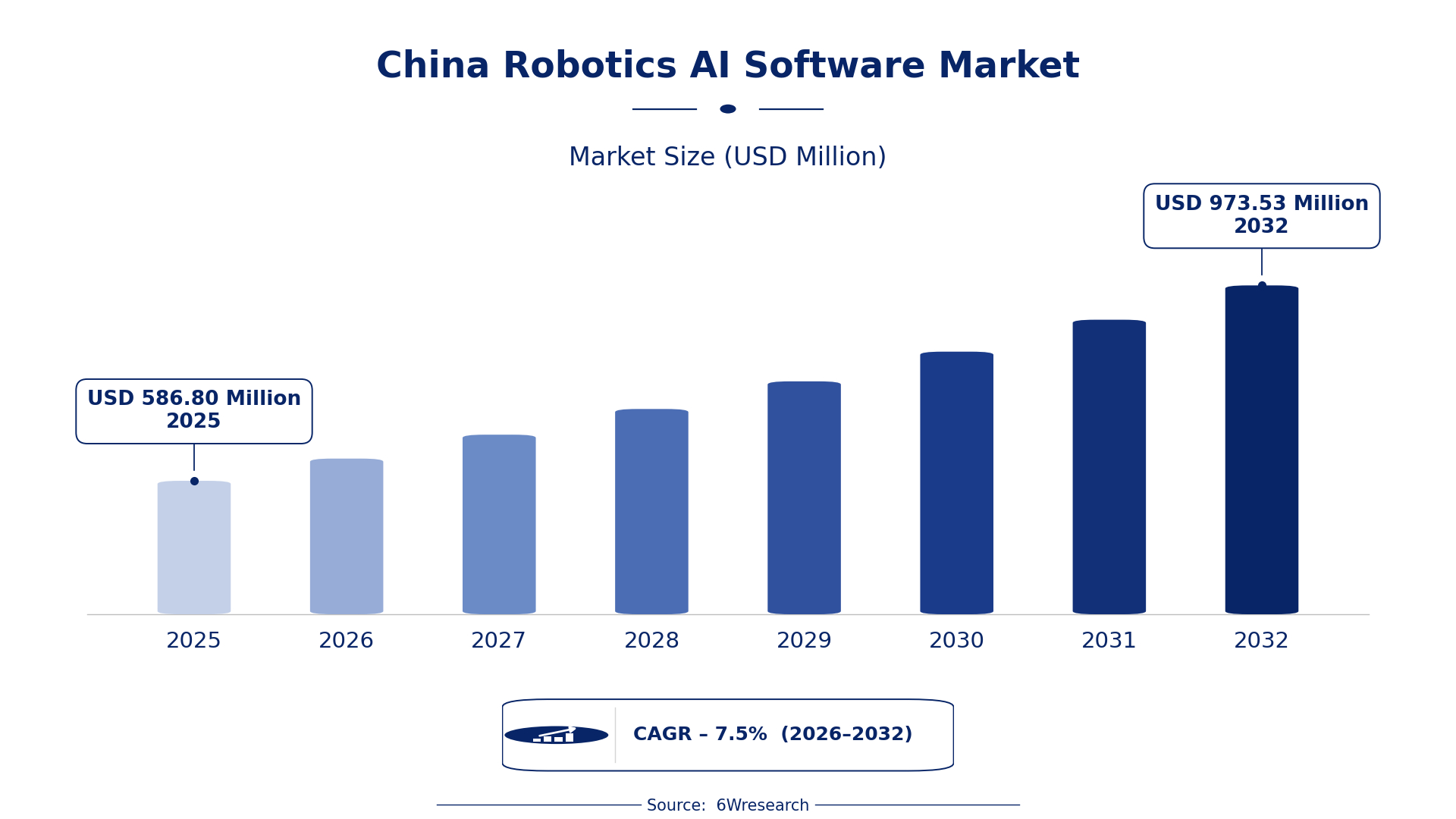
According to 6Wresearch internal database and industry insights, the China Robotics AI Software Market was valued at USD 586.8 million in 2025 and is projected to reach USD 973.53 million by 2032, growing at a CAGR of approximately 7.5% during 2026–2032.
China Robotics AI Software Market Highlights
| Report Metric | Details |
| Report Name | China Robotics AI Software Market |
| Market Size 2025 | USD 586.8 million |
| Market Size 2032 | USD 973.53 million |
| Absolute Growth 2025–2032 | USD 386.73 million |
| CAGR 2026–2032 | 7.5% |
| Peak Annual Growth | 9.1% in 2028 |
| Forecast Period | 2026–2032 |
| Historical Data | 2022–2025 |
| Base Year | 2025 |
| Leading AI Function, 2025 | Motion Planning (37% share) |
| Leading Application Area, 2025 | Manufacturing Robots (36% share) |
| Leading Learning Model, 2025 | Deep Learning/NLP Models (40% share) |
| Leading End User, 2025 | Robotics Engineers (43% share) |
| Fastest-Growing AI Function | Predictive Maintenance (9.5% CAGR) |
| Fastest-Growing Application Area | Service Robots (9.9% CAGR) |
| Fastest-Growing Learning Model | Reinforcement Learning (9.8% CAGR) |
| Fastest-Growing End User | AI Robotics Developers (9.8% CAGR) |
| Growing Sector | Healthcare and Logistics |
| Key End Users | Manufacturers, Logistics Companies, Healthcare Providers, Robotics Engineers |
China Robotics AI Software Market Year-wise Growth Rate and Key Drivers (2022–2032)
This graph illustrates the annual growth rates of the market from 2022 to 2032, highlighting a steady upward trajectory and projected market expansion over the forecast period.
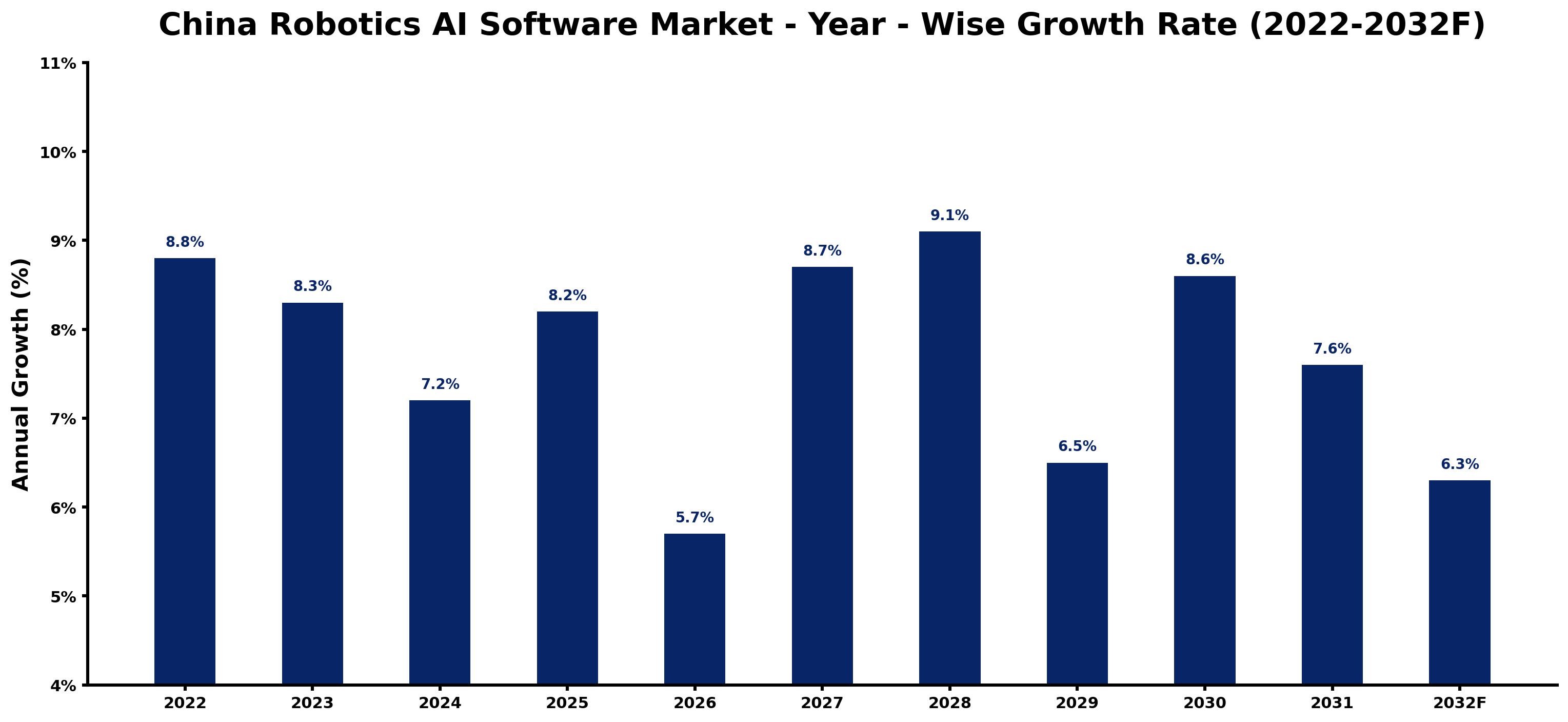
Below, each year's estimated growth is shown next to the factor that most influenced it.
| Year | Estimated Annual Growth (%) | Market Rationale |
| 2022 | 8.8 | The installed base of industrial robots reached approximately 1 million units, driving demand. |
| 2023 | 8.3 | The National Robotics Industry Development Plan aimed for a 30% increase in robotics use by 2025, influencing growth. |
| 2024 | 7.2 | The market experienced slower growth as companies adjusted to new automation technologies and standards. |
| 2025 | 8.2 | Demand for manufacturing robots surged, reflecting increased automation in factories due to the Robotics Industry Development Action Plan. |
| 2026 | 5.7 | A slowdown occurred as the market adjusted to the effects of the subsidy program for SMEs adopting robotics. |
| 2027 | 8.7 | Demand for robotics technology rose again due to advancements in AI and machine learning applications. |
| 2028 | 9.1 | The peak growth year saw increased investments in robotics driven by the Smart Manufacturing Innovation and Development Program. |
| 2029 | 6.5 | Growth slowed as the market began to stabilise after rapid expansions in previous years. |
| 2030 | 8.6 | Healthcare and hospitality sectors boosted demand for service robots, increasing automation prevalence. |
| 2031 | 7.6 | The market continued to grow, albeit at a slower pace, as companies consolidated their robotics investments. |
| 2032 | 6.3 | The market growth rate decreased further as the focus shifted towards refining existing technologies. |
Note: Market size estimations and growth projections presented in this report are based on 6Wresearch's proprietary forecasting methodology, utilizing the latest available industry data, government publications, and primary research inputs.
China Robotics AI Software Market Synopsis
The China Robotics AI Software Market encompasses algorithms that enable robots to perform tasks intelligently, primarily used in manufacturing, logistics, and service industries. The market is expanding rapidly, driven by domestic demand and advancements in technology. With over 200 robotics companies focusing on AI software development, the sector is set for growth. The National Robotics Industry Development Plan aims to increase robotics use in manufacturing by 30% by 2025, stimulating market activity. As China's population exceeds 1.4 billion, the demand for service robots continues to rise, creating vast opportunities for suppliers.
Market Dynamics Impact Analysis (2026–2032)
| Factor | Type | Impact | Primary Segment Affected |
| Advancements in AI technology are enhancing the capabilities of robotics software. | Driver | High | Manufacturing Robots |
| The growing e-commerce sector is increasing the demand for mobile robots in logistics. | Driver | High | Mobile Robots |
| The government subsidy program for SMEs adopting robotics technologies is creating new investment opportunities. | Opportunity | High | Predictive Maintenance |
| The rising demand for automation in healthcare is opening avenues for service robots. | Opportunity | High | Service Robots |
| High development costs for advanced robotics software can limit market entry for new players. | Restraint | High | Motion Planning |
| The complexity of integrating AI with existing systems can slow down adoption rates. | Restraint | Medium | AI Robotics Developers |
| The Robotics AI Software market in China faces challenges from rapid technological changes. | Challenge | High | Robotics Engineers |
| Competition among over 200 robotics companies can lead to pricing pressures. | Challenge | Medium | System Integrators |
Evaluation of Drivers in China Robotics AI Software Market (2026–2032)
Below mentioned are some major drivers and their influence on market dynamics.
| Drivers | Primary Segment Affected | Why It Matters (Evidence) |
| Increased automation in manufacturing processes drives demand for Robotics AI Software. | Manufacturing Robots | In 2022, approximately 1 million industrial robots were installed, leading to a surge in software needs. |
| The rise of e-commerce is pushing logistics companies to adopt mobile robots. | Mobile Robots | The demand for mobile robots in logistics is projected to grow by 20% due to e-commerce expansion. |
| The government’s Robotics Industry Development Action Plan is boosting domestic production capabilities. | Predictive Maintenance | This plan aims for a 30% increase in robotics use by 2025, driving software development. |
| The healthcare sector's increasing reliance on automation is boosting service robot demand. | Service Robots | China's population of over 1.4 billion creates a vast market for service robots in healthcare. |
| Technological advancements in AI are improving the functionalities of robotics software. | Deep Learning/NLP Models | The National AI Development Plan focuses on integrating AI in robotics, improving software capabilities. |
The Robotics AI Software market in China is expanding as end-use demand from manufacturing, logistics, and healthcare sectors rises. The installed base of industrial robots reached approximately 1 million units in 2022, increasing the need for advanced software solutions. The growing e-commerce sector is pushing logistics companies to adopt mobile robots, further driving software demand. The Robotics Industry Development Action Plan aims for a 30% increase in robotics use by 2025, supporting domestic production capabilities. Advancements in AI technology are improving the functionalities of robotics software, leading to more innovative applications in manufacturing and healthcare sectors.
Evaluation of Restraints in China Robotics AI Software Market
The main factors holding the market back are set out below.
| Market Restraint | Primary Segment Affected | Why It Matters (Evidence) |
| High development costs for advanced robotics software limit market entry for new players. | Motion Planning | New entrants face challenges due to substantial investment requirements in technology and talent. |
| Integration complexities slow down the adoption of AI in existing systems. | AI Robotics Developers | Companies struggle to incorporate advanced AI into their current operations, delaying implementation. |
| Limited access to skilled workforce hampers growth in robotics software development. | Robotics Engineers | The demand for skilled professionals exceeds supply, affecting project timelines and innovation. |
| Rapid technological changes can render existing solutions obsolete quickly. | System Integrators | Companies must continuously invest in updates to remain competitive, increasing operational costs. |
| Market saturation in certain segments leads to intense competition and price pressures. | Manufacturing Robots | With over 200 companies in the sector, pricing strategies become crucial for survival. |
China Robotics AI Software Market Challenges
In the China Robotics AI Software market, buyers face inflated costs due to limited access to advanced software solutions, raising project budgets by up to 20%. Technology integration challenges occur when legacy systems do not align with new software, causing implementation delays that can extend timelines by six months for manufacturers. A shortage of qualified robotics engineers hampers development processes, leading to production schedule disruptions for companies. Supply chain disruptions complicate sourcing essential components, resulting in increased lead times of up to 30% for projects, ultimately delaying delivery for end users.
Trends in the China Robotics AI Software Market
Four trends stand out in the China Robotics AI Software Market.
- Shift towards Automation in Healthcare: China is integrating robotics into healthcare, with service robots becoming common in hospitals. In 2023, the government allocated 5 billion CNY for AI and robotics research initiatives, boosting healthcare automation.
- Transition to Smart Manufacturing: Shenzhen is emerging as a major hub for robotics innovation, focusing on smart manufacturing solutions. The National Development and Reform Commission supports this transition, aiming for a 30% increase in robotics use by 2025.
- Growing Demand for Mobile Robots: The logistics sector is rapidly adopting mobile robots to meet e-commerce demands. The demand for mobile robots in logistics is projected to grow by 20%, driven by the rise in online shopping.
- Expansion of AI Capabilities in Robotics: There is a notable increase in the use of deep learning models in robotics applications. The updated National AI Development Plan in 2023 emphasises integrating AI in robotics across industries.
Investment Opportunities in the China Robotics AI Software Market
Investors looking at the China Robotics AI Software Market should consider the following areas.
- Investment in Robotics for E-commerce: Now is an opportune time to invest in mobile robots for logistics, given the booming e-commerce sector. The demand for mobile robots is projected to grow by 20%, driven by online shopping trends.
- Supply of Predictive Maintenance Solutions: There is a growing need for predictive maintenance software solutions in manufacturing. The Robotics Industry Development Action Plan aims for a 30% increase in robotics use by 2025, creating demand for such solutions.
- Development of Service Robots for Healthcare: Healthcare providers are increasingly looking for service robots to improve patient care. The vast population in China creates a substantial market opportunity for suppliers focusing on healthcare robotics.
- Partnerships for Smart Manufacturing Solutions: Collaborating with local firms to develop smart manufacturing solutions is a strategic entry route. The National Development and Reform Commission supports robotics integration in smart manufacturing.
Government Initiatives in the China Robotics AI Software Market
The Ministry of Industry and Information Technology launched the 'Robotics Industry Development Action Plan' in 2021 to enhance innovation and application in various sectors. This plan aims to improve domestic production capabilities and technological advancements in robotics. Following this, the '14th Five-Year Plan for the Development of the Robotics Industry' was approved in 2022, focusing on increasing automation and robotics integration in manufacturing. The 'National AI Development Plan' was updated in 2023 to include specific goals for integrating AI in robotics, further supporting the sector's growth.
In 2023, the government allocated 5 billion CNY for AI and robotics research initiatives, administered by the Ministry of Industry and Information Technology. This funding supports projects that improve robotics capabilities across industries. Additionally, the subsidy program for small and medium-sized enterprises adopting robotics technologies, introduced in 2022, aims to increase automation by 20% by 2025. The National Development and Reform Commission also plays a key role in approving projects that integrate robotics into smart manufacturing.
Future Insight of the China Robotics AI Software Market
The China Robotics AI Software market will experience notable changes by 2032, driven by government initiatives such as the 'Smart Manufacturing Innovation and Development Program' and the National Robotics Industry Development Plan that aim to increase robotics adoption in manufacturing. The installed base of industrial robots is expected to reach around 2 million units, improving automation for buyers. Advancements in machine learning will enhance software capabilities, while the growing e-commerce sector will drive demand for logistics automation. These trends will create new opportunities for suppliers and buyers.
Market Segmentation Analysis
Each segment group is reviewed below, with the leader by share and the fastest grower by CAGR.
By AI Function – Motion Planning Dominated, Predictive Maintenance Expected to Grow Fastest
According to Shubham Padhi, Research Analyst at 6Wresearch, in 2025, Motion Planning led the ai function split with a 37% share. Motion Planning holds the largest share due to its critical role in enabling robots to navigate and execute tasks effectively. This is particularly evident in manufacturing environments where precise motion planning is essential for optimising production processes. Over 2026–2032, Predictive Maintenance is expected to post the fastest growth, at a CAGR of 9.5%. Predictive Maintenance is witnessing rapid growth as businesses increasingly focus on operational efficiency and minimising downtime. The rise of e-commerce logistics is a key factor driving the demand for predictive maintenance solutions to ensure uninterrupted robot functionality. Suppliers should prioritise enhancing predictive maintenance capabilities to meet the increasing demands of manufacturers.
By Application Area – Manufacturing Robots Dominated, Service Robots Expected to Grow Fastest
The largest application area category in 2025 was Manufacturing Robots, with a 36% share of total revenue. Manufacturing Robots dominate the market share because they are essential for automating factory processes, supported by an installed base of approximately 1 million units in China. Government initiatives aimed at boosting robotics adoption in manufacturing further solidify their leading position. Service Robots are projected to grow fastest, at a CAGR of 9.9% during 2026–2032. Service Robots are experiencing the fastest growth due to heightened demand in sectors like hospitality and healthcare, especially as service expectations rise with an ageing population. This growth is also encouraged by government support for smart manufacturing initiatives. Buyers should invest in service robots to stay competitive in rapidly evolving market segments.
By Learning Model – Deep Learning/NLP Models Dominated, Reinforcement Learning Expected to Grow Fastest
With a 40% revenue share in 2025, Deep Learning/NLP Models was the largest learning model category. Deep Learning/NLP Models command the largest share as they are crucial for enabling advanced functionalities in robotics, allowing machines to process complex data effectively. This capability is particularly important for applications requiring sophisticated decision-making. The quickest growth will come from Reinforcement Learning, forecast to expand at a CAGR of 9.8% between 2026 and 2032. Reinforcement Learning is rapidly gaining traction as it empowers robots to learn from their interactions, significantly improving their performance. This model's ability to enhance adaptability is increasingly sought after in diverse operational environments. Suppliers must focus on developing reinforcement learning solutions to align with the changing demands of the robotics market.
By End User – Robotics Engineers Dominated, AI Robotics Developers Expected to Grow Fastest
Robotics Engineers accounted for a 43% market share by end user in 2025. Robotics Engineers hold the largest market share as they are the primary developers and implementers of robotics solutions across various sectors. Their expertise is vital for the successful integration of robotics into both manufacturing and service domains. AI Robotics Developers are set to record the highest CAGR in this split, 9.8% over 2026–2032. AI Robotics Developers are the fastest-growing group, driven by the increasing need for innovative robotic applications that leverage technological advancements. Their role is becoming more critical as industries strive to enhance automation and operational efficiency. Suppliers should engage with AI robotics developers to foster collaboration and drive innovation in robotics applications.
Key Attractiveness of the Report
- 10 Years of Market Numbers
- Historical Data Starting from 2022 to 2025
- Base Year 2025
- Forecast Data until 2032
- Key Performance Indicators Impacting the Market
- Major Upcoming Developments and Projects
Key Highlights of the Report:
- China Robotics AI Software Market Outlook
- Market Size of China Robotics AI Software Market, 2025
- Forecast of China Robotics AI Software Market, 2032
- Historical Data and Forecast of China Robotics AI Software Revenues & Volume for the Period 2022 - 2032F
- China Robotics AI Software Market Trend Evolution
- China Robotics AI Software Market Drivers and Challenges
- China Robotics AI Software Price Trends
- China Robotics AI Software Porter's Five Forces
- China Robotics AI Software Industry Life Cycle
- Historical Data and Forecast of China Robotics AI Software Market Revenues & Volume By AI Function for the Period 2022 - 2032F
- Historical Data and Forecast of China Robotics AI Software Market Revenues & Volume By Motion Planning for the Period 2022 - 2032F
- Historical Data and Forecast of China Robotics AI Software Market Revenues & Volume By Predictive Maintenance for the Period 2022 - 2032F
- Historical Data and Forecast of China Robotics AI Software Market Revenues & Volume By Visual Perception for the Period 2022 - 2032F
- Historical Data and Forecast of China Robotics AI Software Market Revenues & Volume By Voice/NLP Interface for the Period 2022 - 2032F
- Historical Data and Forecast of China Robotics AI Software Market Revenues & Volume By Application Area for the Period 2022 - 2032F
- Historical Data and Forecast of China Robotics AI Software Market Revenues & Volume By Industrial Arms for the Period 2022 - 2032F
- Historical Data and Forecast of China Robotics AI Software Market Revenues & Volume By Manufacturing Robots for the Period 2022 - 2032F
- Historical Data and Forecast of China Robotics AI Software Market Revenues & Volume By Mobile Robots for the Period 2022 - 2032F
- Historical Data and Forecast of China Robotics AI Software Market Revenues & Volume By Service Robots for the Period 2022 - 2032F
- Historical Data and Forecast of China Robotics AI Software Market Revenues & Volume By Learning Model for the Period 2022 - 2032F
- Historical Data and Forecast of China Robotics AI Software Market Revenues & Volume By Reinforcement Learning for the Period 2022 - 2032F
- Historical Data and Forecast of China Robotics AI Software Market Revenues & Volume By Supervised Learning for the Period 2022 - 2032F
- Historical Data and Forecast of China Robotics AI Software Market Revenues & Volume By CNNs/Transformers for the Period 2022 - 2032F
- Historical Data and Forecast of China Robotics AI Software Market Revenues & Volume By Deep Learning/NLP Models for the Period 2022 - 2032F
- Historical Data and Forecast of China Robotics AI Software Market Revenues & Volume By End User for the Period 2022 - 2032F
- Historical Data and Forecast of China Robotics AI Software Market Revenues & Volume By Robotics Engineers for the Period 2022 - 2032F
- Historical Data and Forecast of China Robotics AI Software Market Revenues & Volume By System Integrators for the Period 2022 - 2032F
- Historical Data and Forecast of China Robotics AI Software Market Revenues & Volume By AI Robotics Developers for the Period 2022 - 2032F
- Historical Data and Forecast of China Robotics AI Software Market Revenues & Volume By Public Interaction AI for the Period 2022 - 2032F
- China Robotics AI Software Import Export Trade Statistics
- Market Opportunity Assessment By AI Function
- Market Opportunity Assessment By Application Area
- Market Opportunity Assessment By Learning Model
- Market Opportunity Assessment By End User
- China Robotics AI Software Top Companies Market Share
- China Robotics AI Software Competitive Benchmarking By Technical and Operational Parameters
- China Robotics AI Software Company Profiles
- China Robotics AI Software Key Strategic Recommendations
Market Covered
This report examines the market across the segments below.
By AI Function
- Motion Planning
- Predictive Maintenance
- Visual Perception
- Voice/NLP Interface
By Application Area
- Industrial Arms
- Manufacturing Robots
- Mobile Robots
- Service Robots
By Learning Model
- Reinforcement Learning
- Supervised Learning
- CNNs/Transformers
- Deep Learning/NLP Models
By End User
- Robotics Engineers
- System Integrators
- AI Robotics Developers
- Public Interaction AI































