China Robotics in Additive Manufacturing Market Size & Growth Rate
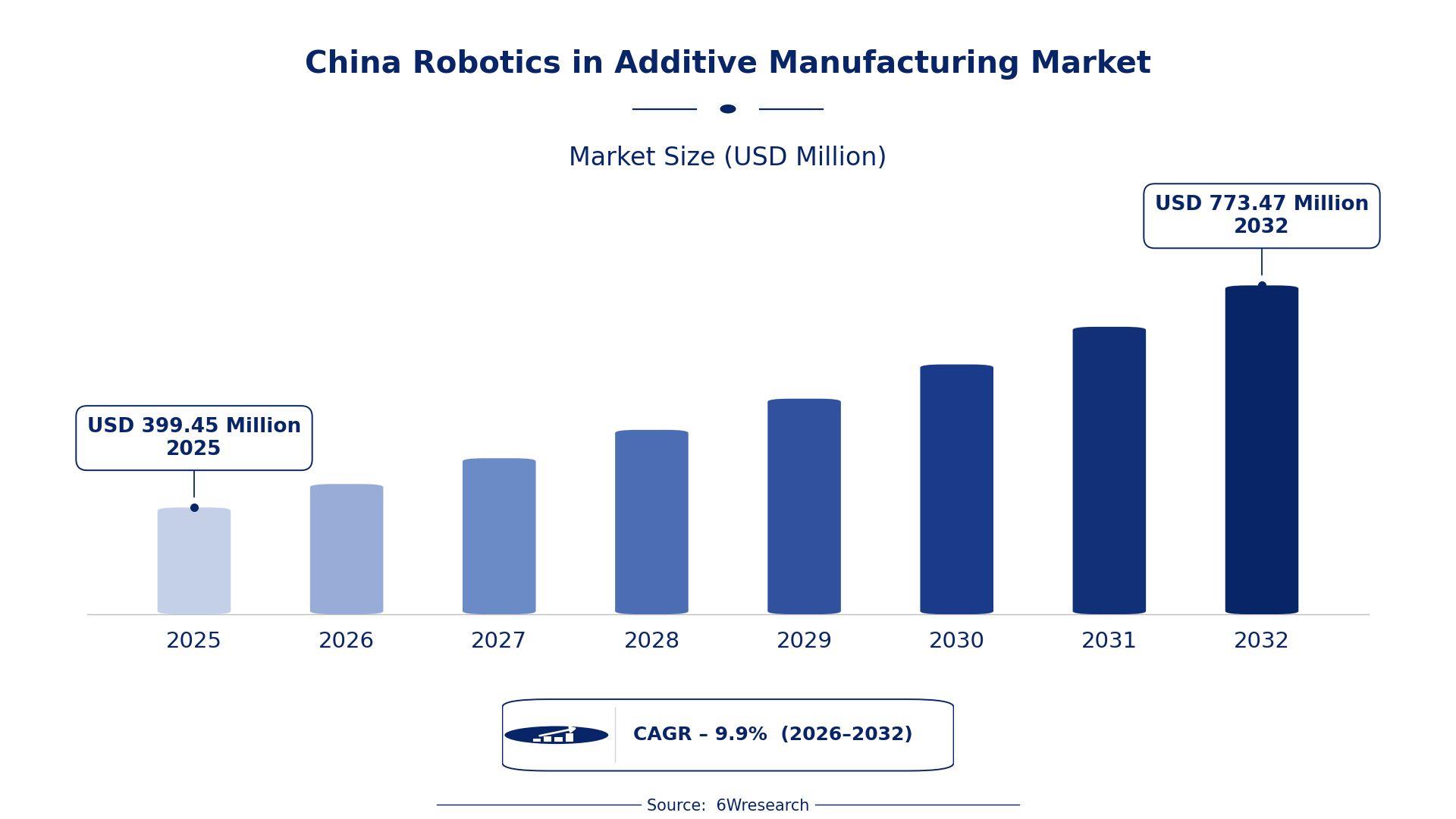
According to 6Wresearch internal database and industry insights, the China Robotics in Additive Manufacturing Market was valued at USD 399.45 million in 2025 and is projected to reach USD 773.47 million by 2032, growing at a CAGR of approximately 9.9% during 2026–2032.
China Robotics in Additive Manufacturing Market Highlights
| Report Metric | Details |
| Report Name | China Robotics in Additive Manufacturing Market |
| Market Size 2025 | USD 399.45 million |
| Market Size 2032 | USD 773.47 million |
| Absolute Growth 2025–2032 | USD 374.02 million |
| CAGR 2026–2032 | 9.9% |
| Peak Annual Growth | 12.4% in 2027 |
| Forecast Period | 2026–2032 |
| Historical Data | 2022–2025 |
| Base Year | 2025 |
| Leading Robot Type, 2025 | Robotic Arms (35% share) |
| Leading Printing Type, 2025 | FDM/FFF (44% share) |
| Leading Material Type, 2025 | Thermoplastics (39% share) |
| Leading End User, 2025 | Automotive Prototyping (42% share) |
| Fastest-Growing Robot Type | Gantry Systems (12.6% CAGR) |
| Fastest-Growing Printing Type | Binder Jetting (12.2% CAGR) |
| Fastest-Growing Material Type | Metal Powders (11.9% CAGR) |
| Fastest-Growing End User | Aerospace Prototyping (12.6% CAGR) |
| Growing Sector | Aerospace Prototyping |
| Key End Users | Automotive Prototyping, Aerospace Prototyping, Defense Contractors, Design Studios |
China Robotics in Additive Manufacturing Market Year-wise Growth Rate and Key Drivers (2022–2032)
This graph illustrates the annual growth rates of the market from 2022 to 2032, highlighting a steady upward trajectory and projected market expansion over the forecast period.
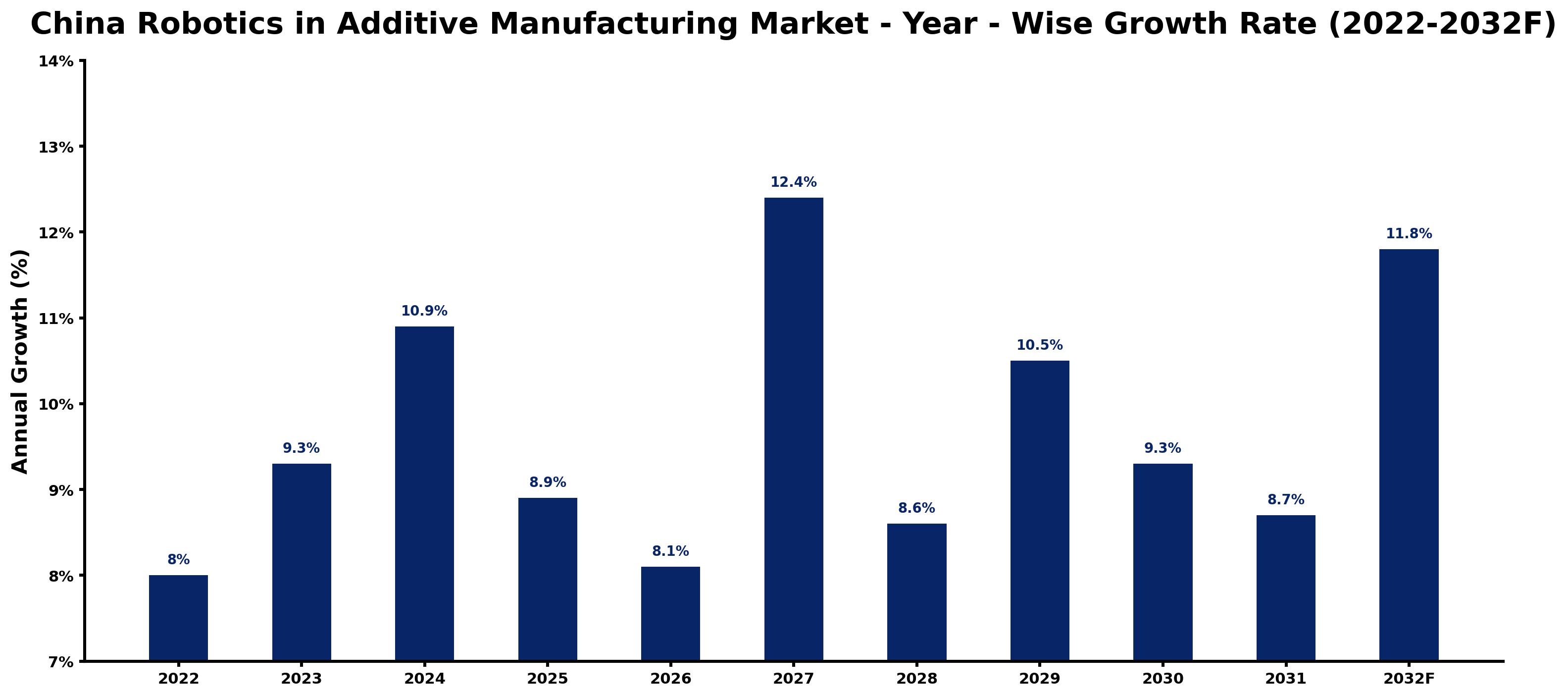
Each row of the following table gives one year's estimated growth and the event or demand shift that explains it.
| Year | Estimated Annual Growth (%) | Market Rationale |
| 2022 | 8.0 | The market experienced steady growth due to the 'Made in China 2025' initiative promoting advanced manufacturing technologies. |
| 2023 | 9.3 | Demand surged as the automotive sector expanded its use of 3D printing for rapid prototyping and production. |
| 2024 | 10.9 | Investment in innovation and technology drove growth in the aerospace industry, particularly in lightweight materials. |
| 2025 | 8.9 | Growth slowed as companies adjusted to the updated National Standard for Additive Manufacturing and quality control measures. |
| 2026 | 8.1 | The market is expected to continue growing, supported by the National Key R&D Program for Advanced Manufacturing. |
| 2027 | 12.4 | A peak in growth rates is projected due to a substantial increase in investment across key industries. |
| 2028 | 8.6 | Growth is expected to slow again as the market stabilises after rapid expansion in previous years. |
| 2029 | 10.5 | The aerospace sector's demand for lightweight components will boost growth rates in additive manufacturing applications. |
| 2030 | 9.3 | A slowdown is projected as companies focus on refining production processes and improving efficiency. |
| 2031 | 8.7 | Growth is expected to continue slowing as market dynamics shift towards sustainability and regulatory compliance. |
| 2032 | 11.8 | A renewed focus on advanced manufacturing technologies is projected to drive demand for robotics in additive manufacturing. |
Note: Market size estimations and growth projections presented in this report are based on 6Wresearch's proprietary forecasting methodology, utilizing the latest available industry data, government publications, and primary research inputs.
China Robotics in Additive Manufacturing Market Synopsis
Robotics in Additive Manufacturing in China integrates robotic systems with 3D printing technologies, driving rapid prototyping and customised manufacturing. This market is expanding due to strong domestic demand from sectors like automotive and aerospace. The automotive sector accounts for approximately 30% of additive manufacturing applications. The 'Made in China 2025' initiative supports advancements in this field, creating a conducive environment for technological growth. With a population of 1.4 billion, China presents a vast market for customised manufacturing solutions.
Market Dynamics Impact Analysis (2026–2032)
| Factor | Type | Impact | Primary Segment Affected |
| Increasing investment in advanced manufacturing technologies | Driver | High | Robotic Arms |
| Rising demand for customized manufacturing solutions | Driver | High | Thermoplastics |
| Growing need for lightweight materials in aerospace | Opportunity | High | Metal Powders |
| Expansion of design studios adopting additive manufacturing | Opportunity | Medium | Automotive Prototyping |
| Quality control challenges in additive manufacturing | Restraint | High | SLA/Resin-Based |
| Limited awareness of additive manufacturing capabilities | Restraint | Medium | Binder Jetting |
| High initial investment costs for advanced robotics | Challenge | High | Multi-Axis Robots |
| Shortage of skilled workforce in robotics and manufacturing | Challenge | Medium | Gantry Systems |
Evaluation of Drivers in China Robotics in Additive Manufacturing Market (2026–2032)
Key forces behind demand, with the segment each one moves most, are listed below.
| Drivers | Primary Segment Affected | Why It Matters (Evidence) |
| Increased automotive sector applications | Automotive Prototyping | The automotive sector accounts for approximately 30% of additive manufacturing applications, driving demand for rapid prototyping. |
| Expansion of aerospace industry investments | Metal Powders | China's aerospace industry is investing heavily in additive manufacturing technologies, increasing the use of metal powders, which represent 25% of the market. |
| Growing adoption of advanced materials | Thermoplastics | Thermoplastics account for over 40% of the market, as they are widely used in various applications. |
| Support from government initiatives | Robotic Arms | The 'Made in China 2025' initiative promotes advanced manufacturing technologies, supporting the robotics sector. |
| Rising demand for customized solutions | Design Studios | China's population of 1.4 billion provides a vast market for customized manufacturing solutions. |
Growth across the Robotics in Additive Manufacturing market in China is anchored in increased automotive sector applications, expansion of aerospace industry investments, and a rise in demand for customised solutions. The automotive sector accounts for approximately 30% of additive manufacturing applications, driving demand for rapid prototyping. China's aerospace industry is investing heavily in additive manufacturing technologies, particularly in metal powders, which represent 25% of the market. In 2023, the China 3D Printing Technology Industry Alliance reported a 15% increase in industry investment, reflecting growing confidence in the sector.
Evaluation of Restraints in China Robotics in Additive Manufacturing Market
The table below lists the restraints and the evidence behind each.
| Market Restraint | Primary Segment Affected | Why It Matters (Evidence) |
| Quality control challenges in additive manufacturing | SLA/Resin-Based | In 2022, the National Standard for Additive Manufacturing was revised to improve quality and safety standards, highlighting existing challenges. |
| Limited awareness of additive manufacturing capabilities | Binder Jetting | Many potential users are unaware of the benefits of binder jetting, limiting market growth. |
| High initial investment costs for advanced robotics | Multi-Axis Robots | The adoption of multi-axis robots requires substantial capital investment, which can deter potential buyers. |
| Shortage of skilled workforce in robotics and manufacturing | Gantry Systems | The lack of skilled professionals in robotics and manufacturing hampers the growth of gantry systems. |
| Regulatory hurdles affecting production timelines | Thermoplastics | Compliance with updated standards can delay production schedules, affecting market responsiveness. |
China Robotics in Additive Manufacturing Market Challenges
Buyers in the China Robotics in Additive Manufacturing market encounter escalating costs as thermoplastics, which account for over 40% of materials, have seen significant price hikes, straining production budgets. Regulatory challenges arise from the updated National Standard for Additive Manufacturing in 2023, complicating compliance for manufacturers and delaying product launches. Supply chain disruptions occur as the aerospace sector, a key consumer of metal powders that represent 25% of the market, faces difficulties in securing these essential materials, leading to potential project delays. Skills shortages present a critical issue as the demand for advanced robotics expertise increases, limiting manufacturers' ability to fully leverage new technologies and diminishing their competitive edge.
Trends in the China Robotics in Additive Manufacturing Market
The trends below show where the China Robotics in Additive Manufacturing Market is heading.
- 15% Increase in Industry Investment: In 2023, the China 3D Printing Technology Industry Alliance reported a 15% increase in industry investment. This surge reflects growing confidence in additive manufacturing technologies, encouraging suppliers to expand their offerings.
- Shift Towards Lightweight Materials in Aerospace: China's aerospace industry is increasingly adopting lightweight materials in additive manufacturing. This trend is driven by the need for efficiency, with investments focused on metal powders, which represent 25% of the market.
- Expansion of Innovation Centers in Jiangsu: Jiangsu province has established several innovation centers focused on additive manufacturing technologies. This initiative aims to promote research and development, enhancing the capabilities of local manufacturers.
- Growing Adoption of SLA/Resin-Based Printing in Medical Applications: The use of SLA/Resin-Based printing is growing in medical applications, particularly for dental products. This trend indicates a shift towards high-resolution prints in healthcare, meeting increasing demand.
Investment Opportunities in the China Robotics in Additive Manufacturing Market
Some of the investment opportunities in the China Robotics in Additive Manufacturing Market are mentioned below.
- 500 Million Yuan Budget for Startups: In 2023, the Ministry of Industry and Information Technology announced a budget of 500 million yuan to support additive manufacturing startups. This funding creates opportunities for new entrants in the market.
- Partnerships in Guangdong Province: Guangdong province is a major hub for additive manufacturing technologies. Establishing partnerships with local firms can facilitate market entry and innovation.
- Focus on Aerospace Prototyping: With a growing demand for aerospace prototyping, there is an opportunity to invest in advanced manufacturing technologies. Aerospace companies are increasingly seeking innovative solutions.
- Expansion of Design Studios: Design studios in China are increasingly adopting additive manufacturing for rapid prototyping. This trend represents a significant opportunity for suppliers of 3D printing technologies.
Government Initiatives in the China Robotics in Additive Manufacturing Market
The 'Additive Manufacturing Development Plan' by the Ministry of Industry and Information Technology, launched in 2021, aims to improve innovation and application in key industries by 2025. This plan encourages investments in additive manufacturing technologies, promoting growth in sectors such as automotive and aerospace. It sets specific targets for development, ensuring the integration of advanced manufacturing practices across industries. Additionally, the updated National Standard for Additive Manufacturing in 2022 improved quality control measures, further supporting industry standards.
The National Key R&D Program for Advanced Manufacturing, initiated by the Ministry of Science and Technology in 2020, supports research in additive technologies. This program funds various projects aimed at enhancing the capabilities of additive manufacturing in China. The program focuses on innovation and collaboration among research institutions and industry players. Furthermore, the National Defense Industry Association supports advancements in additive manufacturing for defense applications, ensuring that the sector remains competitive and innovative.
Future Insight of the China Robotics in Additive Manufacturing Market
By 2032, the China Robotics in Additive Manufacturing market will experience substantial advancements, with the 'Made in China 2025' initiative prioritising cutting-edge manufacturing technologies. The National Additive Manufacturing Innovation Center will significantly enhance research capabilities, facilitating faster product development. A notable 15% increase in industry investment in 2023 indicates robust growth potential. The Guangdong province's ongoing commitment to innovation will further establish it as a central hub for robotics in additive manufacturing, benefiting both buyers and suppliers.
Market Segmentation Analysis
The report offers a comprehensive study of the following market segments and their leading categories in the market.
By Robot Type – Robotic Arms Dominated, Gantry Systems Expected to Grow Fastest
According to Shubham Padhi, Research Analyst at 6Wresearch, Robotic Arms took a 35% share of robot type in 2025, more than any other category. Robotic Arms hold the largest market share due to their precision in handling intricate tasks within additive manufacturing. They are particularly vital in automotive prototyping, where exact specifications are essential for successful design and testing. Over 2026–2032, Gantry Systems are expected to post the fastest growth, at a CAGR of 12.6%. Gantry Systems are rapidly gaining traction as they are ideal for large-scale printing applications, especially in the aerospace sector, where the demand for lightweight components is surging. Their ability to manage extensive projects effectively is a major growth factor, ensuring their continued expansion. Suppliers should enhance the features of gantry systems to meet the rising demand in large-scale additive manufacturing.
By Printing Type – FDM/FFF Dominated, Binder Jetting Expected to Grow Fastest
The largest printing type category in 2025 was FDM/FFF, with a 44% share of total revenue. FDM/FFF technology commands a significant market share as it is extensively used for prototyping and production across multiple industries. Its user-friendliness and cost-effectiveness make it a preferred choice for many manufacturers in China. The quickest growth will come from Binder Jetting, forecast to expand at a CAGR of 12.2% between 2026 and 2032. Binder Jetting is experiencing rapid growth, particularly in the creation of metal and ceramic parts, as industries seek efficient solutions for complex geometries. Its capacity to streamline production processes and reduce material waste is a key driver of its expansion. Buyers should explore integrating binder jetting into their operations to take advantage of its efficiency in producing high-quality components.
By Material Type – Thermoplastics Dominated, Metal Powders Expected to Grow Fastest
With a 39% revenue share in 2025, Thermoplastics was the largest material type category. Thermoplastics dominate the market due to their versatility and broad application in various additive manufacturing processes. They account for over 40% of the material market, making them the preferred choice for numerous manufacturers. Metal Powders are projected to grow fastest, at a CAGR of 11.9% during 2026–2032. Metal Powders are seeing the fastest growth as they become crucial for metal additive manufacturing, particularly in aerospace and automotive sectors. The increasing emphasis on lightweight materials and high-performance applications significantly drives their demand. Suppliers should focus on developing high-quality metal powders to cater to the growing needs of the aerospace and automotive industries.
By End User – Automotive Prototyping Dominated, Aerospace Prototyping Expected to Grow Fastest
In 2025, Automotive Prototyping led the end user split with a 42% share. Automotive Prototyping is the leading end user because it is essential for the design and testing phases of vehicle development. The automotive sector represents approximately 30% of additive manufacturing applications in China, underscoring its significance. Aerospace Prototyping is set to record the highest CAGR in this split, 12.6% over 2026–2032. Aerospace Prototyping is the fastest-growing segment, propelled by the industry's emphasis on lightweight components and advanced manufacturing technologies. Substantial investments in aerospace additive manufacturing technologies and the push for innovation fuel this rapid growth. Suppliers must align their products with the aerospace sector's requirements to capitalise on this expanding market.
Key Attractiveness of the Report
- 10 Years of Market Numbers
- Historical Data Starting from 2022 to 2025
- Base Year 2025
- Forecast Data until 2032
- Key Performance Indicators Impacting the Market
- Major Upcoming Developments and Projects
Key Highlights of the Report:
- China Robotics in Additive Manufacturing Market Outlook
- Market Size of China Robotics in Additive Manufacturing Market, 2025
- Forecast of China Robotics in Additive Manufacturing Market, 2032
- Historical Data and Forecast of China Robotics in Additive Manufacturing Revenues & Volume for the Period 2022 - 2032F
- China Robotics in Additive Manufacturing Market Trend Evolution
- China Robotics in Additive Manufacturing Market Drivers and Challenges
- China Robotics in Additive Manufacturing Price Trends
- China Robotics in Additive Manufacturing Porter's Five Forces
- China Robotics in Additive Manufacturing Industry Life Cycle
- Historical Data and Forecast of China Robotics in Additive Manufacturing Market Revenues & Volume By Robot Type for the Period 2022 - 2032F
- Historical Data and Forecast of China Robotics in Additive Manufacturing Market Revenues & Volume By Robotic Arms for the Period 2022 - 2032F
- Historical Data and Forecast of China Robotics in Additive Manufacturing Market Revenues & Volume By Gantry Systems for the Period 2022 - 2032F
- Historical Data and Forecast of China Robotics in Additive Manufacturing Market Revenues & Volume By Multi-Axis Robots for the Period 2022 - 2032F
- Historical Data and Forecast of China Robotics in Additive Manufacturing Market Revenues & Volume By Hybrid Robots for the Period 2022 - 2032F
- Historical Data and Forecast of China Robotics in Additive Manufacturing Market Revenues & Volume By Printing Type for the Period 2022 - 2032F
- Historical Data and Forecast of China Robotics in Additive Manufacturing Market Revenues & Volume By FDM/FFF for the Period 2022 - 2032F
- Historical Data and Forecast of China Robotics in Additive Manufacturing Market Revenues & Volume By Binder Jetting for the Period 2022 - 2032F
- Historical Data and Forecast of China Robotics in Additive Manufacturing Market Revenues & Volume By SLA/Resin-Based for the Period 2022 - 2032F
- Historical Data and Forecast of China Robotics in Additive Manufacturing Market Revenues & Volume By Wire Arc Additive Mfg for the Period 2022 - 2032F
- Historical Data and Forecast of China Robotics in Additive Manufacturing Market Revenues & Volume By Material Type for the Period 2022 - 2032F
- Historical Data and Forecast of China Robotics in Additive Manufacturing Market Revenues & Volume By Thermoplastics for the Period 2022 - 2032F
- Historical Data and Forecast of China Robotics in Additive Manufacturing Market Revenues & Volume By Metal Powders for the Period 2022 - 2032F
- Historical Data and Forecast of China Robotics in Additive Manufacturing Market Revenues & Volume By Photopolymers for the Period 2022 - 2032F
- Historical Data and Forecast of China Robotics in Additive Manufacturing Market Revenues & Volume By Metal Wires for the Period 2022 - 2032F
- Historical Data and Forecast of China Robotics in Additive Manufacturing Market Revenues & Volume By End User for the Period 2022 - 2032F
- Historical Data and Forecast of China Robotics in Additive Manufacturing Market Revenues & Volume By Automotive Prototyping for the Period 2022 - 2032F
- Historical Data and Forecast of China Robotics in Additive Manufacturing Market Revenues & Volume By Aerospace Prototyping for the Period 2022 - 2032F
- Historical Data and Forecast of China Robotics in Additive Manufacturing Market Revenues & Volume By Design Studios for the Period 2022 - 2032F
- Historical Data and Forecast of China Robotics in Additive Manufacturing Market Revenues & Volume By Defense Contractors for the Period 2022 - 2032F
- China Robotics in Additive Manufacturing Import Export Trade Statistics
- Market Opportunity Assessment By Robot Type
- Market Opportunity Assessment By Printing Type
- Market Opportunity Assessment By Material Type
- Market Opportunity Assessment By End User
- China Robotics in Additive Manufacturing Top Companies Market Share
- China Robotics in Additive Manufacturing Competitive Benchmarking By Technical and Operational Parameters
- China Robotics in Additive Manufacturing Company Profiles
- China Robotics in Additive Manufacturing Key Strategic Recommendations
Market Covered
The report offers an extensive study of the following market segments.
By Robot Type
- Robotic Arms
- Gantry Systems
- Multi-Axis Robots
- Hybrid Robots
By Printing Type
- FDM/FFF
- Binder Jetting
- SLA/Resin-Based
- Wire Arc Additive Mfg
By Material Type
- Thermoplastics
- Metal Powders
- Photopolymers
- Metal Wires
By End User
- Automotive Prototyping
- Aerospace Prototyping
- Design Studios
- Defense Contractors































