China Satellite Uplink AI Market Size & Growth Rate
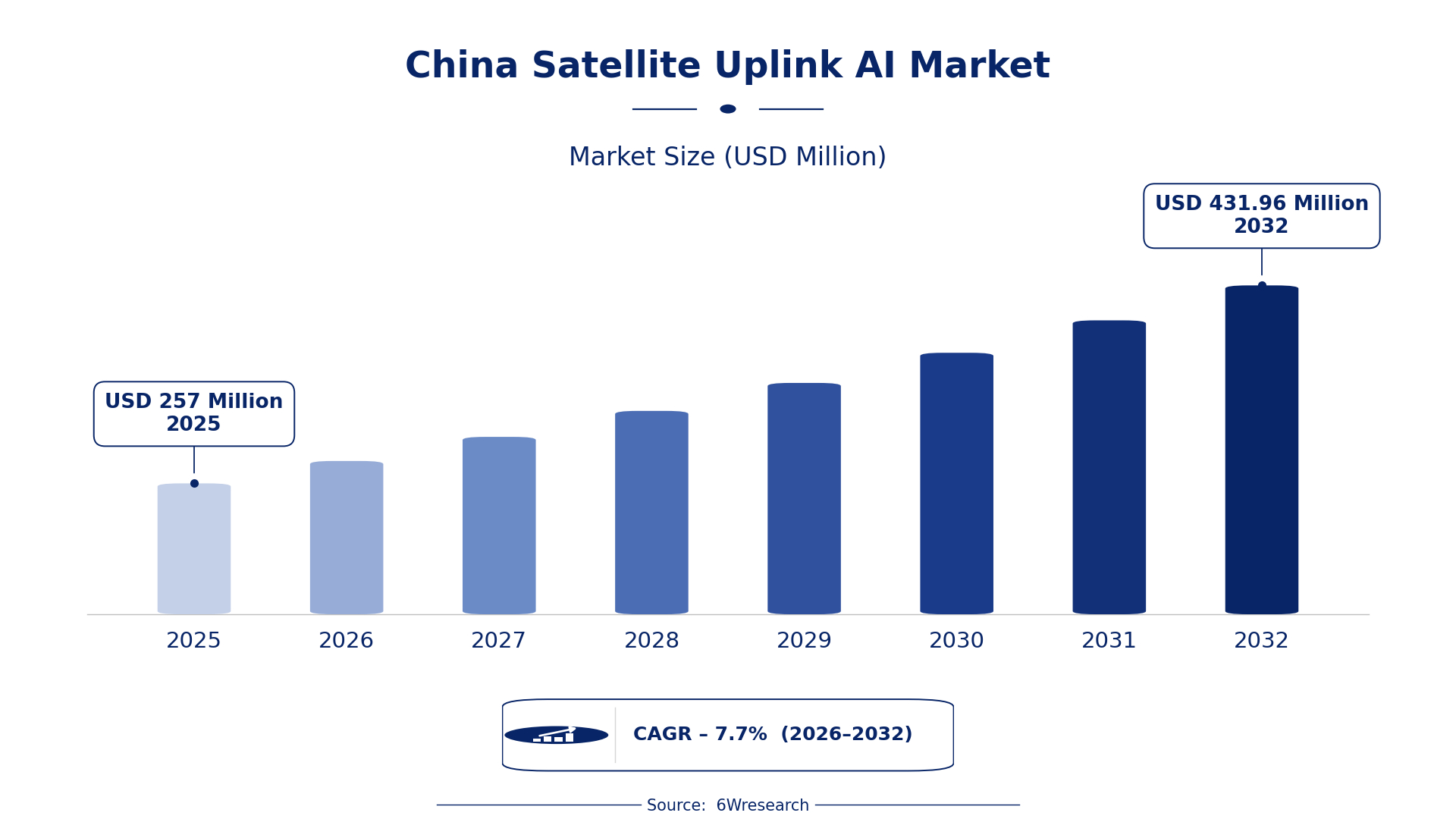
According to 6Wresearch internal database and industry insights, the China Satellite Uplink AI Market was valued at USD 257.0 million in 2025 and is projected to reach USD 431.96 million by 2032, growing at a CAGR of approximately 7.7% during 2026–2032.
China Satellite Uplink AI Market Highlights
| Report Metric | Details |
| Report Name | China Satellite Uplink AI Market |
| Market Size 2025 | USD 257.0 million |
| Market Size 2032 | USD 431.96 million |
| Absolute Growth 2025–2032 | USD 174.96 million |
| CAGR 2026–2032 | 7.7% |
| Peak Annual Growth | 10.1% in 2030 |
| Forecast Period | 2026–2032 |
| Historical Data | 2022–2025 |
| Base Year | 2025 |
| Leading AI Function Type, 2025 | Signal Optimization AI (47% share) |
| Leading Application Area, 2025 | Beam Steering (40% share) |
| Leading Integration Type, 2025 | Onboard + Ground (37% share) |
| Leading End User, 2025 | Satellite Operators (49% share) |
| Fastest-Growing AI Function Type | Fault Prediction AI (10.3% CAGR) |
| Fastest-Growing Application Area | Dynamic Routing (10.0% CAGR) |
| Fastest-Growing Integration Type | Real-Time Processing (10.5% CAGR) |
| Fastest-Growing End User | Ground Station Providers (9.9% CAGR) |
| Growing Sector | Satellite Operators |
| Key End Users | Satellite Operators, Ground Station Providers, Defense Satellite Systems |
China Satellite Uplink AI Market Year-wise Growth Rate and Key Drivers (2022–2032)
This graph illustrates the annual growth rates of the market from 2022 to 2032, highlighting a steady upward trajectory and projected market expansion over the forecast period.
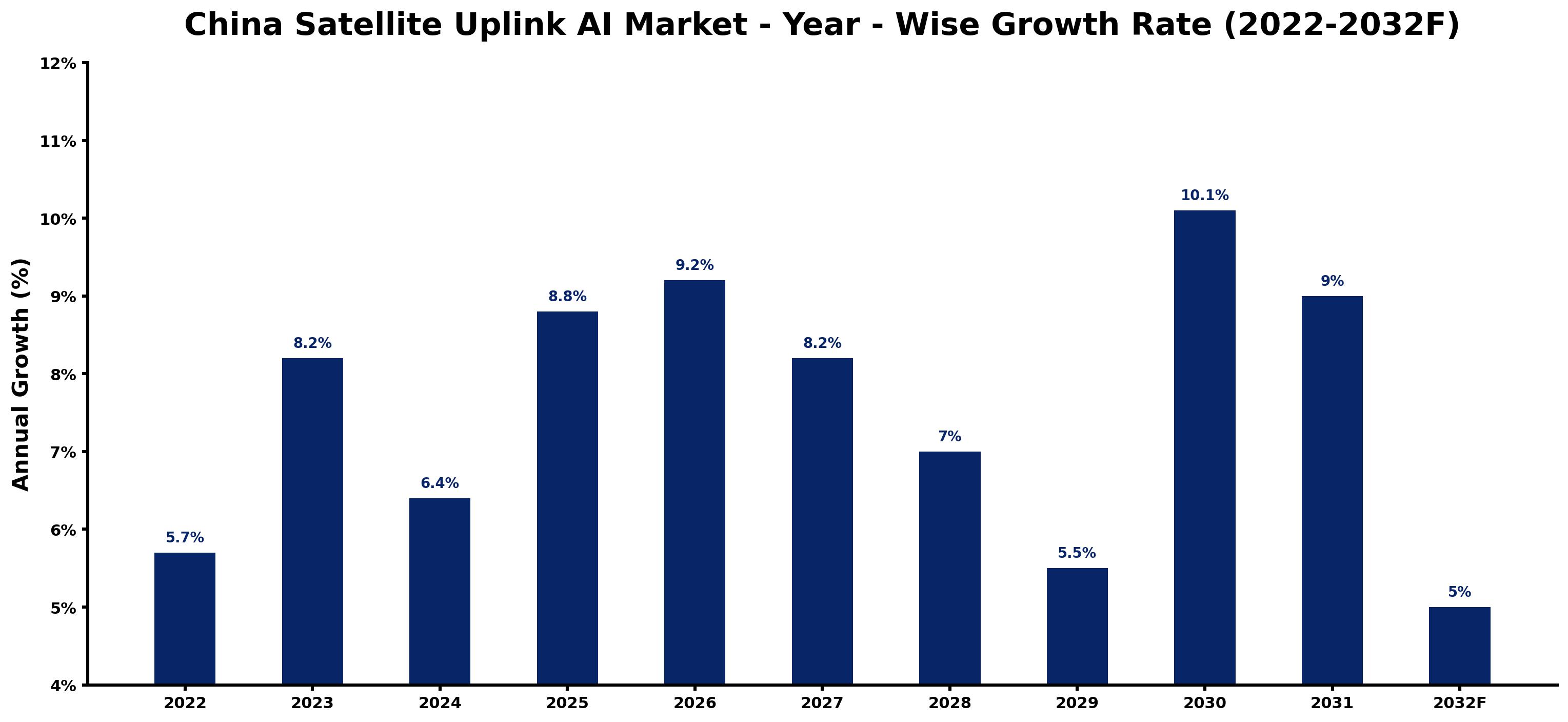
Each row of the following table gives one year's estimated growth and the event or demand shift that explains it.
| Year | Estimated Annual Growth (%) | Market Rationale |
| 2022 | 5.7 | The market experienced steady growth due to increasing satellite operations and demand for advanced communication technologies. |
| 2023 | 8.2 | Demand surged as the National Satellite AI Strategy was launched, promoting AI integration in satellite systems. |
| 2024 | 6.4 | Growth slowed as operators adjusted to previous rapid expansions and focused on optimizing existing systems. |
| 2025 | 8.8 | Increased investments in satellite technology led to faster growth as operators sought to improve communication efficiency through advanced solutions. |
| 2026 | 9.2 | Demand is expected to rise as AI applications become integral to satellite operations, improving overall performance. |
| 2027 | 8.2 | Growth is projected to slow as the market matures, with operators concentrating on existing systems rather than expansion. |
| 2028 | 7.0 | A further slowdown is anticipated as competition intensifies among satellite operators for market share. |
| 2029 | 5.5 | The market will continue to grow, albeit at a slower rate, as operators refine their AI applications and technologies. |
| 2030 | 10.1 | A peak in growth is expected as advancements in AI technology drive demand for satellite uplink solutions and operational efficiencies. |
| 2031 | 9.0 | Growth is projected to slow as operators focus on maintaining existing systems and technologies rather than expansion. |
| 2032 | 5.0 | The market is expected to grow at a slower rate as saturation in certain applications becomes evident. |
Note: Market size estimations and growth projections presented in this report are based on 6Wresearch's proprietary forecasting methodology, utilizing the latest available industry data, government publications, and primary research inputs.
China Satellite Uplink AI Market Synopsis
The China Satellite Uplink AI Market includes technologies that enhance satellite communication through artificial intelligence. This encompasses functions like signal optimisation and fault prediction, developed with sophisticated algorithms. Domestic satellite operators and ground station providers are the main purchasers, propelling demand for these technologies. Government initiatives, particularly the National 14th Five-Year Plan for Science and Technology, advocate for AI integration in satellite systems, promoting market growth. With the satellite communication market expected to reach 1 trillion yuan by 2025, investment in AI solutions is anticipated to rise sharply.
Market Dynamics Impact Analysis (2026–2032)
| Factor | Type | Impact | Primary Segment Affected |
| Growing demand for efficient satellite communication solutions | Driver | High | Signal Optimization AI |
| Increased investments in satellite technology and infrastructure | Driver | High | Fault Prediction AI |
| The need for advanced satellite communication in rural areas | Opportunity | High | Bandwidth Allocation AI |
| Emerging applications in defense satellite systems | Opportunity | Medium | Interference Detection AI |
| Compliance with national standards for satellite AI technologies | Restraint | High | Beam Steering |
| Limited awareness among smaller satellite operators regarding AI benefits | Restraint | Medium | Equipment Health |
| The Satellite Uplink AI market in China faces regulatory hurdles | Challenge | High | Dynamic Routing |
| High competition among satellite operators for advanced technology | Challenge | Medium | Spectrum Monitoring |
Evaluation of Drivers in China Satellite Uplink AI Market (2026–2032)
Below mentioned are some major drivers and their influence on market dynamics.
| Drivers | Primary Segment Affected | Why It Matters (Evidence) |
| Increased satellite operations require advanced AI for signal management | Signal Optimization AI | With over 300 operational satellites, the demand for AI solutions is vital for efficient communication. |
| Growing focus on predictive maintenance improves operational reliability | Fault Prediction AI | As satellite systems age, the need for fault prediction technologies becomes essential for continuity. |
| Demand for bandwidth optimization is rising among satellite operators | Bandwidth Allocation AI | The projected value of the satellite communication market reaching 1 trillion yuan by 2025 drives this need. |
| The need for interference detection ensures signal integrity | Interference Detection AI | With increasing satellite traffic, maintaining signal quality is essential for operational success. |
| Beam steering technology improves communication efficiency | Beam Steering | This technology is necessary for accurately directing satellite beams to ensure effective service delivery. |
Growth in the Satellite Uplink AI market in China comes from rising end-use demand for efficient communication solutions and a strong supply response from technology providers. The satellite communication market is projected to reach a value of 1 trillion yuan by 2025, driving investments in AI technologies. More than 300 operational satellites require advanced AI for effective management, leading to increased purchases of signal optimization and fault prediction systems. The National 14th Five-Year Plan for Science and Technology supports AI integration, further boosting demand. The growing focus on bandwidth optimization among satellite operators is also contributing to market expansion, as they seek to enhance service delivery and operational efficiency.
Evaluation of Restraints in China Satellite Uplink AI Market
The key brakes on demand, and where they bite hardest, are shown below.
| Market Restraint | Primary Segment Affected | Why It Matters (Evidence) |
| Regulatory compliance can delay technology adoption | Beam Steering | National standards for satellite AI technologies mandate compliance, which can slow down implementation for operators. |
| Limited understanding of AI capabilities among smaller operators | Equipment Health | Many smaller satellite operators lack awareness of AI benefits, hindering their adoption of advanced technologies. |
| High costs associated with AI integration can deter investment | Dynamic Routing | The initial investment required for AI technologies can be a barrier for some operators. |
| Competition among operators can lead to price wars | Spectrum Monitoring | Intense competition may result in reduced profit margins, affecting investment in new technologies. |
| Slow regulatory approvals can hinder market growth | Interference Detection AI | The lengthy approval process for new technologies can delay market entry and innovation. |
China Satellite Uplink AI Market Challenges
In the China Satellite Uplink AI market, supply chain disruptions arise from the need for advanced AI to manage over 300 operational satellites, causing delays in service delivery for satellite operators. Fierce competition among domestic satellite operators compresses profit margins, which makes it challenging for smaller firms to invest in necessary AI technologies, limiting their market presence. Regulatory complexities imposed by the Ministry of Industry and Information Technology hinder new entrants, delaying their service launches and reducing options for buyers. A shortage of skilled professionals in AI technology restricts the development of effective solutions, ultimately affecting the efficiency of satellite communication for end users.
Trends in the China Satellite Uplink AI Market
The trends below show where the China Satellite Uplink AI Market is heading.
- Shift from Traditional to AI-Driven Signal Management: Since 2021, the adoption of AI-driven signal management has increased among satellite operators, improving communication quality. The National Satellite AI Strategy promotes this shift, aiming for a 30% efficiency increase by 2025.
- Emergence of Advanced Fault Prediction Technologies: In 2022, the focus on fault prediction technologies gained momentum, with a projected CAGR of 10.3% for this segment. Government funding initiatives support the development of these critical systems.
- Growing Importance of Bandwidth Optimization: As of 2023, the need for bandwidth optimization has become paramount, driven by the increasing number of operational satellites. The average population served by satellite ISPs in rural areas is approximately 100 million.
- Expansion of Defense Applications for Satellite AI: The National Satellite AI Strategy, launched in 2023, highlights the growing importance of AI in defense satellite systems. This initiative aims to improve operational capabilities and efficiency.
Investment Opportunities in the China Satellite Uplink AI Market
Investors looking at the China Satellite Uplink AI Market should consider the following areas.
- Investment in Advanced Signal Optimization Technologies: With the satellite communication market projected to reach 1 trillion yuan by 2025, there exists an opportunity for investment in signal optimisation technologies. Satellite operators are pursuing efficient solutions to elevate communication quality.
- Development of AI Solutions for Rural Connectivity: The average population served by satellite ISPs in rural areas is approximately 100 million, generating a demand for AI solutions to enhance connectivity. Partnering with local entities can ease market entry.
- Focus on Defense Satellite Systems: The National Satellite AI Strategy promotes AI applications in defence, offering opportunities for suppliers to create tailored solutions. Collaborating with government agencies can pave the way for partnerships.
- Enhancement of Ground Station Capabilities: With over 1,000 ground stations operational as of 2023, there is an increasing need for advanced AI technologies. Investing in ground station improvements can yield substantial returns.
Government Initiatives in the China Satellite Uplink AI Market
The 'Satellite Communication Development Plan', launched by the National Space Administration in 2021, aims for a 30% efficiency increase in AI integration by 2025. This plan mandates compliance with national standards for satellite AI technologies, ensuring operators adopt advanced solutions. The 'National Standards for Satellite AI Technologies', established in 2021, require all satellite operators to adhere to specific guidelines, promoting uniformity across the industry. The 'AI in Satellite Communications Program', initiated by the Ministry of Industry and Information Technology in 2022, focuses on funding research projects with a budget of 200 million yuan, supporting satellite operators in developing and implementing AI technologies. In 2023, the State Administration for Science, Technology and Industry for National Defense approved the 'National Satellite AI Strategy', promoting AI applications in defence satellites and improving operational capabilities.
The 'AI in Satellite Communications Program', initiated by the Ministry of Industry and Information Technology in 2022, focuses on funding research projects with a budget of 200 million yuan. This program supports satellite operators in developing and implementing AI technologies. In 2023, the State Administration for Science, Technology and Industry for National Defense approved the 'National Satellite AI Strategy', which promotes AI applications in defence satellites, improving operational capabilities. The 'Smart Satellite Communication Initiative', launched in 2022, fosters innovation in satellite AI technologies, providing resources for development and implementation.
Future Insight of the China Satellite Uplink AI Market
Several forward-looking factors should support the China Satellite Uplink AI market over the coming years. The National Space Administration's programme to enhance satellite communication capabilities will drive demand for advanced AI solutions. By 2025, the satellite communication market is expected to reach a value of 1 trillion yuan, creating opportunities for suppliers to expand their offerings. Established national standards for AI integration will streamline operations, benefiting both buyers and suppliers as the market progresses.
Market Segmentation Analysis
Each segment group is reviewed below, with the leader by share and the fastest grower by CAGR.
By AI Function Type – Signal Optimization AI Dominated, Fault Prediction AI Expected to Grow Fastest
According to Shubham Padhi, Research Analyst at 6Wresearch, Signal Optimization AI accounted for a 47% market share by ai function type in 2025. Signal Optimization AI holds the largest share in the China Satellite Uplink AI Market because it is crucial for enhancing signal quality across more than 300 operational satellites. Domestic satellite operators depend on this technology to ensure effective communication and service delivery, particularly in high-demand regions. Over 2026–2032, Fault Prediction AI is expected to post the fastest growth, at a CAGR of 10.3%. Fault Prediction AI is experiencing rapid growth as it addresses the critical need for maintaining operational continuity in satellite systems, especially highlighted by the recent government programme aimed at enhancing communication capabilities. This focus on predictive technologies will likely attract further investments and development in this area. Suppliers should prioritise advancements in fault prediction technologies to align with the increasing demands of satellite operators.
By Application Area – Beam Steering Dominated, Dynamic Routing Expected to Grow Fastest
In 2025, Beam Steering led the application area split with a 40% share. Beam Steering commands the largest market share as it significantly enhances communication efficiency by accurately directing satellite beams, which is vital for China's extensive satellite network. This technology is widely implemented by satellite operators to improve their service delivery capabilities, especially in urban areas. Dynamic Routing is projected to grow fastest, at a CAGR of 10.0% during 2026–2032. Dynamic Routing is the fastest-growing segment, driven by the urgent need for optimised data paths in complex satellite networks, as evidenced by government investments in satellite technology advancements. This growth reflects the pressing demand for efficient data management solutions among operators in the sector. Buyers should consider investing in dynamic routing solutions to enhance their satellite communication efficiency.
By Integration Type – Onboard + Ground Dominated, Real-Time Processing Expected to Grow Fastest
Onboard + Ground took a 37% share of integration type in 2025, more than any other category. Onboard + Ground integration captures the largest share as it ensures seamless communication between satellites and ground stations, which is crucial for operational success. This integration is widely adopted across China's extensive satellite infrastructure, facilitating effective management and coordination. Real-Time Processing is set to record the highest CAGR in this split, 10.5% over 2026–2032. Real-Time Processing is the fastest-growing integration type, as it enables immediate decision-making in satellite operations, a necessity given the increasing complexity of satellite management. This capability will become increasingly essential as the market continues to expand and evolve. Suppliers must focus on real-time processing solutions to meet the evolving needs of satellite operators.
By End User – Satellite Operators Dominated, Ground Station Providers Expected to Grow Fastest
Satellite Operators held a 49% share of the China Satellite Uplink AI Market by end user in 2025. Satellite Operators dominate the market share due to their primary role in utilising satellite uplink technologies for effective communication management. Their extensive operational base drives the demand for advanced functionalities in satellite communication, particularly in competitive markets. The quickest growth will come from Ground Station Providers, forecast to expand at a CAGR of 9.9% between 2026 and 2032. Ground Station Providers represent the fastest-growing end user segment, as they increasingly adopt advanced technologies to enhance their communication capabilities, reflecting the growing importance of ground support in satellite operations. This trend indicates a shift towards more integrated communication solutions. Buyers should explore partnerships with ground station providers to leverage technological advancements for improved satellite communication.
Key Attractiveness of the Report
- 10 Years of Market Numbers
- Historical Data Starting from 2022 to 2025
- Base Year 2025
- Forecast Data until 2032
- Key Performance Indicators Impacting the Market
- Major Upcoming Developments and Projects
Key Highlights of the Report:
- China Satellite Uplink AI Market Outlook
- Market Size of China Satellite Uplink AI Market, 2025
- Forecast of China Satellite Uplink AI Market, 2032
- Historical Data and Forecast of China Satellite Uplink AI Revenues & Volume for the Period 2022 - 2032F
- China Satellite Uplink AI Market Trend Evolution
- China Satellite Uplink AI Market Drivers and Challenges
- China Satellite Uplink AI Price Trends
- China Satellite Uplink AI Porter's Five Forces
- China Satellite Uplink AI Industry Life Cycle
- Historical Data and Forecast of China Satellite Uplink AI Market Revenues & Volume By AI Function Type for the Period 2022 - 2032F
- Historical Data and Forecast of China Satellite Uplink AI Market Revenues & Volume By Signal Optimization AI for the Period 2022 - 2032F
- Historical Data and Forecast of China Satellite Uplink AI Market Revenues & Volume By Fault Prediction AI for the Period 2022 - 2032F
- Historical Data and Forecast of China Satellite Uplink AI Market Revenues & Volume By Bandwidth Allocation AI for the Period 2022 - 2032F
- Historical Data and Forecast of China Satellite Uplink AI Market Revenues & Volume By Interference Detection AI for the Period 2022 - 2032F
- Historical Data and Forecast of China Satellite Uplink AI Market Revenues & Volume By Application Area for the Period 2022 - 2032F
- Historical Data and Forecast of China Satellite Uplink AI Market Revenues & Volume By Beam Steering for the Period 2022 - 2032F
- Historical Data and Forecast of China Satellite Uplink AI Market Revenues & Volume By Equipment Health for the Period 2022 - 2032F
- Historical Data and Forecast of China Satellite Uplink AI Market Revenues & Volume By Dynamic Routing for the Period 2022 - 2032F
- Historical Data and Forecast of China Satellite Uplink AI Market Revenues & Volume By Spectrum Monitoring for the Period 2022 - 2032F
- Historical Data and Forecast of China Satellite Uplink AI Market Revenues & Volume By Integration Type for the Period 2022 - 2032F
- Historical Data and Forecast of China Satellite Uplink AI Market Revenues & Volume By Onboard + Ground for the Period 2022 - 2032F
- Historical Data and Forecast of China Satellite Uplink AI Market Revenues & Volume By Cloud-Based for the Period 2022 - 2032F
- Historical Data and Forecast of China Satellite Uplink AI Market Revenues & Volume By Edge-Integrated for the Period 2022 - 2032F
- Historical Data and Forecast of China Satellite Uplink AI Market Revenues & Volume By Real-Time Processing for the Period 2022 - 2032F
- Historical Data and Forecast of China Satellite Uplink AI Market Revenues & Volume By End User for the Period 2022 - 2032F
- Historical Data and Forecast of China Satellite Uplink AI Market Revenues & Volume By Satellite Operators for the Period 2022 - 2032F
- Historical Data and Forecast of China Satellite Uplink AI Market Revenues & Volume By Ground Station Providers for the Period 2022 - 2032F
- Historical Data and Forecast of China Satellite Uplink AI Market Revenues & Volume By Satellite ISPs for the Period 2022 - 2032F
- Historical Data and Forecast of China Satellite Uplink AI Market Revenues & Volume By Defense Satellite Systems for the Period 2022 - 2032F
- China Satellite Uplink AI Import Export Trade Statistics
- Market Opportunity Assessment By AI Function Type
- Market Opportunity Assessment By Application Area
- Market Opportunity Assessment By Integration Type
- Market Opportunity Assessment By End User
- China Satellite Uplink AI Top Companies Market Share
- China Satellite Uplink AI Competitive Benchmarking By Technical and Operational Parameters
- China Satellite Uplink AI Company Profiles
- China Satellite Uplink AI Key Strategic Recommendations
Market Covered
This report examines the market across the segments below.
By AI Function Type
- Signal Optimization AI
- Fault Prediction AI
- Bandwidth Allocation AI
- Interference Detection AI
By Application Area
- Beam Steering
- Equipment Health
- Dynamic Routing
- Spectrum Monitoring
By Integration Type
- Onboard + Ground
- Cloud-Based
- Edge-Integrated
- Real-Time Processing
By End User
- Satellite Operators
- Ground Station Providers
- Satellite ISPs
- Defense Satellite Systems































