China Scheduling Optimization AI Market Size & Growth Rate
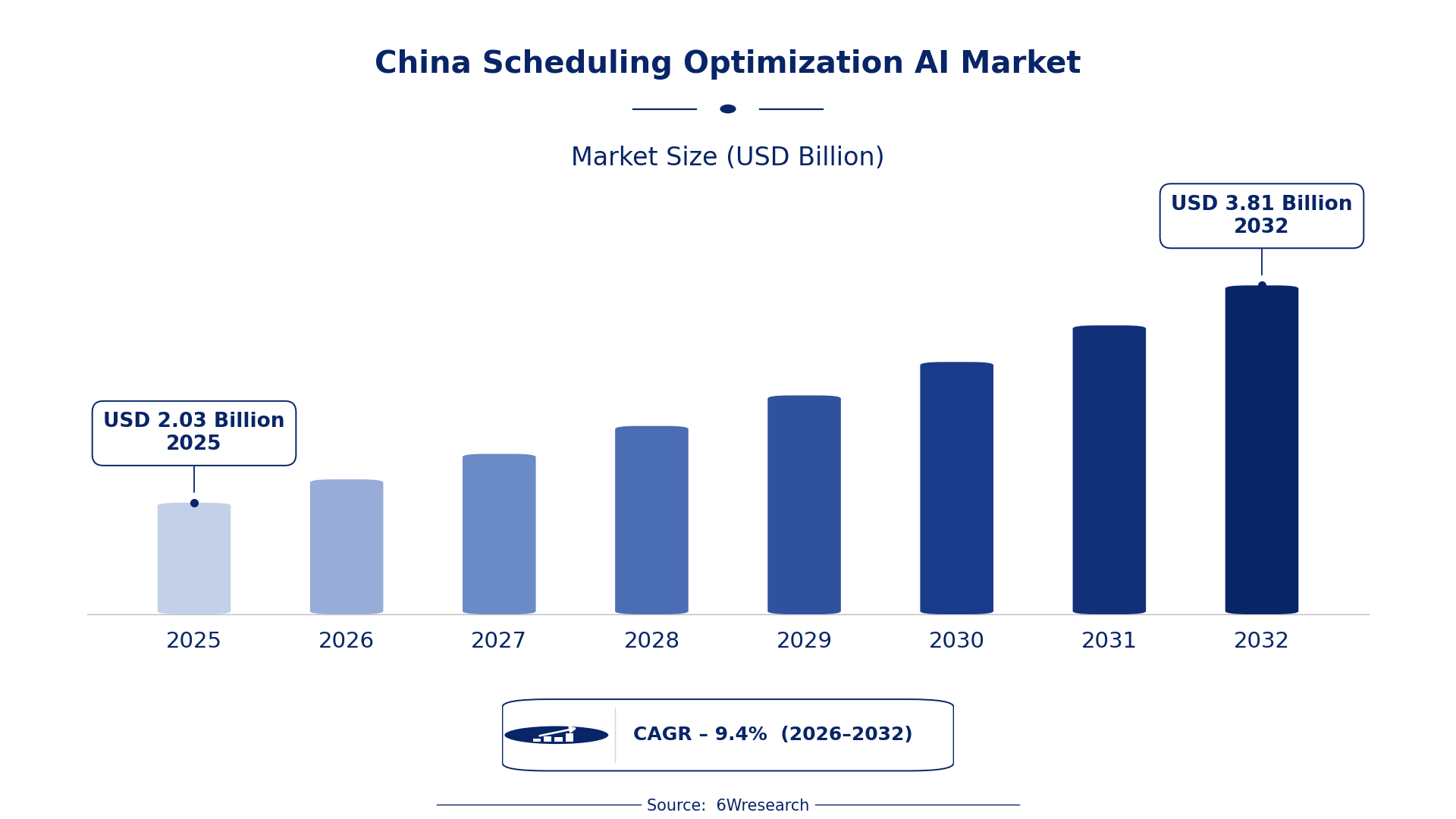
According to 6Wresearch internal database and industry insights, the China Scheduling Optimization AI Market was valued at USD 2.03 billion in 2025 and is projected to reach USD 3.81 billion by 2032, growing at a CAGR of approximately 9.4% during 2026–2032.
China Scheduling Optimization AI Market Highlights
| Report Metric | Details |
| Report Name | China Scheduling Optimization AI Market |
| Market Size 2025 | USD 2.03 billion |
| Market Size 2032 | USD 3.81 billion |
| Absolute Growth 2025–2032 | USD 1.78 billion |
| CAGR 2026–2032 | 9.4% |
| Peak Annual Growth | 12.3% in 2032 |
| Forecast Period | 2026–2032 |
| Historical Data | 2022–2025 |
| Base Year | 2025 |
| Leading Optimization Type, 2025 | Workforce Scheduling (55% share) |
| Leading AI Algorithm, 2025 | Predictive Analytics (45% share) |
| Leading Deployment Mode, 2025 | Cloud-Based (40% share) |
| Leading End User, 2025 | Retail & Hospitality Chains (47% share) |
| Fastest-Growing Optimization Type | Fleet Scheduling (11.1% CAGR) |
| Fastest-Growing AI Algorithm | Reinforcement Learning (11.8% CAGR) |
| Fastest-Growing Deployment Mode | SaaS (11.4% CAGR) |
| Fastest-Growing End User | Delivery & Logistics Firms (10.5% CAGR) |
| Growing Sector | Retail and Logistics |
| Key End Users | Retail Chains, Logistics Firms, Enterprises, Utilities |
China Scheduling Optimization AI Market Year-wise Growth Rate and Key Drivers (2022–2032)
This graph illustrates the annual growth rates of the market from 2022 to 2032, highlighting a steady upward trajectory and projected market expansion over the forecast period.
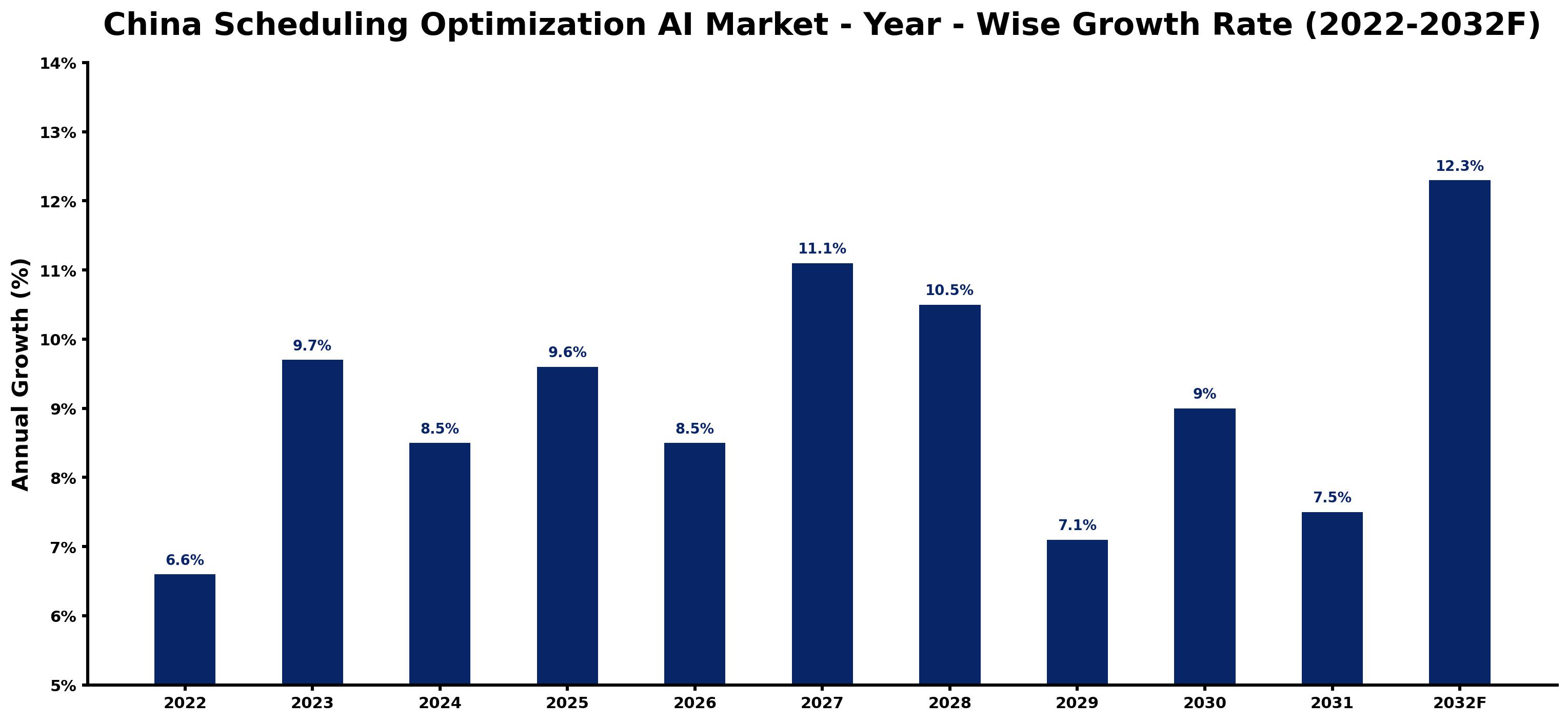
The following table presents the estimated annual growth rate for each year together with the principal factor influencing market performance.
| Year | Estimated Annual Growth (%) | Market Rationale |
| 2022 | 6.6 | The market experienced steady demand driven by existing technologies and user adoption. |
| 2023 | 9.7 | Growth accelerated due to the launch of the AI Innovation Action Plan promoting AI technologies. |
| 2024 | 8.5 | A slowdown occurred as the market adjusted to the rapid growth of the previous year. |
| 2025 | 9.6 | Demand increased again as the retail sector expanded operations with new scheduling tools under the 'Made in China 2025' initiative. |
| 2026 | 8.5 | Growth slowed as companies consolidated gains from AI integration in various sectors, particularly logistics. |
| 2027 | 11.1 | A resurgence in demand was noted as logistics firms adopted advanced scheduling solutions under the Smart Logistics Development Plan. |
| 2028 | 10.5 | Growth moderated as the market matured and competition intensified among AI providers in urban services. |
| 2029 | 7.1 | A further slowdown was observed as firms focused on optimising existing scheduling systems for efficiency. |
| 2030 | 9.0 | Demand increased as new AI technologies were introduced to the market, improving scheduling capabilities across sectors. |
| 2031 | 7.5 | Growth slowed again as the market stabilised after previous fluctuations in demand from retail and logistics. |
| 2032 | 12.3 | A peak in growth is expected as AI adoption reaches new heights across industries, driven by the 'AI Innovation Action Plan'. |
Note: Market size estimations and growth projections presented in this report are based on 6Wresearch's proprietary forecasting methodology, utilizing the latest available industry data, government publications, and primary research inputs.
China Scheduling Optimization AI Market Synopsis
The China Scheduling Optimization AI Market focuses on technologies that improve scheduling efficiency through algorithms. This technology is developed using machine learning and data analytics, primarily for workforce allocation, fleet management, and task scheduling. The market is growing due to strong demand from sectors like retail and logistics, which are increasingly adopting AI technologies. With over 30 million people employed in the retail sector, the need for efficient scheduling solutions is significant. Initiatives like the AI Innovation Action Plan are driving further growth in this market.
Market Dynamics Impact Analysis (2026–2032)
| Factor | Type | Impact | Primary Segment Affected |
| Strong demand from the retail sector for efficient workforce management solutions | Driver | High | Workforce Scheduling |
| Increased adoption of AI technologies in logistics for improved delivery efficiency | Driver | High | Fleet Scheduling |
| Growing need for advanced scheduling solutions in urban services | Opportunity | Medium | Task Scheduling |
| Rising investment in AI technologies for operational efficiency | Opportunity | Medium | Predictive Analytics |
| Limited awareness of AI benefits among smaller enterprises | Restraint | High | Workforce Scheduling |
| High initial investment costs for implementing AI solutions | Restraint | High | Fleet Scheduling |
| The biggest challenge is the slow adoption of AI in traditional industries | Challenge | High | Task Scheduling |
| Competition from alternative scheduling methods may hinder market growth | Challenge | Medium | Predictive Analytics |
Evaluation of Drivers in China Scheduling Optimization AI Market (2026–2032)
Key forces behind demand, with the segment each one moves most, are listed below.
| Drivers | Primary Segment Affected | Why It Matters (Evidence) |
| Increased workforce efficiency through AI-driven scheduling solutions | Workforce Scheduling | The retail sector employs over 30 million people, necessitating efficient scheduling solutions. |
| Optimised routing improving delivery efficiency for logistics firms | Fleet Scheduling | Over 60% of logistics firms in China utilise scheduling optimisation AI, improving service delivery. |
| Growing demand for predictive analytics to forecast scheduling needs | Predictive Analytics | The logistics sector is expected to handle over 14 billion packages in 2023, increasing scheduling needs. |
| Adoption of cloud-based solutions for flexibility and accessibility | Cloud-Based | The SaaS model for scheduling optimisation is gaining traction, with a 40% adoption rate among enterprises. |
| Investment in AI technologies to improve operational efficiencies | Task Scheduling | The 'Digital China' initiative emphasises AI's role in improving operational efficiencies across sectors. |
Market growth for Scheduling Optimization AI in China is underpinned by rising demand from various sectors, including retail and logistics. The retail sector employs over 30 million people, driving the need for efficient workforce scheduling. More than 60% of logistics firms in China utilise scheduling optimisation AI, which improves delivery efficiency. The logistics sector is projected to handle over 14 billion packages in 2023, necessitating advanced scheduling solutions. The SaaS model for scheduling optimisation is gaining traction, with a 40% adoption rate among enterprises, indicating a shift towards cloud-based solutions that improve operational capabilities.
Evaluation of Restraints in China Scheduling Optimization AI Market
Below mentioned are some major restraints and their influence on market dynamics.
| Market Restraint | Primary Segment Affected | Why It Matters (Evidence) |
| Limited awareness of AI benefits among smaller enterprises | Workforce Scheduling | Many small retailers lack knowledge of AI's potential, hindering adoption rates. |
| High initial investment costs for implementing AI solutions | Fleet Scheduling | Logistics firms face budget constraints that delay AI integration, impacting operational efficiency. |
| Resistance to change from traditional scheduling methods | Task Scheduling | Established firms often prefer existing systems over new AI technologies, slowing adoption rates. |
| Complexity of integrating AI with legacy systems | Predictive Analytics | Older systems may not support advanced AI functionalities, limiting upgrades and efficiency gains. |
| Insufficient skilled workforce for AI implementation | Cloud-Based | A shortage of trained personnel slows down the adoption of cloud solutions in various sectors. |
China Scheduling Optimization AI Market Challenges
In the China Scheduling Optimization AI market, buyers encounter high implementation costs, which can account for over 20% of operational budgets for logistics firms. Regulatory hurdles arise from compliance with the National Standards of China, causing project approval delays that impede retailers from optimising workforce efficiency. Competition is intense, with over 10,000 AI startups competing for market share, leading to price wars that jeopardise profit margins for established suppliers. Rising development costs, spurred by the government's $1 billion investment in AI, impose additional financial pressure on smaller enterprises aiming to adopt scheduling optimisation technologies.
Trends in the China Scheduling Optimization AI Market
Four trends stand out in the China Scheduling Optimization AI Market.
- AI Innovation Action Plan Driving Adoption: The Chinese government introduced the 'AI Innovation Action Plan' in 2023, promoting AI technologies including scheduling optimisation. This initiative seeks to integrate AI across sectors, improving efficiency and productivity outcomes.
- Shift Towards Cloud-Based Solutions: A clear shift towards cloud-based scheduling solutions is evident as firms pursue flexibility and scalability. As of 2023, 40% of enterprises have adopted the SaaS model for scheduling optimisation, reflecting changing preferences.
- Increase in Logistics Efficiency: The logistics sector is experiencing a marked increase in efficiency due to the adoption of scheduling optimisation AI. In 2023, the average delivery time for logistics firms decreased by 15%, highlighting the impact of these technologies.
- Growing Focus on Predictive Analytics: Predictive analytics is gaining importance for scheduling optimisation. With a 45% market share in 2025, this AI algorithm is crucial for forecasting demand and optimising schedules across various sectors.
Investment Opportunities in the China Scheduling Optimization AI Market
Investors looking at the China Scheduling Optimization AI Market should consider the following areas.
- Forming Partnerships for AI Development: Collaborating with local tech firms can ease entry into the Chinese market. With the government allocating $1 billion for AI development in 2023, there is a strong opportunity for partnerships.
- Investment in Urban Scheduling Solutions: The demand for efficient scheduling in urban services is rising, with China's urban population reaching 900 million in 2023. Investing in solutions tailored for urban environments can yield substantial returns.
- Focus on Logistics Optimisation: Given that logistics firms are projected to handle over 14 billion packages in 2023, there is a pressing need for advanced scheduling solutions. Targeting this sector can provide valuable opportunities for suppliers.
- Engaging with AI Talent Development Programs: Participating in the 'AI Talent Development Program' initiated by the Ministry of Education can aid in acquiring skilled personnel. This program targets 100 universities by 2025, creating a talent pool for AI implementation.
Government Initiatives in the China Scheduling Optimization AI Market
In 2023, the Ministry of Industry and Information Technology launched the 'AI Innovation Action Plan' to promote AI applications, including scheduling optimisation. This plan builds on previous initiatives like the 'Digital Economy Development Strategy' from 2022, which emphasised AI's role in improving scheduling across various sectors. The new plan aims to integrate AI technologies more effectively, ensuring that industries can adopt advanced scheduling solutions for operational efficiency. The State Council's 'Digital Economy Development Strategy' released in 2022 also supports AI integration, with an investment of $500 million allocated for AI projects.
The National Development and Reform Commission approved the 'AI Development Strategy' in 2021, aiming to boost AI technologies, including scheduling, with a target of increasing AI adoption by 30% by 2025. The Ministry of Industry and Information Technology supports various AI projects, providing funding and resources to improve scheduling capabilities across industries. These initiatives are vital for ensuring that AI technologies are effectively implemented and integrated into existing systems, allowing producers to enhance their operational efficiencies.
Future Insight of the China Scheduling Optimization AI Market
Several forward-looking factors should support the China Scheduling Optimization AI market in the coming years. The 'AI Innovation Action Plan' will accelerate technology adoption across various sectors, improving operational efficiency. Logistics firms are expected to handle over 14 billion packages in 2023, driving demand for advanced scheduling solutions. The 'Digital China' initiative will embed AI in public utilities, improving scheduling capabilities. As the retail market grows by 5% annually, the need for effective workforce allocation will increase.
Market Segmentation Analysis
The report offers a comprehensive study of the following market segments and their leading categories in the market.
By Optimization Type – Workforce Scheduling Dominated, Fleet Scheduling Expected to Grow Fastest
According to Shubham Padhi, Research Analyst at 6Wresearch, the largest optimization type category in 2025 was Workforce Scheduling, with a 55% share of total revenue. Workforce Scheduling holds the largest share due to the vast employment in the retail sector, which employs over 30 million people in China. This segment is essential for managing employee shifts and productivity, making it a critical solution for businesses. The quickest growth will come from Fleet Scheduling, forecast to expand at a CAGR of 11.1% between 2026 and 2032. Fleet Scheduling is experiencing rapid growth as logistics firms handle over 14 billion packages in 2023, necessitating efficient transportation and delivery route optimization. The increasing demand for timely deliveries drives the need for advanced scheduling solutions. Suppliers should focus on developing tailored solutions for workforce and fleet scheduling to meet the growing market demand.
By AI Algorithm – Predictive Analytics Dominated, Reinforcement Learning Expected to Grow Fastest
With a 45% revenue share in 2025, Predictive Analytics was the largest ai algorithm category. Predictive Analytics holds the largest share in the China Scheduling Optimization AI market because it is crucial for accurate demand forecasting and effective schedule management. Its direct use is particularly prominent in logistics, where precise scheduling is vital for operational efficiency and customer satisfaction. Reinforcement Learning is set to record the highest CAGR in this split, 11.8% over 2026–2032. Reinforcement Learning is witnessing the fastest growth as its ability to enhance scheduling in complex scenarios gains recognition, indicating a trend towards more advanced applications. This suggests that as industries strive for improved efficiency, the uptake of Reinforcement Learning will continue to rise, widening its market position. Suppliers need to prioritise the development of predictive analytics solutions to cater to the increasing demand for efficient scheduling across diverse industries.
By Deployment Mode – Cloud-Based Dominated, SaaS Expected to Grow Fastest
Cloud-Based took a 40% share of deployment mode in 2025, more than any other category. Cloud-Based deployment dominates the market due to its preference for scalability and remote access, allowing businesses to manage scheduling efficiently across multiple locations. This model supports the increasing demand for flexible solutions in various sectors. Over 2026–2032, SaaS are expected to post the fastest growth, at a CAGR of 11.4%. SaaS is the fastest-growing deployment mode, with a 40% adoption rate among enterprises in 2023, as it offers flexibility and accessibility that businesses are seeking. This trend indicates a shift towards more user-friendly solutions in scheduling optimization. Suppliers must prioritise SaaS offerings to capture the growing demand for accessible scheduling solutions.
By End User – Retail & Hospitality Chains Dominated, Delivery & Logistics Firms Expected to Grow Fastest
Retail & Hospitality Chains held a 47% share of the China Scheduling Optimization AI Market by end user in 2025. Retail & Hospitality Chains represent the largest share as they heavily rely on scheduling for operational efficiency, making it a critical aspect of their business model. This sector's vast scale and complexity necessitate advanced scheduling solutions. Delivery & Logistics Firms are projected to grow fastest, at a CAGR of 10.5% during 2026–2032. Delivery & Logistics Firms are the fastest-growing end user segment, driven by the need for efficient service delivery in handling over 14 billion packages in 2023. This growth reflects the increasing importance of timely logistics in the market. Suppliers should tailor their offerings to meet the specific needs of retail and logistics sectors to maximise market opportunities.
Key Attractiveness of the Report
- 10 Years of Market Numbers
- Historical Data Starting from 2022 to 2025
- Base Year 2025
- Forecast Data until 2032
- Key Performance Indicators Impacting the Market
- Major Upcoming Developments and Projects
Key Highlights of the Report:
- China Scheduling Optimization AI Market Outlook
- Market Size of China Scheduling Optimization AI Market, 2025
- Forecast of China Scheduling Optimization AI Market, 2032
- Historical Data and Forecast of China Scheduling Optimization AI Revenues & Volume for the Period 2022 - 2032F
- China Scheduling Optimization AI Market Trend Evolution
- China Scheduling Optimization AI Market Drivers and Challenges
- China Scheduling Optimization AI Price Trends
- China Scheduling Optimization AI Porter's Five Forces
- China Scheduling Optimization AI Industry Life Cycle
- Historical Data and Forecast of China Scheduling Optimization AI Market Revenues & Volume By Optimization Type for the Period 2022 - 2032F
- Historical Data and Forecast of China Scheduling Optimization AI Market Revenues & Volume By Workforce Scheduling for the Period 2022 - 2032F
- Historical Data and Forecast of China Scheduling Optimization AI Market Revenues & Volume By Fleet Scheduling for the Period 2022 - 2032F
- Historical Data and Forecast of China Scheduling Optimization AI Market Revenues & Volume By Task Scheduling for the Period 2022 - 2032F
- Historical Data and Forecast of China Scheduling Optimization AI Market Revenues & Volume By Maintenance Scheduling for the Period 2022 - 2032F
- Historical Data and Forecast of China Scheduling Optimization AI Market Revenues & Volume By AI Algorithm for the Period 2022 - 2032F
- Historical Data and Forecast of China Scheduling Optimization AI Market Revenues & Volume By Constraint Programming for the Period 2022 - 2032F
- Historical Data and Forecast of China Scheduling Optimization AI Market Revenues & Volume By Reinforcement Learning for the Period 2022 - 2032F
- Historical Data and Forecast of China Scheduling Optimization AI Market Revenues & Volume By Genetic Algorithms for the Period 2022 - 2032F
- Historical Data and Forecast of China Scheduling Optimization AI Market Revenues & Volume By Predictive Analytics for the Period 2022 - 2032F
- Historical Data and Forecast of China Scheduling Optimization AI Market Revenues & Volume By Deployment Mode for the Period 2022 - 2032F
- Historical Data and Forecast of China Scheduling Optimization AI Market Revenues & Volume By SaaS for the Period 2022 - 2032F
- Historical Data and Forecast of China Scheduling Optimization AI Market Revenues & Volume By On Premise for the Period 2022 - 2032F
- Historical Data and Forecast of China Scheduling Optimization AI Market Revenues & Volume By Cloud-Based for the Period 2022 - 2032F
- Historical Data and Forecast of China Scheduling Optimization AI Market Revenues & Volume By Hybrid Deployment for the Period 2022 - 2032F
- Historical Data and Forecast of China Scheduling Optimization AI Market Revenues & Volume By End User for the Period 2022 - 2032F
- Historical Data and Forecast of China Scheduling Optimization AI Market Revenues & Volume By Retail & Hospitality Chains for the Period 2022 - 2032F
- Historical Data and Forecast of China Scheduling Optimization AI Market Revenues & Volume By Delivery & Logistics Firms for the Period 2022 - 2032F
- Historical Data and Forecast of China Scheduling Optimization AI Market Revenues & Volume By Enterprise Enterprises for the Period 2022 - 2032F
- Historical Data and Forecast of China Scheduling Optimization AI Market Revenues & Volume By Power & Utilities for the Period 2022 - 2032F
- China Scheduling Optimization AI Import Export Trade Statistics
- Market Opportunity Assessment By Optimization Type
- Market Opportunity Assessment By AI Algorithm
- Market Opportunity Assessment By Deployment Mode
- Market Opportunity Assessment By End User
- China Scheduling Optimization AI Top Companies Market Share
- China Scheduling Optimization AI Competitive Benchmarking By Technical and Operational Parameters
- China Scheduling Optimization AI Company Profiles
- China Scheduling Optimization AI Key Strategic Recommendations
Market Covered
This report examines the market across the segments below.
By Optimization Type
- Workforce Scheduling
- Fleet Scheduling
- Task Scheduling
- Maintenance Scheduling
By AI Algorithm
- Constraint Programming
- Reinforcement Learning
- Genetic Algorithms
- Predictive Analytics
By Deployment Mode
- SaaS
- On‑Premise
- Cloud-Based
- Hybrid Deployment
By End User
- Retail & Hospitality Chains
- Delivery & Logistics Firms
- Enterprise Enterprises
- Power & Utilities































