India Scheduling Optimization AI Market Size & Growth Rate
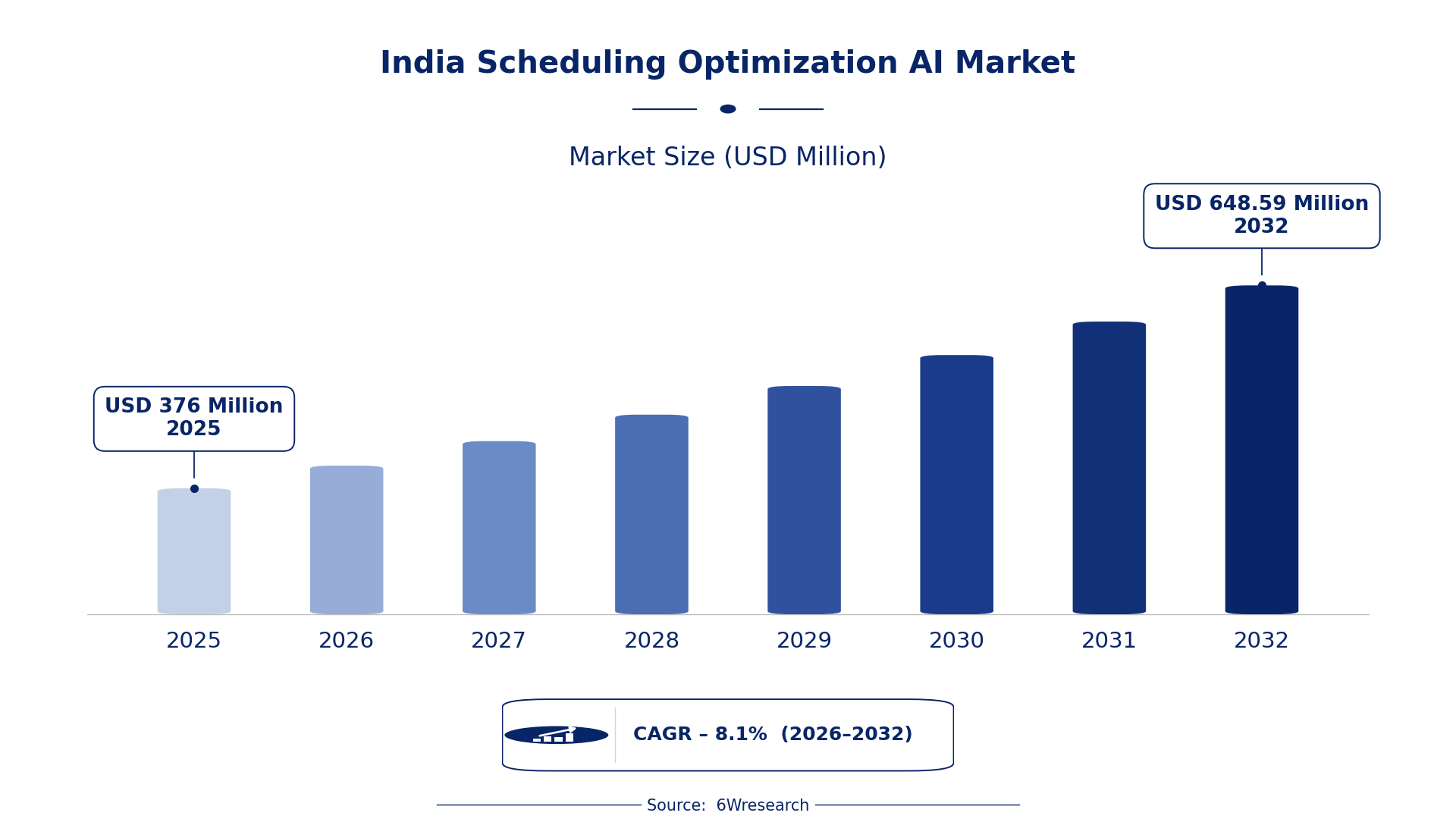
According to 6Wresearch internal database and industry insights, the India Scheduling Optimization AI Market was valued at USD 376.0 million in 2025 and is projected to reach USD 648.59 million by 2032, growing at a CAGR of approximately 8.1% during 2026–2032.
India Scheduling Optimization AI Market Highlights
| Report Metric | Details |
| Report Name | India Scheduling Optimization AI Market |
| Market Size 2025 | USD 376.0 million |
| Market Size 2032 | USD 648.59 million |
| Absolute Growth 2025–2032 | USD 272.59 million |
| CAGR 2026–2032 | 8.1% |
| Peak Annual Growth | 10.7% in 2032 |
| Forecast Period | 2026–2032 |
| Historical Data | 2022–2025 |
| Base Year | 2025 |
| Leading Optimization Type, 2025 | Workforce Scheduling (43% share) |
| Leading AI Algorithm, 2025 | Predictive Analytics (43% share) |
| Leading Deployment Mode, 2025 | Cloud-Based (40% share) |
| Leading End User, 2025 | Retail & Hospitality Chains (35% share) |
| Fastest-Growing Optimization Type | Task Scheduling (10.8% CAGR) |
| Fastest-Growing AI Algorithm | Reinforcement Learning (9.5% CAGR) |
| Fastest-Growing Deployment Mode | SaaS (9.4% CAGR) |
| Fastest-Growing End User | Delivery & Logistics Firms (9.9% CAGR) |
| Growing Sector | Delivery & Logistics Firms |
| Key End Users | Retail & Hospitality Chains, Delivery & Logistics Firms, Enterprise Enterprises, Power & Utilities |
India Scheduling Optimization AI Market Year-wise Growth Rate and Key Drivers (2022–2032)
This graph illustrates the annual growth rates of the market from 2022 to 2032, highlighting a steady upward trajectory and projected market expansion over the forecast period.
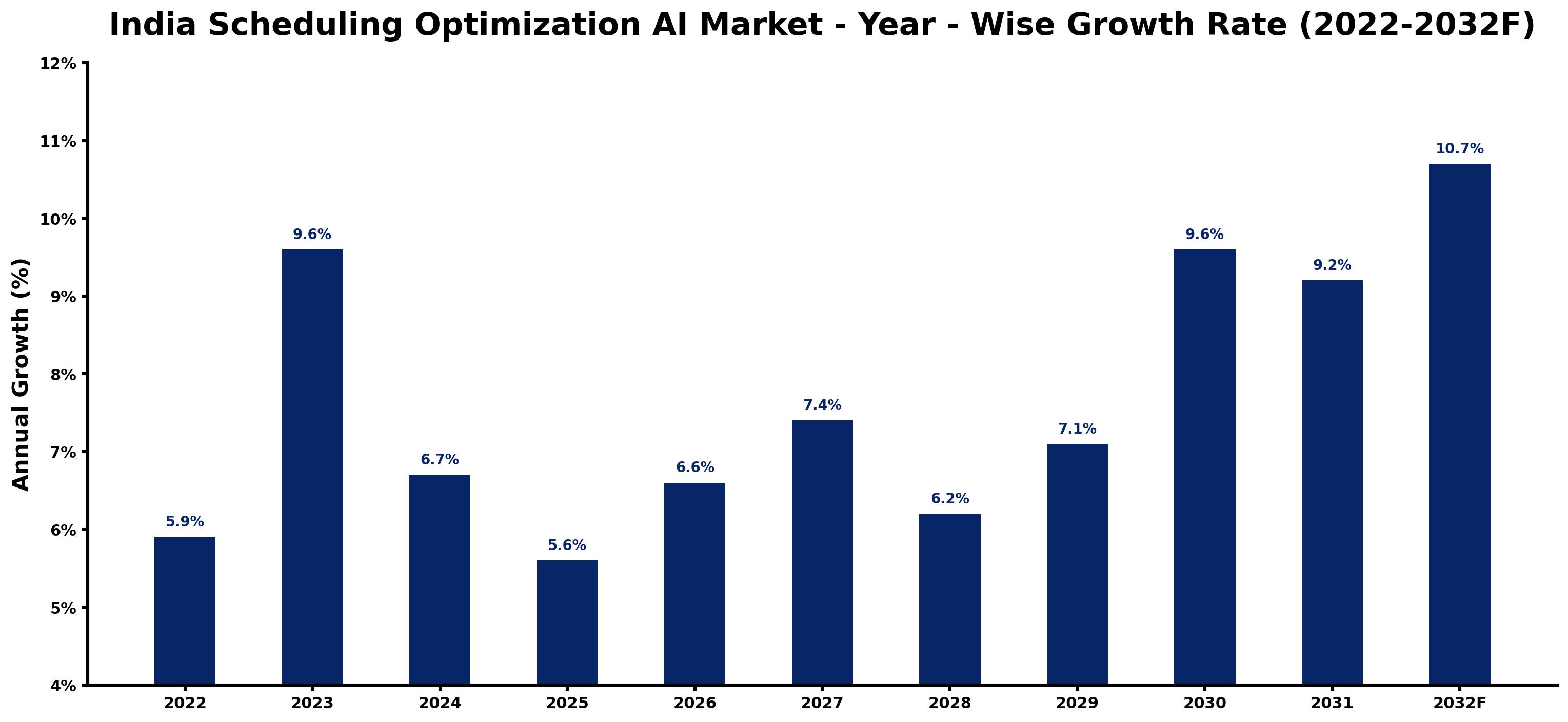
Annual growth estimates for each year appear below with the principal reason behind them, explaining the shifts that set the pace of the market.
| Year | Estimated Annual Growth (%) | Market Rationale |
| 2022 | 5.9 | The workforce in India was expanding, increasing the need for effective scheduling solutions. |
| 2023 | 9.6 | The logistics sector experienced growth, driving demand for fleet scheduling technologies. |
| 2024 | 6.7 | The market saw a slowdown as companies adjusted to new scheduling technologies. |
| 2025 | 5.6 | Demand for scheduling optimization remained strong despite a slowdown in growth rate. |
| 2026 | 6.6 | The logistics sector's projected growth spurred renewed interest in scheduling solutions. |
| 2027 | 7.4 | Increased investments in AI technologies boosted demand for scheduling optimization. |
| 2028 | 6.2 | The market slowed as companies faced challenges in integrating new technologies. |
| 2029 | 7.1 | Growth resumed as logistics firms sought to improve operational efficiency. |
| 2030 | 9.6 | Retail sector expansion led to rising demand for workforce scheduling solutions. |
| 2031 | 9.2 | The market growth rate slowed as companies focused on optimizing existing systems. |
| 2032 | 10.7 | Technological advancements from the National Logistics Policy are expected to drive growth in scheduling optimization. |
Note: Market size estimations and growth projections presented in this report are based on 6Wresearch's proprietary forecasting methodology, utilizing the latest available industry data, government publications, and primary research inputs.
India Scheduling Optimization AI Market Synopsis
Scheduling Optimization AI in India encompasses technologies that improve scheduling processes across various sectors. This technology employs algorithms and machine learning to optimise workforce management, fleet operations, and task assignments. The India Scheduling Optimization AI Market is growing due to the expanding workforce and the logistics sector's projected growth to $215 billion by 2026. Retail, which contributes 10% to India's GDP, also drives demand for effective scheduling solutions. The National Logistics Policy launched in 2022 further supports this growth by improving logistics efficiency.
Market Dynamics Impact Analysis (2026–2032)
| Factor | Type | Impact | Primary Segment Affected |
| Increasing workforce size driving demand for scheduling solutions | Driver | High | Workforce Scheduling |
| Growth in the logistics sector necessitating fleet optimization | Driver | High | Fleet Scheduling |
| Investment in cloud computing solutions for flexibility | Opportunity | High | Cloud-Based |
| Expansion of retail outlets increasing scheduling needs | Opportunity | High | Retail & Hospitality Chains |
| Integration challenges with existing systems | Restraint | Medium | Task Scheduling |
| Limited awareness of AI benefits among smaller firms | Restraint | Medium | Workforce Scheduling |
| High initial investment costs for advanced AI systems | Challenge | Medium | Fleet Scheduling |
| Competition from traditional scheduling methods | Challenge | Medium | Task Scheduling |
Evaluation of Drivers in India Scheduling Optimization AI Market (2026–2032)
The main growth drivers and the segments they affect most are set out below.
| Drivers | Primary Segment Affected | Why It Matters (Evidence) |
| Expanding workforce in India | Workforce Scheduling | The Indian workforce is projected to reach 1.4 billion by 2025, increasing the need for effective scheduling solutions. |
| Growth in logistics sector | Fleet Scheduling | The logistics sector in India is expected to grow to $215 billion by 2026, driving fleet scheduling needs. |
| Rise of cloud computing adoption | Cloud-Based | The cloud computing market in India is anticipated to reach $7.1 billion by 2025, supporting cloud-based scheduling solutions. |
| Retail sector expansion | Retail & Hospitality Chains | India's retail sector includes over 12 million retail outlets, highlighting the demand for scheduling optimization. |
| Government initiatives promoting AI | Task Scheduling | The National Logistics Policy launched in 2022 aims to enhance logistics efficiency, impacting scheduling technologies. |
The Scheduling Optimization AI market in India is expanding as the workforce grows, logistics demand increases, and cloud computing adoption rises. The Indian workforce is projected to reach 1.4 billion by 2025, necessitating effective scheduling solutions. The cloud computing market is anticipated to grow to $7.1 billion by 2025, facilitating cloud-based scheduling solutions. Retail accounts for 10% of India's GDP, highlighting the need for effective scheduling in this sector.
Evaluation of Restraints in India Scheduling Optimization AI Market
The following restraints limit how fast demand can grow.
| Market Restraint | Primary Segment Affected | Why It Matters (Evidence) |
| Integration challenges with existing systems | Task Scheduling | Many companies struggle to integrate new scheduling technologies with their existing systems, leading to inefficiencies. |
| Limited awareness of AI benefits among smaller firms | Workforce Scheduling | Smaller firms often lack knowledge about AI's advantages, hindering their adoption of scheduling optimization solutions. |
| High initial investment costs for advanced AI systems | Fleet Scheduling | The cost of implementing advanced AI scheduling systems can deter companies from investing in these technologies. |
| Competition from traditional scheduling methods | Task Scheduling | Traditional scheduling methods remain prevalent, making it difficult for AI solutions to gain market share. |
| Data privacy concerns affecting AI adoption | Cloud-Based | Concerns regarding data privacy and security can limit the willingness of firms to adopt cloud-based scheduling solutions. |
India Scheduling Optimization AI Market Challenges
Regulatory challenges in the India Scheduling Optimization AI market stem from the Bureau of Indian Standards, which has established guidelines that can postpone product deployment by up to six months for suppliers. Buyers in the retail sector, which contributes 10% to India's GDP, encounter implementation hurdles due to a lack of skilled professionals, resulting in operational productivity losses of 20%. The competition is intense, with over 12 million retail outlets vying for advanced scheduling technologies, leading to price wars that can erode margins for providers. The logistics sector, expected to grow to $215 billion by 2026, increases the demand for scheduling solutions, but many suppliers struggle to keep pace with this rapid expansion, risking missed opportunities for buyers.
Trends in the India Scheduling Optimization AI Market
Below mentioned are some of the trends shaping the India Scheduling Optimization AI Market growth.
- Shift from On-Premise to Cloud-Based Solutions: A shift towards cloud-based scheduling solutions is evident, with the cloud computing market expected to reach $7.1 billion by 2025. This change offers greater flexibility and remote access, benefiting logistics firms and retail chains.
- Increased Adoption of Predictive Analytics: Predictive analytics is gaining traction in scheduling optimization, with its market share expected to be 43% by 2025. This trend is particularly advantageous for retail and logistics sectors, enhancing their operational efficiency.
- Focus on Workforce Management Solutions: Retail and hospitality chains are increasingly focusing on workforce management solutions, driven by the need to optimise employee scheduling. With over 12 million retail outlets in India, this trend is crucial for improving service delivery.
- Growth of AI in Logistics: The logistics sector is progressively adopting AI technologies for scheduling optimization, supported by the National Logistics Policy launched in 2022. This policy aims to improve logistics efficiency, influencing scheduling technologies.
Investment Opportunities in the India Scheduling Optimization AI Market
Some of the investment opportunities in the India Scheduling Optimization AI Market are mentioned below.
- Partnerships with Local Firms: Now is an ideal time to enter the Scheduling Optimization AI market through partnerships with local firms. The logistics sector is projected to grow to $215 billion by 2026, creating a strong demand for scheduling solutions.
- Investment in AI Training Programs: With the workforce expected to reach 1.4 billion by 2025, investing in AI training programs for employees can bridge the skills gap. This will improve the adoption of scheduling optimization across various sectors.
- Expansion into Retail Sector: The retail sector's growth presents a unique opportunity for scheduling solutions. With retail contributing 10% to India's GDP, suppliers can target retail chains to improve their scheduling efficiency.
- Focus on Cloud-Based Solutions: The anticipated growth of the cloud computing market to $7.1 billion by 2025 indicates a strong opportunity for cloud-based scheduling solutions. Suppliers can enter this market by offering scalable and flexible solutions.
Government Initiatives in the India Scheduling Optimization AI Market
The National Logistics Policy 2022, introduced by the Ministry of Commerce and Industry, aims to streamline logistics operations, improving scheduling efficiency across sectors. This policy complements earlier initiatives like the Digital India Programme, which promotes AI technologies for better governance. The integration of these measures will support the adoption of scheduling optimization technologies. The government aims to increase the manufacturing sector's contribution to GDP to 25% by 2025, which will further impact scheduling needs.
Buyers in the logistics sector are utilising the National Logistics Policy to improve their scheduling processes. Agencies like the Ministry of Commerce and Industry are approving projects that align with this policy, ensuring that firms can access funding and support for implementing advanced scheduling solutions. This initiative is important for improving logistics efficiency and meeting the growing demands of the sector.
Future Insight of the India Scheduling Optimization AI Market
The India Scheduling Optimization AI market will experience notable changes by 2032, driven by several key factors. The logistics sector's growth will create an increased need for efficient scheduling solutions, particularly as the National Logistics Policy aims to improve operational efficiency. The workforce is set to expand, leading to a greater demand for effective scheduling across various industries. Investments in the Indian Railways, amounting to ₹50,000 crore, will modernise operations and require advanced scheduling optimization. The cloud computing market's anticipated growth to $7.1 billion by 2025 will further facilitate the adoption of cutting-edge scheduling technologies.
Market Segmentation Analysis
The report offers a comprehensive study of the following market segments and their leading categories in the market.
By Optimization Type – Workforce Scheduling Dominated, Task Scheduling Expected to Grow Fastest
According to Shubham Padhi, Research Analyst at 6Wresearch, Workforce Scheduling held a 43% share of the India Scheduling Optimization AI Market by optimization type in 2025. Workforce Scheduling holds the largest share in India due to its critical role in managing employee shifts and productivity across various sectors. For instance, with over 12 million retail outlets, the demand for effective workforce scheduling is substantial. The quickest growth will come from Task Scheduling, forecast to expand at a CAGR of 10.8% between 2026 and 2032. Task Scheduling is experiencing the fastest growth as organisations increasingly recognise the need for efficient task organisation across diverse sectors. The logistics sector's projected growth to $215 billion by 2026 is a key factor driving this demand. This trend suggests that suppliers should focus on developing tailored solutions for workforce and task scheduling to meet the rising demand.
By AI Algorithm – Predictive Analytics Dominated, Reinforcement Learning Expected to Grow Fastest
Predictive Analytics accounted for a 43% market share by ai algorithm in 2025. Predictive Analytics commands the largest share as it is essential for forecasting scheduling needs based on historical data trends. Its direct application in various sectors ensures its continued relevance and demand. Reinforcement Learning is projected to grow fastest, at a CAGR of 9.5% during 2026–2032. Reinforcement Learning is growing rapidly as businesses seek to improve their scheduling models through advanced AI techniques. This growth is spurred by the increasing adoption of AI technologies across industries, as outlined in the National Strategy for Artificial Intelligence. Suppliers should invest in predictive analytics capabilities while also exploring reinforcement learning to stay competitive in the market.
By Deployment Mode – Cloud-Based Dominated, SaaS Expected to Grow Fastest
In 2025, Cloud-Based led the deployment mode split with a 40% share. Cloud-Based solutions dominate the market due to their scalability and remote access advantages, making them essential for modern scheduling needs. The anticipated growth of the cloud computing market to $7.1 billion by 2025 underscores this trend. SaaS are set to record the highest CAGR in this split, 9.4% over 2026–2032. SaaS is the fastest-growing deployment mode, driven by its flexibility and ease of access for users. This trend aligns with the increasing demand for agile scheduling solutions across various sectors. Vendors should prioritise the development of SaaS offerings to capitalise on this growing preference among users.
By End User – Retail & Hospitality Chains Dominated, Delivery & Logistics Firms Expected to Grow Fastest
With a 35% revenue share in 2025, Retail & Hospitality Chains was the largest end user category. Retail & Hospitality Chains dominate the market share because they require efficient staff and service scheduling to enhance customer experiences. The presence of over 12 million retail outlets in India highlights the critical need for effective scheduling solutions within this sector. Over 2026–2032, Delivery & Logistics Firms are expected to post the fastest growth, at a CAGR of 9.9%. Delivery & Logistics Firms are experiencing rapid growth as they seek to optimise route and delivery schedules to meet rising consumer expectations. The logistics sector's projected expansion to $215 billion by 2026 is a key factor driving this swift increase. This suggests that suppliers should prioritise creating customised solutions for the retail and logistics sectors to optimise their market share.
Key Attractiveness of the Report
- 10 Years of Market Numbers
- Historical Data Starting from 2022 to 2025
- Base Year 2025
- Forecast Data until 2032
- Key Performance Indicators Impacting the Market
- Major Upcoming Developments and Projects
Key Highlights of the Report:
- India Scheduling Optimization AI Market Outlook
- Market Size of India Scheduling Optimization AI Market, 2025
- Forecast of India Scheduling Optimization AI Market, 2032
- Historical Data and Forecast of India Scheduling Optimization AI Revenues & Volume for the Period 2022 - 2032F
- India Scheduling Optimization AI Market Trend Evolution
- India Scheduling Optimization AI Market Drivers and Challenges
- India Scheduling Optimization AI Price Trends
- India Scheduling Optimization AI Porter's Five Forces
- India Scheduling Optimization AI Industry Life Cycle
- Historical Data and Forecast of India Scheduling Optimization AI Market Revenues & Volume By Optimization Type for the Period 2022 - 2032F
- Historical Data and Forecast of India Scheduling Optimization AI Market Revenues & Volume By Workforce Scheduling for the Period 2022 - 2032F
- Historical Data and Forecast of India Scheduling Optimization AI Market Revenues & Volume By Fleet Scheduling for the Period 2022 - 2032F
- Historical Data and Forecast of India Scheduling Optimization AI Market Revenues & Volume By Task Scheduling for the Period 2022 - 2032F
- Historical Data and Forecast of India Scheduling Optimization AI Market Revenues & Volume By Maintenance Scheduling for the Period 2022 - 2032F
- Historical Data and Forecast of India Scheduling Optimization AI Market Revenues & Volume By AI Algorithm for the Period 2022 - 2032F
- Historical Data and Forecast of India Scheduling Optimization AI Market Revenues & Volume By Constraint Programming for the Period 2022 - 2032F
- Historical Data and Forecast of India Scheduling Optimization AI Market Revenues & Volume By Reinforcement Learning for the Period 2022 - 2032F
- Historical Data and Forecast of India Scheduling Optimization AI Market Revenues & Volume By Genetic Algorithms for the Period 2022 - 2032F
- Historical Data and Forecast of India Scheduling Optimization AI Market Revenues & Volume By Predictive Analytics for the Period 2022 - 2032F
- Historical Data and Forecast of India Scheduling Optimization AI Market Revenues & Volume By Deployment Mode for the Period 2022 - 2032F
- Historical Data and Forecast of India Scheduling Optimization AI Market Revenues & Volume By SaaS for the Period 2022 - 2032F
- Historical Data and Forecast of India Scheduling Optimization AI Market Revenues & Volume By On Premise for the Period 2022 - 2032F
- Historical Data and Forecast of India Scheduling Optimization AI Market Revenues & Volume By Cloud-Based for the Period 2022 - 2032F
- Historical Data and Forecast of India Scheduling Optimization AI Market Revenues & Volume By Hybrid Deployment for the Period 2022 - 2032F
- Historical Data and Forecast of India Scheduling Optimization AI Market Revenues & Volume By End User for the Period 2022 - 2032F
- Historical Data and Forecast of India Scheduling Optimization AI Market Revenues & Volume By Retail & Hospitality Chains for the Period 2022 - 2032F
- Historical Data and Forecast of India Scheduling Optimization AI Market Revenues & Volume By Delivery & Logistics Firms for the Period 2022 - 2032F
- Historical Data and Forecast of India Scheduling Optimization AI Market Revenues & Volume By Enterprise Enterprises for the Period 2022 - 2032F
- Historical Data and Forecast of India Scheduling Optimization AI Market Revenues & Volume By Power & Utilities for the Period 2022 - 2032F
- India Scheduling Optimization AI Import Export Trade Statistics
- Market Opportunity Assessment By Optimization Type
- Market Opportunity Assessment By AI Algorithm
- Market Opportunity Assessment By Deployment Mode
- Market Opportunity Assessment By End User
- India Scheduling Optimization AI Top Companies Market Share
- India Scheduling Optimization AI Competitive Benchmarking By Technical and Operational Parameters
- India Scheduling Optimization AI Company Profiles
- India Scheduling Optimization AI Key Strategic Recommendations
Market Covered
This report examines the market across the segments below.
By Optimization Type
- Workforce Scheduling
- Fleet Scheduling
- Task Scheduling
- Maintenance Scheduling
By AI Algorithm
- Constraint Programming
- Reinforcement Learning
- Genetic Algorithms
- Predictive Analytics
By Deployment Mode
- SaaS
- On‑Premise
- Cloud-Based
- Hybrid Deployment
By End User
- Retail & Hospitality Chains
- Delivery & Logistics Firms
- Enterprise Enterprises
- Power & Utilities































