China Seafood Products Market Size & Growth Rate
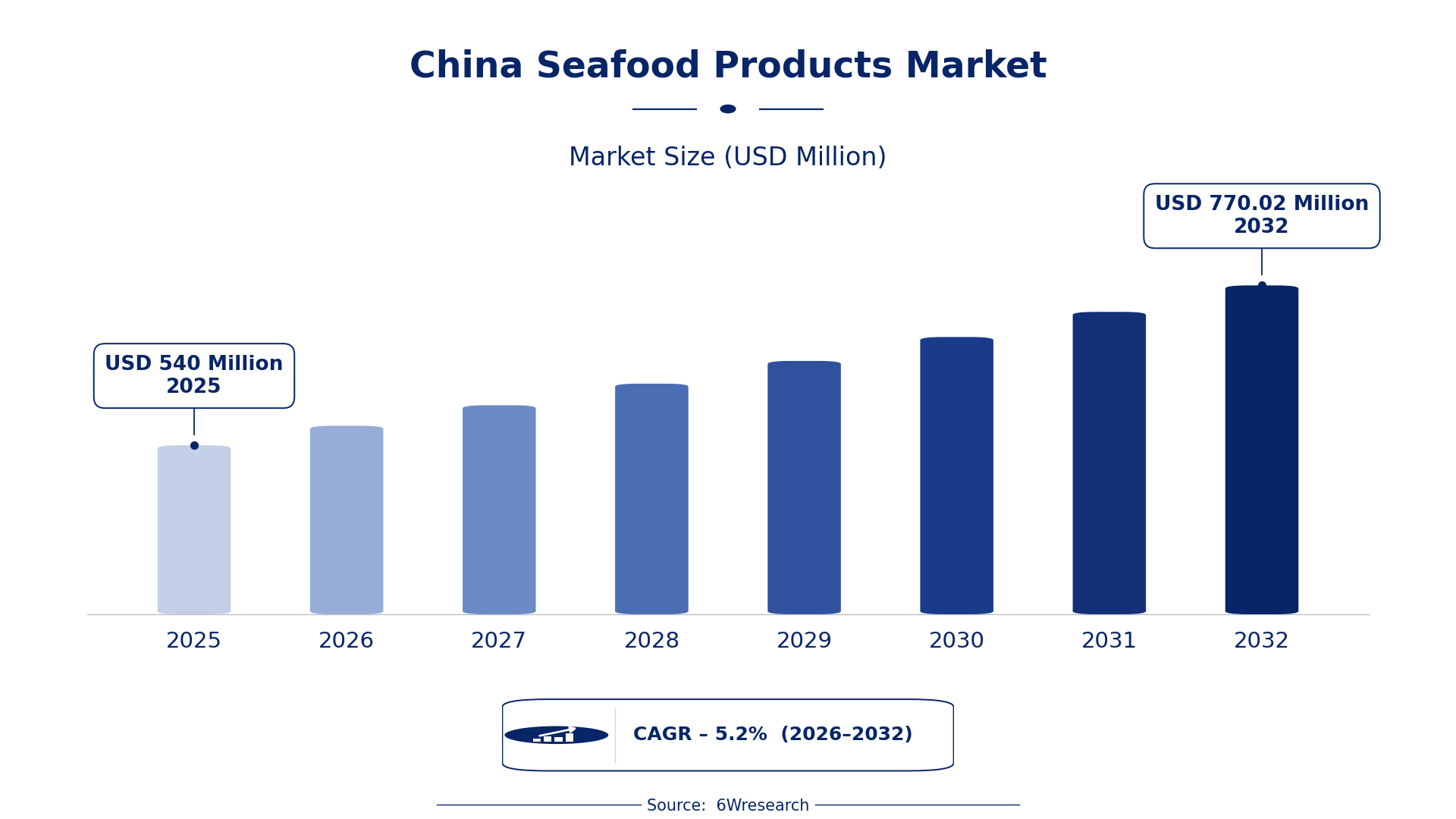
According to 6Wresearch internal database and industry insights, the China Seafood Products Market was valued at USD 540.0 million in 2025 and is projected to reach USD 770.02 million by 2032, growing at a CAGR of approximately 5.2% during 2026–2032.
China Seafood Products Market Highlights
| Report Metric | Details |
| Report Name | China Seafood Products Market |
| Market Size 2025 | USD 540.0 million |
| Market Size 2032 | USD 770.02 million |
| Absolute Growth 2025–2032 | USD 230.02 million |
| CAGR 2026–2032 | 5.2% |
| Peak Annual Growth | 7.8% in 2026 |
| Forecast Period | 2026–2032 |
| Historical Data | 2022–2025 |
| Base Year | 2025 |
| Leading Product Type, 2025 | Frozen Fillets (37% share) |
| Leading Packaging Format, 2025 | Tins / Jars (37% share) |
| Leading Preservation Method, 2025 | Frozen (-18 °C) (50% share) |
| Leading End User, 2025 | Retail Grocery Chains (36% share) |
| Fastest-Growing Product Type | Ready-to-Eat Meals (6.6% CAGR) |
| Fastest-Growing Packaging Format | Retort Pouches (7.6% CAGR) |
| Fastest-Growing Preservation Method | Chilled (7.1% CAGR) |
| Fastest-Growing End User | Restaurants & Catering (7.9% CAGR) |
| Growing Sector | Retail Grocery Chains |
| Key End Users | Retail Grocery Chains, Consumer Households, Restaurants & Catering |
China Seafood Products Market Year-wise Growth Rate and Key Drivers (2022–2032)
This graph illustrates the annual growth rates of the market from 2022 to 2032, highlighting a steady upward trajectory and projected market expansion over the forecast period.
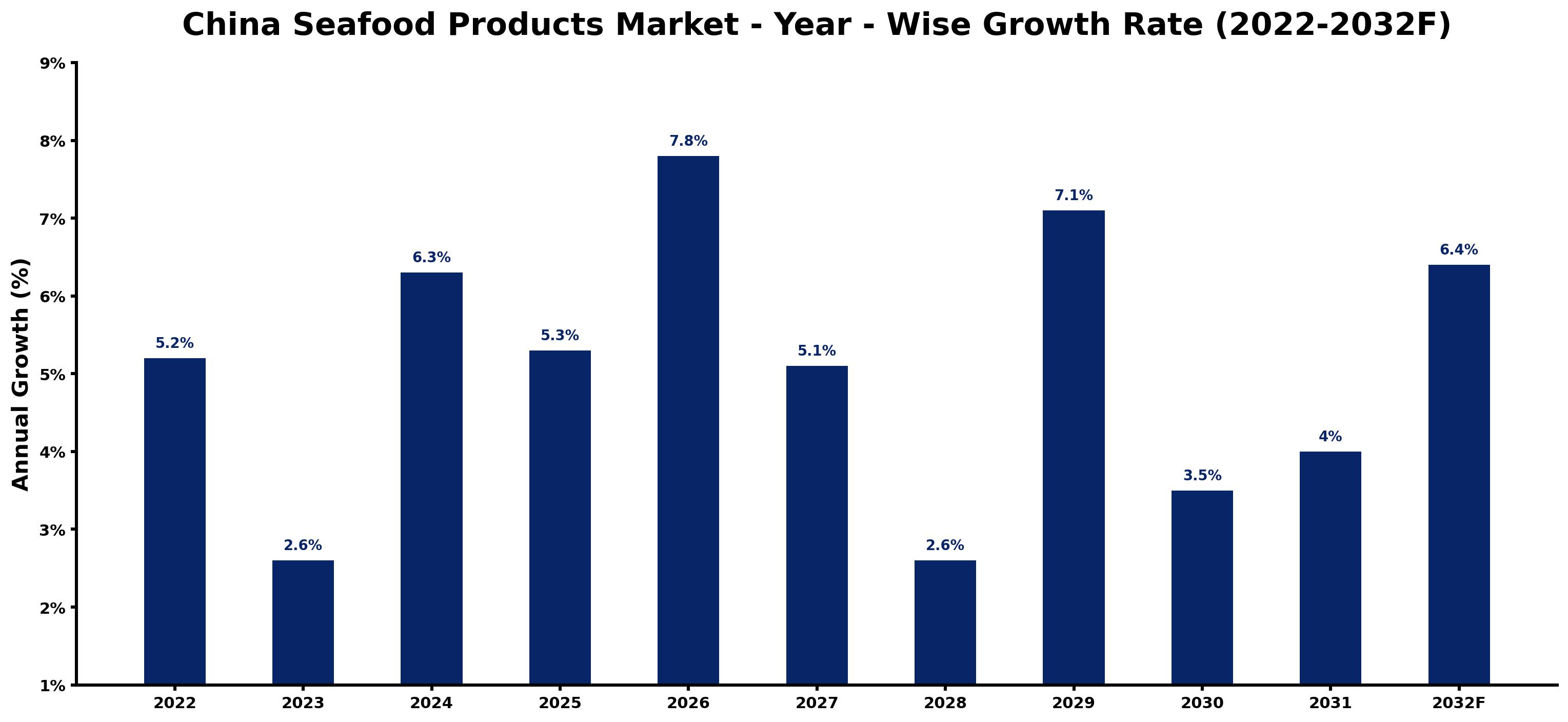
Each row of the following table gives one year's estimated growth and the event or demand shift that explains it.
| Year | Estimated Annual Growth (%) | Market Rationale |
| 2022 | 5.2 | The market experienced steady growth due to the 'Healthy China 2030' initiative promoting seafood consumption. |
| 2023 | 2.6 | Growth slowed as consumer preferences shifted towards sustainable seafood sourcing and healthier options. |
| 2024 | 6.3 | Demand surged as urban households increasingly incorporated seafood into their diets, reflecting changing tastes. |
| 2025 | 5.3 | Growth decelerated as competition intensified among seafood processing plants in coastal regions. |
| 2026 | 7.8 | The market peaked with a strong push for ready-to-eat meal options among consumers in urban areas. |
| 2027 | 5.1 | Demand slowed as supply chain disruptions affected product availability for retailers and restaurants. |
| 2028 | 2.6 | Growth continued to slow as consumers sought more sustainable seafood sourcing options. |
| 2029 | 7.1 | Demand rose again as restaurants expanded their seafood offerings following the easing of restrictions. |
| 2030 | 3.5 | Growth slowed as economic factors influenced consumer spending on premium seafood products. |
| 2031 | 4.0 | Demand picked up as new seafood processing technologies improved product quality and efficiency. |
| 2032 | 6.4 | Growth accelerated with rising health awareness and government initiatives promoting seafood consumption. |
Note: Market size estimations and growth projections presented in this report are based on 6Wresearch's proprietary forecasting methodology, utilizing the latest available industry data, government publications, and primary research inputs.
China Seafood Products Market Synopsis
The Seafood Products Market in China includes a diverse range of marine food items, primarily fish and shellfish, prepared for consumption. These products are sourced from oceans, rivers, and aquaculture farms, then preserved through methods like freezing and canning. The China Seafood Products Market is growing due to rising domestic consumption and an increasing preference for convenience foods. In 2022, per capita seafood consumption reached approximately 37.5 kg, driven by demand from urban households and retail grocery chains. Government initiatives, such as the 'Blue Revolution', are promoting sustainable fishing practices and contributing to market growth.
Market Dynamics Impact Analysis (2026–2032)
| Factor | Type | Impact | Primary Segment Affected |
| Rising domestic consumption of seafood products | Driver | High | Retail Grocery Chains |
| Growing demand for convenience food options | Driver | High | Ready-to-Eat Meals |
| Increasing exports of canned seafood products | Opportunity | Medium | Canned Seafood |
| Expansion of seafood processing facilities | Opportunity | Medium | Frozen Fillets |
| Regulatory challenges impacting seafood safety standards | Restraint | High | Canned Seafood |
| Environmental concerns affecting fishing practices | Restraint | High | Frozen Fillets |
| Supply chain disruptions affecting product availability | Challenge | Medium | Ready-to-Eat Meals |
| Intense competition among seafood processing plants | Challenge | Medium | Canned Seafood |
Evaluation of Drivers in China Seafood Products Market (2026–2032)
The table below links each growth driver to the segment it affects and the evidence for it.
| Drivers | Primary Segment Affected | Why It Matters (Evidence) |
| Rising domestic consumption of seafood products | Frozen Fillets | In 2022, per capita seafood consumption reached approximately 37.5 kg, driving demand for frozen fillets among urban households. |
| Growing preference for convenience foods | Ready-to-Eat Meals | The trend towards ready-to-eat meals surged by 15%, reflecting consumer demand for quick meal solutions. |
| Strong export growth of canned seafood | Canned Seafood | Canned seafood exports reached 1.5 million tons in 2022, indicating strong international demand for convenient seafood options. |
| Investment in processing technology | Canned Seafood | With over 1,000 registered seafood processing plants, investment in technology enhances production capacity and meets quality expectations. |
| Sustainable fishing practices promoted by government initiatives | Frozen (-18 °C) | The 'Blue Revolution' initiative aims to improve sustainability in fishing, ensuring quality frozen seafood products for consumers. |
The Seafood Products market in China is expanding as rising domestic consumption, increasing demand for convenience food options, and strong export growth drive market growth. In 2023, urban households reported a 10% increase in seafood consumption, particularly in frozen fillets, reflecting changing dietary preferences. The trend towards ready-to-eat meals surged by 15%, leading to higher sales in this segment. Canned seafood exports reached 1.5 million tons in 2022, reflecting strong international demand for convenient seafood options. Investment in processing technology, with over 1,000 registered plants, supports production capacity and meets consumer preferences for quality and sustainability.
Evaluation of Restraints in China Seafood Products Market
The main factors holding the market back are set out below.
| Market Restraint | Primary Segment Affected | Why It Matters (Evidence) |
| Regulatory challenges impacting seafood safety standards | Canned Seafood | The updated Food Safety Law of 2020 imposes stricter regulations, complicating compliance for producers. |
| Environmental concerns affecting fishing practices | Frozen Fillets | Sustainability issues have led to stricter fishing quotas, limiting supply availability for producers. |
| Supply chain disruptions affecting product availability | Ready-to-Eat Meals | Recent disruptions have delayed deliveries, affecting availability for consumers and increasing costs. |
| Intense competition among seafood processing plants | Canned Seafood | The high number of processing plants has led to price wars, reducing profitability for many producers. |
| Consumer preference shifting towards plant-based alternatives | Frozen Fillets | The growing trend towards plant-based diets is affecting demand for traditional seafood products. |
China Seafood Products Market Challenges
The China Seafood Products Market still has to solve a few problems, starting with a skills shortage among workers in processing plants. This gap exists due to insufficient training programmes, which delays production timelines for suppliers and hampers their ability to fulfil orders. Supply chain disruptions frequently occur, particularly in coastal provinces, causing inconsistent availability of fresh seafood for buyers and resulting in a 15% increase in procurement costs for restaurants and retailers. Price volatility of raw seafood can burden producers, forcing them to raise prices by up to 20%, ultimately impacting consumers' purchasing decisions.
Trends in the China Seafood Products Market
The trends below show where the China Seafood Products Market is heading.
- Increase in Frozen Seafood Consumption: In 2022, frozen seafood products accounted for about 40% of the total seafood market in China, reflecting consumer preference for convenience and longer shelf life.
- Shift Towards Ready-to-Eat Meals: The demand for ready-to-eat meals has surged since 2023, with urban households increasingly seeking quick meal solutions, driving growth in this segment.
- Rise of Sustainable Seafood Practices: The 'Blue Revolution' initiative launched in 2023 promotes sustainable fishing, influencing consumer choices towards certified seafood products.
- Growth in Canned Seafood Exports: Canned seafood exports from China reached 1.5 million tons in 2022, highlighting the global demand for convenient seafood options.
Investment Opportunities in the China Seafood Products Market
Investors looking at the China Seafood Products Market should consider the following areas.
- Supply of Frozen Seafood Products: With frozen seafood products representing about 40% of the total seafood market, there is a substantial opportunity for suppliers to meet this demand. Retail grocery chains are increasingly stocking frozen options to cater to consumer preferences for convenience.
- Expansion of Ready-to-Eat Meals: The increasing demand for ready-to-eat meals, projected to grow at a CAGR of 6.6%, presents an opportunity for suppliers to develop new products. Restaurants and catering services are looking for quick meal solutions to meet consumer needs.
- Canned Seafood Exports: Canned seafood exports reached 1.5 million tons in 2022, indicating a strong international market. Suppliers can target overseas markets, particularly in regions with growing seafood consumption.
- Investment in Sustainable Practices: The 'Blue Revolution' initiative encourages investment in sustainable fishing practices, with the government aiming to improve quality standards. Producers can align with this initiative to strengthen their market position and attract environmentally conscious buyers.
Government Initiatives in the China Seafood Products Market
The Food Safety Law of the People's Republic of China, updated in 2020, imposes stringent regulations on seafood safety and traceability, ensuring that producers adhere to high standards. This law promotes consumer confidence in seafood products and encourages better practices among producers. Additionally, the National Aquaculture Development Plan 2022-2030 aims to increase aquaculture production by 15% by 2030, overseen by the Ministry of Agriculture, which supports sustainable practices and resource management in the seafood sector.
The Ministry of Agriculture and Rural Affairs oversees the implementation of various schemes, including the 'Aquatic Product Quality Improvement Program' initiated in 2023. This program enhances quality standards for seafood products, ensuring that producers meet regulatory requirements. Furthermore, the 'Sustainable Fisheries Development Plan' launched in 2021 focuses on improving fishery resource management, benefiting both producers and consumers by promoting sustainable practices.
Future Insight of the China Seafood Products Market
Several forward-looking factors should support the China Seafood Products Market over the coming years. The 'Blue Revolution' initiative will promote sustainable fishing practices, ensuring better quality seafood for buyers. By 2032, per capita seafood consumption is expected to reach 45 kg, reflecting a shift towards healthier diets. Advanced processing technologies will improve efficiency in over 1,000 processing plants, benefiting suppliers and ensuring fresher products for consumers. The 'Healthy China 2030' initiative will further encourage seafood consumption, driving interest among urban households.
Market Segmentation Analysis
Each segment group is reviewed below, with the leader by share and the fastest grower by CAGR.
By Product Type – Frozen Fillets Dominated, Ready-to-Eat Meals Expected to Grow Fastest
According to Shubham Padhi, Research Analyst at 6Wresearch, Frozen Fillets accounted for a 37% market share by product type in 2025. Frozen fillets hold the largest share due to their widespread use as a staple protein source in Chinese households. The convenience of frozen fillets aligns with the high per capita seafood consumption of approximately 37.5 kg in 2022. Ready-to-Eat Meals are set to record the highest CAGR in this split, 6.6% over 2026–2032. Ready-to-eat meals are experiencing rapid growth as urban consumers increasingly seek quick meal solutions. The Seafood Industry Association of China reported a 10% increase in seafood consumption among urban households, driving this trend. Suppliers should focus on expanding ready-to-eat meal offerings to capture the growing consumer demand.
By Packaging Format – Tins / Jars Dominated, Retort Pouches Expected to Grow Fastest
Tins / Jars held a 37% share of the China Seafood Products Market by packaging format in 2025. Tins and jars dominate the market as they are a common packaging choice for preserved seafood products, appealing to consumers seeking convenience. Their established presence in retail grocery chains contributes to their leading share. The quickest growth will come from Retort Pouches, forecast to expand at a CAGR of 7.6% between 2026 and 2032. Retort pouches are seeing the fastest growth due to their suitability for specific ready-to-eat seafood items, catering to the rising demand for convenience. This packaging format aligns well with the trends in urban consumption patterns. Manufacturers should consider investing in retort pouch technology to meet the evolving preferences of consumers.
By Preservation Method – Frozen (-18 °C) Dominated, Chilled Expected to Grow Fastest
Frozen (-18 °C) took a 50% share of preservation method in 2025, more than any other category. Frozen seafood products hold the largest share due to their effectiveness in preserving quality and safety, making them a staple in the seafood supply chain. This method is particularly vital in regions like Guangdong and Shandong, where seafood production is concentrated. Over 2026–2032, Chilled is expected to post the fastest growth, at a CAGR of 7.1%. Chilled seafood is experiencing rapid growth as it caters to the demand for fresh options, particularly in urban areas where consumers prioritise quality. The 10% increase in seafood consumption among urban households highlights this trend. Suppliers must invest in chilled distribution to meet the rising consumer preference for fresh seafood.
By End User – Retail Grocery Chains Dominated, Restaurants & Catering Expected to Grow Fastest
In 2025, Retail Grocery Chains led the end user split with a 36% share. Retail grocery chains hold the largest share of the seafood products market due to their role as the primary distribution channel, making seafood widely accessible to consumers. Their extensive network in coastal provinces like Guangdong and Shandong ensures a steady supply of diverse seafood items. Restaurants & Catering is projected to grow fastest, at a CAGR of 7.9% during 2026–2032. The restaurants and catering segment is experiencing rapid growth, driven by rising demand for seafood in dining establishments across urban areas. This trend is illustrated by a reported 10% increase in seafood consumption among urban households, highlighting the shift towards dining out. This indicates that suppliers should prioritise partnerships with restaurants and catering services to capitalise on the growing demand for seafood products.
Key Attractiveness of the Report
- 10 Years of Market Numbers
- Historical Data Starting from 2022 to 2025
- Base Year 2025
- Forecast Data until 2032
- Key Performance Indicators Impacting the Market
- Major Upcoming Developments and Projects
Key Highlights of the Report:
- China Seafood Products Market Outlook
- Market Size of China Seafood Products Market, 2025
- Forecast of China Seafood Products Market, 2032
- Historical Data and Forecast of China Seafood Products Revenues & Volume for the Period 2022 - 2032F
- China Seafood Products Market Trend Evolution
- China Seafood Products Market Drivers and Challenges
- China Seafood Products Price Trends
- China Seafood Products Porter's Five Forces
- China Seafood Products Industry Life Cycle
- Historical Data and Forecast of China Seafood Products Market Revenues & Volume By Product Type for the Period 2022 - 2032F
- Historical Data and Forecast of China Seafood Products Market Revenues & Volume By Frozen Fillets for the Period 2022 - 2032F
- Historical Data and Forecast of China Seafood Products Market Revenues & Volume By Canned Seafood for the Period 2022 - 2032F
- Historical Data and Forecast of China Seafood Products Market Revenues & Volume By Ready-to-Eat Meals for the Period 2022 - 2032F
- Historical Data and Forecast of China Seafood Products Market Revenues & Volume By Smoked & Processed for the Period 2022 - 2032F
- Historical Data and Forecast of China Seafood Products Market Revenues & Volume By Packaging Format for the Period 2022 - 2032F
- Historical Data and Forecast of China Seafood Products Market Revenues & Volume By Vacuum-Sealed for the Period 2022 - 2032F
- Historical Data and Forecast of China Seafood Products Market Revenues & Volume By Tins / Jars for the Period 2022 - 2032F
- Historical Data and Forecast of China Seafood Products Market Revenues & Volume By Retort Pouches for the Period 2022 - 2032F
- Historical Data and Forecast of China Seafood Products Market Revenues & Volume By Plastic Packs for the Period 2022 - 2032F
- Historical Data and Forecast of China Seafood Products Market Revenues & Volume By Preservation Method for the Period 2022 - 2032F
- Historical Data and Forecast of China Seafood Products Market Revenues & Volume By Frozen (-18 C) for the Period 2022 - 2032F
- Historical Data and Forecast of China Seafood Products Market Revenues & Volume By Canned for the Period 2022 - 2032F
- Historical Data and Forecast of China Seafood Products Market Revenues & Volume By Shelf-Stable for the Period 2022 - 2032F
- Historical Data and Forecast of China Seafood Products Market Revenues & Volume By Chilled for the Period 2022 - 2032F
- Historical Data and Forecast of China Seafood Products Market Revenues & Volume By End User for the Period 2022 - 2032F
- Historical Data and Forecast of China Seafood Products Market Revenues & Volume By Retail Grocery Chains for the Period 2022 - 2032F
- Historical Data and Forecast of China Seafood Products Market Revenues & Volume By Consumer Households for the Period 2022 - 2032F
- Historical Data and Forecast of China Seafood Products Market Revenues & Volume By Convenience Stores for the Period 2022 - 2032F
- Historical Data and Forecast of China Seafood Products Market Revenues & Volume By Restaurants & Catering for the Period 2022 - 2032F
- China Seafood Products Import Export Trade Statistics
- Market Opportunity Assessment By Product Type
- Market Opportunity Assessment By Packaging Format
- Market Opportunity Assessment By Preservation Method
- Market Opportunity Assessment By End User
- China Seafood Products Top Companies Market Share
- China Seafood Products Competitive Benchmarking By Technical and Operational Parameters
- China Seafood Products Company Profiles
- China Seafood Products Key Strategic Recommendations
Market Covered
This report examines the market across the segments below.
By Product Type
- Frozen Fillets
- Canned Seafood
- Ready-to-Eat Meals
- Smoked & Processed
By Packaging Format
- Vacuum-Sealed
- Tins / Jars
- Retort Pouches
- Plastic Packs
By Preservation Method
- Frozen (-18 °C)
- Canned
- Shelf-Stable
- Chilled
By End User
- Retail Grocery Chains
- Consumer Households
- Convenience Stores
- Restaurants & Catering































