India Seafood Products Market Size & Growth Rate
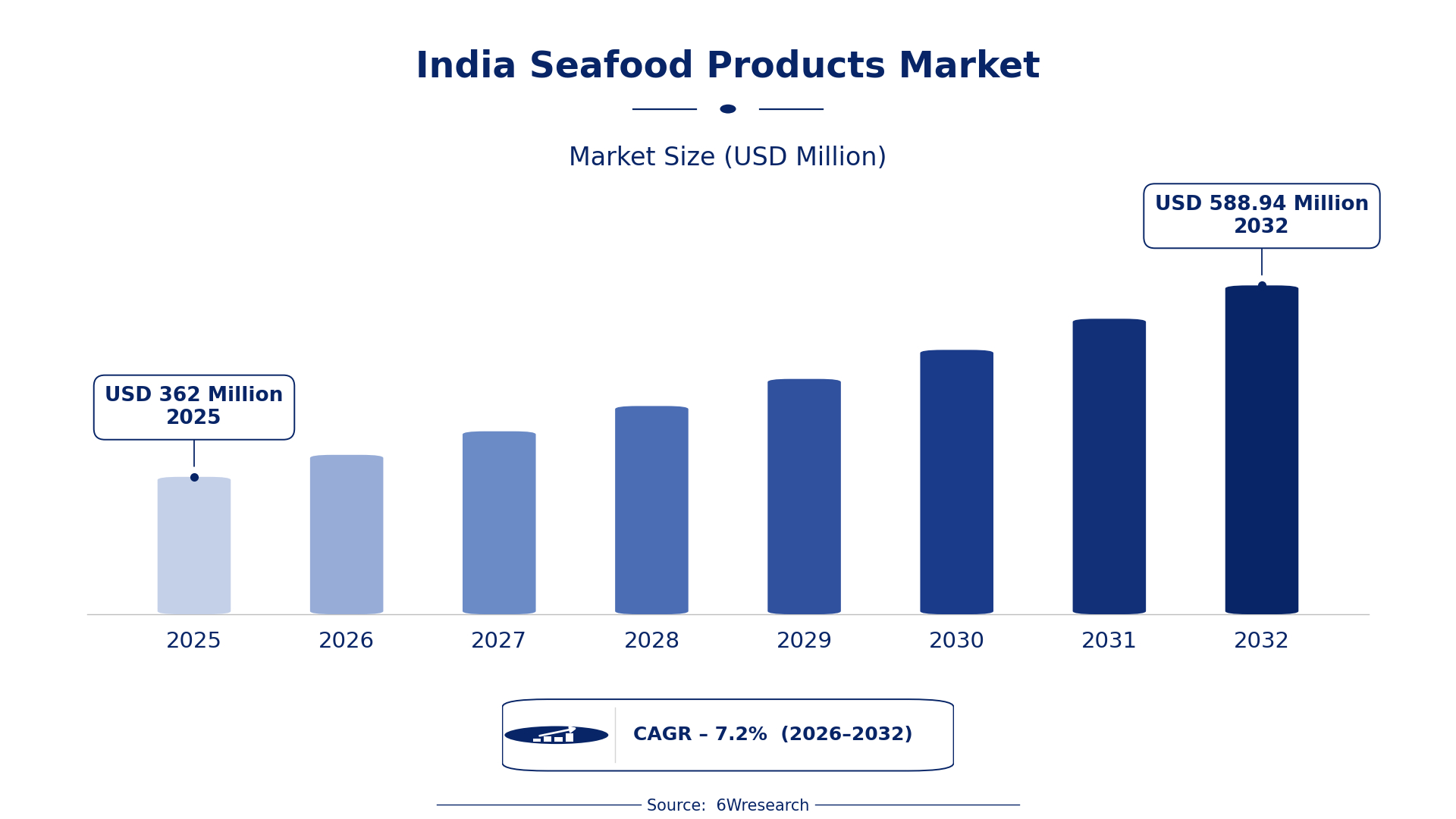
According to 6Wresearch internal database and industry insights, the India Seafood Products Market was valued at USD 362.0 million in 2025 and is projected to reach USD 588.94 million by 2032, growing at a CAGR of approximately 7.2% during 2026–2032.
India Seafood Products Market Highlights
| Report Metric | Details |
| Report Name | India Seafood Products Market |
| Market Size 2025 | USD 362.0 million |
| Market Size 2032 | USD 588.94 million |
| Absolute Growth 2025–2032 | USD 226.94 million |
| CAGR 2026–2032 | 7.2% |
| Peak Annual Growth | 9.6% in 2026 |
| Forecast Period | 2026–2032 |
| Historical Data | 2022–2025 |
| Base Year | 2025 |
| Leading Product Type, 2025 | Canned Seafood (49% share) |
| Leading Packaging Format, 2025 | Tins / Jars (44% share) |
| Leading Preservation Method, 2025 | Frozen (-18 °C) (40% share) |
| Leading End User, 2025 | Restaurants & Catering (46% share) |
| Fastest-Growing Product Type | Ready-to-Eat Meals (9.3% CAGR) |
| Fastest-Growing Packaging Format | Retort Pouches (9.3% CAGR) |
| Fastest-Growing Preservation Method | Chilled (8.2% CAGR) |
| Growing Sector | Restaurants & Catering |
| Key End Users | Consumer Households, Restaurants & Catering, Retail Grocery Chains |
India Seafood Products Market Year-wise Growth Rate and Key Drivers (2022–2032)
This graph illustrates the annual growth rates of the market from 2022 to 2032, highlighting a steady upward trajectory and projected market expansion over the forecast period.
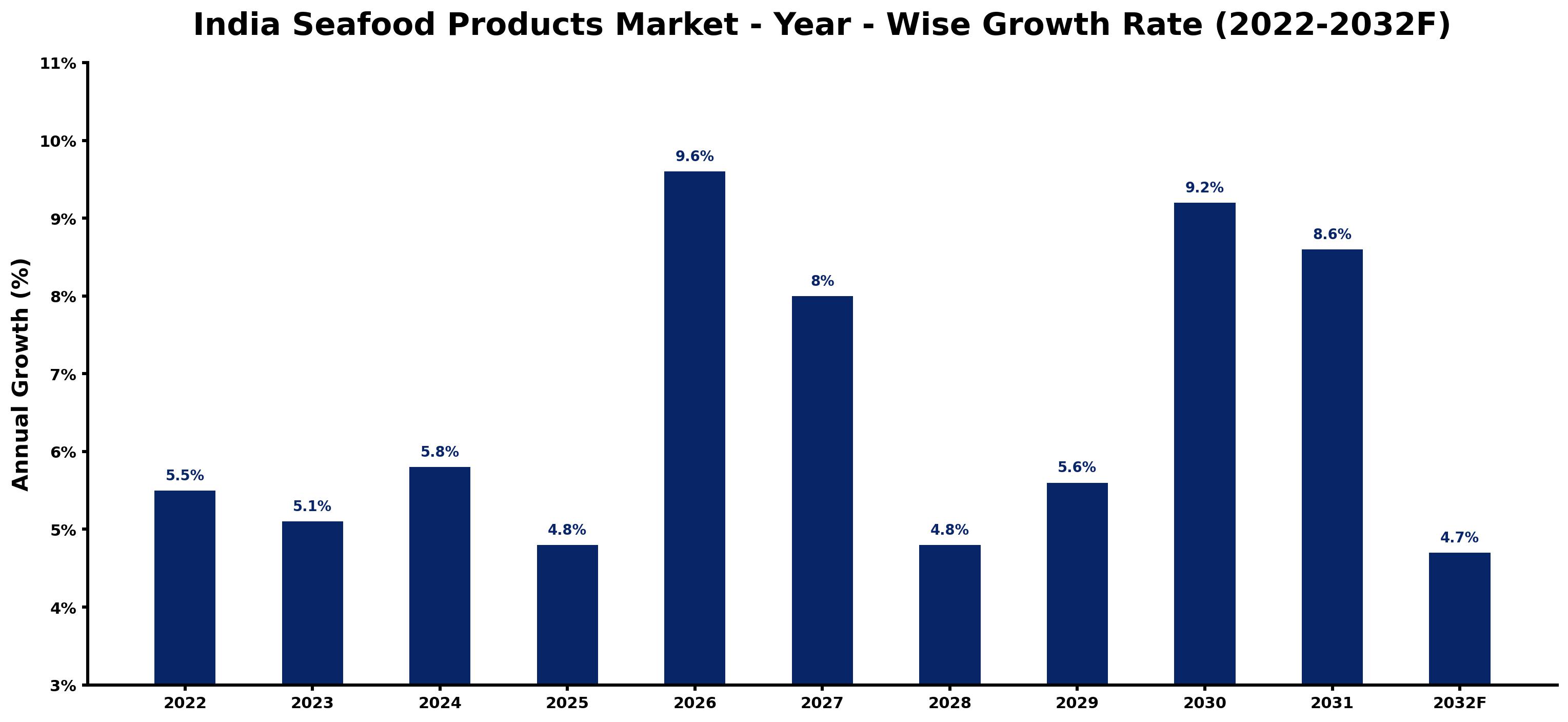
The following table presents the estimated annual growth rate for each year together with the principal factor influencing market performance.
| Year | Estimated Annual Growth (%) | Market Rationale |
| 2022 | 5.5 | The market experienced steady growth due to consistent demand from restaurants and consumer households. |
| 2023 | 5.1 | Growth slowed as consumer spending faced pressure from rising inflation and economic uncertainty. |
| 2024 | 5.8 | An increase in seafood consumption was driven by urbanization and the popularity of ready-to-eat meals. |
| 2025 | 4.8 | Demand continued to grow, albeit at a slower pace, influenced by market saturation in some areas. |
| 2026 | 9.6 | The market is expected to peak as ready-to-eat meals gain popularity among busy consumers. |
| 2027 | 8.0 | Growth is projected to slow as competition increases among seafood suppliers in urban markets. |
| 2028 | 4.8 | Demand is anticipated to remain stable as consumers seek diverse seafood options, particularly frozen products. |
| 2029 | 5.6 | A resurgence in growth is expected as export markets expand, particularly for shrimp and fish. |
| 2030 | 9.2 | The market is projected to grow due to rising health consciousness among consumers seeking protein sources. |
| 2031 | 8.6 | Growth is expected to slow as market maturity sets in, with established players dominating the supply chain. |
| 2032 | 4.7 | The market will continue to grow, driven by sustained demand from restaurants and catering services. |
Note: Market size estimations and growth projections presented in this report are based on 6Wresearch's proprietary forecasting methodology, utilizing the latest available industry data, government publications, and primary research inputs.
India Seafood Products Market Synopsis
Seafood Products in India include fish, crustaceans, and mollusks processed through freezing, canning, and smoking. These items are popular in households, restaurants, and export markets. The India Seafood Products Market is expanding due to increased domestic consumption and rising exports, with seafood production reaching around 4.7 million tons in 2022. Urbanisation and changing consumer preferences for convenient meal options, especially ready-to-eat meals, are key drivers of this demand.
Market Dynamics Impact Analysis (2026–2032)
| Factor | Type | Impact | Primary Segment Affected |
| Rising domestic consumption of seafood products | Driver | High | Frozen Fillets |
| Growing export opportunities, especially for shrimp | Driver | High | Canned Seafood |
| Increased demand for ready-to-eat meals among busy consumers | Opportunity | High | Ready-to-Eat Meals |
| Expansion of seafood processing facilities in coastal states | Opportunity | Medium | Frozen Fillets |
| Competition from alternative protein sources | Restraint | High | Canned Seafood |
| Seasonal fluctuations affecting seafood availability | Restraint | Medium | Frozen Fillets |
| Supply chain disruptions impacting product availability | Challenge | High | Ready-to-Eat Meals |
| Rising operational costs affecting profit margins | Challenge | Medium | Canned Seafood |
Evaluation of Drivers in India Seafood Products Market (2026–2032)
Key forces behind demand, with the segment each one moves most, are listed below.
| Drivers | Primary Segment Affected | Why It Matters (Evidence) |
| Increased health consciousness among consumers | Frozen Fillets | This trend drives demand for seafood as a lean protein source, with production reaching approximately 4.7 million tons in 2022. |
| Urbanization leading to changing dietary preferences | Canned Seafood | Urban consumers are increasingly opting for convenient canned options, contributing to a growing market share, which rose by 8% in 2022. |
| Expansion of export markets for seafood products | Ready-to-Eat Meals | India's seafood exports reached $5.6 billion in 2021-2022, boosting demand for processed seafood, particularly in North America. |
| Government support for seafood exporters | Frozen Fillets | The subsidy scheme introduced in 2021 improves competitiveness, encouraging more exports, with a target of increasing export volume by 15% by 2025. |
| Rising popularity of ready-to-eat meals | Canned Seafood | With a growth rate of 15% annually, this segment attracts busy consumers looking for convenience, particularly in urban areas. |
Growth across the Seafood Products market in India is anchored in rising domestic consumption, expanding export opportunities, and increasing health consciousness among consumers. In 2022, seafood production reached approximately 4.7 million tons, supporting demand for various products, especially frozen fillets and ready-to-eat meals. Urbanization is shifting dietary preferences towards convenient options, particularly in metropolitan areas where busy lifestyles prevail. India's seafood exports amounted to $5.6 billion in 2021-2022, particularly for shrimp and fish, driving growth in the sector.
Evaluation of Restraints in India Seafood Products Market
The main factors holding the market back are set out below.
| Market Restraint | Primary Segment Affected | Why It Matters (Evidence) |
| Competition from alternative protein sources | Canned Seafood | With the rise of plant-based diets, consumers are exploring alternatives, impacting canned seafood sales, which saw a 10% decline in market share in 2022. |
| Seasonal fluctuations affecting seafood availability | Frozen Fillets | Seasonal changes can lead to supply shortages, impacting pricing and availability for consumers, with a reported 15% decrease in supply during off-peak seasons. |
| Rising operational costs affecting profit margins | Ready-to-Eat Meals | Increasing costs of raw materials and processing impact the pricing strategies of producers, with operational costs rising by 12% annually. |
| Limited consumer awareness of seafood benefits | Frozen Fillets | A lack of knowledge about the health benefits of seafood can limit market growth, with only 30% of consumers aware of its nutritional advantages. |
| Supply chain disruptions impacting product availability | Canned Seafood | Logistical challenges can delay deliveries, affecting the supply of canned seafood to retailers, resulting in a 20% increase in delivery times in 2022. |
India Seafood Products Market Challenges
The India Seafood Products Market faces several practical challenges, beginning with outdated processing technology. Many producers depend on traditional freezing and canning methods, resulting in a 20% reduction in product quality that undermines their competitiveness in export markets. Local producers also face increasing competition from countries using advanced processing technologies, which forces them to lower prices and squeeze profit margins. A shortage of skilled workers complicates operations, as over 1.5 million employees lack advanced training, causing delays in product availability for distributors. Regulatory hurdles further burden the industry, with compliance costs rising by 15% annually, impacting pricing strategies for buyers.
Trends in the India Seafood Products Market
Buyers and suppliers in the India Seafood Products Market are adjusting to the following trends.
- Introduction of Ready-to-Eat Seafood Meals: The trend towards ready-to-eat meals began in 2022, as consumers sought convenience. This segment is projected to grow at a rate of 15% annually, reflecting changing lifestyles and increasing demand.
- Shift towards Sustainable Seafood Sourcing: Coastal states like Kerala are increasingly adopting sustainable fishing practices to meet consumer demand. This shift is crucial for long-term viability and is gaining traction among producers, ensuring quality and sustainability.
- Urbanization Driving Canned Seafood Popularity: Urban areas are seeing a rise in canned seafood consumption, driven by convenience and changing dietary habits. This trend is reflected in the growing market share of canned products, appealing to busy consumers.
- Expansion of Export Markets for Seafood: The seafood export market is expanding, particularly for shrimp, which saw exports worth $5.6 billion in 2021-2022. This growth is attracting more investment in processing facilities, boosting local economies.
Investment Opportunities in the India Seafood Products Market
Below are the investment opportunities with the strongest case in the India Seafood Products Market.
- Partnerships with Local Distributors: Now is an opportune time for partnerships with local distributors to increase market reach. The growing demand for seafood in urban areas presents a significant opportunity for suppliers to expand their networks.
- Investment in Processing Facilities: With seafood production reaching 4.7 million tons in 2022, investing in processing facilities can meet rising demand. Coastal states like Tamil Nadu are ideal for such investments, enhancing production capabilities.
- Focus on Ready-to-Eat Meal Production: The increasing popularity of ready-to-eat meals provides a lucrative opportunity for producers. With a 15% annual growth rate, this segment is attracting significant consumer interest and investment.
- Certification for Export Markets: Obtaining certifications for seafood products can open doors to international markets. The subsidy scheme for exporters enhances competitiveness, making it easier to enter global markets and meet quality standards.
Government Initiatives in the India Seafood Products Market
The Ministry of Commerce and Industry introduced a subsidy scheme in 2021 for seafood exporters, improving international competitiveness. This measure builds on existing regulations to support the seafood processing industry. By providing financial assistance, the government aims to boost production and exports, which are crucial for the economy. The scheme encourages investment in quality improvements and marketing initiatives, further strengthening the sector. As a result, seafood exporters can better navigate global markets and increase their market share.
Buyers, particularly seafood exporters, benefit from the subsidy scheme by gaining access to financial support for improving their operations. This assistance allows them to invest in better processing technologies and quality assurance measures. The scheme creates a competitive environment, enabling exporters to meet international standards and consumer preferences. With the backing of government funding, buyers can expand their reach in global markets, improving their profitability and sustainability.
Future Insight of the India Seafood Products Market
Several forward-looking factors should support the India Seafood Products Market over the coming years. The growth of ready-to-eat seafood meals will continue at an annual rate of 15%, aligning with changing consumer lifestyles. Technological advancements in processing methods will improve product quality and extend shelf life, appealing to a wider customer base. Expansion of export markets, particularly for shrimp and fish, is expected to drive production volumes upward. Improved training programmes for workers will help close skill gaps, boosting overall industry productivity.
Market Segmentation Analysis
Each segment group is reviewed below, with the leader by share and the fastest grower by CAGR.
By Product Type – Canned Seafood Dominated, Ready-to-Eat Meals Expected to Grow Fastest
According to Shubham Padhi, Research Analyst at 6Wresearch, Canned Seafood held a 49% share of the India Seafood Products Market by product type in 2025. Canned seafood holds the largest market share because it is favoured for its long shelf life and convenience, making it ideal for both households and restaurants. The segment's popularity is particularly evident in urban areas where busy lifestyles demand easy-to-prepare meal options. The quickest growth will come from Ready-to-Eat Meals, forecast to expand at a CAGR of 9.3% between 2026 and 2032. Ready-to-eat meals are experiencing rapid growth as they cater to the increasing consumer preference for convenience and quick meal solutions. This segment's impressive annual growth rate of 15% indicates a significant shift in dining habits, particularly among urban consumers. Suppliers should focus on expanding their canned seafood range while also innovating in ready-to-eat meal offerings to align with consumer trends.
By Packaging Format – Tins / Jars Dominated, Retort Pouches Expected to Grow Fastest
In 2025, Tins / Jars led the packaging format split with a 44% share. Tins and jars dominate the market share as they are the most common packaging formats for canned seafood products, appealing to both consumers and retailers. Their reliability and ease of storage make them a preferred choice in various distribution channels. Retort Pouches are projected to grow fastest, at a CAGR of 9.3% during 2026–2032. Retort pouches are gaining traction as a modern packaging solution for ready-to-eat seafood meals, appealing to consumers looking for convenience. This shift in packaging preferences signals a potential growth opportunity for suppliers willing to adapt to new formats. Suppliers must consider diversifying their packaging formats to include retort pouches, catering to the evolving preferences of modern consumers.
By Preservation Method – Frozen (-18 °C) Dominated, Chilled Expected to Grow Fastest
Frozen (-18 °C) accounted for a 40% market share by preservation method in 2025. Frozen seafood preserved at -18 °C commands the largest share of the market due to its ability to maintain quality and freshness throughout the supply chain. This method is widely adopted across the industry, ensuring seafood remains in optimal condition from processing to retail. Chilled is set to record the highest CAGR in this split, 8.2% over 2026–2032. Chilled preservation methods are gaining traction as they cater to markets that demand high-quality, fresh seafood products. The growing consumer preference for fresher options positions this segment for strong growth in the coming years. Suppliers should enhance their chilled distribution capabilities to meet the rising demand for fresh seafood products in the market.
By End User – Restaurants & Catering Dominated and Is Expected to Record the Fastest Growth
Restaurants & Catering took a 46% share of end user in 2025, more than any other category. Restaurants and catering services account for the largest share of the seafood market, driven by their substantial demand for diverse seafood offerings. Their reliance on high-quality seafood for menu variety makes this segment essential for suppliers. Its lead should widen, with a projected CAGR of 8.4% during 2026–2032, the highest in this split. As restaurants and catering continue to be the fastest-growing segment, their demand for seafood products is likely to increase further, solidifying their market position. This growth reinforces the importance of maintaining strong relationships with these end users. Suppliers should prioritise building partnerships with restaurants and catering services to secure their position in this expanding market.
Key Attractiveness of the Report
- 10 Years of Market Numbers
- Historical Data Starting from 2022 to 2025
- Base Year 2025
- Forecast Data until 2032
- Key Performance Indicators Impacting the Market
- Major Upcoming Developments and Projects
Key Highlights of the Report:
- India Seafood Products Market Outlook
- Market Size of India Seafood Products Market, 2025
- Forecast of India Seafood Products Market, 2032
- Historical Data and Forecast of India Seafood Products Revenues & Volume for the Period 2022 - 2032F
- India Seafood Products Market Trend Evolution
- India Seafood Products Market Drivers and Challenges
- India Seafood Products Price Trends
- India Seafood Products Porter's Five Forces
- India Seafood Products Industry Life Cycle
- Historical Data and Forecast of India Seafood Products Market Revenues & Volume By Product Type for the Period 2022 - 2032F
- Historical Data and Forecast of India Seafood Products Market Revenues & Volume By Frozen Fillets for the Period 2022 - 2032F
- Historical Data and Forecast of India Seafood Products Market Revenues & Volume By Canned Seafood for the Period 2022 - 2032F
- Historical Data and Forecast of India Seafood Products Market Revenues & Volume By Ready-to-Eat Meals for the Period 2022 - 2032F
- Historical Data and Forecast of India Seafood Products Market Revenues & Volume By Smoked & Processed for the Period 2022 - 2032F
- Historical Data and Forecast of India Seafood Products Market Revenues & Volume By Packaging Format for the Period 2022 - 2032F
- Historical Data and Forecast of India Seafood Products Market Revenues & Volume By Vacuum-Sealed for the Period 2022 - 2032F
- Historical Data and Forecast of India Seafood Products Market Revenues & Volume By Tins / Jars for the Period 2022 - 2032F
- Historical Data and Forecast of India Seafood Products Market Revenues & Volume By Retort Pouches for the Period 2022 - 2032F
- Historical Data and Forecast of India Seafood Products Market Revenues & Volume By Plastic Packs for the Period 2022 - 2032F
- Historical Data and Forecast of India Seafood Products Market Revenues & Volume By Preservation Method for the Period 2022 - 2032F
- Historical Data and Forecast of India Seafood Products Market Revenues & Volume By Frozen (-18 C) for the Period 2022 - 2032F
- Historical Data and Forecast of India Seafood Products Market Revenues & Volume By Canned for the Period 2022 - 2032F
- Historical Data and Forecast of India Seafood Products Market Revenues & Volume By Shelf-Stable for the Period 2022 - 2032F
- Historical Data and Forecast of India Seafood Products Market Revenues & Volume By Chilled for the Period 2022 - 2032F
- Historical Data and Forecast of India Seafood Products Market Revenues & Volume By End User for the Period 2022 - 2032F
- Historical Data and Forecast of India Seafood Products Market Revenues & Volume By Retail Grocery Chains for the Period 2022 - 2032F
- Historical Data and Forecast of India Seafood Products Market Revenues & Volume By Consumer Households for the Period 2022 - 2032F
- Historical Data and Forecast of India Seafood Products Market Revenues & Volume By Convenience Stores for the Period 2022 - 2032F
- Historical Data and Forecast of India Seafood Products Market Revenues & Volume By Restaurants & Catering for the Period 2022 - 2032F
- India Seafood Products Import Export Trade Statistics
- Market Opportunity Assessment By Product Type
- Market Opportunity Assessment By Packaging Format
- Market Opportunity Assessment By Preservation Method
- Market Opportunity Assessment By End User
- India Seafood Products Top Companies Market Share
- India Seafood Products Competitive Benchmarking By Technical and Operational Parameters
- India Seafood Products Company Profiles
- India Seafood Products Key Strategic Recommendations
Market Covered
This report examines the market across the segments below.
By Product Type
- Frozen Fillets
- Canned Seafood
- Ready-to-Eat Meals
- Smoked & Processed
By Packaging Format
- Vacuum-Sealed
- Tins / Jars
- Retort Pouches
- Plastic Packs
By Preservation Method
- Frozen (-18 °C)
- Canned
- Shelf-Stable
- Chilled
By End User
- Retail Grocery Chains
- Consumer Households
- Convenience Stores
- Restaurants & Catering































