China Security Orchestration AI (SOAR) Market Size & Growth Rate
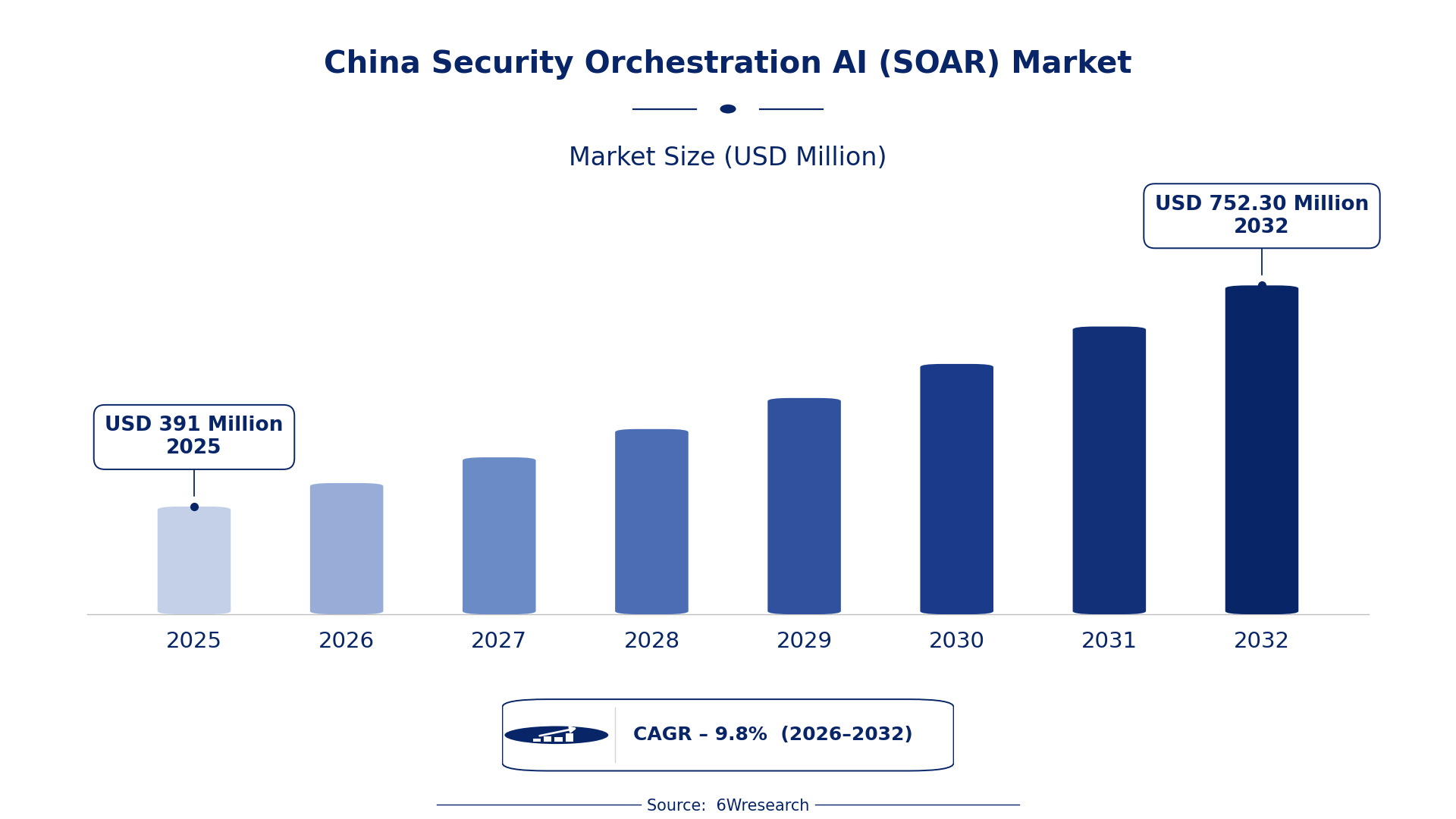
According to 6Wresearch internal database and industry insights, the China Security Orchestration AI (SOAR) Market was valued at USD 391.0 million in 2025 and is projected to reach USD 752.30 million by 2032, growing at a CAGR of approximately 9.8% during 2026–2032.
China Security Orchestration AI (SOAR) Market Highlights
| Report Metric | Details |
| Report Name | China Security Orchestration AI (SOAR) Market |
| Market Size 2025 | USD 391.0 million |
| Market Size 2032 | USD 752.30 million |
| Absolute Growth 2025–2032 | USD 361.30 million |
| CAGR 2026–2032 | 9.8% |
| Peak Annual Growth | 12.2% in 2029 |
| Forecast Period | 2026–2032 |
| Historical Data | 2022–2025 |
| Base Year | 2025 |
| Leading Orchestration Type, 2025 | Incident Automation (38% share) |
| Leading AI Capability, 2025 | Machine Learning (38% share) |
| Leading Integration Type, 2025 | SIEM & ITSM Integration (48% share) |
| Leading End User, 2025 | Financial Institutions (49% share) |
| Fastest-Growing Orchestration Type | Threat Hunting SOAR (10.9% CAGR) |
| Fastest-Growing Integration Type | Threat Intelligence Feeds (12.3% CAGR) |
| Fastest-Growing End User | SOC Analysts (12.1% CAGR) |
| Growing Sector | Cybersecurity |
| Key End Users | Financial Institutions, Enterprise Security Labs, SOC Analysts |
China Security Orchestration AI (SOAR) Market Year-wise Growth Rate and Key Drivers (2022–2032)
This graph illustrates the annual growth rates of the market from 2022 to 2032, highlighting a steady upward trajectory and projected market expansion over the forecast period.
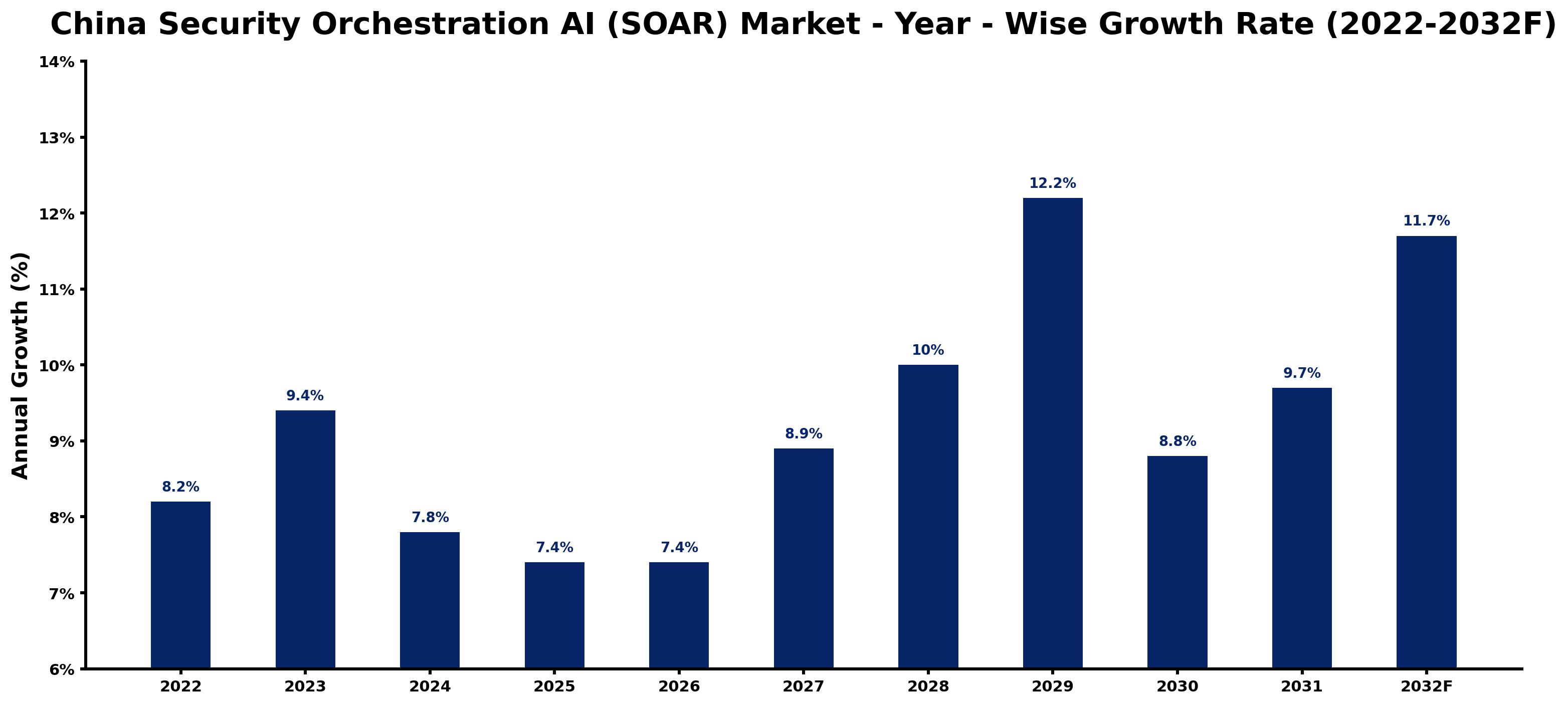
Year by year, the estimates below pair each growth rate with the development that shaped it.
| Year | Estimated Annual Growth (%) | Market Rationale |
| 2022 | 8.2 | The market experienced steady growth due to rising cybersecurity concerns among enterprises, driven by the Cybersecurity Law's requirements. |
| 2023 | 9.4 | Demand surged as the National Cybersecurity Strategy emphasised advanced security technologies, prompting increased investments. |
| 2024 | 7.8 | Growth slowed as enterprises adjusted to the Cybersecurity Law and its compliance requirements, impacting purchasing decisions. |
| 2025 | 7.4 | The market continued to grow but at a slower pace, influenced by compliance with ISO/IEC 27001 standards. |
| 2026 | 7.4 | A further slowdown occurred as companies focused on integrating existing systems with SOAR solutions, affecting adoption rates. |
| 2027 | 8.9 | Growth rebounded as more enterprises recognised the benefits of automation in security operations, leading to increased purchases. |
| 2028 | 10.0 | The market expanded as the adoption of AI-based security solutions increased among financial institutions, driving demand. |
| 2029 | 12.2 | A peak in growth was reached, driven by heightened awareness of cybersecurity threats and incidents, compelling investments. |
| 2030 | 8.8 | Growth decelerated as the market began to stabilise after rapid advancements and investments in security technologies. |
| 2031 | 9.7 | Demand increased again as organisations sought to improve their incident response capabilities, enhancing SOAR adoption. |
| 2032 | 11.7 | The market is expected to grow further as new cybersecurity initiatives are rolled out nationwide, increasing SOAR implementation. |
Note: Market size estimations and growth projections presented in this report are based on 6Wresearch's proprietary forecasting methodology, utilizing the latest available industry data, government publications, and primary research inputs.
China Security Orchestration AI (SOAR) Market Synopsis
The China Security Orchestration AI (SOAR) Market includes technologies that automate incident response and threat management. SOAR connects various security tools, streamlining operations and compliance across industries. Growth in this market is propelled by the National Cybersecurity Strategy and rising demand from financial institutions. With the cybersecurity market valued at approximately 1 trillion RMB in 2023, the emphasis on advanced security technologies opens doors for SOAR adoption.
Market Dynamics Impact Analysis (2026–2032)
| Factor | Type | Impact | Primary Segment Affected |
| Rising cybersecurity threats are driving demand for automated solutions. | Driver | High | Incident Automation |
| Increased investment in cybersecurity infrastructure supports SOAR adoption. | Driver | High | Threat Hunting SOAR |
| The growing need for compliance with cybersecurity regulations creates opportunities for SOAR. | Opportunity | High | Financial Institutions |
| Investment in cybersecurity talent development is essential for market growth. | Opportunity | Medium | Enterprise Security Labs |
| Limited awareness of SOAR benefits may hinder market penetration. | Restraint | Medium | Phishing Response |
| Integration challenges with existing systems can slow down adoption. | Restraint | High | SIEM & ITSM Integration |
| High costs of implementing advanced cybersecurity solutions can deter smaller firms. | Challenge | Medium | Automated Workflows |
| Shortage of skilled cybersecurity professionals affects operational efficiency. | Challenge | High | SOC Analysts |
Evaluation of Drivers in China Security Orchestration AI (SOAR) Market (2026–2032)
Key forces behind demand, with the segment each one moves most, are listed below.
| Drivers | Primary Segment Affected | Why It Matters (Evidence) |
| Increased investment in cybersecurity infrastructure drives demand for SOAR solutions. | Incident Automation | China's cybersecurity market reached approximately 1 trillion RMB in 2023, prompting enterprises to invest in advanced technologies. |
| Growing awareness of the importance of threat detection boosts SOAR adoption. | Threat Hunting SOAR | The National Cybersecurity Strategy emphasises the need for advanced security technologies, resulting in increased purchases. |
| Regulatory compliance requirements are pushing enterprises to adopt SOAR solutions. | Financial Institutions | ISO/IEC 27001 is widely adopted, compelling financial institutions to improve their security measures. |
| The Cybersecurity Talent Development Program aims to address industry shortages, increasing demand for SOAR. | Enterprise Security Labs | The program targets training 100,000 cybersecurity professionals by 2025, supporting market growth. |
| The need for improved incident response capabilities drives SOAR adoption across sectors. | SOC Analysts | The Cybersecurity Emergency Response Plan launched in 2020 improves incident response capabilities nationwide. |
In 2023, the cybersecurity market reached approximately 1 trillion RMB, prompting enterprises to invest in advanced technologies. The demand for SOAR solutions is further supported by the need for enhanced incident response capabilities across various sectors. As organisations increasingly recognise the benefits of automation, demand for SOAR solutions is expected to rise significantly.
Evaluation of Restraints in China Security Orchestration AI (SOAR) Market
Below mentioned are some major restraints and their influence on market dynamics.
| Market Restraint | Primary Segment Affected | Why It Matters (Evidence) |
| Limited awareness of SOAR benefits may hinder market penetration. | Phishing Response | Many enterprises are unaware of the efficiency gains SOAR can provide, affecting their purchasing decisions. |
| Integration challenges with existing systems can slow down adoption. | SIEM & ITSM Integration | Compatibility issues with legacy systems can delay SOAR implementation, impacting operational efficiency. |
| High costs of implementing advanced cybersecurity solutions can deter smaller firms. | Automated Workflows | Smaller enterprises may struggle to allocate budgets for sophisticated SOAR solutions, limiting their adoption. |
| Shortage of skilled cybersecurity professionals affects operational efficiency. | SOC Analysts | With over 200,000 cybersecurity professionals in China, the demand for skilled workers often exceeds supply. |
| Regulatory compliance can impose additional costs on enterprises. | Threat Hunting SOAR | Compliance with standards like ISO/IEC 27001 may require significant investment in SOAR technologies. |
China Security Orchestration AI (SOAR) Market Challenges
The China Security Orchestration AI (SOAR) market faces notable cost challenges that impede growth. High implementation costs for advanced security technologies can deter enterprises, risking losses of up to 20% in operational efficiency for buyers. Supply chain disruptions in acquiring essential cybersecurity tools can delay project timelines for over 30% of firms, impacting their ability to respond to threats promptly. Intense competition among more than 1,500 registered cybersecurity firms creates pricing pressures, forcing suppliers to lower prices, which may compromise service quality. Buyers often struggle with compliance complexities due to evolving regulations, leading to potential fines that can reach millions and harm their reputations.
Trends in the China Security Orchestration AI (SOAR) Market
The trends below show where the China Security Orchestration AI (SOAR) Market is heading.
- Shift towards AI-Driven Security Solutions: China is increasingly adopting AI-based security solutions, particularly among financial institutions. In 2023, AI-based solutions saw a notable increase in fraud detection capabilities.
- Rise of Cybersecurity Talent Development Initiatives: The Cybersecurity Talent Development Program aims to train a large number of professionals by 2025, addressing industry shortages. This initiative is vital for supporting the growing demand for cybersecurity solutions.
- Growing Importance of Incident Response Capabilities: The Cybersecurity Emergency Response Plan launched in 2020 highlights the need for improved incident response. This plan is driving investments in SOAR technologies across various sectors.
- Increased Focus on Compliance Standards: ISO/IEC 27001 adoption is becoming more prevalent among enterprises, particularly in finance. This trend is driving greater demand for SOAR solutions that facilitate compliance.
Investment Opportunities in the China Security Orchestration AI (SOAR) Market
The following opportunities in the China Security Orchestration AI (SOAR) Market pair current demand with a clear way in.
- Investment in Cybersecurity Infrastructure: With the cybersecurity market valued at approximately 1 trillion RMB, there is an opportunity to supply SOAR solutions. Financial institutions are particularly in need of advanced security technologies.
- Partnerships for SOAR Implementation: Now is an ideal time to enter the market through joint ventures or local partnerships. Collaborating with cybersecurity firms in Beijing and Shanghai can facilitate market entry.
- Supply of AI-Based Security Solutions: The increasing focus on AI-based analytics offers a chance to supply innovative SOAR solutions. Financial institutions are actively seeking these technologies to improve fraud detection.
- Expansion of Cybersecurity Talent Development: The target of training a significant number of cybersecurity professionals by 2025 creates opportunities for educational institutions and training providers. Engaging with the Cybersecurity Talent Development Program can facilitate entry.
Government Initiatives in the China Security Orchestration AI (SOAR) Market
The National Cybersecurity Strategy, updated in 2022, strengthens the existing Cybersecurity Law enacted in 2017. This strategy focuses on promoting advanced technologies and innovation in cybersecurity, mandating organizations to implement effective security measures. The emphasis on SOAR adoption is a direct result of this policy framework, compelling enterprises to enhance their security protocols and compliance efforts. As a result, the market for SOAR solutions is expected to grow significantly in the coming years.
The government allocated 500 million RMB in 2022 to improve cybersecurity infrastructure, overseen by the Ministry of Industry and Information Technology. This funding aims to improve the overall cybersecurity environment, including support for SOAR implementations. The Cybersecurity Talent Development Program initiated in 2021 also plays a crucial role in addressing the skills gap in the industry. By training a significant number of professionals by 2025, the program ensures a steady supply of skilled workers to support the growing need for cybersecurity solutions.
Future Insight of the China Security Orchestration AI (SOAR) Market
Several forward-looking factors should support the China Security Orchestration AI (SOAR) market over the coming years. The government's commitment to cybersecurity infrastructure, underscored by a 500 million RMB investment, will drive technological advancements. The Cybersecurity Talent Development Program will expand the skilled workforce, addressing talent gaps in the sector. The formation of the China Cybersecurity Industry Alliance will promote industry standards, enhancing collaboration among firms. These developments will enable buyers and suppliers to navigate the rapidly changing cybersecurity landscape more effectively.
Market Segmentation Analysis
Each segment group is reviewed below, with the leader by share and the fastest grower by CAGR.
By Orchestration Type – Incident Automation Dominated, Threat Hunting SOAR Expected to Grow Fastest
According to Shubham Padhi, Research Analyst at 6Wresearch, Incident Automation accounted for a 38% market share by orchestration type in 2025. Incident Automation holds the largest share as it automates repetitive tasks in security operations, which is crucial for enhancing efficiency in large organisations. Many enterprises in Beijing and Shanghai implement this technology to effectively manage their security processes. Threat Hunting SOAR is set to record the highest CAGR in this split, 10.9% over 2026–2032. Threat Hunting SOAR is experiencing rapid growth as organisations increasingly focus on proactive threat identification to combat evolving cyber threats. The rise in sophisticated cyberattacks, particularly in financial sectors, is driving this demand for enhanced capabilities. Suppliers should enhance their offerings in Threat Hunting SOAR to align with the rising demand for proactive security measures.
By AI Capability – Machine Learning Dominated and Is Expected to Record the Fastest Growth
The largest ai capability category in 2025 was Machine Learning, with a 38% share of total revenue. Machine Learning dominates the market share because it significantly improves threat detection and response through advanced analytics, making it essential for security operations. This capability is widely adopted, especially in financial institutions for fraud detection. Its lead should widen, with a projected CAGR of 10.8% during 2026–2032, the highest in this split. Machine Learning is also the fastest-growing segment, as its applications in automating threat detection and response are becoming increasingly critical. Continuous advancements in machine learning algorithms are propelling further adoption across various industries. Suppliers must invest in developing advanced machine learning solutions to remain competitive in this rapidly evolving market.
By Integration Type – SIEM & ITSM Integration Dominated, Threat Intelligence Feeds Expected to Grow Fastest
SIEM & ITSM Integration took a 48% share of integration type in 2025, more than any other category. SIEM & ITSM Integration leads the market share by providing seamless integration with existing security systems, which enhances overall security workflows for organisations. This integration is particularly crucial for large enterprises managing extensive security operations. Threat Intelligence Feeds are projected to grow fastest, at a CAGR of 12.3% during 2026–2032. Threat Intelligence Feeds are experiencing quick growth as they provide real-time threat intelligence, enriching security data and enabling faster response times. The increasing complexity of cyber threats is accelerating the adoption of this integration. Suppliers should prioritise developing robust threat intelligence solutions to meet the rising demand for enhanced security integration.
By End User – Financial Institutions Dominated, SOC Analysts Expected to Grow Fastest
With a 49% revenue share in 2025, Financial Institutions was the largest end user category. Financial Institutions command the largest share as they utilise SOAR to meet stringent regulatory requirements while strengthening their overall security posture. The high stakes involved in financial transactions necessitate advanced security measures, making this segment critical. The quickest growth will come from SOC Analysts, forecast to expand at a CAGR of 12.1% between 2026 and 2032. SOC Analysts represent the fastest-growing segment, as their reliance on SOAR for efficient threat detection and response is becoming increasingly essential in today's threat landscape. The growing number of cyber threats is driving demand for enhanced operational capabilities. Suppliers should tailor their solutions to meet the specific needs of SOC Analysts to capture the expanding market share in this segment.
Key Attractiveness of the Report
- 10 Years of Market Numbers
- Historical Data Starting from 2022 to 2025
- Base Year 2025
- Forecast Data until 2032
- Key Performance Indicators Impacting the Market
- Major Upcoming Developments and Projects
Key Highlights of the Report:
- China Security Orchestration AI (SOAR) Market Outlook
- Market Size of China Security Orchestration AI (SOAR) Market, 2025
- Forecast of China Security Orchestration AI (SOAR) Market, 2032
- Historical Data and Forecast of China Security Orchestration AI (SOAR) Revenues & Volume for the Period 2022 - 2032F
- China Security Orchestration AI (SOAR) Market Trend Evolution
- China Security Orchestration AI (SOAR) Market Drivers and Challenges
- China Security Orchestration AI (SOAR) Price Trends
- China Security Orchestration AI (SOAR) Porter's Five Forces
- China Security Orchestration AI (SOAR) Industry Life Cycle
- Historical Data and Forecast of China Security Orchestration AI (SOAR) Market Revenues & Volume By Orchestration Type for the Period 2022 - 2032F
- Historical Data and Forecast of China Security Orchestration AI (SOAR) Market Revenues & Volume By Incident Automation for the Period 2022 - 2032F
- Historical Data and Forecast of China Security Orchestration AI (SOAR) Market Revenues & Volume By Threat Hunting SOAR for the Period 2022 - 2032F
- Historical Data and Forecast of China Security Orchestration AI (SOAR) Market Revenues & Volume By Phishing Response for the Period 2022 - 2032F
- Historical Data and Forecast of China Security Orchestration AI (SOAR) Market Revenues & Volume By Forensic Orchestration for the Period 2022 - 2032F
- Historical Data and Forecast of China Security Orchestration AI (SOAR) Market Revenues & Volume By AI Capability for the Period 2022 - 2032F
- Historical Data and Forecast of China Security Orchestration AI (SOAR) Market Revenues & Volume By NLP & Playbook Triggers for the Period 2022 - 2032F
- Historical Data and Forecast of China Security Orchestration AI (SOAR) Market Revenues & Volume By Machine Learning for the Period 2022 - 2032F
- Historical Data and Forecast of China Security Orchestration AI (SOAR) Market Revenues & Volume By Automated Workflows for the Period 2022 - 2032F
- Historical Data and Forecast of China Security Orchestration AI (SOAR) Market Revenues & Volume By AI-based Analytics for the Period 2022 - 2032F
- Historical Data and Forecast of China Security Orchestration AI (SOAR) Market Revenues & Volume By Integration Type for the Period 2022 - 2032F
- Historical Data and Forecast of China Security Orchestration AI (SOAR) Market Revenues & Volume By SIEM & ITSM Integration for the Period 2022 - 2032F
- Historical Data and Forecast of China Security Orchestration AI (SOAR) Market Revenues & Volume By Threat Intelligence Feeds for the Period 2022 - 2032F
- Historical Data and Forecast of China Security Orchestration AI (SOAR) Market Revenues & Volume By Email Gateway Integration for the Period 2022 - 2032F
- Historical Data and Forecast of China Security Orchestration AI (SOAR) Market Revenues & Volume By E-Discovery Tools for the Period 2022 - 2032F
- Historical Data and Forecast of China Security Orchestration AI (SOAR) Market Revenues & Volume By End User for the Period 2022 - 2032F
- Historical Data and Forecast of China Security Orchestration AI (SOAR) Market Revenues & Volume By Enterprise Security Labs for the Period 2022 - 2032F
- Historical Data and Forecast of China Security Orchestration AI (SOAR) Market Revenues & Volume By SOC Analysts for the Period 2022 - 2032F
- Historical Data and Forecast of China Security Orchestration AI (SOAR) Market Revenues & Volume By Financial Institutions for the Period 2022 - 2032F
- Historical Data and Forecast of China Security Orchestration AI (SOAR) Market Revenues & Volume By Legal & Compliance Teams for the Period 2022 - 2032F
- China Security Orchestration AI (SOAR) Import Export Trade Statistics
- Market Opportunity Assessment By Orchestration Type
- Market Opportunity Assessment By AI Capability
- Market Opportunity Assessment By Integration Type
- Market Opportunity Assessment By End User
- China Security Orchestration AI (SOAR) Top Companies Market Share
- China Security Orchestration AI (SOAR) Competitive Benchmarking By Technical and Operational Parameters
- China Security Orchestration AI (SOAR) Company Profiles
- China Security Orchestration AI (SOAR) Key Strategic Recommendations
Market Covered
This report examines the market across the segments below.
By Orchestration Type
- Incident Automation
- Threat Hunting SOAR
- Phishing Response
- Forensic Orchestration
By AI Capability
- NLP & Playbook Triggers
- Machine Learning
- Automated Workflows
- AI-based Analytics
By Integration Type
- SIEM & ITSM Integration
- Threat Intelligence Feeds
- Email Gateway Integration
- E-Discovery Tools
By End User
- Enterprise Security Labs
- SOC Analysts
- Financial Institutions
- Legal & Compliance Teams































