China Self-Driving Vehicle Software Market Size & Growth Rate
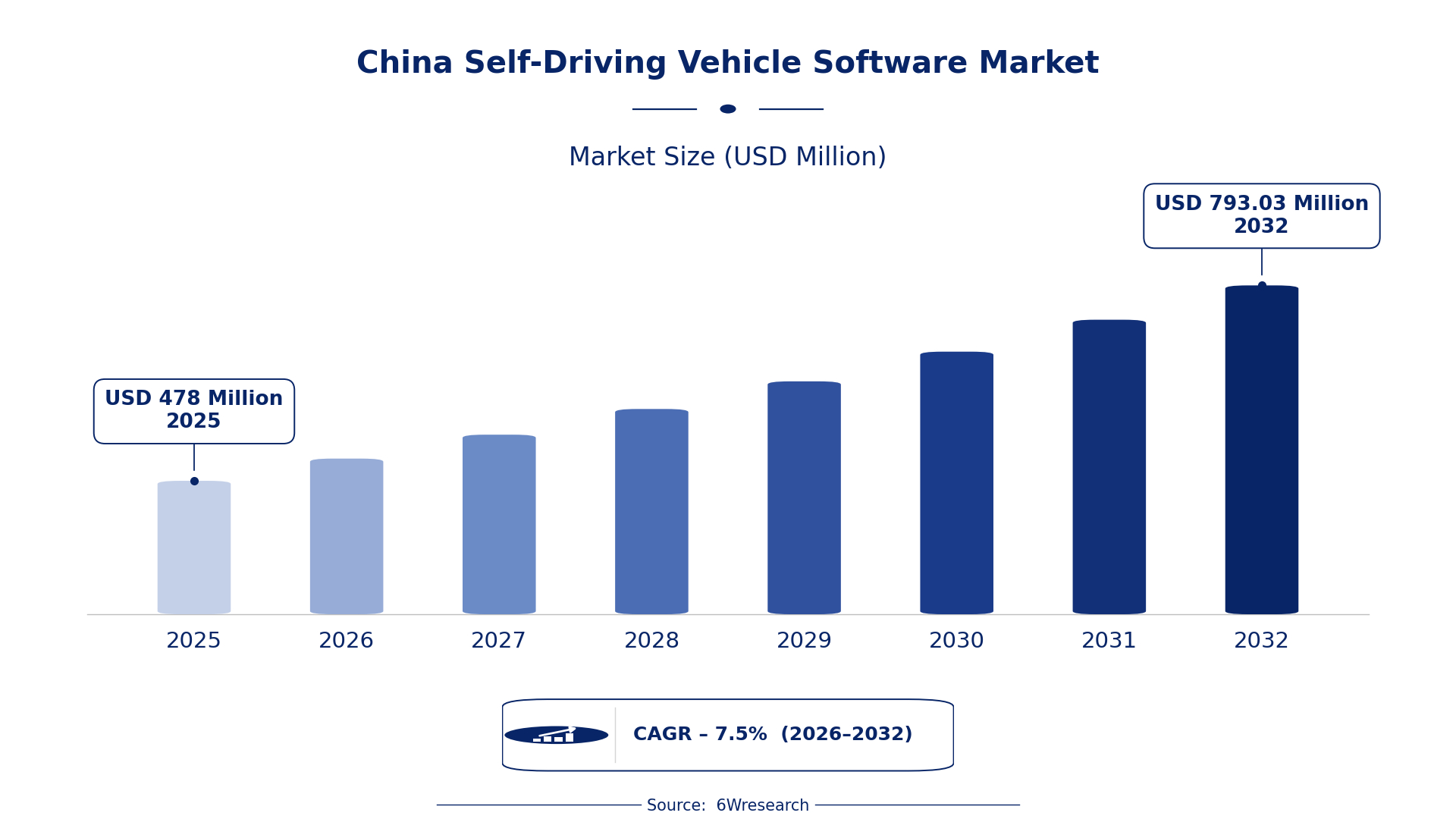
According to 6Wresearch internal database and industry insights, the China Self-Driving Vehicle Software Market was valued at USD 478.0 million in 2025 and is projected to reach USD 793.03 million by 2032, growing at a CAGR of approximately 7.5% during 2026–2032.
China Self-Driving Vehicle Software Market Highlights
| Report Metric | Details |
| Report Name | China Self-Driving Vehicle Software Market |
| Market Size 2025 | USD 478.0 million |
| Market Size 2032 | USD 793.03 million |
| Absolute Growth 2025–2032 | USD 315.03 million |
| CAGR 2026–2032 | 7.5% |
| Peak Annual Growth | 9.8% in 2029 |
| Forecast Period | 2026–2032 |
| Historical Data | 2022–2025 |
| Base Year | 2025 |
| Leading Software Type, 2025 | Perception Software (45% share) |
| Leading Functionality, 2025 | Object Detection (46% share) |
| Leading Deployment Mode, 2025 | Onboard Systems (50% share) |
| Leading End User, 2025 | Autonomous Vehicle OEMs (43% share) |
| Fastest-Growing Software Type | Path Planning Software (9.9% CAGR) |
| Fastest-Growing Functionality | Route Optimization (10.3% CAGR) |
| Fastest-Growing Deployment Mode | Cloud-Connected (10.3% CAGR) |
| Fastest-Growing End User | ADAS Developers (9.8% CAGR) |
| Growing Sector | ADAS Developers |
| Key End Users | Autonomous Vehicle OEMs, ADAS Developers, Automotive Tier-1 Suppliers, Self-Driving Tech Startups |
China Self-Driving Vehicle Software Market Year-wise Growth Rate and Key Drivers (2022–2032)
This graph illustrates the annual growth rates of the market from 2022 to 2032, highlighting a steady upward trajectory and projected market expansion over the forecast period.
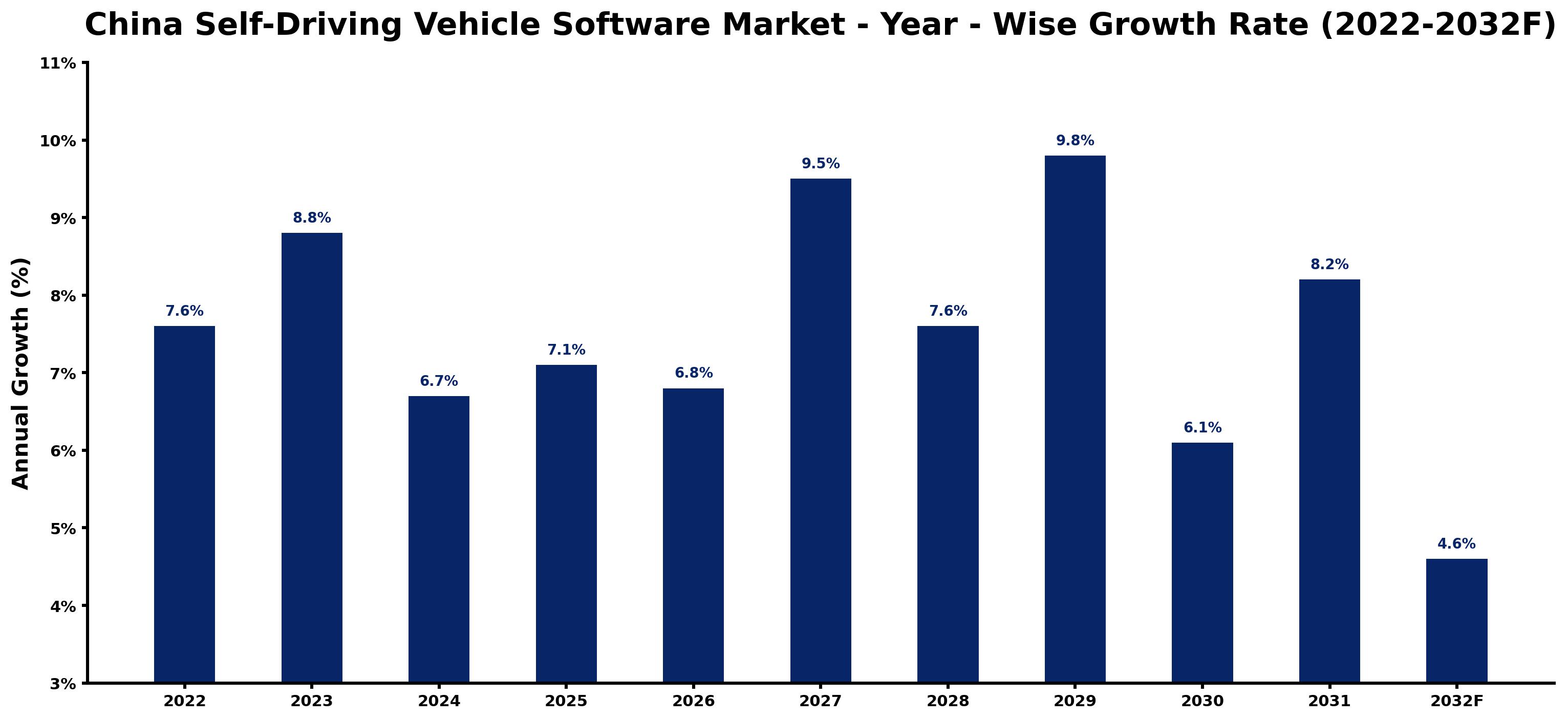
Each row of the following table gives one year's estimated growth and the event or demand shift that explains it.
| Year | Estimated Annual Growth (%) | Market Rationale |
| 2022 | 7.6 | The market experienced steady growth, reflecting increasing interest in autonomous technologies. |
| 2023 | 8.8 | Growth accelerated as the automotive sector embraced advanced self-driving solutions. |
| 2024 | 6.7 | A slight slowdown occurred as companies adjusted to evolving regulatory frameworks. |
| 2025 | 7.1 | Growth rebounded as investments in self-driving technologies gained momentum. |
| 2026 | 6.8 | The market saw a slowdown as manufacturers faced integration challenges with existing systems. |
| 2027 | 9.5 | Demand surged with rising investments in autonomous vehicle research and development. |
| 2028 | 7.6 | Growth slowed again as companies refined their product offerings and strategies. |
| 2029 | 9.8 | The market peaked with significant advancements in software capabilities and deployment. |
| 2030 | 6.1 | A slowdown followed as the market adjusted to new technological standards and regulations. |
| 2031 | 8.2 | Growth resumed as consumer acceptance of autonomous vehicles increased. |
| 2032 | 4.6 | The market is expected to grow at a slower pace as saturation begins to set in. |
Note: Market size estimations and growth projections presented in this report are based on 6Wresearch's proprietary forecasting methodology, utilizing the latest available industry data, government publications, and primary research inputs.
China Self-Driving Vehicle Software Market Synopsis
The Self-Driving Vehicle Software market in China includes technologies that enable vehicles to navigate autonomously. This software relies on complex algorithms and machine learning, prioritising safety and efficiency. The market is expanding due to robust domestic demand from local manufacturers and technology developers. Key buyer groups consist of autonomous vehicle OEMs and ADAS developers. The automotive sector's contribution of approximately 10% to China's GDP underscores its role in attracting further investments in self-driving technologies.
Market Dynamics Impact Analysis (2026–2032)
| Factor | Type | Impact | Primary Segment Affected |
| Increasing investments in autonomous vehicle technologies | Driver | High | Perception Software |
| Rising demand for enhanced vehicle safety features | Driver | High | Control Software |
| Growing interest in autonomous transportation solutions | Opportunity | High | Autonomous Vehicle OEMs |
| Demand for efficient route optimization in urban areas | Opportunity | Medium | Route Optimization |
| Integration challenges with existing vehicle systems | Restraint | High | Control Software |
| Regulatory hurdles affecting software deployment | Restraint | Medium | Path Planning Software |
| Shortage of skilled professionals in software development | Challenge | High | Simulation Software |
| High costs associated with R&D for new technologies | Challenge | Medium | Object Detection |
Evaluation of Drivers in China Self-Driving Vehicle Software Market (2026–2032)
The factors lifting demand, and the evidence behind each, are summarised below.
| Drivers | Primary Segment Affected | Why It Matters (Evidence) |
| Rising investments in autonomous vehicle technologies | Perception Software | In 2022, the government allocated $1 billion to support autonomous vehicle research, driving demand for advanced perception capabilities. |
| Increasing demand for vehicle safety features | Control Software | The installed base of ADAS in China is expected to surpass 10 million units by 2025, boosting the need for control software. |
| Growing interest in autonomous transportation solutions | Autonomous Vehicle OEMs | China's population exceeding 1.4 billion drives the demand for innovative transportation solutions, increasing OEM investments. |
| Demand for efficient route optimization in urban areas | Route Optimization | The 'Smart Transportation Development Plan' aims to integrate AI in vehicle systems by 2025, enhancing route optimization. |
| Expansion of testing licenses for autonomous vehicles | Path Planning Software | By 2023, over 200 autonomous vehicle testing licenses were issued, facilitating the development of path planning technologies. |
The Self-Driving Vehicle Software market in China is expanding due to rising investments in autonomous vehicle technologies, growing demand for vehicle safety features, and a strong emphasis on advanced transportation solutions. By 2025, the installed base of ADAS is projected to exceed 10 million units, increasing the need for control software. With a population surpassing 1.4 billion, China sees strong demand for efficient transportation solutions. The Smart Transportation Development Plan aims to integrate AI in vehicle systems by 2025, further promoting route optimisation capabilities.
Evaluation of Restraints in China Self-Driving Vehicle Software Market
The key brakes on demand, and where they bite hardest, are shown below.
| Market Restraint | Primary Segment Affected | Why It Matters (Evidence) |
| Integration challenges with existing vehicle systems | Control Software | Many manufacturers struggle to integrate new software with existing vehicle systems, delaying deployment and increasing costs. |
| Regulatory hurdles affecting software deployment | Path Planning Software | Evolving regulations create uncertainty, impacting the speed of software implementation in vehicles and delaying market entry. |
| Shortage of skilled professionals in software development | Simulation Software | The lack of qualified personnel in the software development sector hampers innovation and extends project timelines significantly. |
| High costs associated with R&D for new technologies | Object Detection | Investments in R&D for advanced object detection technologies can be prohibitively expensive for smaller firms, limiting competition. |
| Market saturation in urban areas | Autonomous Vehicle OEMs | As more companies enter the market, competition increases, making it harder for new entrants to establish themselves and gain market share. |
China Self-Driving Vehicle Software Market Challenges
The China Self-Driving Vehicle Software market faces several pressing issues, starting with high development costs. In 2023, the average investment for a self-driving software project reached $5 million, which hampers competition for smaller startups. Skills shortages are another hurdle; the sector demands over 300,000 skilled professionals, yet only 150,000 are currently available, limiting growth for producers. Buyers experience delays from regulatory challenges; the National Standard for Autonomous Driving was implemented in 2020, but many firms still struggle with compliance, extending project timelines by up to 12 months. Lastly, fierce competition among over 50 startups in Shanghai sparks innovation but also leads to price wars, reducing profit margins for established players.
Trends in the China Self-Driving Vehicle Software Market
Buyers and suppliers in the China Self-Driving Vehicle Software Market are adjusting to the following trends.
- Shift Towards AI Integration in Vehicle Systems: The Smart Transportation Development Plan aims to integrate AI in vehicle systems by 2025, driving demand for advanced software solutions. Investments in this area are projected to reach $500 million.
- Autonomous Vehicle OEMs Prioritising Safety Features: Autonomous Vehicle OEMs are increasingly focusing on safety features, driven by consumer demand for secure transportation. In 2023, over 70% of new models included advanced safety systems.
- Rise of Cloud-Connected Systems: Cloud-Connected systems are becoming increasingly popular, with a projected CAGR of 10.3% from 2026 to 2032. This trend is evident in the growing number of startups focusing on cloud-based solutions in Shanghai.
- Increased Testing Licenses for Autonomous Vehicles: The issuance of over 200 autonomous vehicle testing licenses in 2023 indicates a growing acceptance of self-driving technologies. This trend supports innovation and development within the industry.
Investment Opportunities in the China Self-Driving Vehicle Software Market
Below are the investment opportunities with the strongest case in the China Self-Driving Vehicle Software Market.
- Investment in Control Software Development: With the installed base of ADAS expected to surpass 10 million units by 2025, there is a strong opportunity for investment in control software development, particularly among automotive tier-1 suppliers.
- Supply of Object Detection Technologies: The demand for advanced object detection technologies is rising, with a projected market size of $478 million by 2025. This creates an opportunity for startups focusing on innovative solutions in the Guangdong province.
- Expansion of Autonomous Vehicle Testing Facilities: The increasing number of testing licenses issued presents an opportunity for investment in autonomous vehicle testing facilities, particularly in the Beijing-Tianjin-Hebei region, which is a key hub for development.
- Development of Route Optimization Solutions: As urban areas grow, the need for efficient route optimization solutions becomes critical. This presents an opportunity for companies to develop innovative software tailored to urban transportation needs.
Government Initiatives in the China Self-Driving Vehicle Software Market
The New Energy Vehicle Industry Development Plan launched in 2023 adds a framework for supporting the development of self-driving technologies, building on the National Standard for Autonomous Driving implemented in 2020. This plan encourages innovation and investment in the sector, aiming to enhance safety and efficiency in autonomous vehicles.
In 2022, the Ministry of Industry and Information Technology allocated $1 billion to support autonomous vehicle research and development, facilitating the approval of new technologies and standards. This funding is aimed at fostering advancements in self-driving vehicle software and promoting industry growth.
Future Insight of the China Self-Driving Vehicle Software Market
The China Self-Driving Vehicle Software market will see transformative changes by 2032, primarily due to the integration of AI in vehicle systems as outlined in the Smart Transportation Development Plan. By 2025, the installed base of Advanced Driver Assistance Systems (ADAS) is expected to surpass 10 million units, indicating a growing acceptance of autonomous technologies. Increased government funding, including $1 billion allocated for research and development, will further drive innovation. As the automotive sector continues to contribute around 10% to China's GDP, buyers and suppliers will benefit from enhanced safety and efficiency in transportation solutions.
Market Segmentation Analysis
The analysis below covers each segmentation, its leading category in 2025 and its fastest-growing category through 2032.
By Software Type – Perception Software Dominated, Path Planning Software Expected to Grow Fastest
According to Shubham Padhi, Research Analyst at 6Wresearch, the largest software type category in 2025 was Perception Software, with a 45% share of total revenue. Perception Software holds the largest share because it is vital for enabling vehicles to interpret their surroundings accurately. This software is particularly important in the Beijing-Tianjin-Hebei region, a leading area for autonomous vehicle development, where safety is a critical concern. Path Planning Software is set to record the highest CAGR in this split, 9.9% over 2026–2032. Path Planning Software is growing rapidly due to its essential role in ensuring efficient navigation and route selection. The surge in autonomous vehicle testing licenses issued in China reflects a heightened need for advanced path planning solutions. Suppliers must focus on enhancing path planning capabilities to cater to the increasing demands of the autonomous vehicle sector.
By Functionality – Object Detection Dominated, Route Optimization Expected to Grow Fastest
Object Detection took a 46% share of functionality in 2025, more than any other category. Object Detection leads the market share as it is crucial for identifying obstacles and surroundings, ensuring safe vehicle operation. This functionality is especially significant in urban centres like Shanghai, where the safety of autonomous vehicles is paramount. Route Optimization is projected to grow fastest, at a CAGR of 10.3% during 2026–2032. Route Optimization is experiencing the fastest growth because it is key to improving travel efficiency and energy consumption. As traffic congestion in cities escalates, the demand for effective route optimisation solutions intensifies. Buyers should seek solutions that incorporate advanced route optimisation to enhance their operational efficiency.
By Deployment Mode – Onboard Systems Dominated, Cloud-Connected Expected to Grow Fastest
Onboard Systems accounted for a 50% market share by deployment mode in 2025. Onboard Systems lead the market share as they are essential for real-time processing and decision-making in autonomous vehicles. Their significance is highlighted by substantial investments in self-driving technologies in regions like Shanghai. Over 2026–2032, Cloud-Connected is expected to post the fastest growth, at a CAGR of 10.3%. Cloud-Connected systems are growing rapidly as they facilitate data analysis and software updates, which are increasingly necessary for maintaining vehicle performance. The push for smarter transportation solutions is driving this demand. Suppliers must consider developing cloud-connected solutions to stay competitive in the evolving market.
By End User – Autonomous Vehicle OEMs Dominated, ADAS Developers Expected to Grow Fastest
Autonomous Vehicle OEMs held a 43% share of the China Self-Driving Vehicle Software Market by end user in 2025. Autonomous Vehicle OEMs dominate the market share as they are the primary developers of self-driving vehicles. Their pivotal role in the automotive industry, which significantly contributes to China's GDP, highlights their market importance. The quickest growth will come from ADAS Developers, forecast to expand at a CAGR of 9.8% between 2026 and 2032. ADAS Developers are witnessing the fastest growth as they concentrate on advanced driver assistance systems that improve vehicle safety and performance. The increasing focus on safety in urban settings is driving this segment's rapid expansion. Buyers should align their strategies with the rising emphasis on advanced driver assistance systems to maintain competitiveness in the market.
Key Attractiveness of the Report
- 10 Years of Market Numbers
- Historical Data Starting from 2022 to 2025
- Base Year 2025
- Forecast Data until 2032
- Key Performance Indicators Impacting the Market
- Major Upcoming Developments and Projects
Key Highlights of the Report:
- China Self-Driving Vehicle Software Market Outlook
- Market Size of China Self-Driving Vehicle Software Market, 2025
- Forecast of China Self-Driving Vehicle Software Market, 2032
- Historical Data and Forecast of China Self-Driving Vehicle Software Revenues & Volume for the Period 2022 - 2032F
- China Self-Driving Vehicle Software Market Trend Evolution
- China Self-Driving Vehicle Software Market Drivers and Challenges
- China Self-Driving Vehicle Software Price Trends
- China Self-Driving Vehicle Software Porter's Five Forces
- China Self-Driving Vehicle Software Industry Life Cycle
- Historical Data and Forecast of China Self-Driving Vehicle Software Market Revenues & Volume By Software Type for the Period 2022 - 2032F
- Historical Data and Forecast of China Self-Driving Vehicle Software Market Revenues & Volume By Perception Software for the Period 2022 - 2032F
- Historical Data and Forecast of China Self-Driving Vehicle Software Market Revenues & Volume By Path Planning Software for the Period 2022 - 2032F
- Historical Data and Forecast of China Self-Driving Vehicle Software Market Revenues & Volume By Control Software for the Period 2022 - 2032F
- Historical Data and Forecast of China Self-Driving Vehicle Software Market Revenues & Volume By Simulation Software for the Period 2022 - 2032F
- Historical Data and Forecast of China Self-Driving Vehicle Software Market Revenues & Volume By Functionality for the Period 2022 - 2032F
- Historical Data and Forecast of China Self-Driving Vehicle Software Market Revenues & Volume By Object Detection for the Period 2022 - 2032F
- Historical Data and Forecast of China Self-Driving Vehicle Software Market Revenues & Volume By Route Optimization for the Period 2022 - 2032F
- Historical Data and Forecast of China Self-Driving Vehicle Software Market Revenues & Volume By Steering & Braking for the Period 2022 - 2032F
- Historical Data and Forecast of China Self-Driving Vehicle Software Market Revenues & Volume By Testing & Validation for the Period 2022 - 2032F
- Historical Data and Forecast of China Self-Driving Vehicle Software Market Revenues & Volume By Deployment Mode for the Period 2022 - 2032F
- Historical Data and Forecast of China Self-Driving Vehicle Software Market Revenues & Volume By Onboard Systems for the Period 2022 - 2032F
- Historical Data and Forecast of China Self-Driving Vehicle Software Market Revenues & Volume By Cloud-Connected for the Period 2022 - 2032F
- Historical Data and Forecast of China Self-Driving Vehicle Software Market Revenues & Volume By Embedded Platform for the Period 2022 - 2032F
- Historical Data and Forecast of China Self-Driving Vehicle Software Market Revenues & Volume By Virtual Environment for the Period 2022 - 2032F
- Historical Data and Forecast of China Self-Driving Vehicle Software Market Revenues & Volume By End User for the Period 2022 - 2032F
- Historical Data and Forecast of China Self-Driving Vehicle Software Market Revenues & Volume By Autonomous Vehicle OEMs for the Period 2022 - 2032F
- Historical Data and Forecast of China Self-Driving Vehicle Software Market Revenues & Volume By ADAS Developers for the Period 2022 - 2032F
- Historical Data and Forecast of China Self-Driving Vehicle Software Market Revenues & Volume By Automotive Tier-1 Suppliers for the Period 2022 - 2032F
- Historical Data and Forecast of China Self-Driving Vehicle Software Market Revenues & Volume By Self-Driving Tech Startups for the Period 2022 - 2032F
- China Self-Driving Vehicle Software Import Export Trade Statistics
- Market Opportunity Assessment By Software Type
- Market Opportunity Assessment By Functionality
- Market Opportunity Assessment By Deployment Mode
- Market Opportunity Assessment By End User
- China Self-Driving Vehicle Software Top Companies Market Share
- China Self-Driving Vehicle Software Competitive Benchmarking By Technical and Operational Parameters
- China Self-Driving Vehicle Software Company Profiles
- China Self-Driving Vehicle Software Key Strategic Recommendations
Market Covered
Segments analysed in this report are listed below.
By Software Type
- Perception Software
- Path Planning Software
- Control Software
- Simulation Software
By Functionality
- Object Detection
- Route Optimization
- Steering & Braking
- Testing & Validation
By Deployment Mode
- Onboard Systems
- Cloud-Connected
- Embedded Platform
- Virtual Environment
By End User
- Autonomous Vehicle OEMs
- ADAS Developers
- Automotive Tier-1 Suppliers
- Self-Driving Tech Startups































