India Self-Driving Vehicle Software Market Size & Growth Rate
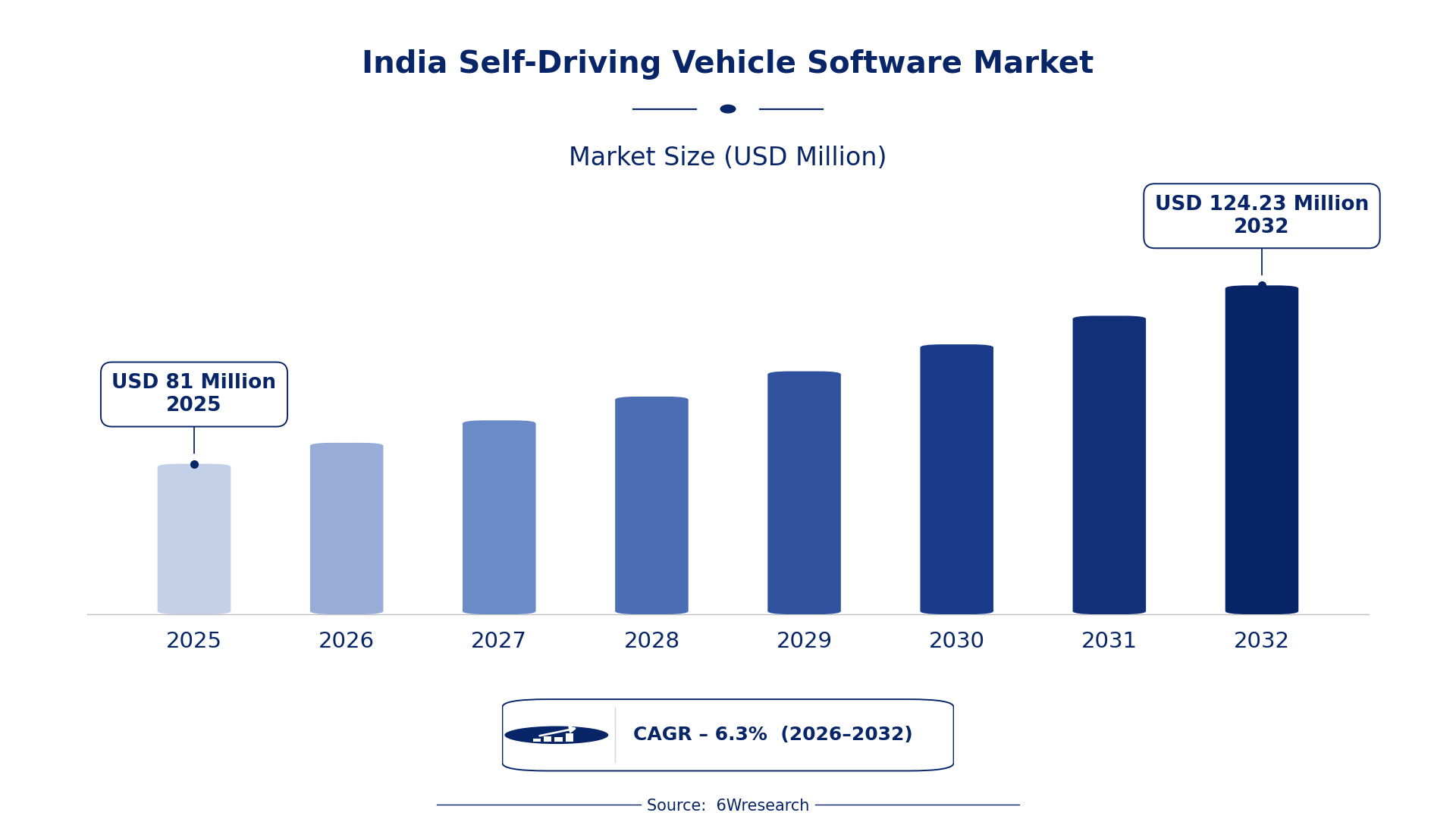
According to 6Wresearch internal database and industry insights, the India Self-Driving Vehicle Software Market was valued at USD 81.0 million in 2025 and is projected to reach USD 124.23 million by 2032, growing at a CAGR of approximately 6.3% during 2026–2032.
India Self-Driving Vehicle Software Market Highlights
| Report Metric | Details |
| Report Name | India Self-Driving Vehicle Software Market |
| Market Size 2025 | USD 81.0 million |
| Market Size 2032 | USD 124.23 million |
| Absolute Growth 2025–2032 | USD 43.23 million |
| CAGR 2026–2032 | 6.3% |
| Peak Annual Growth | 8.7% in 2027 |
| Forecast Period | 2026–2032 |
| Historical Data | 2022–2025 |
| Base Year | 2025 |
| Leading Software Type, 2025 | Perception Software (46% share) |
| Leading Functionality, 2025 | Object Detection (42% share) |
| Leading Deployment Mode, 2025 | Onboard Systems (42% share) |
| Leading End User, 2025 | Autonomous Vehicle OEMs (54% share) |
| Fastest-Growing Software Type | Path Planning Software (8.6% CAGR) |
| Fastest-Growing Functionality | Route Optimization (7.5% CAGR) |
| Fastest-Growing End User | ADAS Developers (8.0% CAGR) |
| Growing Sector | automotive technology |
| Key End Users | autonomous vehicle OEMs, ADAS developers, automotive Tier-1 suppliers, self-driving tech startups |
India Self-Driving Vehicle Software Market Year-wise Growth Rate and Key Drivers (2022–2032)
This graph illustrates the annual growth rates of the market from 2022 to 2032, highlighting a steady upward trajectory and projected market expansion over the forecast period.
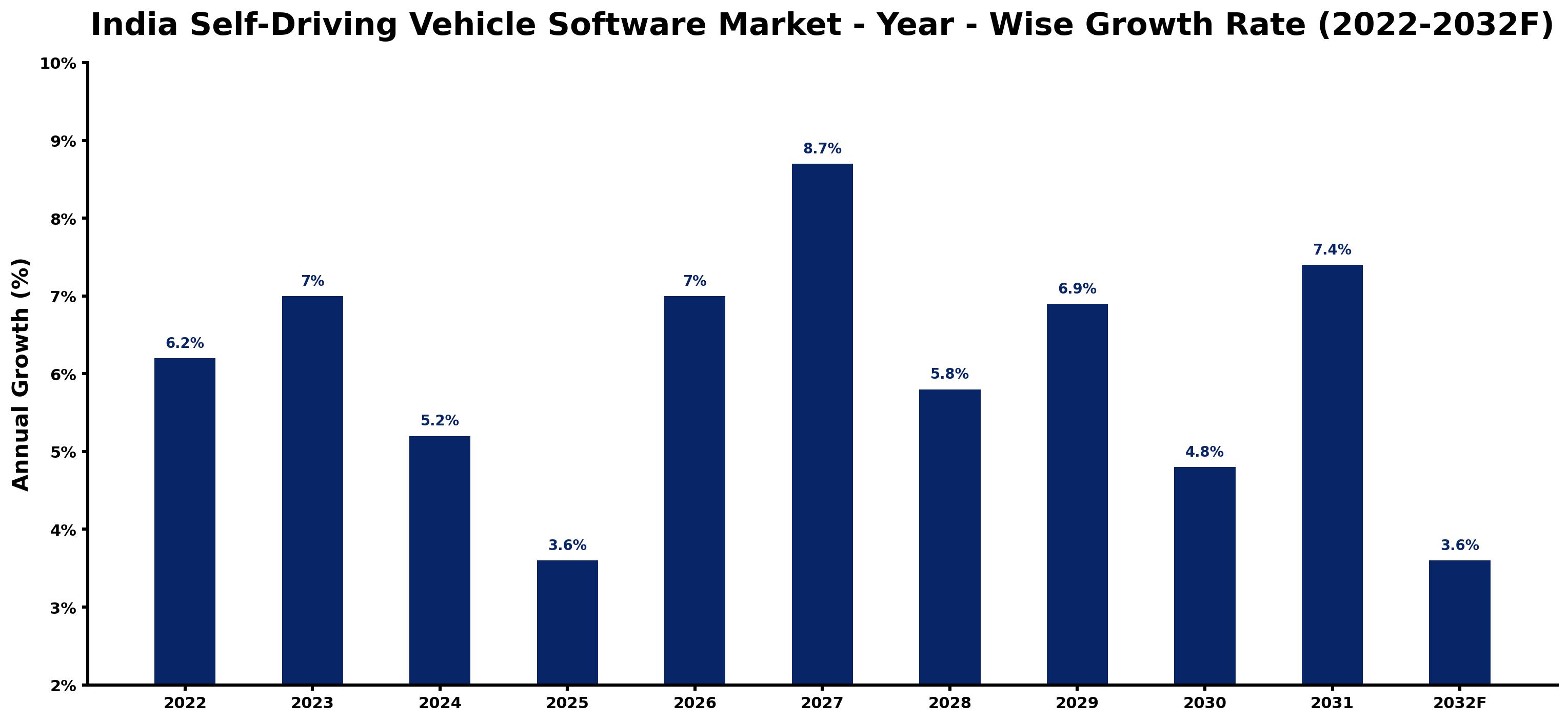
The table below sets out the estimated growth rate for each year and the main factor behind it.
| Year | Estimated Annual Growth (%) | Market Rationale |
| 2022 | 6.2 | Investment in self-driving technologies increased significantly, driven by the National Electric Mobility Mission Plan. |
| 2023 | 7.0 | Growth accelerated as over 50% of manufacturers invested in autonomous vehicle development. |
| 2024 | 5.2 | A slowdown occurred as the market adjusted to evolving regulatory frameworks. |
| 2025 | 3.6 | Development continued at a slower rate as companies focused on R&D for safety standards. |
| 2026 | 7.0 | The market is expected to rebound with renewed investment in autonomous vehicle technologies. |
| 2027 | 8.7 | A peak in growth will be driven by heightened demand from autonomous vehicle OEMs. |
| 2028 | 5.8 | Growth is projected to slow as companies face challenges in regulatory compliance and testing. |
| 2029 | 6.9 | A faster growth rate is expected as new technologies gain traction in the market. |
| 2030 | 4.8 | The market is projected to experience a slowdown as manufacturers adjust to changing consumer preferences. |
| 2031 | 7.4 | Growth is anticipated to pick up again due to increased investments in advanced driver-assistance systems. |
| 2032 | 3.6 | The market will stabilise with consistent demand for self-driving software solutions. |
Note: Market size estimations and growth projections presented in this report are based on 6Wresearch's proprietary forecasting methodology, utilizing the latest available industry data, government publications, and primary research inputs.
India Self-Driving Vehicle Software Market Synopsis
The Self-Driving Vehicle Software Market in India includes advanced algorithms tailored for autonomous navigation. This software enhances vehicle safety, improves traffic efficiency, and supports autonomous features. The market is expanding due to investments from more than 50% of automotive manufacturers and supportive guidelines from the Ministry of Road Transport and Highways. With India's automotive industry expected to reach $300 billion by 2026, the demand for these technologies is set to increase markedly.
Market Dynamics Impact Analysis (2026–2032)
| Factor | Type | Impact | Primary Segment Affected |
| Increasing investments in R&D for autonomous technologies | Driver | High | Perception Software |
| Growing demand for enhanced vehicle safety and efficiency | Driver | High | Object Detection |
| Expansion of autonomous vehicle startups | Opportunity | High | Self-Driving Tech Startups |
| Development of testing facilities for autonomous vehicles | Opportunity | High | Automotive Tier-1 Suppliers |
| Regulatory challenges impacting development timelines | Restraint | High | Path Planning Software |
| High costs associated with R&D and compliance | Restraint | Medium | Control Software |
| Limited infrastructure for testing autonomous vehicles | Challenge | High | Simulation Software |
| Skill gaps in the workforce for advanced technologies | Challenge | Medium | ADAS Developers |
Evaluation of Drivers in India Self-Driving Vehicle Software Market (2026–2032)
The factors lifting demand, and the evidence behind each, are summarised below.
| Drivers | Primary Segment Affected | Why It Matters (Evidence) |
| Increased investment in autonomous technologies | Path Planning Software | Over 50% of Indian automotive manufacturers are investing in self-driving technologies, driving demand for advanced algorithms. |
| Growing emphasis on vehicle safety | Object Detection | The need for advanced safety features is pushing manufacturers to adopt object detection systems. |
| Rising number of autonomous vehicle startups | Self-Driving Tech Startups | With over 20 startups operational, the demand for innovative software solutions is increasing. |
| Government initiatives promoting electric vehicles | Control Software | The National Electric Mobility Mission Plan 2020 encourages the adoption of control software for autonomous vehicles. |
| Development of testing infrastructure | Simulation Software | The National Automotive Testing and R&D Infrastructure Project aims to improve testing capabilities for autonomous vehicles. |
Growth across the Self-Driving Vehicle Software market in India is anchored in increased investment in autonomous technologies, rising demand for vehicle safety features, and the proliferation of startups. Over 50% of automotive manufacturers are investing in self-driving technologies, which boosts demand for advanced algorithms. The establishment of the National Automotive Testing and R&D Infrastructure Project improves testing capabilities, leading to more effective software solutions. As a result, the market is experiencing a surge in demand from various sectors, including automotive OEMs and technology startups. The focus on safety standards is further driving growth in this sector.
Evaluation of Restraints in India Self-Driving Vehicle Software Market
Below mentioned are some major restraints and their influence on market dynamics.
| Market Restraint | Primary Segment Affected | Why It Matters (Evidence) |
| Regulatory challenges impacting development timelines | Path Planning Software | Regulatory uncertainties are causing delays in the development and deployment of path planning technologies. |
| High costs associated with R&D and compliance | Control Software | The financial burden of research and compliance is limiting the ability of smaller firms to compete. |
| Limited infrastructure for testing autonomous vehicles | Simulation Software | Insufficient testing facilities hinder the effective validation of simulation software. |
| Skill gaps in the workforce for advanced technologies | ADAS Developers | A lack of skilled professionals in the automotive sector is affecting the development of advanced driver-assistance systems. |
| Market competition leading to price pressures | Object Detection | Intense competition among manufacturers is driving down prices, impacting profitability. |
India Self-Driving Vehicle Software Market Challenges
The India Self-Driving Vehicle Software market faces several practical problems, beginning with supply chain disruptions that can delay critical component sourcing by up to six months, impacting startups' ability to launch their products on time. Technology integration challenges arise as developers often grapple with the complexity of merging various systems, which can inflate development costs by around 20% for software firms. Compliance with evolving safety standards imposes additional burdens, as companies must allocate resources for regulatory adherence, consuming up to 15% of their budgets. Competition among over 20 startups intensifies pricing pressure, making it difficult for new entrants to secure funding and establish a foothold in the market.
Trends in the India Self-Driving Vehicle Software Market
Several trends are reshaping the India Self-Driving Vehicle Software Market; the most important are set out below.
- National Electric Mobility Mission Plan 2020: The National Electric Mobility Mission Plan 2020 is promoting the adoption of electric and autonomous vehicles in India. With a target of 30% EV penetration by 2030, this initiative is expected to impact the self-driving vehicle software market.
- Rise of Autonomous Vehicle Startups: India is seeing a rise in autonomous vehicle startups, with over 20 currently operational. This growth is driving innovation in self-driving technologies, contributing to market expansion.
- Focus on Vehicle Safety Standards: The Automotive Research Association of India is developing safety standards for autonomous vehicles, expected by 2025. This focus on safety is crucial for gaining consumer trust and driving market growth.
- Development of Testing Infrastructure: The National Automotive Testing and R&D Infrastructure Project is improving testing capabilities for autonomous vehicles. With a budget of ₹1,000 crores, this initiative aims to support the safe deployment of self-driving technologies.
Investment Opportunities in the India Self-Driving Vehicle Software Market
Below are the investment opportunities with the strongest case in the India Self-Driving Vehicle Software Market.
- Self-Driving Vehicle Software: There is a growing opportunity to supply advanced self-driving vehicle software as the market expands. With India's automotive industry projected to reach $300 billion by 2026, suppliers can enter through partnerships with local manufacturers.
- Testing Facilities for Autonomous Vehicles: Investment in testing facilities is essential as the demand for safe autonomous vehicles increases. The state of Maharashtra is a hub for automotive R&D, making it an ideal location for new testing facilities.
- Advanced Driver-Assistance Systems: The demand for advanced driver-assistance systems is rising among automotive manufacturers. Collaborating with ADAS developers can provide opportunities for software suppliers to meet this growing need.
- Skill Development Programs: There is an urgent need for skill development in automotive technologies to address workforce gaps. The Automotive Skills Development Council is promoting training programs, presenting opportunities for educational institutions and training providers.
Government Initiatives in the India Self-Driving Vehicle Software Market
The Automotive Mission Plan 2026, initiated by the Ministry of Heavy Industries, aims to boost the automotive sector's contribution to GDP, targeting $300 billion in revenue. This plan encourages investments in self-driving technologies and infrastructure development. The National Electric Mobility Mission Plan 2020 promotes electric and autonomous vehicles, aiming for 30% EV penetration by 2030. Such measures are vital for establishing a supportive environment for self-driving vehicle software producers and developers.
The National Automotive Testing and R&D Infrastructure Project (NATRiP), approved with a budget of ₹1,000 crores, enhances testing facilities for autonomous vehicles, ensuring safety and compliance. The Ministry of Road Transport and Highways is developing a framework for autonomous vehicles, expected to be finalized by 2024. This framework will provide guidelines for manufacturers, ensuring regulatory compliance and safety standards.
Future Insight of the India Self-Driving Vehicle Software Market
Several forward-looking factors should support the India Self-Driving Vehicle Software market in the coming years. The National Automotive Testing and R&D Infrastructure Project will enhance vehicle testing capabilities, streamlining software development processes. By 2030, the Indian government aims for 30% of vehicles to be electric, driving demand for autonomous technologies. The Automotive Skills Development Council will promote skill development, ensuring a workforce ready for advanced automotive roles. With over 50% of manufacturers investing in self-driving technologies, the market is poised for considerable growth.
Market Segmentation Analysis
Each segment group is reviewed below, with the leader by share and the fastest grower by CAGR.
By Software Type – Perception Software Dominated, Path Planning Software Expected to Grow Fastest
According to Shubham Padhi, Research Analyst at 6Wresearch, the largest software type category in 2025 was Perception Software, with a 46% share of total revenue. Perception Software holds the largest market share because it is crucial for vehicles to accurately interpret their surroundings, especially in densely populated areas. Its importance is underscored by the increasing number of autonomous vehicle startups in India, which rely heavily on this technology for safe navigation. Over 2026–2032, Path Planning Software is expected to post the fastest growth, at a CAGR of 8.6%. Path Planning Software is experiencing rapid growth as it directly influences the efficiency of navigation systems in self-driving vehicles. The rise of over 20 autonomous vehicle startups in India is creating a heightened demand for sophisticated route planning solutions. Suppliers must focus on enhancing their Path Planning Software to meet the evolving requirements of autonomous vehicle developers.
By Functionality – Object Detection Dominated, Route Optimization Expected to Grow Fastest
Object Detection took a 42% share of functionality in 2025, more than any other category. Object Detection leads in market share as it is essential for ensuring vehicle safety by accurately identifying obstacles and pedestrians. This functionality is critical for compliance with safety standards set by the Automotive Research Association of India, which is vital for market acceptance. Route Optimization is set to record the highest CAGR in this split, 7.5% over 2026–2032. Route Optimization is the fastest-growing segment due to the increasing demand for efficient navigation solutions that reduce travel time. The push for electric and autonomous vehicles under the National Electric Mobility Mission Plan 2020 is significantly driving this growth. Buyers should prioritise acquiring advanced Route Optimization solutions to improve the performance and safety of their autonomous systems.
By Deployment Mode – Onboard Systems Dominated and Is Expected to Record the Fastest Growth
Onboard Systems held a 42% share of the India Self-Driving Vehicle Software Market by deployment mode in 2025. Onboard Systems dominate the market share as they are integral to the autonomous capabilities of vehicles, processing data in real-time without reliance on external connectivity. This mode is preferred by manufacturers aiming for immediate responsiveness in complex driving scenarios. The same category are also set to grow fastest, at a CAGR of 8.2% during 2026–2032. Onboard Systems are also the fastest-growing segment, as advancements in technology allow for more sophisticated processing capabilities directly within the vehicle. As the automotive industry invests heavily in self-driving technologies, this growth is expected to continue. Suppliers must ensure their Onboard Systems are equipped with the latest technologies to maintain a competitive edge in the rapidly evolving market.
By End User – Autonomous Vehicle OEMs Dominated, ADAS Developers Expected to Grow Fastest
In 2025, Autonomous Vehicle OEMs led the end user split with a 54% share. Autonomous Vehicle OEMs hold the largest market share as they are the primary developers of self-driving cars, making substantial investments in software solutions. Their commitment to meeting emerging regulatory standards further strengthens their position in the market. ADAS Developers are projected to grow fastest, at a CAGR of 8.0% during 2026–2032. ADAS Developers are the fastest-growing segment, responding to the rising demand for advanced driver-assistance systems that improve vehicle safety. With over 50% of manufacturers investing in self-driving technologies, this segment is set for rapid growth. Suppliers should tailor their offerings to meet the specific requirements of ADAS Developers, ensuring compatibility with the latest advancements in vehicle technology.
Key Attractiveness of the Report
- 10 Years of Market Numbers
- Historical Data Starting from 2022 to 2025
- Base Year 2025
- Forecast Data until 2032
- Key Performance Indicators Impacting the Market
- Major Upcoming Developments and Projects
Key Highlights of the Report:
- India Self-Driving Vehicle Software Market Outlook
- Market Size of India Self-Driving Vehicle Software Market, 2025
- Forecast of India Self-Driving Vehicle Software Market, 2032
- Historical Data and Forecast of India Self-Driving Vehicle Software Revenues & Volume for the Period 2022 - 2032F
- India Self-Driving Vehicle Software Market Trend Evolution
- India Self-Driving Vehicle Software Market Drivers and Challenges
- India Self-Driving Vehicle Software Price Trends
- India Self-Driving Vehicle Software Porter's Five Forces
- India Self-Driving Vehicle Software Industry Life Cycle
- Historical Data and Forecast of India Self-Driving Vehicle Software Market Revenues & Volume By Software Type for the Period 2022 - 2032F
- Historical Data and Forecast of India Self-Driving Vehicle Software Market Revenues & Volume By Perception Software for the Period 2022 - 2032F
- Historical Data and Forecast of India Self-Driving Vehicle Software Market Revenues & Volume By Path Planning Software for the Period 2022 - 2032F
- Historical Data and Forecast of India Self-Driving Vehicle Software Market Revenues & Volume By Control Software for the Period 2022 - 2032F
- Historical Data and Forecast of India Self-Driving Vehicle Software Market Revenues & Volume By Simulation Software for the Period 2022 - 2032F
- Historical Data and Forecast of India Self-Driving Vehicle Software Market Revenues & Volume By Functionality for the Period 2022 - 2032F
- Historical Data and Forecast of India Self-Driving Vehicle Software Market Revenues & Volume By Object Detection for the Period 2022 - 2032F
- Historical Data and Forecast of India Self-Driving Vehicle Software Market Revenues & Volume By Route Optimization for the Period 2022 - 2032F
- Historical Data and Forecast of India Self-Driving Vehicle Software Market Revenues & Volume By Steering & Braking for the Period 2022 - 2032F
- Historical Data and Forecast of India Self-Driving Vehicle Software Market Revenues & Volume By Testing & Validation for the Period 2022 - 2032F
- Historical Data and Forecast of India Self-Driving Vehicle Software Market Revenues & Volume By Deployment Mode for the Period 2022 - 2032F
- Historical Data and Forecast of India Self-Driving Vehicle Software Market Revenues & Volume By Onboard Systems for the Period 2022 - 2032F
- Historical Data and Forecast of India Self-Driving Vehicle Software Market Revenues & Volume By Cloud-Connected for the Period 2022 - 2032F
- Historical Data and Forecast of India Self-Driving Vehicle Software Market Revenues & Volume By Embedded Platform for the Period 2022 - 2032F
- Historical Data and Forecast of India Self-Driving Vehicle Software Market Revenues & Volume By Virtual Environment for the Period 2022 - 2032F
- Historical Data and Forecast of India Self-Driving Vehicle Software Market Revenues & Volume By End User for the Period 2022 - 2032F
- Historical Data and Forecast of India Self-Driving Vehicle Software Market Revenues & Volume By Autonomous Vehicle OEMs for the Period 2022 - 2032F
- Historical Data and Forecast of India Self-Driving Vehicle Software Market Revenues & Volume By ADAS Developers for the Period 2022 - 2032F
- Historical Data and Forecast of India Self-Driving Vehicle Software Market Revenues & Volume By Automotive Tier-1 Suppliers for the Period 2022 - 2032F
- Historical Data and Forecast of India Self-Driving Vehicle Software Market Revenues & Volume By Self-Driving Tech Startups for the Period 2022 - 2032F
- India Self-Driving Vehicle Software Import Export Trade Statistics
- Market Opportunity Assessment By Software Type
- Market Opportunity Assessment By Functionality
- Market Opportunity Assessment By Deployment Mode
- Market Opportunity Assessment By End User
- India Self-Driving Vehicle Software Top Companies Market Share
- India Self-Driving Vehicle Software Competitive Benchmarking By Technical and Operational Parameters
- India Self-Driving Vehicle Software Company Profiles
- India Self-Driving Vehicle Software Key Strategic Recommendations
Market Covered
This report examines the market across the segments below.
By Software Type
- Perception Software
- Path Planning Software
- Control Software
- Simulation Software
By Functionality
- Object Detection
- Route Optimization
- Steering & Braking
- Testing & Validation
By Deployment Mode
- Onboard Systems
- Cloud-Connected
- Embedded Platform
- Virtual Environment
By End User
- Autonomous Vehicle OEMs
- ADAS Developers
- Automotive Tier-1 Suppliers
- Self-Driving Tech Startups































