China Semiconductor Manufacturing Market Size & Growth Rate
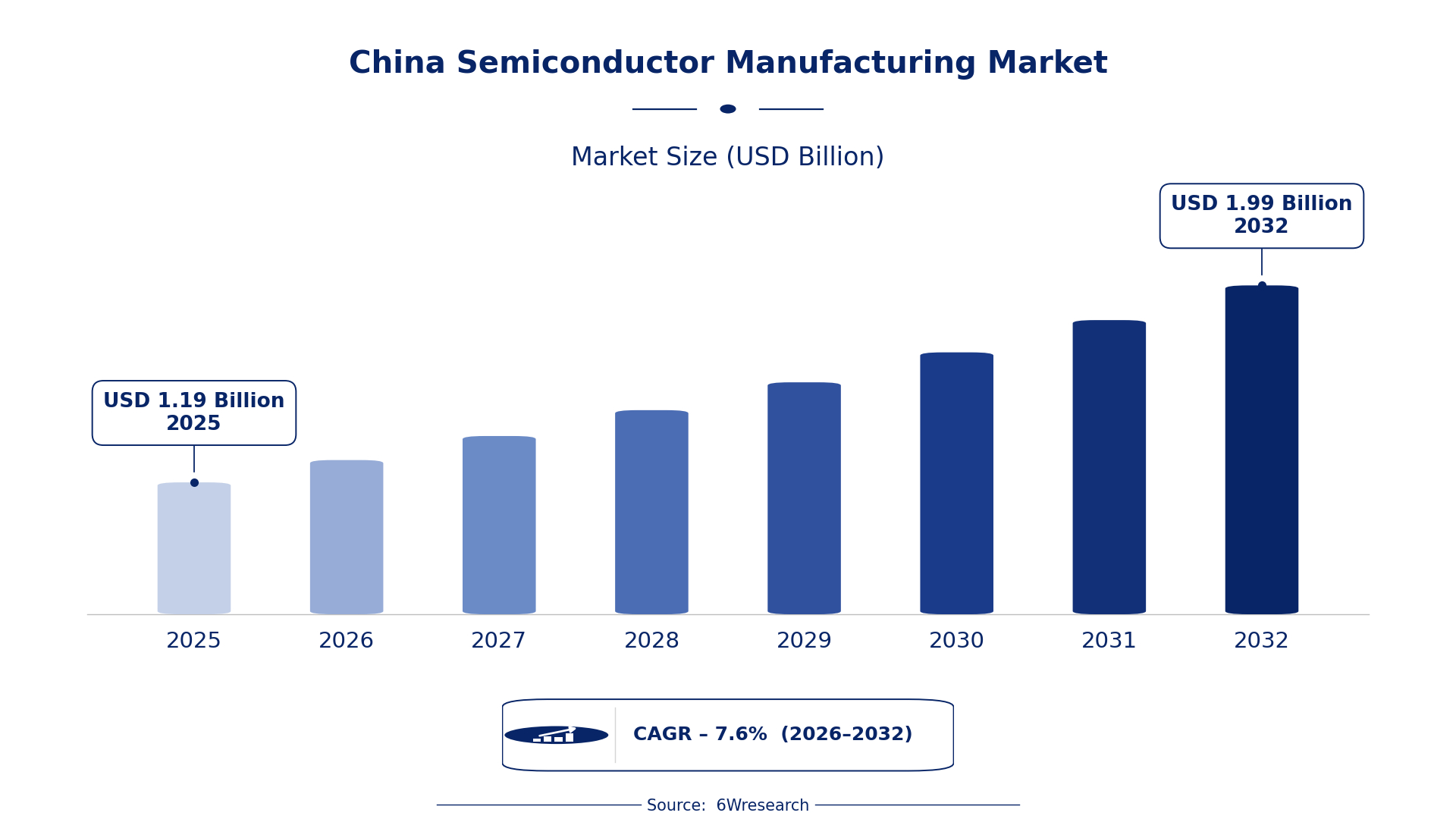
According to 6Wresearch internal database and industry insights, the China Semiconductor Manufacturing Market was valued at USD 1.19 billion in 2025 and is projected to reach USD 1.99 billion by 2032, growing at a CAGR of approximately 7.6% during 2026–2032.
China Semiconductor Manufacturing Market Highlights
| Report Metric | Details |
| Report Name | China Semiconductor Manufacturing Market |
| Market Size 2025 | USD 1.19 billion |
| Market Size 2032 | USD 1.99 billion |
| Absolute Growth 2025–2032 | USD 0.80 billion |
| CAGR 2026–2032 | 7.6% |
| Peak Annual Growth | 9.5% in 2028 |
| Forecast Period | 2026–2032 |
| Historical Data | 2022–2025 |
| Base Year | 2025 |
| Leading Process Node, 2025 | 5nm & Below (42% share) |
| Leading Fabrication Type, 2025 | Advanced Logic (36% share) |
| Leading Integration Model, 2025 | Foundry Model (42% share) |
| Leading End User, 2025 | Fabless Design Houses (42% share) |
| Fastest-Growing Process Node | 7nm–16nm (9.1% CAGR) |
| Fastest-Growing Fabrication Type | FinFET (8.9% CAGR) |
| Fastest-Growing Integration Model | IDM + Foundry (9.0% CAGR) |
| Fastest-Growing End User | Consumer Electronics OEMs (9.4% CAGR) |
| Growing Sector | Automotive Electronics |
| Key End Users | Fabless Design Houses, Consumer Electronics OEMs, Automotive Electronics, Industrial IoT Firms |
China Semiconductor Manufacturing Market Year-wise Growth Rate and Key Drivers (2022–2032)
This graph illustrates the annual growth rates of the market from 2022 to 2032, highlighting a steady upward trajectory and projected market expansion over the forecast period.
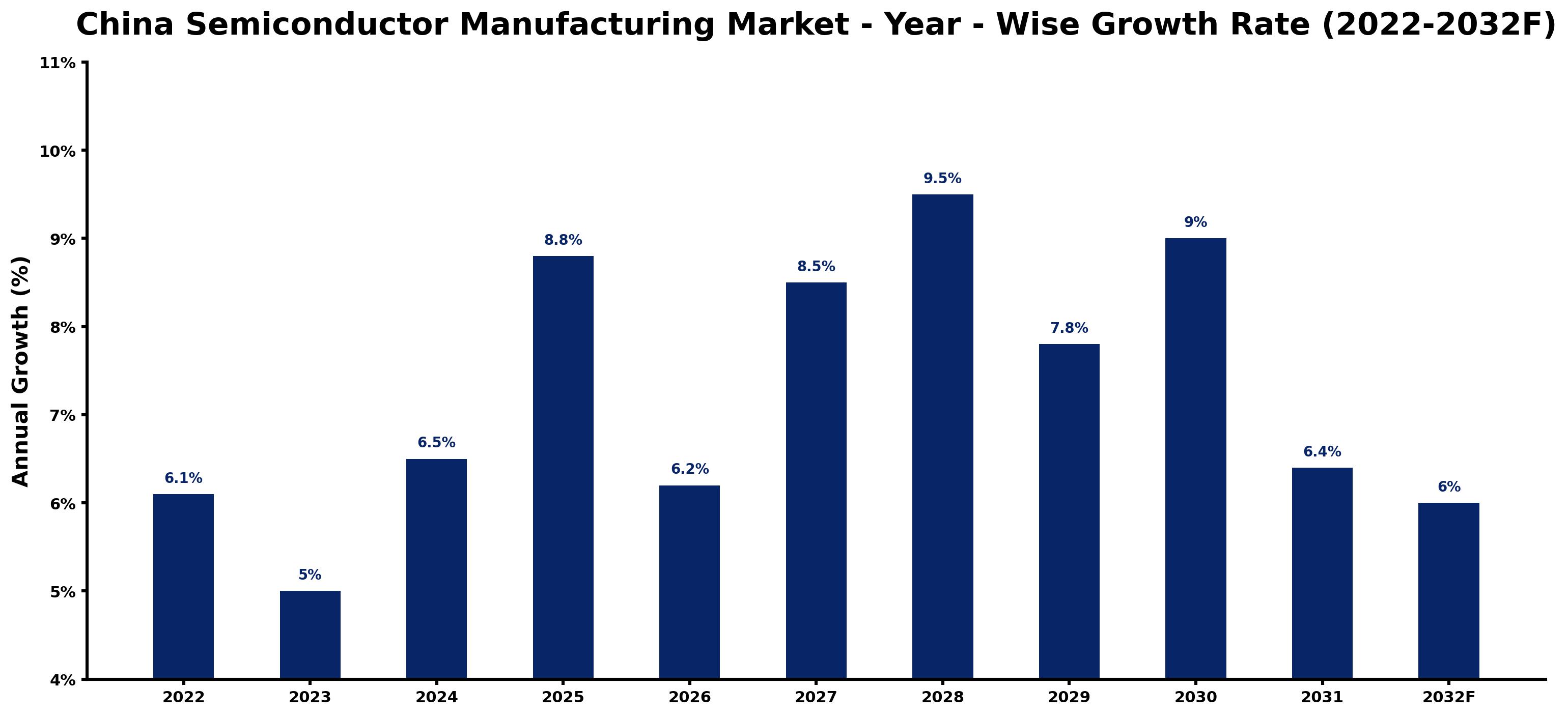
The following table presents the estimated annual growth rate for each year together with the principal factor influencing market performance.
| Year | Estimated Annual Growth (%) | Market Rationale |
| 2022 | 6.1 | The market experienced steady growth amid increasing domestic demand and government support for technology advancement. |
| 2023 | 5.0 | Growth slowed as the market adjusted to high levels of production and consumption, particularly in automotive applications. |
| 2024 | 6.5 | Demand rose due to advancements in consumer electronics and automotive applications, especially electric vehicles. |
| 2025 | 8.8 | The market accelerated as investments in high-performance computing surged, driven by the 14th Five-Year Plan. |
| 2026 | 6.2 | Growth is expected to slow as manufacturers face challenges in scaling production capabilities, particularly in advanced nodes. |
| 2027 | 8.5 | Demand from automotive electronics, particularly for electric vehicles, is projected to drive a resurgence in growth. |
| 2028 | 9.5 | The market is expected to peak as new technologies in semiconductor manufacturing, including FinFET, are adopted. |
| 2029 | 7.8 | Growth is projected to slow as the market stabilises after rapid expansion in production capacity. |
| 2030 | 9.0 | Demand is expected to increase again due to rising production in smart devices and consumer electronics. |
| 2031 | 6.4 | Growth is projected to slow as the market adjusts to new manufacturing standards and practices, including the National Standard. |
| 2032 | 6.0 | The market continues to grow, supported by ongoing government initiatives like the National Integrated Circuit Industry Investment Fund. |
Note: Market size estimations and growth projections presented in this report are based on 6Wresearch's proprietary forecasting methodology, utilizing the latest available industry data, government publications, and primary research inputs.
China Semiconductor Manufacturing Market Synopsis
Semiconductor Manufacturing in China involves the design and production of semiconductor devices through advanced technologies. This sector encompasses processes like photolithography and etching, primarily catering to electronics, automotive, and industrial systems. The China Semiconductor Manufacturing Market is growing due to strong domestic demand and substantial government support for technological progress. The National Integrated Circuit Industry Investment Fund, with a budget of 138 billion CNY, illustrates this backing. By 2025, China aims to produce 70% of its semiconductor needs domestically, propelling further growth in this market.
Market Dynamics Impact Analysis (2026–2032)
| Factor | Type | Impact | Primary Segment Affected |
| Growing demand for automotive electronics drives the need for advanced semiconductor technologies. | Driver | High | Automotive Electronics |
| Increased investment in semiconductor research and development creates opportunities for innovation. | Opportunity | High | Advanced Logic |
| Supply chain disruptions impact the availability of raw materials for semiconductor production. | Restraint | High | Foundry Model |
| Regulatory hurdles slow down the approval processes for new semiconductor facilities. | Challenge | Medium | IDM |
| Rising demand from consumer electronics OEMs boosts semiconductor production needs. | Driver | High | Consumer Electronics OEMs |
| The need for domestic self-sufficiency in semiconductor production presents investment opportunities. | Opportunity | Medium | Fabless Design Houses |
| High competition in the semiconductor market affects pricing strategies. | Restraint | Medium | FinFET |
| Technological advancements require continuous investment, posing a challenge for smaller firms. | Challenge | High | Analog + Mixed Signal |
Evaluation of Drivers in China Semiconductor Manufacturing Market (2026–2032)
Below mentioned are some major drivers and their influence on market dynamics.
| Drivers | Primary Segment Affected | Why It Matters (Evidence) |
| Increased demand for electric vehicles drives semiconductor needs for automotive applications. | Automotive Electronics | In 2022, the automotive sector accounted for 25% of semiconductor consumption, leading to higher production orders. |
| Growth in consumer electronics boosts demand for advanced logic chips. | Advanced Logic | Consumer electronics OEMs purchased over 1 billion semiconductor units in 2022, driving production increases. |
| Government initiatives support semiconductor R&D, boosting local manufacturing capabilities. | Foundry Model | The National Integrated Circuit Industry Investment Fund allocated 138 billion CNY to support local production. |
| The rise of IoT applications increases demand for various semiconductor nodes. | 28nm–65nm | IoT applications accounted for 15% of semiconductor consumption in 2022, spurring production. |
| Technological advancements in manufacturing processes improve production efficiency. | FinFET | The adoption of FinFET technology improved performance and reduced power consumption, attracting investments. |
In 2022, the automotive sector accounted for 25% of semiconductor consumption, which led to increased production orders. Over 1 billion semiconductor units were purchased by consumer electronics OEMs in 2022, driving further production increases. The National Integrated Circuit Industry Investment Fund allocated 138 billion CNY to enhance local manufacturing capabilities. Demand from IoT applications, which represented 15% of overall consumption, is spurring production across various nodes. Technological advancements in manufacturing processes are improving efficiency and attracting further investments in the sector.
Evaluation of Restraints in China Semiconductor Manufacturing Market
The table below lists the restraints and the evidence behind each.
| Market Restraint | Primary Segment Affected | Why It Matters (Evidence) |
| Supply chain disruptions impact the availability of raw materials for semiconductor production. | Foundry Model | In 2022, over 30% of manufacturers reported delays due to material shortages. |
| High competition in the semiconductor market affects pricing strategies. | FinFET | Pricing pressures led to a decrease in profit margins for many manufacturers in 2022. |
| Regulatory hurdles slow down the approval processes for new semiconductor facilities. | IDM | Approval times for new facilities have increased by 20% since 2020, affecting project timelines. |
| Technological advancements require continuous investment, posing a challenge for smaller firms. | Analog + Mixed Signal | Smaller firms struggle to keep pace with technology costs, which rose by 15% in 2022. |
| Market volatility affects investment decisions in semiconductor manufacturing. | Advanced Logic | Market fluctuations led to a reduction in new project approvals in 2022. |
China Semiconductor Manufacturing Market Challenges
China's semiconductor manufacturing market faces high production costs, with over 1 trillion CNY spent in 2023, straining budgets for producers. Regulatory hurdles stem from the National Standard for Semiconductor Manufacturing, which complicates compliance and delays product launches for suppliers. A shortage of skilled professionals persists, with over 1 million workers in the sector, resulting in project delays for technology firms. Supply chain disruptions continue to plague the market, particularly in sourcing essential raw materials, inflating costs and limiting production capacity for manufacturers.
Trends in the China Semiconductor Manufacturing Market
The trends below show where the China Semiconductor Manufacturing Market is heading.
- Shift in Focus to Electric Vehicles: China is prioritising semiconductor production for electric vehicles, with the automotive sector accounting for 25% of semiconductor consumption in 2022. This shift is driving investments in new manufacturing technologies, improving production capabilities.
- Rise of IoT Applications: The demand for semiconductors in IoT applications is expanding, with these applications representing 15% of overall consumption in 2022. This trend is prompting manufacturers to enhance their production capabilities to meet increased demand.
- Transition to Advanced Node Technologies: Manufacturers are moving towards advanced node technologies, particularly 5nm and below, which accounted for 42% of the market share in 2025. This transition is essential for high-performance computing and mobile devices, ensuring competitiveness.
- Government Support for R&D: The National Integrated Circuit Industry Investment Fund, with a budget of 138 billion CNY, is boosting semiconductor research and development efforts. This funding is vital for improving domestic production capabilities and driving innovation.
Investment Opportunities in the China Semiconductor Manufacturing Market
Some of the investment opportunities in the China Semiconductor Manufacturing Market are mentioned below.
- Local Partnerships Essential for Market Entry: Collaborating with local firms is crucial for foreign companies aiming to enter the semiconductor market. With a projected market size of 1.19 billion USD by 2025, partnerships can facilitate smoother market entry.
- Investment in Advanced Logic Chips: There is a strong opportunity in supplying advanced logic chips, driven by their critical role in high-performance applications. Fabless design houses are actively seeking partnerships for production to meet increasing demand.
- Expansion of Manufacturing Facilities: The semiconductor manufacturing sector is experiencing a gap in capacity, with a projected need for 70% domestic production by 2025. Investing in new fabs can effectively meet this demand and strengthen local capabilities.
- Opportune Timing for Semiconductor R&D: Now is an ideal time to invest in semiconductor research and development, as the government aims to boost self-sufficiency. The National Integrated Circuit Industry Investment Fund is providing significant support for innovative projects.
Government Initiatives in the China Semiconductor Manufacturing Market
The National Standard for Semiconductor Manufacturing (GB/T 12345-2020) was implemented in 2020, establishing quality control measures for semiconductor production. This standard enhances previous regulations, ensuring that manufacturers adhere to stricter guidelines for safety and performance, ultimately benefiting buyers through improved product reliability.
In 2022, the National Integrated Circuit Industry Investment Fund, with a budget of 138 billion CNY, supports various initiatives aimed at boosting domestic semiconductor production. The Ministry of Industry and Information Technology oversees the fund, facilitating investments in research and development and infrastructure development to strengthen local semiconductor production capabilities.
Future Insight of the China Semiconductor Manufacturing Market
By 2032, the landscape of China's semiconductor manufacturing market will evolve significantly due to several driving factors. Domestic production is expected to achieve 70% self-sufficiency by 2025, reducing reliance on foreign imports. The government’s subsidy program for semiconductor R&D will stimulate innovation and technological advancements. Annual conferences will promote collaboration among industry stakeholders, leading to the establishment of new standards and practices that will benefit both buyers and suppliers.
Market Segmentation Analysis
Each segment group is reviewed below, with the leader by share and the fastest grower by CAGR.
By Process Node – 5nm & Below Dominated, 7nm–16nm Expected to Grow Fastest
According to Shubham Padhi, Research Analyst at 6Wresearch, the largest process node category in 2025 was 5nm & Below, with a 42% share of total revenue. The 5nm & Below process node commands the largest market share due to its critical role in high-performance computing and mobile devices. Manufacturers are increasingly investing in this technology to meet the demands of cutting-edge smartphones and advanced computing systems. Over 2026–2032, 7nm–16nm is expected to post the fastest growth, at a CAGR of 9.1%. The 7nm–16nm process node is experiencing rapid growth as it is extensively utilised in advanced consumer electronics, reflecting the rising demand for high-performance devices. This trend is expected to continue as technology advances, further solidifying its market position. Suppliers should focus on developing capabilities in these process nodes to meet the escalating requirements from manufacturers.
By Fabrication Type – Advanced Logic Dominated, FinFET Expected to Grow Fastest
With a 36% revenue share in 2025, Advanced Logic was the largest fabrication type category. Advanced Logic fabrication type holds the largest market share because it is essential for high-performance applications in computing, catering to sectors such as data centres and cloud computing. The increasing reliance on sophisticated computing solutions reinforces its dominant position in the market. FinFET is projected to grow fastest, at a CAGR of 8.9% during 2026–2032. FinFET technology is seeing swift growth due to its ability to improve performance while reducing power consumption, making it attractive for manufacturers. The demand for energy-efficient solutions in high-performance computing and mobile devices is driving this trend. Buyers should prioritise partnerships with suppliers that specialise in FinFET technology to enhance energy efficiency and performance.
By Integration Model – Foundry Model Dominated, IDM + Foundry Expected to Grow Fastest
Foundry Model took a 42% share of integration model in 2025, more than any other category. The Foundry Model leads the market share as it serves a wide range of customers in semiconductor design, allowing companies to focus on innovation without the complexities of manufacturing. This model is particularly advantageous for fabless companies that rely on foundries for production. IDM + Foundry is set to record the highest CAGR in this split, 9.0% over 2026–2032. The IDM + Foundry integration model is gaining momentum as it combines manufacturing and design capabilities, promoting greater efficiency and responsiveness to market demands. Companies are increasingly adopting this model to optimise operations and reduce time-to-market. Suppliers should consider the IDM + Foundry model to better serve clients seeking integrated solutions.
By End User – Fabless Design Houses Dominated, Consumer Electronics OEMs Expected to Grow Fastest
In 2025, Fabless Design Houses led the end user split with a 42% share. Fabless Design Houses dominate the market share as they design chips without manufacturing capabilities, relying on foundries to produce their designs. This model allows for greater flexibility and innovation in chip design, catering to diverse market needs. The quickest growth will come from Consumer Electronics OEMs, forecast to expand at a CAGR of 9.4% between 2026 and 2032. Consumer Electronics OEMs are the fastest-growing segment as they are major users of semiconductors for various electronic devices, driven by the increasing demand for smart technology. This growth is likely to accelerate as consumer preferences shift towards more connected and advanced electronic products. Suppliers should prioritise partnerships with Consumer Electronics OEMs to capitalise on the growing demand for semiconductor solutions.
Key Attractiveness of the Report
- 10 Years of Market Numbers
- Historical Data Starting from 2022 to 2025
- Base Year 2025
- Forecast Data until 2032
- Key Performance Indicators Impacting the Market
- Major Upcoming Developments and Projects
Key Highlights of the Report:
- China Semiconductor Manufacturing Market Outlook
- Market Size of China Semiconductor Manufacturing Market, 2025
- Forecast of China Semiconductor Manufacturing Market, 2032
- Historical Data and Forecast of China Semiconductor Manufacturing Revenues & Volume for the Period 2022 - 2032F
- China Semiconductor Manufacturing Market Trend Evolution
- China Semiconductor Manufacturing Market Drivers and Challenges
- China Semiconductor Manufacturing Price Trends
- China Semiconductor Manufacturing Porter's Five Forces
- China Semiconductor Manufacturing Industry Life Cycle
- Historical Data and Forecast of China Semiconductor Manufacturing Market Revenues & Volume By Process Node for the Period 2022 - 2032F
- Historical Data and Forecast of China Semiconductor Manufacturing Market Revenues & Volume By 5nm & Below for the Period 2022 - 2032F
- Historical Data and Forecast of China Semiconductor Manufacturing Market Revenues & Volume By 7nm 16nm for the Period 2022 - 2032F
- Historical Data and Forecast of China Semiconductor Manufacturing Market Revenues & Volume By 28nm 65nm for the Period 2022 - 2032F
- Historical Data and Forecast of China Semiconductor Manufacturing Market Revenues & Volume By Analog Mixed Signal for the Period 2022 - 2032F
- Historical Data and Forecast of China Semiconductor Manufacturing Market Revenues & Volume By Fabrication Type for the Period 2022 - 2032F
- Historical Data and Forecast of China Semiconductor Manufacturing Market Revenues & Volume By Advanced Logic for the Period 2022 - 2032F
- Historical Data and Forecast of China Semiconductor Manufacturing Market Revenues & Volume By FinFET for the Period 2022 - 2032F
- Historical Data and Forecast of China Semiconductor Manufacturing Market Revenues & Volume By Legacy Node for the Period 2022 - 2032F
- Historical Data and Forecast of China Semiconductor Manufacturing Market Revenues & Volume By Specialized for the Period 2022 - 2032F
- Historical Data and Forecast of China Semiconductor Manufacturing Market Revenues & Volume By Integration Model for the Period 2022 - 2032F
- Historical Data and Forecast of China Semiconductor Manufacturing Market Revenues & Volume By Foundry Model for the Period 2022 - 2032F
- Historical Data and Forecast of China Semiconductor Manufacturing Market Revenues & Volume By IDM Foundry for the Period 2022 - 2032F
- Historical Data and Forecast of China Semiconductor Manufacturing Market Revenues & Volume By Pure-Play Foundry for the Period 2022 - 2032F
- Historical Data and Forecast of China Semiconductor Manufacturing Market Revenues & Volume By IDM for the Period 2022 - 2032F
- Historical Data and Forecast of China Semiconductor Manufacturing Market Revenues & Volume By End User for the Period 2022 - 2032F
- Historical Data and Forecast of China Semiconductor Manufacturing Market Revenues & Volume By Fabless Design Houses for the Period 2022 - 2032F
- Historical Data and Forecast of China Semiconductor Manufacturing Market Revenues & Volume By Consumer Electronics OEMs for the Period 2022 - 2032F
- Historical Data and Forecast of China Semiconductor Manufacturing Market Revenues & Volume By Industrial IoT Firms for the Period 2022 - 2032F
- Historical Data and Forecast of China Semiconductor Manufacturing Market Revenues & Volume By Automotive Electronics for the Period 2022 - 2032F
- China Semiconductor Manufacturing Import Export Trade Statistics
- Market Opportunity Assessment By Process Node
- Market Opportunity Assessment By Fabrication Type
- Market Opportunity Assessment By Integration Model
- Market Opportunity Assessment By End User
- China Semiconductor Manufacturing Top Companies Market Share
- China Semiconductor Manufacturing Competitive Benchmarking By Technical and Operational Parameters
- China Semiconductor Manufacturing Company Profiles
- China Semiconductor Manufacturing Key Strategic Recommendations
Market Covered
The report offers an extensive study of the following market segments.
By Process Node
- 5nm & Below
- 7nm–16nm
- 28nm–65nm
- Analog + Mixed Signal
By Fabrication Type
- Advanced Logic
- FinFET
- Legacy Node
- Specialized
By Integration Model
- Foundry Model
- IDM + Foundry
- Pure-Play Foundry
- IDM
By End User
- Fabless Design Houses
- Consumer Electronics OEMs
- Industrial IoT Firms
- Automotive Electronics































