India Semiconductor Manufacturing Market Size & Growth Rate
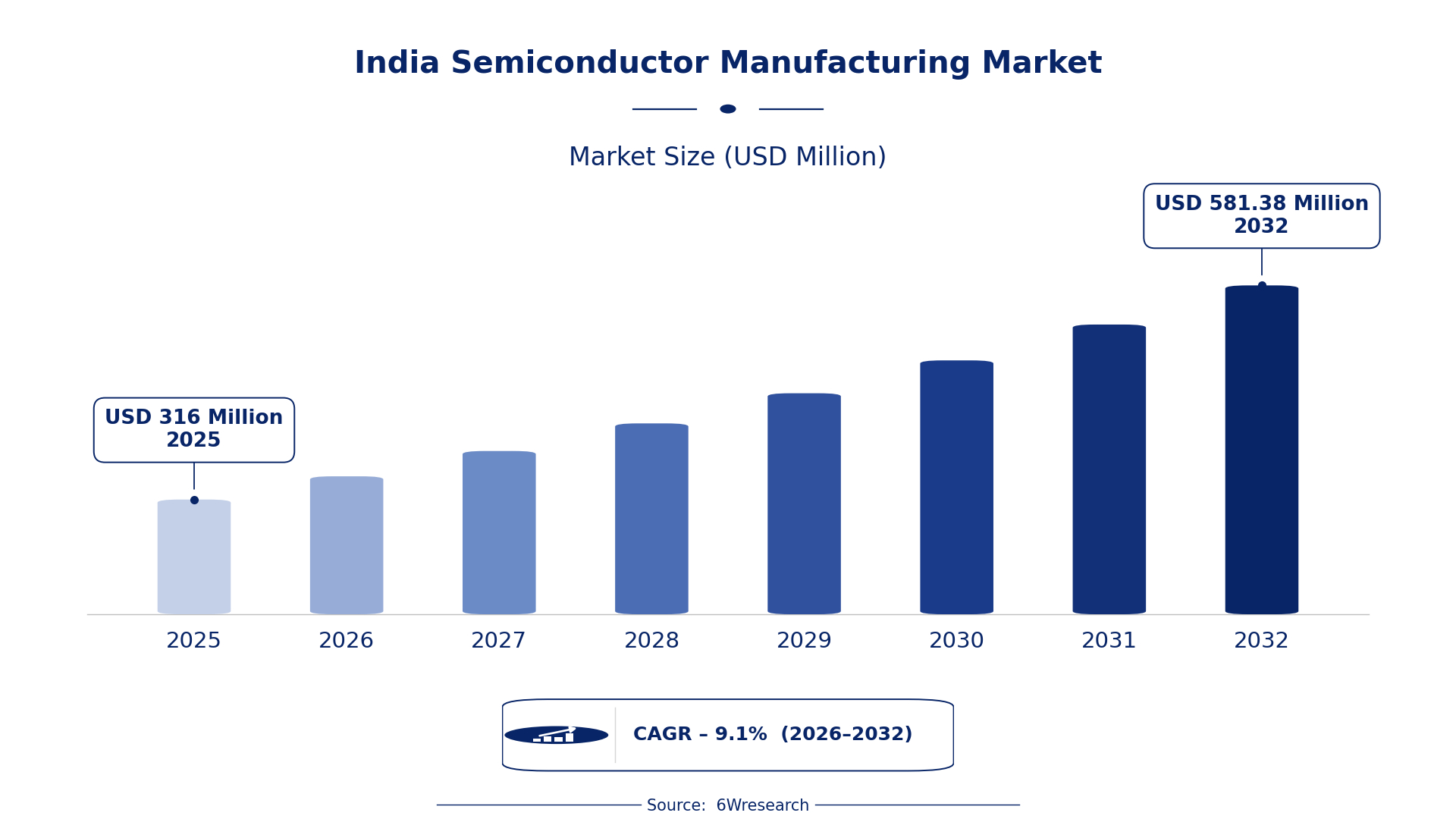
According to 6Wresearch internal database and industry insights, the India Semiconductor Manufacturing Market was valued at USD 316.0 million in 2025 and is projected to reach USD 581.38 million by 2032, growing at a CAGR of approximately 9.1% during 2026–2032.
India Semiconductor Manufacturing Market Highlights
| Report Metric | Details |
| Report Name | India Semiconductor Manufacturing Market |
| Market Size 2025 | USD 316.0 million |
| Market Size 2032 | USD 581.38 million |
| Absolute Growth 2025–2032 | USD 265.38 million |
| CAGR 2026–2032 | 9.1% |
| Peak Annual Growth | 11.4% in 2030 |
| Forecast Period | 2026–2032 |
| Historical Data | 2022–2025 |
| Base Year | 2025 |
| Leading Process Node, 2025 | 5nm & Below (43% share) |
| Leading Fabrication Type, 2025 | Advanced Logic (40% share) |
| Leading Integration Model, 2025 | Foundry Model (33% share) |
| Leading End User, 2025 | Fabless Design Houses (49% share) |
| Fastest-Growing Process Node | 28nm–65nm (11.9% CAGR) |
| Fastest-Growing Integration Model | Pure-Play Foundry (10.4% CAGR) |
| Fastest-Growing End User | Consumer Electronics OEMs (10.9% CAGR) |
| Growing Sector | Consumer Electronics OEMs |
| Key End Users | Fabless Design Houses, Consumer Electronics OEMs, Automotive Electronics, Industrial IoT Firms |
India Semiconductor Manufacturing Market Year-wise Growth Rate and Key Drivers (2022–2032)
This graph illustrates the annual growth rates of the market from 2022 to 2032, highlighting a steady upward trajectory and projected market expansion over the forecast period.
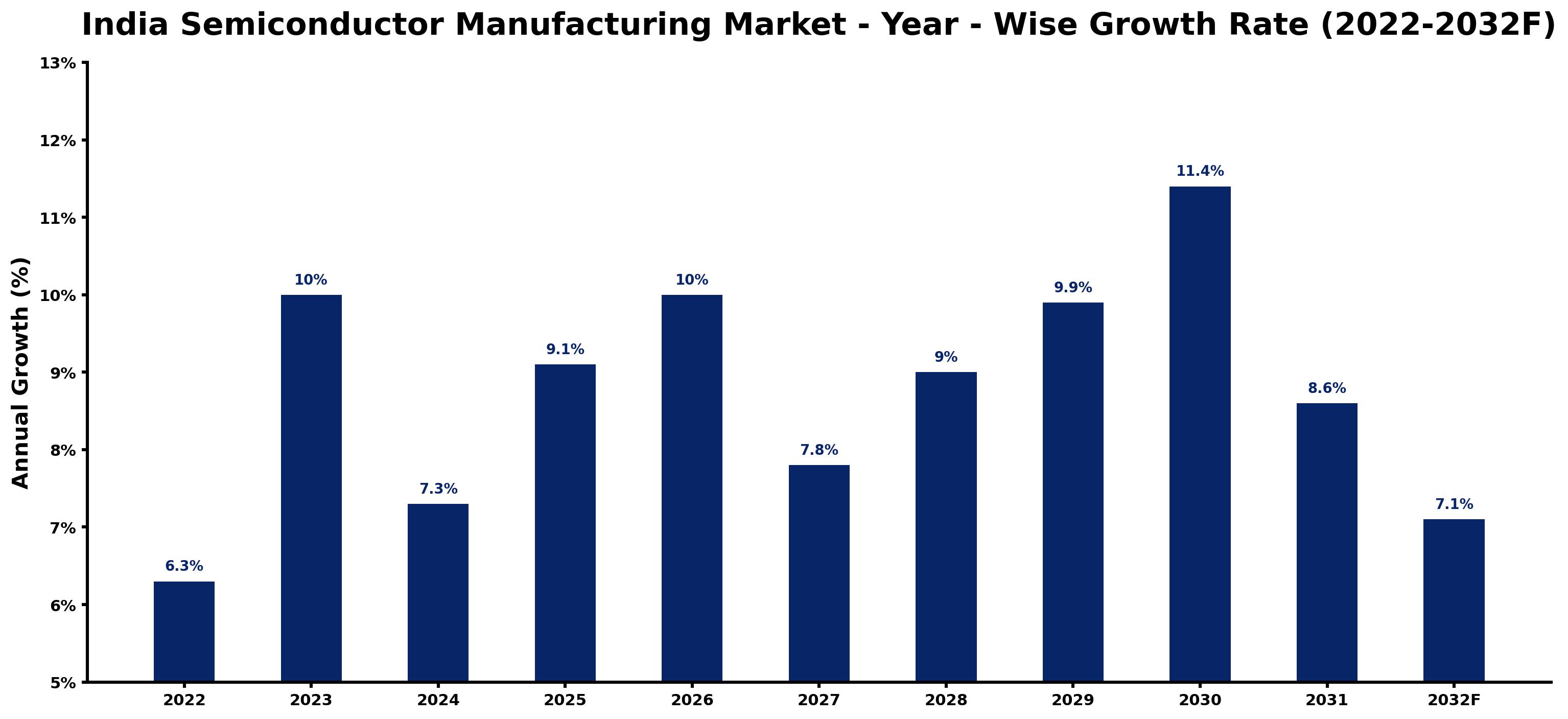
Below, each year's estimated growth is shown next to the factor that most influenced it.
| Year | Estimated Annual Growth (%) | Market Rationale |
| 2022 | 6.3 | The market experienced steady demand from domestic electronics manufacturers. |
| 2023 | 10.0 | Growth accelerated due to increased investments in semiconductor facilities across the country. |
| 2024 | 7.3 | The market saw a slowdown as some projects faced delays in approvals. |
| 2025 | 9.1 | Demand surged with the government's push for local semiconductor production. |
| 2026 | 10.0 | Investment in advanced fabrication technologies is expected to boost growth in the sector. |
| 2027 | 7.8 | A slowdown occurred as the market adjusted to new production capacities. |
| 2028 | 9.0 | Consumer electronics demand is expected to drive growth as new products are launched. |
| 2029 | 9.9 | The market will continue to expand with rising automotive electronics integration. |
| 2030 | 11.4 | The peak growth year will be driven by substantial foreign investments in technology. |
| 2031 | 8.6 | Growth will slow due to the 'Production Linked Incentive Scheme' normalising the market. |
| 2032 | 7.1 | The market is projected to grow steadily as local production ramps up. |
Note: Market size estimations and growth projections presented in this report are based on 6Wresearch's proprietary forecasting methodology, utilizing the latest available industry data, government publications, and primary research inputs.
India Semiconductor Manufacturing Market Synopsis
The India Semiconductor Manufacturing Market encompasses the design and fabrication of semiconductor devices using silicon wafers. Key processes include photolithography, etching, and doping, with primary applications in consumer electronics and automotive sectors. The market is expanding due to rising domestic demand and investments in electronics manufacturing, supported by initiatives like the Semiconductor Mission launched in 2021. With a population exceeding 1.4 billion, the demand for semiconductors is expected to increase, driving further growth in the sector. Major buyers include consumer electronics OEMs and automotive electronics manufacturers, who are increasingly reliant on local semiconductor production.
Market Dynamics Impact Analysis (2026–2032)
| Factor | Type | Impact | Primary Segment Affected |
| Rising investments in semiconductor fabrication facilities are boosting production capacity. | Driver | High | Foundry Model |
| Growing demand for automotive electronics is increasing semiconductor consumption. | Driver | High | Automotive Electronics |
| The government aims for a $300 billion electronics manufacturing industry by 2026, creating opportunities for suppliers. | Opportunity | High | Consumer Electronics OEMs |
| The establishment of new fabrication facilities in Karnataka is creating investment opportunities. | Opportunity | Medium | Advanced Logic |
| Delays in regulatory approvals can slow down project timelines for manufacturers. | Restraint | High | Pure-Play Foundry |
| Limited availability of skilled workforce in semiconductor technologies poses challenges for growth. | Restraint | Medium | FinFET |
| High initial capital investment requirements can deter new entrants into the market. | Challenge | High | Legacy Node |
| Supply chain disruptions can impact the availability of critical materials for production. | Challenge | Medium | 28nm–65nm |
Evaluation of Drivers in India Semiconductor Manufacturing Market (2026–2032)
The main growth drivers and the segments they affect most are set out below.
| Drivers | Primary Segment Affected | Why It Matters (Evidence) |
| Increased government incentives for semiconductor manufacturing encourage new projects. | Foundry Model | The 'Semiconductor Mission' allocates $10 billion, attracting investments in fabrication facilities. |
| Rising demand for consumer electronics drives semiconductor production. | Consumer Electronics OEMs | India's population of over 1.4 billion fuels the need for electronic devices. |
| The push for electric vehicles is increasing semiconductor integration in automotive applications. | Automotive Electronics | The Automotive Mission Plan 2026 aims to grow the automotive electronics market by expanding semiconductor integration. |
| Technological advancements in fabrication processes improve production efficiency. | Advanced Logic | Investments in 5nm and below nodes are critical for high-performance computing. |
| The establishment of electronics manufacturing clusters supports local semiconductor production. | Pure-Play Foundry | The Electronics Manufacturing Cluster Scheme provides financial assistance for facility setup. |
The 'Semiconductor Mission' allocates $10 billion, encouraging investments in new fabrication facilities. Demand for electronic devices continues to rise, prompting manufacturers to increase production. The Automotive Mission Plan 2026 boosts semiconductor integration in automotive applications, further driving demand. The establishment of electronics manufacturing clusters provides financial assistance for new facilities, strengthening local production capabilities.
Evaluation of Restraints in India Semiconductor Manufacturing Market
The main factors holding the market back are set out below.
| Market Restraint | Primary Segment Affected | Why It Matters (Evidence) |
| Delays in regulatory approvals can hinder project timelines. | Foundry Model | Manufacturers face extended waiting periods for necessary permits, affecting production schedules. |
| Limited access to skilled workforce can restrict operational capacity. | FinFET | The semiconductor sector requires specialised skills that are currently in short supply. |
| High initial capital investment can deter new entrants into the market. | Legacy Node | The cost of setting up fabrication facilities is a barrier for startups. |
| Supply chain disruptions can lead to material shortages. | 28nm–65nm | Global supply chain issues affect the availability of essential semiconductor materials. |
| Intense competition among manufacturers can pressure profit margins. | Pure-Play Foundry | Price wars and aggressive marketing strategies impact profitability for existing players. |
India Semiconductor Manufacturing Market Challenges
High skills shortages in the India semiconductor manufacturing market impede production efficiency, costing producers up to 30% in potential output due to delays in project timelines. Limited educational programmes fail to produce enough trained professionals, directly affecting producers' ability to meet the increasing demand for semiconductor devices. Local manufacturers face intense competition from established global players, forcing them to lower prices and eroding profit margins, complicating their operational sustainability. Rapid technological advancements create a gap in capabilities, making it difficult for buyers to access essential products and delaying their product launches.
Trends in the India Semiconductor Manufacturing Market
Several trends are reshaping the India Semiconductor Manufacturing Market; the most important are set out below.
- Shift Towards Advanced Nodes: India is increasingly focusing on advanced semiconductor nodes, with 5nm and below projected to dominate production. The government aims for 43% of the market share in this segment by 2025, promoting competitiveness.
- Growing Demand from Automotive Sector: Automotive Electronics are experiencing growth, driven by the push for electric vehicles. The Automotive Mission Plan 2026 targets a substantial increase in semiconductor integration, aiming for a significant market expansion.
- Expansion of Electronics Manufacturing Clusters: Electronics Manufacturing Clusters are being established across India to support semiconductor production. The Electronics Manufacturing Cluster Scheme provides financial assistance, with numerous projects funded to boost local manufacturing capabilities.
- Rise of Fabless Design Houses: Fabless Design Houses are becoming key players in India's semiconductor ecosystem, contributing to innovation. This segment is projected to hold a 49% market share by 2025, reflecting its growing importance.
Investment Opportunities in the India Semiconductor Manufacturing Market
The following opportunities in the India Semiconductor Manufacturing Market pair current demand with a clear way in.
- $300 Billion Electronics Manufacturing Target: With the government's aim for a $300 billion electronics manufacturing industry by 2026, there is an opportunity for semiconductor suppliers. Collaborating with Consumer Electronics OEMs can facilitate market entry.
- Investment in Advanced Logic Production: The advanced logic segment is set to grow, driven by demand for high-performance computing. Investing in fabrication facilities in Karnataka can capture this expanding market.
- Expansion of Automotive Electronics: The automotive electronics market is set for growth, with increasing integration of semiconductors in vehicles. Suppliers can engage with automotive manufacturers to meet demand.
- Development of Skilled Workforce: There is a pressing need for skilled professionals in semiconductor technologies. Collaborating with educational institutions can help develop the necessary talent pool for the industry.
Government Initiatives in the India Semiconductor Manufacturing Market
The 'Semiconductor Mission' launched in 2021 by the Ministry of Electronics and Information Technology aims to promote local semiconductor manufacturing with a budget of $10 billion. This initiative builds on the 'National Policy on Electronics' updated in 2020, which enhances local manufacturing capabilities and attracts investments in the semiconductor sector. The mission is projected to boost production capacities and foster innovation in the industry.
The Electronics Sector Skill Council of India oversees various schemes that support semiconductor manufacturing. The 'Production Linked Incentive Scheme' initiated in 2021 provides financial incentives to manufacturers, encouraging increased production. Additionally, the 'Electronics Manufacturing Cluster Scheme' offers funding for establishing semiconductor facilities, ensuring that projects receive the necessary financial backing to succeed. These measures collectively aim to strengthen India's semiconductor ecosystem.
Future Insight of the India Semiconductor Manufacturing Market
The India semiconductor manufacturing market will undergo significant changes by 2032, driven by government initiatives like the Semiconductor Mission and a focus on local production. The establishment of a semiconductor manufacturing framework by 2025 will enhance production capabilities and support industry growth. The National Policy on Electronics aims for a $300 billion electronics manufacturing industry by 2026, which will increase demand for semiconductor devices. Training programmes from the National Institute of Electronics and Information Technology will develop a skilled workforce, ensuring the industry is ready for future opportunities.
Market Segmentation Analysis
The report offers a comprehensive study of the following market segments and their leading categories in the market.
By Process Node – 5nm & Below Dominated, 28nm–65nm Expected to Grow Fastest
According to Shubham Padhi, Research Analyst at 6Wresearch, 5nm & Below took a 43% share of process node in 2025, more than any other category. The 5nm & Below process node holds the largest share due to its critical use in high-performance computing and mobile devices, which are in high demand across India. This segment's significance is highlighted by the increasing focus on advanced telecommunications and computing technologies. Over 2026–2032, 28nm–65nm is expected to post the fastest growth, at a CAGR of 11.9%. The 28nm–65nm process node is experiencing rapid growth as it is widely adopted in consumer electronics and IoT devices, which are becoming essential in everyday life. This growth is driven by the surge in popularity of smart home technologies and connected devices, prompting manufacturers to embrace this process. Suppliers should focus on enhancing their capabilities in the 28nm–65nm segment to effectively meet the rising demand in consumer electronics.
By Fabrication Type – Advanced Logic Dominated and Is Expected to Record the Fastest Growth
In 2025, Advanced Logic led the fabrication type split with a 40% share. Advanced Logic commands the largest share in the semiconductor manufacturing market because it is essential for powering modern computing and mobile applications. This segment thrives on the increasing complexity of devices that require advanced processing capabilities, making it vital for manufacturers. Advanced Logic is also forecast to expand faster than any other category, at a CAGR of 10.5% over 2026–2032. Advanced Logic is also the fastest-growing segment, and its lead will continue to expand due to the persistent demand for high-performance chips in emerging technologies like AI and 5G. The ongoing transition towards more sophisticated applications ensures that this segment remains at the forefront of the market. Suppliers must prioritise investments in Advanced Logic technologies to stay competitive in the rapidly evolving semiconductor sector.
By Integration Model – Foundry Model Dominated, Pure-Play Foundry Expected to Grow Fastest
The largest integration model category in 2025 was Foundry Model, with a 33% share of total revenue. The Foundry Model leads the market share as it is the most common approach for semiconductor fabrication in India, offering flexibility and scalability for various manufacturers. This model accommodates a wide range of applications, making it a preferred choice for companies aiming to optimise production processes. Pure-Play Foundry is set to record the highest CAGR in this split, 10.4% over 2026–2032. The Pure-Play Foundry model is witnessing rapid growth as it specifically serves companies focused solely on semiconductor manufacturing without design involvement. This trend reflects the increasing dependence on specialised foundries to satisfy the rising demand for custom chips across different sectors. Manufacturers should explore the Pure-Play Foundry model to improve operational efficiency and better address specific client requirements.
By End User – Fabless Design Houses Dominated, Consumer Electronics OEMs Expected to Grow Fastest
Fabless Design Houses held a 49% share of the India Semiconductor Manufacturing Market by end user in 2025. Fabless Design Houses dominate the market share as they are integral to the semiconductor ecosystem, concentrating on design while outsourcing manufacturing. Their strategic position enables rapid innovation and responsiveness to market demands, significantly contributing to the industry's expansion. The quickest growth will come from Consumer Electronics OEMs, forecast to expand at a CAGR of 10.9% between 2026 and 2032. Consumer Electronics OEMs represent the fastest-growing segment, fuelled by the surging demand for smart devices and consumer electronics. This growth underscores the heightened integration of semiconductor technology in everyday products, creating substantial opportunities for suppliers. Suppliers should align their product offerings with the requirements of Consumer Electronics OEMs to capitalise on opportunities in this fast-growing segment.
Key Attractiveness of the Report
- 10 Years of Market Numbers
- Historical Data Starting from 2022 to 2025
- Base Year 2025
- Forecast Data until 2032
- Key Performance Indicators Impacting the Market
- Major Upcoming Developments and Projects
Key Highlights of the Report:
- India Semiconductor Manufacturing Market Outlook
- Market Size of India Semiconductor Manufacturing Market, 2025
- Forecast of India Semiconductor Manufacturing Market, 2032
- Historical Data and Forecast of India Semiconductor Manufacturing Revenues & Volume for the Period 2022 - 2032F
- India Semiconductor Manufacturing Market Trend Evolution
- India Semiconductor Manufacturing Market Drivers and Challenges
- India Semiconductor Manufacturing Price Trends
- India Semiconductor Manufacturing Porter's Five Forces
- India Semiconductor Manufacturing Industry Life Cycle
- Historical Data and Forecast of India Semiconductor Manufacturing Market Revenues & Volume By Process Node for the Period 2022 - 2032F
- Historical Data and Forecast of India Semiconductor Manufacturing Market Revenues & Volume By 5nm & Below for the Period 2022 - 2032F
- Historical Data and Forecast of India Semiconductor Manufacturing Market Revenues & Volume By 7nm 16nm for the Period 2022 - 2032F
- Historical Data and Forecast of India Semiconductor Manufacturing Market Revenues & Volume By 28nm 65nm for the Period 2022 - 2032F
- Historical Data and Forecast of India Semiconductor Manufacturing Market Revenues & Volume By Analog Mixed Signal for the Period 2022 - 2032F
- Historical Data and Forecast of India Semiconductor Manufacturing Market Revenues & Volume By Fabrication Type for the Period 2022 - 2032F
- Historical Data and Forecast of India Semiconductor Manufacturing Market Revenues & Volume By Advanced Logic for the Period 2022 - 2032F
- Historical Data and Forecast of India Semiconductor Manufacturing Market Revenues & Volume By FinFET for the Period 2022 - 2032F
- Historical Data and Forecast of India Semiconductor Manufacturing Market Revenues & Volume By Legacy Node for the Period 2022 - 2032F
- Historical Data and Forecast of India Semiconductor Manufacturing Market Revenues & Volume By Specialized for the Period 2022 - 2032F
- Historical Data and Forecast of India Semiconductor Manufacturing Market Revenues & Volume By Integration Model for the Period 2022 - 2032F
- Historical Data and Forecast of India Semiconductor Manufacturing Market Revenues & Volume By Foundry Model for the Period 2022 - 2032F
- Historical Data and Forecast of India Semiconductor Manufacturing Market Revenues & Volume By IDM Foundry for the Period 2022 - 2032F
- Historical Data and Forecast of India Semiconductor Manufacturing Market Revenues & Volume By Pure-Play Foundry for the Period 2022 - 2032F
- Historical Data and Forecast of India Semiconductor Manufacturing Market Revenues & Volume By IDM for the Period 2022 - 2032F
- Historical Data and Forecast of India Semiconductor Manufacturing Market Revenues & Volume By End User for the Period 2022 - 2032F
- Historical Data and Forecast of India Semiconductor Manufacturing Market Revenues & Volume By Fabless Design Houses for the Period 2022 - 2032F
- Historical Data and Forecast of India Semiconductor Manufacturing Market Revenues & Volume By Consumer Electronics OEMs for the Period 2022 - 2032F
- Historical Data and Forecast of India Semiconductor Manufacturing Market Revenues & Volume By Industrial IoT Firms for the Period 2022 - 2032F
- Historical Data and Forecast of India Semiconductor Manufacturing Market Revenues & Volume By Automotive Electronics for the Period 2022 - 2032F
- India Semiconductor Manufacturing Import Export Trade Statistics
- Market Opportunity Assessment By Process Node
- Market Opportunity Assessment By Fabrication Type
- Market Opportunity Assessment By Integration Model
- Market Opportunity Assessment By End User
- India Semiconductor Manufacturing Top Companies Market Share
- India Semiconductor Manufacturing Competitive Benchmarking By Technical and Operational Parameters
- India Semiconductor Manufacturing Company Profiles
- India Semiconductor Manufacturing Key Strategic Recommendations
Market Covered
Segments analysed in this report are listed below.
By Process Node
- 5nm & Below
- 7nm–16nm
- 28nm–65nm
- Analog + Mixed Signal
By Fabrication Type
- Advanced Logic
- FinFET
- Legacy Node
- Specialized
By Integration Model
- Foundry Model
- IDM + Foundry
- Pure-Play Foundry
- IDM
By End User
- Fabless Design Houses
- Consumer Electronics OEMs
- Industrial IoT Firms
- Automotive Electronics































