China Sensor-Based Faucets Market Size & Growth Rate
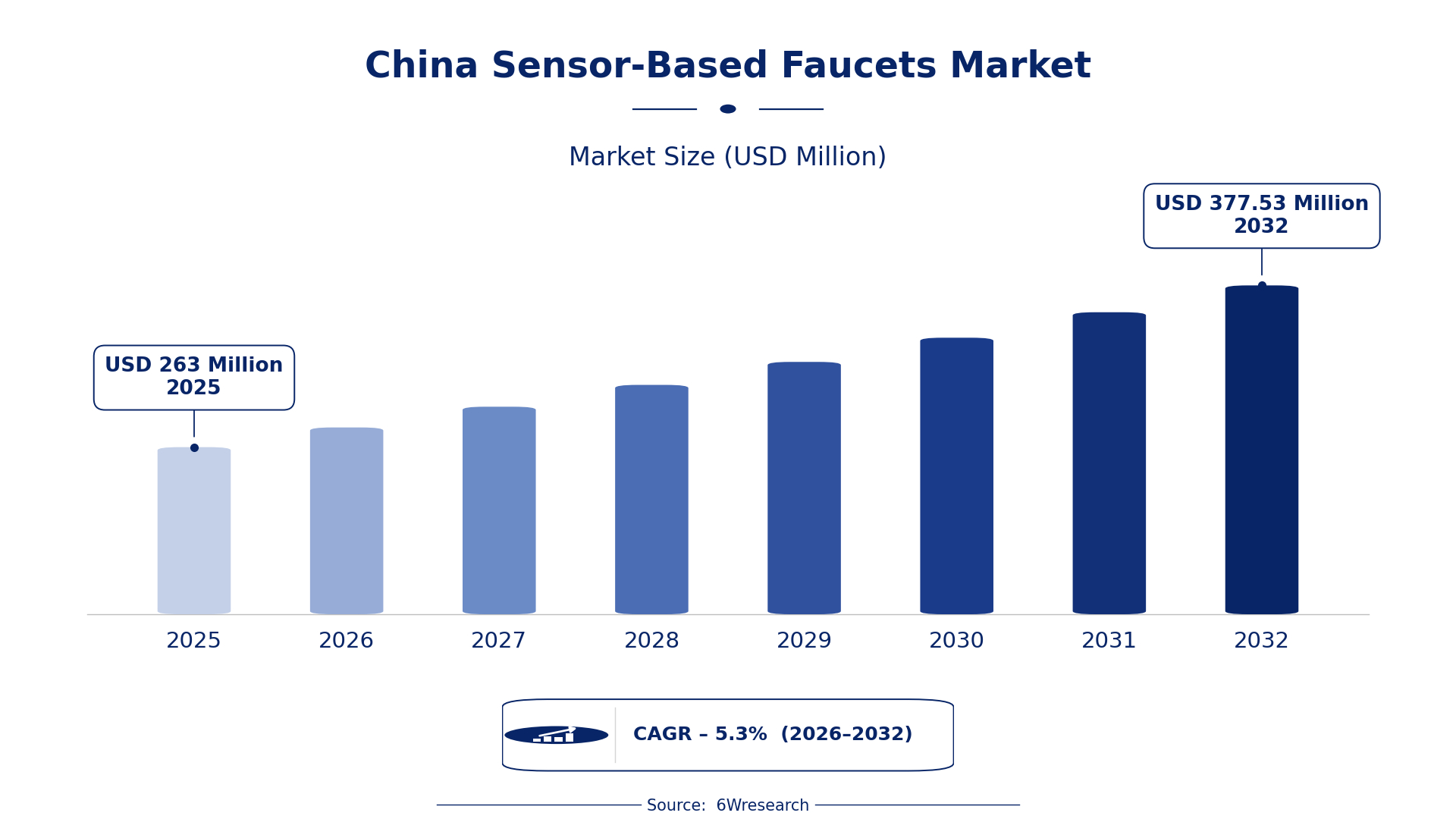
According to 6Wresearch internal database and industry insights, the China Sensor-Based Faucets Market was valued at USD 263.0 million in 2025 and is projected to reach USD 377.53 million by 2032, growing at a CAGR of approximately 5.3% during 2026–2032.
China Sensor-Based Faucets Market Highlights
| Report Metric | Details |
| Report Name | China Sensor-Based Faucets Market |
| Market Size 2025 | USD 263.0 million |
| Market Size 2032 | USD 377.53 million |
| Absolute Growth 2025–2032 | USD 114.53 million |
| CAGR 2026–2032 | 5.3% |
| Peak Annual Growth | 6.7% in 2031 |
| Forecast Period | 2026–2032 |
| Historical Data | 2022–2025 |
| Base Year | 2025 |
| Leading Faucet Type, 2025 | Touchless Faucets (38% share) |
| Leading Sensor Type, 2025 | Infrared Sensors (45% share) |
| Leading Power Source, 2025 | AC Powered (44% share) |
| Leading End User, 2025 | Hotels & Restaurants (43% share) |
| Fastest-Growing Faucet Type | Hybrid Faucets (6.9% CAGR) |
| Fastest-Growing Sensor Type | Capacitive Sensors (6.5% CAGR) |
| Fastest-Growing Power Source | Rechargeable (7.5% CAGR) |
| Fastest-Growing End User | Smart Homes (6.4% CAGR) |
| Growing Sector | Healthcare Facilities |
| Key End Users | Hotels & Restaurants, Healthcare Facilities, Smart Homes, Airports & Malls |
China Sensor-Based Faucets Market Year-wise Growth Rate and Key Drivers (2022–2032)
This graph illustrates the annual growth rates of the market from 2022 to 2032, highlighting a steady upward trajectory and projected market expansion over the forecast period.
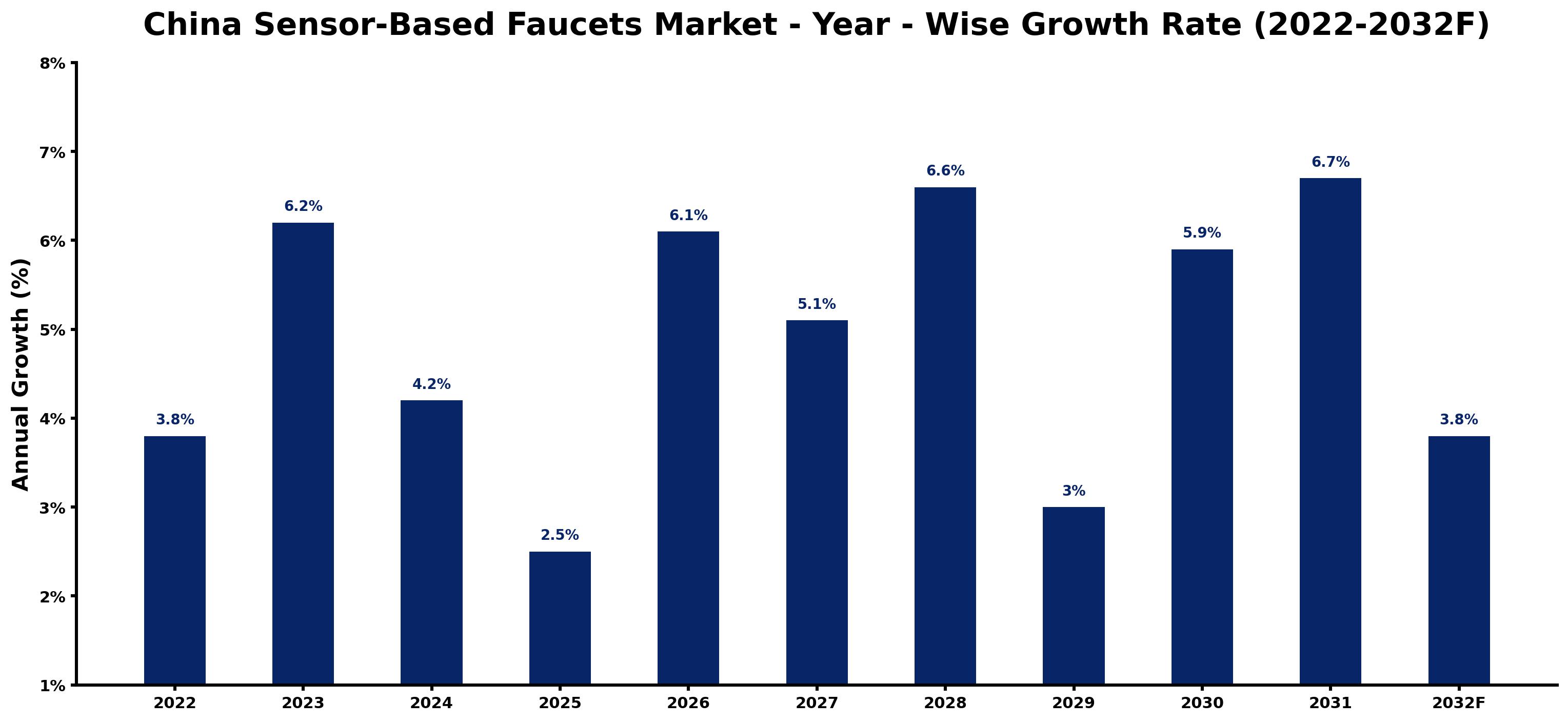
Below, each year's estimated growth is shown next to the factor that most influenced it.
| Year | Estimated Annual Growth (%) | Market Rationale |
| 2022 | 3.8 | The market showed steady growth, reflecting increased urbanisation and demand for smart fixtures. |
| 2023 | 6.2 | Growth accelerated due to heightened awareness of hygiene in public spaces and healthcare facilities, particularly from the updated guidelines by the Ministry of Health. |
| 2024 | 4.2 | A slowdown occurred as the market adjusted to previous rapid growth rates and changing consumer preferences, influenced by the National Standard GB 19581-2004. |
| 2025 | 2.5 | Continued growth was observed, albeit at a slower pace, as the market matured and competition intensified, especially in tier-one cities. |
| 2026 | 6.1 | Growth is expected to pick up again, driven by rising investments in smart technologies and urban infrastructure, supported by the 'Green Building Action Plan'. |
| 2027 | 5.1 | A slowdown in growth is anticipated as market saturation begins to impact new installations, particularly in the hospitality sector. |
| 2028 | 6.6 | Demand is projected to surge again, supported by increased adoption of smart home technologies and water-saving initiatives, reflecting consumer trends. |
| 2029 | 3.0 | Growth is expected to slow as the market faces challenges from supply chain disruptions and rising costs, affecting procurement timelines. |
| 2030 | 5.9 | A rebound in growth is projected, driven by renewed investments in commercial infrastructure and hospitality sectors, enhancing market opportunities. |
| 2031 | 6.7 | The market is expected to peak with strong growth, propelled by the integration of advanced technologies in urban settings, particularly in public facilities. |
| 2032 | 3.8 | A slowdown is anticipated as the market stabilises, reflecting a mature phase of sensor-based faucet adoption, influenced by evolving consumer preferences. |
Note: Market size estimations and growth projections presented in this report are based on 6Wresearch's proprietary forecasting methodology, utilizing the latest available industry data, government publications, and primary research inputs.
China Sensor-Based Faucets Market Synopsis
The China Sensor-Based Faucets Market encompasses advanced fixtures that utilise sensors for automatic water flow. Constructed from durable materials such as brass or stainless steel, these faucets promote hygiene and conserve water. Urbanisation drives market growth, with the urban population reaching 920 million in 2022. Key demand sources include the hospitality and healthcare sectors, which prioritise user experience and sustainability. By 2025, the smart home market is expected to surpass 600 billion yuan, further accelerating the adoption of faucet technology.
Market Dynamics Impact Analysis (2026–2032)
| Factor | Type | Impact | Primary Segment Affected |
| Rising urbanisation and population density drive demand for smart fixtures in public and commercial spaces. | Driver | High | Touchless Faucets |
| Increased focus on hygiene in healthcare facilities leads to higher adoption of sensor-based faucets. | Driver | High | Commercial Faucets |
| Growing investments in smart home technologies create opportunities for innovative faucet designs. | Opportunity | High | Smart Homes |
| The 'Green Building Action Plan' encourages the use of water-saving fixtures in urban development. | Opportunity | High | Healthcare Facilities |
| Supply chain disruptions impact the availability of components for sensor-based faucets. | Restraint | High | Touchless Faucets |
| Rising production costs for materials like brass and stainless steel constrain market growth. | Restraint | Medium | Commercial Faucets |
| Regulatory approvals for new designs can delay market entry for innovative products. | Challenge | High | Hybrid Faucets |
| Competition from traditional faucets may limit market penetration of sensor-based options. | Challenge | Medium | Wall-Mounted Faucets |
Evaluation of Drivers in China Sensor-Based Faucets Market (2026–2032)
The main growth drivers and the segments they affect most are set out below.
| Drivers | Primary Segment Affected | Why It Matters (Evidence) |
| Increased urbanisation leads to higher demand for smart fixtures in public spaces. | Touchless Faucets | The population of urban areas reached 920 million in 2022, driving installations of sensor-based products. |
| Heightened hygiene awareness in healthcare facilities boosts sensor faucet adoption. | Commercial Faucets | Over 30,000 hospitals in China are adopting these fixtures to improve hygiene standards and reduce infection risks. |
| Rising investments in smart home technologies drive demand for advanced faucet designs. | Smart Homes | Smart home adoption is projected to reach 50% by 2025, influencing the design and technology of faucets. |
| Government initiatives promote water-saving technologies in urban developments. | Healthcare Facilities | The 'Green Building Action Plan' launched in 2023 encourages the installation of sensor faucets in new projects. |
| Growing focus on sustainability in commercial sectors increases demand for efficient fixtures. | Hotels & Restaurants | The average daily water consumption in hotels is estimated at 200 liters per room, driving the need for efficient faucets. |
The Sensor-Based Faucets market in China is growing on the back of rising urbanisation, increasing investments, and heightened end-use demand. The population in urban areas reached 920 million in 2022, leading to greater installations of smart fixtures. The healthcare sector, with over 30,000 hospitals, is adopting sensor faucets to improve hygiene standards. The 'Green Building Action Plan' launched in 2023 promotes water-saving technologies, creating additional opportunities for growth. By 2025, smart home adoption is set to reach 50%, driving demand for advanced faucet designs that meet consumer expectations.
Evaluation of Restraints in China Sensor-Based Faucets Market
The following restraints limit how fast demand can grow.
| Market Restraint | Primary Segment Affected | Why It Matters (Evidence) |
| Supply chain disruptions delay the availability of sensor faucet components. | Touchless Faucets | Manufacturers face challenges in sourcing essential electronic components due to global shortages, leading to delays in production. |
| Rising production costs for materials limit profitability for manufacturers. | Commercial Faucets | The increasing prices of brass and stainless steel affect overall production expenses, squeezing margins for producers. |
| Regulatory approvals for new designs can extend time to market. | Hybrid Faucets | New designs require compliance with national standards, which can delay their introduction into the market. |
| Competition from traditional faucets poses challenges to market penetration. | Wall-Mounted Faucets | Established products remain popular, making it difficult for sensor-based alternatives to gain market share. |
| Consumer price sensitivity affects purchasing decisions in the commercial sector. | Touchless Faucets | Higher initial costs of sensor faucets may deter some buyers in cost-conscious markets, impacting sales. |
China Sensor-Based Faucets Market Challenges
The China Sensor-Based Faucets Market faces notable supply chain challenges stemming from reliance on imported electronic components, which can delay production timelines for suppliers. This dependency may extend lead times by up to three months, resulting in lost sales opportunities for manufacturers in a rapidly expanding urban market. Buyers in the hospitality sector encounter regulatory hurdles, as compliance with the National Standard GB 19581-2004 can slow procurement processes, delaying installations in new hotels and impacting potential revenue. Rising material costs for brass and stainless steel can inflate prices by as much as 15%, complicating budgeting for renovations and new projects for buyers.
Trends in the China Sensor-Based Faucets Market
Buyers and suppliers in the China Sensor-Based Faucets Market are adjusting to the following trends.
- Rise in Smart Home Installations: In 2022, the number of smart homes in China reached 70 million, driving demand for sensor-based products. This trend is expected to influence faucet designs and technology significantly by 2025.
- Government Support for Water Efficiency: The 'Water Efficiency Labeling Program' initiated in 2020 promotes water-saving products, leading to increased consumer awareness and adoption of sensor-based faucets in urban settings. This initiative is crucial for driving market growth.
- Growth in Healthcare Facility Upgrades: In 2022, the Ministry of Health updated hygiene guidelines, recommending touchless fixtures. This has resulted in a surge in sensor faucet installations across hospitals nationwide, enhancing hygiene standards.
- Expansion of Commercial Sector Demand: The market for commercial faucets is particularly growing in tier-one cities like Beijing and Shanghai. This trend is driven by the need for efficient water management in hotels and restaurants, creating new opportunities for suppliers.
Investment Opportunities in the China Sensor-Based Faucets Market
Below are the investment opportunities with the strongest case in the China Sensor-Based Faucets Market.
- Investment in Urban Development Projects: In tier-one cities, urban development projects are increasing the demand for sensor-based faucets. The government has allocated funding to promote water-saving technologies, creating ripe opportunities for suppliers to engage with developers.
- Partnerships with Healthcare Facilities: Now is an excellent time to partner with healthcare facilities that are upgrading their infrastructure. The focus on hygiene and infection control is driving demand for sensor-based faucets, making collaborations beneficial.
- Expansion into Smart Home Market: With smart home adoption projected to reach 50% by 2025, suppliers should focus on advanced designs. Collaborating with smart home technology providers can facilitate market entry and growth.
- Government Initiatives: The 'Green Building Action Plan' launched in 2023 presents opportunities for suppliers. Engaging with urban developers can facilitate the integration of water-saving fixtures in new constructions, enhancing market presence.
Government Initiatives in the China Sensor-Based Faucets Market
The Ministry of Housing and Urban-Rural Development oversees the implementation of the 'Green Building Action Plan', which funds projects promoting water-saving technologies. Additionally, the National Development and Reform Commission approved the 'Smart Water Management Strategy' in 2021, encouraging sensor faucet adoption in urban settings. These agencies play a key role in facilitating funding and approvals for projects that improve water efficiency, creating a supportive framework for manufacturers and buyers alike. Their efforts contribute to the integration of smart technologies in urban infrastructure, driving demand for sensor-based faucets.
The Ministry of Health has updated guidelines for hygiene in healthcare facilities, recommending touchless fixtures to reduce infection risks. This has led to increased installations of sensor faucets in hospitals, further supported by the 'Water Efficiency Labeling Program', which promotes water-saving products. These measures aim to improve public health and sustainability in urban environments, ensuring that sensor-based faucets are a priority in new constructions and renovations.
Future Insight of the China Sensor-Based Faucets Market
The China Sensor-Based Faucets Market is poised for positive developments by 2032, driven by multiple factors. The government's 'Green Building Action Plan' will stimulate demand for water-saving technologies, benefiting both commercial and residential buyers. The healthcare sector's ongoing expansion will further promote the adoption of sensor-based faucets, focusing on hygiene in hospitals and clinics. Smart home integration will evolve, with the number of smart homes expected to reach 100 million, creating new opportunities for suppliers to innovate and meet consumer needs.
Market Segmentation Analysis
The report offers a comprehensive study of the following market segments and their leading categories in the market.
By Faucet Type – Touchless Faucets Dominated, Hybrid Faucets Expected to Grow Fastest
According to Dhaval Chaurasia, Assistant Manager at 6Wresearch, Touchless Faucets took a 38% share of faucet type in 2025, more than any other category. Touchless faucets hold the largest market share due to their widespread use in public and commercial spaces, where hygiene is paramount. For instance, urban hotels and restaurants have adopted these fixtures to improve cleanliness and enhance guest satisfaction. The quickest growth will come from Hybrid Faucets, forecast to expand at a CAGR of 6.9% between 2026 and 2032. Hybrid faucets are witnessing significant growth as consumers increasingly prefer versatile solutions that combine traditional and modern features. This trend is particularly strong in urban residential areas, where multifunctional fixtures are highly sought after. Suppliers should focus on developing touchless and hybrid faucet solutions to meet the increasing demand for hygiene and convenience.
By Sensor Type – Infrared Sensors Dominated, Capacitive Sensors Expected to Grow Fastest
The largest sensor type category in 2025 was Infrared Sensors, with a 45% share of total revenue. Infrared sensors lead the market as they are the standard for automatic activation in touchless faucets, widely adopted in commercial settings. Their effectiveness in promoting hygiene makes them a preferred choice in high-traffic areas like hotels and restaurants. Over 2026–2032, Capacitive Sensors are expected to post the fastest growth, at a CAGR of 6.5%. Capacitive sensors are experiencing rapid growth as they are increasingly integrated into high-end residential faucets, appealing to tech-savvy consumers. This shift indicates a rising demand for advanced features in home fixtures, particularly in urban developments. Manufacturers must invest in sensor technology advancements to cater to the evolving preferences of both commercial and residential buyers.
By Power Source – AC Powered Dominated, Rechargeable Expected to Grow Fastest
With a 44% revenue share in 2025, AC Powered was the largest power source category. AC powered faucets dominate the market share as they are the standard choice in most commercial installations, ensuring continuous operation in high-demand environments. This reliability is crucial in settings like hotels and restaurants, where consistent service is essential for guest satisfaction. Rechargeable is projected to grow fastest, at a CAGR of 7.5% during 2026–2032. Rechargeable faucets are emerging as the fastest-growing segment, appealing to consumers who prioritise convenience and contemporary aesthetics in their homes. This trend is particularly noticeable in urban areas where smart home technology is becoming more prevalent. Suppliers should consider expanding their product lines to include rechargeable options to cater to the growing smart home market.
By End User – Hotels & Restaurants Dominated, Smart Homes Expected to Grow Fastest
Hotels & Restaurants held a 43% share of the China Sensor-Based Faucets Market by end user in 2025. Hotels and restaurants represent the largest market share, as these establishments prioritise enhancing guest experience and sustainability in their operations. The high water consumption in these facilities drives the demand for efficient sensor-based faucets. Smart Homes are set to record the highest CAGR in this split, 6.4% over 2026–2032. Smart homes are rapidly becoming the fastest-growing segment as more consumers embrace modern residential designs that incorporate advanced technology. This shift reflects a broader trend towards automation and convenience in daily living. Vendors should tailor their products to meet the specific needs of both the hospitality sector and the expanding smart home market.
Key Attractiveness of the Report
- 10 Years of Market Numbers
- Historical Data Starting from 2022 to 2025
- Base Year 2025
- Forecast Data until 2032
- Key Performance Indicators Impacting the Market
- Major Upcoming Developments and Projects
Key Highlights of the Report:
- China Sensor-Based Faucets Market Outlook
- Market Size of China Sensor-Based Faucets Market, 2025
- Forecast of China Sensor-Based Faucets Market, 2032
- Historical Data and Forecast of China Sensor-Based Faucets Revenues & Volume for the Period 2022 - 2032F
- China Sensor-Based Faucets Market Trend Evolution
- China Sensor-Based Faucets Market Drivers and Challenges
- China Sensor-Based Faucets Price Trends
- China Sensor-Based Faucets Porter's Five Forces
- China Sensor-Based Faucets Industry Life Cycle
- Historical Data and Forecast of China Sensor-Based Faucets Market Revenues & Volume By Faucet Type for the Period 2022 - 2032F
- Historical Data and Forecast of China Sensor-Based Faucets Market Revenues & Volume By Touchless Faucets for the Period 2022 - 2032F
- Historical Data and Forecast of China Sensor-Based Faucets Market Revenues & Volume By Commercial Faucets for the Period 2022 - 2032F
- Historical Data and Forecast of China Sensor-Based Faucets Market Revenues & Volume By Hybrid Faucets for the Period 2022 - 2032F
- Historical Data and Forecast of China Sensor-Based Faucets Market Revenues & Volume By Wall-Mounted Faucets for the Period 2022 - 2032F
- Historical Data and Forecast of China Sensor-Based Faucets Market Revenues & Volume By Sensor Type for the Period 2022 - 2032F
- Historical Data and Forecast of China Sensor-Based Faucets Market Revenues & Volume By Infrared Sensors for the Period 2022 - 2032F
- Historical Data and Forecast of China Sensor-Based Faucets Market Revenues & Volume By Ultrasonic Sensors for the Period 2022 - 2032F
- Historical Data and Forecast of China Sensor-Based Faucets Market Revenues & Volume By IR + Manual Override for the Period 2022 - 2032F
- Historical Data and Forecast of China Sensor-Based Faucets Market Revenues & Volume By Capacitive Sensors for the Period 2022 - 2032F
- Historical Data and Forecast of China Sensor-Based Faucets Market Revenues & Volume By Power Source for the Period 2022 - 2032F
- Historical Data and Forecast of China Sensor-Based Faucets Market Revenues & Volume By Battery-Operated for the Period 2022 - 2032F
- Historical Data and Forecast of China Sensor-Based Faucets Market Revenues & Volume By AC Powered for the Period 2022 - 2032F
- Historical Data and Forecast of China Sensor-Based Faucets Market Revenues & Volume By Dual Powered for the Period 2022 - 2032F
- Historical Data and Forecast of China Sensor-Based Faucets Market Revenues & Volume By Rechargeable for the Period 2022 - 2032F
- Historical Data and Forecast of China Sensor-Based Faucets Market Revenues & Volume By End User for the Period 2022 - 2032F
- Historical Data and Forecast of China Sensor-Based Faucets Market Revenues & Volume By Smart Homes for the Period 2022 - 2032F
- Historical Data and Forecast of China Sensor-Based Faucets Market Revenues & Volume By Hotels & Restaurants for the Period 2022 - 2032F
- Historical Data and Forecast of China Sensor-Based Faucets Market Revenues & Volume By Airports & Malls for the Period 2022 - 2032F
- Historical Data and Forecast of China Sensor-Based Faucets Market Revenues & Volume By Healthcare Facilities for the Period 2022 - 2032F
- China Sensor-Based Faucets Import Export Trade Statistics
- Market Opportunity Assessment By Faucet Type
- Market Opportunity Assessment By Sensor Type
- Market Opportunity Assessment By Power Source
- Market Opportunity Assessment By End User
- China Sensor-Based Faucets Top Companies Market Share
- China Sensor-Based Faucets Competitive Benchmarking By Technical and Operational Parameters
- China Sensor-Based Faucets Company Profiles
- China Sensor-Based Faucets Key Strategic Recommendations
Market Covered
This report examines the market across the segments below.
By Faucet Type
- Touchless Faucets
- Commercial Faucets
- Hybrid Faucets
- Wall-Mounted Faucets
By Sensor Type
- Infrared Sensors
- Ultrasonic Sensors
- IR + Manual Override
- Capacitive Sensors
By Power Source
- Battery-Operated
- AC Powered
- Dual Powered
- Rechargeable
By End User
- Smart Homes
- Hotels & Restaurants
- Airports & Malls
- Healthcare Facilities































