China Service Robots with AI Market Size & Growth Rate
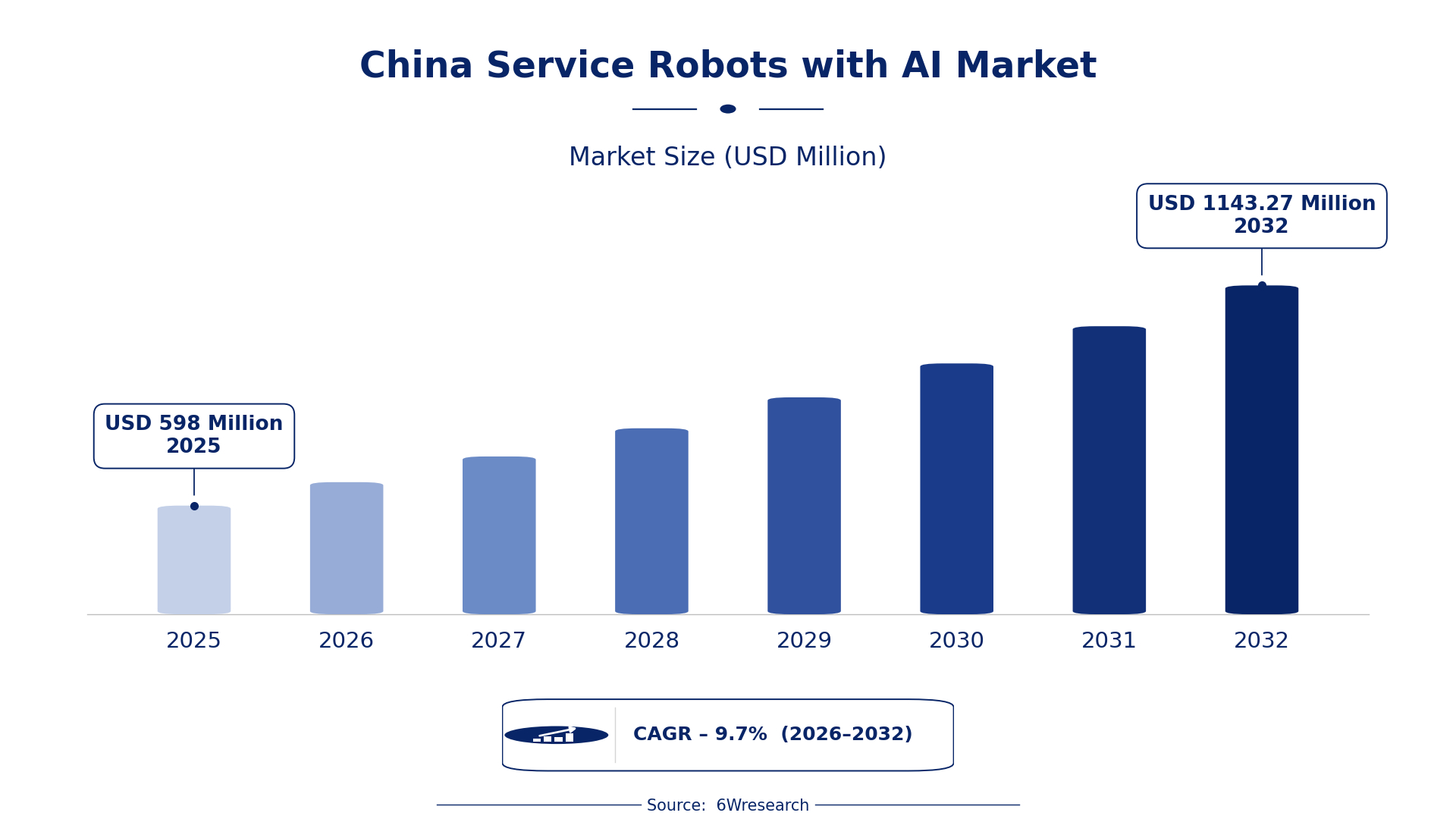
According to 6Wresearch internal database and industry insights, the China Service Robots with AI Market was valued at USD 598.0 million in 2025 and is projected to reach USD 1,143.27 million by 2032, growing at a CAGR of approximately 9.7% during 2026–2032.
China Service Robots with AI Market Highlights
| Report Metric | Details |
| Report Name | China Service Robots with AI Market |
| Market Size 2025 | USD 598.0 million |
| Market Size 2032 | USD 1,143.27 million |
| Absolute Growth 2025–2032 | USD 545.27 million |
| CAGR 2026–2032 | 9.7% |
| Peak Annual Growth | 11.5% in 2027 |
| Forecast Period | 2026–2032 |
| Historical Data | 2022–2025 |
| Base Year | 2025 |
| Leading AI Capability, 2025 | NLP (Voice Assist) (39% share) |
| Leading Robot Application, 2025 | Customer Support (44% share) |
| Leading Learning Mode, 2025 | Cloud-Based AI (37% share) |
| Leading End User, 2025 | Malls/Restaurants (37% share) |
| Fastest-Growing AI Capability | Emotion Recognition (10.9% CAGR) |
| Fastest-Growing Robot Application | Elder Care & Therapy (12.1% CAGR) |
| Fastest-Growing Learning Mode | Onboard Learning (11.7% CAGR) |
| Fastest-Growing End User | Nursing Homes (11.3% CAGR) |
| Growing Sector | Elder Care & Therapy |
| Key End Users | Customer Support, Navigation + Delivery, Elder Care & Therapy, Industrial Service Bots |
China Service Robots with AI Market Year-wise Growth Rate and Key Drivers (2022–2032)
This graph illustrates the annual growth rates of the market from 2022 to 2032, highlighting a steady upward trajectory and projected market expansion over the forecast period.
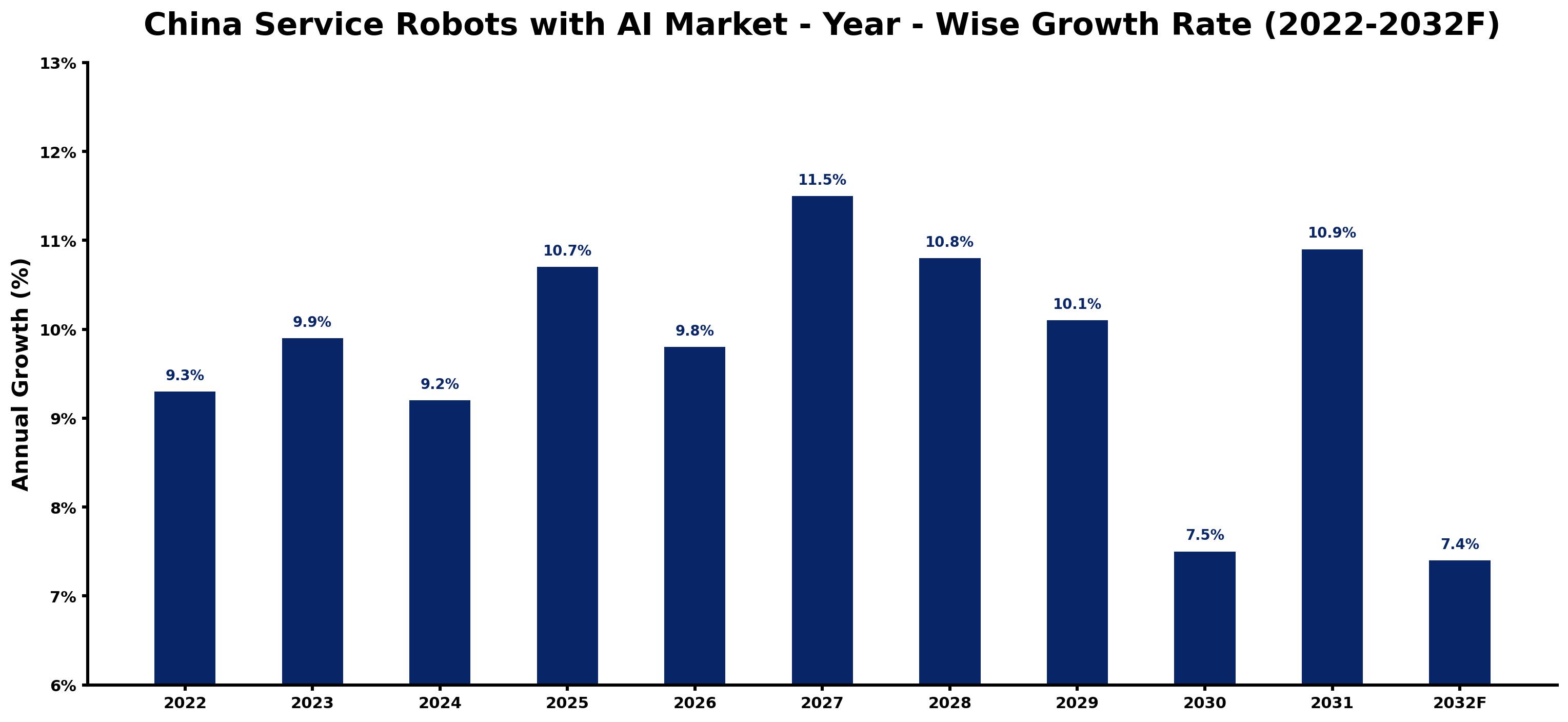
Below, each year's estimated growth is shown next to the factor that most influenced it.
| Year | Estimated Annual Growth (%) | Market Rationale |
| 2022 | 9.3 | The market showed strong activity with increasing adoption of service robots in malls and restaurants. |
| 2023 | 9.9 | Demand accelerated as more than 50% of large malls implemented service robots for customer interaction. |
| 2024 | 9.2 | Growth slowed slightly as the market adjusted following rapid expansion in previous years. |
| 2025 | 10.7 | The market rebounded with growth driven by the National Intelligent Robot Innovation Development Strategy. |
| 2026 | 9.8 | Growth decelerated as the market is expected to stabilise after reaching a historical peak in 2025. |
| 2027 | 11.5 | A surge in demand occurred as the market peaked, driven by advancements in AI capabilities and the 'Smart Manufacturing' initiative. |
| 2028 | 10.8 | Growth is projected to slow again, reflecting a normalisation after the peak growth year. |
| 2029 | 10.1 | Market growth is expected to continue slowing as the focus shifts towards enhancing existing technologies. |
| 2030 | 7.5 | Demand growth is projected to slow further as the market matures and competition intensifies. |
| 2031 | 10.9 | A resurgence in growth is anticipated as new applications in elder care gain traction, supported by the 'Elderly Care Service System Construction Plan'. |
| 2032 | 7.4 | The market is expected to grow at a slower rate as it stabilises after a decade of rapid expansion. |
Note: Market size estimations and growth projections presented in this report are based on 6Wresearch's proprietary forecasting methodology, utilizing the latest available industry data, government publications, and primary research inputs.
China Service Robots with AI Market Synopsis
Service Robots with AI in China are advanced machines that autonomously perform tasks using artificial intelligence. These robots serve various functions including customer support, navigation, delivery, and elder care. The China Service Robots with AI Market is growing due to strong demand from sectors such as retail and healthcare. The National Intelligent Robot Innovation Development Strategy aims to improve AI integration in service robots by 2025, which will further stimulate market activity. With over 30,000 nursing homes in 2023, the demand for elder care robots is also on the rise.
Market Dynamics Impact Analysis (2026–2032)
| Factor | Type | Impact | Primary Segment Affected |
| Growing demand for customer support solutions in retail environments. | Driver | High | Customer Support |
| Increasing adoption of service robots in nursing homes for elder care. | Driver | High | Elder Care & Therapy |
| Investment in AI integration for service robots in healthcare settings. | Opportunity | High | Elder Care & Therapy |
| Expansion of robotics manufacturing facilities in Guangdong province. | Opportunity | High | Customer Support |
| Regulatory uncertainty regarding safety standards for service robots. | Restraint | High | Customer Support |
| High initial costs of implementing service robots in various sectors. | Restraint | Medium | Elder Care & Therapy |
| Intense competition among producers leading to price wars. | Challenge | High | Customer Support |
| Challenges in technology integration with existing systems. | Challenge | Medium | Elder Care & Therapy |
Evaluation of Drivers in China Service Robots with AI Market (2026–2032)
The main growth drivers and the segments they affect most are set out below.
| Drivers | Primary Segment Affected | Why It Matters (Evidence) |
| Rising demand for customer support solutions in malls and restaurants drives the need for service robots. | Customer Support | Over 50% of large malls have adopted service robots for customer interaction. |
| Increasing adoption of service robots in nursing homes improves elder care services. | Elder Care & Therapy | The number of nursing homes in China exceeded 30,000 in 2023. |
| Investment in AI integration is boosting the capabilities of service robots across industries. | Elder Care & Therapy | The 'Robot + AI' initiative aims to improve service robot capabilities. |
| Expansion of robotics manufacturing facilities in Guangdong province supports production. | Customer Support | Guangdong is a key hub for robotics manufacturing. |
| Growing focus on safety and interoperability standards increases demand for compliant robots. | Customer Support | Standards are being developed by the National Standardization Administration. |
Market growth for Service Robots with AI in China is underpinned by increasing demand for customer support solutions, particularly in retail environments. In 2023, over 50% of large malls adopted service robots, significantly increasing market activity. The number of nursing homes exceeded 30,000, driving demand for elder care robots. Investment in AI integration is expected to enhance the functionality of these robots, leading to increased purchases in various sectors.
Evaluation of Restraints in China Service Robots with AI Market
Below mentioned are some major restraints and their influence on market dynamics.
| Market Restraint | Primary Segment Affected | Why It Matters (Evidence) |
| Regulatory uncertainty regarding safety standards for service robots complicates market entry. | Customer Support | The National Standardization Administration is still developing safety and interoperability standards. |
| High initial costs of implementing service robots deter some potential buyers. | Elder Care & Therapy | Many facilities face budget constraints when considering new technology investments. |
| Limited awareness among potential buyers about the benefits of service robots hinders adoption. | Customer Support | Education on the advantages of service robots is still lacking in many sectors. |
| Integration challenges with existing systems can delay implementation of service robots. | Elder Care & Therapy | Facilities often require significant adjustments to accommodate new technology. |
| Fluctuating prices due to intense competition can affect purchasing decisions. | Customer Support | Price wars among producers may lead to inconsistent pricing for buyers. |
China Service Robots with AI Market Challenges
Buyers and suppliers in the China Service Robots with AI market encounter regulatory challenges, as the National Standardization Administration is still finalising safety and interoperability standards. This delay may postpone product launches, costing producers potential revenue and limiting access to advanced technology for hospitals and clinics. Intense competition among distributors complicates pricing strategies, as many are racing to innovate, resulting in price wars that can squeeze profit margins for suppliers. Additionally, technology integration presents challenges for buyers, as many service robots require extensive adjustments to existing systems, leading to costly downtime during implementation.
Trends in the China Service Robots with AI Market
Four trends stand out in the China Service Robots with AI Market.
- Shift from Traditional to AI-Enhanced Service Robots: In 2023, the trend towards AI-enhanced service robots gained momentum, particularly in retail. The 'National AI Development Plan' aims to integrate AI into service robots, improving their capabilities.
- Transition from Manual to Automated Elder Care: The shift towards automated elder care solutions began in 2023, driven by the increasing number of nursing homes. The 'Elderly Care Service System Construction Plan' supports this transition with targeted funding.
- Growing Adoption of Cloud-Based AI in Robotics: Since 2022, there has been a notable increase in the use of Cloud-Based AI in service robots. This technology allows for improved data processing and real-time learning capabilities.
- Emergence of Onboard Learning Technologies: Onboard learning technologies have gained traction since 2023, enabling robots to adapt to their environments. This advancement is important for improving the functionality of service robots in various applications.
Investment Opportunities in the China Service Robots with AI Market
Several openings in the China Service Robots with AI Market merit attention from investors.
- Partnerships for AI Integration: Establishing joint ventures with local technology firms is essential for integrating AI into service robots. This is particularly relevant in regions like Guangdong, where robotics manufacturing is thriving.
- Investment in Nursing Home Robotics: With over 30,000 nursing homes in China, there is a growing need for elder care robots. Suppliers can enter this market by partnering with healthcare providers to develop tailored solutions.
- Focus on Retail Robotics Solutions: The retail sector is increasingly adopting service robots, presenting an opportunity for suppliers. Collaborating with malls and restaurants can facilitate market entry and product deployment.
- Development of Safety Standards: As safety standards for service robots are being developed, companies can invest in compliance solutions. Engaging with the National Standardization Administration will be important for navigating regulatory requirements.
Government Initiatives in the China Service Robots with AI Market
The '14th Five-Year Plan for Robotics', approved by the National Development and Reform Commission in 2021, aims to enhance service robot innovation by 2025. This plan emphasises the integration of AI technologies into service robots, driving industry growth. Additionally, the 'Robot Industry Development Action Plan (2021-2025)' seeks to increase production capacity by 30% by 2025, supporting the manufacturing sector. The 'National AI Development Plan', updated in 2023, includes specific targets for deploying service robots in healthcare settings, further boosting demand.
The Ministry of Industry and Information Technology oversees the implementation of various initiatives, including the 'Smart Manufacturing' initiative launched in 2022. This programme promotes the use of AI in service robots across industries, improving operational efficiency. Furthermore, the agency funds research projects aimed at enhancing service robot capabilities, ensuring that producers can meet evolving market demands. Approval processes for new technologies are also streamlined to facilitate quicker market entry.
Future Insight of the China Service Robots with AI Market
The China Service Robots with AI market will experience transformative changes by 2032, driven by the National Intelligent Robot Innovation Development Strategy, which aims to boost AI integration in service robots. Investment in AI research by the Beijing Municipal Government will spur advancements in robotics applications, improving service capabilities across sectors. By 2025, the installed base of service robots in hospitals is projected to exceed 10,000 units, reflecting a growing reliance on these technologies in healthcare. The increasing adoption of service robots in retail environments will further expand market opportunities.
Market Segmentation Analysis
The analysis below covers each segmentation, its leading category in 2025 and its fastest-growing category through 2032.
By AI Capability – NLP (Voice Assist) Dominated, Emotion Recognition Expected to Grow Fastest
According to Dhaval Chaurasia, Assistant Manager at 6Wresearch, the largest ai capability category in 2025 was NLP (Voice Assist), with a 39% share of total revenue. NLP (Voice Assist) holds the largest share due to its widespread use in customer service, particularly in malls where over 50% have integrated these systems for interactive support. This extensive adoption demonstrates the essential role of voice assistance in enhancing customer engagement and operational efficiency. Emotion Recognition is projected to grow fastest, at a CAGR of 10.9% during 2026–2032. Emotion Recognition is experiencing rapid growth, particularly in elder care applications, driven by the increasing number of nursing homes, which now exceed 30,000 facilities. This trend indicates a rising focus on empathetic interactions in healthcare, propelling its expansion. Suppliers should enhance NLP capabilities while exploring opportunities in emotion recognition to align with market demands.
By Robot Application – Customer Support Dominated, Elder Care & Therapy Expected to Grow Fastest
Customer Support took a 44% share of robot application in 2025, more than any other category. Customer Support leads the market share as the primary application of service robots, especially in malls and restaurants where customer engagement is crucial. The significant presence of service robots in over 50% of large malls underscores their importance in enhancing customer experiences. The quickest growth will come from Elder Care & Therapy, forecast to expand at a CAGR of 12.1% between 2026 and 2032. Elder Care & Therapy is the fastest-growing application, fuelled by the rising number of nursing homes and the increasing need for support in healthcare settings. This growth reflects a societal shift towards improved care for the elderly, creating new opportunities for service robots. Healthcare buyers should invest in elder care robots to meet the rising demand for supportive technologies.
By Learning Mode – Cloud-Based AI Dominated, Onboard Learning Expected to Grow Fastest
With a 37% revenue share in 2025, Cloud-Based AI was the largest learning mode category. Cloud-Based AI dominates the market share as it provides powerful processing capabilities, enabling service robots to perform complex tasks effectively. This technology is crucial for maintaining the efficiency of robots deployed in customer-facing roles across various sectors. Onboard Learning is set to record the highest CAGR in this split, 11.7% over 2026–2032. Onboard Learning is rapidly gaining traction, allowing robots to learn from their environment in real-time. This capability is particularly advantageous in dynamic settings, enhancing the functionality and responsiveness of service robots. Suppliers should prioritise the development of onboard learning features to remain competitive in a market that values adaptability.
By End User – Malls/Restaurants Dominated, Nursing Homes Expected to Grow Fastest
Malls/Restaurants accounted for a 37% market share by end user in 2025. Malls/Restaurants command the largest share in the service robot market, driven by high demand for customer interaction solutions. The integration of service robots in these venues has become standard practice, reflecting their effectiveness in improving customer experiences. Over 2026–2032, Nursing Homes are expected to post the fastest growth, at a CAGR of 11.3%. Nursing Homes represent the fastest-growing end user segment, as the demand for elder care solutions continues to rise with the increasing number of facilities. This trend highlights the urgent need for technology that can effectively support the ageing population. Investing in service robots tailored for nursing homes can provide significant advantages to suppliers looking to enter this expanding market.
Key Attractiveness of the Report
- 10 Years of Market Numbers
- Historical Data Starting from 2022 to 2025
- Base Year 2025
- Forecast Data until 2032
- Key Performance Indicators Impacting the Market
- Major Upcoming Developments and Projects
Key Highlights of the Report:
- China Service Robots with AI Market Outlook
- Market Size of China Service Robots with AI Market, 2025
- Forecast of China Service Robots with AI Market, 2032
- Historical Data and Forecast of China Service Robots with AI Revenues & Volume for the Period 2022 - 2032F
- China Service Robots with AI Market Trend Evolution
- China Service Robots with AI Market Drivers and Challenges
- China Service Robots with AI Price Trends
- China Service Robots with AI Porter's Five Forces
- China Service Robots with AI Industry Life Cycle
- Historical Data and Forecast of China Service Robots with AI Market Revenues & Volume By AI Capability for the Period 2022 - 2032F
- Historical Data and Forecast of China Service Robots with AI Market Revenues & Volume By NLP (Voice Assist) for the Period 2022 - 2032F
- Historical Data and Forecast of China Service Robots with AI Market Revenues & Volume By Computer Vision for the Period 2022 - 2032F
- Historical Data and Forecast of China Service Robots with AI Market Revenues & Volume By Predictive Maintenance for the Period 2022 - 2032F
- Historical Data and Forecast of China Service Robots with AI Market Revenues & Volume By Emotion Recognition for the Period 2022 - 2032F
- Historical Data and Forecast of China Service Robots with AI Market Revenues & Volume By Robot Application for the Period 2022 - 2032F
- Historical Data and Forecast of China Service Robots with AI Market Revenues & Volume By Customer Support for the Period 2022 - 2032F
- Historical Data and Forecast of China Service Robots with AI Market Revenues & Volume By Navigation + Delivery for the Period 2022 - 2032F
- Historical Data and Forecast of China Service Robots with AI Market Revenues & Volume By Industrial Service Bots for the Period 2022 - 2032F
- Historical Data and Forecast of China Service Robots with AI Market Revenues & Volume By Elder Care & Therapy for the Period 2022 - 2032F
- Historical Data and Forecast of China Service Robots with AI Market Revenues & Volume By Learning Mode for the Period 2022 - 2032F
- Historical Data and Forecast of China Service Robots with AI Market Revenues & Volume By Cloud-Based AI for the Period 2022 - 2032F
- Historical Data and Forecast of China Service Robots with AI Market Revenues & Volume By Onboard Learning for the Period 2022 - 2032F
- Historical Data and Forecast of China Service Robots with AI Market Revenues & Volume By Edge AI for the Period 2022 - 2032F
- Historical Data and Forecast of China Service Robots with AI Market Revenues & Volume By Federated Learning for the Period 2022 - 2032F
- Historical Data and Forecast of China Service Robots with AI Market Revenues & Volume By End User for the Period 2022 - 2032F
- Historical Data and Forecast of China Service Robots with AI Market Revenues & Volume By Malls/Restaurants for the Period 2022 - 2032F
- Historical Data and Forecast of China Service Robots with AI Market Revenues & Volume By Smart Warehouses for the Period 2022 - 2032F
- Historical Data and Forecast of China Service Robots with AI Market Revenues & Volume By Manufacturing Facilities for the Period 2022 - 2032F
- Historical Data and Forecast of China Service Robots with AI Market Revenues & Volume By Nursing Homes for the Period 2022 - 2032F
- China Service Robots with AI Import Export Trade Statistics
- Market Opportunity Assessment By AI Capability
- Market Opportunity Assessment By Robot Application
- Market Opportunity Assessment By Learning Mode
- Market Opportunity Assessment By End User
- China Service Robots with AI Top Companies Market Share
- China Service Robots with AI Competitive Benchmarking By Technical and Operational Parameters
- China Service Robots with AI Company Profiles
- China Service Robots with AI Key Strategic Recommendations
Market Covered
Segments analysed in this report are listed below.
By AI Capability
- NLP (Voice Assist)
- Computer Vision
- Predictive Maintenance
- Emotion Recognition
By Robot Application
- Customer Support
- Navigation + Delivery
- Industrial Service Bots
- Elder Care & Therapy
By Learning Mode
- Cloud-Based AI
- Onboard Learning
- Edge AI
- Federated Learning
By End User
- Malls/Restaurants
- Smart Warehouses
- Manufacturing Facilities
- Nursing Homes































