China Shipbuilding Equipment Market Size & Growth Rate
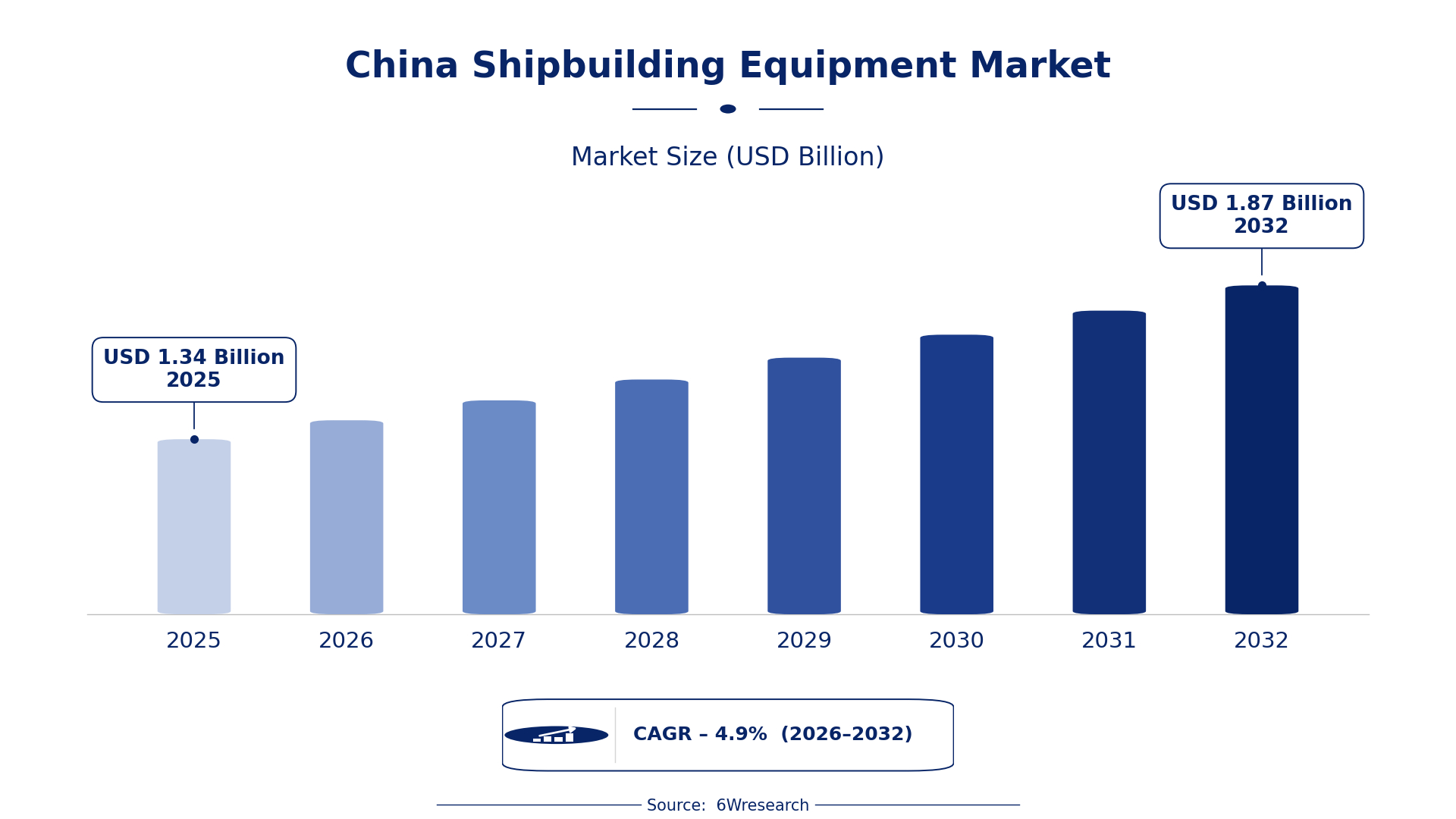
According to 6Wresearch internal database and industry insights, the China Shipbuilding Equipment Market was valued at USD 1.34 billion in 2025 and is projected to reach USD 1.87 billion by 2032, growing at a CAGR of approximately 4.9% during 2026–2032.
China Shipbuilding Equipment Market Highlights
| Report Metric | Details |
| Report Name | China Shipbuilding Equipment Market |
| Market Size 2025 | USD 1.34 billion |
| Market Size 2032 | USD 1.87 billion |
| Absolute Growth 2025–2032 | USD 0.53 billion |
| CAGR 2026–2032 | 4.9% |
| Peak Annual Growth | 7.4% in 2032 |
| Forecast Period | 2026–2032 |
| Historical Data | 2022–2025 |
| Base Year | 2025 |
| Leading Equipment Type, 2025 | Welding Equipment (51% share) |
| Leading Construction Stage, 2025 | Hull Assembly (42% share) |
| Leading Automation Level, 2025 | Manual/CNC (38% share) |
| Leading End User, 2025 | Shipyards (43% share) |
| Fastest-Growing Equipment Type | Propulsion Systems (6.3% CAGR) |
| Fastest-Growing Construction Stage | Engine Room (7.6% CAGR) |
| Fastest-Growing Automation Level | Integrated (6.1% CAGR) |
| Fastest-Growing End User | Shipbuilders (7.2% CAGR) |
| Growing Sector | Shipyards |
| Key End Users | Shipbuilders, Offshore Vessel Makers, Commercial Marine Builders |
China Shipbuilding Equipment Market Year-wise Growth Rate and Key Drivers (2022–2032)
This graph illustrates the annual growth rates of the market from 2022 to 2032, highlighting a steady upward trajectory and projected market expansion over the forecast period.
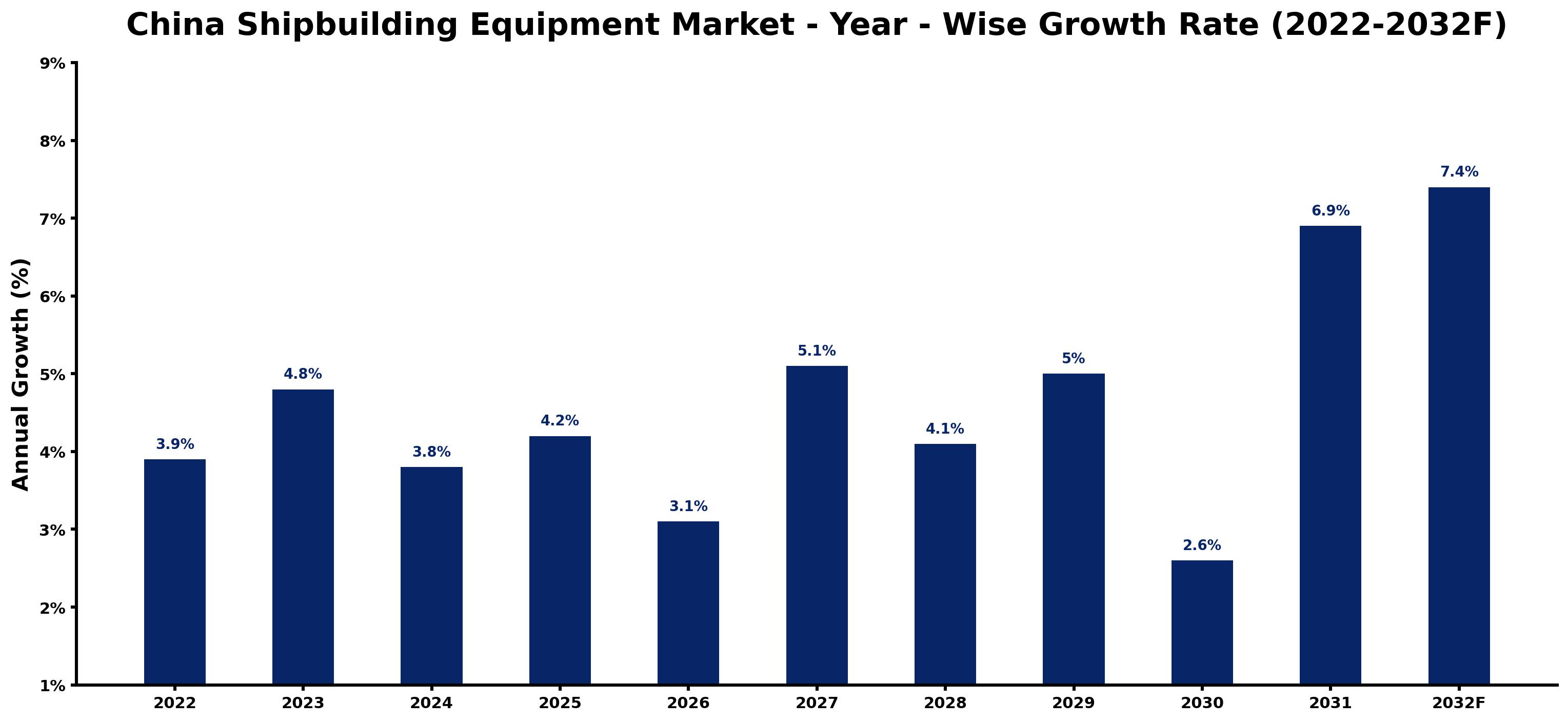
Each row of the following table gives one year's estimated growth and the event or demand shift that explains it.
| Year | Estimated Annual Growth (%) | Market Rationale |
| 2022 | 3.9 | The market experienced steady demand from domestic shipbuilders and offshore vessel makers. |
| 2023 | 4.8 | Growth accelerated due to increased investments in shipbuilding technologies and modernization initiatives. |
| 2024 | 3.8 | A slowdown occurred as the market adjusted to previous rapid growth rates in shipbuilding output. |
| 2025 | 4.2 | Demand surged again, driven by ongoing projects in the Yangtze River Delta region. |
| 2026 | 3.1 | Investment levels are expected to stabilise, affecting purchasing decisions for advanced technologies. |
| 2027 | 5.1 | An increase in demand is projected from shipyards expanding their production capabilities. |
| 2028 | 4.1 | The market will experience a slowdown as new technology adoption faces delays in implementation. |
| 2029 | 5.0 | Demand is expected to rise again, particularly from commercial marine builders investing in new vessels. |
| 2030 | 2.6 | Growth will slow as the market adjusts to changing global economic conditions and supply chain issues. |
| 2031 | 6.9 | An increase in demand is anticipated driven by the Green Ship Technology Promotion Program's initiatives. |
| 2032 | 7.4 | The market is projected to peak as investment in advanced shipbuilding technologies surges. |
Note: Market size estimations and growth projections presented in this report are based on 6Wresearch's proprietary forecasting methodology, utilizing the latest available industry data, government publications, and primary research inputs.
China Shipbuilding Equipment Market Synopsis
Shipbuilding Equipment in China encompasses machinery and tools essential for constructing and repairing ships, including welding equipment and propulsion systems. These products are manufactured using advanced technologies to ensure durability and efficiency. The market is growing due to strong domestic demand from shipbuilders and offshore vessel makers. The government's support for modernization initiatives and the Made in China 2025 initiative are key factors driving this growth. In 2022, shipbuilding output reached 30 million deadweight tons, highlighting the sector's expansion.
Market Dynamics Impact Analysis (2026–2032)
| Factor | Type | Impact | Primary Segment Affected |
| Increased investment in shipbuilding modernization programs | Driver | High | Welding Equipment |
| Growing demand for advanced propulsion systems from shipyards | Driver | High | Propulsion Systems |
| Investment opportunities in the Yangtze River Delta region | Opportunity | High | Shipyards |
| Rising demand for integrated systems in shipbuilding | Opportunity | Medium | Integrated |
| High costs associated with advanced technology adoption | Restraint | High | Navigation Systems |
| Supply chain disruptions affecting equipment availability | Restraint | Medium | Steel Cutting Machines |
| Regulatory hurdles delaying project approvals | Challenge | High | Hull Assembly |
| Competition from international shipbuilding markets | Challenge | Medium | Shipbuilders |
Evaluation of Drivers in China Shipbuilding Equipment Market (2026–2032)
The main growth drivers and the segments they affect most are set out below.
| Drivers | Primary Segment Affected | Why It Matters (Evidence) |
| Increased government funding for shipbuilding modernization | Welding Equipment | In 2023, $200 million was allocated for modernization, boosting demand for welding equipment. |
| Growing domestic shipbuilding output | Propulsion Systems | The output reached 30 million deadweight tons in 2022, increasing demand for propulsion systems. |
| Expansion of shipyards in key regions | Shipyards | The Yangtze River Delta is a major shipbuilding region, driving demand for shipbuilding equipment. |
| Rising focus on sustainability in shipbuilding | Steel Cutting Machines | Innovations in cutting technology improve efficiency, increasing demand for steel cutting machines. |
| Adoption of advanced automation technologies | Navigation Systems | The installed base of navigation systems is expected to reach 50,000 units by 2023, enhancing operational efficiency. |
In 2023, $200 million was allocated for modernization, heightening the demand for advanced welding equipment. Shipbuilding output reached 30 million deadweight tons in 2022, resulting in greater demand for propulsion systems. The Yangtze River Delta, a key shipbuilding region, continues to develop, increasing the need for shipbuilding equipment. The installed base of navigation systems is projected to reach 50,000 units by 2023, indicating a shift towards advanced automation technologies.
Evaluation of Restraints in China Shipbuilding Equipment Market
The following restraints limit how fast demand can grow.
| Market Restraint | Primary Segment Affected | Why It Matters (Evidence) |
| High costs associated with advanced technology adoption | Navigation Systems | Investments in new technologies can exceed budgets, limiting purchases of navigation systems. |
| Supply chain disruptions affecting equipment availability | Steel Cutting Machines | Delays in material supply can hinder production timelines, impacting the availability of cutting machines. |
| Regulatory hurdles delaying project approvals | Hull Assembly | Complex approval processes can slow down project timelines, affecting hull assembly operations. |
| Competition from international shipbuilding markets | Shipbuilders | Foreign competitors may offer lower prices, affecting local shipbuilders' market share. |
| Limited skilled workforce in advanced shipbuilding technologies | Welding Equipment | A shortage of trained personnel can delay projects, impacting the demand for welding equipment. |
China Shipbuilding Equipment Market Challenges
The China Shipbuilding Equipment Market encounters notable supply chain disruptions, primarily due to reliance on specific materials that often face delays, costing producers up to 15% in production time. Importers grapple with rising costs, as tariffs and logistics issues inflate prices by nearly 10% for essential components, squeezing their margins. Technological advancements are lagging, with outdated equipment hindering efficiency and causing project delays for buyers in shipyards. Domestic shipbuilders find it challenging to comply with the National Standard GB/T 17090-2008, risking penalties that could undermine their competitiveness in the global market.
Trends in the China Shipbuilding Equipment Market
Several trends are reshaping the China Shipbuilding Equipment Market; the most important are set out below.
- Shift from Manual to Integrated Systems: Since 2023, shipyards have increasingly adopted integrated systems for efficiency. In 2023, the installed base of integrated systems reached 50,000 units, indicating a trend towards automation.
- Transition to Sustainable Shipbuilding Practices: The Green Ship Technology Promotion Program has driven a shift towards sustainability in shipbuilding. In 2023, over 200 shipbuilding enterprises participated in initiatives to reduce environmental impact.
- Emergence of Advanced Propulsion Technologies: In 2026, demand for advanced propulsion systems surged as shipbuilders sought efficiency. This segment is projected to grow at a CAGR of 6.3% from 2026 to 2032.
- Growing Demand for Modular Construction Techniques: In 2025, shipyards began adopting modular construction techniques to improve flexibility. This shift is expected to reduce production timelines and costs.
Investment Opportunities in the China Shipbuilding Equipment Market
Below are the investment opportunities with the strongest case in the China Shipbuilding Equipment Market.
- Local Partnerships for Equipment Supply: Establishing joint ventures with local shipyards can facilitate entry into the market. In 2023, demand for welding equipment is expected to rise due to modernization efforts.
- Investment in Advanced Welding Technologies: There is a strong need for advanced welding equipment in shipyards. The Yangtze River Delta region is a prime area for investment, given its shipbuilding activities.
- Focus on Integrated Systems for Efficiency: Shipbuilders are increasingly looking for integrated systems to improve productivity. Suppliers can enter this market by collaborating with local manufacturers.
- Expansion of Shipbuilding Facilities: Investing in new shipbuilding facilities in the Bohai Rim can capture growing demand. This region is a key area for shipbuilding activities, with significant growth potential.
Government Initiatives in the China Shipbuilding Equipment Market
In 2023, the Green Ship Technology Promotion Program was implemented, complementing the National Standard GB/T 17090-2008, which governs specifications for shipbuilding equipment. This program improves compliance with modern environmental standards, ensuring that producers meet sustainability requirements. It also encourages investment in technologies that align with these standards, promoting innovation in the sector.
The Ministry of Industry and Information Technology oversees funding for shipbuilding modernization initiatives. This agency approves projects aimed at enhancing technological capabilities, with a budget of $200 million allocated for 2023, allowing producers to upgrade their equipment and processes. This funding is crucial for maintaining competitiveness in the global market and supports the adoption of advanced technologies.
Future Insight of the China Shipbuilding Equipment Market
Several forward-looking factors should support the China Shipbuilding Equipment Market over the coming years. The government’s commitment to shipbuilding modernization programs will spur innovation and operational efficiency. The Green Ship Technology Promotion Program will drive the adoption of sustainable practices, appealing to environmentally conscious buyers. The Made in China 2025 initiative aims to strengthen domestic production capabilities, ensuring local producers maintain their competitive edge. By 2032, the installed base of shipbuilding equipment is expected to reach 70,000 units, boosting operational capacity across the industry.
Market Segmentation Analysis
The analysis below covers each segmentation, its leading category in 2025 and its fastest-growing category through 2032.
By Equipment Type – Welding Equipment Dominated, Propulsion Systems Expected to Grow Fastest
According to Dhaval Chaurasia, Assistant Manager at 6Wresearch, Welding Equipment took a 51% share of equipment type in 2025, more than any other category. Welding equipment holds the largest share in the China shipbuilding equipment market because it is vital for joining metal components in ship construction. Its extensive application in shipyards, particularly in the Yangtze River Delta, highlights its critical role in the industry. The quickest growth will come from Propulsion Systems, forecast to expand at a CAGR of 6.3% between 2026 and 2032. Propulsion systems are rapidly growing due to the rising demand for efficient machinery in shipbuilding. The government's allocation of $200 million for modernization programs in 2023 is expected to accelerate this segment's expansion. Suppliers should focus on enhancing propulsion system offerings to leverage this growth opportunity.
By Construction Stage – Hull Assembly Dominated, Engine Room Expected to Grow Fastest
The largest construction stage category in 2025 was Hull Assembly, with a 42% share of total revenue. Hull assembly leads the construction stage in shipbuilding, as it is a fundamental process that ensures the structural integrity of vessels. This stage is heavily utilised across shipyards in China, underscoring its importance in the overall shipbuilding process. Engine Room is set to record the highest CAGR in this split, 7.6% over 2026–2032. The engine room segment is experiencing rapid growth, driven by the increasing complexity of machinery installations in modern vessels. As shipbuilders aim to optimise performance, the demand for advanced engine room setups is projected to rise significantly. Buyers should consider investing in advanced engine room technologies to maintain competitiveness in the shipbuilding sector.
By Automation Level – Manual/CNC Dominated, Integrated Expected to Grow Fastest
Manual/CNC held a 38% share of the China Shipbuilding Equipment Market by automation level in 2025. The manual/CNC segment dominates the automation level category, as both methods are extensively used in shipbuilding processes across various facilities. This combination allows for the necessary flexibility and precision in manufacturing, making it a preferred choice for many shipyards. Integrated is projected to grow fastest, at a CAGR of 6.1% during 2026–2032. Integrated systems are quickly gaining popularity, as they enhance efficiency and streamline operations in shipbuilding. The industry's shift towards automation and smart manufacturing practices is likely to accelerate the adoption of integrated solutions in the near future. Suppliers should prioritise the development of integrated solutions to meet the growing demand for efficiency in shipbuilding operations.
By End User – Shipyards Dominated, Shipbuilders Expected to Grow Fastest
In 2025, Shipyards led the end user split with a 43% share. Shipyards are the dominant end users of shipbuilding equipment, playing a crucial role in the construction process and holding the largest market share. Their central position supports China's status as a global leader in shipbuilding, making them pivotal to the industry's success. Over 2026–2032, Shipbuilders are expected to post the fastest growth, at a CAGR of 7.2%. Shipbuilders are experiencing the fastest growth in this segment, driven by the rising demand for new vessels and the need for advanced manufacturing capabilities. As the industry evolves, shipbuilders are likely to invest more in innovative technologies to address market demands. Suppliers must align their strategies with the changing needs of shipbuilders to capture emerging market opportunities.
Key Attractiveness of the Report
- 10 Years of Market Numbers
- Historical Data Starting from 2022 to 2025
- Base Year 2025
- Forecast Data until 2032
- Key Performance Indicators Impacting the Market
- Major Upcoming Developments and Projects
Key Highlights of the Report:
- China Shipbuilding Equipment Market Outlook
- Market Size of China Shipbuilding Equipment Market, 2025
- Forecast of China Shipbuilding Equipment Market, 2032
- Historical Data and Forecast of China Shipbuilding Equipment Revenues & Volume for the Period 2022 - 2032F
- China Shipbuilding Equipment Market Trend Evolution
- China Shipbuilding Equipment Market Drivers and Challenges
- China Shipbuilding Equipment Price Trends
- China Shipbuilding Equipment Porter's Five Forces
- China Shipbuilding Equipment Industry Life Cycle
- Historical Data and Forecast of China Shipbuilding Equipment Market Revenues & Volume By Equipment Type for the Period 2022 - 2032F
- Historical Data and Forecast of China Shipbuilding Equipment Market Revenues & Volume By Welding Equipment for the Period 2022 - 2032F
- Historical Data and Forecast of China Shipbuilding Equipment Market Revenues & Volume By Propulsion Systems for the Period 2022 - 2032F
- Historical Data and Forecast of China Shipbuilding Equipment Market Revenues & Volume By Navigation Systems for the Period 2022 - 2032F
- Historical Data and Forecast of China Shipbuilding Equipment Market Revenues & Volume By Steel Cutting Machines for the Period 2022 - 2032F
- Historical Data and Forecast of China Shipbuilding Equipment Market Revenues & Volume By Construction Stage for the Period 2022 - 2032F
- Historical Data and Forecast of China Shipbuilding Equipment Market Revenues & Volume By Hull Assembly for the Period 2022 - 2032F
- Historical Data and Forecast of China Shipbuilding Equipment Market Revenues & Volume By Engine Room for the Period 2022 - 2032F
- Historical Data and Forecast of China Shipbuilding Equipment Market Revenues & Volume By Bridge Installation for the Period 2022 - 2032F
- Historical Data and Forecast of China Shipbuilding Equipment Market Revenues & Volume By Fabrication Yard for the Period 2022 - 2032F
- Historical Data and Forecast of China Shipbuilding Equipment Market Revenues & Volume By Automation Level for the Period 2022 - 2032F
- Historical Data and Forecast of China Shipbuilding Equipment Market Revenues & Volume By Manual/CNC for the Period 2022 - 2032F
- Historical Data and Forecast of China Shipbuilding Equipment Market Revenues & Volume By Integrated for the Period 2022 - 2032F
- Historical Data and Forecast of China Shipbuilding Equipment Market Revenues & Volume By Modular for the Period 2022 - 2032F
- Historical Data and Forecast of China Shipbuilding Equipment Market Revenues & Volume By Robotic for the Period 2022 - 2032F
- Historical Data and Forecast of China Shipbuilding Equipment Market Revenues & Volume By End User for the Period 2022 - 2032F
- Historical Data and Forecast of China Shipbuilding Equipment Market Revenues & Volume By Shipyards for the Period 2022 - 2032F
- Historical Data and Forecast of China Shipbuilding Equipment Market Revenues & Volume By Shipbuilders for the Period 2022 - 2032F
- Historical Data and Forecast of China Shipbuilding Equipment Market Revenues & Volume By Commercial Marine Builders for the Period 2022 - 2032F
- Historical Data and Forecast of China Shipbuilding Equipment Market Revenues & Volume By Offshore Vessel Makers for the Period 2022 - 2032F
- China Shipbuilding Equipment Import Export Trade Statistics
- Market Opportunity Assessment By Equipment Type
- Market Opportunity Assessment By Construction Stage
- Market Opportunity Assessment By Automation Level
- Market Opportunity Assessment By End User
- China Shipbuilding Equipment Top Companies Market Share
- China Shipbuilding Equipment Competitive Benchmarking By Technical and Operational Parameters
- China Shipbuilding Equipment Company Profiles
- China Shipbuilding Equipment Key Strategic Recommendations
Market Covered
The report offers an extensive study of the following market segments.
By Equipment Type
- Welding Equipment
- Propulsion Systems
- Navigation Systems
- Steel Cutting Machines
By Construction Stage
- Hull Assembly
- Engine Room
- Bridge Installation
- Fabrication Yard
By Automation Level
- Manual/CNC
- Integrated
- Modular
- Robotic
By End User
- Shipyards
- Shipbuilders
- Commercial Marine Builders
- Offshore Vessel Makers































