China SIEM with AI Market Size & Growth Rate
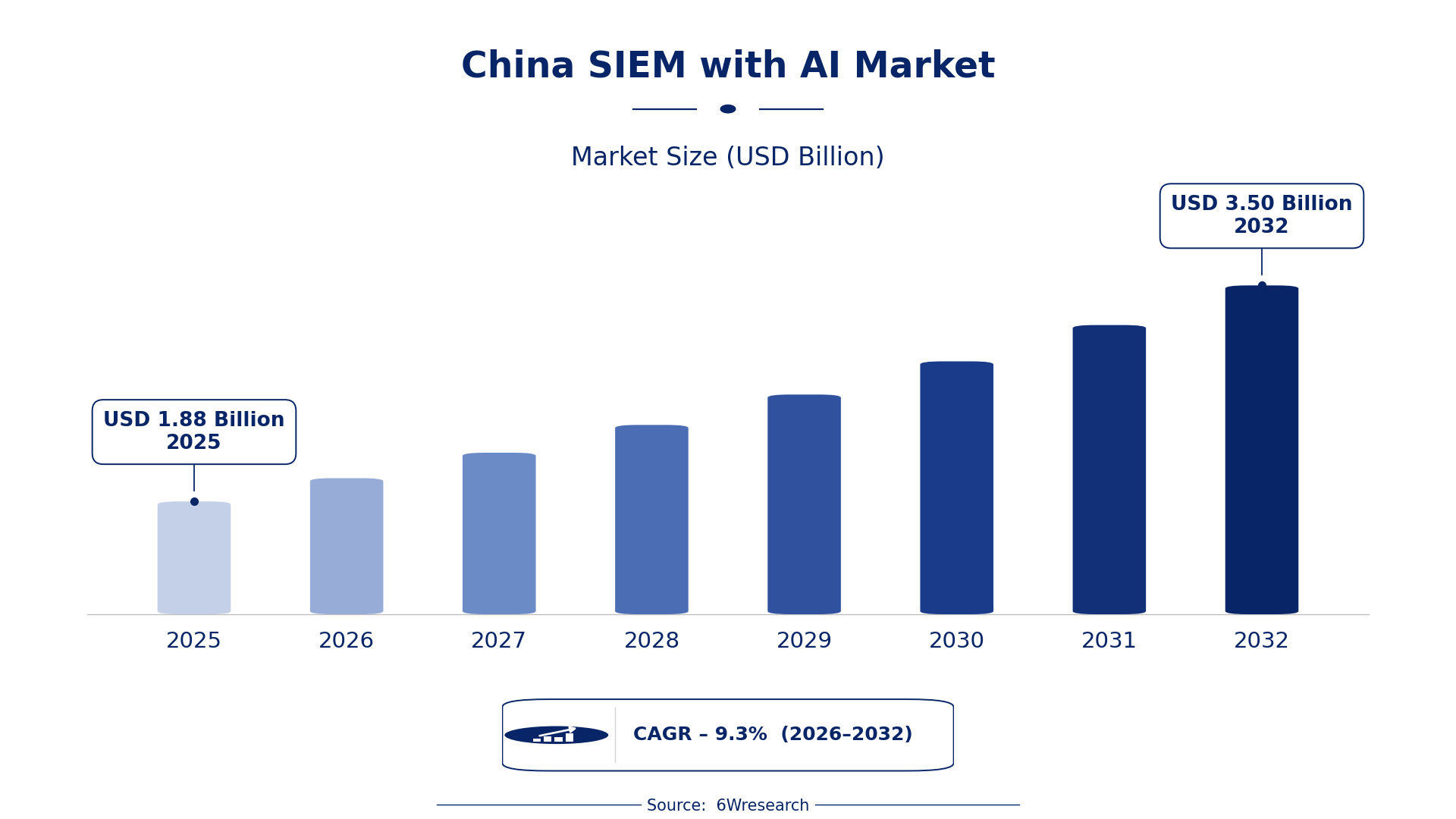
According to 6Wresearch internal database and industry insights, the China SIEM with AI Market was valued at USD 1.88 billion in 2025 and is projected to reach USD 3.50 billion by 2032, growing at a CAGR of approximately 9.3% during 2026–2032.
China SIEM with AI Market Highlights
| Report Metric | Details |
| Report Name | China SIEM with AI Market |
| Market Size 2025 | USD 1.88 billion |
| Market Size 2032 | USD 3.50 billion |
| Absolute Growth 2025–2032 | USD 1.62 billion |
| CAGR 2026–2032 | 9.3% |
| Peak Annual Growth | 11.6% in 2028 |
| Forecast Period | 2026–2032 |
| Historical Data | 2022–2025 |
| Base Year | 2025 |
| Leading SIEM Type, 2025 | Cloud-Based SIEM (42% share) |
| Leading AI Capability, 2025 | Threat Detection AI (53% share) |
| Leading Deployment Mode, 2025 | SaaS (50% share) |
| Leading End User, 2025 | Enterprises (41% share) |
| Fastest-Growing SIEM Type | Hybrid SIEM (10.8% CAGR) |
| Fastest-Growing Deployment Mode | Hardware/Software (10.5% CAGR) |
| Fastest-Growing End User | Banks & Insurance Firms (11.6% CAGR) |
| Growing Sector | Cybersecurity |
| Key End Users | Enterprises, Banks & Insurance Firms, Government Agencies |
China SIEM with AI Market Year-wise Growth Rate and Key Drivers (2022–2032)
This graph illustrates the annual growth rates of the market from 2022 to 2032, highlighting a steady upward trajectory and projected market expansion over the forecast period.
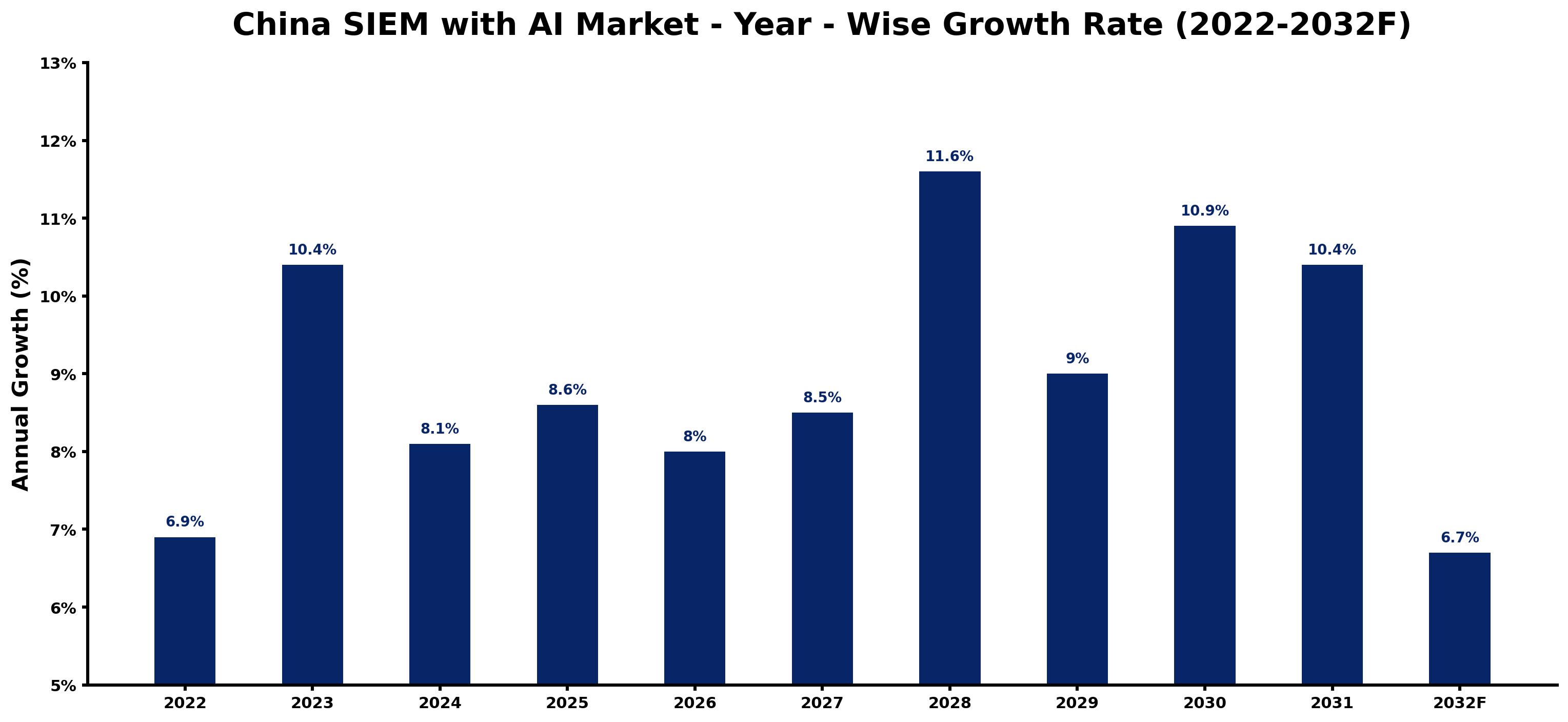
Below, each year's estimated growth is shown next to the factor that most influenced it.
| Year | Estimated Annual Growth (%) | Market Rationale |
| 2022 | 6.9 | The market experienced initial growth due to rising cybersecurity concerns among enterprises. |
| 2023 | 10.4 | Demand surged as major cities like Beijing and Shanghai adopted advanced SIEM technologies. |
| 2024 | 8.1 | Growth slowed as enterprises adjusted to the Cybersecurity Law and new standards. |
| 2025 | 8.6 | Increased investments in cybersecurity infrastructure led to faster growth compared to the previous year. |
| 2026 | 8.0 | Growth is expected to slow again as market maturity begins to set in, despite demand from enterprises. |
| 2027 | 8.5 | A resurgence in demand is projected as companies seek to improve security measures post-breach, particularly in banking. |
| 2028 | 11.6 | The market is expected to peak with substantial investments in AI-driven solutions for threat detection. |
| 2029 | 9.0 | Growth is projected to slow as the market begins to stabilise following rapid expansion in prior years, especially among SMEs. |
| 2030 | 10.9 | Demand is expected to increase again as financial institutions upgrade their security systems to comply with regulations. |
| 2031 | 10.4 | Growth is projected to slow slightly as the market reaches a more mature phase with established players in the cybersecurity sector. |
| 2032 | 6.7 | The market will continue to grow as ongoing regulatory requirements drive demand for SIEM solutions. |
Note: Market size estimations and growth projections presented in this report are based on 6Wresearch's proprietary forecasting methodology, utilizing the latest available industry data, government publications, and primary research inputs.
China SIEM with AI Market Synopsis
SIEM with AI in China combines security data management and artificial intelligence to improve threat detection and response. This technology enhances real-time threat detection, incident response, and compliance reporting. The China SIEM with AI Market is growing due to increasing cybersecurity threats, with over 1,000 registered cybersecurity firms operating in the country. Major cities such as Beijing and Shanghai are at the forefront of SIEM technology adoption, supported by government initiatives that encourage investments in cybersecurity. The National Cybersecurity Strategy and the Cybersecurity Law are driving demand for advanced security solutions across various sectors.
Market Dynamics Impact Analysis (2026–2032)
| Factor | Type | Impact | Primary Segment Affected |
| Growing cybersecurity threats among enterprises drive demand for advanced SIEM solutions. | Driver | High | Cloud-Based SIEM |
| Increased regulatory requirements compel financial institutions to adopt strong SIEM systems. | Driver | High | Banks & Insurance Firms |
| The need for scalable security solutions presents opportunities for cloud-based SIEM providers. | Opportunity | High | Cloud-Based SIEM |
| Investment in AI-driven cybersecurity solutions is increasing, creating demand for innovative SIEM products. | Opportunity | High | Threat Detection AI |
| Limited budgets among SMEs restrict widespread adoption of advanced SIEM technologies. | Restraint | Medium | SMEs |
| Integration complexities of AI with existing systems can hinder effective SIEM deployment. | Restraint | Medium | On-Premise SIEM |
| Talent shortages in cybersecurity professionals affect the ability to deploy SIEM solutions effectively. | Challenge | High | Enterprises |
| Rapid technological changes necessitate continuous updates to SIEM systems, posing a challenge for suppliers. | Challenge | Medium | MSSP-Managed SIEM |
Evaluation of Drivers in China SIEM with AI Market (2026–2032)
The main growth drivers and the segments they affect most are set out below.
| Drivers | Primary Segment Affected | Why It Matters (Evidence) |
| Rising cybersecurity threats among enterprises lead to increased demand for SIEM solutions. | Cloud-Based SIEM | Over 70% of large enterprises have adopted cloud-based SIEM solutions, improving their security posture. |
| Regulatory requirements drive financial institutions to implement strong SIEM systems. | Banks & Insurance Firms | The China Banking and Insurance Regulatory Commission mandates strong SIEM for compliance. |
| Growing investments in AI technologies increase the capabilities of SIEM solutions. | Threat Detection AI | The government allocated $200 million in 2023 to support AI-driven cybersecurity advancements. |
| The increasing number of registered cybersecurity firms promotes competition and innovation in SIEM offerings. | Enterprises | China had over 1,000 registered cybersecurity firms providing SIEM solutions in 2022. |
| The need for real-time threat detection drives demand for advanced SIEM technologies. | MSSP-Managed SIEM | Managed services are increasingly popular among resource-constrained organizations seeking effective security. |
The SIEM with AI market in China is expanding as rising cybersecurity threats, regulatory requirements, and growing investments in AI technologies drive demand. In 2023, the government allocated $100 million to support advancements in cybersecurity technology, promoting innovation in the sector. The increasing number of registered cybersecurity firms encourages competition and innovation in SIEM offerings. Financial institutions are compelled to implement strong SIEM systems due to regulatory mandates, further boosting market growth. As a result, over 70% of large enterprises have adopted cloud-based SIEM solutions, significantly enhancing their security capabilities.
Evaluation of Restraints in China SIEM with AI Market
The following restraints limit how fast demand can grow.
| Market Restraint | Primary Segment Affected | Why It Matters (Evidence) |
| Limited budgets among SMEs restrict the adoption of advanced SIEM technologies. | SMEs | SMEs face financial constraints that hinder their ability to invest in advanced cybersecurity solutions. |
| Integration complexities of AI with existing systems can hinder effective SIEM deployment. | On-Premise SIEM | Many enterprises struggle to integrate AI capabilities into their traditional security infrastructures. |
| Talent shortages in cybersecurity professionals affect the deployment of SIEM solutions. | Enterprises | The population of cybersecurity professionals in China exceeds 1 million, but demand still outstrips supply. |
| Rapid technological changes necessitate continuous updates to SIEM systems. | MSSP-Managed SIEM | Suppliers must keep pace with evolving technologies, which can delay deployment for clients. |
| High implementation costs deter smaller organizations from adopting SIEM solutions. | Hybrid SIEM | Smaller firms often find the initial investment for hybrid systems prohibitive. |
China SIEM with AI Market Challenges
Buyers and suppliers in the China SIEM with AI market face rising costs due to the need for advanced technologies to counter sophisticated cybersecurity threats, which can inflate operational expenses by up to 30% for smaller firms. Local suppliers encounter challenges with regulatory requirements, particularly the Cybersecurity Law of 2017, which mandates SIEM for critical infrastructure, leading to compliance costs that can exceed 15% of their budgets. Supply chain issues arise from reliance on a limited number of domestic cybersecurity firms, causing delays in SIEM solution availability that can extend lead times by several weeks for buyers. Increased competition from international firms pressures local suppliers to reduce prices, risking service quality and potentially destabilising the market.
Trends in the China SIEM with AI Market
The trends below show where the China SIEM with AI Market is heading.
- Shift from On-Premise to Cloud-Based SIEM Solutions: Many enterprises are transitioning from on-premise to cloud-based SIEM solutions for better scalability. In 2023, over 70% of large enterprises opted for cloud-based systems, reflecting a notable market shift.
- Increased Focus on AI-Driven Threat Detection: Organizations are prioritising the integration of AI in SIEM for advanced threat detection. The National Cybersecurity Strategy supports AI adoption, with a $100 million investment in 2023.
- Growing Demand for Managed Security Services: A noticeable trend towards managed security services is emerging as organizations seek to offload security responsibilities. In 2023, MSSP-managed SIEM solutions gained traction among resource-constrained businesses.
- Regulatory Compliance Driving SIEM Adoption: Regulatory requirements are increasingly influencing SIEM adoption across sectors. The Cybersecurity Law mandates SIEM for critical infrastructure, compelling organizations to enhance their security measures.
Investment Opportunities in the China SIEM with AI Market
Investors looking at the China SIEM with AI Market should consider the following areas.
- Partnerships for Cloud-Based SIEM Solutions: Local partnerships are essential for entering the cloud-based SIEM market, projected to reach USD 1.88 billion by 2025. Collaborating with cybersecurity firms can facilitate market entry.
- Investment in AI-Driven Security Technologies: The growing need for AI-driven security solutions presents opportunities for investment. Financial institutions are particularly interested in advanced threat detection technologies.
- Supply of Managed Security Services: The demand for managed security services is rising, creating opportunities for providers. In 2023, many resource-constrained organizations sought MSSP solutions for effective security management.
- Subsidised Cybersecurity Solutions for SMEs: With the government allocating $100 million in 2023 to support SMEs, there is a gap for suppliers to offer affordable SIEM solutions tailored for smaller organizations.
Government Initiatives in the China SIEM with AI Market
In 2023, the Ministry of Industry and Information Technology launched a $200 million initiative to support the development of AI-driven cybersecurity solutions, which promotes the adoption of SIEM technologies across various sectors, ensuring compliance with national security standards. This initiative builds upon existing frameworks like the Cybersecurity Law of 2017, driving demand for advanced security solutions.
The National Cybersecurity Center oversees the implementation of cybersecurity measures, providing resources and best practices for SIEM deployment. In 2022, the Cybersecurity Talent Training Program aimed to develop skills in SIEM technologies, targeting 100,000 professionals by 2025, thereby addressing the talent gap in the industry.
Future Insight of the China SIEM with AI Market
By 2032, buyers and suppliers in the China SIEM with AI market can expect significant advancements driven by government initiatives and technological progress. The National Cybersecurity Strategy will promote the integration of AI in threat detection, improving response times and accuracy across various sectors. The government’s investment in cybersecurity technology will support the training of over 1 million professionals, ensuring a skilled workforce. As major cities like Beijing and Shanghai continue to lead in SIEM technology adoption, buyers will benefit from enhanced solutions tailored to their specific security needs.
Market Segmentation Analysis
The analysis below covers each segmentation, its leading category in 2025 and its fastest-growing category through 2032.
By SIEM Type – Cloud-Based SIEM Dominated, Hybrid SIEM Expected to Grow Fastest
According to Dhaval Chaurasia, Assistant Manager at 6Wresearch, in 2025, Cloud-Based SIEM led the siem type split with a 42% share. Cloud-Based SIEM holds the largest share as it is widely adopted among large enterprises, particularly in major cities like Beijing and Shanghai. Its scalability and flexibility meet the extensive cybersecurity needs of organisations, making it a preferred choice for many. The quickest growth will come from Hybrid SIEM, forecast to expand at a CAGR of 10.8% between 2026 and 2032. Hybrid SIEM is experiencing rapid growth as it combines the benefits of both cloud and on-premise solutions, appealing to a diverse range of users. The rising demand for adaptable deployment options is significantly contributing to this segment's expansion. Suppliers should focus on developing hybrid solutions to capture the growing interest in flexible deployment options.
By AI Capability – Threat Detection AI Dominated and Is Expected to Record the Fastest Growth
With a 53% revenue share in 2025, Threat Detection AI was the largest ai capability category. Threat Detection AI commands the largest market share due to its essential role in identifying and responding to security threats effectively. Its integration into SIEM solutions is increasingly mandated by regulations, solidifying its position in the market. Its lead should widen, with a projected CAGR of 10.7% during 2026–2032, the highest in this split. The ongoing emphasis on Threat Detection AI will ensure its continued growth, as it remains central to enhancing security measures. As organisations face evolving threats, the demand for advanced detection capabilities will keep this segment at the forefront. Buyers must prioritise solutions with robust threat detection capabilities to ensure comprehensive security.
By Deployment Mode – SaaS Dominated, Hardware/Software Expected to Grow Fastest
SaaS accounted for a 50% market share by deployment mode in 2025. SaaS is the leading deployment mode due to its user-friendly nature and ease of maintenance, making it highly appealing for organisations aiming to streamline cybersecurity efforts. This mode allows for quicker updates and scalability, which are essential for contemporary security needs. Over 2026–2032, Hardware/Software is expected to post the fastest growth, at a CAGR of 10.5%. Hardware/Software deployment is gaining traction as some organisations prefer traditional setups for specific applications, though it is less favoured in cloud-centric environments. The need for customised solutions in certain sectors is driving this segment's growth. Suppliers should consider offering both SaaS and traditional deployment options to meet diverse customer preferences.
By End User – Enterprises Dominated, Banks & Insurance Firms Expected to Grow Fastest
Enterprises held a 41% share of the China SIEM with AI Market by end user in 2025. Enterprises represent the largest user segment, driven by extensive security needs across various industries. Their significant investment in cybersecurity technologies reflects the critical importance of protecting sensitive data and operations. Banks & Insurance Firms are projected to grow fastest, at a CAGR of 11.6% during 2026–2032. Banks & Insurance Firms are the fastest-growing segment due to stringent regulatory requirements that demand robust security solutions. The increasing focus on compliance and risk management is propelling this sector's demand for advanced SIEM technologies. Vendors should tailor their offerings to meet the specific regulatory and security needs of the banking and insurance sectors.
Key Attractiveness of the Report
- 10 Years of Market Numbers
- Historical Data Starting from 2022 to 2025
- Base Year 2025
- Forecast Data until 2032
- Key Performance Indicators Impacting the Market
- Major Upcoming Developments and Projects
Key Highlights of the Report:
- China SIEM with AI Market Outlook
- Market Size of China SIEM with AI Market, 2025
- Forecast of China SIEM with AI Market, 2032
- Historical Data and Forecast of China SIEM with AI Revenues & Volume for the Period 2022 - 2032F
- China SIEM with AI Market Trend Evolution
- China SIEM with AI Market Drivers and Challenges
- China SIEM with AI Price Trends
- China SIEM with AI Porter's Five Forces
- China SIEM with AI Industry Life Cycle
- Historical Data and Forecast of China SIEM with AI Market Revenues & Volume By SIEM Type for the Period 2022 - 2032F
- Historical Data and Forecast of China SIEM with AI Market Revenues & Volume By Cloud-Based SIEM for the Period 2022 - 2032F
- Historical Data and Forecast of China SIEM with AI Market Revenues & Volume By On-Premise SIEM for the Period 2022 - 2032F
- Historical Data and Forecast of China SIEM with AI Market Revenues & Volume By Hybrid SIEM for the Period 2022 - 2032F
- Historical Data and Forecast of China SIEM with AI Market Revenues & Volume By MSSP-Managed SIEM for the Period 2022 - 2032F
- Historical Data and Forecast of China SIEM with AI Market Revenues & Volume By AI Capability for the Period 2022 - 2032F
- Historical Data and Forecast of China SIEM with AI Market Revenues & Volume By Threat Detection AI for the Period 2022 - 2032F
- Historical Data and Forecast of China SIEM with AI Market Revenues & Volume By Log Correlation for the Period 2022 - 2032F
- Historical Data and Forecast of China SIEM with AI Market Revenues & Volume By Predictive Alerts for the Period 2022 - 2032F
- Historical Data and Forecast of China SIEM with AI Market Revenues & Volume By Real-Time Anomaly AI for the Period 2022 - 2032F
- Historical Data and Forecast of China SIEM with AI Market Revenues & Volume By Deployment Mode for the Period 2022 - 2032F
- Historical Data and Forecast of China SIEM with AI Market Revenues & Volume By SaaS for the Period 2022 - 2032F
- Historical Data and Forecast of China SIEM with AI Market Revenues & Volume By Hardware/Software for the Period 2022 - 2032F
- Historical Data and Forecast of China SIEM with AI Market Revenues & Volume By Mixed Infrastructure for the Period 2022 - 2032F
- Historical Data and Forecast of China SIEM with AI Market Revenues & Volume By Outsourced for the Period 2022 - 2032F
- Historical Data and Forecast of China SIEM with AI Market Revenues & Volume By End User for the Period 2022 - 2032F
- Historical Data and Forecast of China SIEM with AI Market Revenues & Volume By Enterprises for the Period 2022 - 2032F
- Historical Data and Forecast of China SIEM with AI Market Revenues & Volume By Banks & Insurance Firms for the Period 2022 - 2032F
- Historical Data and Forecast of China SIEM with AI Market Revenues & Volume By Government Agencies for the Period 2022 - 2032F
- Historical Data and Forecast of China SIEM with AI Market Revenues & Volume By SMEs for the Period 2022 - 2032F
- China SIEM with AI Import Export Trade Statistics
- Market Opportunity Assessment By SIEM Type
- Market Opportunity Assessment By AI Capability
- Market Opportunity Assessment By Deployment Mode
- Market Opportunity Assessment By End User
- China SIEM with AI Top Companies Market Share
- China SIEM with AI Competitive Benchmarking By Technical and Operational Parameters
- China SIEM with AI Company Profiles
- China SIEM with AI Key Strategic Recommendations
Market Covered
Segments analysed in this report are listed below.
By SIEM Type
- Cloud-Based SIEM
- On-Premise SIEM
- Hybrid SIEM
- MSSP-Managed SIEM
By AI Capability
- Threat Detection AI
- Log Correlation
- Predictive Alerts
- Real-Time Anomaly AI
By Deployment Mode
- SaaS
- Hardware/Software
- Mixed Infrastructure
- Outsourced
By End User
- Enterprises
- Banks & Insurance Firms
- Government Agencies
- SMEs































