China Simulation and Reconstruction Software Market Size & Growth Rate
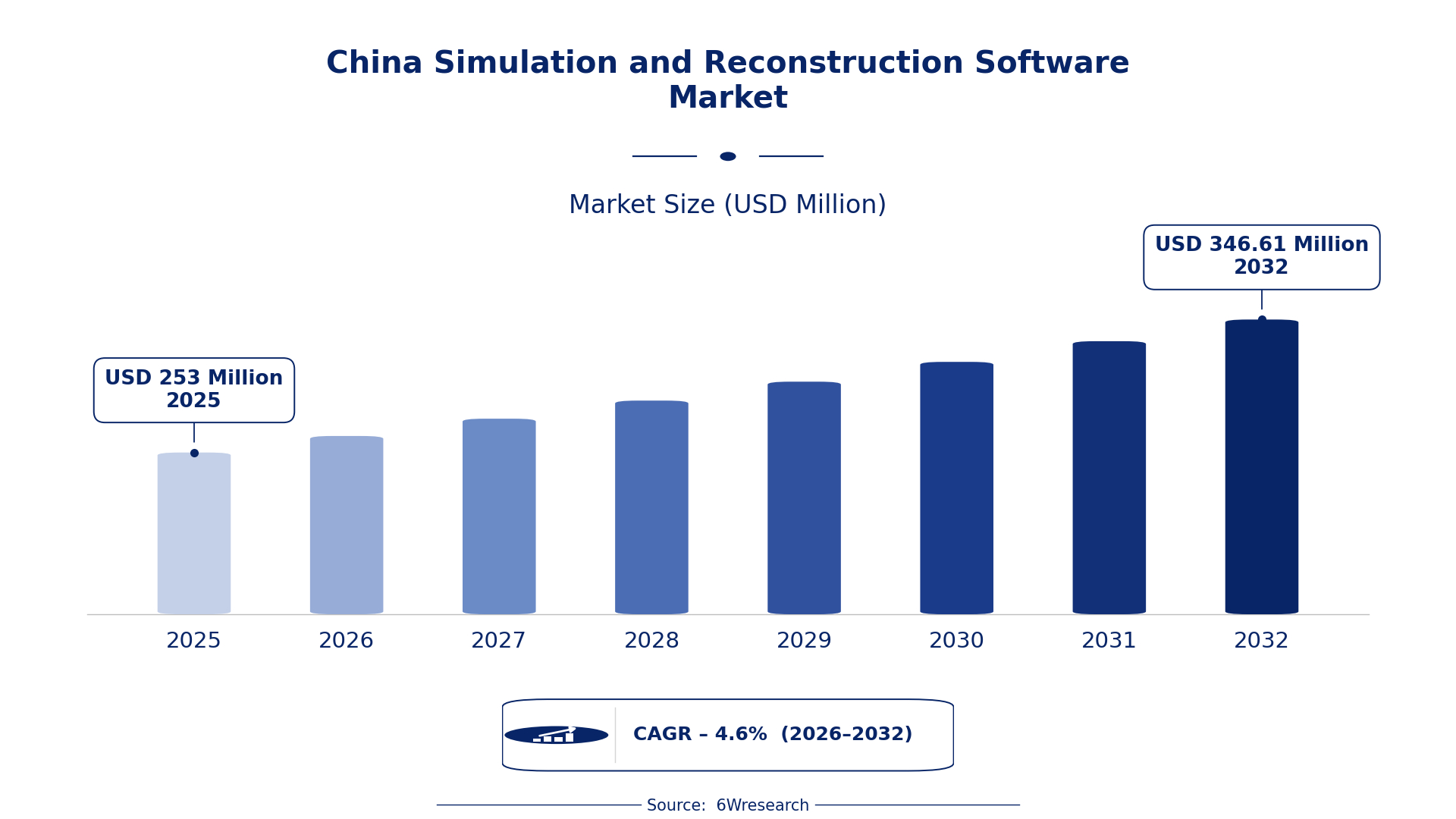
According to 6Wresearch internal database and industry insights, the China Simulation and Reconstruction Software Market was valued at USD 253.0 million in 2025 and is projected to reach USD 346.61 million by 2032, growing at a CAGR of approximately 4.6% during 2026–2032.
China Simulation and Reconstruction Software Market Highlights
| Report Metric | Details |
| Report Name | China Simulation and Reconstruction Software Market |
| Market Size 2025 | USD 253.0 million |
| Market Size 2032 | USD 346.61 million |
| Absolute Growth 2025–2032 | USD 93.61 million |
| CAGR 2026–2032 | 4.6% |
| Peak Annual Growth | 6.5% in 2027 |
| Forecast Period | 2026–2032 |
| Historical Data | 2022–2025 |
| Base Year | 2025 |
| Leading Software Type, 2025 | Engineering Simulation (50% share) |
| Leading Simulation Focus, 2025 | Structural/Fluid Dynamics (38% share) |
| Leading Deployment Platform, 2025 | Cloud (41% share) |
| Leading End User, 2025 | Aerospace & Automotive (44% share) |
| Fastest-Growing Software Type | Virtual Surgery Software (6.0% CAGR) |
| Fastest-Growing Simulation Focus | Medical Scenarios (7.2% CAGR) |
| Fastest-Growing End User | Medical Schools (5.8% CAGR) |
| Growing Sector | Aerospace |
| Key End Users | Aerospace manufacturers, medical schools, city planners, automotive companies |
China Simulation and Reconstruction Software Market Year-wise Growth Rate and Key Drivers (2022–2032)
This graph illustrates the annual growth rates of the market from 2022 to 2032, highlighting a steady upward trajectory and projected market expansion over the forecast period.
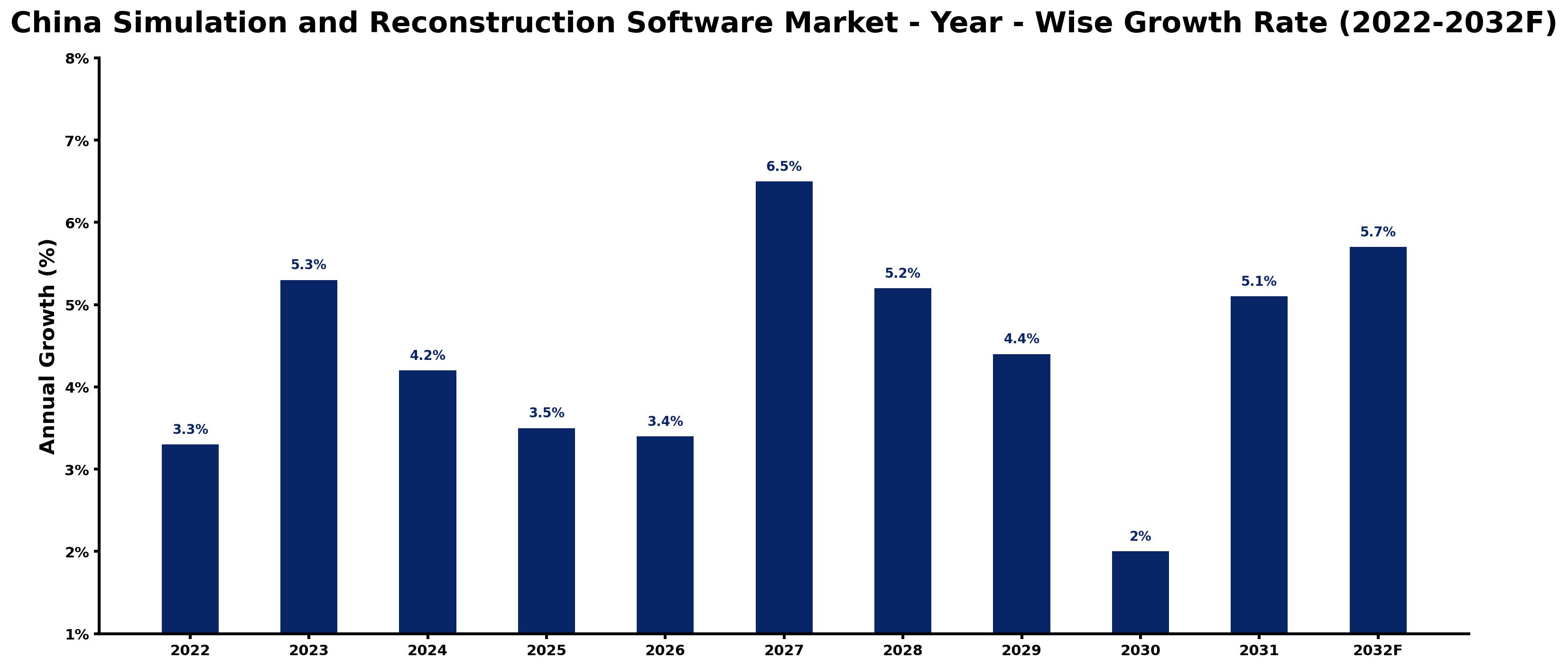
Below, each year's estimated growth is shown next to the factor that most influenced it.
| Year | Estimated Annual Growth (%) | Market Rationale |
| 2022 | 3.3 | The market experienced steady growth due to increasing interest in simulation technologies among aerospace and automotive sectors. |
| 2023 | 5.3 | Growth accelerated as the aerospace sector adopted advanced simulation tools for design and training, driven by significant investments. |
| 2024 | 4.2 | Investment in simulation technologies slowed as companies adjusted to market conditions following the Digital China Initiative's implementation. |
| 2025 | 3.5 | Demand continued to grow but at a slower pace as market saturation approached, particularly in urban planning and infrastructure projects. |
| 2026 | 3.4 | The market is expected to see a slight slowdown as competition intensifies among software providers in the aerospace sector. |
| 2027 | 6.5 | A surge in investment from the aerospace sector is projected to boost demand for engineering simulation tools significantly. |
| 2028 | 5.2 | Growth is expected to slow again as companies consolidate their existing technologies in response to market conditions. |
| 2029 | 4.4 | The market will continue to expand, albeit at a slower rate as new entrants emerge in the simulation software space. |
| 2030 | 2.0 | Growth is projected to decelerate as the market begins to stabilise after rapid expansion in cloud-based solutions. |
| 2031 | 5.1 | Demand is expected to pick up again as industries recognise the value of simulation software in medical training and education. |
| 2032 | 5.7 | The market is projected to grow steadily as the integration of simulation tools becomes standard in educational curricula. |
Note: Market size estimations and growth projections presented in this report are based on 6Wresearch's proprietary forecasting methodology, utilizing the latest available industry data, government publications, and primary research inputs.
China Simulation and Reconstruction Software Market Synopsis
Simulation and Reconstruction Software in China encompasses tools designed to create digital models of real-world scenarios through programming and data analysis. Its applications span engineering, medical training, and urban planning, with notable contributions from the aerospace and healthcare sectors. The China Simulation and Reconstruction Software Market is growing as investments in these industries rise, supported by initiatives like the Digital China Initiative, which seeks to improve software capabilities and increase adoption rates.
Market Dynamics Impact Analysis (2026–2032)
| Factor | Type | Impact | Primary Segment Affected |
| Increasing investments in aerospace simulation technologies. | Driver | High | Engineering Simulation |
| Growing adoption of virtual surgery software in medical schools. | Driver | High | Virtual Surgery Software |
| Expansion of smart city initiatives across major urban areas. | Opportunity | High | Smart City Simulators |
| Rising demand for cloud-based simulation solutions. | Opportunity | High | Cloud |
| Competition among software providers may limit market share. | Restraint | Medium | 3D Reconstruction |
| High development costs can deter smaller firms from entering the market. | Restraint | Medium | Engineering Simulation |
| The market faces challenges from rapid technological changes. | Challenge | High | Virtual Surgery Software |
| Limited integration of simulation software in some educational institutions. | Challenge | Medium | Medical Schools |
Evaluation of Drivers in China Simulation and Reconstruction Software Market (2026–2032)
Key forces behind demand, with the segment each one moves most, are listed below.
| Drivers | Primary Segment Affected | Why It Matters (Evidence) |
| Increased investment in aerospace simulation technologies drives demand. | Engineering Simulation | The aerospace sector in China is expected to invest over 300 million in simulation technologies by 2024, leading to more software purchases for design and testing. |
| Growing adoption of virtual surgery software enhances training capabilities. | Virtual Surgery Software | Medical schools in China have adopted virtual surgery software for training over 100,000 students annually, increasing demand for these solutions. |
| Smart city initiatives are expanding the use of simulation software. | Smart City Simulators | Over 200 major cities in China are utilising simulation software for urban planning, significantly boosting demand in this sector. |
| The shift towards cloud-based solutions is increasing accessibility. | Cloud | China's cloud computing market is projected to reach 200 billion by 2025, encouraging more users to adopt cloud-based simulation software. |
| The integration of simulation software in educational curricula is driving demand. | Medical Schools | The Ministry of Education's programme to integrate simulation software into medical curricula impacts over 1,000 universities, increasing software adoption. |
Growth across the Simulation and Reconstruction Software market in China is anchored in rising end-use demand from sectors like aerospace and healthcare, alongside a strong supply response from software developers. The aerospace sector's investment of over 300 million in simulation technologies by 2024 is prompting increased purchases of engineering simulation tools. The integration of simulation software into medical curricula across 1,000 universities is driving demand for virtual surgery software, impacting over 100,000 students annually. The rapid growth of the cloud computing market, which is projected to reach 200 billion by 2025, encourages the shift towards cloud-based simulation solutions.
Evaluation of Restraints in China Simulation and Reconstruction Software Market
The table below lists the restraints and the evidence behind each.
| Market Restraint | Primary Segment Affected | Why It Matters (Evidence) |
| High development costs can deter smaller firms from entering the market. | 3D Reconstruction | The simulation software market's high development costs limit entry for smaller firms, impacting overall competition. |
| Limited integration of simulation software in some educational institutions. | Virtual Surgery Software | Not all medical schools have adopted simulation software, which restricts market growth in the education sector. |
| Competition among software providers may limit market share. | Engineering Simulation | Intense competition can lead to price wars, affecting profitability for providers in the engineering simulation segment. |
| Rapid technological changes can outpace current solutions. | Smart City Simulators | The fast pace of technological advancements may leave some simulation software outdated, affecting user satisfaction. |
| Regulatory hurdles can slow down software deployment. | Cloud | Compliance with national standards can delay the adoption of cloud-based simulation solutions, impacting market growth. |
China Simulation and Reconstruction Software Market Challenges
The China Simulation and Reconstruction Software market faces a few practical problems, starting with regulatory compliance. The National Standard for Simulation Software, implemented in 2020, imposes stringent quality requirements that can delay product launches for developers, costing them potential revenue. Buyers in the healthcare sector struggle with the high costs associated with acquiring advanced simulation tools, which can exceed 500,000 per institution, limiting access for smaller medical schools. Increasing costs of cloud services can strain budgets for urban planners, affecting project timelines across over 200 major cities involved in smart city initiatives. Sourcing software components can also lead to delays in deployment, impacting service delivery for urban planning projects.
Trends in the China Simulation and Reconstruction Software Market
Below mentioned are some of the trends shaping the China Simulation and Reconstruction Software Market growth.
- Integration of Simulation Software in Medical Training: The Ministry of Education's updated National Curriculum for Medical Training in 2023 includes simulation-based learning, impacting over 500 medical schools. This shift improves training quality for future healthcare professionals.
- Expansion of Smart City Initiatives: China's Smart City Development Plan approved in 2022 allocates 1 billion for urban infrastructure simulation projects. This funding will enhance the capabilities of cities to plan and execute urban development effectively.
- Shift Towards Cloud-Based Solutions: The increasing preference for cloud deployment is evident as the cloud segment is anticipated to grow at 7.1% from 2026 to 2032. This trend allows for greater accessibility and collaboration in simulation software usage.
- Focus on Structural and Fluid Dynamics: Structural and fluid dynamics simulation tools are gaining traction in China's construction industry, valued at 1 trillion annually. This focus is essential for improving design efficiency and safety in engineering projects.
Investment Opportunities in the China Simulation and Reconstruction Software Market
The following opportunities in the China Simulation and Reconstruction Software Market pair current demand with a clear way in.
- Timing for Investment in Simulation Technologies: With the aerospace sector projected to invest over 300 million by 2024, suppliers have a chance to offer advanced simulation solutions. Engaging with aerospace manufacturers can yield substantial returns.
- Gap in Virtual Surgery Training Tools: The demand for virtual surgery software is rising, with over 100,000 students trained annually. Suppliers can concentrate on developing innovative training tools for medical schools to satisfy this growing need.
- Expansion of Smart City Projects: The allocation of 1 billion for urban infrastructure simulation projects presents an opportunity for software developers. Collaborating with city planners can facilitate entry into this expanding market segment.
- Growth in Cloud-Based Simulation Solutions: As the cloud computing market is set to reach 200 billion by 2025, suppliers can invest in scalable simulation software. Partnering with cloud service providers can enhance market penetration.
Government Initiatives in the China Simulation and Reconstruction Software Market
In 2021, the Ministry of Industry and Information Technology launched the 'Digital China Initiative' to improve software capabilities, aiming for a 30% increase in simulation software adoption by 2025. This initiative builds on previous efforts to modernise China's software industry and encourages innovation in simulation technologies. The National Development and Reform Commission's 'Smart City Development Plan', approved in 2022, allocates 1 billion for urban infrastructure simulation projects. This funding supports local governments and city planners in integrating simulation software into their urban development strategies.
The Ministry of Education's programme to integrate simulation software into medical curricula impacts over 1,000 universities, improving training for medical professionals. This initiative aims to enhance educational outcomes and ensure that future healthcare providers are proficient in using advanced simulation tools.
Future Insight of the China Simulation and Reconstruction Software Market
By 2032, the China Simulation and Reconstruction Software market will undergo significant changes driven by several key factors. The aerospace sector is set to invest over 300 million in simulation technologies, improving product development capabilities. Medical education will integrate simulation software into curricula across 1,000 universities, enhancing training for over 100,000 students annually. Government support for AR/VR development, with a budget of 500 million, will promote innovation in simulation applications. The rapid growth of the cloud computing market, expected to reach 200 billion, will facilitate broader software deployment across various industries.
Market Segmentation Analysis
The analysis below covers each segmentation, its leading category in 2025 and its fastest-growing category through 2032.
By Software Type – Engineering Simulation Dominated, Virtual Surgery Software Expected to Grow Fastest
According to Dhaval Chaurasia, Assistant Manager at 6Wresearch, Engineering Simulation took a 50% share of software type in 2025, more than any other category. Engineering Simulation holds the largest share in China's simulation software market due to its critical role in testing designs and processes across various engineering sectors. The aerospace sector's anticipated investment of over 300 million in simulation technologies by 2024 exemplifies the strong demand for these essential tools. Over 2026–2032, Virtual Surgery Software is expected to post the fastest growth, at a CAGR of 6.0%. Virtual Surgery Software is experiencing rapid growth as medical schools adopt it for training over 100,000 students annually. This surge is likely to continue, bolstered by the Ministry of Education's programme to integrate simulation software into the curricula of 1,000 universities, enhancing its uptake. Suppliers should focus on developing advanced engineering applications, while buyers can look forward to a broader selection of sophisticated simulation tools.
By Simulation Focus – Structural/Fluid Dynamics Dominated, Medical Scenarios Expected to Grow Fastest
Structural/Fluid Dynamics accounted for a 38% market share by simulation focus in 2025. Structural/Fluid Dynamics commands the largest market share due to its widespread application in engineering and architecture, where it is vital for ensuring design integrity. The construction industry's annual valuation of 1 trillion highlights the importance of these simulation tools in validating structural performance. Medical Scenarios are set to record the highest CAGR in this split, 7.2% over 2026–2032. Medical Scenarios are rapidly gaining traction, proving essential for training and planning in the healthcare sector. The increasing adoption of virtual surgery software in medical schools indicates a strong growth trajectory for this segment. This trend creates opportunities for suppliers to innovate in medical simulation tools, while buyers can expect enhanced training resources.
By Deployment Platform – Cloud Dominated and Is Expected to Record the Fastest Growth
Cloud held a 41% share of the China Simulation and Reconstruction Software Market by deployment platform in 2025. Cloud deployment leads the market share as it is increasingly favoured for its scalability and accessibility, enabling users to access simulation tools from various locations. The projected growth of China's cloud computing market, expected to reach 200 billion by 2025, reinforces this trend. Cloud is also forecast to expand faster than any other category, at a CAGR of 7.1% over 2026–2032. Cloud is also the fastest-growing segment due to its inherent advantages like flexibility and cost-effectiveness, which are crucial across multiple industries. As more businesses shift towards cloud-based solutions, this growth is set to continue. Suppliers should concentrate on cloud-based offerings, while buyers can benefit from scalable and flexible solutions.
By End User – Aerospace & Automotive Dominated, Medical Schools Expected to Grow Fastest
The largest end user category in 2025 was Aerospace & Automotive, with a 44% share of total revenue. Aerospace & Automotive captures the largest market share, as these sectors are vital for design and testing processes, driving substantial demand for simulation software. The aerospace sector's significant investment in simulation technologies further cements this leading position. Medical Schools are projected to grow fastest, at a CAGR of 5.8% during 2026–2032. Medical Schools represent the fastest-growing end user group, increasingly adopting simulation software for educational purposes in healthcare. The integration of virtual surgery training into medical curricula underscores the urgent need for advanced tools in this field. This trend suggests a growing market for suppliers targeting educational institutions, while buyers can anticipate improved training solutions.
Key Attractiveness of the Report
- 10 Years of Market Numbers
- Historical Data Starting from 2022 to 2025
- Base Year 2025
- Forecast Data until 2032
- Key Performance Indicators Impacting the Market
- Major Upcoming Developments and Projects
Key Highlights of the Report:
- China Simulation and Reconstruction Software Market Outlook
- Market Size of China Simulation and Reconstruction Software Market, 2025
- Forecast of China Simulation and Reconstruction Software Market, 2032
- Historical Data and Forecast of China Simulation and Reconstruction Software Revenues & Volume for the Period 2022 - 2032F
- China Simulation and Reconstruction Software Market Trend Evolution
- China Simulation and Reconstruction Software Market Drivers and Challenges
- China Simulation and Reconstruction Software Price Trends
- China Simulation and Reconstruction Software Porter's Five Forces
- China Simulation and Reconstruction Software Industry Life Cycle
- Historical Data and Forecast of China Simulation and Reconstruction Software Market Revenues & Volume By Software Type for the Period 2022 - 2032F
- Historical Data and Forecast of China Simulation and Reconstruction Software Market Revenues & Volume By 3D Reconstruction for the Period 2022 - 2032F
- Historical Data and Forecast of China Simulation and Reconstruction Software Market Revenues & Volume By Engineering Simulation for the Period 2022 - 2032F
- Historical Data and Forecast of China Simulation and Reconstruction Software Market Revenues & Volume By Virtual Surgery Software for the Period 2022 - 2032F
- Historical Data and Forecast of China Simulation and Reconstruction Software Market Revenues & Volume By Smart City Simulators for the Period 2022 - 2032F
- Historical Data and Forecast of China Simulation and Reconstruction Software Market Revenues & Volume By Simulation Focus for the Period 2022 - 2032F
- Historical Data and Forecast of China Simulation and Reconstruction Software Market Revenues & Volume By Image/Scene Building for the Period 2022 - 2032F
- Historical Data and Forecast of China Simulation and Reconstruction Software Market Revenues & Volume By Structural/Fluid Dynamics for the Period 2022 - 2032F
- Historical Data and Forecast of China Simulation and Reconstruction Software Market Revenues & Volume By Medical Scenarios for the Period 2022 - 2032F
- Historical Data and Forecast of China Simulation and Reconstruction Software Market Revenues & Volume By Urban Infrastructure for the Period 2022 - 2032F
- Historical Data and Forecast of China Simulation and Reconstruction Software Market Revenues & Volume By Deployment Platform for the Period 2022 - 2032F
- Historical Data and Forecast of China Simulation and Reconstruction Software Market Revenues & Volume By Desktop/Cloud for the Period 2022 - 2032F
- Historical Data and Forecast of China Simulation and Reconstruction Software Market Revenues & Volume By On-Premise for the Period 2022 - 2032F
- Historical Data and Forecast of China Simulation and Reconstruction Software Market Revenues & Volume By Hospital Network for the Period 2022 - 2032F
- Historical Data and Forecast of China Simulation and Reconstruction Software Market Revenues & Volume By Cloud for the Period 2022 - 2032F
- Historical Data and Forecast of China Simulation and Reconstruction Software Market Revenues & Volume By End User for the Period 2022 - 2032F
- Historical Data and Forecast of China Simulation and Reconstruction Software Market Revenues & Volume By AR/VR Developers for the Period 2022 - 2032F
- Historical Data and Forecast of China Simulation and Reconstruction Software Market Revenues & Volume By Aerospace & Automotive for the Period 2022 - 2032F
- Historical Data and Forecast of China Simulation and Reconstruction Software Market Revenues & Volume By Medical Schools for the Period 2022 - 2032F
- Historical Data and Forecast of China Simulation and Reconstruction Software Market Revenues & Volume By City Planners for the Period 2022 - 2032F
- China Simulation and Reconstruction Software Import Export Trade Statistics
- Market Opportunity Assessment By Software Type
- Market Opportunity Assessment By Simulation Focus
- Market Opportunity Assessment By Deployment Platform
- Market Opportunity Assessment By End User
- China Simulation and Reconstruction Software Top Companies Market Share
- China Simulation and Reconstruction Software Competitive Benchmarking By Technical and Operational Parameters
- China Simulation and Reconstruction Software Company Profiles
- China Simulation and Reconstruction Software Key Strategic Recommendations
Market Covered
Segments analysed in this report are listed below.
By Software Type
- 3D Reconstruction
- Engineering Simulation
- Virtual Surgery Software
- Smart City Simulators
By Simulation Focus
- Image/Scene Building
- Structural/Fluid Dynamics
- Medical Scenarios
- Urban Infrastructure
By Deployment Platform
- Desktop/Cloud
- On-Premise
- Hospital Network
- Cloud
By End User
- AR/VR Developers
- Aerospace & Automotive
- Medical Schools
- City Planners































