China Simulation Platforms Market Size & Growth Rate
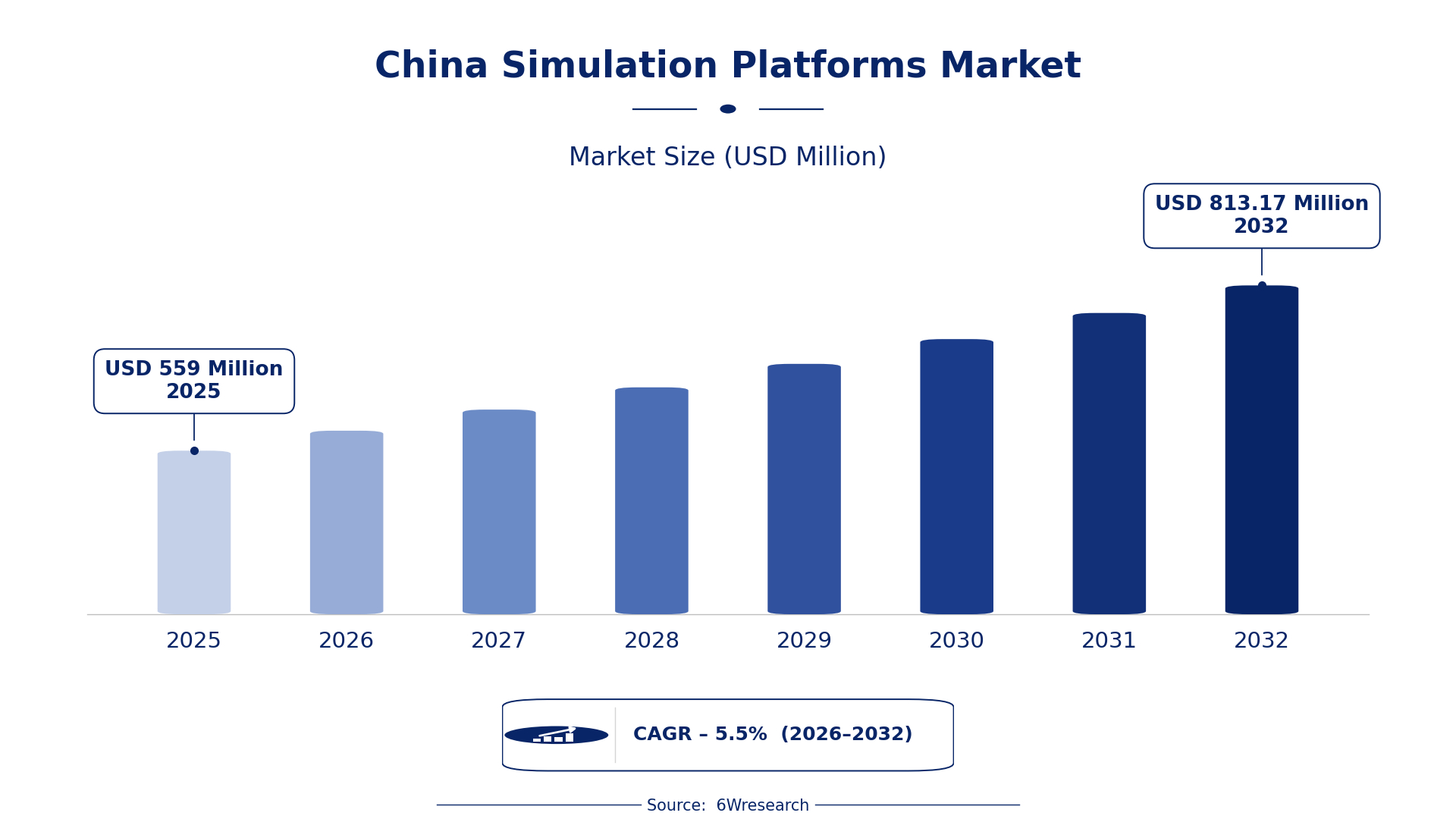
According to 6Wresearch internal database and industry insights, the China Simulation Platforms Market was valued at USD 559.0 million in 2025 and is projected to reach USD 813.17 million by 2032, growing at a CAGR of approximately 5.5% during 2026–2032.
China Simulation Platforms Market Highlights
| Report Metric | Details |
| Report Name | China Simulation Platforms Market |
| Market Size 2025 | USD 559.0 million |
| Market Size 2032 | USD 813.17 million |
| Absolute Growth 2025–2032 | USD 254.17 million |
| CAGR 2026–2032 | 5.5% |
| Peak Annual Growth | 7.5% in 2031 |
| Forecast Period | 2026–2032 |
| Historical Data | 2022–2025 |
| Base Year | 2025 |
| Leading Platform Type, 2025 | Physics Simulation (51% share) |
| Leading Use Case, 2025 | Engineering Design (51% share) |
| Leading Integration Support, 2025 | CAD/CAE (39% share) |
| Leading End User, 2025 | Industrial Design Firms (41% share) |
| Fastest-Growing Platform Type | Traffic Simulation (8.0% CAGR) |
| Fastest-Growing Use Case | Mobility Infrastructure (7.8% CAGR) |
| Fastest-Growing Integration Support | GIS/IoT (7.5% CAGR) |
| Fastest-Growing End User | Government Transport Depts (7.1% CAGR) |
| Growing Sector | Robotics Development |
| Key End Users | Industrial Design Firms, Government Transport Departments, Defense Contractors, Robotics Companies |
China Simulation Platforms Market Year-wise Growth Rate and Key Drivers (2022–2032)
This graph illustrates the annual growth rates of the market from 2022 to 2032, highlighting a steady upward trajectory and projected market expansion over the forecast period.
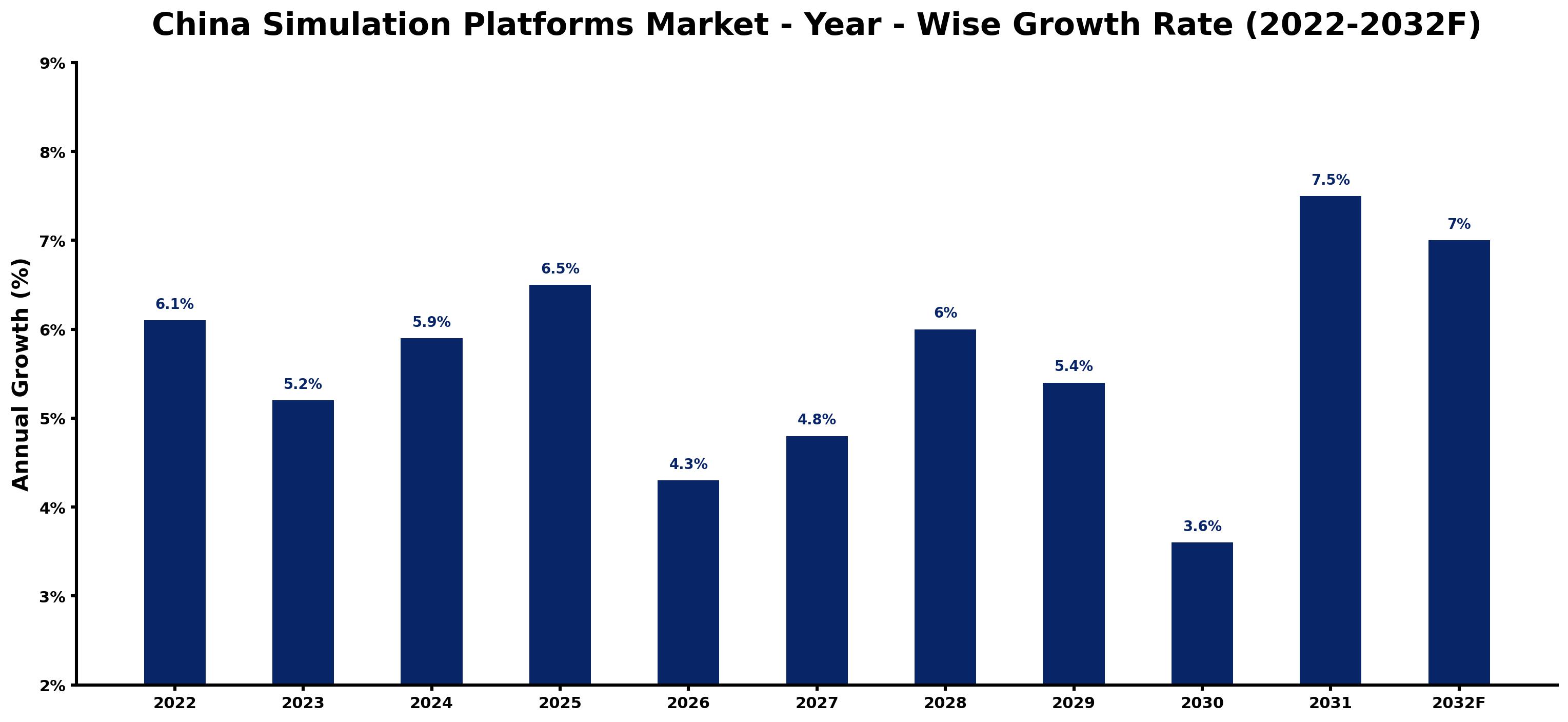
Annual growth estimates for each year appear below with the principal reason behind them, explaining the shifts that set the pace of the market.
| Year | Estimated Annual Growth (%) | Market Rationale |
| 2022 | 6.1 | The market experienced steady growth due to ongoing demand from industrial design firms. |
| 2023 | 5.2 | Growth slowed as the market adjusted to the impacts of global supply chain disruptions. |
| 2024 | 5.9 | Increased investment in smart transportation systems boosted demand for simulation platforms. |
| 2025 | 6.5 | Growth accelerated as the Beijing-Tianjin-Hebei region advanced traffic simulation technologies. |
| 2026 | 4.3 | The market faced a slowdown due to challenges in regulatory approvals for new technologies. |
| 2027 | 4.8 | Demand increased as robotics companies expanded their use of simulation platforms for development. |
| 2028 | 6.0 | Growth rebounded with heightened focus on mobility infrastructure simulations. |
| 2029 | 5.4 | A slowdown occurred as market participants adjusted to evolving industry standards. |
| 2030 | 3.6 | Growth continued to slow as the market faced increased competition and innovation pressures. |
| 2031 | 7.5 | Demand surged as military modernization efforts intensified, driving simulation platform adoption. |
| 2032 | 7.0 | Growth slowed slightly as the market stabilised following rapid advancements in technology. |
Note: Market size estimations and growth projections presented in this report are based on 6Wresearch's proprietary forecasting methodology, utilizing the latest available industry data, government publications, and primary research inputs.
China Simulation Platforms Market Synopsis
Simulation Platforms Market in China includes advanced software systems that create virtual models to replicate real-world processes. These platforms are crucial for engineering design, traffic management, robotics development, and military training. The market is expanding due to the active involvement of over 1,000 industrial design firms and substantial government initiatives such as the 'Made in China 2025' programme. Furthermore, the Chinese government's allocation of $500 million in 2022 for smart transportation systems further drives demand for these technologies.
Market Dynamics Impact Analysis (2026–2032)
| Factor | Type | Impact | Primary Segment Affected |
| Growing investment in smart transportation systems | Driver | High | Traffic Simulation |
| Increasing focus on robotics development | Driver | High | Robotics Simulation |
| Expansion of traffic simulation capabilities in urban areas | Opportunity | High | Traffic Simulation |
| Rising demand for military training simulations | Opportunity | High | Military Simulation |
| Regulatory hurdles in technology approvals | Restraint | Medium | Engineering Design |
| Competition from alternative simulation technologies | Restraint | Medium | Physics Simulation |
| High costs associated with advanced simulation technology development | Challenge | High | Robotics Simulation |
| Delays in government funding for infrastructure projects | Challenge | Medium | Traffic Simulation |
Evaluation of Drivers in China Simulation Platforms Market (2026–2032)
The factors lifting demand, and the evidence behind each, are summarised below.
| Drivers | Primary Segment Affected | Why It Matters (Evidence) |
| Investment in smart transportation systems | Traffic Simulation | The Chinese government allocated $500 million in 2022 to improve smart transportation, increasing demand for simulation platforms. |
| Modernisation of military training | Military Simulation | Ongoing efforts by the People's Liberation Army to modernise training methods are driving demand for military simulation platforms. |
| Growth of robotics companies | Robotics Simulation | The increasing number of robotics companies in China is driving the demand for simulation platforms for product development. |
| Focus on urban planning | Traffic Simulation | The urban density of the Beijing-Tianjin-Hebei region necessitates advanced traffic simulations for effective infrastructure planning. |
| Integration of ISO 26262 standards | Engineering Design | The adoption of ISO 26262 for functional safety in automotive applications is increasing the need for simulation platforms. |
Expansion of the Simulation Platforms market in China is backed by rising investment in smart transportation systems, ongoing military modernisation, and the growth of robotics companies. The increasing number of robotics companies in China is driving the need for simulation platforms for product development. Urban planning efforts in densely populated regions further drive traffic simulation demand. The integration of ISO standards for automotive safety is increasing the necessity for engineering design simulations.
Evaluation of Restraints in China Simulation Platforms Market
The table below lists the restraints and the evidence behind each.
| Market Restraint | Primary Segment Affected | Why It Matters (Evidence) |
| Regulatory hurdles in technology approvals | Engineering Design | Approval delays for new simulation technologies can extend project timelines, impacting industrial design firms. |
| Competition from alternative simulation technologies | Physics Simulation | Emerging technologies may divert investment away from traditional simulation platforms, affecting market share. |
| High costs associated with advanced simulation technology development | Robotics Simulation | The investment required for developing advanced simulation platforms can deter smaller robotics companies. |
| Delays in government funding for infrastructure projects | Traffic Simulation | Funding delays can hinder the timely implementation of traffic simulation technologies, affecting urban planning efforts. |
| Limited awareness of simulation benefits among potential users | Military Simulation | Some defense contractors may not fully recognise the advantages of advanced simulation platforms for training. |
China Simulation Platforms Market Challenges
In China, industrial design firms face high costs for simulation platforms, inflating project budgets by 20%. Compliance with ISO 26262 standards complicates the approval process for automotive technologies, delaying projects by up to six months for manufacturers. Suppliers encounter skills shortages in advanced simulation techniques, requiring substantial training investments that impede innovation. Rapid technological advancements pose integration challenges for existing platforms, compelling producers to divert resources away from development and affecting their market competitiveness.
Trends in the China Simulation Platforms Market
The trends below show where the China Simulation Platforms Market is heading.
- Shift towards Smart Transportation Solutions: The 'Made in China 2025' initiative has accelerated the development of smart transportation systems, increasing the demand for traffic simulation platforms. The government allocated $500 million in 2022 to support these systems, highlighting their importance.
- Growing Integration of ISO Standards: Since 2021, the integration of ISO standards for automotive safety has become more prevalent in simulation platforms. This shift is essential for ensuring compliance in a market projected to grow by 2025.
- Increased Focus on Robotics Development: With numerous robotics companies in China, the emphasis on simulation platforms for product development has intensified. This sector is expected to grow rapidly, reflecting the increasing reliance on advanced simulations.
- Expansion of Military Simulation Applications: The modernization efforts of the People's Liberation Army have led to a surge in military simulation applications. This trend is critical as the defense sector continues to invest heavily in advanced training technologies.
Investment Opportunities in the China Simulation Platforms Market
Several openings in the China Simulation Platforms Market merit attention from investors.
- Investment in Traffic Simulation Infrastructure: The Beijing-Tianjin-Hebei region presents a significant opportunity for traffic simulation infrastructure development, with a projected market size of USD 559 million by 2025. Collaborating with local government agencies can facilitate entry.
- Partnerships with Robotics Companies: With a growing number of robotics companies in China, there is an increasing need for simulation platforms. Establishing joint ventures with these firms can improve market penetration and innovation.
- Focus on Military Training Solutions: The ongoing modernisation of military training in China creates a demand for advanced simulation platforms. Targeting defence contractors can lead to lucrative contracts and collaborations.
- Development of Smart Transportation Systems: The Chinese government's commitment to smart transportation systems, supported by a $500 million investment, creates opportunities for simulation platform providers to engage with urban planners and transport departments.
Government Initiatives in the China Simulation Platforms Market
The 'Made in China 2025' initiative, launched by the National Development and Reform Commission in 2020, aims to improve simulation technologies in manufacturing. This programme encourages investment in advanced simulation platforms, enabling manufacturers to increase efficiency and product quality. Additionally, the Ministry of Industry and Information Technology's '14th Five-Year Plan' (2021) focuses on integrating simulation platforms into smart manufacturing and urban planning. This strategic direction is expected to drive demand for simulation technologies across various sectors. In 2021, the State Council approved the 'New Infrastructure' plan, allocating funding for advanced simulation technologies in transportation systems, further supporting market growth.
The Ministry of Industry and Information Technology oversees the implementation of the '14th Five-Year Plan', which allocates resources for developing simulation platforms in smart manufacturing. The National Natural Science Foundation of China is providing $200 million in funding for research in simulation technologies, benefiting academic and industrial research institutions. The Ministry of Science and Technology's 'National Key Research and Development Program', initiated in 2021, focuses on simulation technologies for defence applications, ensuring that military contractors have access to the latest advancements. These initiatives create a supportive environment for buyers and producers, facilitating the adoption of simulation platforms across various industries.
Future Insight of the China Simulation Platforms Market
The China Simulation Platforms Market will undergo significant changes by 2032, driven by the 'Made in China 2025' initiative that prioritises technological advancement. The government's focus on smart transportation systems will support traffic simulation development, benefiting both buyers and suppliers. The push for 30% electric vehicles by 2025 will necessitate new mobility infrastructure simulations, fostering innovation opportunities. The growing robotics sector, backed by numerous tech startups, will expand the application of simulation platforms across various industries.
Market Segmentation Analysis
Each segment group is reviewed below, with the leader by share and the fastest grower by CAGR.
By Platform Type – Physics Simulation Dominated, Traffic Simulation Expected to Grow Fastest
According to Dhaval Chaurasia, Assistant Manager at 6Wresearch, in 2025, Physics Simulation led the platform type split with a 51% share. Physics Simulation holds the largest share as it is crucial for testing and validating physical phenomena in engineering applications, making it a preferred choice among industrial design firms. The strong presence of over 1,000 industrial design firms in China ensures a steady demand for these platforms. The quickest growth will come from Traffic Simulation, forecast to expand at a CAGR of 8.0% between 2026 and 2032. Traffic Simulation is experiencing rapid growth due to the pressing need for effective urban planning and traffic management solutions, particularly in densely populated regions like Beijing-Tianjin-Hebei. The Chinese government's allocation of $500 million to enhance smart transportation systems significantly accelerates this segment's expansion. Suppliers should concentrate on advancing traffic simulation capabilities to meet the rising demands from urban planners and government agencies.
By Use Case – Engineering Design Dominated, Mobility Infrastructure Expected to Grow Fastest
Engineering Design accounted for a 51% market share by use case in 2025. Engineering Design commands the largest share as it is integral for product development and prototyping across various industries, particularly among industrial design firms. This widespread application ensures a consistent demand for simulation platforms tailored to engineering needs. Mobility Infrastructure is projected to grow fastest, at a CAGR of 7.8% during 2026–2032. Mobility Infrastructure is the fastest-growing use case, driven by the push for optimised transportation systems and the target of 30% electric vehicles by 2025. This focus on mobility infrastructure necessitates advanced simulation tools to design and manage new systems effectively. Buyers in the mobility sector should prioritise simulation platforms that cater specifically to infrastructure design to meet evolving transportation demands.
By Integration Support – CAD/CAE Dominated, GIS/IoT Expected to Grow Fastest
CAD/CAE took a 39% share of integration support in 2025, more than any other category. CAD/CAE integration commands the largest share as it plays a vital role in supporting design processes within engineering workflows, making it essential for many industrial design firms. This integration ensures that simulations align closely with design specifications and regulatory standards, driving its widespread adoption. Over 2026–2032, GIS/IoT is expected to post the fastest growth, at a CAGR of 7.5%. GIS/IoT integration is rapidly gaining traction, propelled by its capacity to enhance data analysis capabilities crucial for modern simulation applications. The increasing focus on data-driven decision-making in sectors like urban planning is driving the growth of GIS/IoT technologies. Suppliers need to prioritise the development of robust GIS/IoT integrations to cater to the rising demand for data-driven simulation solutions.
By End User – Industrial Design Firms Dominated, Government Transport Depts Expected to Grow Fastest
Industrial Design Firms held a 41% share of the China Simulation Platforms Market by end user in 2025. Industrial Design Firms represent the largest share as they are the primary users of simulation platforms for product design and testing, ensuring a steady demand for these tools. Their active role in various industries solidifies their position as key stakeholders in the market. Government Transport Depts are set to record the highest CAGR in this split, 7.1% over 2026–2032. Government Transport Departments are the fastest-growing end user, driven by the need for effective traffic and infrastructure planning in response to urbanisation challenges. Their increasing focus on simulation platforms for mobility solutions will likely expand their market influence. Suppliers should engage with government transport departments to tailor simulation solutions that address specific infrastructure planning needs.
Key Attractiveness of the Report
- 10 Years of Market Numbers
- Historical Data Starting from 2022 to 2025
- Base Year 2025
- Forecast Data until 2032
- Key Performance Indicators Impacting the Market
- Major Upcoming Developments and Projects
Key Highlights of the Report:
- China Simulation Platforms Market Outlook
- Market Size of China Simulation Platforms Market, 2025
- Forecast of China Simulation Platforms Market, 2032
- Historical Data and Forecast of China Simulation Platforms Revenues & Volume for the Period 2022 - 2032F
- China Simulation Platforms Market Trend Evolution
- China Simulation Platforms Market Drivers and Challenges
- China Simulation Platforms Price Trends
- China Simulation Platforms Porter's Five Forces
- China Simulation Platforms Industry Life Cycle
- Historical Data and Forecast of China Simulation Platforms Market Revenues & Volume By Platform Type for the Period 2022 - 2032F
- Historical Data and Forecast of China Simulation Platforms Market Revenues & Volume By Physics Simulation for the Period 2022 - 2032F
- Historical Data and Forecast of China Simulation Platforms Market Revenues & Volume By Traffic Simulation for the Period 2022 - 2032F
- Historical Data and Forecast of China Simulation Platforms Market Revenues & Volume By Robotics Simulation for the Period 2022 - 2032F
- Historical Data and Forecast of China Simulation Platforms Market Revenues & Volume By Military Simulation for the Period 2022 - 2032F
- Historical Data and Forecast of China Simulation Platforms Market Revenues & Volume By Use Case for the Period 2022 - 2032F
- Historical Data and Forecast of China Simulation Platforms Market Revenues & Volume By Engineering Design for the Period 2022 - 2032F
- Historical Data and Forecast of China Simulation Platforms Market Revenues & Volume By Mobility Infrastructure for the Period 2022 - 2032F
- Historical Data and Forecast of China Simulation Platforms Market Revenues & Volume By Motion & Control for the Period 2022 - 2032F
- Historical Data and Forecast of China Simulation Platforms Market Revenues & Volume By Combat Training for the Period 2022 - 2032F
- Historical Data and Forecast of China Simulation Platforms Market Revenues & Volume By Integration Support for the Period 2022 - 2032F
- Historical Data and Forecast of China Simulation Platforms Market Revenues & Volume By CAD/CAE for the Period 2022 - 2032F
- Historical Data and Forecast of China Simulation Platforms Market Revenues & Volume By GIS/IoT for the Period 2022 - 2032F
- Historical Data and Forecast of China Simulation Platforms Market Revenues & Volume By ROS Support for the Period 2022 - 2032F
- Historical Data and Forecast of China Simulation Platforms Market Revenues & Volume By VR/AR Interfaces for the Period 2022 - 2032F
- Historical Data and Forecast of China Simulation Platforms Market Revenues & Volume By End User for the Period 2022 - 2032F
- Historical Data and Forecast of China Simulation Platforms Market Revenues & Volume By Industrial Design Firms for the Period 2022 - 2032F
- Historical Data and Forecast of China Simulation Platforms Market Revenues & Volume By Government Transport Depts for the Period 2022 - 2032F
- Historical Data and Forecast of China Simulation Platforms Market Revenues & Volume By Robotics Companies for the Period 2022 - 2032F
- Historical Data and Forecast of China Simulation Platforms Market Revenues & Volume By Defense Contractors for the Period 2022 - 2032F
- China Simulation Platforms Import Export Trade Statistics
- Market Opportunity Assessment By Platform Type
- Market Opportunity Assessment By Use Case
- Market Opportunity Assessment By Integration Support
- Market Opportunity Assessment By End User
- China Simulation Platforms Top Companies Market Share
- China Simulation Platforms Competitive Benchmarking By Technical and Operational Parameters
- China Simulation Platforms Company Profiles
- China Simulation Platforms Key Strategic Recommendations
Market Covered
This report examines the market across the segments below.
By Platform Type
- Physics Simulation
- Traffic Simulation
- Robotics Simulation
- Military Simulation
By Use Case
- Engineering Design
- Mobility Infrastructure
- Motion & Control
- Combat Training
By Integration Support
- CAD/CAE
- GIS/IoT
- ROS Support
- VR/AR Interfaces
By End User
- Industrial Design Firms
- Government Transport Depts
- Robotics Companies
- Defense Contractors































