China Skincare Soap Market Size & Growth Rate
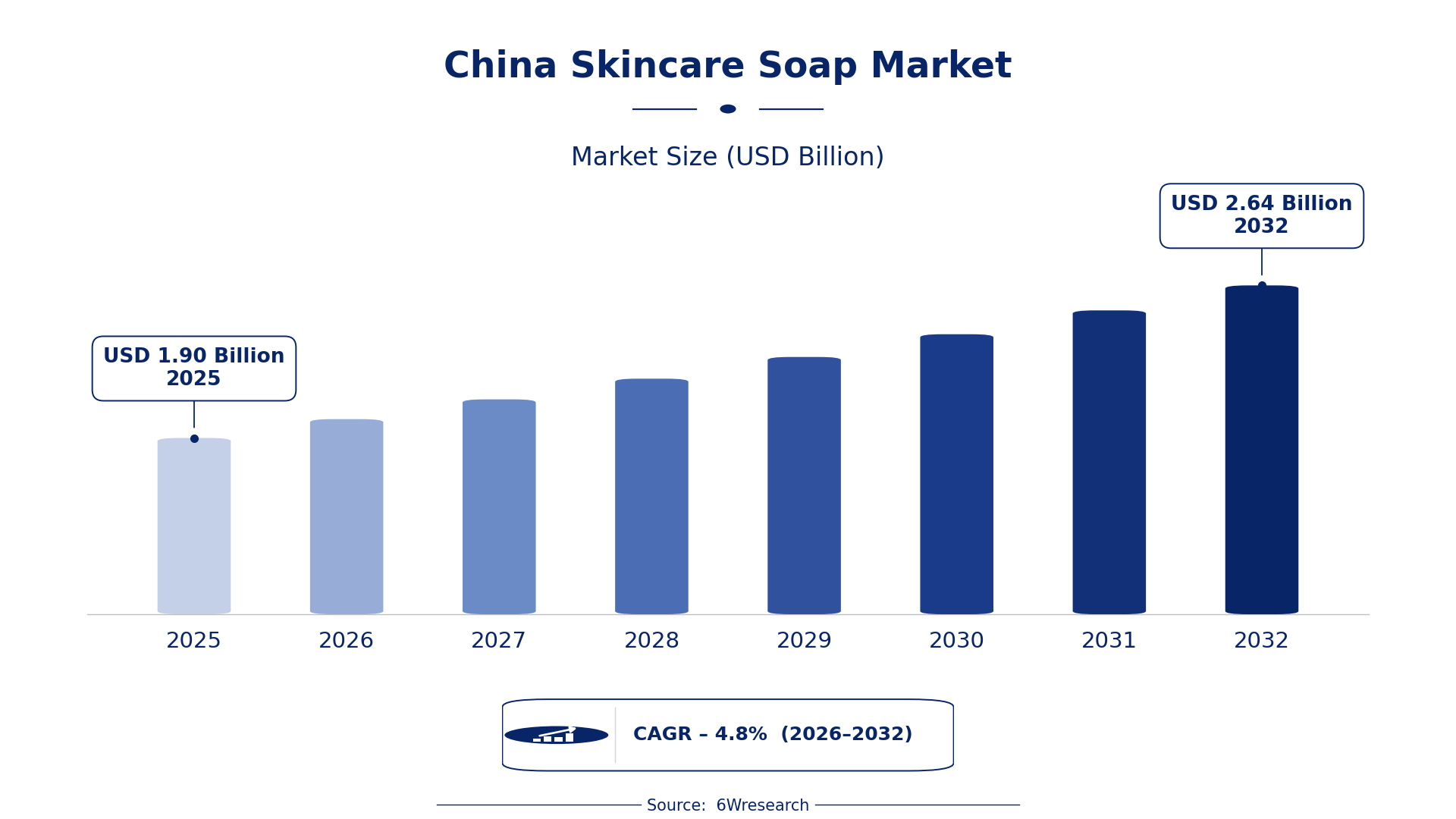
According to 6Wresearch internal database and industry insights, the China Skincare Soap Market was valued at USD 1.90 billion in 2025 and is projected to reach USD 2.64 billion by 2032, growing at a CAGR of approximately 4.8% during 2026–2032.
China Skincare Soap Market Highlights
| Report Metric | Details |
| Report Name | China Skincare Soap Market |
| Market Size 2025 | USD 1.90 billion |
| Market Size 2032 | USD 2.64 billion |
| Absolute Growth 2025–2032 | USD 0.74 billion |
| CAGR 2026–2032 | 4.8% |
| Peak Annual Growth | 7.0% in 2026 |
| Forecast Period | 2026–2032 |
| Historical Data | 2022–2025 |
| Base Year | 2025 |
| Leading Soap Type, 2025 | Moisturizing Soap (37% share) |
| Leading Base Material, 2025 | Glycerin/Shea Butter (51% share) |
| Leading Purpose, 2025 | Skin Brightening (47% share) |
| Leading End User, 2025 | Bath & Body Retailers (39% share) |
| Fastest-Growing Soap Type | Herbal Skincare Soap (7.0% CAGR) |
| Fastest-Growing Base Material | Neem/Aloe/Turmeric (5.8% CAGR) |
| Fastest-Growing Purpose | Acne Treatment (6.8% CAGR) |
| Fastest-Growing End User | Ayurvedic Brands (6.2% CAGR) |
| Growing Sector | personal care |
| Key End Users | Bath & Body Retailers, Pharmacies, Cosmetic Retailers, Ayurvedic Brands |
China Skincare Soap Market Year-wise Growth Rate and Key Drivers (2022–2032)
This graph illustrates the annual growth rates of the market from 2022 to 2032, highlighting a steady upward trajectory and projected market expansion over the forecast period.
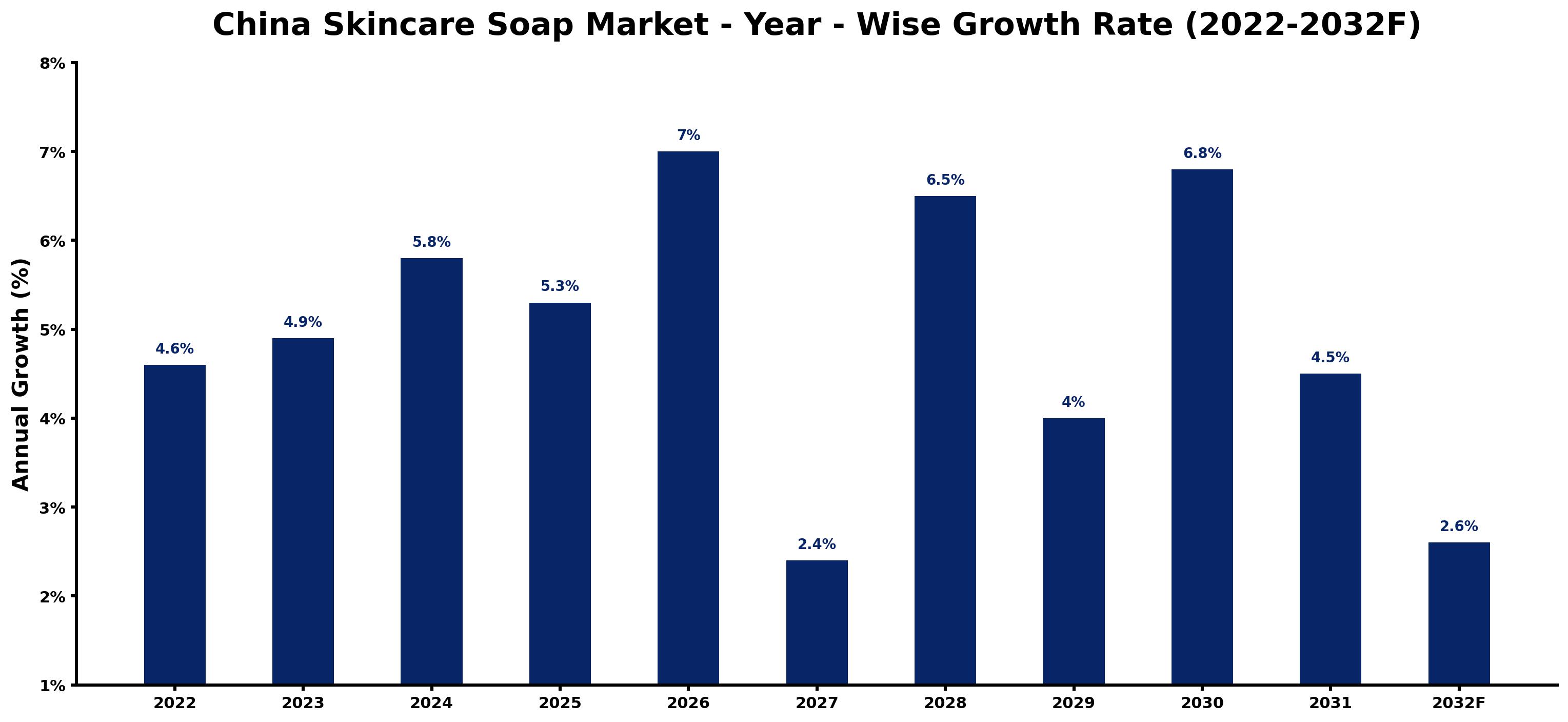
Year by year, the estimates below pair each growth rate with the development that shaped it.
| Year | Estimated Annual Growth (%) | Market Rationale |
| 2022 | 4.6 | The market experienced steady growth, driven by rising consumer interest in herbal skincare products. |
| 2023 | 4.9 | Consumer preference shifted towards herbal skincare soap, boosting demand for natural ingredients. |
| 2024 | 5.8 | The introduction of new moisturizing products contributed to increased sales in the market. |
| 2025 | 5.3 | Growth slowed as the market adjusted to previous high rates of expansion in skincare products. |
| 2026 | 7.0 | The peak growth rate is expected to be achieved due to heightened demand for herbal skincare options. |
| 2027 | 2.4 | A slowdown is projected as market saturation begins to take effect in the skincare segment. |
| 2028 | 6.5 | Demand is expected to surge again, supported by increased awareness of skincare benefits among consumers. |
| 2029 | 4.0 | Growth is projected to slow as competition intensifies among existing skincare brands in the market. |
| 2030 | 6.8 | A resurgence in demand for new product lines will lead to higher sales in the skincare sector. |
| 2031 | 4.5 | Market growth is expected to decelerate as consumer preferences stabilise in the skincare category. |
| 2032 | 2.6 | The market continues to grow, albeit at a slower pace than previous years in skincare. |
Note: Market size estimations and growth projections presented in this report are based on 6Wresearch's proprietary forecasting methodology, utilizing the latest available industry data, government publications, and primary research inputs.
China Skincare Soap Market Synopsis
Skincare Soap in China encompasses products designed for skin cleansing and nourishment. These soaps are produced through saponification, combining fats and alkali, and are primarily used for moisturizing and treating skin conditions. The China Skincare Soap Market is expanding due to a strong preference for herbal options, with over 70% of consumers opting for natural ingredients. This growing interest reflects an increasing awareness of skincare among consumers, particularly in urban areas where demand for effective products is rising.
Market Dynamics Impact Analysis (2026–2032)
| Factor | Type | Impact | Primary Segment Affected |
| Rising consumer interest in herbal skincare soap | Driver | High | Herbal Skincare Soap |
| Increasing prevalence of dry skin conditions | Driver | High | Moisturizing Soap |
| Growing demand for Ayurvedic products | Opportunity | High | Ayurvedic Brands |
| Expansion of retail channels in urban areas | Opportunity | Medium | Bath & Body Retailers |
| Stricter regulations impacting production costs | Restraint | High | Medicated Soap |
| Market saturation limiting new entrants | Restraint | Medium | Whitening Soap |
| The Skincare Soap Market in China faces regulatory hurdles | Challenge | High | Moisturizing Soap |
| Competition from alternative personal care products is rising | Challenge | Medium | Moisturizing Soap |
Evaluation of Drivers in China Skincare Soap Market (2026–2032)
Key forces behind demand, with the segment each one moves most, are listed below.
| Drivers | Primary Segment Affected | Why It Matters (Evidence) |
| Consumer preference for herbal ingredients | Herbal Skincare Soap | Over 70% of consumers prefer herbal skincare soap for its natural ingredients. |
| Increase in dry skin conditions | Moisturizing Soap | The market for moisturizing soap is expected to grow due to rising dry skin conditions in urban areas. |
| Popularity of Ayurvedic products | Ayurvedic Brands | The market for Ayurvedic skincare products has grown by 20% compared to the previous year. |
| Growth in skincare awareness initiatives | Medicated Soap | The 'Healthy Skin Initiative' launched in 2021 promotes skincare awareness, increasing demand for medicated soap. |
| Rising disposable income among consumers | Bath & Body Retailers | The annual skincare product consumption per capita in China is around 150 CNY. |
Growth in the Skincare Soap market in China is driven by a rising consumer preference for herbal ingredients, the prevalence of dry skin conditions, and the popularity of Ayurvedic products. More than 70% of consumers opt for herbal skincare soap, which boosts sales in this segment. The market for moisturising soap is projected to expand due to the increasing incidence of dry skin in urban areas, highlighting a strong need for effective solutions. Annual skincare product consumption per capita in China is approximately 150 CNY, reflecting a rise in disposable income among consumers.
Evaluation of Restraints in China Skincare Soap Market
The table below lists the restraints and the evidence behind each.
| Market Restraint | Primary Segment Affected | Why It Matters (Evidence) |
| Stricter regulations increasing production costs | Medicated Soap | The National Standard for Cosmetics was updated in 2023, imposing stricter regulations that raise production costs. |
| Market saturation limiting new entrants | Whitening Soap | The market is becoming saturated, making it difficult for new brands to gain a foothold. |
| High competition from alternative personal care products | Moisturizing Soap | The rise of alternative personal care products is diverting consumer spending away from skincare soap. |
| Consumer preference for multifunctional products | Moisturizing Soap | Consumers are increasingly gravitating towards multifunctional products, which limits growth for single-use soaps. |
| Limited shelf space in retail outlets | Moisturizing Soap | Retailers are prioritising space for high-demand products, restricting availability of skincare soap. |
China Skincare Soap Market Challenges
In the China skincare soap market, fierce competition among producers leads to price wars that threaten the sustainability of smaller brands. Buyers increasingly prefer herbal skincare soap, resulting in supply shortages for manufacturers struggling to secure sufficient natural ingredients. Rapid technological advancements in production processes necessitate significant investments, which can overwhelm smaller producers lacking adequate capital. Rising costs of raw materials, such as oils and alkalis, are squeezing margins and forcing suppliers to raise prices, potentially alienating price-sensitive consumers and reducing overall sales.
Trends in the China Skincare Soap Market
The trends below show where the China Skincare Soap Market is heading.
- Shift towards Herbal Ingredients: In 2023, over 70% of consumers in China preferred herbal skincare soap, reflecting a shift towards natural ingredients. This trend is reshaping product formulations across the market, encouraging producers to innovate and cater to consumer preferences.
- Increasing Demand for Medicated Soap: The demand for medicated soap is rising, driven by increasing skin issues among youth. In 2023, production of medicated soap reached 1.5 million tons, highlighting the growing focus on skin health and effective treatments.
- Expansion of Retail Channels: The Guangdong province is emerging as a major hub for skincare soap production, enhancing distribution networks. This region is expected to see a rise in retail outlets, facilitating better access for consumers and increasing sales opportunities.
- Focus on Sustainable Practices: The 'Green Cosmetics' program initiated in 2022 is promoting sustainable production practices in the skincare industry. Compliance with this initiative is targeted at 50% by 2025, encouraging eco-friendly product offerings and appealing to environmentally conscious consumers.
Investment Opportunities in the China Skincare Soap Market
The following opportunities in the China Skincare Soap Market pair current demand with a clear way in.
- Investment in Herbal Skincare Soap: The growing preference for herbal skincare soap offers an opportunity for suppliers to invest in natural formulations. With over 70% of consumers favouring these products, partnerships with local herbal producers can facilitate market entry.
- Expansion into Urban Retail Spaces: Urban areas are experiencing a surge in skincare awareness, creating an ideal opportunity to expand retail channels. Collaborating with Bath & Body Retailers in major cities can provide access to a broad consumer base.
- Development of Medicated Soap Lines: The rising demand for medicated soap presents a chance to develop new product lines targeting skin ailments. Pharmacies, which account for 25% of skincare soap sales, can serve as key distribution partners.
- Focus on Ayurvedic Products: The expanding market for Ayurvedic skincare products presents an opportunity for investment in this segment. With a 20% growth rate in 2023, targeting Ayurvedic Brands can yield substantial returns.
Government Initiatives in the China Skincare Soap Market
The 'Green Cosmetics' program initiated by the Ministry of Ecology and Environment in 2022 encourages sustainable practices in the skincare industry. This program aims for 50% compliance by 2025, improving environmental standards for production. Additionally, the National Standard for Cosmetics (GB 7916-2018) was revised in 2023, imposing stricter guidelines for skincare soap production, which ensures product safety and quality for consumers.
Pharmacies are utilising the 'Healthy Skin Initiative' launched by the Ministry of Health in 2021 to improve public awareness of skincare. This initiative aims for a 30% increase in consumer education by 2025, allowing pharmacies to better inform customers about skincare options. The Ministry of Industry and Information Technology also supports small manufacturers of herbal skincare products through a subsidy program, with a budget of 100 million CNY to improve production capabilities.
Future Insight of the China Skincare Soap Market
Several forward-looking factors should support growth in the skincare soap market in China over the coming years. The 'Healthy Skin Initiative' will raise skincare awareness, encouraging consumers to seek effective solutions. The updated National Standard for Cosmetics will improve product safety, fostering greater consumer trust. By 2032, production of medicated soap is expected to rise significantly, reflecting a shift towards therapeutic options. The increasing demand for glycerin-based soaps will appeal to consumers seeking moisturising benefits, creating opportunities for both buyers and suppliers.
Market Segmentation Analysis
Each segment group is reviewed below, with the leader by share and the fastest grower by CAGR.
By Soap Type – Moisturizing Soap Dominated, Herbal Skincare Soap Expected to Grow Fastest
According to Dhaval Chaurasia, Assistant Manager at 6Wresearch, with a 37% revenue share in 2025, Moisturizing Soap was the largest soap type category. Moisturizing soap holds the largest market share in China as it caters to the widespread concern of dry skin, especially in urban settings. Its average retail price of approximately 30 CNY per unit ensures accessibility for consumers seeking effective skincare solutions. Herbal Skincare Soap is projected to grow fastest, at a CAGR of 7.0% during 2026–2032. Herbal skincare soap is experiencing rapid growth, evidenced by a 15% increase in sales in 2022, as consumers increasingly prefer products with natural ingredients. This trend is likely to persist as awareness of the benefits of herbal options continues to rise. Suppliers should focus on expanding their herbal product lines to meet the growing consumer demand for natural skincare solutions.
By Base Material – Glycerin/Shea Butter Dominated, Neem/Aloe/Turmeric Expected to Grow Fastest
Glycerin/Shea Butter took a 51% share of base material in 2025, more than any other category. Glycerin and shea butter dominate the market share as they are widely recognised for their moisturizing properties, making them essential in many skincare formulations. Their popularity is further supported by the growing consumer awareness of skin hydration needs. The quickest growth will come from Neem/Aloe/Turmeric, forecast to expand at a CAGR of 5.8% between 2026 and 2032. Neem, aloe, and turmeric are gaining traction as the fastest-growing base materials, particularly in herbal formulations, reflecting a 20% growth in Ayurvedic skincare products in the past year. This indicates a shift towards more natural and effective ingredients in skincare. Manufacturers should consider integrating neem, aloe, and turmeric into their product lines to capitalise on the rising demand for herbal-based skincare.
By Purpose – Skin Brightening Dominated, Acne Treatment Expected to Grow Fastest
In 2025, Skin Brightening led the purpose split with a 47% share. Skin brightening products dominate the market share due to their strong appeal among consumers aiming to enhance their skin appearance. This purpose aligns closely with the beauty standards prevalent in urban regions, making it a highly sought-after effect in skincare. Over 2026–2032, Acne Treatment is expected to post the fastest growth, at a CAGR of 6.8%. The acne treatment segment is witnessing the fastest growth, driven by a surge in skin issues among the youth demographic. As awareness of effective acne solutions increases, this segment is set for significant expansion. Brands should prioritise the development of specialised acne treatment products to effectively address the rising concerns of younger consumers.
By End User – Bath & Body Retailers Dominated, Ayurvedic Brands Expected to Grow Fastest
Bath & Body Retailers accounted for a 39% market share by end user in 2025. Bath and body retailers hold the largest market share as they serve as a primary distribution channel for skincare soap products. Their extensive reach ensures consumers have easy access to a diverse range of skincare options, thereby boosting overall sales. Ayurvedic Brands are set to record the highest CAGR in this split, 6.2% over 2026–2032. Ayurvedic brands are emerging as the fastest-growing end user segment, reflecting a notable shift towards holistic and natural skincare solutions. This growth highlights changing consumer preferences that favour wellness-oriented products. Suppliers should strengthen their partnerships with Ayurvedic brands to effectively capitalise on the expanding market for natural skincare products.
Key Attractiveness of the Report
- 10 Years of Market Numbers
- Historical Data Starting from 2022 to 2025
- Base Year 2025
- Forecast Data until 2032
- Key Performance Indicators Impacting the Market
- Major Upcoming Developments and Projects
Key Highlights of the Report:
- China Skincare Soap Market Outlook
- Market Size of China Skincare Soap Market, 2025
- Forecast of China Skincare Soap Market, 2032
- Historical Data and Forecast of China Skincare Soap Revenues & Volume for the Period 2022 - 2032F
- China Skincare Soap Market Trend Evolution
- China Skincare Soap Market Drivers and Challenges
- China Skincare Soap Price Trends
- China Skincare Soap Porter's Five Forces
- China Skincare Soap Industry Life Cycle
- Historical Data and Forecast of China Skincare Soap Market Revenues & Volume By Soap Type for the Period 2022 - 2032F
- Historical Data and Forecast of China Skincare Soap Market Revenues & Volume By Herbal Skincare Soap for the Period 2022 - 2032F
- Historical Data and Forecast of China Skincare Soap Market Revenues & Volume By Moisturizing Soap for the Period 2022 - 2032F
- Historical Data and Forecast of China Skincare Soap Market Revenues & Volume By Medicated Soap for the Period 2022 - 2032F
- Historical Data and Forecast of China Skincare Soap Market Revenues & Volume By Whitening Soap for the Period 2022 - 2032F
- Historical Data and Forecast of China Skincare Soap Market Revenues & Volume By Base Material for the Period 2022 - 2032F
- Historical Data and Forecast of China Skincare Soap Market Revenues & Volume By Neem/Aloe/Turmeric for the Period 2022 - 2032F
- Historical Data and Forecast of China Skincare Soap Market Revenues & Volume By Glycerin/Shea Butter for the Period 2022 - 2032F
- Historical Data and Forecast of China Skincare Soap Market Revenues & Volume By Sulfur/Salicylic Acid for the Period 2022 - 2032F
- Historical Data and Forecast of China Skincare Soap Market Revenues & Volume By Kojic Acid/Glutathione for the Period 2022 - 2032F
- Historical Data and Forecast of China Skincare Soap Market Revenues & Volume By Purpose for the Period 2022 - 2032F
- Historical Data and Forecast of China Skincare Soap Market Revenues & Volume By Acne Treatment for the Period 2022 - 2032F
- Historical Data and Forecast of China Skincare Soap Market Revenues & Volume By Dry Skin Relief for the Period 2022 - 2032F
- Historical Data and Forecast of China Skincare Soap Market Revenues & Volume By Fungal/Bacterial Skin for the Period 2022 - 2032F
- Historical Data and Forecast of China Skincare Soap Market Revenues & Volume By Skin Brightening for the Period 2022 - 2032F
- Historical Data and Forecast of China Skincare Soap Market Revenues & Volume By End User for the Period 2022 - 2032F
- Historical Data and Forecast of China Skincare Soap Market Revenues & Volume By Ayurvedic Brands for the Period 2022 - 2032F
- Historical Data and Forecast of China Skincare Soap Market Revenues & Volume By Bath & Body Retailers for the Period 2022 - 2032F
- Historical Data and Forecast of China Skincare Soap Market Revenues & Volume By Pharmacies for the Period 2022 - 2032F
- Historical Data and Forecast of China Skincare Soap Market Revenues & Volume By Cosmetic Retailers for the Period 2022 - 2032F
- China Skincare Soap Import Export Trade Statistics
- Market Opportunity Assessment By Soap Type
- Market Opportunity Assessment By Base Material
- Market Opportunity Assessment By Purpose
- Market Opportunity Assessment By End User
- China Skincare Soap Top Companies Market Share
- China Skincare Soap Competitive Benchmarking By Technical and Operational Parameters
- China Skincare Soap Company Profiles
- China Skincare Soap Key Strategic Recommendations
Market Covered
Segments analysed in this report are listed below.
By Soap Type
- Herbal Skincare Soap
- Moisturizing Soap
- Medicated Soap
- Whitening Soap
By Base Material
- Neem/Aloe/Turmeric
- Glycerin/Shea Butter
- Sulfur/Salicylic Acid
- Kojic Acid/Glutathione
By Purpose
- Acne Treatment
- Dry Skin Relief
- Fungal/Bacterial Skin
- Skin Brightening
By End User
- Ayurvedic Brands
- Bath & Body Retailers
- Pharmacies
- Cosmetic Retailers































