China Small Cell RAN Market Size & Growth Rate
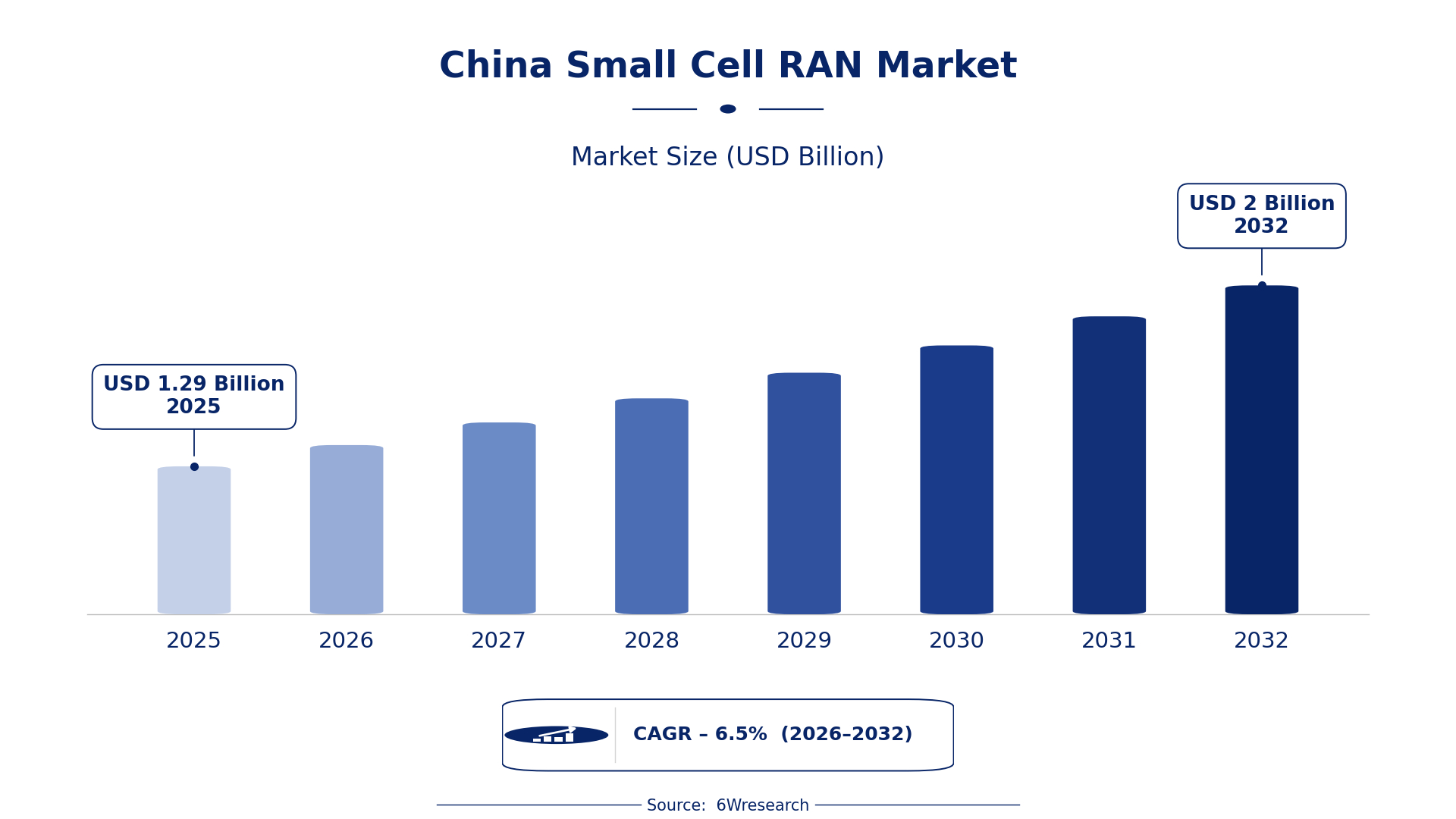
According to 6Wresearch internal database and industry insights, the China Small Cell RAN Market was valued at USD 1.29 billion in 2025 and is projected to reach USD 2 billion by 2032, growing at a CAGR of approximately 6.5% during 2026–2032.
China Small Cell RAN Market Highlights
| Report Metric | Details |
| Report Name | China Small Cell RAN Market |
| Market Size 2025 | USD 1.29 billion |
| Market Size 2032 | USD 2 billion |
| Absolute Growth 2025–2032 | USD 0.71 billion |
| CAGR 2026–2032 | 6.5% |
| Peak Annual Growth | 7.6% in 2028 |
| Forecast Period | 2026–2032 |
| Historical Data | 2022–2025 |
| Base Year | 2025 |
| Leading RAN Type, 2025 | Distributed RAN (38% share) |
| Leading Network Generation, 2025 | 5G (42% share) |
| Leading Installation Type, 2025 | Tower/Pole Mounted (36% share) |
| Leading End User, 2025 | Telecom Service Providers (41% share) |
| Fastest-Growing RAN Type | Open RAN (O-RAN) (9.2% CAGR) |
| Fastest-Growing Installation Type | Cloud (8.8% CAGR) |
| Fastest-Growing End User | Network Infrastructure Vendors (8.0% CAGR) |
| Growing Sector | Telecommunications |
| Key End Users | Telecom Service Providers, Network Infrastructure Vendors, Rural/Private Networks, Telco Cloud Providers |
China Small Cell RAN Market Year-wise Growth Rate and Key Drivers (2022–2032)
This graph illustrates the annual growth rates of the market from 2022 to 2032, highlighting a steady upward trajectory and projected market expansion over the forecast period.
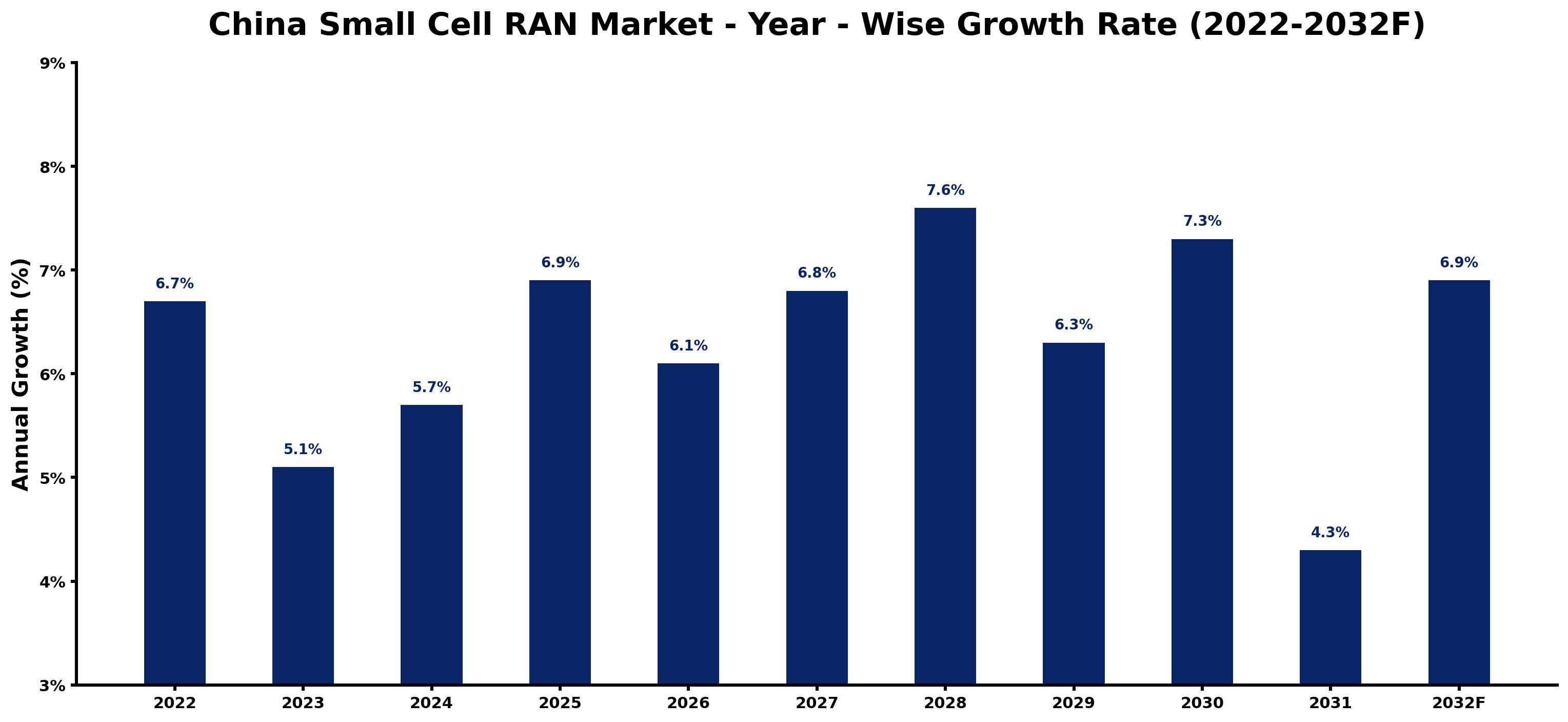
Each row of the following table gives one year's estimated growth and the event or demand shift that explains it.
| Year | Estimated Annual Growth (%) | Market Rationale |
| 2022 | 6.7 | The market experienced solid growth due to strong urban demand for improved connectivity. |
| 2023 | 5.1 | Growth slowed as the market adjusted to previous high levels of investment in infrastructure. |
| 2024 | 5.7 | Demand increased as telecom service providers expanded small cell deployments in urban areas. |
| 2025 | 6.9 | Growth accelerated as 5G coverage reached 90% in urban regions, driving further installations. |
| 2026 | 6.1 | A slowdown occurred as the '14th Five-Year Plan' began to influence deployment strategies. |
| 2027 | 6.8 | Demand rose again as urban areas sought to improve network capacity during peak usage. |
| 2028 | 7.6 | The market peaked with a surge in investment driven by the '5G Application Innovation Action Plan'. |
| 2029 | 6.3 | Growth slowed as the market stabilised after rapid expansion in previous years. |
| 2030 | 7.3 | Demand increased again as telecom service providers focused on enhancing rural connectivity through government initiatives. |
| 2031 | 4.3 | A slowdown occurred as the market adjusted to the previous year's high growth rate. |
| 2032 | 6.9 | Growth resumed as new applications for small cells emerged across various sectors. |
Note: Market size estimations and growth projections presented in this report are based on 6Wresearch's proprietary forecasting methodology, utilizing the latest available industry data, government publications, and primary research inputs.
China Small Cell RAN Market Synopsis
Small Cell RAN in China encompasses technology that improves mobile network coverage and capacity through low-power base stations. This technology is essential for enhancing urban connectivity and expanding rural coverage. The China Small Cell RAN Market is experiencing growth, driven by significant domestic demand, substantial investments in infrastructure, and the ongoing rollout of 5G networks. By 2025, the telecom sector is projected to invest over $100 billion in infrastructure, further propelling market expansion. Telecom service providers are key buyers, actively seeking solutions to meet the increasing demand for connectivity.
Market Dynamics Impact Analysis (2026–2032)
| Factor | Type | Impact | Primary Segment Affected |
| Strong urban demand for enhanced connectivity drives installations of small cells. | Driver | High | Distributed RAN |
| Investment in 5G infrastructure is expanding network capabilities and coverage. | Driver | High | 5G |
| Telecom service providers are actively seeking solutions to improve network performance. | Opportunity | High | Telecom Service Providers |
| Rural connectivity initiatives present opportunities for small cell deployment. | Opportunity | Medium | Rural/Private Networks |
| Market saturation is limiting new deployments in urban areas. | Restraint | High | Distributed RAN |
| High installation costs can deter smaller service providers from adopting small cell technology. | Restraint | Medium | Telecom Service Providers |
| Approval delays for new installations can slow down deployment timelines. | Challenge | High | Telecom Service Providers |
| Competition among service providers can lead to price pressures affecting profitability. | Challenge | Medium | Telecom Service Providers |
Evaluation of Drivers in China Small Cell RAN Market (2026–2032)
The factors lifting demand, and the evidence behind each, are summarised below.
| Drivers | Primary Segment Affected | Why It Matters (Evidence) |
| Urban demand for improved connectivity drives small cell installations. | Distributed RAN | China's urban areas are increasingly reliant on mobile services, leading to higher demand for small cells. |
| Investment in 5G infrastructure is boosting small cell deployments. | 5G | With 90% coverage in urban areas, telecom providers are expanding networks to support 5G. |
| The growing number of mobile subscribers is pushing for expanded networks. | Telecom Service Providers | As mobile subscribers exceed 1.5 billion, providers are investing in small cells to improve service. |
| Government initiatives support rural broadband expansion through small cells. | Rural/Private Networks | The National Development and Reform Commission's initiatives are driving investments in underserved areas. |
| Technological advancements in small cell solutions are improving deployment efficiency. | Open RAN (O-RAN) | The push for interoperability is promoting faster and more efficient small cell installations. |
Market growth for Small Cell RAN in China is underpinned by urban demand for better connectivity, significant investments in 5G infrastructure, and the expansion of telecom networks. By 2023, 90% of urban areas had 5G coverage, prompting further small cell deployments. The telecom sector is expected to invest over $100 billion in infrastructure by 2025, which will enhance network capabilities. As mobile subscriptions exceed 1.5 billion, demand for improved services continues to rise.
Evaluation of Restraints in China Small Cell RAN Market
The key brakes on demand, and where they bite hardest, are shown below.
| Market Restraint | Primary Segment Affected | Why It Matters (Evidence) |
| Market saturation in urban areas limits new small cell deployments. | Distributed RAN | As urban areas become saturated with existing small cells, demand for new installations declines. |
| High installation costs deter smaller service providers from adopting technology. | Telecom Service Providers | Smaller providers may struggle with the financial burden of deploying small cell networks. |
| Regulatory approval delays can hinder timely deployment of small cells. | Telecom Service Providers | Lengthy approval processes for new installations can slow down market growth. |
| Competition among service providers can lead to price pressures. | Telecom Service Providers | Intense competition may force providers to lower prices, impacting profitability. |
| Limited awareness of small cell benefits in rural areas affects adoption. | Rural/Private Networks | Potential users in rural regions may not fully understand the advantages of small cell technology. |
China Small Cell RAN Market Challenges
In the China Small Cell RAN market, fierce competition among numerous providers leads to aggressive pricing strategies that squeeze profit margins for producers. Supply chain disruptions, particularly for critical components sourced internationally, can delay small cell deployments by up to four months, impacting network expansion for telecom operators. Rising raw material costs, driven by global market fluctuations, have increased production expenses by approximately 15%, compelling producers to pass these costs onto buyers, which limits affordability for telecom operators. Regulatory hurdles, including stringent approval processes, can extend project timelines by as much as six months for buyers seeking to enhance network coverage.
Trends in the China Small Cell RAN Market
Below mentioned are some of the trends shaping the China Small Cell RAN Market growth.
- Launch of the '5G Application Innovation Action Plan': In 2023, the Ministry of Industry and Information Technology launched the '5G Application Innovation Action Plan' to promote small cell deployment across urban and rural areas. This initiative aims to drive innovative use cases for small cells, encouraging further investments in infrastructure.
- Telecom Service Providers Increasing Urban Deployments: Telecom service providers are actively expanding small cell deployments in major cities to meet the growing demand for mobile connectivity. As of 2023, urban areas are seeing a rise in small cell installations, with over 90% of urban regions covered by 5G.
- Shift Towards Rural Connectivity Initiatives: Since 2021, there has been a notable shift towards improving rural connectivity through small cell technology. The National Development and Reform Commission's initiatives are driving investments in underserved areas, aiming to bridge the digital divide.
- Emergence of Open RAN Technology: Open RAN technology is gaining traction in China, promoting interoperability and innovation in network deployment. This trend aligns with the government's push for digital infrastructure development, improving small cell capabilities.
Investment Opportunities in the China Small Cell RAN Market
Below are the investment opportunities with the strongest case in the China Small Cell RAN Market.
- Telecom Service Providers Seeking Connectivity Solutions: Telecom service providers are investing in small cell technology to improve network performance. With over 1.5 billion mobile subscribers, there is a pressing need for connectivity solutions in urban areas.
- Expanding Rural Markets Through Partnerships: Now is the time for companies to collaborate with local telecom service providers to expand small cell deployments in rural areas. The National Development and Reform Commission's initiatives are driving investments in these underserved regions.
- Investment in Small Cell Infrastructure: Investing in small cell infrastructure is essential for meeting the growing demand for mobile connectivity. The projected $100 billion investment in telecommunications infrastructure by 2025 presents a significant opportunity for suppliers.
- Focus on Open RAN Solutions: With the rise of Open RAN technology, there is an opportunity to supply innovative small cell solutions. This aligns with the government's push for interoperability and efficiency in network deployment.
Government Initiatives in the China Small Cell RAN Market
In 2023, the Ministry of Industry and Information Technology launched the '5G Application Innovation Action Plan', which promotes small cell deployment across urban and rural areas. This initiative builds on the '14th Five-Year Plan', prioritising digital infrastructure development, including small cells. The updated 'Telecommunications Regulations' in 2022 streamline processes for network expansion, facilitating faster deployments of small cell technology. These measures collectively enhance the operational landscape for producers and buyers.
The National Development and Reform Commission's 'New Infrastructure' initiative aims to invest over $100 billion in telecommunications infrastructure, including small cells, by 2025. This programme supports various projects that improve connectivity across urban and rural areas, ensuring that small cell technology is integrated into future developments. Agencies like the Ministry of Industry and Information Technology oversee these initiatives, enabling producers to navigate regulatory frameworks more effectively.
Future Insight of the China Small Cell RAN Market
The China Small Cell RAN market is set to evolve significantly by 2032, driven by increased investments in digital infrastructure and a focus on enhancing urban and rural connectivity. The 'New Infrastructure' initiative will propel the deployment of small cell technology, supporting high-density areas during peak usage. By 2025, the telecom sector's projected investment in infrastructure will exceed $100 billion, leading to improved network capacity. National standards for small cell installations will streamline processes, enabling producers to deploy solutions more efficiently and allowing buyers to enhance service delivery.
Market Segmentation Analysis
The analysis below covers each segmentation, its leading category in 2025 and its fastest-growing category through 2032.
By RAN Type – Distributed RAN Dominated, Open RAN (O-RAN) Expected to Grow Fastest
According to Dhaval Chaurasia, Assistant Manager at 6Wresearch, Distributed RAN held a 38% share of the China Small Cell RAN Market by ran type in 2025. Distributed RAN holds the largest market share because it is crucial for enhancing network coverage in urban areas where demand for connectivity is high. Its implementation in regions such as Guangdong has significantly improved service quality for a large number of users. The quickest growth will come from Open RAN (O-RAN), forecast to expand at a CAGR of 9.2% between 2026 and 2032. Open RAN (O-RAN) is experiencing rapid growth as it promotes interoperability and innovation, appealing to telecom operators looking for flexible deployment solutions. The alignment of O-RAN with the government's initiatives, such as the '5G Application Innovation Action Plan', is driving its adoption. Suppliers should focus on developing O-RAN solutions to meet the increasing demand and align with governmental support.
By Network Generation – 5G Dominated and Is Expected to Record the Fastest Growth
5G took a 42% share of network generation in 2025, more than any other category. 5G commands the largest market share as it is essential for next-generation mobile connectivity, catering to China's vast population of over 1.5 billion mobile subscribers. The extensive rollout of 5G infrastructure is a key factor in maintaining its leading position. Its lead should widen, with a projected CAGR of 8.9% during 2026–2032, the highest in this split. 5G is also the fastest-growing segment, fuelled by the rising demand for high-speed connectivity and the government's commitment to advancing digital infrastructure. The focus on 5G in the '14th Five-Year Plan' ensures continued growth in this sector. Buyers must invest in 5G solutions to remain competitive and meet the increasing demand for enhanced mobile services.
By Installation Type – Tower/Pole Mounted Dominated, Cloud Expected to Grow Fastest
In 2025, Tower/Pole Mounted led the installation type split with a 36% share. Tower/Pole Mounted installations capture the largest market share as they are the preferred method for deploying small cells in urban settings, ensuring optimal coverage. This installation type is widely favoured by telecom service providers to enhance connectivity in densely populated areas. Cloud is projected to grow fastest, at a CAGR of 8.8% during 2026–2032. Cloud installations are rapidly gaining popularity due to their ability to enable remote management and scalability of small cell networks, appealing to operators seeking efficient solutions. This trend reflects broader movements towards network optimisation and flexibility. Suppliers should explore cloud-based solutions to address the growing demand for scalable and efficient small cell deployments.
By End User – Telecom Service Providers Dominated, Network Infrastructure Vendors Expected to Grow Fastest
The largest end user category in 2025 was Telecom Service Providers, with a 41% share of total revenue. Telecom Service Providers account for the largest market share as they are the primary customers for small cell solutions, driving the need for improved network coverage and capacity. Their significant investments in infrastructure underscore their critical role in the market. Network Infrastructure Vendors are set to record the highest CAGR in this split, 8.0% over 2026–2032. Network Infrastructure Vendors are the fastest-growing segment, increasingly adopting small cell technology to meet the demands of telecom service providers. This growth is supported by ongoing investments in network infrastructure within the telecom sector. Suppliers should tailor their offerings to meet the specific needs of network infrastructure vendors, who are becoming key players in the small cell market.
Key Attractiveness of the Report
- 10 Years of Market Numbers
- Historical Data Starting from 2022 to 2025
- Base Year 2025
- Forecast Data until 2032
- Key Performance Indicators Impacting the Market
- Major Upcoming Developments and Projects
Key Highlights of the Report:
- China Small Cell RAN Market Outlook
- Market Size of China Small Cell RAN Market, 2025
- Forecast of China Small Cell RAN Market, 2032
- Historical Data and Forecast of China Small Cell RAN Revenues & Volume for the Period 2022 - 2032F
- China Small Cell RAN Market Trend Evolution
- China Small Cell RAN Market Drivers and Challenges
- China Small Cell RAN Price Trends
- China Small Cell RAN Porter's Five Forces
- China Small Cell RAN Industry Life Cycle
- Historical Data and Forecast of China Small Cell RAN Market Revenues & Volume By RAN Type for the Period 2022 - 2032F
- Historical Data and Forecast of China Small Cell RAN Market Revenues & Volume By Distributed RAN for the Period 2022 - 2032F
- Historical Data and Forecast of China Small Cell RAN Market Revenues & Volume By Centralized RAN for the Period 2022 - 2032F
- Historical Data and Forecast of China Small Cell RAN Market Revenues & Volume By Open RAN (O-RAN) for the Period 2022 - 2032F
- Historical Data and Forecast of China Small Cell RAN Market Revenues & Volume By Virtualized RAN (vRAN) for the Period 2022 - 2032F
- Historical Data and Forecast of China Small Cell RAN Market Revenues & Volume By Network Generation for the Period 2022 - 2032F
- Historical Data and Forecast of China Small Cell RAN Market Revenues & Volume By 5G for the Period 2022 - 2032F
- Historical Data and Forecast of China Small Cell RAN Market Revenues & Volume By 4G/5G for the Period 2022 - 2032F
- Historical Data and Forecast of China Small Cell RAN Market Revenues & Volume By Open-Interface for the Period 2022 - 2032F
- Historical Data and Forecast of China Small Cell RAN Market Revenues & Volume By Software Defined for the Period 2022 - 2032F
- Historical Data and Forecast of China Small Cell RAN Market Revenues & Volume By Installation Type for the Period 2022 - 2032F
- Historical Data and Forecast of China Small Cell RAN Market Revenues & Volume By Tower/Pole Mounted for the Period 2022 - 2032F
- Historical Data and Forecast of China Small Cell RAN Market Revenues & Volume By Data Centers for the Period 2022 - 2032F
- Historical Data and Forecast of China Small Cell RAN Market Revenues & Volume By Plug & Play for the Period 2022 - 2032F
- Historical Data and Forecast of China Small Cell RAN Market Revenues & Volume By Cloud for the Period 2022 - 2032F
- Historical Data and Forecast of China Small Cell RAN Market Revenues & Volume By End User for the Period 2022 - 2032F
- Historical Data and Forecast of China Small Cell RAN Market Revenues & Volume By Network Infrastructure Vendors for the Period 2022 - 2032F
- Historical Data and Forecast of China Small Cell RAN Market Revenues & Volume By Telecom Service Providers for the Period 2022 - 2032F
- Historical Data and Forecast of China Small Cell RAN Market Revenues & Volume By Rural/Private Networks for the Period 2022 - 2032F
- Historical Data and Forecast of China Small Cell RAN Market Revenues & Volume By Telco Cloud Providers for the Period 2022 - 2032F
- China Small Cell RAN Import Export Trade Statistics
- Market Opportunity Assessment By RAN Type
- Market Opportunity Assessment By Network Generation
- Market Opportunity Assessment By Installation Type
- Market Opportunity Assessment By End User
- China Small Cell RAN Top Companies Market Share
- China Small Cell RAN Competitive Benchmarking By Technical and Operational Parameters
- China Small Cell RAN Company Profiles
- China Small Cell RAN Key Strategic Recommendations
Market Covered
This report examines the market across the segments below.
By RAN Type
- Distributed RAN
- Centralized RAN
- Open RAN (O-RAN)
- Virtualized RAN (vRAN)
By Network Generation
- 5G
- 4G/5G
- Open-Interface
- Software Defined
By Installation Type
- Tower/Pole Mounted
- Data Centers
- Plug & Play
- Cloud
By End User
- Network Infrastructure Vendors
- Telecom Service Providers
- Rural/Private Networks
- Telco Cloud Providers































