China Smart Building IAQ Market Size & Growth Rate
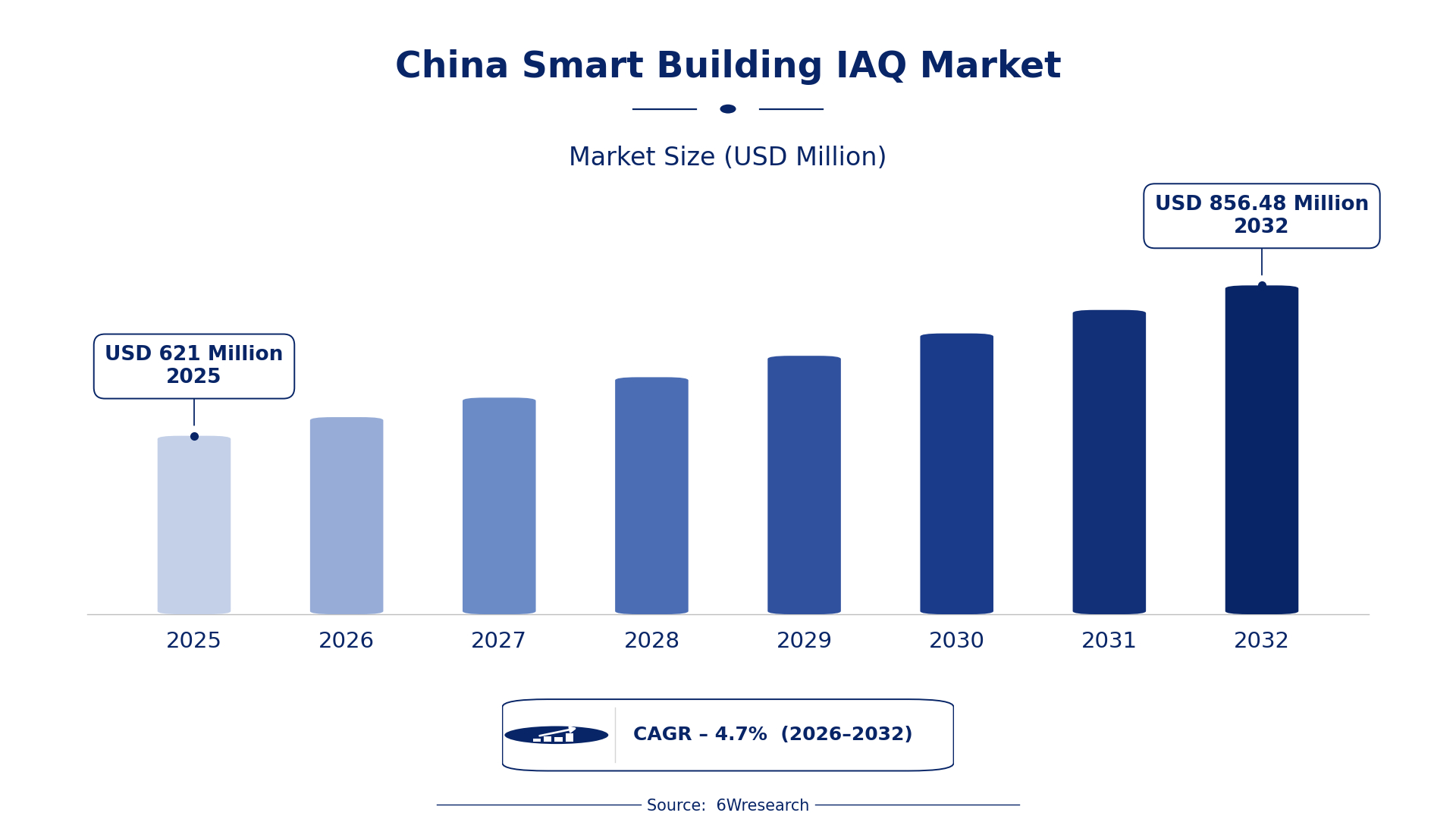
According to 6Wresearch internal database and industry insights, the China Smart Building IAQ Market was valued at USD 621.0 million in 2025 and is projected to reach USD 856.48 million by 2032, growing at a CAGR of approximately 4.7% during 2026–2032.
China Smart Building IAQ Market Highlights
| Report Metric | Details |
| Report Name | China Smart Building IAQ Market |
| Market Size 2025 | USD 621.0 million |
| Market Size 2032 | USD 856.48 million |
| Absolute Growth 2025–2032 | USD 235.48 million |
| CAGR 2026–2032 | 4.7% |
| Peak Annual Growth | 6.9% in 2032 |
| Forecast Period | 2026–2032 |
| Historical Data | 2022–2025 |
| Base Year | 2025 |
| Leading IAQ Technology, 2025 | CO₂ Sensors (40% share) |
| Leading Parameter Monitored, 2025 | Air Quality Feedback (39% share) |
| Leading Building Type, 2025 | Offices (32% share) |
| Leading End User, 2025 | Smart Infrastructure Firms (36% share) |
| Fastest-Growing IAQ Technology | AI-Based IAQ Dashboards (7.5% CAGR) |
| Fastest-Growing Parameter Monitored | Real-Time Environment (7.2% CAGR) |
| Fastest-Growing Building Type | Schools (6.6% CAGR) |
| Growing Sector | Smart Infrastructure Firms |
| Key End Users | Smart Infrastructure Firms, Facility Management, HVAC Providers, Real Estate Developers |
China Smart Building IAQ Market Year-wise Growth Rate and Key Drivers (2022–2032)
This graph illustrates the annual growth rates of the market from 2022 to 2032, highlighting a steady upward trajectory and projected market expansion over the forecast period.
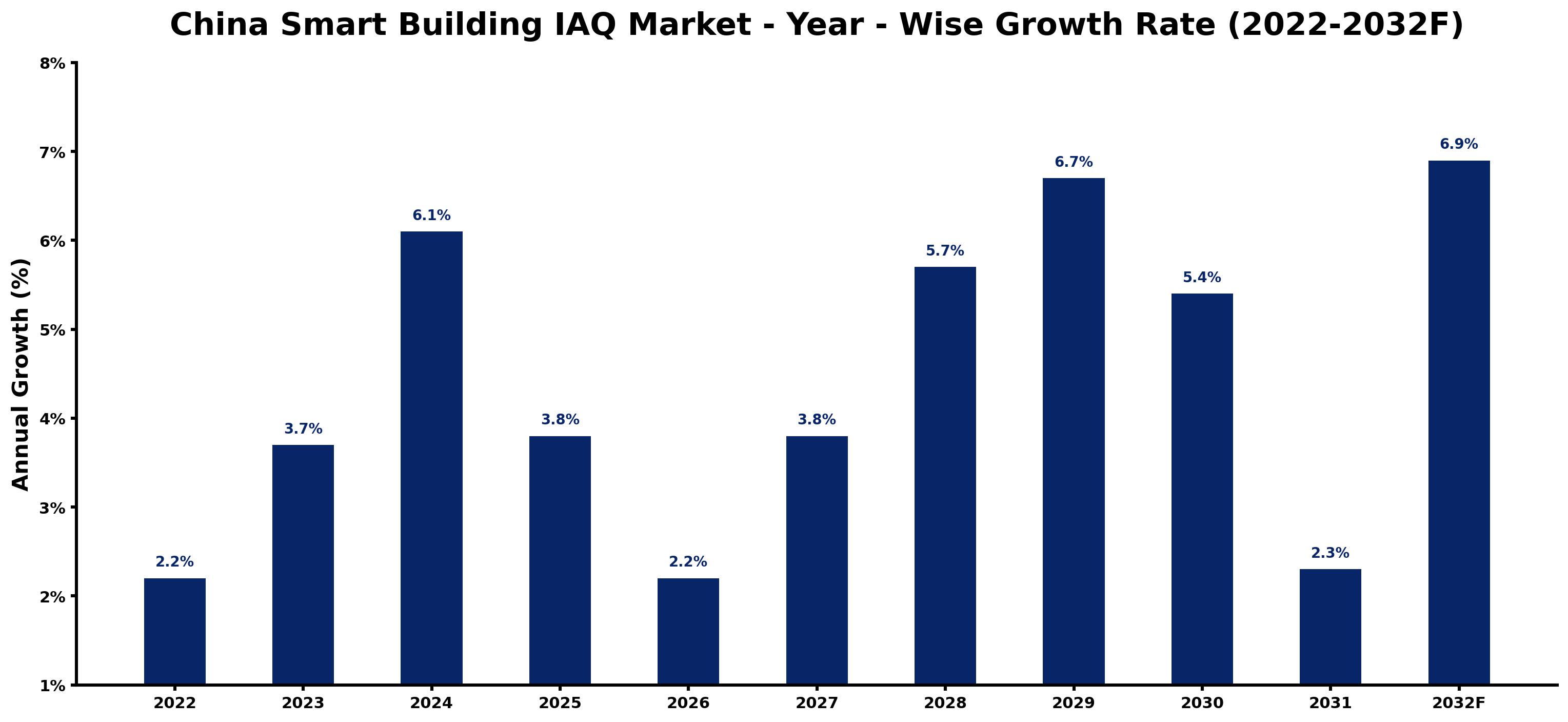
The following table presents the estimated annual growth rate for each year together with the principal factor influencing market performance.
| Year | Estimated Annual Growth (%) | Market Rationale |
| 2022 | 2.2 | The market experienced steady growth as urban residents increased, driving demand for better indoor air quality solutions. |
| 2023 | 3.7 | Demand rose due to heightened awareness of air quality issues among urban populations, spurred by the Green Building Action Plan. |
| 2024 | 6.1 | Demand surged as the government promoted smart building standards under the Smart City Development Plan. |
| 2025 | 3.8 | Growth slowed as the market adjusted to previous rapid expansions and regulatory changes. |
| 2026 | 2.2 | A further slowdown occurred as the market stabilised after rapid growth in prior years. |
| 2027 | 3.8 | Demand increased again, supported by rising investments in smart infrastructure projects across urban areas. |
| 2028 | 5.7 | Growth picked up as more building types adopted advanced IAQ technologies for enhanced performance. |
| 2029 | 6.7 | The market continued to expand, driven by increasing urbanisation and the need for better health standards. |
| 2030 | 5.4 | A slight slowdown was observed as the market matured and competition intensified among providers. |
| 2031 | 2.3 | Growth decelerated as buyers became more selective in their investments in IAQ technologies. |
| 2032 | 6.9 | Demand surged again as new government initiatives were launched to enhance indoor air quality standards. |
Note: Market size estimations and growth projections presented in this report are based on 6Wresearch's proprietary forecasting methodology, utilizing the latest available industry data, government publications, and primary research inputs.
China Smart Building IAQ Market Synopsis
Smart Building IAQ in China encompasses technologies designed to monitor and improve indoor air quality in various buildings. These systems use sensors and software to improve occupant comfort and health while optimizing energy efficiency. The China Smart Building IAQ Market is growing due to urbanization, increased awareness of air quality issues, and government initiatives like the Smart City Development Plan, which promotes smart building standards. With over 1.4 billion urban residents, the demand for improved indoor air quality solutions continues to rise.
Market Dynamics Impact Analysis (2026–2032)
| Factor | Type | Impact | Primary Segment Affected |
| Urbanisation driving demand for improved indoor air quality solutions among residential complexes. | Driver | High | Residential Complexes |
| Government initiatives promoting smart building standards enhance market growth. | Driver | High | Smart Infrastructure Firms |
| Growing investments in smart building technologies create opportunities for suppliers. | Opportunity | High | Smart Infrastructure Firms |
| The need for compliance with indoor air quality regulations opens new market avenues. | Opportunity | Medium | Facility Management |
| High initial investment costs for advanced IAQ technologies may deter some buyers. | Restraint | High | Smart Infrastructure Firms |
| Limited awareness of IAQ solutions among smaller building operators restricts market reach. | Restraint | Medium | Residential Complexes |
| Smart Building IAQ Market in China faces challenges related to technology integration and costs. | Challenge | High | HVAC Providers |
| Competition among providers may lead to pricing pressures, affecting profitability for suppliers. | Challenge | Medium | Real Estate Developers |
Evaluation of Drivers in China Smart Building IAQ Market (2026–2032)
The main growth drivers and the segments they affect most are set out below.
| Drivers | Primary Segment Affected | Why It Matters (Evidence) |
| Increased urbanisation leads to higher demand for indoor air quality solutions. | Residential Complexes | With over 1.4 billion urban residents, the need for improved air quality is critical. |
| Government initiatives promote smart building standards, boosting market growth. | Smart Infrastructure Firms | The Smart City Development Plan encourages the adoption of advanced IAQ technologies. |
| Rising investments in smart building technologies create new opportunities for suppliers. | Facility Management | China's smart building sector is projected to attract over 500 billion yuan in investments by 2025. |
| Compliance with indoor air quality regulations drives demand for monitoring solutions. | Hospitals | The National Standard for Indoor Air Quality sets guidelines that hospitals must follow. |
| Growing awareness of health impacts from poor air quality increases buyer interest. | Schools | Educational institutions focus on creating safe learning environments for students. |
The need for improved indoor air quality solutions is critical, especially with over 1.4 billion urban residents. The Smart City Development Plan promotes smart building standards, which boosts market potential. The smart building sector is set to attract over 500 billion yuan in investments by 2025, driving innovation in IAQ technologies. Awareness of health impacts from poor air quality is increasing, leading to more purchases of advanced monitoring solutions in educational institutions and healthcare facilities.
Evaluation of Restraints in China Smart Building IAQ Market
Below mentioned are some major restraints and their influence on market dynamics.
| Market Restraint | Primary Segment Affected | Why It Matters (Evidence) |
| High initial investment costs for advanced IAQ technologies may deter some buyers. | Smart Infrastructure Firms | The upfront costs can limit adoption among smaller firms and projects. |
| Limited awareness of IAQ solutions among smaller building operators restricts market reach. | Residential Complexes | Many smaller operators lack knowledge about the benefits of IAQ technologies. |
| Integration challenges with existing building systems can slow adoption of new technologies. | HVAC Providers | Compatibility issues may delay the implementation of advanced IAQ solutions. |
| Regulatory compliance can be complex and costly for some building types. | Industrial Buildings | Navigating compliance with multiple standards can be burdensome for operators. |
| Market competition may lead to price pressures, affecting profitability for suppliers. | Real Estate Developers | Increased competition can force developers to lower prices, impacting margins. |
China Smart Building IAQ Market Challenges
The China Smart Building IAQ Market encounters several practical challenges, beginning with high implementation costs. Advanced IAQ technologies often necessitate investments exceeding 500 billion yuan, which can prolong project timelines for producers and diminish their profit margins. Buyers face difficulties integrating these systems into existing infrastructures, resulting in operational disruptions that may last for months. A shortage of skilled professionals in smart building technologies limits suppliers' ability to meet demand, causing project delays that can inflate costs by up to 30%. Rapid technological changes compel producers to frequently update their offerings, risking obsolescence and financial strain as they compete in a fast-evolving market.
Trends in the China Smart Building IAQ Market
Four trends stand out in the China Smart Building IAQ Market.
- Shift towards Integrated IAQ Solutions: In 2023, the Shanghai Smart Building Expo showcased advancements in integrated IAQ solutions, reflecting a growing trend. The event highlighted over 200 products, indicating a shift towards systems that combine multiple IAQ technologies.
- Transition from Traditional to Smart Monitoring: In 2023, Beijing initiated a program to upgrade air quality monitoring in public buildings, marking a transition towards smart monitoring solutions. This program includes the installation of over 500 advanced monitoring systems to enhance air quality management.
- Emergence of AI-Based IAQ Technologies: The introduction of AI-Based IAQ Dashboards in 2021 has transformed monitoring practices. These dashboards provide real-time data visualisation, with a growth rate of 7.5%, indicating a shift in how air quality is managed.
- Focus on Healthier Indoor Environments: In 2023, schools across Guangdong province began implementing advanced IAQ technologies to ensure healthier learning environments. This initiative targets over 1,000 schools, reflecting a growing emphasis on indoor air quality in educational settings.
Investment Opportunities in the China Smart Building IAQ Market
The following opportunities in the China Smart Building IAQ Market pair current demand with a clear way in.
- Partnerships with Local Firms: Now is an opportune time for foreign investors to partner with local firms in China, as the smart building sector is projected to attract over 500 billion yuan in investments by 2025, facilitating market entry.
- Expansion into Urban Areas: With over 1.4 billion urban residents, there is a pressing need for improved IAQ solutions. Suppliers can target urban centres, focusing on residential complexes and offices to meet rising demand.
- Investment in Smart Infrastructure: The ongoing development of smart city initiatives creates a demand for advanced IAQ technologies. Suppliers should consider investing in smart infrastructure projects to capture this growing market segment.
- Certification for Compliance: With the National Standard for Indoor Air Quality in place, companies can invest in certification processes to ensure compliance, enhancing their marketability and appeal to buyers.
Government Initiatives in the China Smart Building IAQ Market
In 2023, the 'Green Building Action Plan' was launched by the Ministry of Housing and Urban-Rural Development to improve energy efficiency and indoor air quality standards in new buildings. This plan builds on the 'Smart City Development Plan' issued in 2021, which promotes smart building technologies and enhances urban living conditions. Together, these measures create a supportive framework for the adoption of advanced IAQ solutions across various building types, ensuring compliance with national standards and improving indoor environments.
In 2023, the Urban Air Quality Improvement Program initiated by the Ministry of Ecology and Environment allocated funding to upgrade air quality monitoring systems in urban areas. This program aims to enhance the effectiveness of air quality management across cities, ensuring compliance with the National Standard for Indoor Air Quality. The ministry oversees the implementation of these measures, which are critical for maintaining health standards in public buildings and improving overall air quality monitoring capabilities.
Future Insight of the China Smart Building IAQ Market
Several forward-looking factors should support the growth of the China Smart Building IAQ Market over the coming years. The government's 'Green Building Action Plan' will drive demand for effective solutions that improve energy efficiency and indoor air conditions. Urbanisation will continue to heighten the need for better air quality in densely populated areas. The expansion of smart city initiatives will create new opportunities for suppliers to broaden their service offerings. Furthermore, the National Air Quality Monitoring Network will provide essential data, enabling more informed decisions in air quality management.
Market Segmentation Analysis
The report offers a comprehensive study of the following market segments and their leading categories in the market.
By IAQ Technology – CO₂ Sensors Dominated, AI-Based IAQ Dashboards Expected to Grow Fastest
According to Dhaval Chaurasia, Assistant Manager at 6Wresearch, in 2025, CO₂ Sensors led the iaq technology split with a 40% share. CO₂ sensors play a vital role in monitoring indoor air quality, ensuring safety and comfort across various building types. Their importance is underscored by regulations like the National Standard for Indoor Air Quality, which necessitates their use in many facilities. AI-Based IAQ Dashboards are set to record the highest CAGR in this split, 7.5% over 2026–2032. The increasing focus on efficient air quality management is spurring the adoption of advanced monitoring technologies, which allow for timely responses to air quality fluctuations. Events such as the Shanghai Smart Building Expo 2023 highlight the rising interest in these innovative solutions. Suppliers should prioritise the development of CO₂ sensor technologies to cater to the growing demand for effective indoor air quality management.
By Parameter Monitored – Air Quality Feedback Dominated, Real-Time Environment Expected to Grow Fastest
The largest parameter monitored category in 2025 was Air Quality Feedback, with a 39% share of total revenue. Air quality feedback systems deliver immediate insights, enabling users to take swift actions to enhance indoor air conditions. This capability is particularly crucial in urban areas, where air quality challenges are more pronounced. The quickest growth will come from Real-Time Environment, forecast to expand at a CAGR of 7.2% between 2026 and 2032. The surge in demand for continuous environmental monitoring is driven by the need for ongoing oversight of air quality, facilitating proactive management. Government initiatives aimed at improving air quality monitoring in public buildings further fuel this trend. Buyers can achieve a competitive advantage by investing in continuous monitoring systems that ensure adherence to current air quality standards.
By Building Type – Offices Dominated, Schools Expected to Grow Fastest
Offices held a 32% share of the China Smart Building IAQ Market by building type in 2025. Offices hold the largest share of the market as they require high air quality standards to safeguard employee health and productivity. This need is amplified by the growing urban population, which exceeds 1.4 billion, driving demand for improved air quality solutions. Schools are projected to grow fastest, at a CAGR of 6.6% during 2026–2032. Schools are rapidly adopting smart building IAQ solutions, driven by a heightened focus on creating safe learning environments. Government initiatives aimed at improving educational infrastructure further contribute to this segment's growth. Suppliers should tailor their products to meet the specific requirements of educational institutions, seizing the opportunity presented by this expanding market.
By End User – Smart Infrastructure Firms Dominated and Is Expected to Record the Fastest Growth
With a 36% revenue share in 2025, Smart Infrastructure Firms was the largest end user category. Smart infrastructure firms lead the market by incorporating indoor air quality solutions into their projects, thereby improving building performance and sustainability. Their commitment to advanced technologies solidifies their position as frontrunners in the smart building sector. Smart Infrastructure Firms are also forecast to expand faster than any other category, at a CAGR of 6.6% over 2026–2032. Smart infrastructure firms are also the fastest-growing segment, as their projects increasingly demand sophisticated indoor air quality solutions to meet regulatory requirements. This dual role enhances their market dominance and growth potential. Suppliers must align their products with the requirements of smart infrastructure firms to capture a larger share of this expanding market.
Key Attractiveness of the Report
- 10 Years of Market Numbers
- Historical Data Starting from 2022 to 2025
- Base Year 2025
- Forecast Data until 2032
- Key Performance Indicators Impacting the Market
- Major Upcoming Developments and Projects
Key Highlights of the Report:
- China Smart Building IAQ Market Outlook
- Market Size of China Smart Building IAQ Market, 2025
- Forecast of China Smart Building IAQ Market, 2032
- Historical Data and Forecast of China Smart Building IAQ Revenues & Volume for the Period 2022 - 2032F
- China Smart Building IAQ Market Trend Evolution
- China Smart Building IAQ Market Drivers and Challenges
- China Smart Building IAQ Price Trends
- China Smart Building IAQ Porter's Five Forces
- China Smart Building IAQ Industry Life Cycle
- Historical Data and Forecast of China Smart Building IAQ Market Revenues & Volume By IAQ Technology for the Period 2022 - 2032F
- Historical Data and Forecast of China Smart Building IAQ Market Revenues & Volume By CO Sensors for the Period 2022 - 2032F
- Historical Data and Forecast of China Smart Building IAQ Market Revenues & Volume By VOC Monitors for the Period 2022 - 2032F
- Historical Data and Forecast of China Smart Building IAQ Market Revenues & Volume By Humidity Controllers for the Period 2022 - 2032F
- Historical Data and Forecast of China Smart Building IAQ Market Revenues & Volume By AI-Based IAQ Dashboards for the Period 2022 - 2032F
- Historical Data and Forecast of China Smart Building IAQ Market Revenues & Volume By Parameter Monitored for the Period 2022 - 2032F
- Historical Data and Forecast of China Smart Building IAQ Market Revenues & Volume By Air Quality Feedback for the Period 2022 - 2032F
- Historical Data and Forecast of China Smart Building IAQ Market Revenues & Volume By Pollutant Detection for the Period 2022 - 2032F
- Historical Data and Forecast of China Smart Building IAQ Market Revenues & Volume By Real-Time Environment for the Period 2022 - 2032F
- Historical Data and Forecast of China Smart Building IAQ Market Revenues & Volume By Multi-Sensor Integration for the Period 2022 - 2032F
- Historical Data and Forecast of China Smart Building IAQ Market Revenues & Volume By Building Type for the Period 2022 - 2032F
- Historical Data and Forecast of China Smart Building IAQ Market Revenues & Volume By Offices, Schools for the Period 2022 - 2032F
- Historical Data and Forecast of China Smart Building IAQ Market Revenues & Volume By Hospitals for the Period 2022 - 2032F
- Historical Data and Forecast of China Smart Building IAQ Market Revenues & Volume By Industrial Buildings for the Period 2022 - 2032F
- Historical Data and Forecast of China Smart Building IAQ Market Revenues & Volume By Residential Complexes for the Period 2022 - 2032F
- Historical Data and Forecast of China Smart Building IAQ Market Revenues & Volume By End User for the Period 2022 - 2032F
- Historical Data and Forecast of China Smart Building IAQ Market Revenues & Volume By Smart Infrastructure Firms for the Period 2022 - 2032F
- Historical Data and Forecast of China Smart Building IAQ Market Revenues & Volume By Facility Management for the Period 2022 - 2032F
- Historical Data and Forecast of China Smart Building IAQ Market Revenues & Volume By HVAC Providers for the Period 2022 - 2032F
- Historical Data and Forecast of China Smart Building IAQ Market Revenues & Volume By Real Estate Developers for the Period 2022 - 2032F
- China Smart Building IAQ Import Export Trade Statistics
- Market Opportunity Assessment By IAQ Technology
- Market Opportunity Assessment By Parameter Monitored
- Market Opportunity Assessment By Building Type
- Market Opportunity Assessment By End User
- China Smart Building IAQ Top Companies Market Share
- China Smart Building IAQ Competitive Benchmarking By Technical and Operational Parameters
- China Smart Building IAQ Company Profiles
- China Smart Building IAQ Key Strategic Recommendations
Market Covered
Segments analysed in this report are listed below.
By IAQ Technology
- CO₂ Sensors
- VOC Monitors
- Humidity Controllers
- AI-Based IAQ Dashboards
By Parameter Monitored
- Air Quality Feedback
- Pollutant Detection
- Real-Time Environment
- Multi-Sensor Integration
By Building Type
- Offices
- Schools
- Hospitals
- Industrial Buildings
- Residential Complexes
By End User
- Smart Infrastructure Firms
- Facility Management
- HVAC Providers
- Real Estate Developers































