India Smart Building IAQ Market Size & Growth Rate
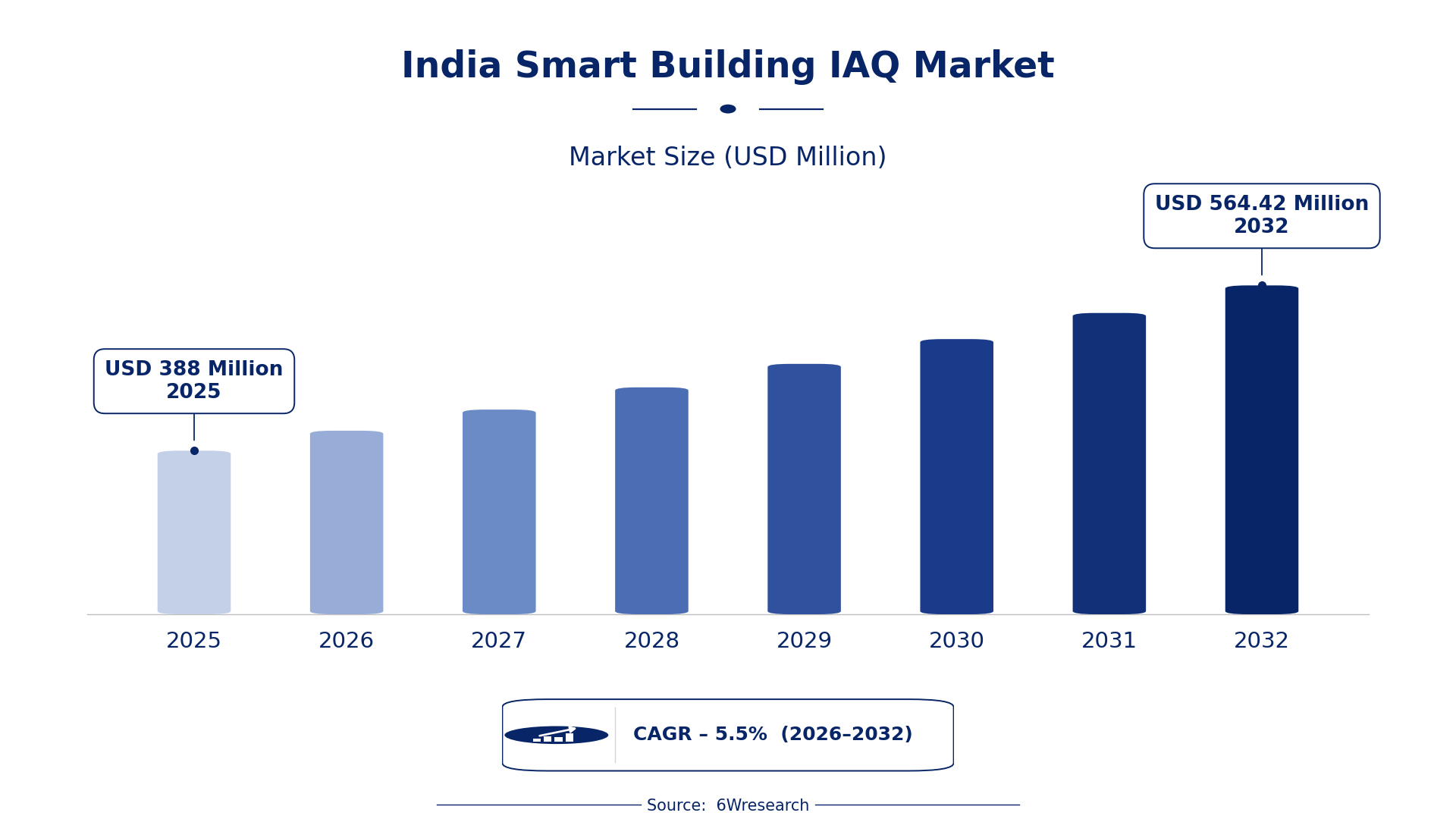
According to 6Wresearch internal database and industry insights, the India Smart Building IAQ Market was valued at USD 388.0 million in 2025 and is projected to reach USD 564.42 million by 2032, growing at a CAGR of approximately 5.5% during 2026–2032.
India Smart Building IAQ Market Highlights
| Report Metric | Details |
| Report Name | India Smart Building IAQ Market |
| Market Size 2025 | USD 388.0 million |
| Market Size 2032 | USD 564.42 million |
| Absolute Growth 2025–2032 | USD 176.42 million |
| CAGR 2026–2032 | 5.5% |
| Peak Annual Growth | 7.8% in 2028 |
| Forecast Period | 2026–2032 |
| Historical Data | 2022–2025 |
| Base Year | 2025 |
| Leading IAQ Technology, 2025 | CO₂ Sensors (50% share) |
| Leading Parameter Monitored, 2025 | Air Quality Feedback (50% share) |
| Leading Building Type, 2025 | Offices (39% share) |
| Leading End User, 2025 | Smart Infrastructure Firms (34% share) |
| Fastest-Growing IAQ Technology | VOC Monitors (8.0% CAGR) |
| Fastest-Growing Parameter Monitored | Pollutant Detection (7.7% CAGR) |
| Fastest-Growing Building Type | Schools (7.5% CAGR) |
| Fastest-Growing End User | Facility Management (7.3% CAGR) |
| Growing Sector | Smart Infrastructure |
| Key End Users | Smart Infrastructure Firms, Facility Management, Real Estate Developers |
India Smart Building IAQ Market Year-wise Growth Rate and Key Drivers (2022–2032)
This graph illustrates the annual growth rates of the market from 2022 to 2032, highlighting a steady upward trajectory and projected market expansion over the forecast period.
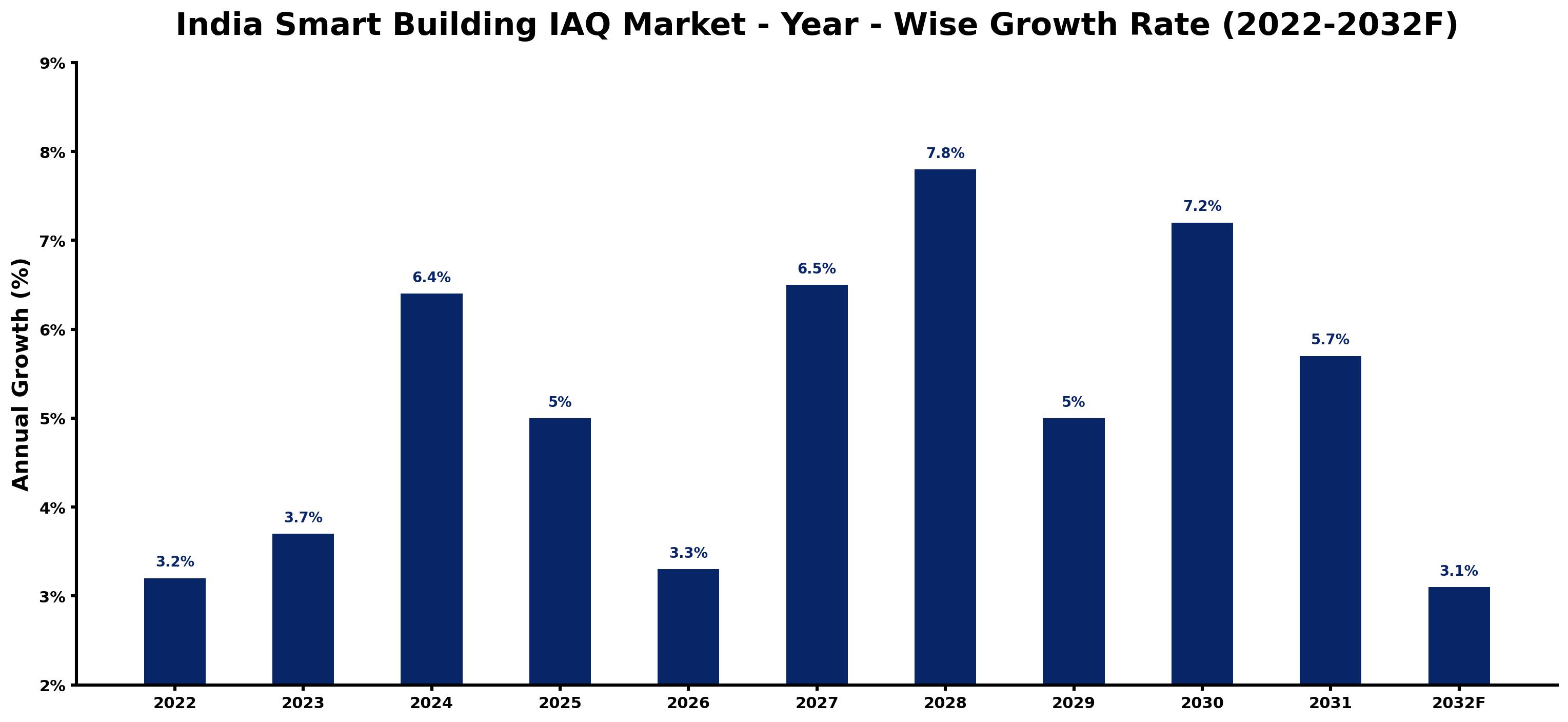
The table below sets out the estimated growth rate for each year and the main factor behind it.
| Year | Estimated Annual Growth (%) | Market Rationale |
| 2022 | 3.2 | The market showed steady growth due to increasing urbanisation and awareness of indoor air quality. |
| 2023 | 3.7 | Demand rose as more buildings adopted smart technologies for energy efficiency and health. |
| 2024 | 6.4 | Growth accelerated with the implementation of new indoor air quality standards by the Bureau of Indian Standards. |
| 2025 | 5.0 | The market experienced a slowdown as growth rates normalised after rapid expansion in previous years. |
| 2026 | 3.3 | Demand is expected to continue growing due to ongoing urban infrastructure projects and the Smart Cities Mission. |
| 2027 | 6.5 | Growth is projected to pick up again as the focus on health and comfort in buildings intensifies. |
| 2028 | 7.8 | The market is expected to peak with heightened investments in smart building technologies and air quality solutions. |
| 2029 | 5.0 | Growth will slow again as market dynamics adjust to previous peaks and demand stabilises. |
| 2030 | 7.2 | A resurgence in growth is anticipated as urban areas prioritise smart building initiatives and sustainability. |
| 2031 | 5.7 | The market will continue to grow, but at a slower rate as new projects begin to stabilise. |
| 2032 | 3.1 | Growth is expected to slow further as the market matures and competition increases. |
Note: Market size estimations and growth projections presented in this report are based on 6Wresearch's proprietary forecasting methodology, utilizing the latest available industry data, government publications, and primary research inputs.
India Smart Building IAQ Market Synopsis
Smart Building Indoor Air Quality (IAQ) products in India encompass advanced technologies that monitor and improve air quality in buildings. These products utilise sensors for CO₂, VOCs, and humidity to enhance occupant health and productivity. The India Smart Building IAQ Market is expanding due to urbanisation, with the urban population reaching 472 million in 2021, and the Smart Cities Mission promoting sustainable infrastructure. Increased focus on energy-efficient solutions in commercial and residential sectors further drives demand for these technologies.
Market Dynamics Impact Analysis (2026–2032)
| Factor | Type | Impact | Primary Segment Affected |
| Rising urban population and health awareness drive demand for indoor air quality solutions. | Driver | High | CO₂ Sensors |
| Increased investment in smart building technologies enhances supply capabilities. | Driver | High | AI-Based IAQ Dashboards |
| Growing focus on health in educational institutions creates demand for improved air quality. | Opportunity | High | Schools |
| Urban infrastructure projects necessitate advanced air quality management solutions. | Opportunity | Medium | Offices |
| High costs of advanced IAQ technologies can limit adoption among smaller firms. | Restraint | High | VOC Monitors |
| Regulatory compliance requirements can delay project implementation timelines. | Restraint | Medium | Humidity Controllers |
| Limited awareness of IAQ technologies among end-users slows market penetration. | Challenge | High | Air Quality Feedback |
| Supply chain disruptions can affect the availability of critical components for IAQ products. | Challenge | Medium | Pollutant Detection |
Evaluation of Drivers in India Smart Building IAQ Market (2026–2032)
Below mentioned are some major drivers and their influence on market dynamics.
| Drivers | Primary Segment Affected | Why It Matters (Evidence) |
| Increased urbanisation leads to higher demand for IAQ solutions in buildings. | CO₂ Sensors | India's urban population reached 472 million in 2021, driving demand for smart building solutions. |
| Growing health consciousness among occupants boosts demand for air quality monitoring. | VOC Monitors | The Ministry of Health and Family Welfare emphasises the importance of indoor air quality. |
| Investment in smart technologies improves building energy efficiency and occupant comfort. | AI-Based IAQ Dashboards | The HVAC industry in India is projected to grow significantly, with increasing adoption of smart technologies. |
| Regulatory standards for indoor air quality drive compliance among building developers. | Humidity Controllers | The Bureau of Indian Standards has established standards for indoor air quality monitoring. |
| Smart Cities Mission promotes sustainable urban development, including IAQ management. | Air Quality Feedback | The Smart Cities Mission aims to enhance urban infrastructure, including air quality management. |
The urban population reached 472 million in 2021, which has increased demand for smart building solutions. The HVAC sector is projected to grow significantly, supporting the integration of smart technologies in buildings. The emphasis on health and comfort in buildings is driving demand for advanced air quality solutions. The implementation of new indoor air quality standards by the Bureau of Indian Standards is encouraging compliance among developers.
Evaluation of Restraints in India Smart Building IAQ Market
The following restraints limit how fast demand can grow.
| Market Restraint | Primary Segment Affected | Why It Matters (Evidence) |
| High costs of advanced IAQ technologies limit adoption among smaller firms. | VOC Monitors | The initial investment required for VOC monitoring systems can deter smaller enterprises from implementation. |
| Regulatory compliance requirements can delay project implementation timelines. | Humidity Controllers | Compliance with the National Building Code can prolong the approval process for new installations. |
| Limited awareness of IAQ technologies among end-users slows market penetration. | Air Quality Feedback | Many building owners remain unaware of the benefits of advanced air quality monitoring solutions. |
| Supply chain disruptions can affect the availability of critical components for IAQ products. | Pollutant Detection | Global supply chain issues have led to delays in obtaining necessary sensors and technologies. |
| Market competition can lead to price wars, affecting profitability for manufacturers. | AI-Based IAQ Dashboards | Intense competition among suppliers can drive down prices, impacting revenue margins. |
India Smart Building IAQ Market Challenges
India's regulatory landscape for smart building IAQ products creates hurdles, as multiple standards from the Bureau of Indian Standards can delay approvals by up to six months for suppliers. High costs associated with implementing advanced air quality technologies can consume 15-20% of total project budgets, making it difficult for buyers to justify these expenses. Urban developers face challenges in sourcing quality components due to ongoing supply chain disruptions, which can extend project timelines by three to four months. Limited awareness among buyers about the benefits of smart building IAQ solutions hampers market growth, as many do not recognise the health and productivity advantages these technologies offer.
Trends in the India Smart Building IAQ Market
Below mentioned are some of the trends shaping the India Smart Building IAQ Market growth.
- Growing Demand for Real-Time Monitoring: Real-time environment monitoring is becoming essential for facilities management, especially in hospitals. The emphasis on immediate responses to air quality changes is driving investment in advanced IAQ solutions, with hospitals increasingly adopting these technologies.
- Increased Focus on Regulatory Compliance: The updated National Building Code includes stricter guidelines for indoor air quality management. This regulatory shift is prompting building developers to invest in compliant IAQ technologies, ensuring adherence to safety standards.
- Integration of Multi-Sensor Systems: The National Air Quality Monitoring Programme is pushing for the adoption of multi-sensor integration in smart buildings. This approach allows for improved monitoring of various air quality parameters, enhancing response times and effectiveness.
- Shift towards Healthier Indoor Environments: Schools are increasingly adopting smart IAQ technologies to improve student health and learning. The focus on better air quality aligns with the Clean Air for Health initiative, which promotes healthier environments.
Investment Opportunities in the India Smart Building IAQ Market
Some of the investment opportunities in the India Smart Building IAQ Market are mentioned below.
- Investment in Smart Infrastructure: The growing focus on smart buildings creates opportunities to supply advanced IAQ solutions. Real Estate Developers are increasingly seeking technologies for new projects, especially in urban areas where demand is rising.
- Certification for Green Building Standards: Investing in IAQ products that meet green building standards can attract eco-conscious buyers. The Indian Green Building Council promotes these standards, creating demand for compliant technologies.
- Expansion into Tier 2 Cities: The rising urbanisation in Tier 2 cities presents a chance to introduce smart IAQ products. Collaborating with local partners can ease market entry and enhance distribution, tapping into new customer bases.
- Joint Ventures for Local Manufacturing: Local partnerships can facilitate the production of IAQ technologies, reducing costs. Smart Infrastructure Firms in Tier 1 cities are keen to collaborate for efficient solutions.
Government Initiatives in the India Smart Building IAQ Market
The Ministry of Housing and Urban Affairs launched the Smart Cities Mission in 2015, which promotes sustainable urban development with a focus on smart building technologies. This initiative encourages the integration of advanced IAQ solutions in urban planning. The National Building Code was updated in 2020 to include guidelines for indoor air quality management in buildings, ensuring compliance with safety and environmental standards. The Clean Air for Health initiative, launched in 2022, addresses the health impacts of poor air quality in urban settings, promoting better indoor environments. The government allocated funds for improving air quality in major metropolitan areas as part of urban renewal projects.
In 2023, the Ministry of Environment, Forest and Climate Change oversees the National Air Quality Monitoring Programme, which monitors air quality in real-time across cities, enhancing public awareness. The programme has been instrumental in establishing standards for air quality management. The Ministry of Health and Family Welfare also plays a significant role in promoting indoor air quality initiatives, ensuring that health considerations are integrated into urban planning. The government has allocated substantial funding for these initiatives, which directly benefit producers and buyers of smart building IAQ technologies.
Future Insight of the India Smart Building IAQ Market
The India Smart Building IAQ market will undergo significant changes by 2032, driven by urbanisation and initiatives like the Smart Cities Mission. Improved standards from the Bureau of Indian Standards will streamline compliance, facilitating easier market entry for suppliers. The HVAC sector will experience substantial growth, enabling the adoption of advanced technologies in buildings, especially in urban centres. Increased government funding for urban air quality projects will focus on enhancing indoor environments, promoting healthier living conditions across major metropolitan areas.
Market Segmentation Analysis
Each segment group is reviewed below, with the leader by share and the fastest grower by CAGR.
By IAQ Technology – CO₂ Sensors Dominated, VOC Monitors Expected to Grow Fastest
According to Dhaval Chaurasia, Assistant Manager at 6Wresearch, CO₂ Sensors accounted for a 50% market share by iaq technology in 2025. CO₂ sensors hold the largest market share due to their critical role in monitoring air quality and ensuring safety in buildings. Their widespread adoption in commercial spaces, particularly in urban areas, reflects the growing emphasis on health and safety standards. The quickest growth will come from VOC Monitors, forecast to expand at a CAGR of 8.0% between 2026 and 2032. VOC monitors are experiencing the fastest growth as awareness increases regarding the health impacts of volatile organic compounds in indoor environments. With urbanisation driving demand for healthier spaces, the adoption of these monitors is expected to surge significantly. This trend indicates that suppliers should focus on enhancing their offerings in VOC monitoring technologies to meet rising market demands.
By Parameter Monitored – Air Quality Feedback Dominated, Pollutant Detection Expected to Grow Fastest
With a 50% revenue share in 2025, Air Quality Feedback was the largest parameter monitored category. Air quality feedback leads the market as it provides essential data for improving indoor air conditions, which is crucial for occupant health. The increasing regulatory focus on air quality standards further solidifies its dominant position in the market. Over 2026–2032, Pollutant Detection is expected to post the fastest growth, at a CAGR of 7.7%. Pollutant detection is the fastest-growing parameter due to heightened awareness of harmful pollutants and their effects on health. This growth is driven by initiatives like the National Clean Air Programme, which aims to reduce pollution levels significantly. Suppliers must invest in advanced pollutant detection technologies to align with regulatory changes and consumer expectations.
By Building Type – Offices Dominated, Schools Expected to Grow Fastest
In 2025, Offices led the building type split with a 39% share. Offices dominate the market share as there is a significant demand for improving employee productivity and health through better air quality. The corporate sector's increasing investment in smart technologies further supports this trend. Schools are set to record the highest CAGR in this split, 7.5% over 2026–2032. Schools are the fastest-growing building type for IAQ solutions, driven by a growing focus on student health and learning environments. Government initiatives promoting healthier school settings are accelerating this growth. This shift suggests that suppliers should tailor their products to meet the specific needs of educational institutions.
By End User – Smart Infrastructure Firms Dominated, Facility Management Expected to Grow Fastest
Smart Infrastructure Firms took a 34% share of end user in 2025, more than any other category. Smart infrastructure firms command the largest market share as they are key players in implementing smart building technologies. Their strategic investments in IAQ solutions are crucial for enhancing urban living standards. Facility Management is projected to grow fastest, at a CAGR of 7.3% during 2026–2032. Facility management is the fastest-growing end user segment, as these firms play an integral role in maintaining building operations and ensuring occupant comfort. The rising complexity of building management systems is driving this growth. Suppliers should focus on developing solutions that cater specifically to the needs of facility management firms to capitalise on this growth opportunity.
Key Attractiveness of the Report
- 10 Years of Market Numbers
- Historical Data Starting from 2022 to 2025
- Base Year 2025
- Forecast Data until 2032
- Key Performance Indicators Impacting the Market
- Major Upcoming Developments and Projects
Key Highlights of the Report:
- India Smart Building IAQ Market Outlook
- Market Size of India Smart Building IAQ Market, 2025
- Forecast of India Smart Building IAQ Market, 2032
- Historical Data and Forecast of India Smart Building IAQ Revenues & Volume for the Period 2022 - 2032F
- India Smart Building IAQ Market Trend Evolution
- India Smart Building IAQ Market Drivers and Challenges
- India Smart Building IAQ Price Trends
- India Smart Building IAQ Porter's Five Forces
- India Smart Building IAQ Industry Life Cycle
- Historical Data and Forecast of India Smart Building IAQ Market Revenues & Volume By IAQ Technology for the Period 2022 - 2032F
- Historical Data and Forecast of India Smart Building IAQ Market Revenues & Volume By CO Sensors for the Period 2022 - 2032F
- Historical Data and Forecast of India Smart Building IAQ Market Revenues & Volume By VOC Monitors for the Period 2022 - 2032F
- Historical Data and Forecast of India Smart Building IAQ Market Revenues & Volume By Humidity Controllers for the Period 2022 - 2032F
- Historical Data and Forecast of India Smart Building IAQ Market Revenues & Volume By AI-Based IAQ Dashboards for the Period 2022 - 2032F
- Historical Data and Forecast of India Smart Building IAQ Market Revenues & Volume By Parameter Monitored for the Period 2022 - 2032F
- Historical Data and Forecast of India Smart Building IAQ Market Revenues & Volume By Air Quality Feedback for the Period 2022 - 2032F
- Historical Data and Forecast of India Smart Building IAQ Market Revenues & Volume By Pollutant Detection for the Period 2022 - 2032F
- Historical Data and Forecast of India Smart Building IAQ Market Revenues & Volume By Real-Time Environment for the Period 2022 - 2032F
- Historical Data and Forecast of India Smart Building IAQ Market Revenues & Volume By Multi-Sensor Integration for the Period 2022 - 2032F
- Historical Data and Forecast of India Smart Building IAQ Market Revenues & Volume By Building Type for the Period 2022 - 2032F
- Historical Data and Forecast of India Smart Building IAQ Market Revenues & Volume By Offices, Schools for the Period 2022 - 2032F
- Historical Data and Forecast of India Smart Building IAQ Market Revenues & Volume By Hospitals for the Period 2022 - 2032F
- Historical Data and Forecast of India Smart Building IAQ Market Revenues & Volume By Industrial Buildings for the Period 2022 - 2032F
- Historical Data and Forecast of India Smart Building IAQ Market Revenues & Volume By Residential Complexes for the Period 2022 - 2032F
- Historical Data and Forecast of India Smart Building IAQ Market Revenues & Volume By End User for the Period 2022 - 2032F
- Historical Data and Forecast of India Smart Building IAQ Market Revenues & Volume By Smart Infrastructure Firms for the Period 2022 - 2032F
- Historical Data and Forecast of India Smart Building IAQ Market Revenues & Volume By Facility Management for the Period 2022 - 2032F
- Historical Data and Forecast of India Smart Building IAQ Market Revenues & Volume By HVAC Providers for the Period 2022 - 2032F
- Historical Data and Forecast of India Smart Building IAQ Market Revenues & Volume By Real Estate Developers for the Period 2022 - 2032F
- India Smart Building IAQ Import Export Trade Statistics
- Market Opportunity Assessment By IAQ Technology
- Market Opportunity Assessment By Parameter Monitored
- Market Opportunity Assessment By Building Type
- Market Opportunity Assessment By End User
- India Smart Building IAQ Top Companies Market Share
- India Smart Building IAQ Competitive Benchmarking By Technical and Operational Parameters
- India Smart Building IAQ Company Profiles
- India Smart Building IAQ Key Strategic Recommendations
Market Covered
This report examines the market across the segments below.
By IAQ Technology
- CO₂ Sensors
- VOC Monitors
- Humidity Controllers
- AI-Based IAQ Dashboards
By Parameter Monitored
- Air Quality Feedback
- Pollutant Detection
- Real-Time Environment
- Multi-Sensor Integration
By Building Type
- Offices
- Schools
- Hospitals
- Industrial Buildings
- Residential Complexes
By End User
- Smart Infrastructure Firms
- Facility Management
- HVAC Providers
- Real Estate Developers































