China Smart Commuter Solutions Market Size & Growth Rate
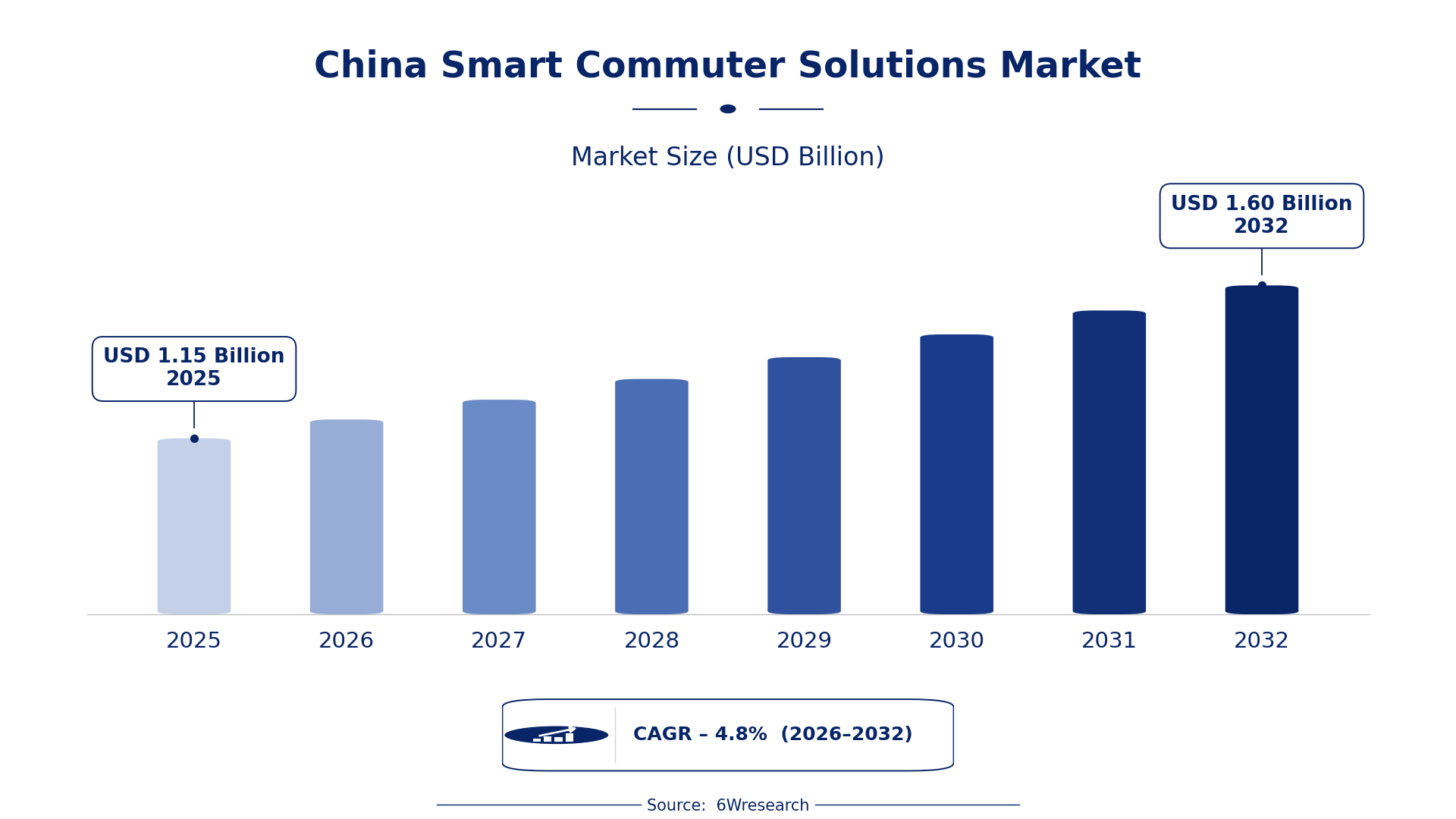
According to 6Wresearch internal database and industry insights, the China Smart Commuter Solutions Market was valued at USD 1.15 billion in 2025 and is projected to reach USD 1.60 billion by 2032, growing at a CAGR of approximately 4.8% during 2026–2032.
China Smart Commuter Solutions Market Highlights
| Report Metric | Details |
| Report Name | China Smart Commuter Solutions Market |
| Market Size 2025 | USD 1.15 billion |
| Market Size 2032 | USD 1.60 billion |
| Absolute Growth 2025–2032 | USD 0.45 billion |
| CAGR 2026–2032 | 4.8% |
| Peak Annual Growth | 7.2% in 2026 |
| Forecast Period | 2026–2032 |
| Historical Data | 2022–2025 |
| Base Year | 2025 |
| Leading Solution Type, 2025 | Multi-Modal Apps (40% share) |
| Leading Core Feature, 2025 | Real-Time Scheduling (39% share) |
| Leading Transportation Mode, 2025 | Trains + Buses (38% share) |
| Leading End User, 2025 | Urban Commuters (46% share) |
| Fastest-Growing Solution Type | Smart Ticketing (6.8% CAGR) |
| Fastest-Growing Core Feature | QR/Contactless Pass (6.9% CAGR) |
| Fastest-Growing Transportation Mode | Metro (7.1% CAGR) |
| Fastest-Growing End User | Transit Authorities (7.1% CAGR) |
| Growing Sector | Urban Mobility |
| Key End Users | Urban Commuters, Transit Authorities, Ride-Sharing Operators, Government Urban Agencies |
China Smart Commuter Solutions Market Year-wise Growth Rate and Key Drivers (2022–2032)
This graph illustrates the annual growth rates of the market from 2022 to 2032, highlighting a steady upward trajectory and projected market expansion over the forecast period.
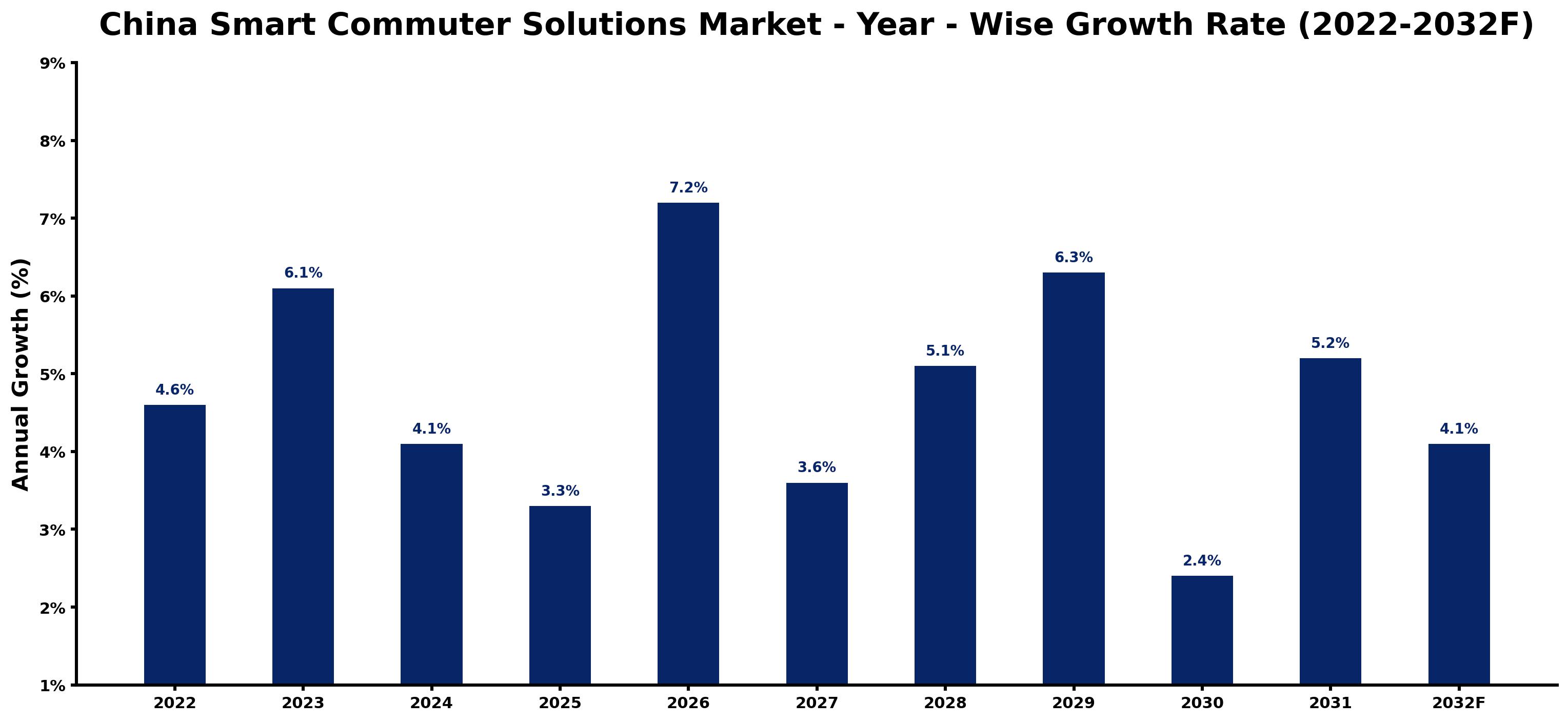
The table below sets out the estimated growth rate for each year and the main factor behind it.
| Year | Estimated Annual Growth (%) | Market Rationale |
| 2022 | 4.6 | Urban commuters in China exceeded 500 million, driving demand for efficient solutions. |
| 2023 | 6.1 | The Ministry of Transport promoted smart ticketing systems, improving user convenience. |
| 2024 | 4.1 | Growth slowed as smart ticketing technology was implemented in over 50 major cities. |
| 2025 | 3.3 | Demand continued to grow with the urban population reaching 64% in 2022. |
| 2026 | 7.2 | Real-time scheduling applications are expected to be adopted by 70% of major transit authorities. |
| 2027 | 3.6 | Growth is projected to slow as the average daily ridership of metro systems remains high. |
| 2028 | 5.1 | Demand is expected to rise with the National Smart Transportation Strategy integrating AI in urban transit. |
| 2029 | 6.3 | Growth is projected to accelerate as BRT systems expand to over 200 cities across China. |
| 2030 | 2.4 | Growth is expected to slow as the average commuter in Shanghai spends about 1.5 hours daily. |
| 2031 | 5.2 | Demand will increase with the Chinese government allocating $1 billion for smart mobility projects. |
| 2032 | 4.1 | Growth is projected to slow as the installed base of smart ticketing systems reaches 300 million devices. |
Note: Market size estimations and growth projections presented in this report are based on 6Wresearch's proprietary forecasting methodology, utilizing the latest available industry data, government publications, and primary research inputs.
China Smart Commuter Solutions Market Synopsis
Smart Commuter Solutions Market in China encompasses technology-driven applications designed to improve urban transportation efficiency. These solutions optimize travel routes, facilitate ticketing processes, and provide real-time updates for commuters. The market is growing due to urbanization and the need for efficient public transport systems. In 2023, urban commuters in China exceeded 500 million, highlighting the increasing demand for these technologies. Local government initiatives and the integration of AI are further driving this market's expansion.
Market Dynamics Impact Analysis (2026–2032)
| Factor | Type | Impact | Primary Segment Affected |
| Urbanization drives demand for efficient public transport solutions. | Driver | High | Smart Ticketing |
| The integration of AI in urban transit enhances operational efficiency. | Driver | High | Real-Time Scheduling |
| The increasing urban population creates a demand gap for smart commuting solutions. | Opportunity | High | eBike & eScooter Apps |
| The expansion of BRT systems across cities presents investment opportunities. | Opportunity | Medium | Multi-Modal Apps |
| High initial investment costs can deter adoption of smart solutions. | Restraint | High | Smart Ticketing |
| Limited infrastructure in some regions hampers the implementation of smart technologies. | Restraint | Medium | Real-Time Scheduling |
| Buyers face challenges in navigating complex regulatory environments. | Challenge | High | eBike & eScooter Apps |
| Suppliers encounter competition from established local players in the market. | Challenge | Medium | Multi-Modal Apps |
Evaluation of Drivers in China Smart Commuter Solutions Market (2026–2032)
The factors lifting demand, and the evidence behind each, are summarised below.
| Drivers | Primary Segment Affected | Why It Matters (Evidence) |
| Urban population growth increases the need for efficient public transport solutions. | Smart Ticketing | In 2022, the urban population in China reached 64%, driving demand for smart ticketing systems. |
| The integration of AI improves operational efficiency in urban transport. | Real-Time Scheduling | The 'National Smart Transportation Strategy' aims to integrate AI in urban transit by 2025. |
| Government initiatives promote eco-friendly transport solutions. | eBike & eScooter Apps | The 'Green Transport Development Plan' encourages the use of eBikes and scooters in urban areas. |
| The expansion of BRT systems improves public transport efficiency. | Multi-Modal Apps | China's BRT systems have expanded to over 200 cities, improving urban mobility. |
| Real-time scheduling applications improve user experience. | Commuter AI Dashboards | Real-time scheduling applications have been adopted by 70% of major transit authorities in China. |
In 2022, the urban population reached 64%, intensifying the need for effective public transport solutions. The 'National Smart Transportation Strategy' aims to incorporate AI by 2025, enhancing operational efficiency across transit systems. Real-time scheduling applications have been adopted by 70% of major transit authorities, improving user experience and operational management.
Evaluation of Restraints in China Smart Commuter Solutions Market
The following restraints limit how fast demand can grow.
| Market Restraint | Primary Segment Affected | Why It Matters (Evidence) |
| High initial investment costs can deter adoption of smart solutions. | Smart Ticketing | The average cost of implementing smart ticketing systems can exceed $1 million per city. |
| Limited infrastructure in some regions hampers the implementation of smart technologies. | Real-Time Scheduling | Over 200 cities lack the necessary infrastructure to support advanced scheduling applications. |
| Regulatory complexities can create barriers for new entrants in the market. | eBike & eScooter Apps | Navigating local regulations can delay the launch of new eBike initiatives. |
| Competition from established local players can limit market share for new suppliers. | Multi-Modal Apps | Local firms dominate the market, making entry challenging for newcomers. |
| Consumer resistance to change can slow adoption rates of new technologies. | Commuter AI Dashboards | Many users prefer traditional commuting methods over new tech-driven solutions. |
China Smart Commuter Solutions Market Challenges
Rising costs pose a major challenge in the China Smart Commuter Solutions market, as urban commuters exceed 500 million, increasing the demand for efficient transport. Suppliers encounter supply chain disruptions due to reliance on advanced components, which can delay the rollout of new technologies for transit authorities. Buyers face outdated systems that lack real-time updates, resulting in longer commute times and reduced satisfaction for commuters. Furthermore, integrating new smart solutions often demands substantial investments, straining budgets for local governments and hindering the adoption of necessary upgrades.
Trends in the China Smart Commuter Solutions Market
Below mentioned are some of the trends shaping the China Smart Commuter Solutions Market growth.
- Shift towards Smart Ticketing Systems: The Ministry of Transport promotes smart ticketing systems under the 'Smart Transportation Development Plan 2021-2025', leading to implementation in over 60 major cities. This shift enhances user convenience and operational efficiency.
- Emergence of AI in Urban Transit: The 'National Smart Transportation Strategy' launched in 2021 aims to integrate AI in urban transit by 2025. This initiative is expected to improve operational efficiency and user experience across various transport modes.
- Growth of eBike Initiatives: The 'Green Transport Development Plan' initiated in 2021 encourages the use of eBikes and scooters in urban areas. This trend supports eco-friendly transport options and aims to reduce urban congestion.
- Expansion of BRT Systems: China's BRT systems have expanded to over 200 cities, improving public transport efficiency. This expansion supports better commuting and encourages multi-modal transport solutions.
Investment Opportunities in the China Smart Commuter Solutions Market
Investors looking at the China Smart Commuter Solutions Market should consider the following areas.
- Entry through Local Partnerships: With urban commuters exceeding 500 million, there is an opportunity for local partnerships in smart ticketing solutions. Collaborating with transit authorities can facilitate market entry.
- Demand from Transit Authorities: Transit authorities are increasingly seeking smart commuter solutions to improve efficiency. Investing in AI-driven technologies can meet this demand, especially in major urban centres.
- Timing with Government Initiatives: The Chinese government allocated $1 billion for smart urban mobility projects in 2023, creating an immediate opportunity for investment in smart commuter technologies.
- Gap in Smart Ticketing Systems: The installed base of smart ticketing systems is projected to reach 300 million devices by 2025, highlighting a market gap for suppliers to fill.
Government Initiatives in the China Smart Commuter Solutions Market
In 2022, the Ministry of Transport launched the 'Smart Transportation Development Plan 2021-2025' to improve urban mobility through technology integration. This plan aims to support public transport systems and promote smart ticketing solutions. The National Development and Reform Commission approved the 'Green Transport Development Plan' in 2021, which encourages eco-friendly transport solutions. Additionally, the Ministry of Housing and Urban-Rural Development initiated the 'Urban Mobility Initiative' in 2023 to improve public transport accessibility across urban areas. These measures support the growth of smart commuter technologies.
Transit authorities utilise the 'Smart Transportation Development Plan' to implement smart ticketing systems, improving operational efficiency. The Ministry of Transport oversees this initiative, ensuring compliance with the 'National Smart Transit System Standard' established in 2021. Funding for smart urban mobility projects, amounting to $1 billion in 2023, is allocated to support various initiatives. The 'Urban Mobility Initiative' also provides resources for improving public transport accessibility, benefiting urban commuters significantly. These schemes enable transit authorities to adopt solutions that enhance user experience.
Future Insight of the China Smart Commuter Solutions Market
Several forward-looking factors should support the China Smart Commuter Solutions market over the coming years. The Ministry of Transport's initiatives will enhance smart ticketing systems across over 50 major cities, streamlining payment processes for commuters. By 2025, the installed base of smart ticketing systems is projected to reach 300 million devices, significantly improving operational efficiency for transit authorities. The integration of AI in urban transit, as outlined in the 'National Smart Transportation Strategy', will enable better route optimisation and scheduling, providing substantial benefits for both buyers and suppliers.
Market Segmentation Analysis
The report offers a comprehensive study of the following market segments and their leading categories in the market.
By Solution Type – Multi-Modal Apps Dominated, Smart Ticketing Expected to Grow Fastest
According to Dhaval Chaurasia, Assistant Manager at 6Wresearch, in 2025, Multi-Modal Apps led the solution type split with a 40% share. Multi-Modal Apps dominate the market due to their ability to seamlessly connect various transport modes, appealing to over 500 million urban commuters in China. The Ministry of Transport's endorsement of smart ticketing systems further enhances the functionality of these applications, solidifying their leading position. Over 2026–2032, Smart Ticketing is expected to post the fastest growth, at a CAGR of 6.8%. Smart Ticketing is experiencing rapid growth, with over 50 major cities implementing these systems to streamline fare collection and enhance user convenience. The Chinese government's allocation of $1 billion for smart urban mobility projects is a key factor driving this expansion. Suppliers should prioritise developing integrated solutions that improve user experience and operational efficiency for urban commuters.
By Core Feature – Real-Time Scheduling Dominated, QR/Contactless Pass Expected to Grow Fastest
Real-Time Scheduling took a 39% share of core feature in 2025, more than any other category. Real-Time Scheduling captures the largest market share as it delivers crucial up-to-date travel information, essential for millions of urban commuters daily. The adoption of these features by 70% of major transit authorities highlights their vital role in enhancing the overall commuter experience. QR/Contactless Pass is set to record the highest CAGR in this split, 6.9% over 2026–2032. QR/Contactless Pass technology is rapidly gaining traction, enabling quick and safe access to transport services, which is increasingly important in urban settings. The heightened demand for hygiene and efficiency in public transport systems is a significant driver of this growth. Buyers should seek solutions that integrate real-time information and contactless access to boost commuter satisfaction.
By Transportation Mode – Trains + Buses Dominated, Metro Expected to Grow Fastest
Trains + Buses accounted for a 38% market share by transportation mode in 2025. Trains + Buses form the backbone of urban public transport systems, catering to millions of commuters across China's extensive network. The average daily ridership of metro systems in cities like Beijing, reaching approximately 10 million passengers, underscores their importance. Metro is projected to grow fastest, at a CAGR of 7.1% during 2026–2032. Metro systems are the fastest-growing mode of transport, crucial for accommodating high-capacity urban transit needs. The ongoing expansion of metro networks in response to urbanisation trends indicates their increasing significance in urban mobility solutions. Suppliers must focus on technologies that enhance the efficiency and capacity of metro systems to meet rising commuter demands.
By End User – Urban Commuters Dominated, Transit Authorities Expected to Grow Fastest
Urban Commuters held a 46% share of the China Smart Commuter Solutions Market by end user in 2025. Urban Commuters are the largest user group for smart commuter solutions, driven by the urban population's growth to 64% in 2022. Their daily commuting requirements make them the primary target for technology developers in this sector. The quickest growth will come from Transit Authorities, forecast to expand at a CAGR of 7.1% between 2026 and 2032. Transit Authorities are swiftly adopting smart commuter technologies to enhance service efficiency and user satisfaction. Their proactive approach to implementing these solutions positions them as pivotal players in the market's growth. Suppliers should collaborate with transit authorities to create tailored solutions that address specific challenges in urban commuting.
Key Attractiveness of the Report
- 10 Years of Market Numbers
- Historical Data Starting from 2022 to 2025
- Base Year 2025
- Forecast Data until 2032
- Key Performance Indicators Impacting the Market
- Major Upcoming Developments and Projects
Key Highlights of the Report:
- China Smart Commuter Solutions Market Outlook
- Market Size of China Smart Commuter Solutions Market, 2025
- Forecast of China Smart Commuter Solutions Market, 2032
- Historical Data and Forecast of China Smart Commuter Solutions Revenues & Volume for the Period 2022 - 2032F
- China Smart Commuter Solutions Market Trend Evolution
- China Smart Commuter Solutions Market Drivers and Challenges
- China Smart Commuter Solutions Price Trends
- China Smart Commuter Solutions Porter's Five Forces
- China Smart Commuter Solutions Industry Life Cycle
- Historical Data and Forecast of China Smart Commuter Solutions Market Revenues & Volume By Solution Type for the Period 2022 - 2032F
- Historical Data and Forecast of China Smart Commuter Solutions Market Revenues & Volume By Multi-Modal Apps for the Period 2022 - 2032F
- Historical Data and Forecast of China Smart Commuter Solutions Market Revenues & Volume By Smart Ticketing for the Period 2022 - 2032F
- Historical Data and Forecast of China Smart Commuter Solutions Market Revenues & Volume By eBike & eScooter Apps for the Period 2022 - 2032F
- Historical Data and Forecast of China Smart Commuter Solutions Market Revenues & Volume By Commuter AI Dashboards for the Period 2022 - 2032F
- Historical Data and Forecast of China Smart Commuter Solutions Market Revenues & Volume By Core Feature for the Period 2022 - 2032F
- Historical Data and Forecast of China Smart Commuter Solutions Market Revenues & Volume By Real-Time Scheduling for the Period 2022 - 2032F
- Historical Data and Forecast of China Smart Commuter Solutions Market Revenues & Volume By QR/Contactless Pass for the Period 2022 - 2032F
- Historical Data and Forecast of China Smart Commuter Solutions Market Revenues & Volume By Navigation + Booking for the Period 2022 - 2032F
- Historical Data and Forecast of China Smart Commuter Solutions Market Revenues & Volume By Crowd Prediction/Analytics for the Period 2022 - 2032F
- Historical Data and Forecast of China Smart Commuter Solutions Market Revenues & Volume By Transportation Mode for the Period 2022 - 2032F
- Historical Data and Forecast of China Smart Commuter Solutions Market Revenues & Volume By Trains + Buses for the Period 2022 - 2032F
- Historical Data and Forecast of China Smart Commuter Solutions Market Revenues & Volume By Metro, BRT for the Period 2022 - 2032F
- Historical Data and Forecast of China Smart Commuter Solutions Market Revenues & Volume By Personal/Micro-Mobility for the Period 2022 - 2032F
- Historical Data and Forecast of China Smart Commuter Solutions Market Revenues & Volume By Rail & Bus Terminals for the Period 2022 - 2032F
- Historical Data and Forecast of China Smart Commuter Solutions Market Revenues & Volume By End User for the Period 2022 - 2032F
- Historical Data and Forecast of China Smart Commuter Solutions Market Revenues & Volume By Urban Commuters for the Period 2022 - 2032F
- Historical Data and Forecast of China Smart Commuter Solutions Market Revenues & Volume By Transit Authorities for the Period 2022 - 2032F
- Historical Data and Forecast of China Smart Commuter Solutions Market Revenues & Volume By Ride-Sharing Operators for the Period 2022 - 2032F
- Historical Data and Forecast of China Smart Commuter Solutions Market Revenues & Volume By Government Urban Agencies for the Period 2022 - 2032F
- China Smart Commuter Solutions Import Export Trade Statistics
- Market Opportunity Assessment By Solution Type
- Market Opportunity Assessment By Core Feature
- Market Opportunity Assessment By Transportation Mode
- Market Opportunity Assessment By End User
- China Smart Commuter Solutions Top Companies Market Share
- China Smart Commuter Solutions Competitive Benchmarking By Technical and Operational Parameters
- China Smart Commuter Solutions Company Profiles
- China Smart Commuter Solutions Key Strategic Recommendations
Market Covered
The report offers an extensive study of the following market segments.
By Solution Type
- Multi-Modal Apps
- Smart Ticketing
- eBike & eScooter Apps
- Commuter AI Dashboards
By Core Feature
- Real-Time Scheduling
- QR/Contactless Pass
- Navigation + Booking
- Crowd Prediction/Analytics
By Transportation Mode
- Trains + Buses
- Metro
- BRT
- Personal/Micro-Mobility
- Rail & Bus Terminals
By End User
- Urban Commuters
- Transit Authorities
- Ride-Sharing Operators
- Government Urban Agencies































