China Smart Connectivity Market Size & Growth Rate
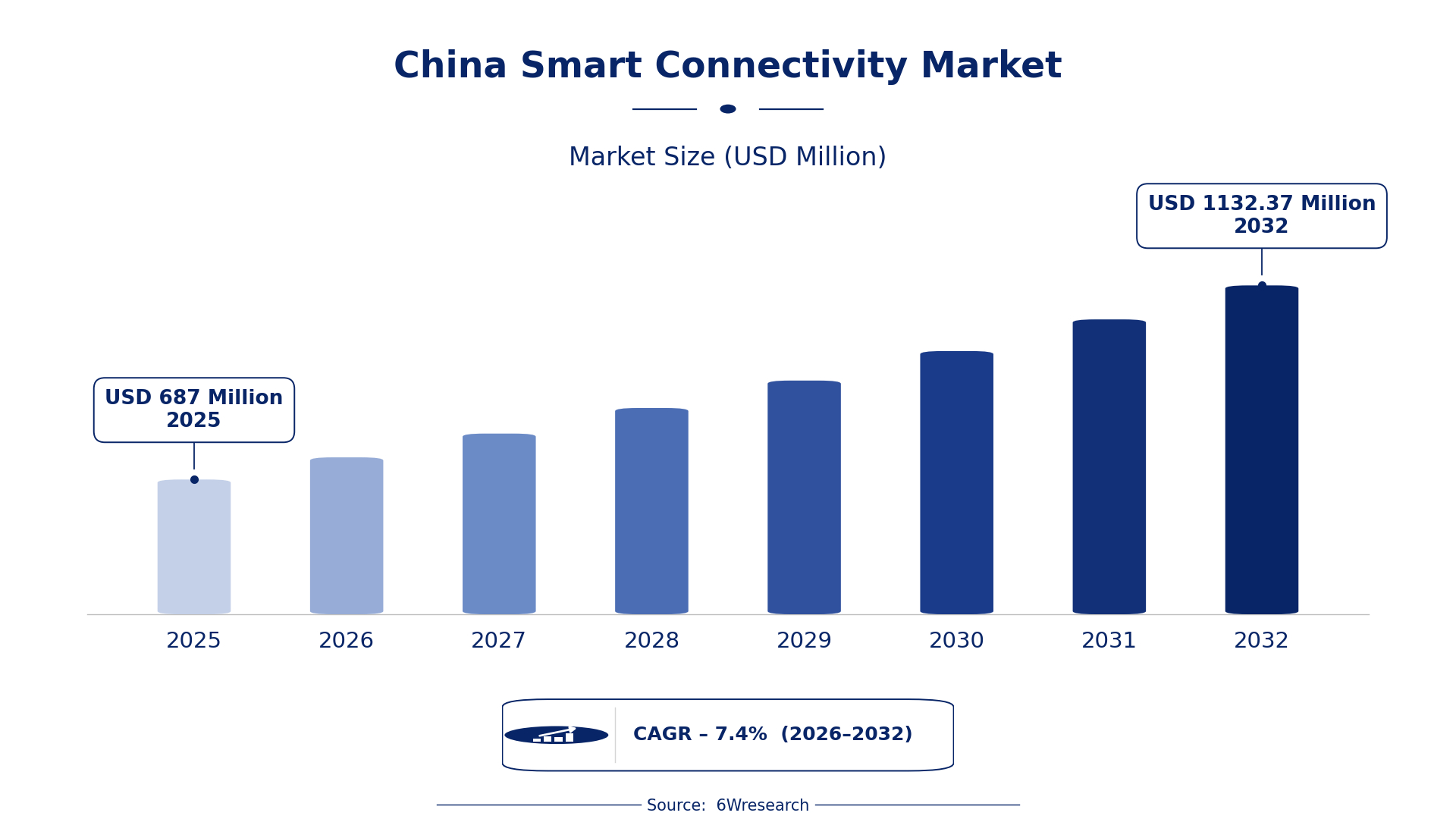
According to 6Wresearch internal database and industry insights, the China Smart Connectivity Market was valued at USD 687.0 million in 2025 and is projected to reach USD 1,132.37 million by 2032, growing at a CAGR of approximately 7.4% during 2026–2032.
China Smart Connectivity Market Highlights
| Report Metric | Details |
| Report Name | China Smart Connectivity Market |
| Market Size 2025 | USD 687.0 million |
| Market Size 2032 | USD 1,132.37 million |
| Absolute Growth 2025–2032 | USD 445.37 million |
| CAGR 2026–2032 | 7.4% |
| Peak Annual Growth | 9.6% in 2026 |
| Forecast Period | 2026–2032 |
| Historical Data | 2022–2025 |
| Base Year | 2025 |
| Leading Connectivity Type, 2025 | 5G Connectivity (42% share) |
| Leading Network Layer, 2025 | High-Speed IoT (35% share) |
| Leading Target Devices, 2025 | Smart Cities (46% share) |
| Leading End User, 2025 | Telecom Operators (42% share) |
| Fastest-Growing Connectivity Type | LPWAN (LoRa, NB-IoT) (8.6% CAGR) |
| Fastest-Growing Network Layer | Low Power Devices (8.7% CAGR) |
| Fastest-Growing Target Devices | Agriculture (9.1% CAGR) |
| Fastest-Growing End User | Smart Grid/Infra Firms (10.2% CAGR) |
| Growing Sector | Smart Grid/Infra Firms |
| Key End Users | Telecom Operators, Smart Grid/Infra Firms, Managed Network Providers, Global IoT Deployers |
China Smart Connectivity Market Year-wise Growth Rate and Key Drivers (2022–2032)
This graph illustrates the annual growth rates of the market from 2022 to 2032, highlighting a steady upward trajectory and projected market expansion over the forecast period.
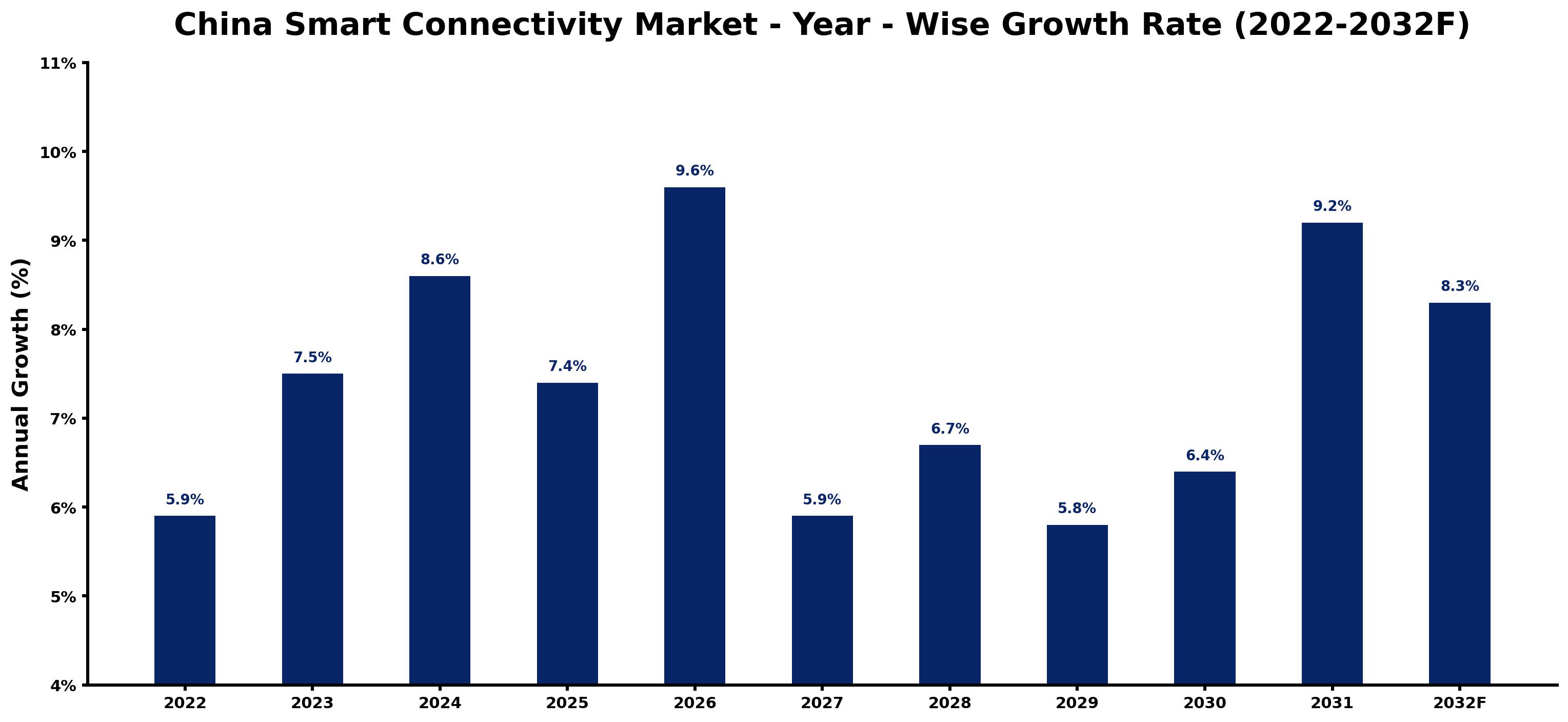
Each row of the following table gives one year's estimated growth and the event or demand shift that explains it.
| Year | Estimated Annual Growth (%) | Market Rationale |
| 2022 | 5.9 | Demand was driven by urbanisation and the need for advanced connectivity solutions. |
| 2023 | 7.5 | The growth accelerated due to increased mobile subscriptions and urban infrastructure development. |
| 2024 | 8.6 | Smart city initiatives gained momentum, pushing connectivity needs higher. |
| 2025 | 7.4 | Growth slowed as the market adjusted to previous rapid expansions. |
| 2026 | 9.6 | The peak growth is expected to be supported by the surge in 5G user adoption. |
| 2027 | 5.9 | A slowdown will occur as the market begins to stabilise after peak growth. |
| 2028 | 6.7 | Growth is projected to resume with increased investment in smart agriculture technologies. |
| 2029 | 5.8 | The market will experience a slowdown as urban connectivity reaches saturation. |
| 2030 | 6.4 | Growth is anticipated to pick up again due to advancements in smart transportation. |
| 2031 | 9.2 | The market is expected to expand as smart grid initiatives gain traction. |
| 2032 | 8.3 | Growth will slow as the market matures and competition intensifies. |
Note: Market size estimations and growth projections presented in this report are based on 6Wresearch's proprietary forecasting methodology, utilizing the latest available industry data, government publications, and primary research inputs.
China Smart Connectivity Market Synopsis
Smart Connectivity in China encompasses the integration of advanced communication technologies for IoT applications. It supports urban infrastructure, smart agriculture, and transportation systems. The China Smart Connectivity Market is expanding due to urbanisation, technological advancements, and substantial investments in smart city projects. With a population of approximately 1.4 billion, the demand for connectivity solutions is considerable. The 14th Five-Year Plan aims for 100 smart cities by 2025, propelling market growth.
Market Dynamics Impact Analysis (2026–2032)
| Factor | Type | Impact | Primary Segment Affected |
| Urbanisation is increasing demand for smart connectivity solutions in cities. | Driver | High | Smart Cities |
| Investment in smart agriculture technologies is boosting connectivity needs. | Driver | High | Agriculture |
| The rise in mobile subscriptions creates opportunities for connectivity providers. | Opportunity | High | Telecom Operators |
| The push for smart city projects opens avenues for infrastructure development. | Opportunity | High | Smart Cities |
| Infrastructure limitations hinder the rollout of connectivity solutions in rural areas. | Restraint | High | Remote Area Coverage |
| High costs of deployment restrict access to advanced connectivity technologies. | Restraint | Medium | High-Speed IoT |
| Supply chain disruptions affect the availability of low-power devices. | Challenge | High | LPWAN (LoRa, NB-IoT) |
| Regulatory hurdles delay the implementation of smart connectivity projects. | Challenge | Medium | 5G Connectivity |
Evaluation of Drivers in China Smart Connectivity Market (2026–2032)
Key forces behind demand, with the segment each one moves most, are listed below.
| Drivers | Primary Segment Affected | Why It Matters (Evidence) |
| Increased mobile subscriptions drive demand for 5G connectivity. | 5G Connectivity | China had over 1.4 billion mobile subscribers in 2022, leading to higher connectivity needs. |
| Investment in smart city projects boosts urban infrastructure. | Smart Cities | The 14th Five-Year Plan targets 100 smart cities by 2025, boosting demand. |
| Growth in IoT applications necessitates low-power devices. | LPWAN (LoRa, NB-IoT) | The National Development and Reform Commission promotes IoT integration in agriculture. |
| Smart meter installations improve utility management and monitoring. | Smart Grid/Infra Firms | China's smart meter installations reached 500 million units by 2023. |
| Technological advancements in connectivity improve operational efficiency. | High-Speed IoT | The Ministry of Industry and Information Technology supports LPWAN deployment for urban applications. |
Expansion of the Smart Connectivity market in China is driven by rising mobile subscriptions, investments in urban infrastructure, and advancements in IoT applications. With over 1.4 billion mobile subscribers in 2022, the demand for 5G connectivity surged, resulting in a marked increase in purchases. The goal of establishing 100 smart cities by 2025 further accelerates this growth. Smart meter installations reached 500 million units by 2023, enhancing utility management.
Evaluation of Restraints in China Smart Connectivity Market
The table below lists the restraints and the evidence behind each.
| Market Restraint | Primary Segment Affected | Why It Matters (Evidence) |
| Infrastructure limitations hinder connectivity rollout in rural areas. | Remote Area Coverage | Limited infrastructure affects the deployment of smart connectivity solutions in underserved regions. |
| High costs of deployment restrict access to advanced technologies. | High-Speed IoT | The financial burden of implementing high-speed networks limits market participation. |
| Supply chain disruptions affect the availability of low-power devices. | LPWAN (LoRa, NB-IoT) | Global supply chain issues delay the production of essential IoT components. |
| Regulatory hurdles delay smart connectivity projects. | 5G Connectivity | Complex approval processes slow down the implementation of 5G infrastructure. |
| Limited public awareness restricts market growth. | Smart Cities | A lack of understanding of smart technologies prevents widespread adoption. |
China Smart Connectivity Market Challenges
Buyers and suppliers in the China Smart Connectivity market encounter regulatory hurdles that can delay project approvals, especially as new standards for smart technologies emerge. These regulations can extend timelines by up to six months, raising costs for developers and impacting project viability. Supply chain issues stem from a mismatch between component demand and local production, leading to higher expenses for manufacturers. A shortage of skilled workers in advanced technology fields hampers the deployment of smart connectivity solutions, resulting in project delays and increased labour costs for firms.
Trends in the China Smart Connectivity Market
Below mentioned are some of the trends shaping the China Smart Connectivity Market growth.
- Shift towards Smart City Development in China: China is increasingly focusing on smart city initiatives, with the 14th Five-Year Plan targeting 100 smart cities by 2025. This shift is expected to improve urban infrastructure and connectivity, driving demand for smart solutions.
- Emergence of LPWAN Technologies: The adoption of LPWAN technologies is gaining momentum, particularly in agriculture, where low-power devices are essential. The National Development and Reform Commission's support for IoT integration is facilitating this trend.
- Growth of Smart Meter Installations: Smart meter installations are rapidly increasing, with China reaching 500 million units by 2023. This trend improves utility management and monitoring, creating new opportunities for connectivity providers.
- Advancements in Smart Transportation: Investments in smart transportation technologies are projected to exceed 1 trillion CNY by 2025. This trend improves connectivity solutions for vehicles and urban infrastructure.
Investment Opportunities in the China Smart Connectivity Market
Several openings in the China Smart Connectivity Market merit attention from investors.
- Investment in Smart City Projects: With the target of 100 smart cities by 2025, there is a notable investment opportunity in urban infrastructure development. Telecom operators and infrastructure firms can benefit from partnerships with local governments.
- Expansion of IoT Applications in Agriculture: The push for smart agriculture technologies presents a significant opportunity for suppliers. With the National Development and Reform Commission's support, investments can focus on low-power devices and IoT solutions.
- Growth in Smart Meter Solutions: The increasing number of smart meter installations offers a chance for technology providers. Collaborating with utility companies can facilitate market entry and product adoption.
- Development of 5G Infrastructure: The expansion of 5G networks is a critical opportunity for connectivity providers. Engaging in joint ventures with local telecom operators can accelerate deployment and service availability.
Government Initiatives in the China Smart Connectivity Market
The '14th Five-Year Plan for Economic and Social Development' emphasises digital infrastructure investment, led by the National Development and Reform Commission, aiming for smart connectivity by 2025. This plan promotes the integration of advanced communication technologies across sectors. The 'Smart City Development Strategy' issued by the Ministry of Housing and Urban-Rural Development in 2021 supports the establishment of 100 smart cities by 2025, improving urban infrastructure and connectivity. Additionally, the 'IoT Innovation and Development Action Plan' launched by the Ministry of Industry and Information Technology in 2020 aims to enhance IoT applications across various sectors by 2025, driving demand for smart connectivity solutions.
Telecom operators benefit from the 'Smart City Pilot Program' launched in 2021, which encourages innovation in urban infrastructure. This initiative provides funding for projects that integrate smart technologies, enhancing connectivity solutions. The National Development and Reform Commission supports various schemes that promote the deployment of smart connectivity in agriculture, aiming to improve efficiency and productivity. Furthermore, the Ministry of Industry and Information Technology oversees the implementation of standards that facilitate the interoperability of smart devices, ensuring integration across platforms.
Future Insight of the China Smart Connectivity Market
The China Smart Connectivity market is set for transformative changes by 2032, driven by the government's ambition to establish 100 smart cities by 2025, which will catalyse urban infrastructure investments. The integration of IoT in agriculture will expand connectivity in rural areas, improving access for underserved populations. Projections show that 5G users will reach 600 million by 2025, significantly increasing demand for advanced smart connectivity solutions. These trends will open new avenues for both buyers and suppliers in the market.
Market Segmentation Analysis
The analysis below covers each segmentation, its leading category in 2025 and its fastest-growing category through 2032.
By Connectivity Type – 5G Connectivity Dominated, LPWAN (LoRa, NB-IoT) Expected to Grow Fastest
According to Dhaval Chaurasia, Assistant Manager at 6Wresearch, in 2025, 5G Connectivity led the connectivity type split with a 42% share. 5G Connectivity holds the largest market share due to its critical role in enabling real-time data transmission for smart applications. The increasing number of over 1.4 billion mobile subscribers in China fuels the demand for this advanced connectivity. The quickest growth will come from LPWAN (LoRa, NB-IoT), forecast to expand at a CAGR of 8.6% between 2026 and 2032. LPWAN technologies such as LoRa and NB-IoT are rapidly expanding because they provide efficient low-power, long-range communication for IoT devices. The government's initiatives to integrate IoT in agriculture are a key factor propelling this growth. Suppliers should focus on enhancing their 5G infrastructure while also investing in LPWAN solutions to meet diverse connectivity needs.
By Network Layer – High-Speed IoT Dominated, Low Power Devices Expected to Grow Fastest
High-Speed IoT held a 35% share of the China Smart Connectivity Market by network layer in 2025. High-Speed IoT leads the market share as it is essential for applications that require fast data exchange, particularly in smart city initiatives. This aligns with China's goal of establishing 100 smart cities by 2025, driving demand for high-speed networks. Low Power Devices are set to record the highest CAGR in this split, 8.7% over 2026–2032. Low Power Devices are experiencing rapid growth because they are crucial for battery-operated IoT applications, which are becoming more prevalent across various sectors. The increasing adoption of smart devices in both urban and rural areas significantly boosts this demand. Suppliers need to prioritise high-speed IoT solutions while also addressing the growing market for low power devices.
By Target Devices – Smart Cities Dominated, Agriculture Expected to Grow Fastest
Smart Cities took a 46% share of target devices in 2025, more than any other category. Smart Cities command the largest market share as they are fundamental to urban infrastructure development, supported by initiatives like the Smart City Pilot Program. The focus on smart city projects leads to substantial investments in connectivity solutions. Over 2026–2032, Agriculture is expected to post the fastest growth, at a CAGR of 9.1%. Agriculture is the fastest-growing segment as it facilitates precision farming and smart irrigation, which are essential for enhancing food security. The promotion of IoT in agriculture by the National Development and Reform Commission significantly contributes to this growth. This indicates that suppliers should align their strategies to support smart city initiatives while also addressing the agricultural sector's connectivity needs.
By End User – Telecom Operators Dominated, Smart Grid/Infra Firms Expected to Grow Fastest
With a 42% revenue share in 2025, Telecom Operators was the largest end user category. Telecom Operators dominate the market share as they are the primary providers of connectivity services vital for smart applications. Their extensive infrastructure and large customer base position them as key players in the smart connectivity market. Smart Grid/Infra Firms are projected to grow fastest, at a CAGR of 10.2% during 2026–2032. Smart Grid/Infra Firms are witnessing the fastest growth as they are integral to modernising energy infrastructure, which is essential for smart city development. The projected investments exceeding 1 trillion CNY in smart transportation highlight this trend. This suggests that suppliers should focus on building partnerships with telecom operators while also catering to the evolving needs of smart grid and infrastructure firms.
Key Attractiveness of the Report
- 10 Years of Market Numbers
- Historical Data Starting from 2022 to 2025
- Base Year 2025
- Forecast Data until 2032
- Key Performance Indicators Impacting the Market
- Major Upcoming Developments and Projects
Key Highlights of the Report:
- China Smart Connectivity Market Outlook
- Market Size of China Smart Connectivity Market, 2025
- Forecast of China Smart Connectivity Market, 2032
- Historical Data and Forecast of China Smart Connectivity Revenues & Volume for the Period 2022 - 2032F
- China Smart Connectivity Market Trend Evolution
- China Smart Connectivity Market Drivers and Challenges
- China Smart Connectivity Price Trends
- China Smart Connectivity Porter's Five Forces
- China Smart Connectivity Industry Life Cycle
- Historical Data and Forecast of China Smart Connectivity Market Revenues & Volume By Connectivity Type for the Period 2022 - 2032F
- Historical Data and Forecast of China Smart Connectivity Market Revenues & Volume By 5G Connectivity for the Period 2022 - 2032F
- Historical Data and Forecast of China Smart Connectivity Market Revenues & Volume By LPWAN (LoRa, NB-IoT) for the Period 2022 - 2032F
- Historical Data and Forecast of China Smart Connectivity Market Revenues & Volume By Wi-Fi 6/6E for the Period 2022 - 2032F
- Historical Data and Forecast of China Smart Connectivity Market Revenues & Volume By Satellite IoT Links for the Period 2022 - 2032F
- Historical Data and Forecast of China Smart Connectivity Market Revenues & Volume By Network Layer for the Period 2022 - 2032F
- Historical Data and Forecast of China Smart Connectivity Market Revenues & Volume By High-Speed IoT for the Period 2022 - 2032F
- Historical Data and Forecast of China Smart Connectivity Market Revenues & Volume By Low Power Devices for the Period 2022 - 2032F
- Historical Data and Forecast of China Smart Connectivity Market Revenues & Volume By High-Density Networks for the Period 2022 - 2032F
- Historical Data and Forecast of China Smart Connectivity Market Revenues & Volume By Remote Area Coverage for the Period 2022 - 2032F
- Historical Data and Forecast of China Smart Connectivity Market Revenues & Volume By Target Devices for the Period 2022 - 2032F
- Historical Data and Forecast of China Smart Connectivity Market Revenues & Volume By Smart Cities, Vehicles for the Period 2022 - 2032F
- Historical Data and Forecast of China Smart Connectivity Market Revenues & Volume By Sensors, Meters for the Period 2022 - 2032F
- Historical Data and Forecast of China Smart Connectivity Market Revenues & Volume By Commercial Buildings for the Period 2022 - 2032F
- Historical Data and Forecast of China Smart Connectivity Market Revenues & Volume By Agriculture, Maritime for the Period 2022 - 2032F
- Historical Data and Forecast of China Smart Connectivity Market Revenues & Volume By End User for the Period 2022 - 2032F
- Historical Data and Forecast of China Smart Connectivity Market Revenues & Volume By Telecom Operators for the Period 2022 - 2032F
- Historical Data and Forecast of China Smart Connectivity Market Revenues & Volume By Smart Grid/Infra Firms for the Period 2022 - 2032F
- Historical Data and Forecast of China Smart Connectivity Market Revenues & Volume By Managed Network Providers for the Period 2022 - 2032F
- Historical Data and Forecast of China Smart Connectivity Market Revenues & Volume By Global IoT Deployers for the Period 2022 - 2032F
- China Smart Connectivity Import Export Trade Statistics
- Market Opportunity Assessment By Connectivity Type
- Market Opportunity Assessment By Network Layer
- Market Opportunity Assessment By Target Devices
- Market Opportunity Assessment By End User
- China Smart Connectivity Top Companies Market Share
- China Smart Connectivity Competitive Benchmarking By Technical and Operational Parameters
- China Smart Connectivity Company Profiles
- China Smart Connectivity Key Strategic Recommendations
Market Covered
Segments analysed in this report are listed below.
By Connectivity Type
- 5G Connectivity
- LPWAN (LoRa, NB-IoT)
- Wi-Fi 6/6E
- Satellite IoT Links
By Network Layer
- High-Speed IoT
- Low Power Devices
- High-Density Networks
- Remote Area Coverage
By Target Devices
- Smart Cities
- Vehicles
- Sensors
- Meters
- Commercial Buildings
- Agriculture
- Maritime
By End User
- Telecom Operators
- Smart Grid/Infra Firms
- Managed Network Providers
- Global IoT Deployers































