China Smart Defense Systems Market Size & Growth Rate
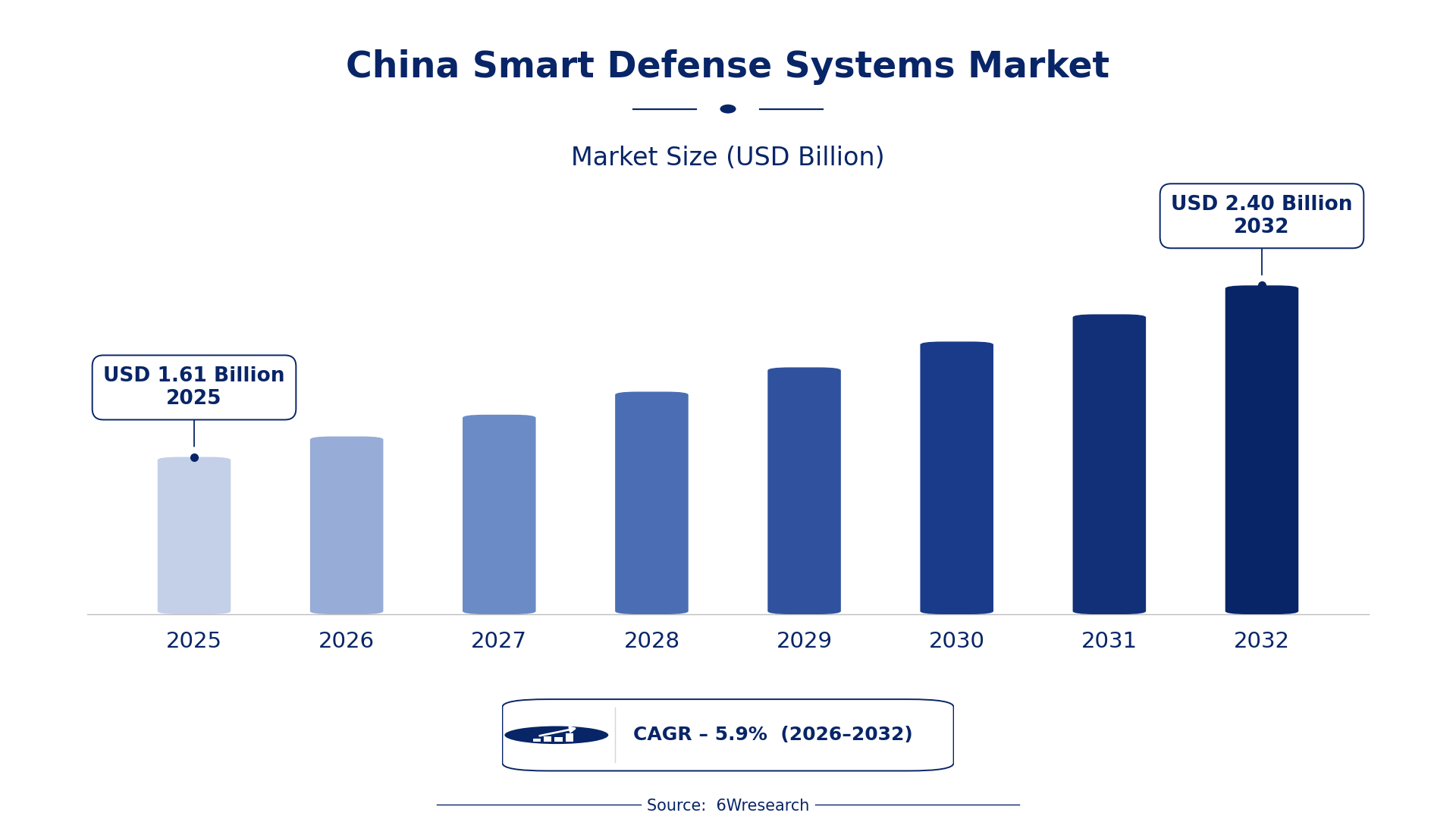
According to 6Wresearch internal database and industry insights, the China Smart Defense Systems Market was valued at USD 1.61 billion in 2025 and is projected to reach USD 2.40 billion by 2032, growing at a CAGR of approximately 5.9% during 2026–2032.
China Smart Defense Systems Market Highlights
| Report Metric | Details |
| Report Name | China Smart Defense Systems Market |
| Market Size 2025 | USD 1.61 billion |
| Market Size 2032 | USD 2.40 billion |
| Absolute Growth 2025–2032 | USD 0.79 billion |
| CAGR 2026–2032 | 5.9% |
| Peak Annual Growth | 7.8% in 2027 |
| Forecast Period | 2026–2032 |
| Historical Data | 2022–2025 |
| Base Year | 2025 |
| Leading System Type, 2025 | Autonomous Weapon Systems (46% share) |
| Leading Smart Capability, 2025 | Target Identification AI (41% share) |
| Leading Deployment Area, 2025 | Ground/Sea/Air (48% share) |
| Leading End User, 2025 | Military R&D Units (42% share) |
| Fastest-Growing System Type | Smart Surveillance Drones (8.2% CAGR) |
| Fastest-Growing Smart Capability | Live Recon + AI Mapping (7.2% CAGR) |
| Fastest-Growing Deployment Area | Digital Infrastructure (7.6% CAGR) |
| Fastest-Growing End User | Homeland Security (7.6% CAGR) |
| Growing Sector | Military Technology |
| Key End Users | Military R&D Units, National Security Agencies, Advanced Defense Tech Firms, Homeland Security |
China Smart Defense Systems Market Year-wise Growth Rate and Key Drivers (2022–2032)
This graph illustrates the annual growth rates of the market from 2022 to 2032, highlighting a steady upward trajectory and projected market expansion over the forecast period.
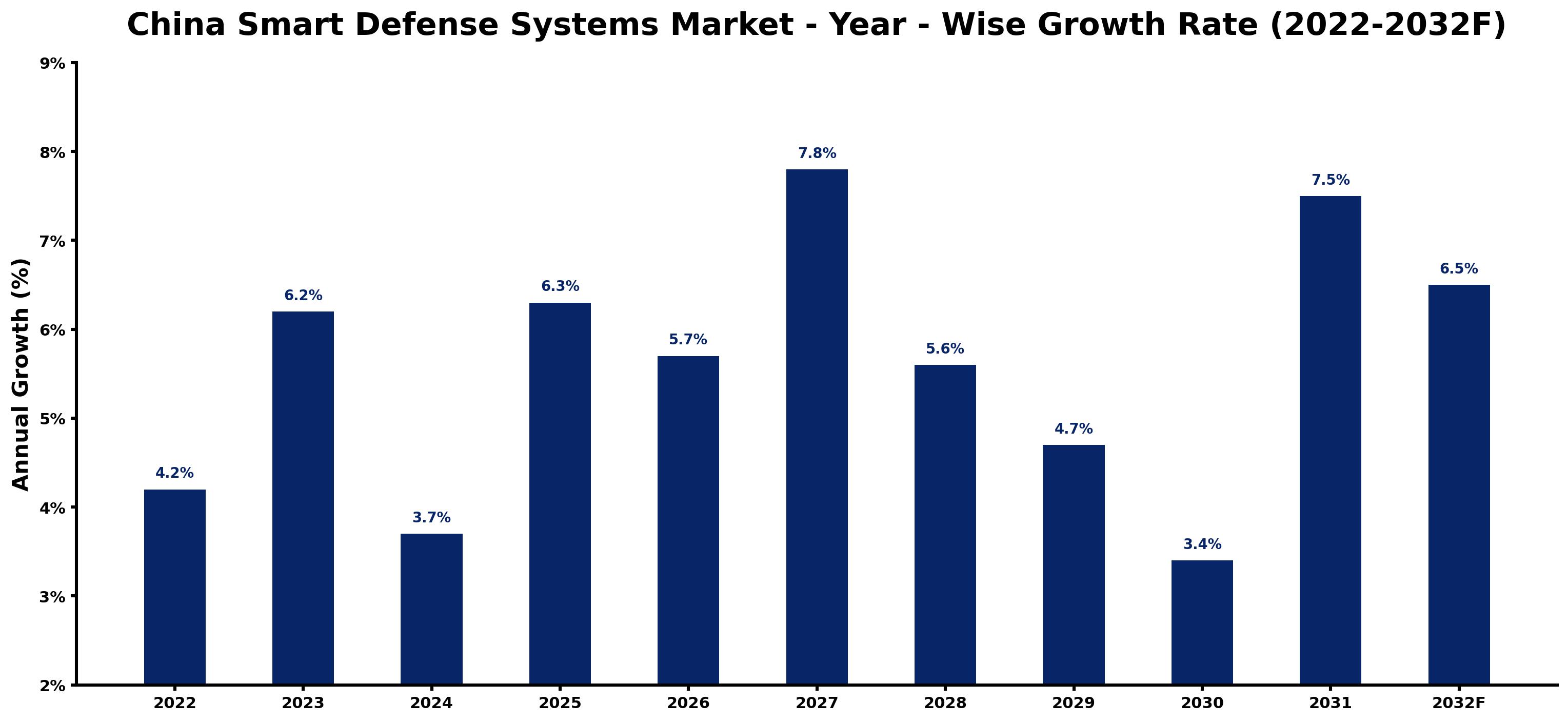
The table below sets out the estimated growth rate for each year and the main factor behind it.
| Year | Estimated Annual Growth (%) | Market Rationale |
| 2022 | 4.2 | The defense budget highlighted modernization efforts, driving demand for advanced systems. |
| 2023 | 6.2 | Increased investment in military R&D accelerated demand for new technologies. |
| 2024 | 3.7 | Investment growth slowed as military budgets faced adjustments in priorities. |
| 2025 | 6.3 | A surge in military modernization initiatives boosted demand for smart defense systems. |
| 2026 | 5.7 | Growth is expected to moderate as focus shifts to integrating existing technologies. |
| 2027 | 7.8 | A significant increase in military spending will lead to heightened demand for advanced systems. |
| 2028 | 5.6 | Demand growth is projected to slow as the market adjusts after rapid expansion. |
| 2029 | 4.7 | Continued investment in defense technologies will maintain positive growth, albeit at a slower pace. |
| 2030 | 3.4 | Growth is expected to decelerate as the market adjusts to previous years' rapid expansion. |
| 2031 | 7.5 | A resurgence in military R&D funding will revitalise demand for smart defense technologies. |
| 2032 | 6.5 | Demand is projected to stabilise as military modernization efforts continue to evolve. |
Note: Market size estimations and growth projections presented in this report are based on 6Wresearch's proprietary forecasting methodology, utilizing the latest available industry data, government publications, and primary research inputs.
China Smart Defense Systems Market Synopsis
Smart Defense Systems in China include advanced technologies tailored for military use, such as autonomous weaponry and surveillance solutions. These systems are crafted through software engineering and robotics, bolstering national security and military operations. The China Smart Defense Systems Market is growing, driven by significant investments in military modernisation and technology integration. In 2023, the defense budget reached around 1.55 trillion yuan, highlighting the commitment to developing advanced capabilities. The National Defense Science and Technology Industry Development Plan aims to strengthen indigenous capabilities by 2025, further stimulating demand.
Market Dynamics Impact Analysis (2026–2032)
| Factor | Type | Impact | Primary Segment Affected |
| Military modernization initiatives are driving demand for advanced technologies. | Driver | High | Autonomous Weapon Systems |
| Growing investment in military R&D is fostering innovation in defense technologies. | Driver | High | Smart Surveillance Drones |
| Increasing focus on cybersecurity creates opportunities for advanced defense solutions. | Opportunity | High | Cyber Defense Platforms |
| The rise of smart surveillance drones presents investment opportunities in the defense sector. | Opportunity | High | Smart Surveillance Drones |
| High development costs can limit the entry of new players in the market. | Restraint | High | Cyber Defense Platforms |
| Regulatory compliance can delay the deployment of new defense technologies. | Restraint | Medium | Autonomous Weapon Systems |
| Talent shortages in advanced technology sectors hinder market growth. | Challenge | High | Smart Armor & Wearables |
| Integration of new technologies into existing systems poses challenges for suppliers. | Challenge | Medium | Autonomous Weapon Systems |
Evaluation of Drivers in China Smart Defense Systems Market (2026–2032)
The factors lifting demand, and the evidence behind each, are summarised below.
| Drivers | Primary Segment Affected | Why It Matters (Evidence) |
| Increased defense budget allocations support advanced technology procurement. | Autonomous Weapon Systems | China's defense budget for 2023 is approximately 1.55 trillion yuan, supporting military capabilities. |
| Investment in military R&D accelerates technology development. | Smart Surveillance Drones | In 2022, over 200 billion yuan was invested in military R&D, focusing on AI systems. |
| Cybersecurity threats drive demand for defense technologies. | Cyber Defense Platforms | The Cybersecurity Law of 2017 mandates enhanced cybersecurity measures across all sectors. |
| Military modernization strategies boost procurement of advanced systems. | Smart Armor & Wearables | The National Defense Science and Technology Innovation Plan allocates funding for advanced technologies. |
| Collaboration between military and civilian sectors fosters innovation. | Autonomous Weapon Systems | The Military-Civil Fusion Development Strategy encourages joint technology development. |
Market growth in China for Smart Defense Systems is supported by increased defense budget allocations, military R&D investments, and escalating cybersecurity threats. The defense budget for 2023 stands at approximately 1.55 trillion yuan, facilitating the procurement of advanced technologies. In 2022, military R&D saw over 200 billion yuan in investments, concentrating on AI systems and speeding up technology development. The National Defense Science and Technology Innovation Plan, announced in 2023, backs autonomous weapon systems and AI technologies, providing essential funding for development.
Evaluation of Restraints in China Smart Defense Systems Market
The key brakes on demand, and where they bite hardest, are shown below.
| Market Restraint | Primary Segment Affected | Why It Matters (Evidence) |
| High development costs can limit market entry. | Cyber Defense Platforms | The investment in advanced technologies requires substantial capital, deterring smaller firms. |
| Regulatory compliance delays technology deployment. | Autonomous Weapon Systems | Producers must navigate complex regulations, which can slow product introduction to the market. |
| Limited skilled workforce affects technology implementation. | Smart Armor & Wearables | Talent shortages in advanced technology sectors hinder effective market growth. |
| Integration challenges with existing systems can slow adoption. | Autonomous Weapon Systems | Suppliers face difficulties in incorporating new technologies into legacy systems. |
| Market saturation in certain segments may limit growth potential. | Smart Surveillance Drones | As competition increases, profit margins may decrease, affecting investments. |
China Smart Defense Systems Market Challenges
Buyers in the China Smart Defense Systems market encounter technological challenges as the rapid pace of AI and robotics development can push project timelines back by six months. Suppliers face high research and development costs, with over 200 billion yuan invested in military R&D in 2022, which can lead to increased prices for buyers. Compliance with the Cybersecurity Law of 2017 raises operational costs by around 15% for producers, impacting their pricing strategies. Skills shortages in advanced defense technologies limit innovation, compelling companies to allocate additional resources for training and recruitment, which further delays project delivery.
Trends in the China Smart Defense Systems Market
Buyers and suppliers in the China Smart Defense Systems Market are adjusting to the following trends.
- Shift Towards Autonomous Systems: China is increasingly adopting autonomous weapon systems for military operations. In 2023, funding for these capabilities rose by 15%, demonstrating a strong commitment to modernisation.
- Rise of Smart Surveillance Drones: The integration of smart surveillance drones is revolutionising military reconnaissance. By 2025, the military intends to deploy over 1,000 drones, showcasing a commitment to enhancing aerial capabilities.
- Focus on Cyber Defense Technologies: The emphasis on cybersecurity is reshaping defence strategies. The Cybersecurity Strategy introduced in 2020 aims to strengthen national security, with a projected 20% increase in funding for cyber defense initiatives.
- Collaboration Between Military and Civilian Sectors: The Military-Civil Fusion Development Strategy is driving innovation in defence technologies. This strategy aims to boost R&D collaboration, with an anticipated 30% increase in joint projects by 2025.
Investment Opportunities in the China Smart Defense Systems Market
Several openings in the China Smart Defense Systems Market merit attention from investors.
- Investment in Autonomous Weapon Systems: With a projected rise in military budgets, there is an opportunity to invest in autonomous weapon systems. The military's focus on modernisation generates demand for advanced technologies, particularly in Guangdong's defence tech parks.
- Expansion of Cyber Defense Platforms: The growing need for cybersecurity solutions presents an opportunity to supply advanced cyber defense platforms. Collaborating with national security agencies will ease entry into this expanding market, especially in Shandong province.
- Development of Smart Surveillance Drones: The increasing demand for smart surveillance drones offers a promising investment opportunity. By partnering with military R&D units, suppliers can access the growing market, particularly in technology hubs like Beijing.
- Enhancing Smart Armor & Wearables: The need for improved soldier safety creates opportunities for smart armor and wearables. Engaging with military procurement offices can open doors to this market segment, especially in regions with active defence initiatives.
Government Initiatives in the China Smart Defense Systems Market
The Ministry of National Defense implements various strategies that influence smart defense systems. The Defense Technology Innovation Strategy, launched in 2022, allocates funding for R&D projects, ensuring military units access advanced technologies. The National Defense Science and Technology Innovation Plan announced in 2023 supports autonomous weapon systems and AI technologies, providing 200 billion yuan for development. Additionally, the China Association for Science and Technology promotes collaboration between academia and defense sectors, ensuring new technologies meet military needs. These initiatives collectively strengthen the capabilities of China's defense industry.
National security agencies utilise the Cybersecurity Strategy to enforce enhanced cybersecurity measures. This strategy mandates compliance across all sectors, ensuring that defense technologies align with national security objectives. The Ministry oversees the deployment of smart defense systems, facilitating approvals for projects that meet stringent standards. Funding is allocated to initiatives that bolster cybersecurity capabilities, ensuring that military applications are safeguarded against emerging threats. This comprehensive approach fortifies the overall security framework for defense technologies.
Future Insight of the China Smart Defense Systems Market
By 2032, buyers and suppliers in the China Smart Defense Systems market can expect significant advancements driven by the Smart Defense Initiative and the National Medium- and Long-Term Program for Science and Technology Development. The focus on AI integration in military applications will improve operational efficiency and effectiveness. The establishment of defense tech parks in Guangdong and Shandong will facilitate collaboration between academia and industry, fostering innovation. Consequently, the market will see a surge in advanced technologies that strengthen national security and enhance military capabilities.
Market Segmentation Analysis
Each segment group is reviewed below, with the leader by share and the fastest grower by CAGR.
By System Type – Autonomous Weapon Systems Dominated, Smart Surveillance Drones Expected to Grow Fastest
According to Dhaval Chaurasia, Assistant Manager at 6Wresearch, the largest system type category in 2025 was Autonomous Weapon Systems, with a 46% share of total revenue. Autonomous Weapon Systems dominate the market share in China due to their critical role in military operations, providing strategic advantages. The substantial military personnel count of approximately 2 million highlights the ongoing demand for these advanced systems. Over 2026–2032, Smart Surveillance Drones are expected to post the fastest growth, at a CAGR of 8.2%. Smart Surveillance Drones are rapidly gaining traction as they are increasingly employed for reconnaissance and intelligence gathering, supported by the military modernization strategy aimed at integrating these technologies by 2025. This focus on enhancing surveillance capabilities will ensure their continued adoption. Suppliers should prioritise the development of autonomous systems to meet the rising demand from military operations.
By Smart Capability – Target Identification AI Dominated, Live Recon + AI Mapping Expected to Grow Fastest
In 2025, Target Identification AI led the smart capability split with a 41% share. Target Identification AI leads in market share as it significantly improves accuracy in threat assessment and targeting, making it essential for military operations. The strong emphasis on military R&D and technological integration reinforces its importance as a key capability. Live Recon + AI Mapping is set to record the highest CAGR in this split, 7.2% over 2026–2032. Live Recon + AI Mapping is the fastest-growing segment, driven by the necessity for real-time situational awareness and planning in military contexts. The increasing demand for operational efficiency will accelerate the adoption of this capability. Buyers must allocate resources towards advanced capabilities to ensure operational effectiveness.
By Deployment Area – Ground/Sea/Air Dominated, Digital Infrastructure Expected to Grow Fastest
Ground/Sea/Air took a 48% share of deployment area in 2025, more than any other category. Ground/Sea/Air holds the largest market share as it is applicable across all military domains, reflecting the comprehensive nature of defense operations in China. This broad applicability ensures sustained investment and development across these critical areas. The quickest growth will come from Digital Infrastructure, forecast to expand at a CAGR of 7.6% between 2026 and 2032. Digital Infrastructure is experiencing rapid growth, as it is vital for maintaining secure communication channels in modern military operations. The heightened focus on cybersecurity and integrated systems will further drive investment in this sector. Suppliers need to enhance digital solutions to ensure secure communications in military deployments.
By End User – Military R&D Units Dominated, Homeland Security Expected to Grow Fastest
Military R&D Units accounted for a 42% market share by end user in 2025. Military R&D Units account for the largest share due to their commitment to developing new defense technologies that align with national security objectives. Their pivotal role in driving innovation ensures a consistent demand for advanced systems. Homeland Security is projected to grow fastest, at a CAGR of 7.6% during 2026–2032. Homeland Security is the fastest-growing segment, fuelled by the urgent need to protect citizens and critical infrastructure. The government's focus on strengthening security measures will continue to propel this growth. Buyers in the homeland security sector should prioritise investments in advanced defense technologies to effectively counter emerging threats.
Key Attractiveness of the Report
- 10 Years of Market Numbers
- Historical Data Starting from 2022 to 2025
- Base Year 2025
- Forecast Data until 2032
- Key Performance Indicators Impacting the Market
- Major Upcoming Developments and Projects
Key Highlights of the Report:
- China Smart Defense Systems Market Outlook
- Market Size of China Smart Defense Systems Market, 2025
- Forecast of China Smart Defense Systems Market, 2032
- Historical Data and Forecast of China Smart Defense Systems Revenues & Volume for the Period 2022 - 2032F
- China Smart Defense Systems Market Trend Evolution
- China Smart Defense Systems Market Drivers and Challenges
- China Smart Defense Systems Price Trends
- China Smart Defense Systems Porter's Five Forces
- China Smart Defense Systems Industry Life Cycle
- Historical Data and Forecast of China Smart Defense Systems Market Revenues & Volume By System Type for the Period 2022 - 2032F
- Historical Data and Forecast of China Smart Defense Systems Market Revenues & Volume By Autonomous Weapon Systems for the Period 2022 - 2032F
- Historical Data and Forecast of China Smart Defense Systems Market Revenues & Volume By Smart Surveillance Drones for the Period 2022 - 2032F
- Historical Data and Forecast of China Smart Defense Systems Market Revenues & Volume By Cyber Defense Platforms for the Period 2022 - 2032F
- Historical Data and Forecast of China Smart Defense Systems Market Revenues & Volume By Smart Armor & Wearables for the Period 2022 - 2032F
- Historical Data and Forecast of China Smart Defense Systems Market Revenues & Volume By Smart Capability for the Period 2022 - 2032F
- Historical Data and Forecast of China Smart Defense Systems Market Revenues & Volume By Target Identification AI for the Period 2022 - 2032F
- Historical Data and Forecast of China Smart Defense Systems Market Revenues & Volume By Live Recon + AI Mapping for the Period 2022 - 2032F
- Historical Data and Forecast of China Smart Defense Systems Market Revenues & Volume By Threat Detection AI for the Period 2022 - 2032F
- Historical Data and Forecast of China Smart Defense Systems Market Revenues & Volume By Biometric + Condition Data for the Period 2022 - 2032F
- Historical Data and Forecast of China Smart Defense Systems Market Revenues & Volume By Deployment Area for the Period 2022 - 2032F
- Historical Data and Forecast of China Smart Defense Systems Market Revenues & Volume By Ground/Sea/Air for the Period 2022 - 2032F
- Historical Data and Forecast of China Smart Defense Systems Market Revenues & Volume By Border Patrolling for the Period 2022 - 2032F
- Historical Data and Forecast of China Smart Defense Systems Market Revenues & Volume By Digital Infrastructure for the Period 2022 - 2032F
- Historical Data and Forecast of China Smart Defense Systems Market Revenues & Volume By Field Troops for the Period 2022 - 2032F
- Historical Data and Forecast of China Smart Defense Systems Market Revenues & Volume By End User for the Period 2022 - 2032F
- Historical Data and Forecast of China Smart Defense Systems Market Revenues & Volume By Military R&D Units for the Period 2022 - 2032F
- Historical Data and Forecast of China Smart Defense Systems Market Revenues & Volume By Homeland Security for the Period 2022 - 2032F
- Historical Data and Forecast of China Smart Defense Systems Market Revenues & Volume By National Security Agencies for the Period 2022 - 2032F
- Historical Data and Forecast of China Smart Defense Systems Market Revenues & Volume By Advanced Defense Tech Firms for the Period 2022 - 2032F
- China Smart Defense Systems Import Export Trade Statistics
- Market Opportunity Assessment By System Type
- Market Opportunity Assessment By Smart Capability
- Market Opportunity Assessment By Deployment Area
- Market Opportunity Assessment By End User
- China Smart Defense Systems Top Companies Market Share
- China Smart Defense Systems Competitive Benchmarking By Technical and Operational Parameters
- China Smart Defense Systems Company Profiles
- China Smart Defense Systems Key Strategic Recommendations
Market Covered
This report examines the market across the segments below.
By System Type
- Autonomous Weapon Systems
- Smart Surveillance Drones
- Cyber Defense Platforms
- Smart Armor & Wearables
By Smart Capability
- Target Identification AI
- Live Recon + AI Mapping
- Threat Detection AI
- Biometric + Condition Data
By Deployment Area
- Ground/Sea/Air
- Border Patrolling
- Digital Infrastructure
- Field Troops
By End User
- Military R&D Units
- Homeland Security
- National Security Agencies
- Advanced Defense Tech Firms






































