China Smart Devices Market Size & Growth Rate
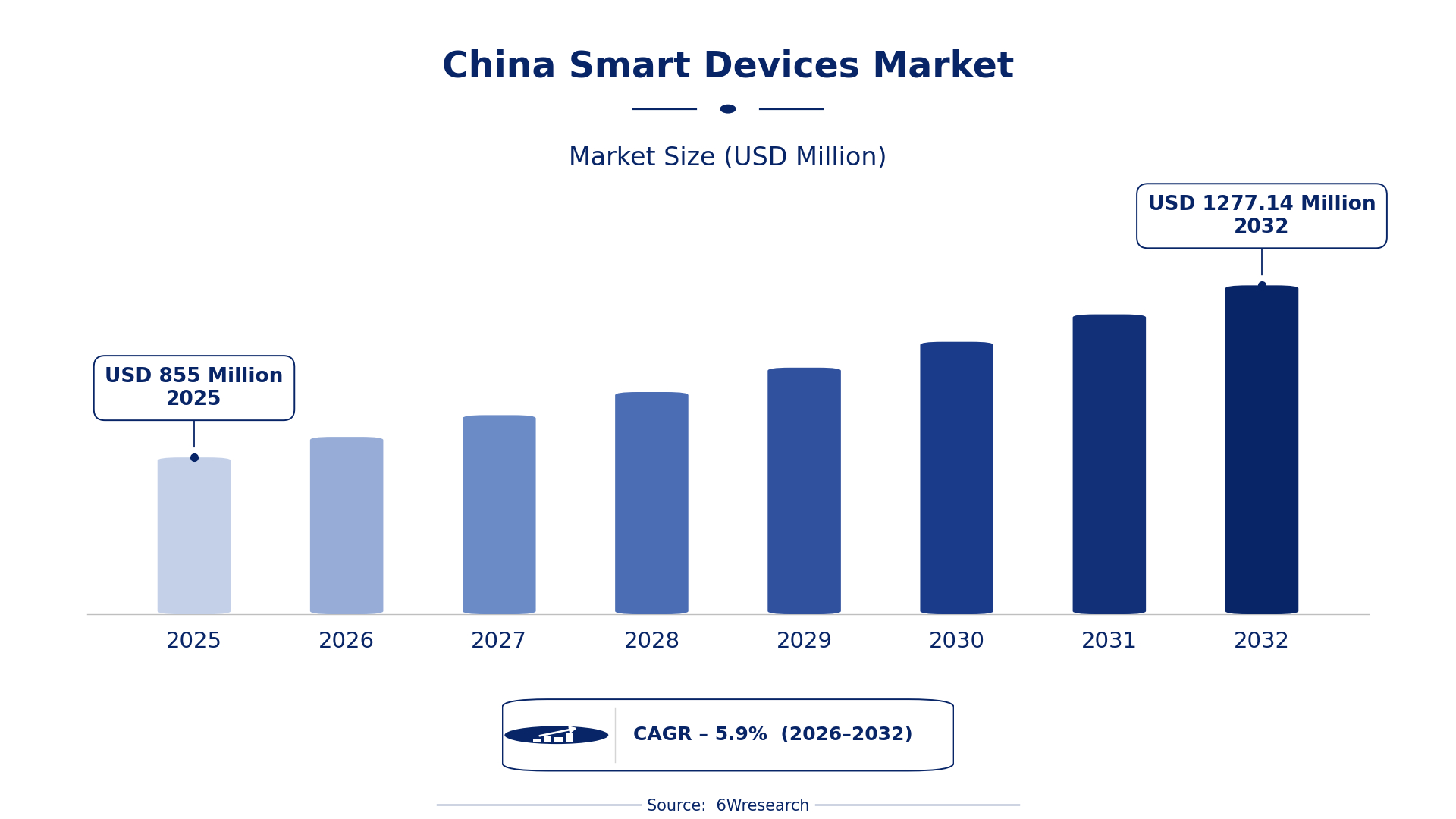
According to 6Wresearch internal database and industry insights, the China Smart Devices Market was valued at USD 855.0 million in 2025 and is projected to reach USD 1,277.14 million by 2032, growing at a CAGR of approximately 5.9% during 2026–2032.
China Smart Devices Market Highlights
| Report Metric | Details |
| Report Name | China Smart Devices Market |
| Market Size 2025 | USD 855.0 million |
| Market Size 2032 | USD 1,277.14 million |
| Absolute Growth 2025–2032 | USD 422.14 million |
| CAGR 2026–2032 | 5.9% |
| Peak Annual Growth | 8.4% in 2029 |
| Forecast Period | 2026–2032 |
| Historical Data | 2022–2025 |
| Base Year | 2025 |
| Leading Device Type, 2025 | Smart TVs (40% share) |
| Leading Smart Feature, 2025 | Voice Assistant (36% share) |
| Leading Connectivity, 2025 | Wi-Fi/Bluetooth (41% share) |
| Leading End User, 2025 | Smart Home Users (47% share) |
| Fastest-Growing Device Type | Smart Watches (8.4% CAGR) |
| Fastest-Growing Smart Feature | Health + Notifications (7.8% CAGR) |
| Fastest-Growing Connectivity | IoT Cloud (7.0% CAGR) |
| Fastest-Growing End User | Wearable Consumers (7.3% CAGR) |
| Growing Sector | Smart Home Technology |
| Key End Users | Smart Home Users, Wearable Consumers, Entertainment Electronics |
China Smart Devices Market Year-wise Growth Rate and Key Drivers (2022–2032)
This graph illustrates the annual growth rates of the market from 2022 to 2032, highlighting a steady upward trajectory and projected market expansion over the forecast period.
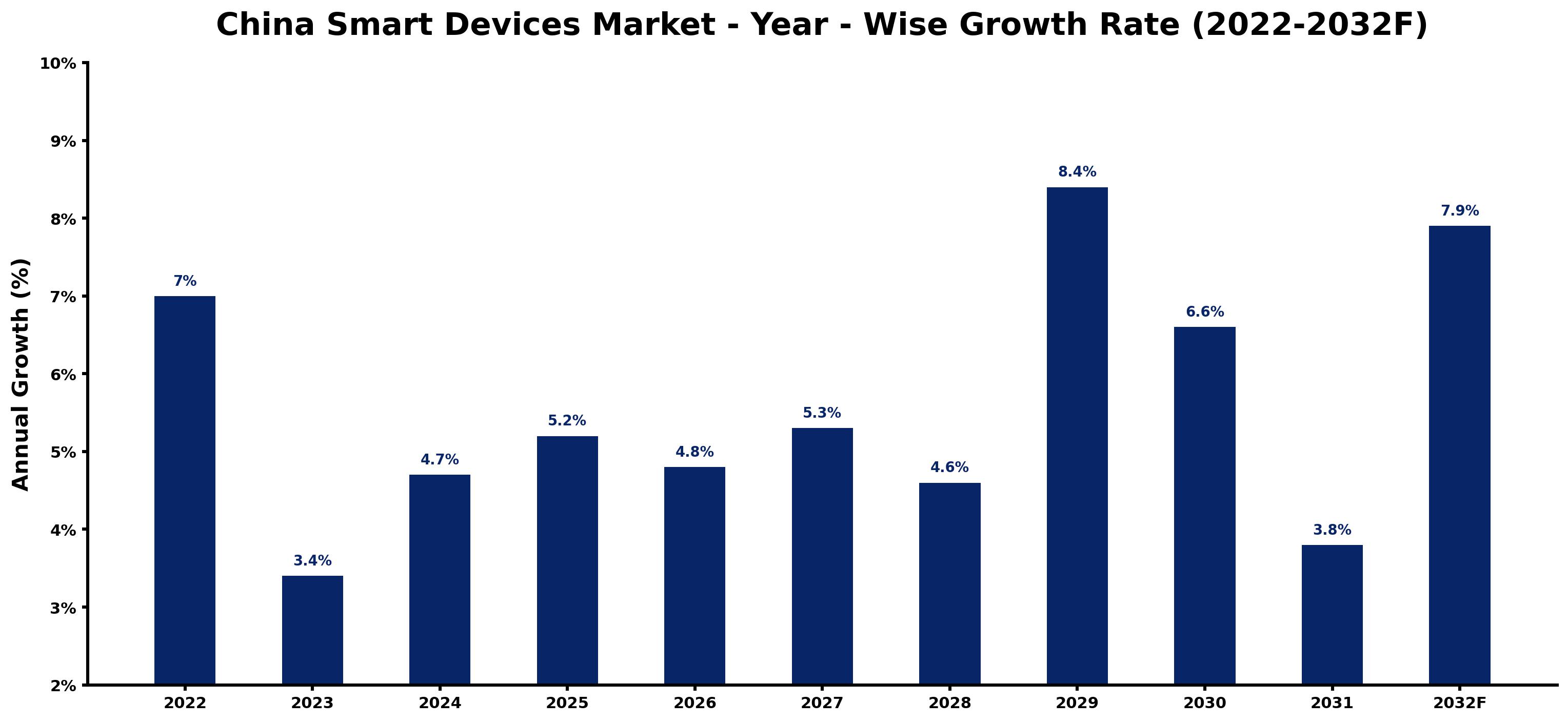
Below, each year's estimated growth is shown next to the factor that most influenced it.
| Year | Estimated Annual Growth (%) | Market Rationale |
| 2022 | 7.0 | The market experienced strong demand due to urbanisation and technological advancements. |
| 2023 | 3.4 | Growth slowed as consumer spending shifted towards essential goods amid economic uncertainty. |
| 2024 | 4.7 | Increased adoption of smart home technology spurred faster growth in consumer electronics. |
| 2025 | 5.2 | Rising urban population and demand for smart home integration drove market expansion. |
| 2026 | 4.8 | Competition intensified among manufacturers, leading to slower growth rates. |
| 2027 | 5.3 | Consumer interest in health monitoring devices boosted demand for wearables. |
| 2028 | 4.6 | Market growth slowed as saturation in some segments began to emerge. |
| 2029 | 8.4 | A surge in smart home technology adoption led to peak growth in the market. |
| 2030 | 6.6 | Growth slowed as the market began to stabilise after rapid expansion. |
| 2031 | 3.8 | Market growth decelerated due to increased competition and market maturity. |
| 2032 | 7.9 | Demand for smart devices is expected to rise due to urbanisation and health initiatives. |
Note: Market size estimations and growth projections presented in this report are based on 6Wresearch's proprietary forecasting methodology, utilizing the latest available industry data, government publications, and primary research inputs.
China Smart Devices Market Synopsis
The China Smart Devices Market includes electronic devices that connect to the internet for remote control. These devices encompass smart speakers, watches, and TVs, primarily utilised for home automation and health monitoring. The market is expanding due to rapid urbanisation, with over 400 million smart home users in 2022. The smart speaker segment achieved 100 million units sold in 2023, showcasing strong consumer interest and technological progress. Government initiatives further support this expansion by encouraging smart home integration and innovation.
Market Dynamics Impact Analysis (2026–2032)
| Factor | Type | Impact | Primary Segment Affected |
| Urbanisation is driving demand for smart home devices as more consumers seek automation solutions. | Driver | High | Smart Home Users |
| Health monitoring trends are increasing the adoption of wearable devices among consumers. | Driver | High | Wearable Consumers |
| The growing smart home user base presents opportunities for new product development. | Opportunity | High | Smart Home Users |
| Investment in smart kitchen technology is rising, driven by consumer interest. | Opportunity | Medium | Smart Refrigerators |
| Intense competition among manufacturers can lead to price wars, impacting profit margins. | Restraint | High | Smart Speakers |
| Market saturation in certain segments may limit growth potential in the coming years. | Restraint | Medium | Smart TVs |
| The Smart Devices Market in China faces challenges from rapidly evolving technology and consumer preferences. | Challenge | High | Smart Watches |
| Supply chain disruptions can delay product availability and affect market growth. | Challenge | Medium | Smart Speakers |
Evaluation of Drivers in China Smart Devices Market (2026–2032)
The factors lifting demand, and the evidence behind each, are summarised below.
| Drivers | Primary Segment Affected | Why It Matters (Evidence) |
| Urbanisation drives demand for smart home devices, with over 400 million smart home users. | Smart Home Users | This demographic shift increases the need for home automation solutions. |
| Health consciousness is boosting wearable device sales, with smart watches accounting for 35% of sales. | Wearable Consumers | Consumers are increasingly focused on health monitoring and fitness tracking. |
| Technological advancements in IoT are improving device connectivity, leading to higher adoption rates. | IoT Cloud | Better connectivity features encourage consumers to invest in smart devices. |
| The popularity of streaming services is driving smart TV sales, with a penetration rate of 70%. | Smart TVs | Consumers seek enhanced entertainment experiences through smart technology. |
| Government initiatives support innovation in smart devices, fostering a conducive environment for growth. | Smart Home Users | Programs like the Smart Health Promotion Program encourage health monitoring technology. |
Growth across the Smart Devices market in China is anchored in urbanisation, health consciousness, and technological advancements. In 2023, the total installed base of smart devices exceeded 1 billion units, reflecting strong consumer adoption. The smart speaker market reached 100 million units sold, driven by increased demand for voice-activated control in homes. With health monitoring becoming a priority, smart watches accounted for 35% of wearable device sales. The penetration rate of smart TVs is approximately 70%, as viewers seek improved entertainment options.
Evaluation of Restraints in China Smart Devices Market
The following restraints limit how fast demand can grow.
| Market Restraint | Primary Segment Affected | Why It Matters (Evidence) |
| Intense competition among manufacturers results in price wars, impacting profitability. | Smart Speakers | This competition can lower margins for producers, affecting overall market health. |
| Market saturation in certain segments limits growth potential and innovation. | Smart TVs | As more consumers own smart TVs, the incentive for new purchases decreases. |
| Supply chain disruptions can delay product availability and impact sales. | Smart TVs | Manufacturers face challenges in sourcing components, causing potential shortages. |
| Consumer preferences are rapidly evolving, making it difficult for companies to keep up. | Smart Watches | Failure to adapt to changing trends can lead to lost market share. |
| Regulatory compliance can increase operational costs for manufacturers. | Smart Refrigerators | Producers must invest in meeting standards, which affects pricing strategies. |
China Smart Devices Market Challenges
In 2023, over 400 million smart home users in China face compatibility issues due to a lack of standardisation among smart devices, complicating integration for buyers who seek seamless automation. Regulatory hurdles persist, as the National Standard for Smart Home Systems established in 2021 is only partially implemented, causing delays in compliance for producers and hindering timely product launches. Supply chain interruptions impact the availability of essential components, resulting in longer lead times for manufacturers and limiting product diversity for consumers. Rising production costs, driven by material shortages, have forced some producers to raise prices, making smart devices less affordable for buyers in a competitive market.
Trends in the China Smart Devices Market
Four trends stand out in the China Smart Devices Market.
- Shift towards Smart Home Automation: China is experiencing a shift towards smart home devices, with the Smart Home Industry Alliance promoting integration. In 2023, the market saw over 400 million smart home users driving this trend, indicating a growing market for automation.
- Transition to Health-Focused Wearables: The focus on health monitoring is changing the wearable market, with smart watches gaining popularity. In 2023, they accounted for 35% of wearable device sales, reflecting consumer demand for fitness tracking and health management.
- Emergence of IoT Cloud Services: IoT Cloud services are becoming essential for smart device functionality, enabling better data management. With investments projected to grow significantly, this segment is set for expansion as smart devices proliferate in households.
- Prioritisation of Voice Assistants in Smart Devices: Voice assistants are increasingly integral to smart devices, improving user experience. The Voice Assistant segment held a 36% share in 2025, showcasing its importance in smart home integration and consumer engagement.
Investment Opportunities in the China Smart Devices Market
Below are the investment opportunities with the strongest case in the China Smart Devices Market.
- Gap in Smart Kitchen Technology: With rising consumer interest, the smart refrigerator segment is anticipated to expand. In 2023, investments in smart kitchen technology are targeting tech-savvy consumers seeking convenience and efficiency.
- Entry through Local Partnerships: Now is an opportune moment to invest in smart home technology, particularly through local partnerships. Collaborating with regional manufacturers can improve market access and distribution channels for new products.
- Growing Demand for Health Monitoring Devices: The increasing focus on health monitoring presents opportunities for innovative wearable devices. Targeting urban consumers, especially through health-focused initiatives, can drive sales and market penetration.
- Expansion of Smart Home Integration: The growing smart home user base offers an opportunity for new product development. Engaging with the Smart Home Industry Alliance can facilitate entry into this expanding market and enhance product visibility.
Government Initiatives in the China Smart Devices Market
The 'Smart Manufacturing 2025' initiative launched by the Ministry of Industry and Information Technology in 2021 aims to enhance production capabilities in the smart devices sector. This initiative focuses on the quality and efficiency of smart device manufacturing. The 'Guidelines for the Development of Smart Home Appliances' published in 2020 set industry standards, promoting best practices among producers. The '14th Five-Year Plan for Digital Economy Development' approved in 2021 aims to boost smart device integration across sectors. These measures support the growth of the smart devices market by ensuring quality and innovation.
The subsidy program introduced by the National Development and Reform Commission in 2022 for smart home technology adoption targets low-income households. This initiative encourages the integration of smart devices into everyday life, making them more accessible. Furthermore, the Ministry of Science and Technology's 'Smart Health Promotion Program' launched in 2023 supports health monitoring devices in urban areas. These programs provide funding and resources to promote the adoption of smart technologies among consumers, enhancing their daily lives.
Future Insight of the China Smart Devices Market
The China Smart Devices Market is poised for substantial growth by 2032, driven by urbanisation and rising consumer interest in connected technology. Government initiatives supporting smart device innovation will accelerate product development, while the IoT Cloud service market is expected to expand, improving connectivity options. By 2030, China's urban population is projected to reach 1 billion, further boosting the adoption of smart devices. With smart watches accounting for 35% of wearable device sales in 2023, the demand for integrated solutions will create new opportunities for suppliers.
Market Segmentation Analysis
Each segment group is reviewed below, with the leader by share and the fastest grower by CAGR.
By Device Type – Smart TVs Dominated, Smart Watches Expected to Grow Fastest
According to Dhaval Chaurasia, Assistant Manager at 6Wresearch, Smart TVs took a 40% share of device type in 2025, more than any other category. Smart TVs dominate the market share due to their extensive use for streaming and entertainment, appealing to a diverse consumer base. With a penetration rate of approximately 70% in China, they have become indispensable in modern households. Over 2026–2032, Smart Watches are expected to post the fastest growth, at a CAGR of 8.4%. Smart watches are experiencing rapid growth driven by their popularity for health tracking and notifications, catering to the rising demand for health-oriented devices. As more consumers adopt wearable technology for fitness, this segment is poised for further expansion. Suppliers should prioritise the enhancement of smart watch features to attract the increasing health-conscious consumer segment.
By Smart Feature – Voice Assistant Dominated, Health + Notifications Expected to Grow Fastest
Voice Assistant held a 36% share of the China Smart Devices Market by smart feature in 2025. Voice assistants hold the largest market share as they are integral for smart home integration, allowing users to manage multiple devices seamlessly. Their ability to improve user experience makes them a preferred choice among smart device users. Health + Notifications are set to record the highest CAGR in this split, 7.8% over 2026–2032. Health and notifications are the fastest-growing smart features, especially in wearables, as consumers increasingly seek devices that align with their health and wellness goals. This trend is likely to continue as technology advances and health awareness rises. Suppliers should focus on developing health-oriented features to meet the growing consumer demand for wellness-focused smart devices.
By Connectivity – Wi-Fi/Bluetooth Dominated, IoT Cloud Expected to Grow Fastest
In 2025, Wi-Fi/Bluetooth led the connectivity split with a 41% share. Wi-Fi and Bluetooth are fundamental for connectivity in all smart devices, enabling smooth communication and control. Their broad adoption guarantees compatibility across various devices, reinforcing their status as the leading connectivity option. The quickest growth will come from IoT Cloud, forecast to expand at a CAGR of 7.0% between 2026 and 2032. The IoT Cloud is rapidly expanding as it becomes essential for data management and device control, promoting smarter interactions among devices. With the rise in consumer adoption of smart technology, the demand for robust cloud services is expected to grow significantly. This suggests that suppliers should invest in enhancing IoT Cloud capabilities to improve device functionality and overall user satisfaction.
By End User – Smart Home Users Dominated, Wearable Consumers Expected to Grow Fastest
With a 47% revenue share in 2025, Smart Home Users was the largest end user category. Smart home users represent the largest share, driven by a growing segment of tech-savvy consumers eager to adopt advanced technologies for home automation. The increasing urban population further supports this trend, leading to higher demand for smart home devices. Wearable Consumers are projected to grow fastest, at a CAGR of 7.3% during 2026–2032. Wearable consumers are the fastest-growing segment, particularly among health-conscious individuals seeking technology that supports their fitness and wellness journeys. This growth is expected to accelerate as more people integrate wearables into their daily routines. This highlights the need for suppliers to tailor products to meet the specific preferences of health-focused consumers in the wearable market.
Key Attractiveness of the Report
- 10 Years of Market Numbers
- Historical Data Starting from 2022 to 2025
- Base Year 2025
- Forecast Data until 2032
- Key Performance Indicators Impacting the Market
- Major Upcoming Developments and Projects
Key Highlights of the Report:
- China Smart Devices Market Outlook
- Market Size of China Smart Devices Market, 2025
- Forecast of China Smart Devices Market, 2032
- Historical Data and Forecast of China Smart Devices Revenues & Volume for the Period 2022 - 2032F
- China Smart Devices Market Trend Evolution
- China Smart Devices Market Drivers and Challenges
- China Smart Devices Price Trends
- China Smart Devices Porter's Five Forces
- China Smart Devices Industry Life Cycle
- Historical Data and Forecast of China Smart Devices Market Revenues & Volume By Device Type for the Period 2022 - 2032F
- Historical Data and Forecast of China Smart Devices Market Revenues & Volume By Smart Speakers for the Period 2022 - 2032F
- Historical Data and Forecast of China Smart Devices Market Revenues & Volume By Smart Watches for the Period 2022 - 2032F
- Historical Data and Forecast of China Smart Devices Market Revenues & Volume By Smart TVs for the Period 2022 - 2032F
- Historical Data and Forecast of China Smart Devices Market Revenues & Volume By Smart Refrigerators for the Period 2022 - 2032F
- Historical Data and Forecast of China Smart Devices Market Revenues & Volume By Smart Feature for the Period 2022 - 2032F
- Historical Data and Forecast of China Smart Devices Market Revenues & Volume By Voice Assistant for the Period 2022 - 2032F
- Historical Data and Forecast of China Smart Devices Market Revenues & Volume By Health + Notifications for the Period 2022 - 2032F
- Historical Data and Forecast of China Smart Devices Market Revenues & Volume By Streaming + Apps for the Period 2022 - 2032F
- Historical Data and Forecast of China Smart Devices Market Revenues & Volume By Inventory + Alerts for the Period 2022 - 2032F
- Historical Data and Forecast of China Smart Devices Market Revenues & Volume By Connectivity for the Period 2022 - 2032F
- Historical Data and Forecast of China Smart Devices Market Revenues & Volume By Wi-Fi/Bluetooth for the Period 2022 - 2032F
- Historical Data and Forecast of China Smart Devices Market Revenues & Volume By LTE/Bluetooth for the Period 2022 - 2032F
- Historical Data and Forecast of China Smart Devices Market Revenues & Volume By Wi-Fi + OS Integration for the Period 2022 - 2032F
- Historical Data and Forecast of China Smart Devices Market Revenues & Volume By IoT Cloud for the Period 2022 - 2032F
- Historical Data and Forecast of China Smart Devices Market Revenues & Volume By End User for the Period 2022 - 2032F
- Historical Data and Forecast of China Smart Devices Market Revenues & Volume By Smart Home Users for the Period 2022 - 2032F
- Historical Data and Forecast of China Smart Devices Market Revenues & Volume By Wearable Consumers for the Period 2022 - 2032F
- Historical Data and Forecast of China Smart Devices Market Revenues & Volume By Entertainment Electronics for the Period 2022 - 2032F
- Historical Data and Forecast of China Smart Devices Market Revenues & Volume By Kitchen Appliance Makers for the Period 2022 - 2032F
- China Smart Devices Import Export Trade Statistics
- Market Opportunity Assessment By Device Type
- Market Opportunity Assessment By Smart Feature
- Market Opportunity Assessment By Connectivity
- Market Opportunity Assessment By End User
- China Smart Devices Top Companies Market Share
- China Smart Devices Competitive Benchmarking By Technical and Operational Parameters
- China Smart Devices Company Profiles
- China Smart Devices Key Strategic Recommendations
Market Covered
This report examines the market across the segments below.
By Device Type
- Smart Speakers
- Smart Watches
- Smart TVs
- Smart Refrigerators
By Smart Feature
- Voice Assistant
- Health + Notifications
- Streaming + Apps
- Inventory + Alerts
By Connectivity
- Wi-Fi/Bluetooth
- LTE/Bluetooth
- Wi-Fi + OS Integration
- IoT Cloud
By End User
- Smart Home Users
- Wearable Consumers
- Entertainment Electronics
- Kitchen Appliance Makers































