China Smart Environment Market Size & Growth Rate
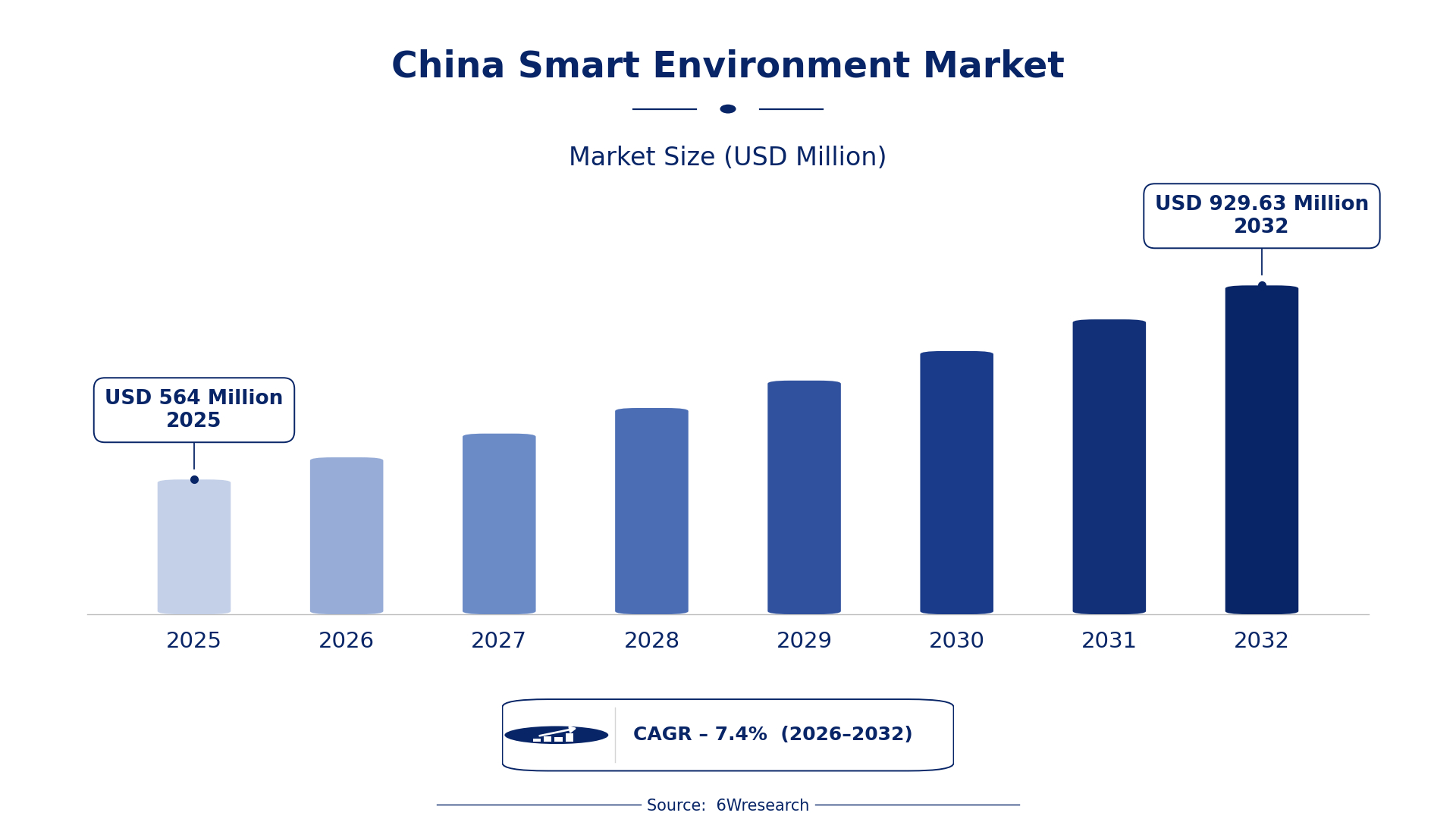
According to 6Wresearch internal database and industry insights, the China Smart Environment Market was valued at USD 564.0 million in 2025 and is projected to reach USD 929.63 million by 2032, growing at a CAGR of approximately 7.4% during 2026–2032.
China Smart Environment Market Highlights
| Report Metric | Details |
| Report Name | China Smart Environment Market |
| Market Size 2025 | USD 564.0 million |
| Market Size 2032 | USD 929.63 million |
| Absolute Growth 2025–2032 | USD 365.63 million |
| CAGR 2026–2032 | 7.4% |
| Peak Annual Growth | 9.0% in 2026 |
| Forecast Period | 2026–2032 |
| Historical Data | 2022–2025 |
| Base Year | 2025 |
| Leading Environment Type, 2025 | Urban Green Monitoring (44% share) |
| Leading Smart Feature, 2025 | CO₂/PM Sensors (40% share) |
| Leading Monitoring Tool, 2025 | IoT Sensor Grid (40% share) |
| Leading End User, 2025 | Municipal Planners (44% share) |
| Fastest-Growing Environment Type | Agricultural Fields (9.8% CAGR) |
| Fastest-Growing Smart Feature | Smart Irrigation Alerts (10.0% CAGR) |
| Fastest-Growing Monitoring Tool | AI + Vision Systems (8.9% CAGR) |
| Fastest-Growing End User | AgriTech Firms (9.4% CAGR) |
| Growing Sector | Smart Agriculture |
| Key End Users | Municipal Planners, AgriTech Firms, Environmental Agencies, Disaster Management Units |
China Smart Environment Market Year-wise Growth Rate and Key Drivers (2022–2032)
This graph illustrates the annual growth rates of the market from 2022 to 2032, highlighting a steady upward trajectory and projected market expansion over the forecast period.
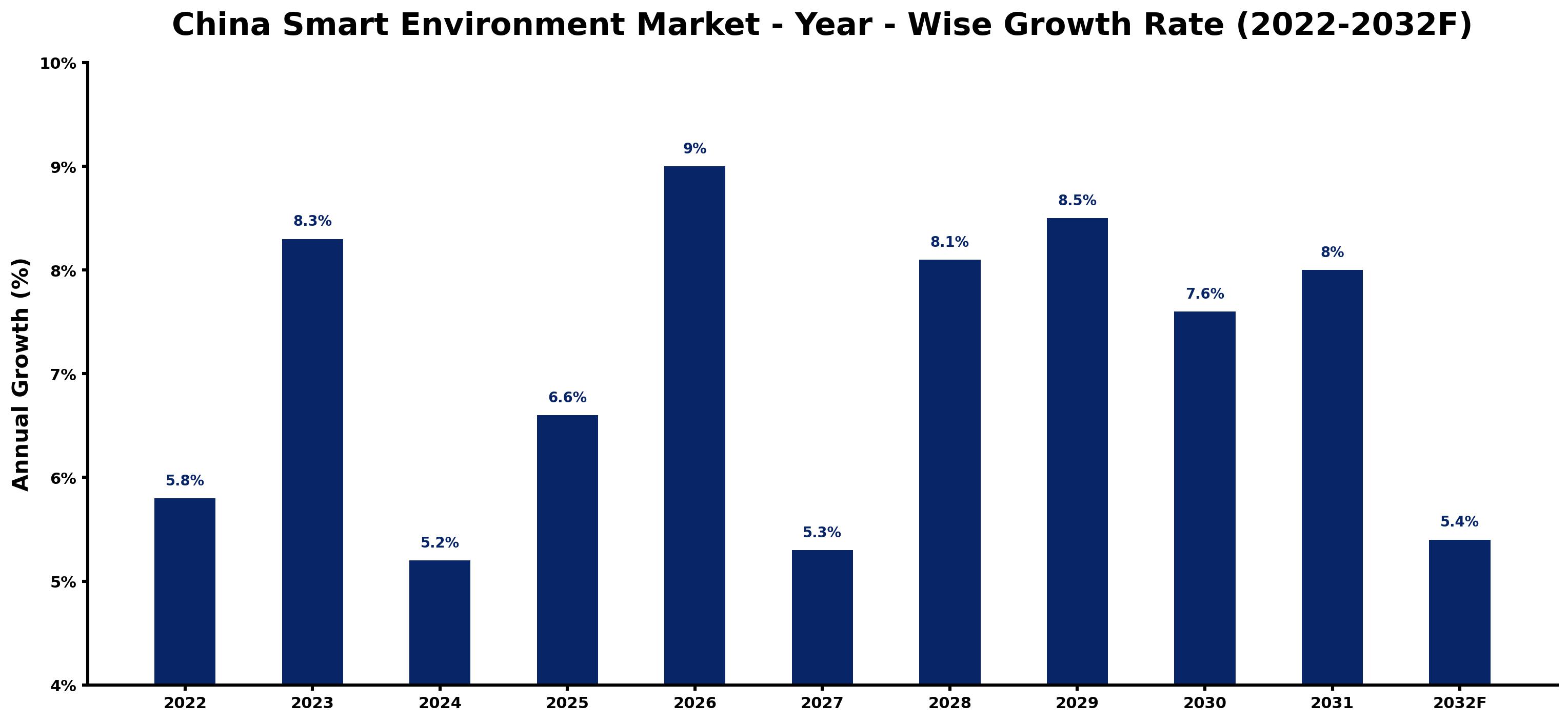
Below, each year's estimated growth is shown next to the factor that most influenced it.
| Year | Estimated Annual Growth (%) | Market Rationale |
| 2022 | 5.8 | The market displayed steady growth driven by urbanisation and environmental needs. |
| 2023 | 8.3 | Demand surged due to increased urban population and focus on sustainable practices. |
| 2024 | 5.2 | Growth slowed as some projects faced delays in implementation and funding. |
| 2025 | 6.6 | A rebound occurred with enhanced investment in smart environmental technologies. |
| 2026 | 9.0 | The market peaked as major cities adopted comprehensive smart monitoring systems. |
| 2027 | 5.3 | Growth decelerated as market adjustments took place following peak demand. |
| 2028 | 8.1 | An uptick in growth was noted with renewed focus on sustainable urban planning. |
| 2029 | 8.5 | Demand continued to rise as agricultural efficiency initiatives gained traction. |
| 2030 | 7.6 | Growth slowed again as market saturation began to affect new investments. |
| 2031 | 8.0 | A resurgence occurred as municipalities expanded their smart monitoring capabilities. |
| 2032 | 5.4 | Growth slowed as the market stabilised, reflecting matured technology adoption. |
Note: Market size estimations and growth projections presented in this report are based on 6Wresearch's proprietary forecasting methodology, utilizing the latest available industry data, government publications, and primary research inputs.
China Smart Environment Market Synopsis
The Smart Environment market in China integrates technology into environmental monitoring and management. Advanced sensor technologies and data analytics are employed across urban planning, agriculture, and disaster management. This market is expanding due to rising urbanisation, with 64% of the population residing in cities, alongside substantial investments in smart technologies. Government initiatives, particularly the Green Development Plan, further drive the demand for effective environmental solutions.
Market Dynamics Impact Analysis (2026–2032)
| Factor | Type | Impact | Primary Segment Affected |
| Rising urban population drives demand for urban green monitoring solutions. | Driver | High | Urban Green Monitoring |
| Technological advancements in smart agriculture enhance productivity. | Driver | High | Agricultural Fields |
| Investment in smart irrigation technologies is increasing. | Opportunity | High | Smart Irrigation Alerts |
| Growing focus on forest health monitoring creates new opportunities. | Opportunity | High | Forest Monitoring |
| Limited funding for smart environmental projects restricts growth. | Restraint | High | Smart Water Ecosystems |
| Regulatory compliance challenges hinder market expansion. | Restraint | Medium | CO₂/PM Sensors |
| The Smart Environment market faces competition from traditional monitoring methods. | Challenge | High | IoT Sensor Grid |
| Technological integration complexities can delay project implementation. | Challenge | Medium | Smart Irrigation Alerts |
Evaluation of Drivers in China Smart Environment Market (2026–2032)
Key forces behind demand, with the segment each one moves most, are listed below.
| Drivers | Primary Segment Affected | Why It Matters (Evidence) |
| Increasing urbanisation necessitates efficient urban green monitoring solutions. | Urban Green Monitoring | In 2022, China's urban population reached 64%, driving demand for effective monitoring solutions. |
| Technological advancements in agriculture improve productivity and resource management. | Agricultural Fields | China has over 300 million hectares of agricultural land, necessitating smart agriculture technologies. |
| Government initiatives promote smart irrigation technologies to improve efficiency. | Smart Irrigation Alerts | The Ministry of Agriculture and Rural Affairs supports smart irrigation systems to optimise water use, enhancing agricultural outputs. |
| Focus on air quality improvement drives demand for CO₂/PM sensors. | CO₂/PM Sensors | The National Standard for Air Quality regulates urban air quality monitoring, increasing sensor demand for compliance. |
| Integration of smart technologies in environmental monitoring improves data accuracy. | IoT Sensor Grid | The National Environmental Monitoring Center updated standards to include smart monitoring technologies, enhancing data collection. |
In 2022, urbanisation reached 64%, driving demand for urban green monitoring solutions. The Smart Agriculture Promotion Plan supports over 300 million hectares of agricultural land, necessitating advanced technologies. The National Standard for Air Quality increases demand for CO₂/PM sensors to ensure compliance. Updated standards from the National Environmental Monitoring Center enhance the integration of smart technologies, leading to improved data accuracy in environmental monitoring.
Evaluation of Restraints in China Smart Environment Market
Below mentioned are some major restraints and their influence on market dynamics.
| Market Restraint | Primary Segment Affected | Why It Matters (Evidence) |
| Limited funding for smart environmental projects restricts growth. | Smart Water Ecosystems | Many municipalities face budget constraints, affecting the implementation of smart monitoring systems. |
| Regulatory compliance challenges hinder market expansion. | CO₂/PM Sensors | Strict environmental regulations require extensive testing and certification, delaying product launches. |
| Competition from traditional monitoring methods limits market share. | IoT Sensor Grid | Established methods still dominate in many regions, slowing the adoption of smart technologies. |
| Integration complexities can delay project implementation. | Smart Irrigation Alerts | Farmers may struggle with the transition to advanced irrigation systems, causing delays in adoption. |
| Lack of skilled workforce hampers technology adoption. | Agricultural Fields | The need for trained personnel to manage smart agricultural technologies remains unmet, affecting operational efficiency. |
China Smart Environment Market Challenges
In the China Smart Environment market, producers struggle with outdated technology, limiting the effectiveness of environmental monitoring solutions. Many use legacy systems that cannot integrate with new IoT devices, delaying project timelines for municipal planners by up to six months. Importers face fierce competition from local manufacturers, resulting in price wars that erode profit margins and threaten their sustainability. Buyers encounter supply chain disruptions due to inconsistent availability of advanced sensors, causing project delays of three to four weeks for environmental agencies. Skills shortages in data analytics complicate operations, increasing costs by 20% for producers lacking qualified personnel.
Trends in the China Smart Environment Market
The trends below show where the China Smart Environment Market is heading.
- Shift from Traditional to Smart Water Management: Municipal planners in Beijing are increasingly adopting smart water management systems, initiated in 2023, to optimise water resource allocation. This shift is crucial as urban water demand rises, with the city aiming to improve efficiency by 20%.
- Transition to Advanced Agricultural Technologies: The Smart Agriculture Promotion Plan, launched in 2022, is driving the adoption of advanced technologies across China's 300 million hectares of agricultural land. This transition is key for improving productivity and resource efficiency, targeting a 15% increase in crop yields.
- Emergence of Integrated Environmental Monitoring: In 2023, the National Environmental Monitoring Center updated its standards to include smart monitoring technologies, enhancing data accuracy for environmental assessments. This integration supports compliance with the National Standard for Air Quality, impacting urban air quality management.
- Prioritisation of CO₂ Monitoring Solutions: The government's commitment to reducing carbon emissions by 30% by 2030 is accelerating demand for CO₂ monitoring solutions. This focus is driving investments in sensor technologies, with a projected increase in installations by 25% in urban areas.
Investment Opportunities in the China Smart Environment Market
Investors looking at the China Smart Environment Market should consider the following areas.
- Investment in Smart Water Management Systems: There is an opportunity to supply smart water management technologies. In 2023, Beijing's system optimised water allocation, indicating a growing market for similar solutions across urban areas.
- Supply of Smart Irrigation Technologies: The agricultural sector is increasingly adopting smart irrigation solutions. With over 300 million hectares of agricultural land, partnerships with local farmers can facilitate entry into this market.
- Development of CO₂ Monitoring Solutions: The demand for CO₂ monitoring solutions is rising, driven by the government's goal to reduce carbon emissions by 30% by 2030. Collaborating with environmental agencies can enhance market access.
- Expansion of Forest Monitoring Technologies: The focus on forest health monitoring presents an opportunity for smart monitoring solutions. Engaging with local governments can facilitate the implementation of these technologies.
Government Initiatives in the China Smart Environment Market
The Green Development Action Plan launched by the Ministry of Ecology and Environment in 2021 promotes smart environmental technologies with a focus on urban areas. This initiative encourages municipalities to adopt advanced monitoring systems, improving environmental management. It aims to integrate technology into urban planning and resource management, ensuring sustainable practices across cities. The plan also sets targets for reducing emissions and improving air quality, driving demand for CO₂ monitoring solutions and enhancing overall environmental quality.
In 2022, the National Development and Reform Commission introduced the Smart Agriculture Promotion Plan, which supports farmers in adopting technology to improve productivity. This programme aims to improve resource efficiency and promote sustainable agricultural practices. It provides funding for the development and implementation of smart irrigation systems, ensuring better water management. The Ministry of Agriculture and Rural Affairs oversees the plan, ensuring alignment with national agricultural goals.
Future Insight of the China Smart Environment Market
The China Smart Environment market will evolve by 2032, driven by the implementation of advanced sensor technologies and data processing systems. The Green Development Plan launched in 2021 will accelerate the adoption of smart agriculture solutions across 300 million hectares of farmland. The government's commitment to reducing carbon emissions by 30% by 2030 will significantly increase demand for CO₂ monitoring solutions. New standards for smart environmental technologies will enhance compliance and improve data quality for buyers and suppliers.
Market Segmentation Analysis
The report offers a comprehensive study of the following market segments and their leading categories in the market.
By Environment Type – Urban Green Monitoring Dominated, Agricultural Fields Expected to Grow Fastest
According to Dhaval Chaurasia, Assistant Manager at 6Wresearch, the largest environment type category in 2025 was Urban Green Monitoring, with a 44% share of total revenue. Urban green monitoring commands the largest share due to its critical role in managing urban green spaces effectively, especially in highly populated cities. For example, Beijing's initiatives to implement advanced monitoring systems underscore the importance of this segment in urban planning. The quickest growth will come from Agricultural Fields, forecast to expand at a CAGR of 9.8% between 2026 and 2032. Agricultural fields are experiencing rapid growth, largely due to China's extensive agricultural land of over 300 million hectares that necessitates smart agriculture technologies. This demand is further stimulated by government programmes aimed at promoting efficient resource usage in farming practices. Suppliers should prioritise solutions that cater to urban planners and the agricultural sector to seize the expanding market share.
By Smart Feature – CO₂/PM Sensors Dominated, Smart Irrigation Alerts Expected to Grow Fastest
With a 40% revenue share in 2025, CO₂/PM Sensors was the largest smart feature category. CO₂/PM sensors lead the market share as they are essential for monitoring air quality and pollution levels in urban settings. The significance of these sensors is reinforced by the National Standard for Air Quality, which enforces strict air quality monitoring protocols. Over 2026–2032, Smart Irrigation Alerts are expected to post the fastest growth, at a CAGR of 10.0%. Smart irrigation alerts are witnessing the fastest growth, driven by the increasing demand for efficient water usage in agriculture, supported by government initiatives promoting smart irrigation technologies. This segment's rapid expansion aligns with the broader push for sustainable agricultural practices. Buyers should invest in advanced sensor technologies to ensure compliance with environmental standards and enhance operational efficiency.
By Monitoring Tool – IoT Sensor Grid Dominated, AI + Vision Systems Expected to Grow Fastest
IoT Sensor Grid accounted for a 40% market share by monitoring tool in 2025. The IoT sensor grid holds the largest market share as it is the foundational technology for effective environmental monitoring. Its widespread adoption is vital for accurate data collection and analysis across various environmental applications. AI + Vision Systems are set to record the highest CAGR in this split, 8.9% over 2026–2032. AI + vision systems are growing quickly as they improve data analysis capabilities, enabling more informed decision-making in environmental management. This growth is supported by advancements in technology that enhance monitoring precision. Suppliers must focus on developing advanced monitoring tools to meet the increasing demand for effective environmental solutions.
By End User – Municipal Planners Dominated, AgriTech Firms Expected to Grow Fastest
Municipal Planners took a 44% share of end user in 2025, more than any other category. Municipal planners account for the largest market share as they heavily depend on data for urban development and planning. Their requirement for effective environmental monitoring solutions is crucial for fostering sustainable urban growth. AgriTech Firms are projected to grow fastest, at a CAGR of 9.4% during 2026–2032. AgriTech firms represent the fastest-growing segment as they increasingly implement technology to boost agricultural outputs and resource management. This growth is driven by the need for sustainable agricultural practices, bolstered by government support. Suppliers should target municipal planners and AgriTech firms to align their offerings with the needs of these critical end users.
Key Attractiveness of the Report
- 10 Years of Market Numbers
- Historical Data Starting from 2022 to 2025
- Base Year 2025
- Forecast Data until 2032
- Key Performance Indicators Impacting the Market
- Major Upcoming Developments and Projects
Key Highlights of the Report:
- China Smart Environment Market Outlook
- Market Size of China Smart Environment Market, 2025
- Forecast of China Smart Environment Market, 2032
- Historical Data and Forecast of China Smart Environment Revenues & Volume for the Period 2022 - 2032F
- China Smart Environment Market Trend Evolution
- China Smart Environment Market Drivers and Challenges
- China Smart Environment Price Trends
- China Smart Environment Porter's Five Forces
- China Smart Environment Industry Life Cycle
- Historical Data and Forecast of China Smart Environment Market Revenues & Volume By Environment Type for the Period 2022 - 2032F
- Historical Data and Forecast of China Smart Environment Market Revenues & Volume By Urban Green Monitoring for the Period 2022 - 2032F
- Historical Data and Forecast of China Smart Environment Market Revenues & Volume By Agricultural Fields for the Period 2022 - 2032F
- Historical Data and Forecast of China Smart Environment Market Revenues & Volume By Forest Monitoring for the Period 2022 - 2032F
- Historical Data and Forecast of China Smart Environment Market Revenues & Volume By Smart Water Ecosystems for the Period 2022 - 2032F
- Historical Data and Forecast of China Smart Environment Market Revenues & Volume By Smart Feature for the Period 2022 - 2032F
- Historical Data and Forecast of China Smart Environment Market Revenues & Volume By CO /PM Sensors for the Period 2022 - 2032F
- Historical Data and Forecast of China Smart Environment Market Revenues & Volume By Smart Irrigation Alerts for the Period 2022 - 2032F
- Historical Data and Forecast of China Smart Environment Market Revenues & Volume By Wildfire Detection for the Period 2022 - 2032F
- Historical Data and Forecast of China Smart Environment Market Revenues & Volume By Contamination Alerts for the Period 2022 - 2032F
- Historical Data and Forecast of China Smart Environment Market Revenues & Volume By Monitoring Tool for the Period 2022 - 2032F
- Historical Data and Forecast of China Smart Environment Market Revenues & Volume By IoT Sensor Grid for the Period 2022 - 2032F
- Historical Data and Forecast of China Smart Environment Market Revenues & Volume By Satellite/Drone Data for the Period 2022 - 2032F
- Historical Data and Forecast of China Smart Environment Market Revenues & Volume By AI Vision Systems for the Period 2022 - 2032F
- Historical Data and Forecast of China Smart Environment Market Revenues & Volume By Smart Buoy Networks for the Period 2022 - 2032F
- Historical Data and Forecast of China Smart Environment Market Revenues & Volume By End User for the Period 2022 - 2032F
- Historical Data and Forecast of China Smart Environment Market Revenues & Volume By Municipal Planners for the Period 2022 - 2032F
- Historical Data and Forecast of China Smart Environment Market Revenues & Volume By AgriTech Firms for the Period 2022 - 2032F
- Historical Data and Forecast of China Smart Environment Market Revenues & Volume By Disaster Management Units for the Period 2022 - 2032F
- Historical Data and Forecast of China Smart Environment Market Revenues & Volume By Environmental Agencies for the Period 2022 - 2032F
- China Smart Environment Import Export Trade Statistics
- Market Opportunity Assessment By Environment Type
- Market Opportunity Assessment By Smart Feature
- Market Opportunity Assessment By Monitoring Tool
- Market Opportunity Assessment By End User
- China Smart Environment Top Companies Market Share
- China Smart Environment Competitive Benchmarking By Technical and Operational Parameters
- China Smart Environment Company Profiles
- China Smart Environment Key Strategic Recommendations
Market Covered
This report examines the market across the segments below.
By Environment Type
- Urban Green Monitoring
- Agricultural Fields
- Forest Monitoring
- Smart Water Ecosystems
By Smart Feature
- CO₂/PM Sensors
- Smart Irrigation Alerts
- Wildfire Detection
- Contamination Alerts
By Monitoring Tool
- IoT Sensor Grid
- Satellite/Drone Data
- AI + Vision Systems
- Smart Buoy Networks
By End User
- Municipal Planners
- AgriTech Firms
- Disaster Management Units
- Environmental Agencies































