India Smart Environment Market Size & Growth Rate
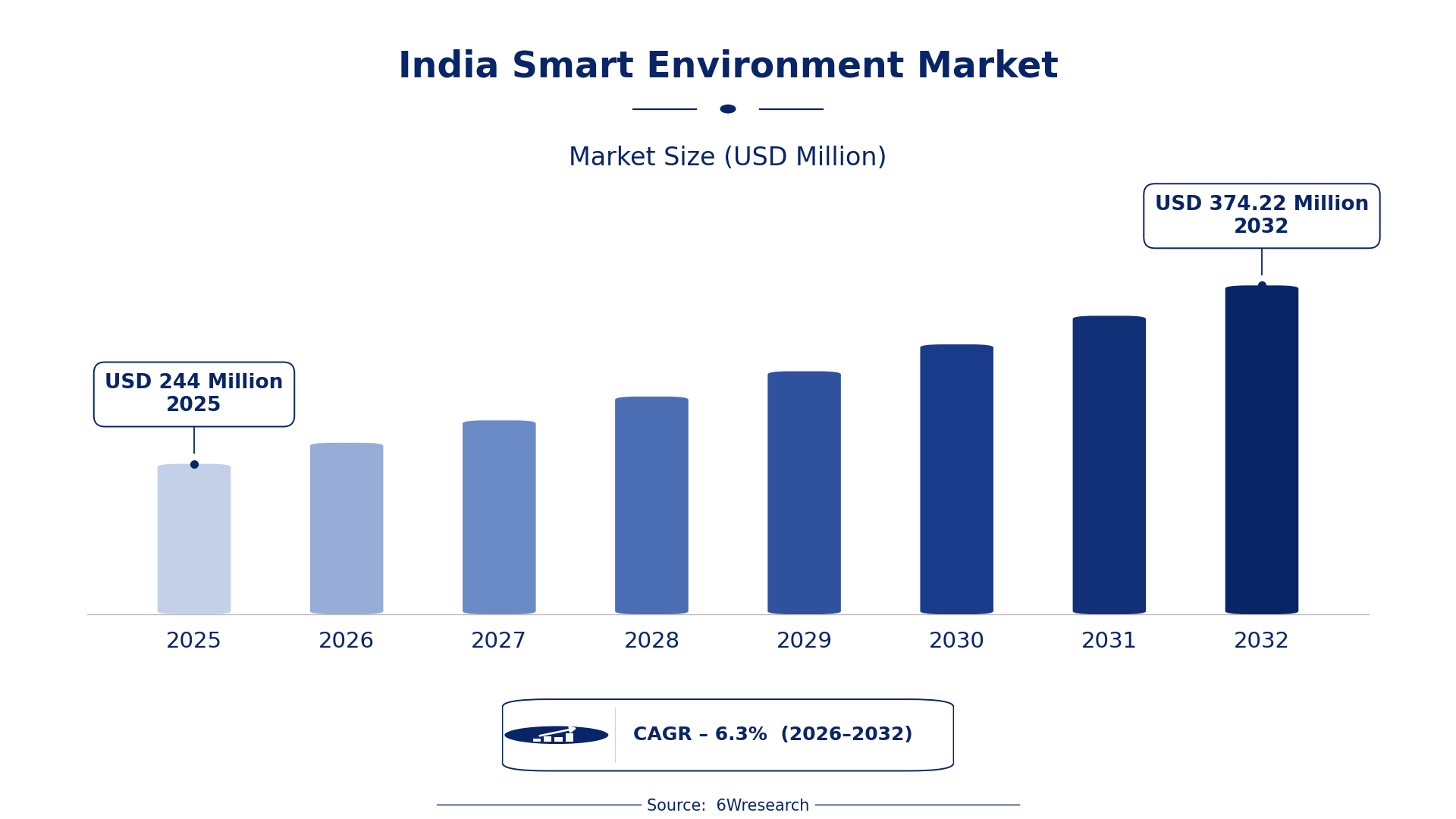
According to 6Wresearch internal database and industry insights, the India Smart Environment Market was valued at USD 244.0 million in 2025 and is projected to reach USD 374.22 million by 2032, growing at a CAGR of approximately 6.3% during 2026–2032.
India Smart Environment Market Highlights
| Report Metric | Details |
| Report Name | India Smart Environment Market |
| Market Size 2025 | USD 244.0 million |
| Market Size 2032 | USD 374.22 million |
| Absolute Growth 2025–2032 | USD 130.22 million |
| CAGR 2026–2032 | 6.3% |
| Peak Annual Growth | 8.8% in 2030 |
| Forecast Period | 2026–2032 |
| Historical Data | 2022–2025 |
| Base Year | 2025 |
| Leading Environment Type, 2025 | Urban Green Monitoring (49% share) |
| Leading Smart Feature, 2025 | CO₂/PM Sensors (39% share) |
| Leading Monitoring Tool, 2025 | IoT Sensor Grid (35% share) |
| Leading End User, 2025 | Municipal Planners (37% share) |
| Fastest-Growing Environment Type | Agricultural Fields (8.9% CAGR) |
| Fastest-Growing Smart Feature | Smart Irrigation Alerts (8.3% CAGR) |
| Fastest-Growing End User | AgriTech Firms (8.1% CAGR) |
| Growing Sector | Urban Planning |
| Key End Users | Municipal Planners, AgriTech Firms, Environmental Agencies, Disaster Management Units |
India Smart Environment Market Year-wise Growth Rate and Key Drivers (2022–2032)
This graph illustrates the annual growth rates of the market from 2022 to 2032, highlighting a steady upward trajectory and projected market expansion over the forecast period.
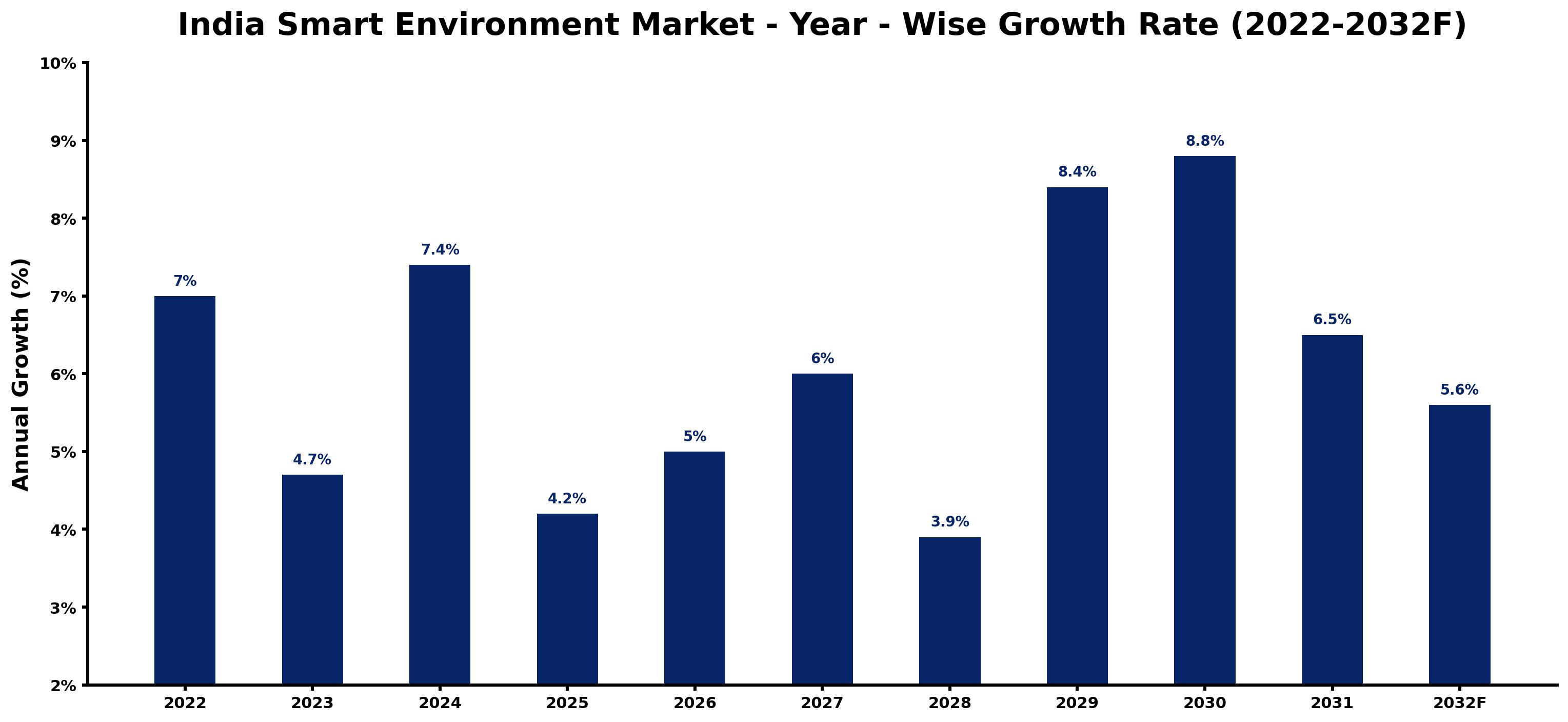
Annual growth estimates for each year appear below with the principal reason behind them, explaining the shifts that set the pace of the market.
| Year | Estimated Annual Growth (%) | Market Rationale |
| 2022 | 7.0 | The market experienced steady growth due to the Smart Cities Mission promoting urban sustainability. |
| 2023 | 4.7 | Growth slowed as urban local bodies faced implementation challenges under the Smart Cities Mission. |
| 2024 | 7.4 | A resurgence in demand occurred as urban planners accelerated smart city projects. |
| 2025 | 4.2 | Growth decelerated again due to budget constraints impacting municipal investments in smart solutions. |
| 2026 | 5.0 | An uptick in demand is expected to be driven by the introduction of smart irrigation systems under the Digital Agriculture Mission. |
| 2027 | 6.0 | Demand is projected to increase as environmental agencies adopt advanced monitoring technologies under the National Clean Air Programme. |
| 2028 | 3.9 | Growth is anticipated to slow as market saturation begins in urban green monitoring solutions. |
| 2029 | 8.4 | A rebound in growth is expected as disaster management units seek advanced technologies. |
| 2030 | 8.8 | The peak growth rate is projected to be reached with significant investments in smart monitoring systems. |
| 2031 | 6.5 | Growth will slow as the market adjusts to new regulatory standards and compliance requirements. |
| 2032 | 5.6 | A further slowdown is expected as competition intensifies among technology providers. |
Note: Market size estimations and growth projections presented in this report are based on 6Wresearch's proprietary forecasting methodology, utilizing the latest available industry data, government publications, and primary research inputs.
India Smart Environment Market Synopsis
The Smart Environment product in India encompasses technologies designed to monitor and manage environmental conditions using IoT, AI, and data analytics. These solutions integrate sensors, software, and data platforms to provide real-time insights for urban planning, agricultural optimisation, and disaster management. The India Smart Environment Market is growing due to municipal needs, agricultural advancements, and environmental protection initiatives. With over 1,000 urban local bodies implementing smart solutions, demand is projected to rise. The Smart Cities Mission aims to develop 100 smart cities by 2023, improving urban infrastructure and sustainability efforts.
Market Dynamics Impact Analysis (2026–2032)
| Factor | Type | Impact | Primary Segment Affected |
| Rising urbanisation and environmental concerns drive demand for smart monitoring solutions. | Driver | High | Urban Green Monitoring |
| The need for precision farming technologies is pushing agricultural advancements. | Driver | High | Agricultural Fields |
| Investment in smart irrigation systems presents opportunities for technology suppliers. | Opportunity | High | Smart Irrigation Alerts |
| The growth of environmental agencies creates demand for monitoring technologies. | Opportunity | High | CO₂/PM Sensors |
| Budget constraints limit investment in smart environment solutions by municipalities. | Restraint | High | Urban Green Monitoring |
| Market saturation in urban areas restricts further growth potential. | Restraint | Medium | Smart Water Ecosystems |
| Competition among technology providers may hinder market entry for new firms. | Challenge | Medium | IoT Sensor Grid |
| Regulatory compliance requirements can delay project implementation timelines. | Challenge | High | CO₂/PM Sensors |
Evaluation of Drivers in India Smart Environment Market (2026–2032)
Below mentioned are some major drivers and their influence on market dynamics.
| Drivers | Primary Segment Affected | Why It Matters (Evidence) |
| Increased urbanisation necessitates advanced monitoring systems for city planning. | Urban Green Monitoring | India has over 1,000 urban local bodies implementing smart environment solutions. |
| Growing agricultural demands require precision farming technologies to optimise resources. | Agricultural Fields | India's agricultural sector employs over 50% of the population, highlighting the need for smart farming solutions. |
| The Smart Cities Mission promotes infrastructure upgrades, driving demand for smart technologies. | Smart Water Ecosystems | The Smart Cities Mission aims to develop 100 smart cities by 2023, improving urban infrastructure. |
| Environmental protection initiatives require effective monitoring and management solutions. | CO₂/PM Sensors | The National Clean Air Programme launched in 2022 addresses air pollution with smart monitoring. |
| Investment in disaster management technologies is increasing due to climate change concerns. | Disaster Management Units | The National Disaster Management Authority focuses on integrating smart technologies for disaster response. |
Over 1,000 urban local bodies are implementing smart solutions, creating demand for monitoring technologies. The agricultural sector employs over 50% of the population, necessitating precision farming solutions. Investment in disaster management technologies is rising due to climate change concerns, leading to further demand for advanced solutions.
Evaluation of Restraints in India Smart Environment Market
The table below lists the restraints and the evidence behind each.
| Market Restraint | Primary Segment Affected | Why It Matters (Evidence) |
| Budget constraints limit municipal investments in smart environment solutions. | Urban Green Monitoring | The Indian government allocated INR 1,000 crore for urban green spaces in 2023. |
| Market saturation in urban areas restricts further growth potential for providers. | Smart Water Ecosystems | India has over 1,000 urban local bodies implementing smart environment solutions. |
| Regulatory compliance requirements can delay project implementation timelines. | CO₂/PM Sensors | The Central Pollution Control Board regulates air quality standards and promotes smart monitoring initiatives. |
| Inconsistent funding for environmental projects can hinder development. | Agricultural Fields | The Ministry of Agriculture promotes smart irrigation systems under the Pradhan Mantri Krishi Sinchai Yojana. |
| Limited awareness of smart technologies among smaller municipalities affects adoption. | Smart Water Ecosystems | Many smaller municipalities struggle with budget constraints to implement new technologies. |
India Smart Environment Market Challenges
The India Smart Environment market encounters several practical problems. Regulatory frameworks often lag behind technological advancements, delaying project approvals for urban local bodies by up to six months, which hampers timely implementation. High implementation costs deter many municipalities from adopting smart solutions, with initial investments reaching INR 5 crore for integrated systems, limiting access for smaller local bodies. Technological integration poses a challenge, as over 600,000 villages lack the necessary infrastructure, leading to inefficient deployment of smart water management technologies. Intense competition among local providers can trigger price wars, ultimately compromising service quality for buyers in urban planning and disaster management.
Trends in the India Smart Environment Market
Several trends are reshaping the India Smart Environment Market; the most important are set out below.
- Shift from Traditional to Smart Water Management: The Smart Water Management Programme aims to improve water quality monitoring across major rivers by 2025. This shift encourages municipalities to adopt advanced technologies, impacting urban planning and sustainability efforts.
- Transition to Smart Irrigation Systems: In 2022, the Ministry of Agriculture introduced the 'Digital Agriculture Mission' to promote smart irrigation and precision farming technologies. This transition is vital for optimising water usage in agriculture, particularly as the population grows.
- Emerging Focus on Urban Green Spaces: In 2023, the Indian government allocated INR 1,000 crore for urban green spaces. This focus on sustainability is reshaping urban planning and increasing demand for smart environment solutions among municipal planners.
- Prioritisation of Real-time Air Quality Monitoring: The National Air Quality Monitoring Programme was revised in 2021 to incorporate real-time data analytics. This prioritisation drives demand for CO₂/PM sensors, improving air quality management efforts.
Investment Opportunities in the India Smart Environment Market
Investors looking at the India Smart Environment Market should consider the following areas.
- Urban Areas Needing Smart Solutions: With over 1,000 urban local bodies, there is a gap in smart environment solutions. Municipal planners are seeking advanced technologies to improve urban sustainability, creating opportunities for suppliers to enter the market.
- Agricultural Sector Demanding Precision Technologies: The agricultural sector, employing over 50% of the population, requires smart farming solutions. Investing in precision farming technologies can meet the needs of AgriTech firms looking to optimise resource management.
- Environmental Agencies Seeking Monitoring Technologies: Environmental agencies are increasingly focused on monitoring technologies to comply with regulations. The demand for CO₂/PM sensors is expected to rise, providing opportunities for technology providers.
- Disaster Management Units Needing Advanced Solutions: Disaster management units require advanced technologies for effective response. The National Disaster Management Authority's focus on integrating smart technologies presents opportunities for suppliers in this sector.
Government Initiatives in the India Smart Environment Market
In 2023, the Ministry of Environment launched the 'Smart Environment Initiative' with a budget of INR 500 crore to support municipalities in implementing smart solutions for environmental monitoring and management. This initiative aims to improve urban sustainability through technology. Additionally, the National Mission for Clean Ganga, updated in 2021, includes smart monitoring systems for river health under the National River Conservation Plan, promoting better water management practices across major rivers.
The Digital Agriculture Mission, introduced by the Ministry of Agriculture in 2022, promotes smart irrigation and precision farming technologies. This scheme encourages investments in advanced agricultural practices, facilitating better resource management. The Central Pollution Control Board regulates air quality standards and promotes smart monitoring initiatives, ensuring compliance with environmental regulations and improving public health. The National Disaster Management Authority focuses on integrating smart technologies for disaster response, enhancing the capabilities of disaster management units.
Future Insight of the India Smart Environment Market
By 2032, buyers and suppliers in the India Smart Environment market can expect notable advancements driven by key initiatives. The Smart Cities Mission will continue to evolve, enhancing urban infrastructure and integrating advanced technologies. The National Clean Air Programme will broaden monitoring capabilities, effectively tackling pollution. With the Indian population projected to reach 1.4 billion by 2025, the demand for smart environmental solutions will escalate, encouraging innovations in agricultural optimisation and disaster management. Increased government support for AI technologies will further improve environmental applications.
Market Segmentation Analysis
The report offers a comprehensive study of the following market segments and their leading categories in the market.
By Environment Type – Urban Green Monitoring Dominated, Agricultural Fields Expected to Grow Fastest
According to Dhaval Chaurasia, Assistant Manager at 6Wresearch, the largest environment type category in 2025 was Urban Green Monitoring, with a 49% share of total revenue. Urban Green Monitoring holds the largest share because it plays a critical role in city planning and sustainability efforts, particularly with over 1,000 urban local bodies implementing these solutions. The Smart Cities Mission reinforces the need for effective urban green management to enhance infrastructure and improve quality of life. Agricultural Fields are set to record the highest CAGR in this split, 8.9% over 2026–2032. Agricultural Fields is experiencing rapid growth as the adoption of precision farming techniques becomes more prevalent, which are essential for optimising resource management. The agricultural sector employs over 50% of the population, highlighting the increasing demand for smart solutions in this area. Suppliers should prioritise developing tailored solutions for urban and agricultural applications to effectively capture the growing market share.
By Smart Feature – CO₂/PM Sensors Dominated, Smart Irrigation Alerts Expected to Grow Fastest
CO₂/PM Sensors held a 39% share of the India Smart Environment Market by smart feature in 2025. CO₂/PM Sensors dominate the market share due to their necessity for air quality monitoring and compliance with regulatory standards, particularly under the National Clean Air Programme. Their extensive use in urban environments underscores their importance in maintaining air quality and safeguarding public health. Over 2026–2032, Smart Irrigation Alerts are expected to post the fastest growth, at a CAGR of 8.3%. Smart Irrigation Alerts are witnessing rapid growth as the need to optimise water usage in agriculture intensifies, especially with government initiatives promoting smart irrigation systems. This trend is vital for enhancing agricultural productivity in a water-scarce environment. Buyers should invest in advanced smart features to enhance environmental monitoring and improve resource efficiency.
By Monitoring Tool – IoT Sensor Grid Dominated and Is Expected to Record the Fastest Growth
With a 35% revenue share in 2025, IoT Sensor Grid was the largest monitoring tool category. The IoT Sensor Grid leads the market share as it is essential for various smart environment applications, enabling real-time data collection and analysis. Its integration into urban planning and agricultural practices is crucial for informed decision-making and effective management. The same category is also set to grow fastest, at a CAGR of 7.7% during 2026–2032. The IoT Sensor Grid is also the fastest-growing segment, as its versatility and capacity to support multiple applications make it indispensable for smart environments. With rising demand for real-time monitoring, its adoption will continue to increase. Suppliers must enhance their IoT offerings to meet the growing demand for comprehensive monitoring solutions.
By End User – Municipal Planners Dominated, AgriTech Firms Expected to Grow Fastest
In 2025, Municipal Planners led the end user split with a 37% share. Municipal Planners represent the largest share of the market as they are the primary users of smart environment technologies for urban development and sustainability initiatives. Their role in implementing smart solutions is essential for addressing the needs of rapidly growing urban populations. AgriTech Firms are projected to grow fastest, at a CAGR of 8.1% during 2026–2032. AgriTech Firms are the fastest-growing segment, driven by the necessity for advanced technologies to boost agricultural productivity and sustainability. As the agricultural sector evolves, these firms are increasingly adopting smart solutions to maintain competitiveness. Suppliers should tailor their offerings to meet the specific needs of municipal planners and AgriTech firms to seize emerging opportunities.
Key Attractiveness of the Report
- 10 Years of Market Numbers
- Historical Data Starting from 2022 to 2025
- Base Year 2025
- Forecast Data until 2032
- Key Performance Indicators Impacting the Market
- Major Upcoming Developments and Projects
Key Highlights of the Report:
- India Smart Environment Market Outlook
- Market Size of India Smart Environment Market, 2025
- Forecast of India Smart Environment Market, 2032
- Historical Data and Forecast of India Smart Environment Revenues & Volume for the Period 2022 - 2032F
- India Smart Environment Market Trend Evolution
- India Smart Environment Market Drivers and Challenges
- India Smart Environment Price Trends
- India Smart Environment Porter's Five Forces
- India Smart Environment Industry Life Cycle
- Historical Data and Forecast of India Smart Environment Market Revenues & Volume By Environment Type for the Period 2022 - 2032F
- Historical Data and Forecast of India Smart Environment Market Revenues & Volume By Urban Green Monitoring for the Period 2022 - 2032F
- Historical Data and Forecast of India Smart Environment Market Revenues & Volume By Agricultural Fields for the Period 2022 - 2032F
- Historical Data and Forecast of India Smart Environment Market Revenues & Volume By Forest Monitoring for the Period 2022 - 2032F
- Historical Data and Forecast of India Smart Environment Market Revenues & Volume By Smart Water Ecosystems for the Period 2022 - 2032F
- Historical Data and Forecast of India Smart Environment Market Revenues & Volume By Smart Feature for the Period 2022 - 2032F
- Historical Data and Forecast of India Smart Environment Market Revenues & Volume By CO /PM Sensors for the Period 2022 - 2032F
- Historical Data and Forecast of India Smart Environment Market Revenues & Volume By Smart Irrigation Alerts for the Period 2022 - 2032F
- Historical Data and Forecast of India Smart Environment Market Revenues & Volume By Wildfire Detection for the Period 2022 - 2032F
- Historical Data and Forecast of India Smart Environment Market Revenues & Volume By Contamination Alerts for the Period 2022 - 2032F
- Historical Data and Forecast of India Smart Environment Market Revenues & Volume By Monitoring Tool for the Period 2022 - 2032F
- Historical Data and Forecast of India Smart Environment Market Revenues & Volume By IoT Sensor Grid for the Period 2022 - 2032F
- Historical Data and Forecast of India Smart Environment Market Revenues & Volume By Satellite/Drone Data for the Period 2022 - 2032F
- Historical Data and Forecast of India Smart Environment Market Revenues & Volume By AI Vision Systems for the Period 2022 - 2032F
- Historical Data and Forecast of India Smart Environment Market Revenues & Volume By Smart Buoy Networks for the Period 2022 - 2032F
- Historical Data and Forecast of India Smart Environment Market Revenues & Volume By End User for the Period 2022 - 2032F
- Historical Data and Forecast of India Smart Environment Market Revenues & Volume By Municipal Planners for the Period 2022 - 2032F
- Historical Data and Forecast of India Smart Environment Market Revenues & Volume By AgriTech Firms for the Period 2022 - 2032F
- Historical Data and Forecast of India Smart Environment Market Revenues & Volume By Disaster Management Units for the Period 2022 - 2032F
- Historical Data and Forecast of India Smart Environment Market Revenues & Volume By Environmental Agencies for the Period 2022 - 2032F
- India Smart Environment Import Export Trade Statistics
- Market Opportunity Assessment By Environment Type
- Market Opportunity Assessment By Smart Feature
- Market Opportunity Assessment By Monitoring Tool
- Market Opportunity Assessment By End User
- India Smart Environment Top Companies Market Share
- India Smart Environment Competitive Benchmarking By Technical and Operational Parameters
- India Smart Environment Company Profiles
- India Smart Environment Key Strategic Recommendations
Market Covered
This report examines the market across the segments below.
By Environment Type
- Urban Green Monitoring
- Agricultural Fields
- Forest Monitoring
- Smart Water Ecosystems
By Smart Feature
- CO₂/PM Sensors
- Smart Irrigation Alerts
- Wildfire Detection
- Contamination Alerts
By Monitoring Tool
- IoT Sensor Grid
- Satellite/Drone Data
- AI + Vision Systems
- Smart Buoy Networks
By End User
- Municipal Planners
- AgriTech Firms
- Disaster Management Units
- Environmental Agencies































