China Smart Farming Sensors Market Size & Growth Rate
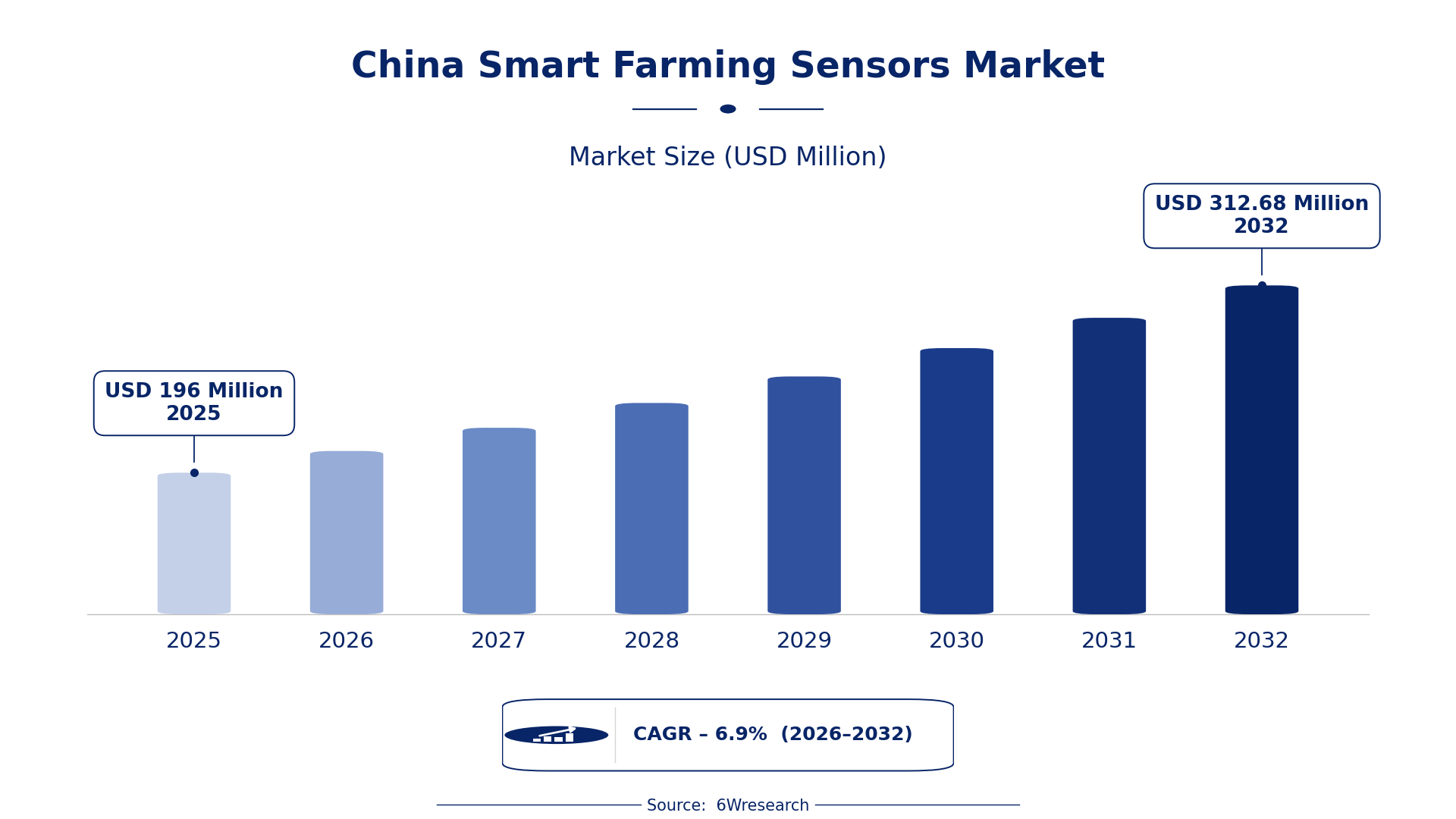
According to 6Wresearch internal database and industry insights, the China Smart Farming Sensors Market was valued at USD 196.0 million in 2025 and is projected to reach USD 312.68 million by 2032, growing at a CAGR of approximately 6.9% during 2026–2032.
China Smart Farming Sensors Market Highlights
| Report Metric | Details |
| Report Name | China Smart Farming Sensors Market |
| Market Size 2025 | USD 196.0 million |
| Market Size 2032 | USD 312.68 million |
| Absolute Growth 2025–2032 | USD 116.68 million |
| CAGR 2026–2032 | 6.9% |
| Peak Annual Growth | 8.7% in 2031 |
| Forecast Period | 2026–2032 |
| Historical Data | 2022–2025 |
| Base Year | 2025 |
| Leading Sensor Type, 2025 | Soil Moisture Sensors (49% share) |
| Leading Monitoring Focus, 2025 | Irrigation Optimization (51% share) |
| Leading Deployment Area, 2025 | In-Field (52% share) |
| Leading End User, 2025 | Precision Farmers (42% share) |
| Fastest-Growing Sensor Type | Weather Sensors (8.4% CAGR) |
| Fastest-Growing Monitoring Focus | Microclimate Monitoring (9.0% CAGR) |
| Fastest-Growing Deployment Area | On-Farm Stations (8.8% CAGR) |
| Fastest-Growing End User | Greenhouse Growers (7.9% CAGR) |
| Growing Sector | Greenhouse Growers |
| Key End Users | Precision Farmers, Greenhouse Growers, Dairy & Poultry Farms, AgriChem Solution Providers |
China Smart Farming Sensors Market Year-wise Growth Rate and Key Drivers (2022–2032)
This graph illustrates the annual growth rates of the market from 2022 to 2032, highlighting a steady upward trajectory and projected market expansion over the forecast period.
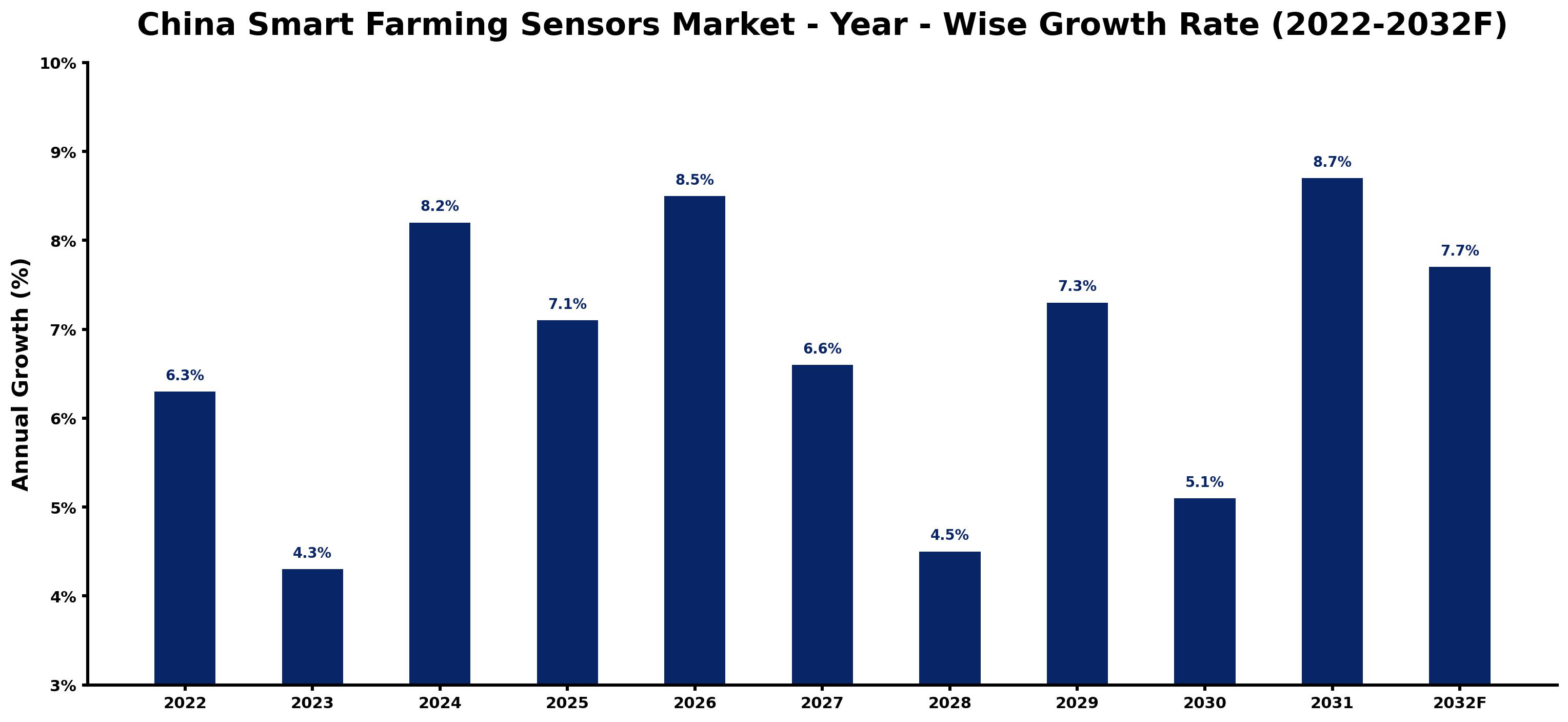
Below, each year's estimated growth is shown next to the factor that most influenced it.
| Year | Estimated Annual Growth (%) | Market Rationale |
| 2022 | 6.3 | The market exhibited steady growth, driven by the National Agricultural Technology Extension and Service Center promoting smart farming practices. |
| 2023 | 4.3 | Growth slowed due to the Agricultural Internet of Things initiative focusing on integrating existing technologies. |
| 2024 | 8.2 | The market rebounded with heightened investment in precision agriculture initiatives, particularly in Shandong province. |
| 2025 | 7.1 | Demand continued to rise as farmers sought efficient irrigation solutions through the Agricultural Machinery Purchase Subsidy Program. |
| 2026 | 8.5 | Investment surged, reflecting a growing interest in advanced monitoring systems, especially among precision farmers. |
| 2027 | 6.6 | Growth slowed as manufacturers faced challenges in scaling production capacity for weather sensors. |
| 2028 | 4.5 | Market expansion decelerated, with a focus on improving product features for livestock bio-sensors. |
| 2029 | 7.3 | Increased demand for smart solutions revitalised growth in the sector, particularly in greenhouse operations. |
| 2030 | 5.1 | Growth slowed as market players adjusted to changing consumer preferences for smart farming technologies. |
| 2031 | 8.7 | The market peaked with significant investments in smart farming technologies, driven by government subsidies. |
| 2032 | 7.7 | A slight slowdown occurred as the market stabilised after rapid growth in adoption rates. |
Note: Market size estimations and growth projections presented in this report are based on 6Wresearch's proprietary forecasting methodology, utilizing the latest available industry data, government publications, and primary research inputs.
China Smart Farming Sensors Market Synopsis
Smart Farming Sensors in China encompass advanced devices designed to monitor environmental parameters essential for agriculture. These sensors optimise irrigation, monitor microclimates, and assess livestock health, improving farming efficiency. The China Smart Farming Sensors Market is expanding due to rising demand from precision farmers and greenhouse growers.
Market Dynamics Impact Analysis (2026–2032)
| Factor | Type | Impact | Primary Segment Affected |
| Increased investment in precision agriculture technologies | Driver | High | Irrigation Optimization |
| Growing adoption of smart farming practices among farmers | Driver | High | Precision Farmers |
| Rising demand for efficient farming solutions | Opportunity | High | Greenhouse Growers |
| Expansion of smart farming technologies in major agricultural provinces | Opportunity | Medium | In-Field |
| High costs associated with technology adoption | Restraint | High | Livestock Bio-Sensors |
| Limited awareness of smart farming benefits among small farmers | Restraint | Medium | Weather Sensors |
| Challenges in integrating new technologies with existing systems | Challenge | High | Soil Moisture Sensors |
| Supply chain disruptions affecting sensor availability | Challenge | Medium | CO₂ & pH Sensors |
Evaluation of Drivers in China Smart Farming Sensors Market (2026–2032)
The table below links each growth driver to the segment it affects and the evidence for it.
| Drivers | Primary Segment Affected | Why It Matters (Evidence) |
| Increased investment in precision agriculture technologies | Irrigation Optimization | This investment enables farmers to adopt advanced irrigation systems, improving water efficiency and crop yields, with the Ministry of Agriculture allocating 1 billion CNY for smart farming technology development. |
| Growing adoption of smart farming practices among farmers | Precision Farmers | As more farmers recognise the benefits, demand for smart sensors rises, leading to increased purchases in major agricultural provinces like Shandong. |
| Expansion of smart farming technologies in major agricultural provinces | In-Field | Regions like Shandong and Henan are adopting these technologies, boosting overall market demand for smart farming sensors. |
| Government subsidies for smart farming technologies | Weather Sensors | Subsidies encourage small farmers to invest in weather monitoring, increasing sensor uptake, with the Agricultural Machinery Purchase Subsidy Program supporting farmers in acquiring smart farming equipment. |
| Integration of the Agricultural Internet of Things (AIoT) initiative | Livestock Bio-Sensors | This initiative promotes data-driven farming, increasing the need for bio-sensors in livestock management, particularly among dairy and poultry farms. |
The Smart Farming Sensors market in China is expanding as increased investment in precision agriculture technologies, along with growing adoption of smart farming practices, drives demand. Provinces like Shandong are adopting advanced irrigation systems, enhancing water efficiency and crop yields. The integration of smart farming sensors with data analytics facilitates better decision-making for farmers.
Evaluation of Restraints in China Smart Farming Sensors Market
Below mentioned are some major restraints and their influence on market dynamics.
| Market Restraint | Primary Segment Affected | Why It Matters (Evidence) |
| Skills shortage among small farmers | Precision Farmers | Many small farmers lack the technical knowledge to effectively utilise smart farming sensors, leading to inefficient resource use and potential yield losses. |
| High costs of smart farming technologies | Weather Sensors | Small farmers often struggle to afford these investments, delaying their transition to modern practices and limiting market growth. |
| Competition from traditional farming methods | Irrigation Optimization | Buyers in agricultural regions like Shandong experience competition from conventional practices, which can slow the uptake of advanced solutions. |
| Fierce competition from local manufacturers | Livestock Bio-Sensors | Suppliers face price wars that can erode profit margins, affecting their ability to invest in new technologies. |
| Regulatory hurdles for new technology adoption | Microclimate Monitoring | Complex approval processes can delay the introduction of new smart farming solutions, hindering market expansion. |
China Smart Farming Sensors Market Challenges
In China, the smart farming sensors market faces a skills gap, as many small farmers lack the technical know-how to effectively utilise these advanced devices. This shortfall leads to inefficient resource management, costing farmers around 20% in potential yield gains. The high costs associated with smart farming technologies further hinder adoption; numerous small farmers struggle to invest in these solutions, delaying their transition to modern agricultural practices. Buyers in major agricultural provinces like Shandong and Henan encounter competition from traditional farming methods, which can obstruct the shift towards modern technologies. Suppliers also face intense competition from local manufacturers, resulting in price wars that can erode profit margins.
Trends in the China Smart Farming Sensors Market
Below mentioned are some of the trends shaping the China Smart Farming Sensors Market growth.
- Shift from Traditional to Smart Farming: In 2023, the Ministry of Agriculture's programme promoting smart farming technologies is driving a shift away from traditional methods. With over 200 million hectares of arable land adopting these technologies, farmers are increasingly recognising the benefits.
- Emergence of Integrated Farming Solutions: Since 2022, there has been a notable change towards integrated farming solutions that combine sensors with data analytics. The Agricultural Internet of Things initiative is facilitating this transition, improving decision-making for farmers.
- Increase in Subsidised Smart Farming Equipment: The Agricultural Machinery Purchase Subsidy Program, launched in 2023, is increasing the accessibility of smart farming equipment for small farmers. This initiative is set to boost sensor adoption rates across various agricultural regions.
- Growth in Greenhouse Operations: Smart farming sensors are increasingly adopted in greenhouse operations, particularly in Jiangsu province. This trend is driven by the need for precise environmental control, resulting in improved crop yields.
Investment Opportunities in the China Smart Farming Sensors Market
The following opportunities in the China Smart Farming Sensors Market pair current demand with a clear way in.
- Investment in Precision Agriculture: With a projected market size of 100 billion CNY by 2025, there is a notable opportunity for investment in precision agriculture technologies. Precision farmers in Shandong are actively seeking advanced solutions to boost crop yields.
- Expansion into Greenhouse Markets: The rising adoption of smart farming sensors in greenhouse operations presents a chance for suppliers. With Jiangsu province at the forefront, partnerships with local growers can facilitate market entry.
- Development of AIoT Solutions: The integration of smart farming sensors with data analytics presents a valuable opportunity for technology providers. Collaborating with research institutions can aid in developing effective solutions for farmers.
- Focus on Livestock Management Technologies: As the demand for livestock bio-sensors increases, there is an opportunity to provide advanced monitoring solutions. Engaging with dairy and poultry farms can lead to beneficial partnerships.
Government Initiatives in the China Smart Farming Sensors Market
The National Standard for Smart Agriculture (GB/T 39630-2020) sets guidelines for smart farming practices, ensuring producers meet quality standards. This regulation requires manufacturers to pursue ISO 9001 certification to guarantee product reliability and safety, benefiting buyers by ensuring high-quality products. The government's aim to increase smart agriculture technology adoption by 30% by 2025 seeks to improve efficiency and productivity in the agricultural sector, benefiting both producers and consumers.
In 2023, the Ministry of Agriculture announced a budget of 1 billion CNY for smart farming technology development. This funding supports research and development initiatives aimed at enhancing the effectiveness of smart farming solutions. The Agricultural Internet of Things initiative promotes the integration of smart sensors with data analytics, facilitating better decision-making for farmers and boosting overall productivity.
Future Insight of the China Smart Farming Sensors Market
Several forward-looking factors should support the smart farming sensors market in China in the coming years. The Ministry of Agriculture's budget of 1 billion CNY for smart farming technology development will improve accessibility for small farmers. The Agricultural Internet of Things initiative aims to integrate sensors with data analytics, enhancing decision-making for producers. By 2025, the government's target to increase smart agriculture technology adoption by 30% will further drive market growth. Research from the China Agricultural University is expected to validate the effectiveness of these technologies, encouraging wider acceptance among agricultural stakeholders.
Market Segmentation Analysis
Each segment group is reviewed below, with the leader by share and the fastest grower by CAGR.
By Sensor Type – Soil Moisture Sensors Dominated, Weather Sensors Expected to Grow Fastest
According to Dhaval Chaurasia, Assistant Manager at 6Wresearch, Soil Moisture Sensors accounted for a 49% market share by sensor type in 2025. Soil moisture sensors hold the largest share in the China Smart Farming Sensors Market because they are essential for irrigation management and crop health monitoring. Their widespread use across over 200 million hectares of arable land in provinces like Shandong and Henan underscores their importance to farmers. Weather Sensors are set to record the highest CAGR in this split, 8.4% over 2026–2032. Weather sensors are experiencing rapid growth as they play a critical role in predicting weather patterns that directly affect farming activities. The increasing focus on precise weather forecasting to enhance agricultural productivity is propelling this segment's expansion. Suppliers should prioritise enhancing the availability and capabilities of weather sensors to meet the rising demand.
By Monitoring Focus – Irrigation Optimization Dominated, Microclimate Monitoring Expected to Grow Fastest
In 2025, Irrigation Optimization led the monitoring focus split with a 51% share. Irrigation optimization commands the largest market share as it is vital for efficient water usage in agriculture, especially in a country with vast arable land. The growing adoption of these solutions by farmers reflects the need to manage water resources effectively amid population pressures. Over 2026–2032, Microclimate Monitoring is expected to post the fastest growth, at a CAGR of 9.0%. Microclimate monitoring is the fastest-growing segment, crucial for understanding localized weather conditions that can significantly impact crop yields. The rising interest in precision agriculture practices is driving the rapid growth of this segment. Buyers will benefit from investing in microclimate monitoring solutions to enhance crop management and improve yield outcomes.
By Deployment Area – In-Field Dominated, On-Farm Stations Expected to Grow Fastest
In-Field held a 52% share of the China Smart Farming Sensors Market by deployment area in 2025. In-field deployment leads the market share as it is the primary area for sensor installation, allowing farmers to monitor crops directly. This approach is essential for real-time data collection and immediate decision-making in agricultural practices. The quickest growth will come from On-Farm Stations, forecast to expand at a CAGR of 8.8% between 2026 and 2032. On-farm stations represent the fastest-growing deployment area, used for centralised data collection and analysis, thereby improving operational efficiency. The trend towards integrated farming solutions is accelerating the adoption of these stations. Suppliers should concentrate on developing more robust on-farm station solutions to cater to the increasing demand for centralised data management.
By End User – Precision Farmers Dominated, Greenhouse Growers Expected to Grow Fastest
With a 42% revenue share in 2025, Precision Farmers was the largest end user category. Precision farmers represent the largest share of the market as they are the primary users of smart farming technologies, concentrating on maximising yields and efficiency. Their demand for advanced solutions is reflected in the substantial investments made in smart farming practices. Greenhouse Growers are projected to grow fastest, at a CAGR of 7.9% during 2026–2032. Greenhouse growers are the fastest-growing end user segment, utilising smart farming sensors for controlled environment agriculture. The rising popularity of greenhouse farming is driving the rapid expansion of this segment. Suppliers should tailor their offerings to meet the specific needs of greenhouse growers, who are seeking advanced technologies for optimal crop production.
Key Attractiveness of the Report
- 10 Years of Market Numbers
- Historical Data Starting from 2022 to 2025
- Base Year 2025
- Forecast Data until 2032
- Key Performance Indicators Impacting the Market
- Major Upcoming Developments and Projects
Key Highlights of the Report:
- China Smart Farming Sensors Market Outlook
- Market Size of China Smart Farming Sensors Market, 2025
- Forecast of China Smart Farming Sensors Market, 2032
- Historical Data and Forecast of China Smart Farming Sensors Revenues & Volume for the Period 2022 - 2032F
- China Smart Farming Sensors Market Trend Evolution
- China Smart Farming Sensors Market Drivers and Challenges
- China Smart Farming Sensors Price Trends
- China Smart Farming Sensors Porter's Five Forces
- China Smart Farming Sensors Industry Life Cycle
- Historical Data and Forecast of China Smart Farming Sensors Market Revenues & Volume By Sensor Type for the Period 2022 - 2032F
- Historical Data and Forecast of China Smart Farming Sensors Market Revenues & Volume By Soil Moisture Sensors for the Period 2022 - 2032F
- Historical Data and Forecast of China Smart Farming Sensors Market Revenues & Volume By Weather Sensors for the Period 2022 - 2032F
- Historical Data and Forecast of China Smart Farming Sensors Market Revenues & Volume By Livestock Bio-Sensors for the Period 2022 - 2032F
- Historical Data and Forecast of China Smart Farming Sensors Market Revenues & Volume By CO & pH Sensors for the Period 2022 - 2032F
- Historical Data and Forecast of China Smart Farming Sensors Market Revenues & Volume By Monitoring Focus for the Period 2022 - 2032F
- Historical Data and Forecast of China Smart Farming Sensors Market Revenues & Volume By Irrigation Optimization for the Period 2022 - 2032F
- Historical Data and Forecast of China Smart Farming Sensors Market Revenues & Volume By Microclimate Monitoring for the Period 2022 - 2032F
- Historical Data and Forecast of China Smart Farming Sensors Market Revenues & Volume By Animal Vital Signs for the Period 2022 - 2032F
- Historical Data and Forecast of China Smart Farming Sensors Market Revenues & Volume By Soil Chemistry Analysis for the Period 2022 - 2032F
- Historical Data and Forecast of China Smart Farming Sensors Market Revenues & Volume By Deployment Area for the Period 2022 - 2032F
- Historical Data and Forecast of China Smart Farming Sensors Market Revenues & Volume By In-Field for the Period 2022 - 2032F
- Historical Data and Forecast of China Smart Farming Sensors Market Revenues & Volume By On-Farm Stations for the Period 2022 - 2032F
- Historical Data and Forecast of China Smart Farming Sensors Market Revenues & Volume By Wearable on Livestock for the Period 2022 - 2032F
- Historical Data and Forecast of China Smart Farming Sensors Market Revenues & Volume By Underground Deployment for the Period 2022 - 2032F
- Historical Data and Forecast of China Smart Farming Sensors Market Revenues & Volume By End User for the Period 2022 - 2032F
- Historical Data and Forecast of China Smart Farming Sensors Market Revenues & Volume By Precision Farmers for the Period 2022 - 2032F
- Historical Data and Forecast of China Smart Farming Sensors Market Revenues & Volume By Greenhouse Growers for the Period 2022 - 2032F
- Historical Data and Forecast of China Smart Farming Sensors Market Revenues & Volume By Dairy & Poultry Farms for the Period 2022 - 2032F
- Historical Data and Forecast of China Smart Farming Sensors Market Revenues & Volume By AgriChem Solution Providers for the Period 2022 - 2032F
- China Smart Farming Sensors Import Export Trade Statistics
- Market Opportunity Assessment By Sensor Type
- Market Opportunity Assessment By Monitoring Focus
- Market Opportunity Assessment By Deployment Area
- Market Opportunity Assessment By End User
- China Smart Farming Sensors Top Companies Market Share
- China Smart Farming Sensors Competitive Benchmarking By Technical and Operational Parameters
- China Smart Farming Sensors Company Profiles
- China Smart Farming Sensors Key Strategic Recommendations
Market Covered
Segments analysed in this report are listed below.
By Sensor Type
- Soil Moisture Sensors
- Weather Sensors
- Livestock Bio-Sensors
- CO₂ & pH Sensors
By Monitoring Focus
- Irrigation Optimization
- Microclimate Monitoring
- Animal Vital Signs
- Soil Chemistry Analysis
By Deployment Area
- In-Field
- On-Farm Stations
- Wearable on Livestock
- Underground Deployment
By End User
- Precision Farmers
- Greenhouse Growers
- Dairy & Poultry Farms
- AgriChem Solution Providers































