India Smart Farming Sensors Market Size & Growth Rate
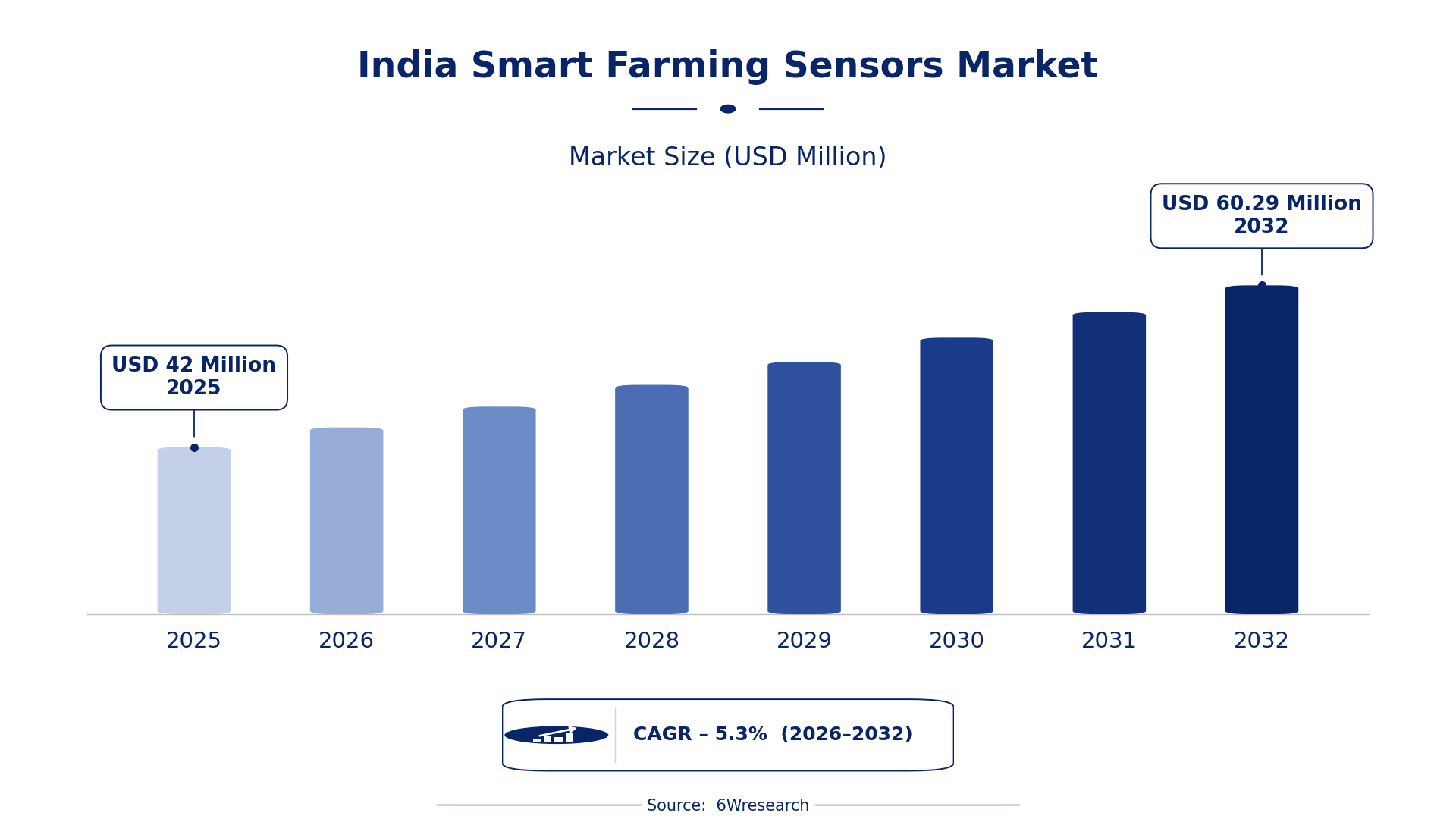
According to 6Wresearch internal database and industry insights, the India Smart Farming Sensors Market was valued at USD 42.0 million in 2025 and is projected to reach USD 60.29 million by 2032, growing at a CAGR of approximately 5.3% during 2026–2032.
India Smart Farming Sensors Market Highlights
| Report Metric | Details |
| Report Name | India Smart Farming Sensors Market |
| Market Size 2025 | USD 42.0 million |
| Market Size 2032 | USD 60.29 million |
| Absolute Growth 2025–2032 | USD 18.29 million |
| CAGR 2026–2032 | 5.3% |
| Peak Annual Growth | 7.6% in 2028 |
| Forecast Period | 2026–2032 |
| Historical Data | 2022–2025 |
| Base Year | 2025 |
| Leading Sensor Type, 2025 | Soil Moisture Sensors (39% share) |
| Leading Monitoring Focus, 2025 | Irrigation Optimization (54% share) |
| Leading Deployment Area, 2025 | In-Field (35% share) |
| Leading End User, 2025 | Precision Farmers (48% share) |
| Fastest-Growing Sensor Type | Weather Sensors (6.9% CAGR) |
| Fastest-Growing Monitoring Focus | Microclimate Monitoring (6.3% CAGR) |
| Fastest-Growing Deployment Area | On-Farm Stations (6.5% CAGR) |
| Fastest-Growing End User | Greenhouse Growers (7.1% CAGR) |
| Growing Sector | Precision Agriculture |
| Key End Users | Precision Farmers, Dairy & Poultry Farms, AgriChem Solution Providers |
India Smart Farming Sensors Market Year-wise Growth Rate and Key Drivers (2022–2032)
This graph illustrates the annual growth rates of the market from 2022 to 2032, highlighting a steady upward trajectory and projected market expansion over the forecast period.
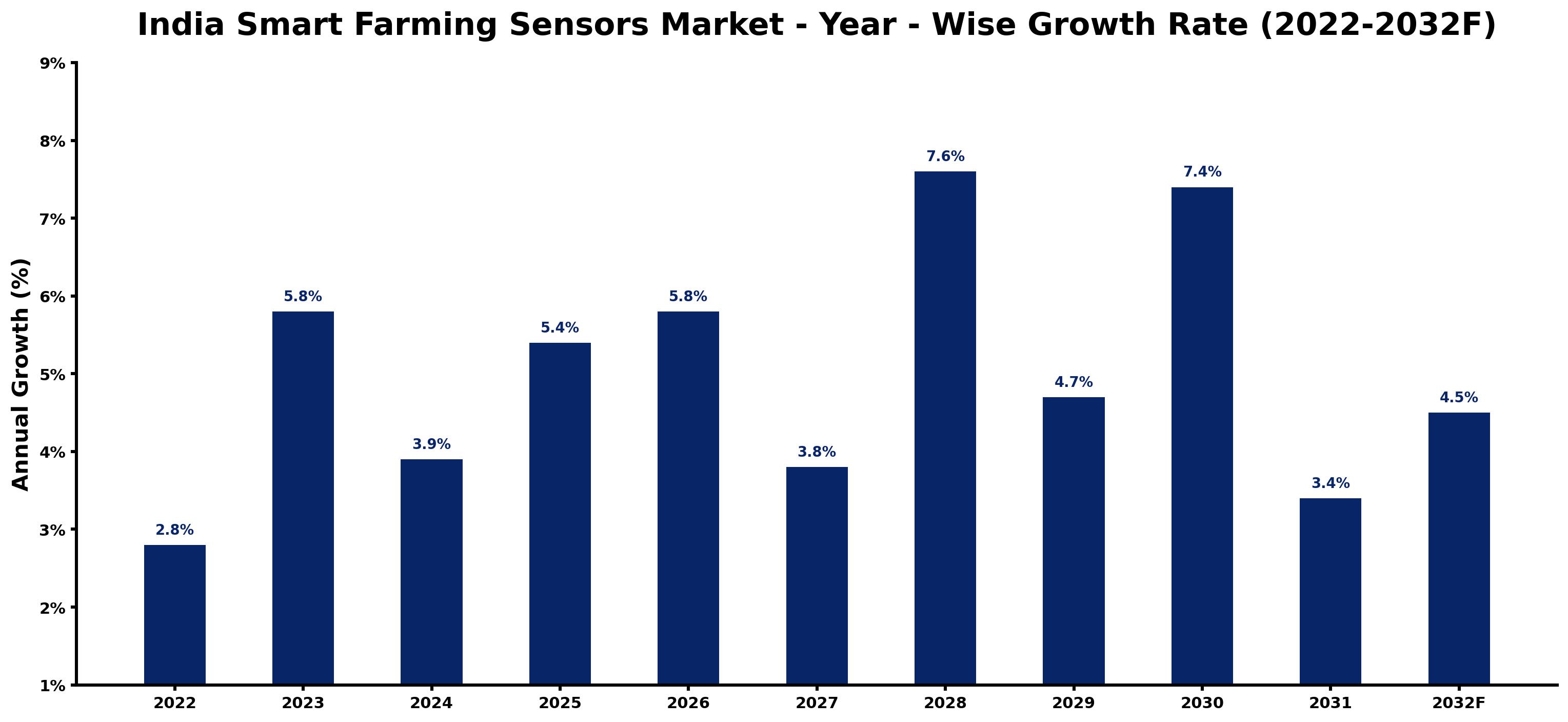
Year by year, the estimates below pair each growth rate with the development that shaped it.
| Year | Estimated Annual Growth (%) | Market Rationale |
| 2022 | 2.8 | The market showed steady growth as farmers increasingly adopted smart technologies for better yields through the Pradhan Mantri Krishi Sinchai Yojana. |
| 2023 | 5.8 | Growth accelerated due to heightened awareness of sustainable farming practices among precision farmers in Maharashtra. |
| 2024 | 3.9 | A slowdown occurred as farmers adjusted to the rapid technological adoption seen the previous year. |
| 2025 | 5.4 | Demand surged again as the government promoted irrigation efficiency through the Pradhan Mantri Krishi Sinchai Yojana. |
| 2026 | 5.8 | Growth is expected to continue as precision farming gains traction, particularly among dairy and poultry farms in Karnataka. |
| 2027 | 3.8 | A slowdown is projected as the market faces challenges in technology integration among smaller farms in rural areas. |
| 2028 | 7.6 | The market is expected to peak with investments in smart farming technologies, enhancing agricultural productivity through government initiatives. |
| 2029 | 4.7 | Growth is anticipated to slow as competition increases among sensor providers, impacting pricing strategies for farmers. |
| 2030 | 7.4 | A rebound is expected as precision farming practices expand, driven by rising food production demands in Gujarat and Rajasthan. |
| 2031 | 3.4 | The market is projected to experience a slowdown as buyers adjust to new technologies and their applications in various regions. |
| 2032 | 4.5 | Growth is expected to rise again as more farmers adopt smart farming solutions for efficiency, particularly in Maharashtra. |
Note: Market size estimations and growth projections presented in this report are based on 6Wresearch's proprietary forecasting methodology, utilizing the latest available industry data, government publications, and primary research inputs.
India Smart Farming Sensors Market Synopsis
Smart Farming Sensors in India are advanced devices that monitor environmental and soil conditions to optimise agricultural practices. These sensors are vital for irrigation management, livestock health monitoring, and soil chemistry analysis. The India Smart Farming Sensors Market is growing due to increasing food production demands and government initiatives like the Pradhan Mantri Krishi Sinchai Yojana, which promotes efficient irrigation practices. With over 600 million people employed in agriculture, the demand for smart farming technologies is substantial, driving investments in this sector.
Market Dynamics Impact Analysis (2026–2032)
| Factor | Type | Impact | Primary Segment Affected |
| Increasing adoption of irrigation optimization technologies among farmers | Driver | High | Irrigation Optimization |
| Rising demand for livestock monitoring solutions in dairy farms | Driver | High | Livestock Bio-Sensors |
| Growing need for efficient water management in agriculture | Opportunity | High | Soil Moisture Sensors |
| Expansion of precision farming practices in Maharashtra and Karnataka | Opportunity | Medium | Precision Farmers |
| High initial costs of smart farming sensor technologies | Restraint | High | Soil Moisture Sensors |
| Limited awareness and training among smallholder farmers | Restraint | Medium | Livestock Bio-Sensors |
| The Smart Farming Sensors Market in India faces challenges in technology adoption | Challenge | High | Irrigation Optimization |
| Supply chain disruptions affecting sensor availability and pricing | Challenge | Medium | Weather Sensors |
Evaluation of Drivers in India Smart Farming Sensors Market (2026–2032)
The main growth drivers and the segments they affect most are set out below.
| Drivers | Primary Segment Affected | Why It Matters (Evidence) |
| Government initiatives promoting irrigation efficiency | Irrigation Optimization | The Pradhan Mantri Krishi Sinchai Yojana aims to improve water use efficiency, leading farmers to invest in smart sensors. |
| Rising livestock health concerns among dairy farmers | Livestock Bio-Sensors | Increased focus on animal welfare drives demand for bio-sensors, particularly in Gujarat and Rajasthan. |
| Growing awareness of soil health management | Soil Moisture Sensors | Farmers are increasingly using soil moisture sensors to optimise irrigation practices, especially in Punjab and Haryana. |
| Technological advancements in sensor capabilities | Weather Sensors | Improved accuracy and affordability of weather sensors encourage adoption among precision farmers. |
| Increase in private sector investments in agriculture technology | Precision Farmers | Investment in smart farming technologies supports farmers in achieving higher yields and efficiency. |
Growth in the Smart Farming Sensors market in India comes from rising adoption of irrigation optimisation technologies and increasing livestock monitoring solutions. In 2022, over 600 million individuals were employed in agriculture, driving demand for smart farming technologies. Increased awareness of soil health management has led to a rise in the use of soil moisture sensors. As precision farming practices expand in Maharashtra and Karnataka, demand for smart farming sensors continues to rise.
Evaluation of Restraints in India Smart Farming Sensors Market
The table below lists the restraints and the evidence behind each.
| Market Restraint | Primary Segment Affected | Why It Matters (Evidence) |
| High initial costs of smart farming technologies | Soil Moisture Sensors | The investment required for advanced sensors limits access for smaller farms, affecting adoption rates. |
| Limited awareness among smallholder farmers | Livestock Bio-Sensors | Many small farmers lack knowledge about the benefits of bio-sensors, hindering market growth. |
| Supply chain disruptions impacting sensor availability | Weather Sensors | Recent global supply chain issues have led to delays in sensor delivery, affecting farmers' purchasing decisions. |
| Inconsistent regulatory standards for agricultural sensors | Irrigation Optimization | Varying guidelines can create confusion among producers, slowing down sensor integration into farming practices. |
| Technological complexity deterring adoption | Precision Farmers | Some farmers find it challenging to understand and implement advanced sensor technologies, limiting market penetration. |
India Smart Farming Sensors Market Challenges
The India Smart Farming Sensors Market faces several practical problems, starting with regulatory hurdles that slow down the adoption of new technologies. The Bureau of Indian Standards has established guidelines that can delay product launches for suppliers by up to six months. Next, high costs associated with advanced smart farming sensors deter many farmers from investing; initial setup costs can exceed ₹50,000 per farm, making it unaffordable for smallholders. A skills gap exists as many farmers lack the technical knowledge to operate these devices, resulting in underutilisation of the technology. Buyers often struggle with limited access to reliable suppliers, leading to inconsistent product availability and forcing them to rely on outdated methods.
Trends in the India Smart Farming Sensors Market
Four trends stand out in the India Smart Farming Sensors Market.
- Shift towards Precision Farming: Precision farmers are increasingly adopting smart farming sensors to improve productivity. In 2022, the market saw a 5.8% growth, driven by the need for efficient resource management in Maharashtra.
- Emergence of Livestock Bio-Sensors: Livestock bio-sensors have gained traction in dairy farms across Gujarat and Rajasthan, with usage rising notably in recent years. The market for these sensors is projected to grow as farmers seek better animal health management.
- Transition from Traditional to Smart Irrigation: The shift began in 2015 with the introduction of the Pradhan Mantri Krishi Sinchai Yojana, promoting smart irrigation solutions. In 2022, the allocation of ₹1,500 crores for agricultural technology advancements further accelerated this transition.
- Increase in Government Support for Smart Farming: The National Agriculture Technology Mission, introduced in 2023, aims to support tech adoption among farmers. This initiative is expected to facilitate the integration of smart farming solutions across India.
Investment Opportunities in the India Smart Farming Sensors Market
Investors looking at the India Smart Farming Sensors Market should consider the following areas.
- Partnerships with Local Farmers: Now is the right time to invest in smart farming sensors, especially for companies looking to partner with local farmers. The growing demand in Maharashtra and Karnataka presents an opportunity for collaboration.
- Investment in Sensor Manufacturing: With the market expected to reach USD 60.29 million by 2032, investing in local sensor manufacturing facilities can meet rising demand. Precision farmers in these regions are actively seeking advanced technologies.
- Expansion into Dairy Farming: Dairy farms in Gujarat and Rajasthan are increasingly reliant on monitoring technologies, creating an opportunity for suppliers. Entering this market can be achieved through local partnerships and targeted marketing.
- Development of Training Programs: There is a pressing need for training programs to educate farmers on smart farming technologies. Collaborating with agricultural universities can facilitate knowledge transfer and increase adoption rates.
Government Initiatives in the India Smart Farming Sensors Market
The Bureau of Indian Standards has set guidelines for agricultural sensors in 2021, ensuring quality and safety standards for producers. This measure helps buyers by providing assurance that the sensors meet required specifications, thus improving their reliability in the field. The guidelines encourage manufacturers to adhere to best practices, building trust in smart farming technologies.
The Ministry of Agriculture and Farmers' Welfare oversees initiatives to integrate technology in farming, approving funding for various projects. In 2022, the government allocated ₹1,500 crores for agricultural technology advancements, supporting the development and adoption of smart farming sensors. This funding enables producers to access advanced technologies, improving agricultural productivity and sustainability.
Future Insight of the India Smart Farming Sensors Market
The India Smart Farming Sensors Market will see substantial advancements by 2032, driven by technology and government initiatives. The Pradhan Mantri Krishi Sinchai Yojana will improve irrigation efficiency, while the National Agriculture Technology Mission will support tech adoption among farmers. By 2025, precision farming is projected to grow in Maharashtra and Karnataka, benefiting local producers. As the Digital India initiative progresses, buyers and suppliers will experience greater integration of smart farming practices, leading to more sustainable agricultural outputs.
Market Segmentation Analysis
The analysis below covers each segmentation, its leading category in 2025 and its fastest-growing category through 2032.
By Sensor Type – Soil Moisture Sensors Dominated, Weather Sensors Expected to Grow Fastest
According to Dhaval Chaurasia, Assistant Manager at 6Wresearch, in 2025, Soil Moisture Sensors led the sensor type split with a 39% share. Soil moisture sensors hold the largest market share in India because they are essential for irrigation management, particularly in states like Punjab and Haryana where water conservation is critical. Their widespread adoption is supported by government initiatives aimed at improving irrigation efficiency and promoting sustainable agricultural practices. The quickest growth will come from Weather Sensors, forecast to expand at a CAGR of 6.9% between 2026 and 2032. Weather sensors are witnessing rapid growth as farmers increasingly rely on accurate climate predictions to enhance their agricultural practices. The introduction of advanced weather monitoring technologies is enabling farmers to adapt to changing weather conditions, thus accelerating their adoption across various regions. Suppliers should focus on developing advanced weather sensors to meet the rising demand from farmers seeking improved climate adaptability.
By Monitoring Focus – Irrigation Optimization Dominated, Microclimate Monitoring Expected to Grow Fastest
With a 54% revenue share in 2025, Irrigation Optimization was the largest monitoring focus category. Irrigation optimization leads the market due to its critical importance in efficient water usage within India's vast agricultural sector, which employs over 600 million individuals. The push for sustainable practices, bolstered by government initiatives, has made this segment a priority for many farmers. Microclimate Monitoring is set to record the highest CAGR in this split, 6.3% over 2026–2032. Microclimate monitoring is growing rapidly as it allows farmers to understand localized weather patterns, leading to more precise agricultural decisions. The increasing emphasis on microclimates is a response to the need for tailored farming solutions across India's diverse climatic conditions. Buyers should consider investing in microclimate monitoring solutions to refine their farming strategies and improve crop yields.
By Deployment Area – In-Field Dominated, On-Farm Stations Expected to Grow Fastest
In-Field held a 35% share of the India Smart Farming Sensors Market by deployment area in 2025. In-field deployment holds the largest market share as it serves as the primary application area for smart farming sensors, directly influencing crop management and irrigation practices. This segment benefits from the extensive agricultural activities occurring throughout various regions in India. On-Farm Stations are projected to grow fastest, at a CAGR of 6.5% during 2026–2032. On-farm stations are the fastest-growing deployment area, offering centralized monitoring locations that improve data collection and analysis. The increasing establishment of such stations indicates a shift towards more integrated farming approaches, enabling better resource management. Suppliers should consider expanding their offerings for on-farm station solutions to capitalise on this growing trend.
By End User – Precision Farmers Dominated, Greenhouse Growers Expected to Grow Fastest
Precision Farmers took a 48% share of end user in 2025, more than any other category. Precision farmers dominate the market as they represent the primary user group for advanced farming technologies, aiming to maximise yield and efficiency. Their dedication to adopting smart farming solutions is reflected in the increasing investments in technology-driven agriculture. Over 2026–2032, Greenhouse Growers are expected to post the fastest growth, at a CAGR of 7.1%. Greenhouse growers are the fastest-growing end user segment, utilising sensors to create controlled environments that optimise plant growth. The rising popularity of greenhouse farming in India is driving demand for smart farming sensors specifically designed for these unique requirements. Suppliers should tailor their products to meet the specific needs of greenhouse growers to capitalise on this expanding market.
Key Attractiveness of the Report
- 10 Years of Market Numbers
- Historical Data Starting from 2022 to 2025
- Base Year 2025
- Forecast Data until 2032
- Key Performance Indicators Impacting the Market
- Major Upcoming Developments and Projects
Key Highlights of the Report:
- India Smart Farming Sensors Market Outlook
- Market Size of India Smart Farming Sensors Market, 2025
- Forecast of India Smart Farming Sensors Market, 2032
- Historical Data and Forecast of India Smart Farming Sensors Revenues & Volume for the Period 2022 - 2032F
- India Smart Farming Sensors Market Trend Evolution
- India Smart Farming Sensors Market Drivers and Challenges
- India Smart Farming Sensors Price Trends
- India Smart Farming Sensors Porter's Five Forces
- India Smart Farming Sensors Industry Life Cycle
- Historical Data and Forecast of India Smart Farming Sensors Market Revenues & Volume By Sensor Type for the Period 2022 - 2032F
- Historical Data and Forecast of India Smart Farming Sensors Market Revenues & Volume By Soil Moisture Sensors for the Period 2022 - 2032F
- Historical Data and Forecast of India Smart Farming Sensors Market Revenues & Volume By Weather Sensors for the Period 2022 - 2032F
- Historical Data and Forecast of India Smart Farming Sensors Market Revenues & Volume By Livestock Bio-Sensors for the Period 2022 - 2032F
- Historical Data and Forecast of India Smart Farming Sensors Market Revenues & Volume By CO & pH Sensors for the Period 2022 - 2032F
- Historical Data and Forecast of India Smart Farming Sensors Market Revenues & Volume By Monitoring Focus for the Period 2022 - 2032F
- Historical Data and Forecast of India Smart Farming Sensors Market Revenues & Volume By Irrigation Optimization for the Period 2022 - 2032F
- Historical Data and Forecast of India Smart Farming Sensors Market Revenues & Volume By Microclimate Monitoring for the Period 2022 - 2032F
- Historical Data and Forecast of India Smart Farming Sensors Market Revenues & Volume By Animal Vital Signs for the Period 2022 - 2032F
- Historical Data and Forecast of India Smart Farming Sensors Market Revenues & Volume By Soil Chemistry Analysis for the Period 2022 - 2032F
- Historical Data and Forecast of India Smart Farming Sensors Market Revenues & Volume By Deployment Area for the Period 2022 - 2032F
- Historical Data and Forecast of India Smart Farming Sensors Market Revenues & Volume By In-Field for the Period 2022 - 2032F
- Historical Data and Forecast of India Smart Farming Sensors Market Revenues & Volume By On-Farm Stations for the Period 2022 - 2032F
- Historical Data and Forecast of India Smart Farming Sensors Market Revenues & Volume By Wearable on Livestock for the Period 2022 - 2032F
- Historical Data and Forecast of India Smart Farming Sensors Market Revenues & Volume By Underground Deployment for the Period 2022 - 2032F
- Historical Data and Forecast of India Smart Farming Sensors Market Revenues & Volume By End User for the Period 2022 - 2032F
- Historical Data and Forecast of India Smart Farming Sensors Market Revenues & Volume By Precision Farmers for the Period 2022 - 2032F
- Historical Data and Forecast of India Smart Farming Sensors Market Revenues & Volume By Greenhouse Growers for the Period 2022 - 2032F
- Historical Data and Forecast of India Smart Farming Sensors Market Revenues & Volume By Dairy & Poultry Farms for the Period 2022 - 2032F
- Historical Data and Forecast of India Smart Farming Sensors Market Revenues & Volume By AgriChem Solution Providers for the Period 2022 - 2032F
- India Smart Farming Sensors Import Export Trade Statistics
- Market Opportunity Assessment By Sensor Type
- Market Opportunity Assessment By Monitoring Focus
- Market Opportunity Assessment By Deployment Area
- Market Opportunity Assessment By End User
- India Smart Farming Sensors Top Companies Market Share
- India Smart Farming Sensors Competitive Benchmarking By Technical and Operational Parameters
- India Smart Farming Sensors Company Profiles
- India Smart Farming Sensors Key Strategic Recommendations
Market Covered
This report examines the market across the segments below.
By Sensor Type
- Soil Moisture Sensors
- Weather Sensors
- Livestock Bio-Sensors
- CO₂ & pH Sensors
By Monitoring Focus
- Irrigation Optimization
- Microclimate Monitoring
- Animal Vital Signs
- Soil Chemistry Analysis
By Deployment Area
- In-Field
- On-Farm Stations
- Wearable on Livestock
- Underground Deployment
By End User
- Precision Farmers
- Greenhouse Growers
- Dairy & Poultry Farms
- AgriChem Solution Providers































