China Smart Home Intercom Systems Market Size & Growth Rate
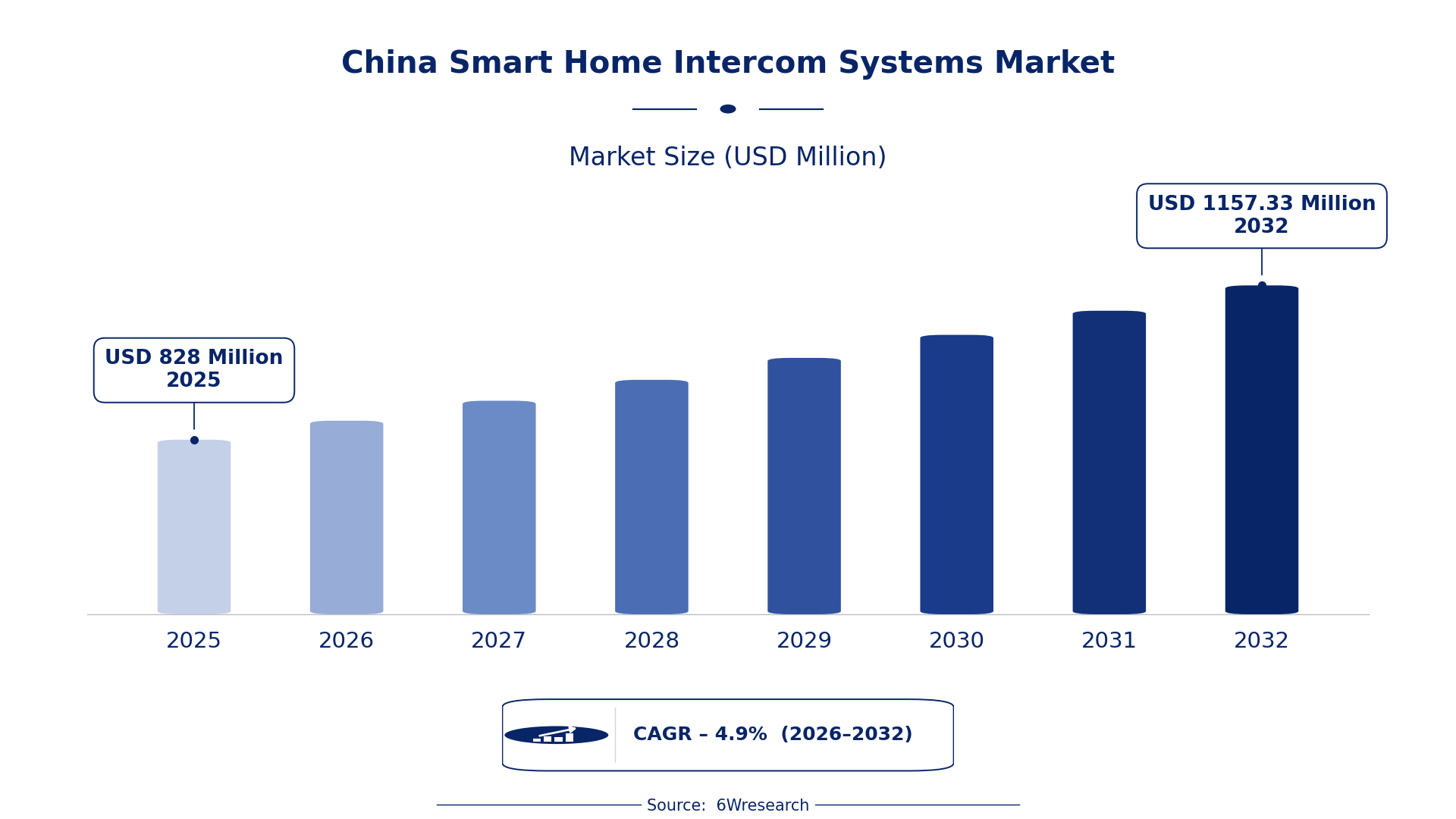
According to 6Wresearch internal database and industry insights, the China Smart Home Intercom Systems Market was valued at USD 828.0 million in 2025 and is projected to reach USD 1,157.33 million by 2032, growing at a CAGR of approximately 4.9% during 2026–2032.
China Smart Home Intercom Systems Market Highlights
| Report Metric | Details |
| Report Name | China Smart Home Intercom Systems Market |
| Market Size 2025 | USD 828.0 million |
| Market Size 2032 | USD 1,157.33 million |
| Absolute Growth 2025–2032 | USD 329.33 million |
| CAGR 2026–2032 | 4.9% |
| Peak Annual Growth | 6.9% in 2031 |
| Forecast Period | 2026–2032 |
| Historical Data | 2022–2025 |
| Base Year | 2025 |
| Leading System Type, 2025 | Video Intercom (37% share) |
| Leading Feature, 2025 | Two-Way Video & Audio (48% share) |
| Leading Connectivity, 2025 | Wi-Fi (30% share) |
| Leading End User, 2025 | Residential Users (49% share) |
| Fastest-Growing System Type | AI-Enabled Intercoms (6.1% CAGR) |
| Fastest-Growing Feature | Mobile Integration (6.4% CAGR) |
| Fastest-Growing Connectivity | Cloud + Edge (6.7% CAGR) |
| Fastest-Growing End User | Smart Apartments (7.5% CAGR) |
| Growing Sector | Residential Users |
| Key End Users | Residential Users, Smart Apartments, Home Builders, Smart Home Integrators |
China Smart Home Intercom Systems Market Year-wise Growth Rate and Key Drivers (2022–2032)
This graph illustrates the annual growth rates of the market from 2022 to 2032, highlighting a steady upward trajectory and projected market expansion over the forecast period.
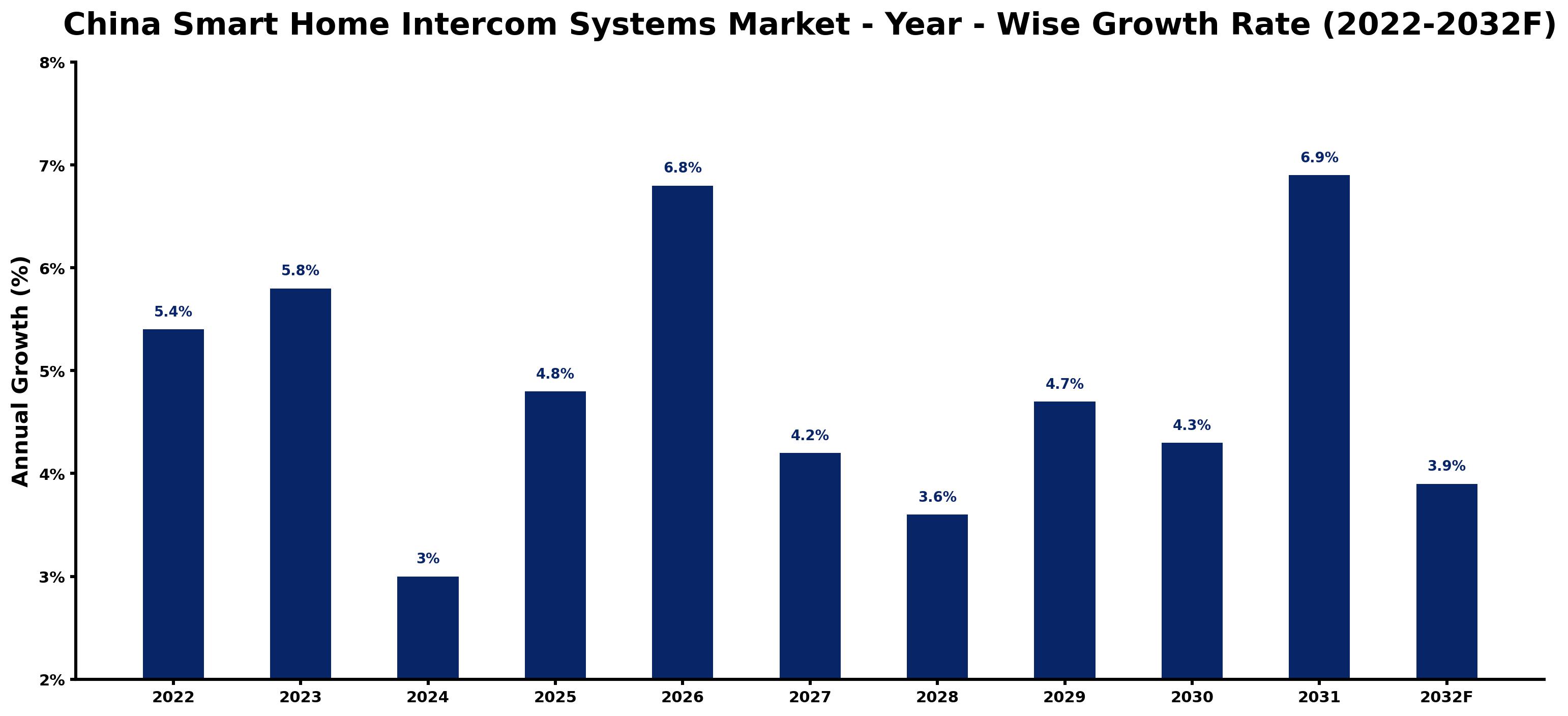
Each row of the following table gives one year's estimated growth and the event or demand shift that explains it.
| Year | Estimated Annual Growth (%) | Market Rationale |
| 2022 | 5.4 | The market experienced steady growth due to increased consumer interest in smart home technologies. |
| 2023 | 5.8 | Demand surged as urban households adopted more smart devices, driving intercom system sales. |
| 2024 | 3.0 | Growth slowed as market saturation began affecting new installations in urban areas. |
| 2025 | 4.8 | The residential sector saw renewed interest in smart intercoms, boosting demand significantly. |
| 2026 | 6.8 | Technological advancements in AI-enabled intercoms will drive faster adoption among consumers. |
| 2027 | 4.2 | Growth will slow as competition intensifies among manufacturers in the smart home sector. |
| 2028 | 3.6 | Market expansion will continue but at a slower pace due to rising consumer costs. |
| 2029 | 4.7 | Increased integration of smart technologies in residential buildings will spur demand again. |
| 2030 | 4.3 | Growth will slow as the market adjusts to new consumer preferences and technologies. |
| 2031 | 6.9 | A peak in demand will be reached as AI-enabled features become mainstream in intercom systems. |
| 2032 | 3.9 | Growth will decelerate as the market matures, with a focus on upgrades and replacements. |
Note: Market size estimations and growth projections presented in this report are based on 6Wresearch's proprietary forecasting methodology, utilizing the latest available industry data, government publications, and primary research inputs.
China Smart Home Intercom Systems Market Synopsis
The China Smart Home Intercom Systems Market encompasses integrated communication devices that facilitate communication and enhance home security. These systems utilise advanced audio and video technology, featuring Wi-Fi connectivity and mobile app integration. The market is expanding due to increasing demand from residential users and smart apartments, driven by national initiatives for smart home integration and technological advancements. By 2025, demand for AI-enabled intercoms will rise, reflecting a shift towards more connected living environments.
Market Dynamics Impact Analysis (2026–2032)
| Factor | Type | Impact | Primary Segment Affected |
| Increased demand for enhanced home security features drives sales of intercom systems. | Driver | High | Video Intercom |
| The rise of smart apartments creates a growing need for integrated communication solutions. | Driver | High | AI-Enabled Intercoms |
| The ongoing urbanisation trend presents opportunities for smart home technology integration. | Opportunity | High | Residential Users |
| Rising disposable incomes among urban households enables more investment in smart technologies. | Opportunity | High | Smart Apartments |
| High initial costs of installation deter some potential buyers from adopting these systems. | Restraint | Medium | Voice-Only Systems |
| Limited awareness of smart home technologies in rural areas restricts market growth. | Restraint | Medium | App-Based Intercoms |
| The Smart Home Intercom Systems market in China faces challenges due to intense competition among manufacturers. | Challenge | High | Two-Way Video & Audio |
| Supply chain disruptions can delay the availability of advanced intercom systems for buyers. | Challenge | Medium | Mobile Integration |
Evaluation of Drivers in China Smart Home Intercom Systems Market (2026–2032)
The factors lifting demand, and the evidence behind each, are summarised below.
| Drivers | Primary Segment Affected | Why It Matters (Evidence) |
| Rising consumer demand for integrated security solutions boosts intercom system sales. | Video Intercom | In 2022, the residential sector accounted for 70% of demand, prompting manufacturers to improve features. |
| Growing interest in smart home integration drives the adoption of AI-enabled intercoms. | AI-Enabled Intercoms | By 2025, demand for AI-enabled intercoms will rise sharply, attracting new buyers. |
| Urbanisation leads to increased installation of smart devices in new residential buildings. | Residential Users | In 2023, 60% of new residential buildings in major cities are set to include smart intercom systems. |
| Technological advancements improve the functionality of smart home intercom systems. | App-Based Intercoms | The average urban household has 3 smart devices, increasing the need for interconnected systems. |
| The push for smart home standards promotes compliance and innovation in the market. | Two-Way Video & Audio | The national standard GB/T 32960-2016 governs smart home systems, ensuring quality and safety. |
Growth in the Smart Home Intercom Systems market in China stems from rising consumer demand for integrated security solutions, urbanisation, and technological advancements. In 2022, the residential sector accounted for 70% of demand, prompting manufacturers to improve features. By 2025, demand for AI-enabled intercoms will surge, attracting new buyers, particularly in smart apartments. Urbanisation leads to increased installation of smart devices in new residential buildings, with 60% of new constructions in major cities expected to include smart intercoms in 2023. The push for smart home standards encourages compliance and innovation, ensuring quality and safety in the market.
Evaluation of Restraints in China Smart Home Intercom Systems Market
The main factors holding the market back are set out below.
| Market Restraint | Primary Segment Affected | Why It Matters (Evidence) |
| High initial costs of installation deter potential buyers from adopting intercom systems. | Voice-Only Systems | The average cost of a smart intercom system is around 2,000 CNY, which can be prohibitive for many households. |
| Limited awareness of smart home technologies in rural areas restricts market growth. | App-Based Intercoms | Many rural households lack knowledge about the benefits of smart intercom systems, limiting adoption rates. |
| Competition among manufacturers leads to price wars, affecting profit margins. | Two-Way Video & Audio | As more players enter the market, maintaining competitive pricing becomes challenging, squeezing profitability for suppliers. |
| Supply chain disruptions can delay the availability of advanced intercom systems for buyers. | Mobile Integration | Global supply chain issues have impacted the timely delivery of components, affecting installation schedules. |
| Consumer hesitance to adopt new technologies slows overall market growth. | AI-Enabled Intercoms | Some consumers prefer traditional systems, limiting the uptake of advanced features and delaying market expansion. |
China Smart Home Intercom Systems Market Challenges
The China Smart Home Intercom Systems market faces high initial costs, with an average system priced at around 2,000 CNY, which deters many buyers from making purchases. Rapid technological advancements create compatibility issues, as older systems struggle to integrate with newer smart home technologies, delaying upgrades for homeowners. A lack of skilled technicians hampers installation and maintenance, leading to longer wait times for consumers and increased dissatisfaction. Intense competition among over 300 member companies in the Smart Home Industry Alliance drives prices down, but it also reduces profit margins for suppliers, limiting their ability to invest in product development.
Trends in the China Smart Home Intercom Systems Market
Four trends stand out in the China Smart Home Intercom Systems Market.
- Shift Towards AI-Enabled Intercoms: By 2025, demand for AI-enabled intercoms will rise sharply, reflecting a shift in consumer preferences. This trend is supported by the Smart Home Development Plan launched in 2021, which promotes smart technology integration in residential buildings.
- Increased Integration with Smart Home Systems: The integration of intercom systems with other smart home devices is becoming more common, improving user experience. In 2023, 60% of new residential buildings in major cities are set to include smart intercom systems.
- Rise of Mobile Integration: Mobile integration is becoming a key feature in intercom systems, allowing remote access and control. The average urban household has 3 smart devices, increasing the need for interconnected systems.
- Growing Demand for Two-Way Video Communication: The demand for two-way video communication in intercom systems is rising, driven by security concerns. By 2025, the share of two-way video intercoms is projected to reach 48% in the market.
Investment Opportunities in the China Smart Home Intercom Systems Market
Some of the investment opportunities in the China Smart Home Intercom Systems Market are mentioned below.
- Investment in AI-Enabled Intercoms: The demand for AI-enabled intercoms will rise sharply by 2025, creating investment opportunities. Smart home integrators can focus on these advanced systems to meet growing consumer expectations for enhanced features.
- Expansion in Smart Apartments: The growing trend of smart apartments presents opportunities for intercom system suppliers. With urbanisation, more residential buildings are being equipped with smart technologies, increasing demand for intercoms in these developments.
- Focus on Rural Market Adoption: The Ministry of Industry and Information Technology's subsidy program in 2023 targets 1 million households, creating opportunities for suppliers. This initiative encourages the adoption of smart home technologies in rural areas, expanding the market base.
- Improving Security Features: There is a growing opportunity to improve security features in intercom systems, appealing to safety-conscious consumers. The push for integrated security solutions is driving demand in the residential sector, particularly among urban households.
Government Initiatives in the China Smart Home Intercom Systems Market
The 'Smart Home Development Plan' launched by the Ministry of Housing and Urban-Rural Development in 2021 aims to promote smart technology integration in residential buildings. This initiative encourages the adoption of smart home technologies and supports innovation in the sector. Additionally, the national standard GB/T 32960-2016 was updated in 2022 to include new technological advancements, ensuring compliance for manufacturers. This standard helps to maintain quality and safety in smart home systems, benefiting both producers and consumers.
The Ministry of Industry and Information Technology initiated a subsidy program in 2023 to support the adoption of smart home technologies in rural areas, targeting 1 million households. This program aims to increase awareness and usage of smart intercom systems among rural buyers. Furthermore, the 'Digital China Initiative' launched in 2020 includes provisions for smart home technologies, promoting their use in urban planning and development. This initiative supports the overall growth of the smart home market, ensuring that intercom systems are integrated into future urban designs.
Future Insight of the China Smart Home Intercom Systems Market
By 2032, buyers and suppliers in the China Smart Home Intercom Systems market can expect a notable shift towards advanced intercom solutions as consumer preferences evolve. The government's 'Smart Home Development Plan' will encourage innovation and ensure that new residential buildings incorporate modern intercom systems. Urban centres like Shanghai and Beijing will continue to lead in smart technology adoption, fostering a more interconnected living environment. With smart home penetration projected to reach 30% by 2025, suppliers must adapt to meet the growing demands of tech-savvy consumers.
Market Segmentation Analysis
The analysis below covers each segmentation, its leading category in 2025 and its fastest-growing category through 2032.
By System Type – Video Intercom Dominated, AI-Enabled Intercoms Expected to Grow Fastest
According to Dhaval Chaurasia, Assistant Manager at 6Wresearch, Video Intercom took a 37% share of system type in 2025, more than any other category. Video intercom systems hold the largest share in China's smart home intercom market due to their crucial role in providing visual communication and security. These systems are increasingly adopted in new residential buildings, especially in urban centres where safety is a top priority. Over 2026–2032, AI-Enabled Intercoms are expected to post the fastest growth, at a CAGR of 6.1%. The demand for AI-enabled intercoms is on the rise as consumers increasingly prefer systems that offer enhanced features for user interaction. As video intercoms continue to dominate, their established presence will likely help them maintain a competitive edge. Suppliers should focus on advancing video intercom technology to cater to the rising consumer demand for security and communication.
By Feature – Two-Way Video & Audio Dominated, Mobile Integration Expected to Grow Fastest
In 2025, Two-Way Video & Audio led the feature split with a 48% share. Two-way video and audio intercoms command the largest market share because they are vital for facilitating interactive communication within homes. Their ability to provide real-time audio and visual interaction makes them the preferred choice, particularly in urban environments where connectivity is essential. The quickest growth will come from Mobile Integration, forecast to expand at a CAGR of 6.4% between 2026 and 2032. Mobile integration is rapidly gaining traction as consumers seek solutions that seamlessly connect with their smart devices, significantly enhancing intercom functionality. This trend indicates a strong shift towards mobile-friendly features in the market. Suppliers must prioritise mobile integration to meet consumer expectations for improved convenience and connectivity.
By Connectivity – Wi-Fi Dominated, Cloud + Edge Expected to Grow Fastest
The largest connectivity category in 2025 was Wi-Fi, with a 30% share of total revenue. Wi-Fi is the leading connectivity method for smart devices, securing the largest share in the smart home intercom systems market. Its widespread availability and reliability make it the go-to choice for residential users aiming to enhance their home communication systems. Cloud + Edge is set to record the highest CAGR in this split, 6.7% over 2026–2032. Cloud and edge connectivity are experiencing rapid growth as consumers demand remote access and advanced functionalities for their intercom systems. This trend aligns with the broader shift towards integrated smart home solutions that require robust connectivity. Suppliers should invest in cloud and edge technologies to stay competitive and meet the increasing demand for advanced connectivity solutions.
By End User – Residential Users Dominated, Smart Apartments Expected to Grow Fastest
With a 49% revenue share in 2025, Residential Users was the largest end user category. Residential users represent the largest segment of the smart home intercom systems market, holding a significant share. The rising number of smart devices in urban households drives demand for intercom systems, underscoring their relevance in contemporary living. Smart Apartments are projected to grow fastest, at a CAGR of 7.5% during 2026–2032. Smart apartments are emerging as a rapidly growing segment, with many new residential projects integrating smart technologies to appeal to tech-savvy consumers. This shift reflects changing preferences towards environments that enhance convenience and security. Suppliers should target smart apartment developments to capitalise on the growing demand for integrated smart home solutions.
Key Attractiveness of the Report
- 10 Years of Market Numbers
- Historical Data Starting from 2022 to 2025
- Base Year 2025
- Forecast Data until 2032
- Key Performance Indicators Impacting the Market
- Major Upcoming Developments and Projects
Key Highlights of the Report:
- China Smart Home Intercom Systems Market Outlook
- Market Size of China Smart Home Intercom Systems Market, 2025
- Forecast of China Smart Home Intercom Systems Market, 2032
- Historical Data and Forecast of China Smart Home Intercom Systems Revenues & Volume for the Period 2022 - 2032F
- China Smart Home Intercom Systems Market Trend Evolution
- China Smart Home Intercom Systems Market Drivers and Challenges
- China Smart Home Intercom Systems Price Trends
- China Smart Home Intercom Systems Porter's Five Forces
- China Smart Home Intercom Systems Industry Life Cycle
- Historical Data and Forecast of China Smart Home Intercom Systems Market Revenues & Volume By System Type for the Period 2022 - 2032F
- Historical Data and Forecast of China Smart Home Intercom Systems Market Revenues & Volume By Video Intercom for the Period 2022 - 2032F
- Historical Data and Forecast of China Smart Home Intercom Systems Market Revenues & Volume By AI-Enabled Intercoms for the Period 2022 - 2032F
- Historical Data and Forecast of China Smart Home Intercom Systems Market Revenues & Volume By Voice-Only Systems for the Period 2022 - 2032F
- Historical Data and Forecast of China Smart Home Intercom Systems Market Revenues & Volume By App-Based Intercoms for the Period 2022 - 2032F
- Historical Data and Forecast of China Smart Home Intercom Systems Market Revenues & Volume By Feature for the Period 2022 - 2032F
- Historical Data and Forecast of China Smart Home Intercom Systems Market Revenues & Volume By Two-Way Video & Audio for the Period 2022 - 2032F
- Historical Data and Forecast of China Smart Home Intercom Systems Market Revenues & Volume By Face Recognition for the Period 2022 - 2032F
- Historical Data and Forecast of China Smart Home Intercom Systems Market Revenues & Volume By Voice Messaging for the Period 2022 - 2032F
- Historical Data and Forecast of China Smart Home Intercom Systems Market Revenues & Volume By Mobile Integration for the Period 2022 - 2032F
- Historical Data and Forecast of China Smart Home Intercom Systems Market Revenues & Volume By Connectivity for the Period 2022 - 2032F
- Historical Data and Forecast of China Smart Home Intercom Systems Market Revenues & Volume By Wi-Fi, Ethernet for the Period 2022 - 2032F
- Historical Data and Forecast of China Smart Home Intercom Systems Market Revenues & Volume By Cloud + Edge for the Period 2022 - 2032F
- Historical Data and Forecast of China Smart Home Intercom Systems Market Revenues & Volume By Mesh/Bluetooth for the Period 2022 - 2032F
- Historical Data and Forecast of China Smart Home Intercom Systems Market Revenues & Volume By Smartphone App for the Period 2022 - 2032F
- Historical Data and Forecast of China Smart Home Intercom Systems Market Revenues & Volume By End User for the Period 2022 - 2032F
- Historical Data and Forecast of China Smart Home Intercom Systems Market Revenues & Volume By Residential Users for the Period 2022 - 2032F
- Historical Data and Forecast of China Smart Home Intercom Systems Market Revenues & Volume By Smart Apartments for the Period 2022 - 2032F
- Historical Data and Forecast of China Smart Home Intercom Systems Market Revenues & Volume By Home Builders for the Period 2022 - 2032F
- Historical Data and Forecast of China Smart Home Intercom Systems Market Revenues & Volume By Smart Home Integrators for the Period 2022 - 2032F
- China Smart Home Intercom Systems Import Export Trade Statistics
- Market Opportunity Assessment By System Type
- Market Opportunity Assessment By Feature
- Market Opportunity Assessment By Connectivity
- Market Opportunity Assessment By End User
- China Smart Home Intercom Systems Top Companies Market Share
- China Smart Home Intercom Systems Competitive Benchmarking By Technical and Operational Parameters
- China Smart Home Intercom Systems Company Profiles
- China Smart Home Intercom Systems Key Strategic Recommendations
Market Covered
The report offers an extensive study of the following market segments.
By System Type
- Video Intercom
- AI-Enabled Intercoms
- Voice-Only Systems
- App-Based Intercoms
By Feature
- Two-Way Video & Audio
- Face Recognition
- Voice Messaging
- Mobile Integration
By Connectivity
- Wi-Fi
- Ethernet
- Cloud + Edge
- Mesh/Bluetooth
- Smartphone App
By End User
- Residential Users
- Smart Apartments
- Home Builders
- Smart Home Integrators































