China Smart Irrigation AI Market Size & Growth Rate
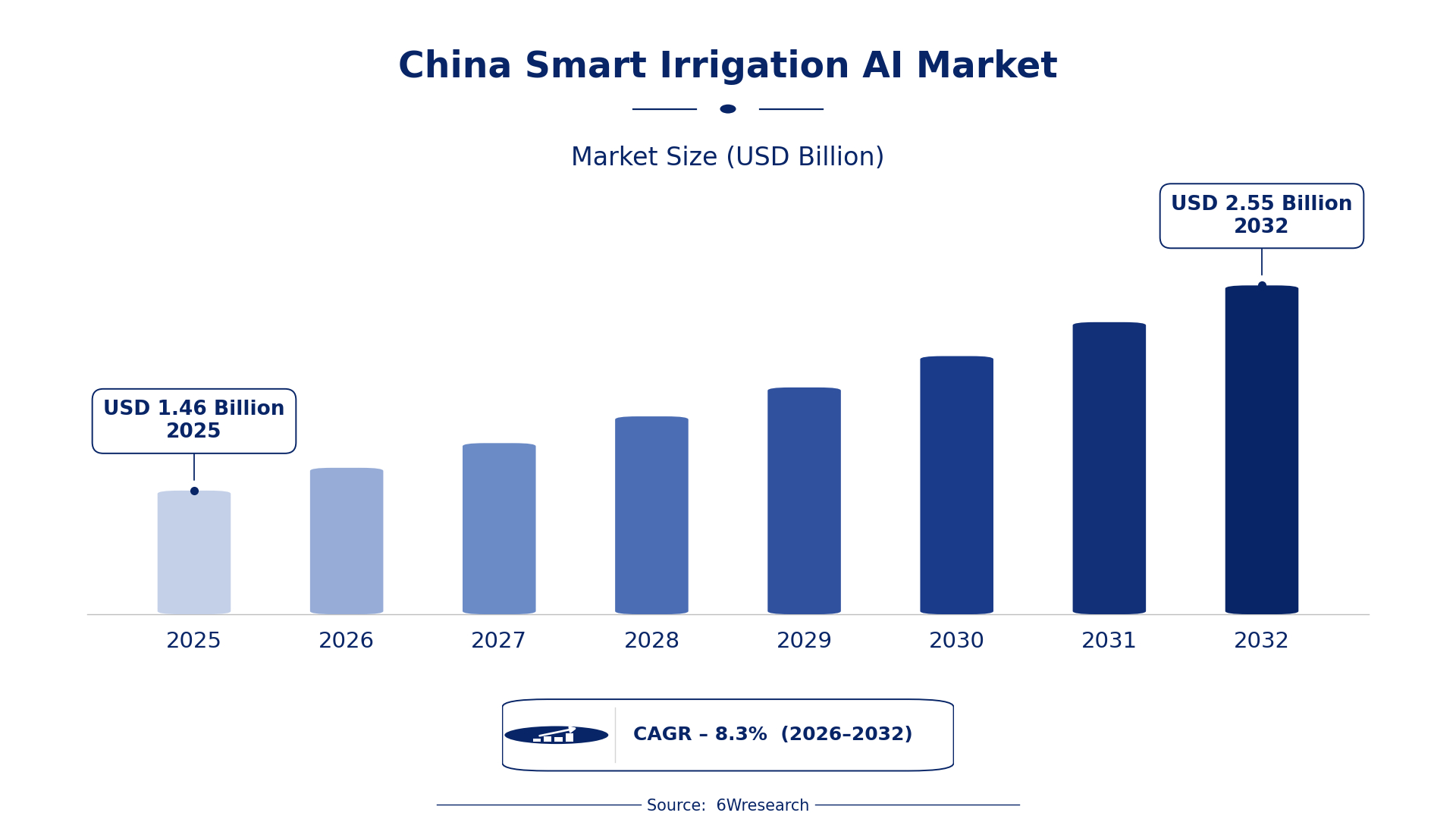
According to 6Wresearch internal database and industry insights, the China Smart Irrigation AI Market was valued at USD 1.46 billion in 2025 and is projected to reach USD 2.55 billion by 2032, growing at a CAGR of approximately 8.3% during 2026–2032.
China Smart Irrigation AI Market Highlights
| Report Metric | Details |
| Report Name | China Smart Irrigation AI Market |
| Market Size 2025 | USD 1.46 billion |
| Market Size 2032 | USD 2.55 billion |
| Absolute Growth 2025–2032 | USD 1.09 billion |
| CAGR 2026–2032 | 8.3% |
| Peak Annual Growth | 9.6% in 2026 |
| Forecast Period | 2026–2032 |
| Historical Data | 2022–2025 |
| Base Year | 2025 |
| Leading AI Function, 2025 | Weather Forecast AI (40% share) |
| Leading Controlled Element, 2025 | Water Volume Scheduling (42% share) |
| Leading Connectivity, 2025 | Cloud + Sensors (42% share) |
| Leading End User, 2025 | Smart Farms (41% share) |
| Fastest-Growing AI Function | Soil Moisture AI (10.7% CAGR) |
| Fastest-Growing Controlled Element | Water Use Optimization (10.2% CAGR) |
| Fastest-Growing Connectivity | LoRa + IoT (9.5% CAGR) |
| Fastest-Growing End User | AgriTech Companies (10.3% CAGR) |
| Growing Sector | Agriculture |
| Key End Users | AgriTech companies, smart farms, precision farmers, irrigation consultants |
China Smart Irrigation AI Market Year-wise Growth Rate and Key Drivers (2022–2032)
This graph illustrates the annual growth rates of the market from 2022 to 2032, highlighting a steady upward trajectory and projected market expansion over the forecast period.
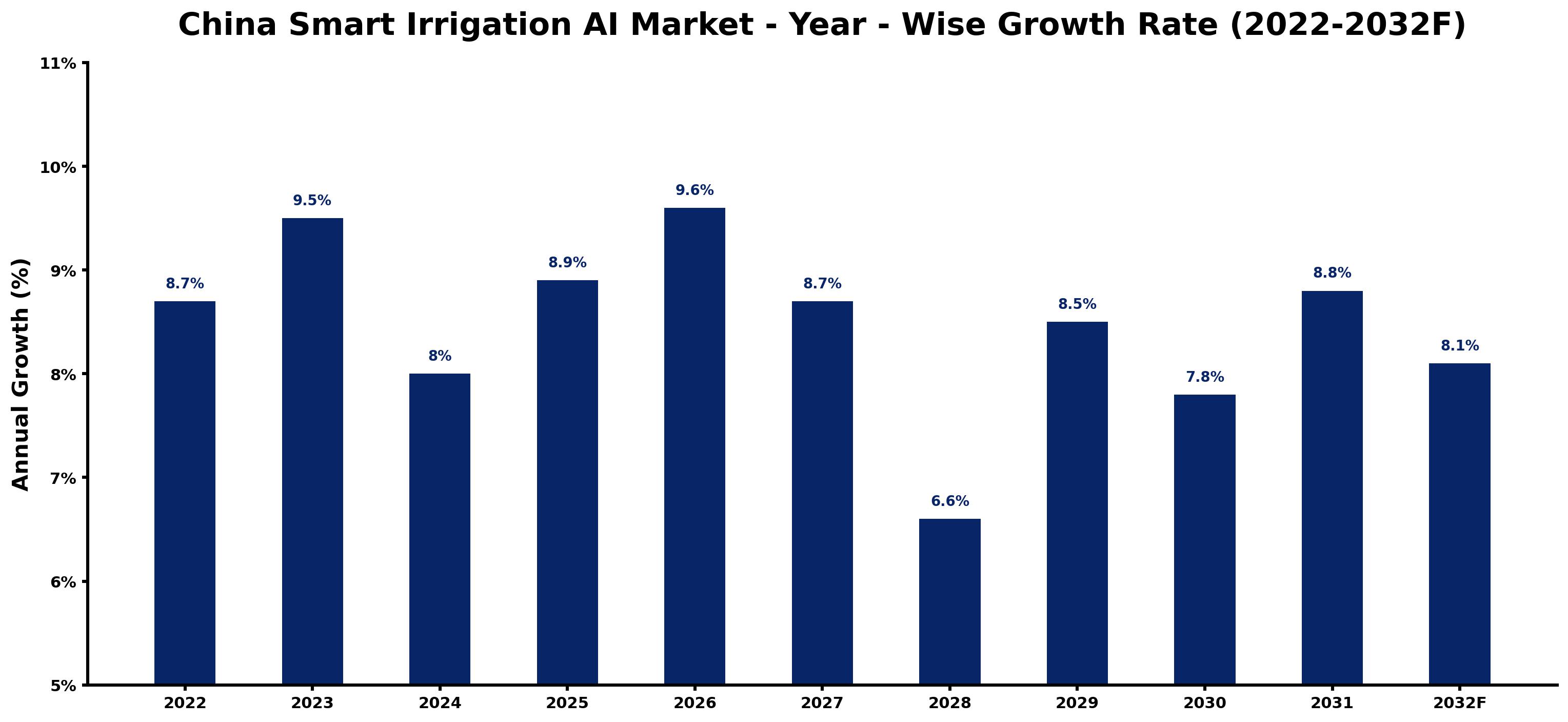
Annual growth estimates for each year appear below with the principal reason behind them, explaining the shifts that set the pace of the market.
| Year | Estimated Annual Growth (%) | Market Rationale |
| 2022 | 8.7 | The market experienced solid growth due to increased interest in sustainable farming practices. |
| 2023 | 9.5 | Demand surged as smart farms expanded, driven by technological advancements in irrigation. |
| 2024 | 8.0 | Growth slowed as market adjustments occurred following rapid adoption in previous years. |
| 2025 | 8.9 | Investment in smart irrigation technologies increased, enhancing efficiency and crop yields. |
| 2026 | 9.6 | The market peaked as precision agriculture technologies gained traction across the sector. |
| 2027 | 8.7 | Growth slowed as the market began to stabilise after reaching peak levels in 2026. |
| 2028 | 6.6 | A further slowdown occurred as the market adjusted to the previous years' rapid growth. |
| 2029 | 8.5 | Demand rebounded as smart irrigation solutions became more widely accepted among farmers. |
| 2030 | 7.8 | Growth slowed again as market maturity set in, leading to more stable purchasing patterns. |
| 2031 | 8.8 | A resurgence in growth occurred as new technologies continued to attract investment. |
| 2032 | 8.1 | The market stabilises as smart irrigation becomes a standard practice in agriculture. |
Note: Market size estimations and growth projections presented in this report are based on 6Wresearch's proprietary forecasting methodology, utilizing the latest available industry data, government publications, and primary research inputs.
China Smart Irrigation AI Market Synopsis
Smart Irrigation AI in China optimises water usage in agriculture through advanced technologies like machine learning and IoT. It boosts crop yield, conserves water, and cuts operational costs. The Smart Irrigation AI Market is expanding due to rising investment in sustainable practices and the growth of smart farms. In 2022, investment reached 10 billion CNY, demonstrating a strong commitment to modernising agricultural methods. The ongoing integration of AI technologies is set to drive further demand in the coming years.
Market Dynamics Impact Analysis (2026–2032)
| Factor | Type | Impact | Primary Segment Affected |
| Increasing investment in smart irrigation technologies enhances efficiency and productivity. | Driver | High | Water Volume Scheduling |
| Growing adoption of precision agriculture technologies supports water conservation efforts. | Driver | High | Soil Moisture AI |
| Rising demand for sustainable farming practices creates opportunities for technology providers. | Opportunity | High | Smart Farms |
| The expansion of smart farms presents a significant market entry point for new technologies. | Opportunity | High | AgriTech Companies |
| High initial investment costs may deter some farmers from adopting smart irrigation solutions. | Restraint | Medium | Water Use Optimization |
| Limited awareness of smart irrigation benefits restricts market growth in rural areas. | Restraint | Medium | Precision Farmers |
| Supply chain disruptions can delay the availability of smart irrigation components. | Challenge | High | Cloud + Sensors |
| Regulatory hurdles may slow the approval of new smart irrigation technologies. | Challenge | Medium | Machine Learning Models |
Evaluation of Drivers in China Smart Irrigation AI Market (2026–2032)
The factors lifting demand, and the evidence behind each, are summarised below.
| Drivers | Primary Segment Affected | Why It Matters (Evidence) |
| Increased funding for smart irrigation projects drives technology adoption. | Water Volume Scheduling | Investment in smart irrigation technologies reached 10 billion CNY in 2022, encouraging farmers to adopt advanced technologies. |
| Rising agricultural output value boosts demand for efficient irrigation solutions. | Soil Moisture AI | The annual agricultural output value in China is over 6 trillion CNY, prompting farmers to invest in advanced technologies. |
| Growing number of smart farms increases the need for automated irrigation systems. | Smart Farms | In 2022, there were approximately 1.5 million smart farms in China, driving demand for smart irrigation solutions. |
| Government initiatives promote sustainable irrigation practices among farmers. | AgriTech Companies | The 'Green Development Action Plan' promotes sustainable irrigation, encouraging technology adoption. |
| Technological advancements in AI improve irrigation efficiency and effectiveness. | Machine Learning Models | The installed base of IoT devices in agriculture is projected to exceed 50 million units by 2025, facilitating smarter irrigation. |
The Smart Irrigation AI market in China is growing on the back of increased funding for smart irrigation projects, which reached 10 billion CNY in 2022, encouraging farmers to adopt advanced technologies. The annual agricultural output value, estimated at over 6 trillion CNY, boosts demand for efficient irrigation solutions. The number of smart farms, approximately 1.5 million in 2022, increases the need for automated irrigation systems. Advancements in AI are improving irrigation efficiency, with the installed base of IoT devices projected to exceed 50 million units by 2025, facilitating smarter solutions.
Evaluation of Restraints in China Smart Irrigation AI Market
The main factors holding the market back are set out below.
| Market Restraint | Primary Segment Affected | Why It Matters (Evidence) |
| High initial investment costs may deter farmers from adopting smart irrigation solutions. | Water Use Optimization | The average farm size in China is about 0.5 hectares, making the cost of smart irrigation systems a barrier for smallholders. |
| Limited awareness of smart irrigation benefits restricts market growth in rural areas. | Precision Farmers | Many farmers lack knowledge about the advantages of smart irrigation, hindering adoption rates. |
| Supply chain disruptions can delay the availability of smart irrigation components. | Cloud + Sensors | Ongoing global supply chain issues have affected the timely delivery of essential irrigation technologies. |
| Regulatory hurdles may slow the approval of new smart irrigation technologies. | Machine Learning Models | Complex approval processes for new technologies can delay market entry and adoption. |
| Competition from traditional irrigation methods may limit market penetration. | Soil Moisture AI | Farmers accustomed to conventional practices may resist transitioning to smart irrigation solutions. |
China Smart Irrigation AI Market Challenges
Farmers in the China Smart Irrigation AI market face high initial costs, often exceeding 10 billion CNY for advanced systems, which limits adoption among small-scale operators. Intense competition exists among around 1.5 million smart farms, driving up prices and creating instability for producers. The average water use efficiency of 60% indicates considerable waste in current irrigation practices, leading to increased operational costs for farmers. Supply chain disruptions can hinder the timely rollout of smart irrigation technologies, complicating access to these solutions for agricultural producers.
Trends in the China Smart Irrigation AI Market
Four trends stand out in the China Smart Irrigation AI Market.
- Shift Towards Smart Farming: The adoption of advanced irrigation technologies is increasing among smart farms, driven by the need for efficiency. In 2022, approximately 1.5 million smart farms in China were reported, indicating a shift towards modern agricultural practices.
- Emergence of IoT in Agriculture: Integration of IoT devices in agriculture is transforming irrigation practices. By 2025, the installed base of IoT devices in agriculture is expected to exceed 50 million units, improving data-driven decision-making for farmers.
- Focus on Sustainable Practices: Sustainable irrigation practices are gaining traction among farmers, supported by government initiatives. The 'Green Development Action Plan', introduced in 2022, promotes environmentally friendly irrigation methods, reflecting a broader trend towards sustainability.
- Increased Investment in Agricultural Technology: Investment in agricultural technology is on the rise, with 10 billion CNY allocated in 2022. This funding is crucial for developing and implementing smart irrigation solutions that improve productivity and resource management.
Investment Opportunities in the China Smart Irrigation AI Market
Investors looking at the China Smart Irrigation AI Market should consider the following areas.
- Partnerships with Local Farmers: Collaborating with local farmers can facilitate the introduction of smart irrigation technologies in rural areas. With 10 billion CNY invested in 2022, AgriTech companies can work with farmers to improve irrigation efficiency.
- Expansion in Smart Farm Regions: There is a growing opportunity in regions with a high concentration of smart farms. The 1.5 million smart farms in China represent a significant market for advanced irrigation solutions.
- Investment in Training Programs: Investment in training programs for farmers can boost the adoption of smart irrigation technologies. The 'Digital Agriculture Promotion Program' allocates 5 billion CNY to improve technology adoption in rural areas.
- Development of New Technologies: The demand for innovative irrigation solutions presents opportunities for technology developers. The average water use efficiency in agriculture is around 60%, indicating a need for improvements.
Government Initiatives in the China Smart Irrigation AI Market
The 'Smart Agriculture Development Plan' by the Ministry of Agriculture, launched in 2021, aims to integrate AI technologies into 30% of farms by 2025. This plan encourages the adoption of smart irrigation solutions to improve agricultural productivity and sustainability. Additionally, the 'Green Development Action Plan', introduced in 2022, promotes sustainable irrigation practices across the agricultural sector, further supporting the integration of smart technologies. The 'National Development and Reform Commission' approved the '14th Five-Year Plan for Agricultural Modernization' in 2021, focusing on smart irrigation technologies to enhance resource management.
The Ministry of Agriculture oversees the implementation of several key initiatives, including the 'Digital Agriculture Promotion Program', which allocates 5 billion CNY to improve technology adoption in rural areas. This program funds projects that aim to modernise agricultural practices, including smart irrigation. Additionally, the 'China Agricultural Technology Extension System' promotes smart irrigation solutions, providing training and resources to farmers. These initiatives are important for increasing awareness and facilitating the adoption of smart irrigation technologies across the country.
Future Insight of the China Smart Irrigation AI Market
The China Smart Irrigation AI market will undergo transformative changes by 2032, primarily driven by enhanced technology integration and robust government support. Investment in smart irrigation technologies is projected to exceed 10 billion CNY annually, reflecting a strong commitment to innovation. The 'Smart Agriculture Development Plan' will promote widespread adoption of AI, significantly improving water management practices. As precision agriculture technologies aim to cover 20% of China's farmland by 2025, buyers will benefit from increased efficiency and reduced costs, while suppliers will find new opportunities for growth.
Market Segmentation Analysis
Each segment group is reviewed below, with the leader by share and the fastest grower by CAGR.
By AI Function – Weather Forecast AI Dominated, Soil Moisture AI Expected to Grow Fastest
According to Dhaval Chaurasia, Assistant Manager at 6Wresearch, Weather Forecast AI accounted for a 40% market share by ai function in 2025. Weather Forecast technology holds the largest share as it is essential for optimising irrigation schedules through accurate weather predictions. Its application across China's extensive irrigated farmland, which exceeds 300 million acres, makes it vital for effective water management. Soil Moisture AI is set to record the highest CAGR in this split, 10.7% over 2026–2032. Soil Moisture technology is experiencing rapid growth because it directly measures soil moisture levels, which is crucial for efficient water usage. With over 30% of precision farming operations utilising soil moisture sensors, this technology is becoming increasingly important for farmers aiming to maximise efficiency. Suppliers should focus on enhancing Soil Moisture technology offerings to meet the rising demand for efficient irrigation solutions.
By Controlled Element – Water Volume Scheduling Dominated, Water Use Optimization Expected to Grow Fastest
Water Volume Scheduling held a 42% share of the China Smart Irrigation AI Market by controlled element in 2025. Water Volume Scheduling leads the market due to its critical role in managing irrigation timing and ensuring optimal water allocation across diverse farm sizes. This approach is essential for effective resource management in China's vast agricultural sector. Over 2026–2032, Water Use Optimization is expected to post the fastest growth, at a CAGR of 10.2%. Water Use Optimization is experiencing rapid growth as it prioritises maximising water efficiency in irrigation systems, particularly important given China's annual irrigation water consumption of approximately 400 billion cubic meters. Buyers are encouraged to adopt Water Use Optimization technologies to improve water efficiency and reduce operational costs.
By Connectivity – Cloud + Sensors Dominated, LoRa + IoT Expected to Grow Fastest
Cloud + Sensors took a 42% share of connectivity in 2025, more than any other category. Cloud and Sensors dominate the connectivity segment as they are essential for data collection and remote monitoring in smart irrigation systems. Their widespread use supports the increasing number of smart farms, which are pivotal in China's agricultural landscape. LoRa + IoT is projected to grow fastest, at a CAGR of 9.5% during 2026–2032. LoRa and IoT are gaining traction rapidly due to their capability for long-range communication among smart irrigation devices, improving connectivity in rural areas. This is significant as the installed base of IoT devices in agriculture is projected to exceed 50 million units by 2025. Suppliers should invest in LoRa and IoT technologies to address the growing connectivity needs of smart irrigation systems.
By End User – Smart Farms Dominated, AgriTech Companies Expected to Grow Fastest
In 2025, Smart Farms led the end user split with a 41% share. Smart Farms account for the largest share of the end user segment as they are the primary adopters of advanced irrigation technologies, significantly enhancing crop yields. With around 1.5 million smart farms in China, their integration of innovative irrigation solutions is crucial for sustainable agricultural practices. The quickest growth will come from AgriTech Companies, forecast to expand at a CAGR of 10.3% between 2026 and 2032. AgriTech Companies are the fastest-growing end user group as they develop and implement smart irrigation solutions tailored to the evolving agricultural landscape. Their role is crucial in promoting sustainable practices, especially under government initiatives like the Digital Agriculture Promotion Program. Suppliers should target AgriTech Companies to align with advancements in smart irrigation solutions.
Key Attractiveness of the Report
- 10 Years of Market Numbers
- Historical Data Starting from 2022 to 2025
- Base Year 2025
- Forecast Data until 2032
- Key Performance Indicators Impacting the Market
- Major Upcoming Developments and Projects
Key Highlights of the Report:
- China Smart Irrigation AI Market Outlook
- Market Size of China Smart Irrigation AI Market, 2025
- Forecast of China Smart Irrigation AI Market, 2032
- Historical Data and Forecast of China Smart Irrigation AI Revenues & Volume for the Period 2022 - 2032F
- China Smart Irrigation AI Market Trend Evolution
- China Smart Irrigation AI Market Drivers and Challenges
- China Smart Irrigation AI Price Trends
- China Smart Irrigation AI Porter's Five Forces
- China Smart Irrigation AI Industry Life Cycle
- Historical Data and Forecast of China Smart Irrigation AI Market Revenues & Volume By AI Function for the Period 2022 - 2032F
- Historical Data and Forecast of China Smart Irrigation AI Market Revenues & Volume By Weather Forecast AI for the Period 2022 - 2032F
- Historical Data and Forecast of China Smart Irrigation AI Market Revenues & Volume By Soil Moisture AI for the Period 2022 - 2032F
- Historical Data and Forecast of China Smart Irrigation AI Market Revenues & Volume By Image-Based AI for the Period 2022 - 2032F
- Historical Data and Forecast of China Smart Irrigation AI Market Revenues & Volume By Historical Pattern AI for the Period 2022 - 2032F
- Historical Data and Forecast of China Smart Irrigation AI Market Revenues & Volume By Controlled Element for the Period 2022 - 2032F
- Historical Data and Forecast of China Smart Irrigation AI Market Revenues & Volume By Water Volume Scheduling for the Period 2022 - 2032F
- Historical Data and Forecast of China Smart Irrigation AI Market Revenues & Volume By Zone-Specific Flow Control for the Period 2022 - 2032F
- Historical Data and Forecast of China Smart Irrigation AI Market Revenues & Volume By Crop Hydration Assessment for the Period 2022 - 2032F
- Historical Data and Forecast of China Smart Irrigation AI Market Revenues & Volume By Water Use Optimization for the Period 2022 - 2032F
- Historical Data and Forecast of China Smart Irrigation AI Market Revenues & Volume By Connectivity for the Period 2022 - 2032F
- Historical Data and Forecast of China Smart Irrigation AI Market Revenues & Volume By Cloud + Sensors for the Period 2022 - 2032F
- Historical Data and Forecast of China Smart Irrigation AI Market Revenues & Volume By LoRa + IoT for the Period 2022 - 2032F
- Historical Data and Forecast of China Smart Irrigation AI Market Revenues & Volume By Drones + Imaging for the Period 2022 - 2032F
- Historical Data and Forecast of China Smart Irrigation AI Market Revenues & Volume By Machine Learning Models for the Period 2022 - 2032F
- Historical Data and Forecast of China Smart Irrigation AI Market Revenues & Volume By End User for the Period 2022 - 2032F
- Historical Data and Forecast of China Smart Irrigation AI Market Revenues & Volume By Smart Farms for the Period 2022 - 2032F
- Historical Data and Forecast of China Smart Irrigation AI Market Revenues & Volume By Precision Farmers for the Period 2022 - 2032F
- Historical Data and Forecast of China Smart Irrigation AI Market Revenues & Volume By AgriTech Companies for the Period 2022 - 2032F
- Historical Data and Forecast of China Smart Irrigation AI Market Revenues & Volume By Irrigation Consultants for the Period 2022 - 2032F
- China Smart Irrigation AI Import Export Trade Statistics
- Market Opportunity Assessment By AI Function
- Market Opportunity Assessment By Controlled Element
- Market Opportunity Assessment By Connectivity
- Market Opportunity Assessment By End User
- China Smart Irrigation AI Top Companies Market Share
- China Smart Irrigation AI Competitive Benchmarking By Technical and Operational Parameters
- China Smart Irrigation AI Company Profiles
- China Smart Irrigation AI Key Strategic Recommendations
Market Covered
This report examines the market across the segments below.
By AI Function
- Weather Forecast AI
- Soil Moisture AI
- Image-Based AI
- Historical Pattern AI
By Controlled Element
- Water Volume Scheduling
- Zone-Specific Flow Control
- Crop Hydration Assessment
- Water Use Optimization
By Connectivity
- Cloud + Sensors
- LoRa + IoT
- Drones + Imaging
- Machine Learning Models
By End User
- Smart Farms
- Precision Farmers
- AgriTech Companies
- Irrigation Consultants































